

|
시장보고서
상품코드
2124713
아시아태평양의 컨텐츠 서비스 플랫폼 : 시장 점유율 분석, 업계 동향과 통계, 성장 예측(2026-2031년)Asia Pacific Content Services Platform - Market Share Analysis, Industry Trends & Statistics, Growth Forecasts (2026 - 2031) |
||||||
 Mordor Intelligence
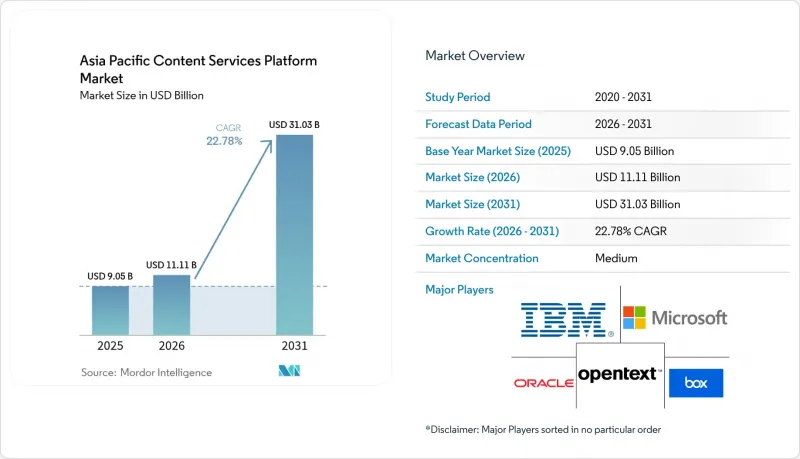
Mordor Intelligence에 의하면, 2026년 아시아태평양의 컨텐츠 서비스 플랫폼 시장 규모는 111억 1,000만 달러로 추정되며, 2025년 90억 5,000만 달러에서 2031년에는 310억 3,000만 달러에 달할 것으로 예측됩니다.
2026-2031년 연평균 성장률(CAGR)은 22.78%를 기록할 것으로 전망됩니다.

본 보고서는 구성 요소별(솔루션/소프트웨어, 문서·기록 관리 등), 도입 모델별(클라우드, On-Premise/하이브리드), 조직 규모별(중소기업, 대기업), 최종 사용자 산업별(은행, 금융서비스 및 보험(BFSI), 정부·공공 부문 등), 지역별로 분류되어 있습니다. 시장 전망은 금액(달러) 기준으로 제시되어 있습니다.
아시아태평양의 컨텐츠 서비스 플랫폼 시장 동향 및 인사이트
아세안 및 인도 전역에서 ‘클라우드 퍼스트’ 투자 붐
2019년부터 2024년에 걸쳐 이 지역의 클라우드 인프라 투자는 117% 급증했으며, 기업들이 레거시 리포지토리에서 확장 가능한 SaaS 제품군으로 전환함에 따라 컨텐츠 서비스 플랫폼 시장을 견인했습니다. 마이크로소프트가 인도네시아에 17억 달러 규모의 클라우드 인프라를 구축한 것과 Office 365가 아시아태평양에서 두 자릿수 성장을 기록한 것은 벤더들의 노력을 여실히 보여줍니다. 금융 서비스 기관들은 클라우드 도입 의무화 요건을 충족하기 위해 프로젝트를 앞당겨 진행하면서, 규정 준수를 충족하는 문서 워크플로우에 대한 수요를 확대되고 있습니다. 싱가포르의 ‘Advanced Digital Solutions’가 프로젝트 비용의 50%를 지원하는 보조금 제도 덕분에 450건 이상의 솔루션이本番 환경에 도입되었으며, 말레이시아와 태국에서도 유사한 움직임이 확산되고 있습니다. 공공 부문의 자금 지원, 하이퍼스케일러의 확장, 그리고 동종 업계의 성공 사례가 맞물리면서 향후 3년 동안 클라우드는 컨텐츠 서비스 플랫폼 시장에서 기본 아키텍처로서의 입지를 확고히할 것입니다.
생성형 AI를 통합한 컨텐츠 인텔리전스 애드온
기업들은 2024년에 생성형 AI 예산을 3배로 늘려 34억 달러에 달할 것으로 예상되며, 이에 따라 플랫폼은 수동적인 스토리지에서 인사이트 엔진으로 전환되고 있습니다. IBM은 분류, 정보 마스킹, 요약 생성을 자동화하는 아시아태평양(APAC) 내 도입을 원동력으로 삼아 생성형 AI 매출에서 60억 달러를 돌파했습니다. 어도비의 ‘Document Cloud’는 구조화된 데이터를 추출하는 AI 기능을 통합하여 2024년 3분기 사상 최대 매출인 54억 1,000만 달러를 기록했습니다. 이 중 APAC 지역이 매출의 14.1%를 차지했습니다. ServiceNow는 Raytion 인수를 통해 검색 정확도를 향상시켰으며, AI를 통한 기능 강화가 업계를 선도하기 위한 필수 조건임을 입증했습니다. 조기 도입 기업들로부터 수작업 처리 시간이 70% 단축되었습니다는 보고가 있었으며, ROI 개선이 입증되었습니다. 이러한 변화는 단순한 기능 주도적 변화가 아니라, 구매자의 기준 자체를 재정의하고 컨텐츠 서비스 플랫폼 시장을 ‘지능형 지식 패브릭(Intelligent Knowledge Fabric)’으로 재구축하고 있습니다.
데이터 소재지에 따른 분절화
2025년 1월에 시행될 중국의 ‘네트워크 데이터 보안 관리 규정’은 ‘중요 데이터’에 대한 국경 간 공개 심사 및 현지 처리를 의무화하여, 다국적 기업의 소프트웨어 제품군에 대한 규정 준수 비용을 증가시키고 있습니다. 인도의 ‘디지털 개인 데이터 보호법’은 명시적인 동의의 단계적 획득과 현지화를 요구하고 있어, 소프트웨어 아키텍처의 재구성을 촉구하고 있습니다. 각 벤더사는 현재 관할 구역별로 서로 다른 빌드를 유지하고 있어 규모의 경제가 훼손되고 있습니다. 중견 기업들은 여러 지역에 걸친 거버넌스를 시행할 예산이 부족하여 도입 속도가 둔화되고 있습니다. 베트남에서도 유사한 규정이 마련되어 있어 시장의 분할화가 더욱 심화될 것으로 보입니다. 컨텐츠 서비스 플랫폼 시장은 성장을 이어가고 있지만, 이러한 정책으로 인해 단기적인 성장 속도는 둔화되고 있으며, 현지 기존 기업들이 유리한 입지를 점하고 있습니다.
부문 분석
소프트웨어는 2025년 매출의 61.02%를 계속 차지하고 있으며, 컨텐츠 서비스 플랫폼 시장의 규정 준수에 필수적인 문서·기록 관리 모듈이 주도적인 역할을 하고 있습니다. 그러나 기업들이 전문적인 통합 및 변경 관리 지원을 요구함에 따라 서비스 부문은 23.95%라는 가장 높은 연평균 성장률(CAGR)을 기록했습니다. 이러한 변화로 인해 벤더 생태계 내에서 도입 파트너의 중요성이 높아지고 있습니다. 하이랜드(Highland)의 하이데라바드 거점 및 말레이시아 3만 5,000명의 사용자를 대상으로 한 DDMS 2.0의 도입은 컨설팅형 서비스가 공공 부문의 대규모 계약 수주로 이어지는 좋은 사례입니다. AI를 활용한 데이터 캡처의 혁신으로 도입 주기가 단축되는 한편, 워크플로우 제품군은 프로세스 자동화 플랫폼과 융합되고 있습니다. 지역별 개인정보 보호법이 강화되는 가운데, 보안 및 거버넌스 강화는 여전히 필수적인 요건입니다.
이러한 서비스로의 전환은 부착률과 지속적 수익 증대로 이어지며, 해당 분야의 전문 지식을 갖춘 벤더에게 유리하게 작용합니다. 계약 모델은 라이선싱과 유지보수를 결합한 형태에서 성과 기반의 관리형 서비스로 전환되고 있습니다. 그 결과, 서비스와 관련된 컨텐츠 서비스 플랫폼 시장 규모는 2031년까지 기여도를 확대할 것으로 예측됩니다. 지속적인 최적화와 규제 대응 업데이트를 제공하는 벤더는 고객 기반을 공고히 하고, 전환 비용을 높이며, 프리미엄 가격 책정을 뒷받침할 것으로 기대됩니다.
클라우드 솔루션은 2025년 컨텐츠 서비스 플랫폼 시장 점유율의 69.78%를 차지할 것으로 예상되며, 연평균 성장률(CAGR)은 24.99%로 전망됩니다. 기업들은 광범위한 디지털 로드맵에 부합하는 종량제 요금제와 원활한 API 통합을 높이 평가했습니다. 마이크로소프트의 유료 Office 365 라이선스 4억 개는 컨텐츠 중심의 협업에서 플랫폼의 매력을 보여줍니다. 규제가 엄격한 산업에서는 하이브리드 모델이나 On-Premise 모델이 여전히 존재하지만, 이러한 사용자들조차도 외부와의 협업을 위해 클라우드 커넥터를 채택하고 있습니다. 각 벤더사는 현재 데이터 로컬리티 조항을 충족하기 위해 지역별 PoP(Point of Presence) 및 주권 클라우드를 통한 대응을 중시하고 있습니다.
하이퍼스케일러의 노드가 확대되고, 마켓플레이스를 통한 과금 체계가 조달 프로세스를 효율화함에 따라 경제적 이점은 더욱 커지고 있습니다. 어도비의 ‘Document Cloud’는 제품군 간의 일관성을 강점으로 삼고 있으며, 통합된 클라우드 네이티브 생태계를 추구하는 구매자의 선호도를 반영하고 있습니다. 그 결과, 중소기업의 도입이 급증하고 대기업이 워크로드를 단계적으로 이전함에 따라, 클라우드 도입과 관련된 컨텐츠 서비스 플랫폼 시장 규모는 2031년까지 80.54%를 넘어설 것으로 예측됩니다.
기타 혜택:
- 엑셀 형식 시장 예측(ME) 시트
- 3개월간의 애널리스트 지원
자주 묻는 질문
목차
제1장 서론
제2장 조사 방법
제3장 주요 요약
제4장 시장 구도
제5장 시장 규모와 성장 예측
제6장 경쟁 구도
제7장 시장 기회와 향후 전망
LSH 26.09.14According to Mordor Intelligence, the content services platform market size in Asia-Pacific in 2026 is estimated at USD 11.11 billion, growing from 2025 value of USD 9.05 billion with 2031 projections showing USD 31.03 billion, growing at 22.78% CAGR over 2026-2031.
This report is Segmented by Component (Solution/Software, Including Document and Records Management, and More), Deployment Model (Cloud, On-premise/Hybrid), Organization Size (SMEs, Large Enterprises), End-User Industry (BFSI, Government and Public Sector, and More), and Geography. The Market Forecasts are Provided in Terms of Value (USD)
Asia Pacific Content Services Platform Market Trends and Insights
Cloud-first spending boom across ASEAN and India
Regional cloud infrastructure investment surged 117% between 2019 and 2024, lifting the content services platform market as businesses traded legacy repositories for scalable SaaS suites.Microsoft's USD 1.7 billion Indonesian cloud buildout and double-digit Office 365 APAC growth illustrate vendor commitment. Financial services institutions are front-loading projects to satisfy cloud-adoption mandates, widening demand for compliant document workflows. Singapore's Advanced Digital Solutions grants that cover 50% of project costs have guided more than 450 solutions into production, driving replication across Malaysia and Thailand. The compounding influence of public-sector funding, hyperscaler expansion, and peer success stories positions cloud as the default architecture for the content services platform market over the next three years.
Generative-AI infused content intelligence add-ons
Enterprises are tripling Gen-AI budgets to USD 3.4 billion in 2024, steering platforms from passive storage toward insight engines. IBM exceeded USD 6 billion in Gen-AI revenue on the strength of APAC deployments that automate classification, redaction, and summary creation. Adobe's Document Cloud integrated AI features that extract structured data, supporting record Q3 2024 revenue of USD 5.41 billion, with APAC at 14.1% of turnover. ServiceNow supplemented search precision through the Raytion acquisition, confirming that AI enrichment is table-stakes for leadership. Early adopters report 70% decreases in manual processing time, validating positive ROI. The shift is not merely feature-led-it reshapes buyer criteria, repositioning the content services platform market as an intelligent knowledge fabric.
Data-residency splinter-net
China's Network Data Security Management Regulations effective January 2025 force cross-border disclosure reviews and local processing for "important data," raising compliance cost for multinational suites. India's Digital Personal Data Protection Act demands explicit consent layers and localization that reshape software architecture. Vendors now maintain variant builds per jurisdiction, eroding economies of scale. Mid-market firms lack budgets for multiregional governance, slowing adoption. Vietnam is drafting similar rules, signaling more fragmentation. While the content services platform market continues to grow, these policies clip near-term velocity and favor local incumbents.
Other drivers and restraints analyzed in the detailed report include:
- SME digital-workflow subsidies
- 5G-enabled edge content processing for field operations
- Scarcity of hyperscale datacenter capacity outside tier-1 cities
For complete list of drivers and restraints, kindly check the Table Of Contents.
Segment Analysis
Software continued to anchor 61.02% of 2025 revenue, led by document and records management modules essential for compliance in the content services platform market. However, services posted the fastest 23.95% CAGR as enterprises sought expert integration and change-management support. The shift elevates implementation partners in vendor ecosystems. Hyland's Hyderabad hub and rollout of DDMS 2.0 to 35 000 Malaysian users illustrate how consultative delivery unlocks large public-sector deals. AI-driven data-capture innovations are compressing onboarding cycles while workflow suites converge with process-automation platforms. Security and governance upgrades remain non-negotiable as regional privacy laws tighten.
The services pivot translates into higher attach rates and recurring revenue, favoring vendors that embed domain expertise. Engagement models are migrating from license plus maintenance toward outcome-based managed services. As a result, the content services platform market size tied to services is projected to widen its contribution through 2031. Vendors that deliver continuous optimization and regulatory updates are expected to consolidate accounts, raising switching costs and supporting premium pricing.
Cloud options secured 69.78% of the 2025 content services platform market share and are forecast for 24.99% CAGR. Enterprises appreciate consumption-based pricing and seamless API integrations that align with broader digital roadmaps. Microsoft's 400 million paid Office 365 seats demonstrate platform pull for content-centric collaboration. Hybrid and on-premise models persist within heavily regulated verticals, yet even these users adopt cloud connectors for external collaboration. Vendors now emphasize regional PoPs and sovereign-cloud offsets to satisfy data-locality clauses.
The economic case deepens as hyperscaler nodes proliferate and marketplace billing streamlines procurement. Adobe's Document Cloud thrives on cross-suite coherence, mirroring buyer preference for unified, cloud-native ecosystems. Consequently, the content services platform market size linked to cloud deployments is expected to eclipse 80.54% by 2031 as SME adoption surges and large enterprises migrate phased workloads.
Complete Report Scope:
- By Component
- Solution / Software
- Document and Records Management
- Data Capture
- Workflow / Case Management
- Information Security and Governance
- Other Solutions
- Services
- Solution / Software
- By Deployment Model
- Cloud
- On-premise / Hybrid
- By Organization Size
- Small and Medium-sized Enterprises (SMEs)
- Large Enterprises
- By End-user Industry
- BFSI
- Government and Public Sector
- Healthcare and Life Sciences
- IT and Telecom
- Retail and E-commerce
- Transportation and Logistics
- Other Industries
- By Country
- China
- India
- Japan
- South Korea
- Australia and New Zealand
- Rest of Asia-Pacific
List of Companies Covered in this Report:
- Adobe Inc.
- Alfresco Software Ltd. (a Hyland company)
- Box, Inc.
- Fabasoft AG
- Fujifilm Business Innovation Corp.
- Hitachi Vantara LLC
- Hewlett Packard Enterprise
- Hyland Software, Inc.
- IBM Corporation
- iManage, LLC
- Kyocera Document Solutions Inc.
- Laserfiche, Inc.
- M-Files Corporation
- Microsoft Corporation
- Nintex Global Ltd.
- Objective Corporation Ltd.
- OpenText Corporation
- Oracle Corporation
- SaaSplaza (SoftwareOne)
- Tata Consultancy Services Ltd. (TCS BaNCS Content Suite)
- Tencent Cloud (TCI ECM)
Additional Benefits:
- The market estimate (ME) sheet in Excel format
- 3 months of analyst support
TABLE OF CONTENTS
1 INTRODUCTION
- 1.1 Study Assumptions and Market Definition
- 1.2 Scope of the Study
2 RESEARCH METHODOLOGY
3 EXECUTIVE SUMMARY
4 MARKET LANDSCAPE
- 4.1 Market Overview
- 4.2 Market Drivers
- 4.2.1 Cloud-first spending boom across ASEAN and India
- 4.2.2 Generative-AI infused content intelligence add-ons
- 4.2.3 SME digital-workflow subsidies (e.g., Singapore DSG grants)
- 4.2.4 5G-enabled edge content processing for field operations
- 4.2.5 Mandatory e-invoicing regulations in Japan and Korea
- 4.2.6 Carbon-accounted content storage buying criteria
- 4.3 Market Restraints
- 4.3.1 Data-residency splinter-net (China CSL, India DPDP)
- 4.3.2 Scarcity of in-region hyperscale datacenter capacity outside tier-1 cities
- 4.3.3 Skills gap in low-code workflow design
- 4.3.4 Rising subscription fatigue among mid-market buyers
- 4.4 Value / Supply-Chain Analysis
- 4.5 Regulatory Landscape
- 4.6 Technological Outlook
- 4.7 Porter's Five Forces
- 4.7.1 Threat of New Entrants
- 4.7.2 Bargaining Power of Suppliers
- 4.7.3 Bargaining Power of Buyers
- 4.7.4 Threat of Substitutes
- 4.7.5 Intensity of Rivalry
5 MARKET SIZE AND GROWTH FORECASTS (VALUE)
- 5.1 By Component
- 5.1.1 Solution / Software
- 5.1.1.1 Document and Records Management
- 5.1.1.2 Data Capture
- 5.1.1.3 Workflow / Case Management
- 5.1.1.4 Information Security and Governance
- 5.1.1.5 Other Solutions
- 5.1.2 Services
- 5.1.1 Solution / Software
- 5.2 By Deployment Model
- 5.2.1 Cloud
- 5.2.2 On-premise / Hybrid
- 5.3 By Organization Size
- 5.3.1 Small and Medium-sized Enterprises (SMEs)
- 5.3.2 Large Enterprises
- 5.4 By End-user Industry
- 5.4.1 BFSI
- 5.4.2 Government and Public Sector
- 5.4.3 Healthcare and Life Sciences
- 5.4.4 IT and Telecom
- 5.4.5 Retail and E-commerce
- 5.4.6 Transportation and Logistics
- 5.4.7 Other Industries
- 5.5 By Country
- 5.5.1 China
- 5.5.2 India
- 5.5.3 Japan
- 5.5.4 South Korea
- 5.5.5 Australia and New Zealand
- 5.5.6 Rest of Asia-Pacific
6 COMPETITIVE LANDSCAPE
- 6.1 Market Concentration
- 6.2 Strategic Moves
- 6.3 Market Share Analysis
- 6.4 Company Profiles (includes Global level Overview, Market level overview, Core Segments, Financials as available, Strategic Information, Market Rank/Share for key companies, Products and Services, and Recent Developments)
- 6.4.1 Adobe Inc.
- 6.4.2 Alfresco Software Ltd. (a Hyland company)
- 6.4.3 Box, Inc.
- 6.4.4 Fabasoft AG
- 6.4.5 Fujifilm Business Innovation Corp.
- 6.4.6 Hitachi Vantara LLC
- 6.4.7 Hewlett Packard Enterprise
- 6.4.8 Hyland Software, Inc.
- 6.4.9 IBM Corporation
- 6.4.10 iManage, LLC
- 6.4.11 Kyocera Document Solutions Inc.
- 6.4.12 Laserfiche, Inc.
- 6.4.13 M-Files Corporation
- 6.4.14 Microsoft Corporation
- 6.4.15 Nintex Global Ltd.
- 6.4.16 Objective Corporation Ltd.
- 6.4.17 OpenText Corporation
- 6.4.18 Oracle Corporation
- 6.4.19 SaaSplaza (SoftwareOne)
- 6.4.20 Tata Consultancy Services Ltd. (TCS BaNCS Content Suite)
- 6.4.21 Tencent Cloud (TCI ECM)
7 MARKET OPPORTUNITIES AND FUTURE OUTLOOK
- 7.1 White-space and Unmet-need Assessment


