|
시장보고서
상품코드
2124719
수의 피부과약 : 시장 점유율 분석, 업계 동향 및 통계, 성장 예측(2026-2031년)Veterinary Dermatology Drugs - Market Share Analysis, Industry Trends & Statistics, Growth Forecasts (2026 - 2031) |
||||||
 Mordor Intelligence
Mordor Intelligence에 의하면, 수의 피부과약 시장 규모는 2025년에 69억 2,000만 달러로 평가되었습니다. 2026년 74억 1,000만 달러에서 2031년까지 104억 5,000만 달러에 이를 것으로 예상되며, 예측 기간(2026-2031년) CAGR은 7.12%를 나타낼 전망입니다.

본 보고서는 동물 유형(반려동물, 가축), 투여 경로(외용, 주사, 경구), 적응증(기생충 감염증, 기타), 유통 채널(수의병원 및 클리닉, 소매 약국, 전자상거래), 지역(북미, 유럽, 아시아태평양, 기타)별로 분류되어 있습니다. 시장 예측은 금액(달러) 기준으로 제시되어 있습니다.
세계의 수의 피부과약 시장 동향 및 인사이트
전 세계 반려동물 보유 수의 급증과 반려동물의 인간화에 따른 지출 확대
반려동물의 인간화로 인해 피부과 의료는 일시적인 개입에서 계획적인 관리로 변화하고 있습니다. 도시 지역의 가구에서는 과거 어린이 건강 관리에 할당되었던 예산을 반려동물 관리에 배정하고 있으며, 이로 인해 수개월에 걸친 아토피 피부염 치료 계획의 준수가 촉진되고 있습니다. 동아시아 지역의 고양이 사육 수 급증과 원격 의료 이용 확대에 힘입어 조기 진단에 대한 접근성이 넓어지고, 치료 대상이 되는 동물의 수가 증가하고 있습니다. 또한, 라틴아메리카의 가처분 소득 증가로 인해 반려인들은 자가 제조 치료법 대신 브랜드 구충제를 선택하고 있습니다. 이러한 동향들이 복합적으로 작용하여 수의 피부과약 시장의 고객 기반을 확대되고 있습니다.
단일클론 항체 및 JAK 억제제 요법의 급속한 보급
특정 사이토카인을 억제하는 생물학적 제제가 광범위하게 작용하는 항염증제를 대체하고 있습니다. 사이트포인트는 출시 이후 전 세계적으로 1,000만 마리 이상의 개에게 투여되었습니다. 아포켈은 경구 투여를 통해 신속한 증상 완화를 가져오지만, 생백신과의 병용에 관한 주의사항이 첨부 문서에 기재되어 있어 수의사들은 예방접종 시기를 조정하도록 권고받고 있습니다. 엘란코(Elanco)사의 젠렐리아(Zenleria)는 백신 유발성 질환과 관련된 2024년 FDA 안전 정보 통지의 대상이 되었으며, 시판 후 모니터링으로 인해 도입이 지연될 가능성이 있는 것으로 나타났습니다. 이러한 역풍에도 불구하고, 스테로이드와 관련된 부작용을 피할 수 있는 의약품에 대해서는 반려인들이 높은 가격을 기꺼이 수용하기 때문에 이 부문은 가장 빠르게 성장하고 있습니다.
바이오의약품 및 만성 질환 치료제의 높은 비용
중형견에 대한 단일클론 항체 1회 투여 비용은 50-100달러에 달하며, 반려동물 보험의 보장 범위가 충분하지 않은 신흥국에서는 예산에 부담을 주고 있습니다. 지방의 반려인들은 종종 제네릭 코르티코스테로이드에 의존할 수밖에 없으며, 그 결과 만성 피부염이 적절하게 관리되지 못하고 있습니다. 생산 동물에 대한 사용은 더욱 드문데, 이는 무리 단위의 경제성 때문에 고가의 개체 치료보다 도태가 우선시되기 때문입니다. 정기 구독형 웰니스 플랜은 비용을 일부 상쇄하지만, 여전히 부유층이 많은 지역에 집중되어 있어 보급 현황에 편차가 있습니다.
부문별 분석
반려동물 시장은 2025년 매출의 72.53%를 차지했으며, 도시화와 반려동물 1마리당 지출 증가에 힘입어 2031년까지 연평균 9.75%의 성장률을 보일 것으로 전망됩니다. 가축 시장은 나머지 27.47%를 차지하고 있지만, 가격에 대한 민감성과 엄격한 항생제 정책으로 인해 성장이 제한되고 있습니다. 반려동물을 위한 수의 피부과약 시장 규모는 2031년까지 80억 달러를 넘어설 것으로 예측됩니다. 낙농가들은 종종 약제비와 소 떼의 교체 비용을 저울질하기 때문에 소에 대한 생물학적 제제의 사용은 제한적입니다.
동아시아 도시 지역에 거주하는 밀레니얼 세대는 아파트 생활을 하는 경우가 많아 고양이를 선호하는 경향이 있으며, 이로 인해 고양이용 피부과 의약품 처방량이 더욱 증가하고 있습니다. 대조적으로, 가금류 사육 업계에서는 감염 후 치료제보다 생물 보안에 중점을 두고 있어 이 틈새 시장은 여전히 소규모로 남아 있습니다. 이러한 동향으로 인해 투자는 계속해서 반려동물 분야의 획기적인 기술 개발에 집중될 것으로 보입니다.
2025년에는 외용제가 46.15%의 점유율로 1위를 차지했으나, 주사제는 연평균 10.82%의 속도로 성장하고 있습니다. 4-8주마다 투여하는 사이트포인트의 투여 일정은 반려인이 투여를 잊는 것을 방지하고 수의사의 관리를 확실하게 하고 있습니다. 증상 악화를 관리하기 위한 지속형 스테로이드는 이러한 장점을 재현하기 위해 임상시험이 진행되고 있습니다. 기생충 방제 분야에서는 기호성 향상으로 인해 씹어 먹는 정제가 여전히 인기를 끌고 있습니다.
2024년 AVMA 조사에 따르면, 반려인의 32.9%가 온라인 약국에서 구매했지만, 몇 주에 걸친 경구약 복용 순응도는 저조하여 동물병원에서 주사제를 투여하는 방식의 장점이 부각되었습니다. 현재의 성장세가 유지된다면, 시장 내 주사제의 점유율은 2031년까지 32%에 달할 가능성이 있습니다.
지역별 분석
북미는 반려동물 1마리당 지출액이 높고, 생물학적 제제의 조기 도입이 뒷받침되어 2025년 매출의 38.52%를 차지했습니다. 예방용 구충제의 보급률이 포화 상태에 가까워지고 가격 경쟁이 격화되면서 성장은 정체 국면에 접어들고 있습니다. 캐나다는 꾸준한 성장세를 보이고 있지만, 멕시코는 소득 격차와 전문 클리닉 수가 적어 성장이 더딘 임베디드니다.
아시아태평양은 2031년까지 연평균 성장률(CAGR)이 11.32%로 가장 빠르게 성장하고 있는 지역입니다. 가처분 소득 증가, 소형 반려동물을 선호하는 도시 지역의 아파트 생활, 그리고 원격 의료의 확산이 수요를 뒷받침하고 있습니다. 이 지역의 규제 당국이 일본 PMDA의 심사에 의존하고 있다는 점은 제품 출시를 가속화하여 출시까지의 기간을 단축시키고 있습니다.
유럽은 여전히 큰 시장 규모를 유지하고 있지만, 성장 속도는 둔화되고 있습니다. 이는 더욱 엄격한 가격 규제와, 향후 도입될 제네릭 의약품의 생물학적 동등성에 관한 지침으로 인해 브랜드 의약품의 이익률이 압박받을 가능성이 있기 때문입니다. 2024년에 도입된 영국의 온라인 소매업체 등록 제도는 온라인 약국의 운영을 표준화하고, 그레이 마켓을 통한 수입을 억제할 가능성이 있습니다. 라틴아메리카 및 중동 및 아프리카는 전체적으로 시장 점유율은 작지만, 주요 도시 지역에서는 급속한 성장이 관찰되는 곳도 있으나, 생물학적 제제를 위한 콜드체인 인프라가 제한적이어서 그 성장을 상쇄하고 있습니다.
기타 혜택 :
- 엑셀 형식 시장 예측(ME) 시트
- 3개월간의 애널리스트 지원
목차
제1장 서론
제2장 조사 방법
제3장 주요 요약
제4장 시장 구도
제5장 시장 규모 및 성장 예측
제6장 경쟁 구도
제7장 시장 기회 및 향후 전망
KTHAccording to Mordor Intelligence, the veterinary dermatology drugs market size was valued at USD 6.92 billion in 2025 and estimated to grow from USD 7.41 billion in 2026 to reach USD 10.45 billion by 2031, at a CAGR of 7.12% during the forecast period (2026-2031).
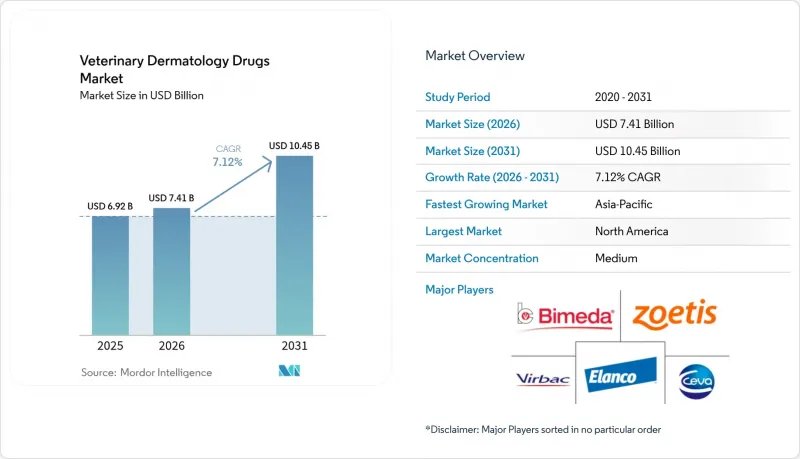
This report is Segmented by Animal (Companion Animal and Livestock Animal), Route of Administration (Topical, Injectable, and Oral), Indication (Parasitic Infections, and Other Indications), Distribution Channel (Retail, Hospital Pharmacies and E-Commerce), and Geography (North America, Europe, Asia-Pacific, and More). The Market Forecasts are Provided in Terms of Value (USD).
Global Veterinary Dermatology Drugs Market Trends and Insights
Surge in Global Pet Ownership & Humanization Expenditure
Pet humanization is turning dermatology from episodic intervention to planned care. Urban households allocate budgets once reserved for pediatric health, driving adherence to multi-month atopic regimens. Rapid growth in cat ownership in East-Asia and expanding telemedicine use broaden access to early diagnosis, raising the treated population. Higher disposable incomes in Latin America are also moving owners toward branded parasiticides rather than homemade remedies. Together, these trends enlarge the paying base for the veterinary dermatology drugs market.
Rapid Uptake of Monoclonal-Antibody & JAK-Inhibitor Therapies
Biologics that block specific cytokines are replacing broad anti-inflammatories. Cytopoint has treated more than 10 million dogs worldwide since launch. Apoquel delivers fast relief through oral dosing yet carries label cautions on live-vaccine overlap, prompting veterinarians to stagger immunizations. Elanco's Zenrelia faced a 2024 FDA safety communication about vaccine-induced disease, proving that post-market vigilance can slow adoption. Despite such headwinds, the segment grows fastest because owners accept higher prices for drugs that avoid steroid-linked adverse events.
High Cost of Biologics & Chronic Therapies
A single monoclonal-antibody dose for a medium-sized dog can cost USD 50-100, straining budgets in emerging economies without robust pet-insurance coverage. Rural owners often default to generic corticosteroids, leaving chronic dermatitis unmanaged. Production-animal use is even rarer because herd economics favor culling over expensive individual treatment. Subscription wellness plans partly offset costs but remain concentrated in wealthier regions, keeping adoption uneven.
Other drivers and restraints analyzed in the detailed report include:
- Climate-Driven Expansion of Ectoparasite Ranges Elevating Skin Infections
- AI-Enabled Tele-Dermatology Platforms Widening Early-Diagnosis Reach
- Emerging Resistance to Isoxazoline Ectoparasiticides
For complete list of drivers and restraints, kindly check the Table Of Contents.
Segment Analysis
Companion animals captured 72.53% of 2025 sales and will expand at 9.75% annually through 2031, driven by urbanization and higher spend per pet. Livestock accounts for the remaining 27.47%, constrained by price sensitivity and strict antibiotic policies. The veterinary dermatology drugs market size for companion animals is forecast to cross USD 8 billion by 2031. Dairy farmers often weigh drug cost against herd replacement, limiting biologic use in cattle.
Urban millennials in East-Asia prefer cats due to apartment living, further lifting feline dermatology prescriptions. In contrast, poultry operations focus on biosecurity rather than post-infection drugs, keeping that niche small. These dynamics ensure investment remains skewed toward companion-animal breakthroughs.
Topicals led with 46.15% share in 2025, yet injectables are growing at 10.82% annually. Cytopoint's 4-to-8-week dosing schedule eliminates owner forgetfulness and secures veterinarian oversight. Long-acting depot steroids for flare management are in trials, aiming to replicate this benefit. Oral chewables remain popular for parasites due to palatability improvements.
A 2024 AVMA survey found 32.9% of owners buying from online pharmacies, but adherence to multi-week orals lagged, underscoring the appeal of clinic-administered injectables. The veterinary dermatology drugs market share for injectables could reach 32% by 2031 if current growth holds.
Complete Report Scope:
- By Animal Type
- Companion Animals
- Livestock Animals
- By Route of Administration
- Topical
- Oral
- Injectable
- Other Routes
- By Indication
- Parasitic Infections
- Allergic / Atopic Dermatitis
- Bacterial & Fungal Skin Infections
- Other Indications
- By Distribution Channel
- Veterinary Hospitals & Clinics
- Retail Pharmacies
- E-commerce
- Other Channels
- Geography
- North America
- United States
- Canada
- Mexico
- Europe
- Germany
- United Kingdom
- France
- Italy
- Spain
- Rest of Europe
- Asia-Pacific
- China
- India
- Japan
- Australia
- South Korea
- Rest of Asia-Pacific
- Middle East and Africa
- GCC
- South Africa
- Rest of Middle East and Africa
- South America
- Brazil
- Argentina
- Rest of South America
- North America
Geography Analysis
North America generated 38.52% of 2025 revenue, supported by high spend per pet and early biologic adoption. Growth is plateauing as preventive parasiticide penetration nears saturation and price competition intensifies. Canada posts steady gains, while Mexico lags due to income disparities and fewer specialty clinics.
Asia-Pacific is the fastest-growing region at an 11.32% CAGR through 2031. Rising disposable income, urban apartment living that favors small pets, and expanding telemedicine adoption support demand. Regional regulatory reliance on Japanese PMDA reviews accelerates product availability, shortening launch timelines.
Europe remains sizeable but slower-moving, constrained by stricter pricing rules and upcoming generic bioequivalence guidelines that may squeeze branded margins. The United Kingdom's online retailer registration regime, launched in 2024, standardizes e-pharmacy practices and could curb grey-market imports. Latin America and the Middle East & Africa together represent a smaller share but show pockets of rapid growth in major urban centers, offset by limited cold-chain infrastructure for biologics.
- AB Science
- Bimeda
- Bioiberica
- Boehringer Ingelheim
- Ceva
- Dechra Pharmaceuticals
- Elanco
- Hester Biosciences
- Indian Immunologicals
- Kyoritsu Seiyaku
- Leti Pharma
- Merck Animal Health (MSD)
- Nextmune AB
- Norbrook Laboratories
- Pharmgate Animal Health
- Toray Animal Health
- Vetoquinol
- Virbac
- Vivaldis
- Zoetis
Additional Benefits:
- The market estimate (ME) sheet in Excel format
- 3 months of analyst support
TABLE OF CONTENTS
1 Introduction
- 1.1 Study Assumptions & Market Definition
- 1.2 Scope of the Study
2 Research Methodology
3 Executive Summary
4 Market Landscape
- 4.1 Market Overview
- 4.2 Market Drivers
- 4.2.1 Rising incidence of allergic & atopic dermatitis in companion animals
- 4.2.2 Surge in global pet ownership & humanisation expenditure
- 4.2.3 Rapid uptake of monoclonal-antibody & JAK-inhibitor therapies
- 4.2.4 Climate-driven expansion of ectoparasite ranges elevating skin infections
- 4.2.5 AI-enabled tele-dermatology platforms widening early-diagnosis reach
- 4.2.6 Subscription pet-wellness plans bundling dermatology preventives
- 4.3 Market Restraints
- 4.3.1 High cost of biologics & chronic therapies
- 4.3.2 Limited awareness & veterinary access in low-income regions
- 4.3.3 Emerging resistance to isoxazoline ectoparasiticides
- 4.3.4 Vaccine-drug interaction warnings curbing new JAK-inhibitor uptake
- 4.4 Supply-Chain Analysis
- 4.5 Regulatory Landscape
- 4.6 Technological Outlook
- 4.7 Porter's Five Forces
- 4.7.1 Threat of New Entrants
- 4.7.2 Bargaining Power of Buyers
- 4.7.3 Bargaining Power of Suppliers
- 4.7.4 Threat of Substitutes
- 4.7.5 Intensity of Competitive Rivalry
5 Market Size & Growth Forecasts (Value, USD)
- 5.1 By Animal Type
- 5.1.1 Companion Animals
- 5.1.2 Livestock Animals
- 5.2 By Route of Administration
- 5.2.1 Topical
- 5.2.2 Oral
- 5.2.3 Injectable
- 5.2.4 Other Routes
- 5.3 By Indication
- 5.3.1 Parasitic Infections
- 5.3.2 Allergic / Atopic Dermatitis
- 5.3.3 Bacterial & Fungal Skin Infections
- 5.3.4 Other Indications
- 5.4 By Distribution Channel
- 5.4.1 Veterinary Hospitals & Clinics
- 5.4.2 Retail Pharmacies
- 5.4.3 E-commerce
- 5.4.4 Other Channels
- 5.5 Geography
- 5.5.1 North America
- 5.5.1.1 United States
- 5.5.1.2 Canada
- 5.5.1.3 Mexico
- 5.5.2 Europe
- 5.5.2.1 Germany
- 5.5.2.2 United Kingdom
- 5.5.2.3 France
- 5.5.2.4 Italy
- 5.5.2.5 Spain
- 5.5.2.6 Rest of Europe
- 5.5.3 Asia-Pacific
- 5.5.3.1 China
- 5.5.3.2 India
- 5.5.3.3 Japan
- 5.5.3.4 Australia
- 5.5.3.5 South Korea
- 5.5.3.6 Rest of Asia-Pacific
- 5.5.4 Middle East and Africa
- 5.5.4.1 GCC
- 5.5.4.2 South Africa
- 5.5.4.3 Rest of Middle East and Africa
- 5.5.5 South America
- 5.5.5.1 Brazil
- 5.5.5.2 Argentina
- 5.5.5.3 Rest of South America
- 5.5.1 North America
6 Competitive Landscape
- 6.1 Market Concentration
- 6.2 Market Share Analysis
- 6.3 Company Profiles (includes Global level overview, Market overview, Core Segments, Financials, Strategic Information, Market Rank/Share, Products & Services, Recent Developments)
- 6.3.1 AB Science
- 6.3.2 Bimeda Inc.
- 6.3.3 Bioiberica S.A.U.
- 6.3.4 Boehringer Ingelheim Animal Health
- 6.3.5 Ceva Sante Animale
- 6.3.6 Dechra Pharmaceuticals
- 6.3.7 Elanco Animal Health
- 6.3.8 Hester Biosciences
- 6.3.9 Indian Immunologicals Ltd.
- 6.3.10 Kyoritsu Seiyaku
- 6.3.11 Leti Pharma
- 6.3.12 Merck Animal Health (MSD)
- 6.3.13 Nextmune AB
- 6.3.14 Norbrook Laboratories
- 6.3.15 Pharmgate Animal Health
- 6.3.16 Toray Animal Health
- 6.3.17 Vetoquinol SA
- 6.3.18 Virbac SA
- 6.3.19 Vivaldis
- 6.3.20 Zoetis Inc.
7 Market Opportunities & Future Outlook
- 7.1 White-space & Unmet-Need Assessment