
|
시장보고서
상품코드
2124721
OHV(Off-highway Vehicle) 텔레매틱스 시장 : 시장 점유율 분석, 업계 동향 및 통계, 성장 예측(2026-2031년)Off-Highway Vehicle Telematics - Market Share Analysis, Industry Trends & Statistics, Growth Forecasts (2026 - 2031) |
||||||
 Mordor Intelligence
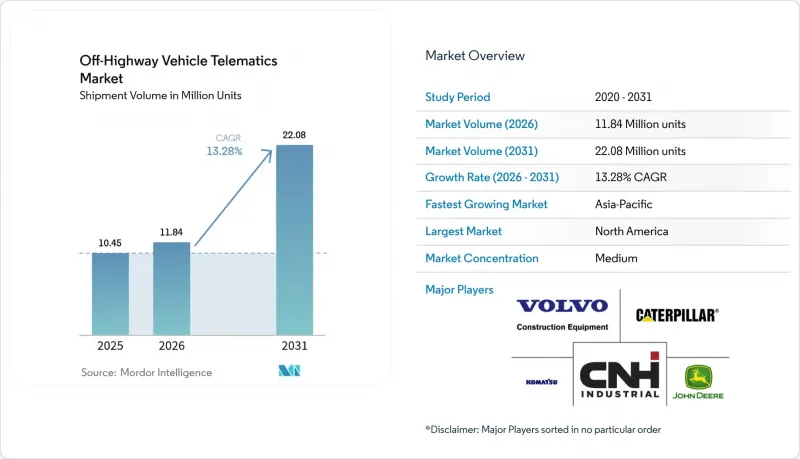
Mordor Intelligence에 의하면, OHV(Off-highway Vehicle) 텔레매틱스 시장 규모는 2025년에 1,045만 대라고 평가되었고, 2026년 1,184만 대로부터 2031년까지 2,208만 대에 이를 것으로 예측되며, 예측 기간(2026-2031년) CAGR은 13.28%를 나타낼 전망입니다.
본 보고서는 구성 요소별(하드웨어, 소프트웨어, 서비스), 연결 방식별(셀룰러, 위성 등), 솔루션 유형별(OEM 내장형, 애프터마켓 설치형), 차량 유형별(건설 기계, 농업 기계, 광산기계 등), 최종 사용자 산업별(건설, 농업, 광업 등), 지역별로 분류되어 있습니다. 시장 예측은 수량(대수) 기준으로 제시되어 있습니다.
세계의 오프로드 차량용 텔레매틱스 시장 동향 및 인사이트
중장비에 대한 OEM 텔레매틱스 탑재 의무화 규제
캘리포니아주가 제안한 Tier 5 규제는 2029년까지 56-560 kW 엔진의 NOx를 90% 감축할 것을 요구하며, 규정 준수 감사를 위해 배기가스 데이터를 지속적으로 업로드할 것을 의무화하고 있습니다. 이로 인해 북미 전역에서 텔레매틱스는 선택 사항이 아닌 사실상 표준 사양이 되었습니다. 유럽의 Stage V 요건도 이러한 추세를 반영하여 디젤 미립자 필터의 실시간 모니터링을 의무화하고 있습니다. 이에 대응하여 각 OEM 업체들은 공장에서 텔레매틱스 기능을 기본 사양으로 탑재하고 있으며, 이를 통해 추가 비용이 절감됨에 따라 건설, 농업, 광업 분야의 차량 군에 대한 도입이 가속화되고 있습니다. 이와 유사한 규정에 따라 향후 운전자의 피로 경고나 민감한 구역에서의 지오펜싱이 의무화될 가능성도 열려 있으며, 오프로드 차량용 텔레매틱스 시장은 안전 기준 전반에 걸친 규정 준수를 향해 나아가고 있습니다.
통신 사각지대 없는 커버리지를 실현하는 저궤도 위성 군집의 급증
Starlink와 같은 저궤도 네트워크는 지금까지 농촌 지역의 농업 및 노천 광산에서 텔레매틱스 보급을 제한해 온 통신 단절을 해소하고 있습니다. John Deere의 캔자스주 현장 시험에서는 반경 70마일 내의 농지 전역에서 지속적인 데이터 흐름이 유지되어, 실시간 농법 조정 및 예측 유지보수가 가능해졌으며, 이는 연료 절약과 예기치 않은 수리 비용 절감으로 이어졌습니다. 광업 기업들은 더 큰 혜택을 누리고 있습니다. 끊김 없는 데이터 스트림 덕분에 고가치의 채굴 기계에서 발생하는 비용이 많이 드는 가동 중단 시간을 최대 20%까지 줄일 수 있기 때문입니다. 위성 서비스의월이용료는 여전히 1대당 50-200달러 범위이지만, 차량 군(fleet)에 대한 급속한 도입에 따라 대량 구매 할인이 확대되고 있어, 오프로드 차량용 텔레매틱스 시장의 장기적인 성장을 뒷받침하고 있습니다.
기존 유지보수 업무 프로세스를 변경하는 데 대한 최종 사용자의 거부감
많은 가족 경영의 도급업체와 농장은 데이터 과다나 업무 흐름의 혼란을 이유로, 분석 기능이 충실한 대시보드보다는 육안 검사나 정비사의 직관에 의존하고 있습니다. 기술자의 데이터 분석 능력이 부족한 경우, 이러한 거부감은 더욱 강해져 디지털화로 인한 이점을 저해하는 종이 로그가 병행하여 작성되는 결과로 이어집니다. 단순한 위치 추적에서 시작하여 이후 예측 알고리즘으로 전환하는 단계적 도입이 가장 성공적이라는 사실로 미루어 볼 때, 오프로드 차량용 텔레매틱스 시장에서의 도입에 있어 중요한 장벽은 기술이 아니라 문화적 변화임이 드러납니다.
부문 분석
2025년에도 하드웨어의 점유율은 53.65%를 유지했습니다. 이는 어떤 도입이든 여전히 텔레매틱스 제어 장치, 센서, 안테나에서 시작되기 때문입니다. 그러나 소프트웨어의 연평균 성장률(CAGR)이 15.72%라는 점은 오프로드 차량용 텔레매틱스 시장이 기본적인 추적에서 고급 데이터 분석으로 진화하고 있음을 보여줍니다. 클라우드 플랫폼, AI 엔진, 시각화 도구와 관련된 오프로드 차량용 텔레매틱스 시장 규모는 예측 기간 동안 하드웨어 지출을 초과할 것으로 예상되며, 이는 원시 데이터보다 인사이트력에 대한 수요가 증가하고 있음을 반영합니다.
또한, 차량 운영 사업자들이 설치, API 통합, 지속적인 최적화를 전문가에게 의존함에 따라 서비스 수익도 함께 증가하고 있습니다. 150만 대의 연결 자산에서 데이터를 추출하는 Caterpillar의 생성형 AI 서비스 엔진은 소프트웨어 및 서비스가 결합되어 고객의 가동 시간과 만족도를 어떻게 향상시키는지를 보여줍니다. 사용자 기반이 확대됨에 따라, 장비 등급, 차량 규모, 규정 준수 요건에 맞춘 구독 플랜을 통해 여러 브랜드가 혼재된 환경에서 소프트웨어의 보급이 더욱 확대될 것입니다.
2025년에는 58.55%의 점유율을 차지한 4G 및 5G 셀룰러 통신은 일상적인 데이터 트래픽의 기반이 될 것입니다. 그러나 통신 사업자의 서비스 지역 밖을 이동하는 장비(노천 광산, 대규모 농장, 외딴 산림 지역 등)에는 원활한 장애 복구 기능이 필요합니다. 연평균 성장률(CAGR) 15.12%로 성장하고 있는 듀얼 모드 셀룰러·위성 시스템은 수동 개입 없이 연속성을 보장하고, 분석 파이프라인 및 규제 관련 로그를 유지합니다.
John Deere의 StarLink 안테나 통합은 각 OEM 업체들이 프리미엄 트랙터에 위성 기능을 기본 사양으로 탑재하여, 가동 중단이 발생하기 쉬운 사각지대를 완벽하게 추적 가능한 경작지로 변화시키고 있음을 보여줍니다. 한편, Wi-Fi, Bluetooth 또는 초광대역(UWB)을 결합한 로컬 메시 네트워크는 인근 기계들을 서로 연결하여 충돌 경고 및 펌웨어 업데이트 정보를 공유합니다. 이러한 하이브리드 토폴로지가 결합되어 오프로드 차량용 텔레매틱스 시장의 다음 단계를 뒷받침하고 있습니다.
지역별 분석
2025년, 북미는 오프로드 차량용 텔레매틱스 시장에서 36.35%의 점유율을 차지하며 시장을 주도했습니다. 이는 확립된 딜러 네트워크, 배기가스 및 안전 규제의 엄격한 시행, 그리고 데이터 기반 차량 관리 문화에 힘입은 결과입니다. 높은 가처분 소득과 대규모 계약업체의 차량 보유 대수는 하드웨어 교체 주기를 안정화시켜 구독 서비스의 급속한 보급으로 이어지고 있습니다. OEM과 딜러 간의 파트너십을 통해 도입이 더욱 간소화되어, 중규모 소유자라도 막대한 IT 비용을 들이지 않고도 분석 대시보드를 이용할 수 있게 되었습니다.
유럽도 이에 뒤이어 스테이지 V 배기가스 규제와 장비 소유자에게 미세먼지 및 NOx 데이터의 지속적인 기록을 의무화하는 지역 차원의 탄소 감축 의무에 힘입어 성장하고 있습니다. 독일과 스칸디나비아 국가에서는 텔레매틱스에 기반한 탄소 배출량 산정을 통합한 차량 그룹에 보상을 제공하는 인센티브 프로그램이 시행되고 있어, 규정 준수 및 ESG 보고를 위한 플랫폼 도입이 더욱 촉진되고 있습니다. 또한, EU의 일반 데이터 보호 규정(GDPR(EU 개인정보보호규정))에 따라 공급업체는 ‘프라이버시 바이 디자인(Privacy by Design)’ 솔루션을 구축해야 할 의무가 있으며, 이를 통해 유럽 고객들은 텔레매틱스 활용 범위를 확대하는 데 있어 안심감을 얻고 있습니다.
아시아태평양은 성장의 원동력이 되고 있으며, 2031년까지의 연평균 성장률(CAGR)은 15.78%로 예측됩니다. 중국의 일대일로 이니셔티브와 인도의 국가 인프라 계획으로 인해 총 수백만 대의 새로운 기계가 필요하며, 그 대부분에는 성능 추적을 위한 텔레매틱스 기능이 출고 시 기본으로 탑재되어 있습니다. 현지 생산을 통해 기기 비용을 낮게 억제함으로써, 가격에 민감한 구매자층으로의 보급이 가속화되고 있습니다. 또한 각국 정부는 농가에게 커넥티드 기기 구입 비용을 보조하는 정밀 농업 지원금을 도입하고 있어, 이를 통해 오프로드 차량용 텔레매틱스 시장이 대도시권을 넘어 지방 농촌 지역으로 확대될 것으로 확실시되고 있습니다. 동남아시아 일부 지역에서는 여전히 기술자 부족이 심각한 문제이지만, 각 OEM 업체들은 이러한 격차를 해소하기 위해 교육 아카데미와 원격 진단센터를 빠르게 개설하고 있습니다.
기타 혜택 :
- 엑셀 형식 시장 예측(ME) 시트
- 3개월간의 애널리스트 지원
자주 묻는 질문
목차
제1장 서론
제2장 조사 방법
제3장 주요 요약
제4장 시장 구도
제5장 시장 규모 및 성장 예측(수량)
제6장 경쟁 구도
제7장 시장 기회 및 향후 동향
AJYAccording to Mordor Intelligence, the off-Highway vehicle telematics market size was valued at 10.45 million units in 2025 and estimated to grow from 11.84 million units in 2026 to reach 22.08 million units by 2031, at a CAGR of 13.28% during the forecast period (2026-2031).
This report is Segmented by Component (Hardware, Software, and Services), Connectivity (Cellular, Satellite, and More), Solution Type (OEM-Embedded and Aftermarket-Installed), Vehicle Type (Construction Equipment, Agricultural Machinery, Mining Equipment, and More), End-User Industry (Construction, Agriculture, Mining, and More), and Geography. The Market Forecasts are Provided in Terms of Volume (Units).
Global Off-Highway Vehicle Telematics Market Trends and Insights
Regulations mandating OEM-installed telematics on heavy equipment
California's proposed Tier 5 rules demand 90% NOx reduction for 56-560 kW engines by 2029 and require continuous emissions data uploads for compliance auditing, effectively making telematics standard rather than optional throughout North America. European Stage V requirements echo this stance by obligating real-time monitoring of diesel particulate filters. OEMs respond by bundling telematics at the factory, lowering incremental costs and accelerating adoption curves across construction, agriculture, and mining fleets. The same provisions open the door for future mandates on operator-fatigue alerts and geofencing in sensitive zones, pushing the off-highway vehicle telematics market toward full-spectrum safety compliance.
Surge in low-orbit satellite constellations enabling "black-spot-free" coverage
Low-Earth-orbit networks such as Starlink now bridge connectivity gaps that historically limited telematics in rural agriculture and open-pit mines. John Deere's Kansas field trials maintained continuous data flow across a 70-mile farming radius, enabling real-time agronomic tweaks and predictive maintenance that saved fuel and reduced unexpected repairs. Mining firms gain even more, as uninterrupted data streams cut costly downtime by up to 20% on high-value extraction machinery. While satellite subscriptions still range USD 50-200 per unit each month, volume pricing is trending downward alongside rapid fleet uptake, underpinning long-term growth for the off-highway vehicle telematics market.
End-user reluctance to alter legacy maintenance workflows
Many family-owned contractors and farms rely on visual inspections and mechanic intuition rather than dashboards rich in analytics, citing "data overload" and workflow disruption. Resistance is heightened where technicians lack data-analysis skills, leading to parallel paper logs that undercut digital gains. Gradual rollouts that begin with simple location tracking before moving to predictive algorithms have proven most successful, indicating cultural change-not technology-is the critical adoption hurdle for the off-highway vehicle telematics market.
Other drivers and restraints analyzed in the detailed report include:
- Falling unit cost of ruggedized TCUs and sensors
- Emerging AI-based predictive-maintenance marketplaces for rental fleets
- Shortage of certified telematics technicians in rural regions
For complete list of drivers and restraints, kindly check the Table Of Contents.
Segment Analysis
Hardware retained a 53.65% share in 2025 because every deployment still begins with a telematics control unit, sensors, and antennas. Yet software's 15.72% CAGR illustrates how the off-highway vehicle telematics market is evolving from basic tracking to advanced data analytics. The off-highway vehicle telematics market size associated with cloud platforms, AI engines, and visualization tools will outpace hardware outlays over the forecast period, reflecting demand for insight rather than raw data.
Service revenue grows in parallel as fleets lean on experts for installation, API integration, and ongoing optimization. Caterpillar's generative-AI service engine, which mines data from 1.5 million connected assets, demonstrates how software and services combine to lift customer uptime and satisfaction. As the user base expands, subscription tiers tailored to equipment class, fleet size, and compliance needs will deepen software penetration across mixed-brand environments.
With a 58.55% share in 2025, 4G and 5G cellular remain the baseline for day-to-day data traffic. However, equipment that roams outside carrier footprints-open-pit mines, large farms, remote forestry tracts-demands seamless fail-over. Dual-mode cellular-satellite systems growing at 15.12% CAGR guarantee continuity without manual intervention, sustaining analytics pipelines and regulatory logs.
John Deere's integration of Starlink antennas shows how OEMs package satellite as standard on premium tractors, turning downtime black spots into fully traceable acreage. Meanwhile, local mesh networks that combine Wi-Fi, Bluetooth, or ultra-wideband link neighboring machines to share collision warnings and firmware updates. Together, these hybrid topologies underpin the next phase of the off-highway vehicle telematics market.
Complete Report Scope:
- By Component
- Hardware
- Software
- Services
- By Connectivity
- Cellular
- Satellite
- Dual-Mode (Cell + Satellite)
- Short-Range (Wi-Fi / BLE / UWB)
- By Solution Type
- OEM-Embedded
- Aftermarket-Installed
- By Vehicle Type
- Construction Equipment
- Earth-moving
- Lifting
- Road-building
- Agricultural Machinery
- Tractors
- Harvesters
- Implements
- Mining Equipment
- Surface
- Underground
- Forestry Machinery
- Feller-bunchers
- Forwarders
- Material-Handling and Others
- Cranes
- Forklifts
- ATVs
- Construction Equipment
- By End-user Industry
- Construction
- Agriculture
- Mining
- Forestry
- Rental and Leasing Fleets
- By Geography
- North America
- United States
- Canada
- Mexico
- South America
- Brazil
- Argentina
- Chile
- Rest of South America
- Europe
- Germany
- United Kingdom
- France
- Italy
- Spain
- Russia
- Rest of Europe
- Asia-Pacific
- China
- India
- Japan
- South Korea
- Singapore
- Malaysia
- Australia
- Rest of Asia-Pacific
- Middle East and Africa
- Middle East
- United Arab Emirates
- Saudi Arabia
- Turkey
- Rest of Middle East
- Africa
- South Africa
- Nigeria
- Egypt
- Rest of Africa
- Middle East
- North America
Geography Analysis
North America led the off-highway vehicle telematics market in 2025 with a 36.35% share, aided by well-established dealer networks, robust enforcement of emissions and safety rules, and a culture of data-driven fleet management. High disposable incomes and large contractor fleets translate into steady hardware refresh cycles and rapid uptake of subscription services. OEM-dealer partnerships further simplify onboarding, ensuring that even mid-tier owners gain access to analytics dashboards without heavy IT overhead.
Europe follows closely, propelled by Stage V emissions controls and region-wide carbon-reduction mandates that oblige equipment owners to document particulate and NOx data continually. Incentive programs in Germany and Scandinavia reward fleets that integrate telematics-based carbon accounting, driving stronger platform adoption for compliance and ESG reporting. Additionally, the EU's General Data Protection Regulation forces vendors to engineer privacy-by-design solutions, giving European customers confidence to expand telematics footprints.
Asia-Pacific represents the growth engine, projected at a 15.78% CAGR through 2031. China's Belt and Road Initiative and India's National Infrastructure Pipeline collectively require millions of new machines, most factory-equipped with telematics for performance tracking. Local manufacturing keeps device costs low, accelerating penetration among cost-sensitive buyers. National governments also deploy precision-farming subsidies that reimburse farmers for connected equipment, ensuring that the off-highway vehicle telematics market spreads beyond megacities into rural provinces. While technician shortages remain acute in parts of Southeast Asia, OEMs are rapidly opening training academies and remote diagnostic centers to bridge the gap.
- Caterpillar Inc.
- Komatsu Ltd.
- Deere & Company
- CNH Industrial N.V.
- Volvo Construction Equipment AB
- Hitachi Construction Machinery Co. Ltd.
- Liebherr-International AG
- Doosan Bobcat Inc.
- SANY Heavy Industry Co. Ltd.
- JCB Ltd.
- Trimble Inc.
- ORBCOMM Inc.
- Geotab Inc.
- Samsara Inc.
- Trackunit A/S
- Proemion GmbH
- Teltonika Telematics UAB
- Topcon Positioning Systems Inc.
- Hexagon AB (Leica Geosystems)
- ACTIA Group
- Danfoss Power Solutions (PLUS+1 Connect)
- Quake Global Inc.
- HED Inc. (CANect)
- Zonar Systems Inc.
- Skylo Technologies
- CalAmp Corp.
Additional Benefits:
- The market estimate (ME) sheet in Excel format
- 3 months of analyst support
TABLE OF CONTENTS
1 INTRODUCTION
- 1.1 Study Assumptions and Market Definition
- 1.2 Scope of the Study
2 RESEARCH METHODOLOGY
3 EXECUTIVE SUMMARY
4 MARKET LANDSCAPE
- 4.1 Market Overview
- 4.2 Market Drivers
- 4.2.1 Regulations mandating OEM-installed telematics on heavy equipment
- 4.2.2 Surge in low-orbit satellite constellations enabling "black-spot-free" coverage
- 4.2.3 Falling unit cost of ruggedized TCUs and sensors
- 4.2.4 Integration of telematics-driven carbon-credit monetisation platforms
- 4.2.5 OEM-agnostic AEMP 2.0 data-standard adoption unlocking mixed-fleet analytics
- 4.2.6 Emerging AI-based predictive-maintenance marketplaces for rental fleets
- 4.3 Market Restraints
- 4.3.1 End-user reluctance to alter legacy maintenance workflows
- 4.3.2 Shortage of certified telematics technicians in rural regions
- 4.3.3 Data-sovereignty and cybersecurity compliance costs for cross-border fleets
- 4.3.4 Fragmented satellite subscription pricing models inhibiting small-fleet uptake
- 4.4 Industry Value Chain Analysis
- 4.5 Regulatory Landscape
- 4.6 Technological Outlook
- 4.7 Industry Attractiveness - Porter's Five Forces Analysis
- 4.7.1 Bargaining Power of Suppliers
- 4.7.2 Bargaining Power of Buyers
- 4.7.3 Threat of New Entrants
- 4.7.4 Threat of Substitutes
- 4.7.5 Intensity of Competitive Rivalry
- 4.8 Impact of Macroeconomic Factors on the Market
5 MARKET SIZE AND GROWTH FORECASTS (VOLUMES)
- 5.1 By Component
- 5.1.1 Hardware
- 5.1.2 Software
- 5.1.3 Services
- 5.2 By Connectivity
- 5.2.1 Cellular
- 5.2.2 Satellite
- 5.2.3 Dual-Mode (Cell + Satellite)
- 5.2.4 Short-Range (Wi-Fi / BLE / UWB)
- 5.3 By Solution Type
- 5.3.1 OEM-Embedded
- 5.3.2 Aftermarket-Installed
- 5.4 By Vehicle Type
- 5.4.1 Construction Equipment
- 5.4.1.1 Earth-moving
- 5.4.1.2 Lifting
- 5.4.1.3 Road-building
- 5.4.2 Agricultural Machinery
- 5.4.2.1 Tractors
- 5.4.2.2 Harvesters
- 5.4.2.3 Implements
- 5.4.3 Mining Equipment
- 5.4.3.1 Surface
- 5.4.3.2 Underground
- 5.4.4 Forestry Machinery
- 5.4.4.1 Feller-bunchers
- 5.4.4.2 Forwarders
- 5.4.5 Material-Handling and Others
- 5.4.5.1 Cranes
- 5.4.5.2 Forklifts
- 5.4.5.3 ATVs
- 5.4.1 Construction Equipment
- 5.5 By End-user Industry
- 5.5.1 Construction
- 5.5.2 Agriculture
- 5.5.3 Mining
- 5.5.4 Forestry
- 5.5.5 Rental and Leasing Fleets
- 5.6 By Geography
- 5.6.1 North America
- 5.6.1.1 United States
- 5.6.1.2 Canada
- 5.6.1.3 Mexico
- 5.6.2 South America
- 5.6.2.1 Brazil
- 5.6.2.2 Argentina
- 5.6.2.3 Chile
- 5.6.2.4 Rest of South America
- 5.6.3 Europe
- 5.6.3.1 Germany
- 5.6.3.2 United Kingdom
- 5.6.3.3 France
- 5.6.3.4 Italy
- 5.6.3.5 Spain
- 5.6.3.6 Russia
- 5.6.3.7 Rest of Europe
- 5.6.4 Asia-Pacific
- 5.6.4.1 China
- 5.6.4.2 India
- 5.6.4.3 Japan
- 5.6.4.4 South Korea
- 5.6.4.5 Singapore
- 5.6.4.6 Malaysia
- 5.6.4.7 Australia
- 5.6.4.8 Rest of Asia-Pacific
- 5.6.5 Middle East and Africa
- 5.6.5.1 Middle East
- 5.6.5.1.1 United Arab Emirates
- 5.6.5.1.2 Saudi Arabia
- 5.6.5.1.3 Turkey
- 5.6.5.1.4 Rest of Middle East
- 5.6.5.2 Africa
- 5.6.5.2.1 South Africa
- 5.6.5.2.2 Nigeria
- 5.6.5.2.3 Egypt
- 5.6.5.2.4 Rest of Africa
- 5.6.5.1 Middle East
- 5.6.1 North America
6 COMPETITIVE LANDSCAPE
- 6.1 Market Concentration
- 6.2 Strategic Moves
- 6.3 Market Share Analysis
- 6.4 Company Profiles (includes Global level Overview, Market level overview, Core Segments, Financials as available, Strategic Information, Market Rank/Share for key companies, Products and Services, and Recent Developments)
- 6.4.1 Caterpillar Inc.
- 6.4.2 Komatsu Ltd.
- 6.4.3 Deere & Company
- 6.4.4 CNH Industrial N.V.
- 6.4.5 Volvo Construction Equipment AB
- 6.4.6 Hitachi Construction Machinery Co. Ltd.
- 6.4.7 Liebherr-International AG
- 6.4.8 Doosan Bobcat Inc.
- 6.4.9 SANY Heavy Industry Co. Ltd.
- 6.4.10 JCB Ltd.
- 6.4.11 Trimble Inc.
- 6.4.12 ORBCOMM Inc.
- 6.4.13 Geotab Inc.
- 6.4.14 Samsara Inc.
- 6.4.15 Trackunit A/S
- 6.4.16 Proemion GmbH
- 6.4.17 Teltonika Telematics UAB
- 6.4.18 Topcon Positioning Systems Inc.
- 6.4.19 Hexagon AB (Leica Geosystems)
- 6.4.20 ACTIA Group
- 6.4.21 Danfoss Power Solutions (PLUS+1 Connect)
- 6.4.22 Quake Global Inc.
- 6.4.23 HED Inc. (CANect)
- 6.4.24 Zonar Systems Inc.
- 6.4.25 Skylo Technologies
- 6.4.26 CalAmp Corp.
7 MARKET OPPORTUNITIES AND FUTURE TRENDS
- 7.1 White-Space and Unmet-Need Assessment