

|
시장보고서
상품코드
2124725
상업용 조명 : 시장 점유율 분석, 업계 동향과 통계, 성장 예측(2026-2031년)Commercial Lighting - Market Share Analysis, Industry Trends & Statistics, Growth Forecasts (2026 - 2031) |
||||||
 Mordor Intelligence
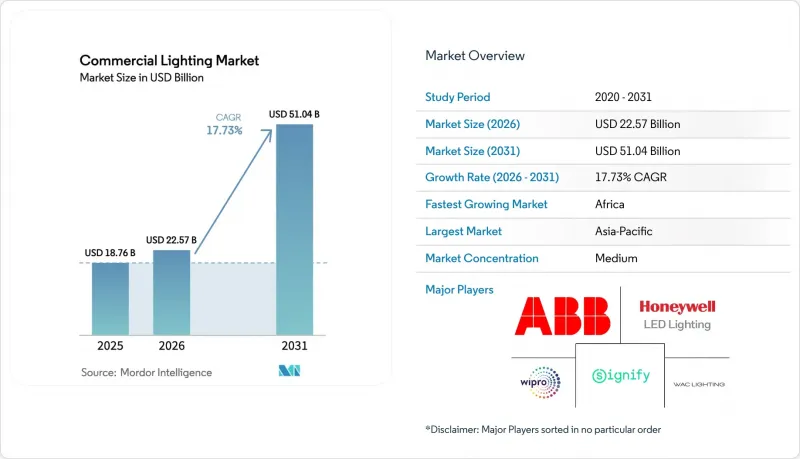
Mordor Intelligence에 의하면, 상업용 조명 시장 규모는 2025년에 187억 6,000만 달러, 2026년에 225억 7,000만 달러, 2031년까지 510억 4,000만 달러에 이를 것으로 예측되며, 2026-2031년 CAGR 17.73%를 기록할 전망입니다.
본 보고서는 조명 유형(램프 및 조명 기구), 광원(LED 및 기존), 최종 사용자(상업용 사무실, 소매, 호텔·레저, 의료 등), 설치 형태(신축 및 개보수, 리모델링),연결성(커넥티드/스마트 조명 및 비커넥티드 조명), 그리고 지역별로 분류되어 있습니다. 시장 예측은 금액(달러) 기준으로 제시되어 있습니다.
전 세계 상업용 조명 시장 동향 및 인사이트
에너지 효율 규제 및 LED 도입
세계적으로 규제가 강화됨에 따라 사양서에서 구형 램프가 배제되고 있으며, 많은 관할 구역에서 단순 회수 기간이 3년 미만으로 단축되고 있습니다. 2024년에 발효된 유럽의 에코디자인 규정 개정에 따라 고와트 T8 형광등이 금지되어, 건물 소유주는 개보수를 실시하거나 벌금을 물게 됩니다. 캘리포니아주 ‘타이틀 24’의 2025년 개정안에서는 실내 조명의 최소 광속 효율이 1와트당 100루멘으로 상향 조정되었으며, 광대한 공간에서의 네트워크 제어가 의무화되어, 이로 인해 신규 프로젝트에서 네트워크에 연결되지 않은 방식의 선택지는 사실상 배제되었습니다. 중국의 GB 50034-2024 규격에서는 조명의 전력 밀도에 상한선이 설정되고, 주변부의 조광이 의무화되어 있으며, 2060년 탄소 중립 공약에 부합하는 국가적 건설 기준이 확립되었습니다. 인도는 2024년에 별점 평가 제도를 상업용 조명 기구로 확대하고, 이미 국산 LED 어셈블리에 우대 조치를 취하고 있는 수입 관세에 더해 성능에 기반한 인센티브를 추가로 부여했습니다. 이러한 조치들이 맞물리면서, 2025년 시점에서 여전히 전 세계 설치 대수의 약 3분의 1을 차지하고 있던 형광등의 철거가 가속화되고 있습니다.
LED 가격 하락과 효율 향상
중국 제조업체들이 8인치 에피택셜 웨이퍼의 생산 규모를 확대하고 수율 관리를 개선한 결과, 중출력 LED 패키지의 가격은 2024년과 2025년 모두 두 자릿수 하락을 기록했습니다. 시그니파이(Signify)는 일반적인 트로퍼의 부품 원가가 15% 하락했다고 보고했으며, 이로 인해 이익률이 상승했음에도 불구하고 소매 가격은 보합세를 유지할 수 있었습니다. 니치아 화학공업의 220루멘/와트 패키지와 크리(Cree)가 실험실에서 달성한 240루멘/와트라는 수치는 양산 제품에서 150루멘/와트를 초과하는 시스템 효율로 이어집니다. 서울세미컨덕터의 ‘Acrich’ 드라이버리스 플랫폼은 고장이 잦은 전원 공급 장치를 제거하여 신뢰성을 향상시키는 동시에 조명 기구의 비용을 18% 절감했습니다. 따라서 상업용 조명 시장은 플라이휠 효과를 누리고 있습니다. 초기 비용의 감소로 잠재 수요가 확대되고, 이것이 규모의 경제를 가져와 가격을 더욱 낮추는 선순환이 발생하고 있습니다.
부품 공급망의 변동성
소수의 드라이버 IC 및 희토류 공급업체에 의한 시장 집중으로 인해, 상업용 조명 시장은 장기화되는 리드타임과 가격 급등 위험에 노출되어 있습니다. 2025년 초, 텍사스 기기와 ST마이크로일렉트로닉스는 파워 매니지먼트 IC 시장의 약 60%를 장악하고 있었으나, 자동차 수요 증가로 인해 두 회사 모두 납기일을 22주로 연장했습니다. 중국의 유로퓸 첨가 형광체 수출 할당제로 인해 2024년에는 현물 가격이 28% 상승했으나, 2025년 중반에는 안정되었습니다. 대량 주문 계약이 없는 중소 OEM 제조업체들은 제품 출시를 연기하거나 시장에서 철수했습니다. 북미의 조립 제조업체들은 많은 LED 모듈에 대해 25%의 관세가 계속 부과됨에 따라 베트남이나 멕시코로 생산 거점을 이전하고 있지만, 비용 및 인증 일정에 대해서는 결과가 엇갈리고 있습니다.
부문 분석
2025년 매출에서 조명 기구가 차지하는 비율은 56.78%로, 상업용 조명 시장 점유율 측면에서 램프를 확실히 앞지르고 있는 것으로 나타났습니다. 2031년까지 연평균 17.79%의 성장이 예상에 따라, 시공업체들은 완전히 통합된 조명 기구가 가져다주는 노동력 절감 효과를 높이 평가하고 있는 것으로 보입니다. 일체형 설계로 인해 현장 조립 시간이 약 30% 단축됩니다. 이는 성숙한 시장에서 숙련된 인력 부족으로 인해 설치 비용이 상승하고 있는 상황에서 매우 중요한 이점입니다. 이 부문의 우위는 현대적인 얕은 플레넘에 대응하는 이식형 트로퍼와 리니어 스트립에 의해 뒷받침되고 있습니다. Hubbell 및 Acuity와 같은 시장 선도 기업들은 공장에서 무선 컨트롤러를 지속적으로 내장함으로써 상호 운용성을 보장하는 동시에 현장 오류를 줄이고 있습니다.
조광 가능한 백색광 기능은 브랜드 차별화와 웰니스 지표가 중시되는 호텔 및 병원에서 보급이 확대되고 있습니다. Fagerhult사는 북유럽의 120곳 이상의 호텔에 ‘Organic Response’ 플랫폼을 도입하여 천장 재설계 없이도 투숙객 만족도 점수를 향상시켰습니다. 하이베이 조명 기구에는 현재 블루투스 및 Li-Fi 무선 기능이 출고 시 표준으로 탑재되어 있어, 창고 천장을 데이터 네트워크로 변화시키고 있습니다. WAC Lighting의 ‘Aether’ 시리즈는 Li-Fi가 내장된 선형 프로파일을 제공하며, 안전한 광대역 연결을 필요로 하는 기업 캠퍼스에 매력적인 선택지가 되고 있습니다. 대조적으로, 건축기준법에 따라 나사식 소켓 개조와 호환되지 않는 조명 기구 수준의 제어가 의무화되어 있어 램프 부문은 꾸준히 축소되고 있습니다.
LED 제품은 2025년 시장 가치의 66.59%를 차지할 것으로 예상되며, 2031년까지 연평균 18.31%의 성장률을 유지할 것으로 전망되어 상업용 조명 시장에서 그 중심적인 역할을 부각시키고 있습니다. 와트당 150루멘을 초과하는 시스템 수준의 효율과 가격 하락으로 인해, 전기 요금에 보조금이 지급되는 시장에서도 LED로 개조하는 것이 매력적인 선택지가 되고 있습니다. 현재 프리미엄 폼 팩터 분야에서 칩 온 보드(COB) 및 칩 스케일 패키지가 기존의 중출력 어레이를 대체하며, 더 높은 루멘 밀도와 뛰어난 방열 성능을 제공합니다. 델타 일렉트로닉스는 2025년, 3,000켈빈에서 140루멘/와트를 달성하고 연색 지수가 95를 넘는 COB 다운라이트를 출시했습니다. 이는 색 재현성이 수익에 직접적인 영향을 미치는 소매 용도를 직접 겨냥한 제품입니다.
EU와 일본의 수은 함유 램프 폐기 처분세로 인해 기존 광원은 계속해서 위축되고 있습니다. 오스람(OSRAM)은 2024년 말 램프 사업 부문을 매각한 후, 5,000만 달러 규모의 연구개발 예산을 HID에서 LED 및 LiDAR 부품으로 전환했습니다. Nanosys사와 3M사의 양자점 변환 필름이 하이엔드 건축용 조명 기구에 채택되어, 효율을 크게 저하시키지 않으면서 분광 범위를 확대되고 있습니다. 형광등의 잔존 시장은 저소득 지역에서 여전히 유지되고 있지만, 공급망 해체와 교체용 재고 고갈에 따라 해마다 축소되고 있습니다.
지역별 분석
2025년, 아시아태평양은 매출 점유율의 84.12%를 차지하며 상업용 조명 시장에서 중심적인 역할을 부각시켰습니다. 중국만 해도 스마트 가로등 및 상업용 조명을 포함한 스마트 시티 계획에 2조 3,000억 위안(3,200억 달러)을 투자한 반면, 인도의 에너지 효율청은 공공 건축물 조달 지침이 될 최소 광속 효율 기준을 설정했습니다. 일본은 2024년, 주변 구역에서의 자연 채광 자동 도입을 의무화하여 국가 에너지법을 한층 더 강화했습니다. 한국은 ‘그린 뉴딜’ 융자를 통해 개보수 비용의 최대 40%를 보조하고 있어, 건축 재고가 성숙 단계에 있음에도 불구하고 상업적 수요를 촉진하고 있습니다.
아프리카는 연평균 4%의 도시화와 태양광 발전 마이크로그리드 및 LED 패키지를 결합한 다자간 개발 자금 조달에 힘입어 2031년까지 연평균 20.06%라는 가장 높은 성장률을 보이고 있습니다. 아프리카개발은행의 ‘지속 가능한 에너지 기금’은 2024년에 18억 달러를 출자했으며, 그중 18%를 상업용 조명 프로젝트가 차지하고 있습니다. 나이지리아 농촌 전기화청은 2,500곳 시장에 태양광 발전식 LED를 설치하고, 모바일 키오스크를 통해 결제를 일괄 관리했습니다. 케냐의 새로운 기준은 2030년까지 100% 재생에너지로 운영하겠다는 국가 공약에 부합하는 것이며, LED의 효율은 전력망의 안정성에 있어 매우 중요합니다.
북미와 유럽은 세계 시장 점유율은 작지만 여전히 혁신의 중심지로 남아 있습니다. 미국 에너지부는 2024년, 조광 가능한 조명의 연구 개발에 4,500만 달러를 배정했습니다. 독일의 KfW 은행은 40% 이상의 절전 효과가 기대되는 개보수 공사에 대해 연이율 0.5%의 대출을 제공하며, 조명을 즉각적인 효과를 볼 수 있는 에너지 절약 대책으로 전환하고 있습니다. 중동에서는 NEOM과 같은 프로젝트 주도형 메가시티를 통해 진전이 나타나고 있습니다. 이곳에서는 Li-Fi 조명 기기가 전자기 간섭 없이 데이터를 제공하고 있으며, 한편 두바이의 2050년 청정 에너지 로드맵에서는 모든 신규 상업용 건축물에 LED 사용이 의무화되어 있습니다. 라틴아메리카에서는 진전 정도에 편차가 보이지만, 브라질의 PROCEL 규격과 멕시코의 CONUEE 규격 덕분에 소매업 및 호텔·관광 업계에서 LED 보급률은 지속적으로 상승하고 있습니다.
기타 혜택:
- 엑셀 형식 시장 예측(ME) 시트
- 3개월간의 애널리스트 지원
자주 묻는 질문
목차
제1장 서론
제2장 조사 방법
제3장 주요 요약
제4장 시장 구도
제5장 시장 규모와 성장 예측
제6장 경쟁 구도
제7장 시장 기회와 향후 전망
LSH 26.09.14According to Mordor Intelligence, the commercial lighting market size is projected to be USD 18.76 billion in 2025, USD 22.57 billion in 2026, and reach USD 51.04 billion by 2031, growing at a CAGR of 17.73% from 2026 to 2031.
This report is Segmented by Lighting Type (Lamps and Luminaires), Lighting Source (LED and Conventional), End-User (Commercial Offices, Retail, Hospitality and Leisure, Healthcare, and More), Installation Type (New Construction and Retrofit/Renovation), Connectivity (Connected/Smart Lighting and Non-Connected Lighting), and Geography. The Market Forecasts are Provided in Terms of Value (USD).
Global Commercial Lighting Market Trends and Insights
Energy-Efficiency Regulations and LED Adoption
Tightening global codes are removing legacy lamps from specification schedules, compressing simple paybacks to fewer than three years in many jurisdictions. The European Ecodesign update that became effective in 2024 bans high-wattage T8 fluorescents, forcing building owners to retrofit or face fines. California's 2025 revision of Title 24 lifts minimum indoor efficacy to 100 lumens per watt and mandates networked controls in large spaces, effectively excluding non-connected options from new projects. China's GB 50034-2024 standard caps lighting power density and requires perimeter dimming, aligning national construction with its 2060 carbon-neutral pledge. India extended its star-rating scheme to commercial luminaires in 2024, layering performance incentives on top of import tariffs that already favor domestic LED assembly. Together, these measures accelerate removal of an installed fluorescent base that still represented roughly one-third of global stock in 2025.
Declining LED Prices and Efficacy Improvements
Mid-power LED packages recorded double-digit price drops in both 2024 and 2025 as Chinese fabs scaled 8-inch epitaxial wafers and improved yield management. Signify reported a 15% fall in the bill-of-materials for a typical troffer, allowing retail prices to stay flat even as margins rose. Nichia's 220 lumens-per-watt packages and Cree's laboratory achievement of 240 lumens per watt translate to system efficiencies above 150 lumens per watt in volume products. Seoul Semiconductor's Acrich driver-less platform shaved 18% off fixture cost while improving reliability by removing the failure-prone power supply. The commercial lighting market therefore enjoys a flywheel effect: lower upfront cost expands addressable demand, which in turn enables scale efficiencies that push prices even lower.
Component Supply-Chain Volatility
Concentration among a handful of driver IC and rare-earth suppliers exposes the commercial lighting market to prolonged lead times and price spikes. Texas Instruments and STMicroelectronics controlled around 60% of power-management ICs in early 2025, and both stretched delivery windows to 22 weeks due to automotive demand. China's export quotas on europium-doped phosphors pushed spot prices up 28% in 2024 before stabilizing mid-2025. Smaller OEMs, lacking volume contracts, delayed launches or exited markets. North American assemblers continue to face 25% tariffs on many LED modules, prompting relocations to Vietnam and Mexico with mixed results on cost and qualification timelines.
Other drivers and restraints analyzed in the detailed report include:
- Smart Building and IoT Integration Demand
- Human-Centric Lighting for Occupant Wellness
- Construction-Cycle Dependency
For complete list of drivers and restraints, kindly check the Table Of Contents.
Segment Analysis
Luminaires represented 56.78% of 2025 revenues, indicating their clear lead over lamps within the commercial lighting market share. Growth at a 17.79% pace to 2031 suggests that contractors value the labor savings that arrive with fully integrated fixtures. Integrated designs cut on-site assembly time by about 30%, a critical advantage as skilled labor shortages inflate installation costs in mature markets. The segment's dominance is underpinned by recessed troffers and linear strips that align with modern shallow plenums. Market leaders such as Hubbell and Acuity continue to integrate wireless controllers at the factory, guaranteeing interoperability and reducing field errors.
Tunable-white capabilities are spreading across hotels and hospitals, where brand differentiation and wellness metrics matter. Fagerhult deployed its Organic Response platform in more than 120 Nordic hotels, boosting guest satisfaction scores without redesigning ceilings. High-bay luminaires now arrive with Bluetooth and Li-Fi radios factory-mounted, turning warehouse ceilings into data networks. WAC Lighting's Aether line offers linear profiles with embedded Li-Fi, a choice that appeals to corporate campuses seeking secure broadband. In contrast, the lamp segment declines steadily as building codes require luminaire-level controls incompatible with screw-base retrofits.
LED products captured 66.59% of 2025 value and will compound at 18.31% through 2031, underscoring their central role in the commercial lighting market. System-level efficiencies above 150 lumens per watt and declining prices make LED retrofits attractive even in markets with subsidized electricity. Chip-on-board and chip-scale packages now displace older mid-power arrays in premium form factors, offering higher lumen density and superior thermal handling. Delta Electronics launched a COB downlight in 2025 that reaches 140 lumens per watt at 3,000 kelvin with a color-rendering index above 95, directly targeting retail applications where color fidelity drives revenue.
Conventional sources continue to recede, accelerated by disposal levies on mercury-containing lamps in the EU and Japan. OSRAM redirected USD 50 million in R&D budgets from HID to LED and LiDAR components after divesting its lamp unit in late 2024. Quantum-dot conversion films from Nanosys and 3M enter high-end architectural fixtures, broadening spectral coverage without substantial efficacy loss. The residual market for fluorescents survives in low-income geographies but shrinks each year as supplier networks dissolve and replacement inventories dry up.
Complete Report Scope:
- By Lighting Type
- Lamps
- Luminaires
- By Lighting Source
- LED
- Conventional (Fluorescent, HID, Other Conventional Lighting Sources)
- By End-User
- Commercial Offices
- Retail
- Hospitality and Leisure
- Healthcare
- Other End-Users
- By Installation Type
- New Construction
- Retrofit / Renovation
- By Connectivity
- Connected / Smart Lighting
- Non-Connected Lighting
- By Geography
- North America
- United States
- Canada
- Mexico
- South America
- Brazil
- Argentina
- Rest of South America
- Europe
- Germany
- United Kingdom
- France
- Italy
- Spain
- Russia
- Rest of Europe
- Asia-Pacific
- China
- Japan
- India
- South Korea
- South-East Asia
- Rest of Asia-Pacific
- Middle East
- Saudi Arabia
- United Arab Emirates
- Turkey
- Rest of Middle East
- Africa
- South Africa
- Nigeria
- Rest of Africa
- North America
Geography Analysis
Asia Pacific commanded an 84.12% revenue share in 2025, underscoring its central role in the commercial lighting market. China alone funneled RMB 2.3 trillion (USD 320 billion) into smart-city programs that include intelligent street and commercial lighting, while India's Bureau of Energy Efficiency set minimum efficacy thresholds that guide procurement for public buildings. Japan imposed automatic daylight harvesting for perimeter zones in 2024, further tightening national energy law. South Korea subsidizes up to 40% of retrofit costs through its Green New Deal financing, unlocking commercial demand despite a mature construction stock.
Africa grows fastest at 20.06% through 2031, propelled by 4% annual urbanization and multilateral development loans that combine solar microgrids with LED packages. The African Development Bank's Sustainable Energy Fund disbursed USD 1.8 billion in 2024, with commercial lighting projects comprising 18% of that amount. Nigeria's Rural Electrification Agency installed solar-powered LEDs in 2,500 markets, bundling payments through mobile kiosks. Kenya's new standards align with a national pledge to run on 100% renewables by 2030, making LED efficacy critical to grid stability.
North America and Europe remain innovation hotspots even though they hold smaller global shares. The U.S. Department of Energy allocated USD 45 million in 2024 to tunable lighting R&D. Germany's KfW bank offers 0.5% interest loans for retrofits that deliver at least 40% savings, turning lighting into a quick-win energy measure. The Middle East advances via project-driven megacities like NEOM, where Li-Fi luminaires provide data without electromagnetic interference, while Dubai's 2050 clean energy roadmap mandates LEDs in all new commercial builds. Latin America advances unevenly, but Brazil's PROCEL and Mexico's CONUEE standards keep LED penetration moving upward across retail and hospitality clusters.
- Signify N.V.
- Acuity Brands, Inc.
- Hubbell Incorporated
- Zumtobel Group AG
- Cree Lighting (IDEAL INDUSTRIES, Inc.)
- Panasonic Corporation (Lighting)
- OSRAM GmbH
- Eaton Corporation plc (Cooper Lighting)
- Wipro Lighting Limited
- ABB Ltd. (Lighting)
- Honeywell International Inc. (LED Lighting)
- Legrand SA
- Lutron Electronics
- GE Current, a Daintree Company
- Fagerhult Group
- Siteco GmbH
- Delta Electronics, Inc. (Lighting BU)
- Syska LED Lights Pvt Ltd.
- WAC Lighting
- Havells India Ltd. (Lighting)
Additional Benefits:
- The market estimate (ME) sheet in Excel format
- 3 months of analyst support
TABLE OF CONTENTS
1 INTRODUCTION
- 1.1 Study Assumptions and Market Definition
- 1.2 Scope of the Study
2 RESEARCH METHODOLOGY
3 EXECUTIVE SUMMARY
4 MARKET LANDSCAPE
- 4.1 Market Overview
- 4.2 Market Drivers
- 4.2.1 Energy-Efficiency Regulations and LED Adoption
- 4.2.2 Declining LED Prices and Efficacy Improvements
- 4.2.3 Smart Building and IoT Integration Demand
- 4.2.4 Human-Centric Lighting for Occupant Wellness
- 4.2.5 Li-Fi-Enabled Luminaires for Data Connectivity
- 4.2.6 ESG-Linked Financing Accelerating Retrofits
- 4.3 Market Restraints
- 4.3.1 Component Supply-Chain Volatility
- 4.3.2 Construction-Cycle Dependency
- 4.3.3 Interoperability Gaps in Connected Systems
- 4.3.4 EPR and Recycling-Compliance Cost Burden
- 4.4 Industry Value Chain Analysis
- 4.5 Impact of Macroeconomic Factors on the Market
- 4.6 Regulatory Landscape
- 4.7 Technological Outlook
- 4.8 Porter's Five Forces Analysis
- 4.8.1 Bargaining Power of Suppliers
- 4.8.2 Bargaining Power of Buyers
- 4.8.3 Threat of New Entrants
- 4.8.4 Threat of Substitutes
- 4.8.5 Intensity of Competitive Rivalry
5 MARKET SIZE AND GROWTH FORECASTS (VALUE)
- 5.1 By Lighting Type
- 5.1.1 Lamps
- 5.1.2 Luminaires
- 5.2 By Lighting Source
- 5.2.1 LED
- 5.2.2 Conventional (Fluorescent, HID, Other Conventional Lighting Sources)
- 5.3 By End-User
- 5.3.1 Commercial Offices
- 5.3.2 Retail
- 5.3.3 Hospitality and Leisure
- 5.3.4 Healthcare
- 5.3.5 Other End-Users
- 5.4 By Installation Type
- 5.4.1 New Construction
- 5.4.2 Retrofit / Renovation
- 5.5 By Connectivity
- 5.5.1 Connected / Smart Lighting
- 5.5.2 Non-Connected Lighting
- 5.6 By Geography
- 5.6.1 North America
- 5.6.1.1 United States
- 5.6.1.2 Canada
- 5.6.1.3 Mexico
- 5.6.2 South America
- 5.6.2.1 Brazil
- 5.6.2.2 Argentina
- 5.6.2.3 Rest of South America
- 5.6.3 Europe
- 5.6.3.1 Germany
- 5.6.3.2 United Kingdom
- 5.6.3.3 France
- 5.6.3.4 Italy
- 5.6.3.5 Spain
- 5.6.3.6 Russia
- 5.6.3.7 Rest of Europe
- 5.6.4 Asia-Pacific
- 5.6.4.1 China
- 5.6.4.2 Japan
- 5.6.4.3 India
- 5.6.4.4 South Korea
- 5.6.4.5 South-East Asia
- 5.6.4.6 Rest of Asia-Pacific
- 5.6.5 Middle East
- 5.6.5.1 Saudi Arabia
- 5.6.5.2 United Arab Emirates
- 5.6.5.3 Turkey
- 5.6.5.4 Rest of Middle East
- 5.6.6 Africa
- 5.6.6.1 South Africa
- 5.6.6.2 Nigeria
- 5.6.6.3 Rest of Africa
- 5.6.1 North America
6 COMPETITIVE LANDSCAPE
- 6.1 Market Concentration
- 6.2 Strategic Moves
- 6.3 Market Share Analysis
- 6.4 Company Profiles (Includes Global Level Overview, Market Level Overview, Core Segments, Financials As Available, Strategic Information, Market Rank/Share For Key Companies, Products and Services, and Recent Developments)
- 6.4.1 Signify N.V.
- 6.4.2 Acuity Brands, Inc.
- 6.4.3 Hubbell Incorporated
- 6.4.4 Zumtobel Group AG
- 6.4.5 Cree Lighting (IDEAL INDUSTRIES, Inc.)
- 6.4.6 Panasonic Corporation (Lighting)
- 6.4.7 OSRAM GmbH
- 6.4.8 Eaton Corporation plc (Cooper Lighting)
- 6.4.9 Wipro Lighting Limited
- 6.4.10 ABB Ltd. (Lighting)
- 6.4.11 Honeywell International Inc. (LED Lighting)
- 6.4.12 Legrand SA
- 6.4.13 Lutron Electronics
- 6.4.14 GE Current, a Daintree Company
- 6.4.15 Fagerhult Group
- 6.4.16 Siteco GmbH
- 6.4.17 Delta Electronics, Inc. (Lighting BU)
- 6.4.18 Syska LED Lights Pvt Ltd.
- 6.4.19 WAC Lighting
- 6.4.20 Havells India Ltd. (Lighting)
7 MARKET OPPORTUNITIES AND FUTURE OUTLOOK
- 7.1 White-Space and Unmet-Need Assessment


