

|
시장보고서
상품코드
2124734
동남아시아, 중동 및 아프리카의 소형 무기 및 탄약 시장 : 시장 점유율 분석, 업계 동향 및 통계, 성장 예측(2026-2031년)Southeast Asia, Middle-East And Africa Small Arms And Ammunition - Market Share Analysis, Industry Trends & Statistics, Growth Forecasts (2026 - 2031) |
||||||
 Mordor Intelligence
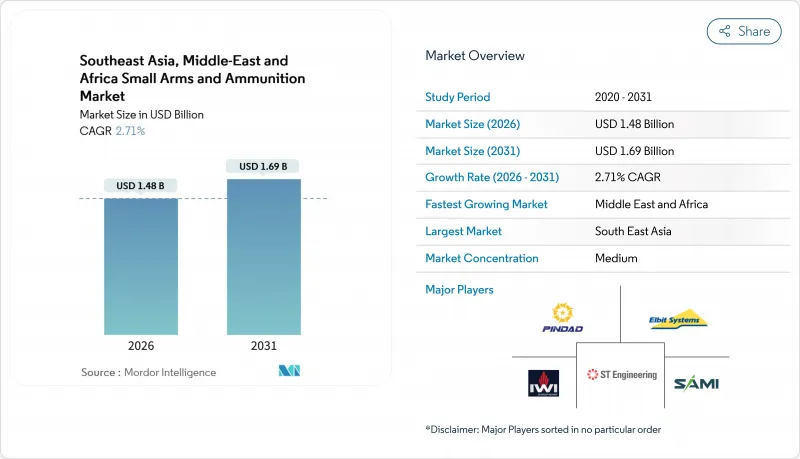
Mordor Intelligence에 의하면, 동남아시아, 중동 및 아프리카의 소형 무기 및 탄약 시장은 2026년에 14억 8,000만 달러 규모로 추정되고, 2031년까지 16억 9,000만 달러에 이를 전망이며, CAGR은 2.71%를 나타낼 것으로 예측되고 있습니다.
본 보고서는 구경별(5.56mm, 6.8mm, 7.62mm, 9mm, 12.7mm, 기타), 무기 플랫폼별(권총, 소총,경기관총, 기관단총, 산탄총), 최종 사용자별(민간, 법 집행 기관, 군), 지역별(동남아시아, 중동 및 아프리카)로 분류되어 있습니다. 시장 전망은 금액(달러) 기준으로 제시되어 있습니다.
동남아시아, 중동 및 아프리카의 소형 무기 및 탄약 시장 동향과 인사이트
대테러 및 국내 치안을 위한 조달 증가
무장 집단의 폭력 및 국경을 넘는 범죄로 인해 동남아시아, 중동 및 아프리카의 소형 무기 및 탄약 시장에서의 조달이 계속해서 가속화되고 있습니다. 필리핀 국가경찰은 아부 사야프의 공격에 대응하기 위해 2024년에 권총 및 카빈총 계약을 2,150만 달러에 체결했으며, 인도네시아 브리모브(기동대)는 파푸아 주의 분리주의자들에 대응하기 위해 2025년에 소총 비축량을 15% 확대했습니다. 사우디아라비아 내무부는 예멘에서 발생한 드론 침입 사태에 대응하여 2025년에 1만 2,000정 이상의 돌격소총을 구매했습니다. 케냐도 이에 발맞추어 국경 경비용으로 8,500정의 소총을 도입했습니다. 이는 소음기나 모듈러 레일을 장착한, 소형이며 신속하게 전개 가능한 무기로의 전환이 두드러지고 있음을 보여줍니다. 이러한 조달 동향은 해당 지역에서 국내 치안 강화와 대테러 능력 향상에 대한 중시가 높아지고 있음을 여실히 드러내고 있습니다.
동남아시아(SEA) 및 GCC 국가들의 군사 현대화 프로그램
GCC 국가 및 아세안(ASEAN) 회원국의 국방 백서에서는 유효 사거리를 연장하는 고성능 광학 장비, 소음기, 모듈식 구경에 대한 지출이 중점적으로 다루어지고 있습니다. UAE는 2024년, 사거리를 30% 연장하는 6.8mm 시스템 도입에 4억 5,000만 달러를 배정했는데, 이는 미 육군의 차세대 분대 무기(NGSW) 구상과 일치합니다. 싱가포르는 2025년에 ST Engineering에 1만 8,000정의 소총을 발주했으며, 말레이시아는 2028년까지 공동 생산될 무기에 1억 8,000만 달러를 배정하고, 기술 이전 조항을 포함한 공급업체를 우대하고 있습니다. 이러한 현대화 노력은 군사 능력 강화를 목적으로 한 첨단 무기 및 공동 생산 협정으로의 전략적 전환을 반영하고 있습니다.
엄격한 수입 허가 및 최종 사용자 인증
유엔의 틀에서는 수입업체에게 최종 사용자 확인이 의무화되어 있으며, 이로 인해 동남아시아, 중동 및 아프리카의 소형 무기 및 탄약 시장에서 조달 주기가 최대 9개월까지 연장되고 있습니다. 싱가포르의 무기 및 폭발물법에 따라 2025년에는 3건의 탄약 계약이 지연되었으며, ISACS의 마킹 규정은 규정 준수 팀에 자금을 할당할 수 없는 소규모 공장에 부담을 주고 있습니다. 기존 기업들은 이러한 비용을 흡수하고 있지만, 기회주의적인 공급업체들은 시장에서 철수하고 있으며, 그 결과 가격 경쟁에 따른 압박이 약화되고 있습니다. 규제 환경은 점점 더 엄격해지고 있으며, 이는 지역 전체의 조달 프로세스 속도와 비용에 영향을 미치고 있습니다.
부문 분석
7.62mm 탄약 부문은 구형 AK 소총의 재고에 힘입어 2025년 매출의 35.45%를 차지했습니다. 그러나 자금은 점점 더 서유럽 표준을 준수하는 구경으로 전환되고 있습니다. 예를 들어, 인도네시아는 2024년에 7.62×39 mm 탄약 4,200만 발을 발주했으나, 2025-2029년 소형 무기 예산 중 이 구경에 할당된 비중은 고작 18%에 그쳤습니다. 대조적으로, 6.8 mm 탄약은 600미터 거리에서 치사율이 20% 더 높다는 것이 미국의 전투 시험을 통해 입증됨에 따라, 동남아시아, 중동 및 아프리카의 소형 무기·탄약 시장에서 가장 높은 연평균 성장률(CAGR) 4.16%를 기록하며 성장할 것으로 예측됩니다. 5.56mm 탄약은 여전히 필수적이며, 2025년에 말레이시아가 2,800만 발을 발주한 사실에서도 알 수 있듯이, 9mm 탄약의 비축량은 경찰 권총의 교체에 따라 증가하고 있습니다.338 라푸아 매그넘과 같은 틈새 구경은 특수 작전 부대에서 선호되지만, 총 매출에 기여하는 비중은 미미합니다.
최종 사용자가 하위 호환성과 뛰어난 탄도 성능을 모두 요구하는 가운데, 구경의 다양화가 시장에 긍정적인 영향을 미치고 있습니다. 각 공급업체는 총신을 교체하는 것만으로 5.56mm, 6.8mm, 7.62mm 탄약을 사용할 수 있는 모듈식 소총을 제공하고 있으며, 이를 통해 수명 주기 비용 절감과 물류 간소화를 도모하고 있습니다. 또한, 폴리머 탄피 기술의 발전으로 30-40%의 경량화가 예상되어, 병사들은 적재 제한을 초과하지 않으면서도 더 많은 탄약을 휴대할 수 있게 될 것입니다.
기타 혜택 :
- 엑셀 형식 시장 예측(ME) 시트
- 3개월간의 애널리스트 지원
자주 묻는 질문
목차
제1장 서론
제2장 조사 방법
제3장 주요 요약
제4장 시장 구도
제5장 시장 규모 및 성장 예측
제6장 경쟁 구도
제7장 시장 기회 및 향후 전망
AJY 26.09.15According to Mordor Intelligence, the small arms and ammunition market in Southeast Asia, the Middle East, and Africa was valued at USD 1.48 billion in 2026 and is expected to reach USD 1.69 billion by 2031, registering a CAGR of 2.71%.
This report is Segmented by Caliber (5. 56 Mm, 6. 8 Mm, 7. 62 Mm, 9 Mm, 12. 7 Mm, and Other Calibers), Weapon Platform (Handguns, Rifles, Light Machine Guns, Sub-Machine Guns, Shotguns), End User (Civil, Law Enforcement, Military), and Geography (Southeast Asia, Middle East, Africa). The Market Forecasts are Provided in Terms of Value (USD).
Southeast Asia, Middle-East And Africa Small Arms And Ammunition Market Trends and Insights
Counter-terrorism and internal-security procurement surge
Armed-group violence and cross-border crime continue to accelerate procurements across Southeast Asia, the Middle East, and Africa's small arms and ammunition market. The Philippine National Police signed USD 21.5 million in 2024 contracts for pistols and carbines to counter Abu Sayyaf attacks, and Indonesia's Brimob expanded rifle stocks by 15 percent in 2025 to confront separatists in Papua. Saudi Arabia's Ministry of Interior purchased more than 12,000 assault rifles in 2025 after drone incursions from Yemen. Kenya followed suit with 8,500 rifles for border patrols, highlighting the pivot toward compact, quick-deploy weapons fitted with suppressors and modular rails. These procurements underline the growing emphasis on enhancing internal security and counter-terrorism capabilities in the region.
Military modernisation programmes across SEA and GCC
Defense white papers across GCC states and ASEAN members channel spending toward bright optics, suppressors, and modular calibers that extend effective range. The UAE allocated USD 450 million in 2024 to adopt 6.8 millimeter systems, which deliver 30 percent longer reach, echoing the US Army's Next Generation Squad Weapon logic. Singapore placed an order for 18,000 rifles with ST Engineering in 2025, and Malaysia earmarked USD 180 million for co-produced ordnance by 2028, rewarding vendors that embed technology-transfer clauses. These modernization efforts reflect a strategic shift toward advanced weaponry and collaborative production agreements aimed at strengthening military capabilities.
Stringent import licensing and end-user certification
United Nations frameworks require importers to verify end-users, extending procurement cycles in the Southeast Asia, Middle East, and Africa small arms and ammunition market by up to nine months. Singapore's Arms and Explosives Act delayed three ammunition contracts in 2025, and ISACS marking rules strain smaller factories that cannot fund compliance teams. While incumbents absorb these costs, opportunistic suppliers withdraw, reducing competitive price pressure. The regulatory environment is becoming increasingly stringent, impacting the pace and cost of procurement processes across the region.
Other drivers and restraints analyzed in the detailed report include:
- Rising civilian gun ownership and shooting-sports demand
- Offset and localisation policies boosting in-region production
- Oil-price-linked budget volatility in MEA states
For complete list of drivers and restraints, kindly check the Table Of Contents.
Segment Analysis
The 7.62 millimeter segment accounted for 35.45% of 2025 sales, driven by legacy AK inventories. However, funding is increasingly directed toward calibers compatible with Western standards. For instance, Indonesia ordered 42 million 7.62X39 millimeter rounds in 2024 but allocated only 18% of its 2025-2029 small-arms budget to this caliber. In contrast, 6.8 millimeter ammunition is expected to grow at a 4.16% CAGR, the highest in the Southeast Asia, Middle East, and Africa small arms and ammunition market, following US combat tests that demonstrated 20% greater lethality at 600 meters. The 5.56 millimeter caliber remains essential, as evidenced by Malaysia's order of 28 million rounds in 2025, while 9 millimeter stockpiles expand in tandem with police sidearm upgrades. Niche calibers like .338 Lapua Magnum attract special-operations units but contribute minimally to overall revenue.
The market benefits from caliber diversification as end users seek both backward compatibility and advanced ballistics. Suppliers are offering modular rifles that can accommodate 5.56mm, 6.8mm, and 7.62mm rounds by swapping barrels, thereby reducing lifecycle costs and simplifying logistics. Additionally, advancements in polymer-cased technology promise 30-40% weight reductions, enabling soldiers to carry more ammunition without exceeding load limits.
Complete Report Scope:
- By Caliber
- 5.56 mm
- 6.8 mm
- 7.62 mm
- 9 mm
- 12.7 mm
- Other Calibers
- By Weapon Platform
- Handguns
- Rifles
- Light Machine Guns (LMGs)
- Sub-Machine Guns (SMGs)
- Shotguns
- By End User
- Civil
- Law Enforcement
- Military
- By Geography
- Southeast Asia
- Indonesia
- Malaysia
- Philippines
- Singapore
- Rest of Southeast Asia
- Middle East and Africa
- Middle East
- United Arab Emirates
- Saudi Arabia
- Rest of Middle East
- Africa
- South Africa
- Rest of Africa
- Middle East
- Southeast Asia
List of Companies Covered in this Report:
- PT Pindad
- Singapore Technologies Engineering Ltd.
- SMEOrdnance Sdn. Bhd.
- Israel Weapon Industries (IWI) Ltd.
- Saudi Arabian Military Industries (SAMI)
- Oman Munition Production Company (OMPC)
- Elbit Systems Ltd.
- Jordan Ammunition Manufacturing Services (Jorammo)
- Kenya Ordnance Factories Corporation (KOFC)
- Defence Industries Corporation of Nigeria (DICON)
- Kalashnikov Concern JSC
- CBC Global Ammunition
- SIG SAUER, Inc.
- Rheinmetall AG
- Heckler & Koch GmbH
- Denel SOC Ltd.
- FN HERSTAL
Additional Benefits:
- The market estimate (ME) sheet in Excel format
- 3 months of analyst support
TABLE OF CONTENTS
1 INTRODUCTION
- 1.1 Study Assumptions and Market Definition
- 1.2 Scope of the Study
2 RESEARCH METHODOLOGY
3 EXECUTIVE SUMMARY
4 MARKET LANDSCAPE
- 4.1 Market Overview
- 4.2 Market Drivers
- 4.2.1 Counter-terrorism and internal-security procurement surge
- 4.2.2 Military modernisation programmes across SEA and GCC
- 4.2.3 Rising civilian gun ownership and shooting sports demand
- 4.2.4 Offset and localisation policies boosting in-region production
- 4.2.5 Growth of private security firms safeguarding energy assets
- 4.2.6 E-commerce enabled grey-market ammunition sales
- 4.3 Market Restraints
- 4.3.1 Stringent import licensing and end-user certification
- 4.3.2 Oil-price-linked budget volatility in MEA states
- 4.3.3 Illicit trafficking concerns prompting tighter traceability
- 4.3.4 Shift to non-lethal directed-energy crowd-control options
- 4.4 Value Chain Analysis
- 4.5 Regulatory Landscape
- 4.6 Technological Outlook
- 4.7 Porter's Five Forces Analysis
- 4.7.1 Bargaining Power of Buyers
- 4.7.2 Bargaining Power of Suppliers
- 4.7.3 Threat of New Entrants
- 4.7.4 Threat of Substitutes
- 4.7.5 Competitive Rivalry
5 MARKET SIZE AND GROWTH FORECASTS (VALUE)
- 5.1 By Caliber
- 5.1.1 5.56 mm
- 5.1.2 6.8 mm
- 5.1.3 7.62 mm
- 5.1.4 9 mm
- 5.1.5 12.7 mm
- 5.1.6 Other Calibers
- 5.2 By Weapon Platform
- 5.2.1 Handguns
- 5.2.2 Rifles
- 5.2.3 Light Machine Guns (LMGs)
- 5.2.4 Sub-Machine Guns (SMGs)
- 5.2.5 Shotguns
- 5.3 By End User
- 5.3.1 Civil
- 5.3.2 Law Enforcement
- 5.3.3 Military
- 5.4 By Geography
- 5.4.1 Southeast Asia
- 5.4.1.1 Indonesia
- 5.4.1.2 Malaysia
- 5.4.1.3 Philippines
- 5.4.1.4 Singapore
- 5.4.1.5 Rest of Southeast Asia
- 5.4.2 Middle East and Africa
- 5.4.2.1 Middle East
- 5.4.2.1.1 United Arab Emirates
- 5.4.2.1.2 Saudi Arabia
- 5.4.2.1.3 Rest of Middle East
- 5.4.2.2 Africa
- 5.4.2.2.1 South Africa
- 5.4.2.2.2 Rest of Africa
- 5.4.2.1 Middle East
- 5.4.1 Southeast Asia
6 COMPETITIVE LANDSCAPE
- 6.1 Market Concentration
- 6.2 Strategic Moves
- 6.3 Market Share Analysis
- 6.4 Company Profiles (includes Global level Overview, Market level overview, Core Segments, Financials as available, Strategic Information, Market Rank/Share for key companies, Products and Services, and Recent Developments)
- 6.4.1 PT Pindad
- 6.4.2 Singapore Technologies Engineering Ltd.
- 6.4.3 SMEOrdnance Sdn. Bhd.
- 6.4.4 Israel Weapon Industries (IWI) Ltd.
- 6.4.5 Saudi Arabian Military Industries (SAMI)
- 6.4.6 Oman Munition Production Company (OMPC)
- 6.4.7 Elbit Systems Ltd.
- 6.4.8 Jordan Ammunition Manufacturing Services (Jorammo)
- 6.4.9 Kenya Ordnance Factories Corporation (KOFC)
- 6.4.10 Defence Industries Corporation of Nigeria (DICON)
- 6.4.11 Kalashnikov Concern JSC
- 6.4.12 CBC Global Ammunition
- 6.4.13 SIG SAUER, Inc.
- 6.4.14 Rheinmetall AG
- 6.4.15 Heckler & Koch GmbH
- 6.4.16 Denel SOC Ltd.
- 6.4.17 FN HERSTAL
7 MARKET OPPORTUNITIES AND FUTURE OUTLOOK
- 7.1 White-space and Unmet-Need Assessment


