

|
시장보고서
상품코드
2124745
마이크로니들 약물 전달 시스템 : 시장 점유율 분석, 업계 동향과 통계, 성장 예측(2026-2031년)Microneedle Drug Delivery Systems - Market Share Analysis, Industry Trends & Statistics, Growth Forecasts (2026 - 2031) |
||||||
 Mordor Intelligence
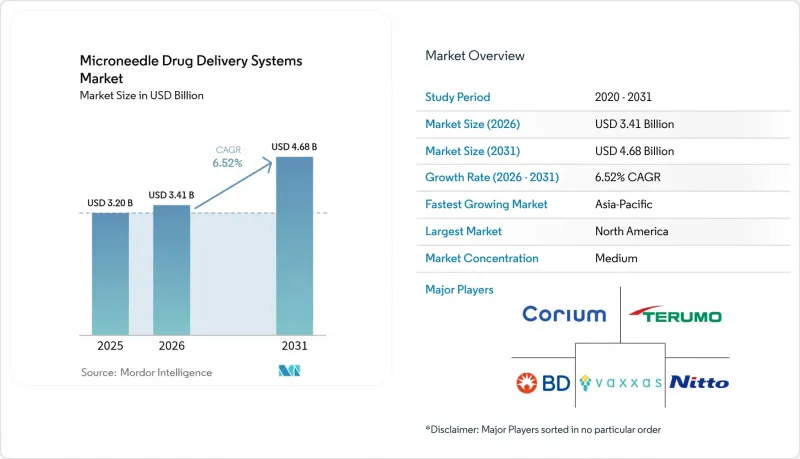
Mordor Intelligence에 의하면, 마이크로니들 약물 전달 시스템 시장 규모는 2025년 32억 달러, 2026년 34억 1,000만 달러에서 2031년까지 46억 8,000만 달러에 이르고, 2026-2031년 연평균 복합 성장률(CAGR)은 6.52%를 기록할 전망입니다.
본 보고서는 기기 유형(중실형, 중공형, 코팅형 등), 소재(실리콘, 금속, 폴리머 등), 용도(백신 접종, 인슐린 투여·당뇨병 관리 등), 최종 사용자(병원 및 진료소, 제약·바이오기술 기업 등), 지역(북미, 유럽 등)별로 분류되어 있습니다. 시장 전망은 금액(달러) 기준으로 제시되어 있습니다.
전 세계 마이크로니들 약물 전달 시스템 시장 동향 및 인사이트
통증 없는 자가 투여가 필요한 만성 질환 유병률 증가
2025년에는 5억 3,700만 명의 성인이 당뇨병을 앓고 있으며, 2030년까지 6억 4,300만 명에 달할 것으로 예측되지만, 여전히 주사바늘에 대한 공포가 인슐린 주사의 복약 순응도를 저하시키고 있습니다. 마이크로니들 패치는 눈에 보이는 바늘을 제거하고 주 단위 치료 계획에 따라 기본 용량을 투여함으로써, 실제 임상 연구에서 ‘목표 범위 내 체류 시간’ 성과를 23% 향상시켰습니다. 현재 종양학 임상시험에서는 종양 내 체크포인트 억제제 투여에 용해형 어레이가 활용되고 있으며, 전신 독성을 최소화하면서 정맥 내 투여에 비해 40배 높은 약물 농도를 달성하고 있습니다. 미국과 독일에서 인슐린 패치의 보험 급여가 기존 주사와 동등해짐에 따라, 오랫동안 존재해 온 상업적 장벽이 제거되었습니다. 이러한 요인들이 결합되어 마이크로니들 패치는 만성 질환 치료 경로에서 단순한 편의성을 제공하는 선택지에서 임상적으로 필수적인 도구로 그 위상을 높이고 있습니다.
기존 주사에 비해 갖는 장점: 환자의 치료 순응도 향상
바늘에 대한 공포증은 성인의 최대 30%, 소아의 63%에서 나타나며, 이는 백신 접종률을 직접적으로 제한하고 있습니다. 마이크로니들은 진피 조직에 불과 50-900µm만 침투하기 때문에 신경이 밀집된 층을 피하여 통증을 사실상 없앱니다. 2024년 무작위 대조 시험에서는 참가자의 89%가 근육 주사보다 독감 패치를 선호하는 것으로 나타났으며, 소아의 수용률은 91%까지 상승했습니다. Gavi의 2025-2030년 전략에서는 예방접종 격차를 해소하기 위해 마이크로니들로 재제형화가 검토되는 11유형의 백신이 제시되어 있습니다. 인도 농촌 지역의 지역 보건 종사자 프로그램에서는 자가 부착형 패치를 사용함으로써 홍역·풍진 백신 접종률이 78%에서 97%로 향상되었습니다. 이러한 연구 결과는 통증 없는 투여가 인구 수준에서 준수율 향상으로 직결된다는 사실을 뒷받침합니다.
패치 1장당 약물 적재 용량의 한계
일반적인 용해형 어레이는 1cm²당 0.5-2mg의 유효 성분을 함유하지만, 이는 단일클론 항체에 필요한 50-200mg보다 훨씬 적은 양입니다. 100 mg의 용량을 투여하려면 50 cm²의 패치가 필요하며, 이는 환자에게 현실적이지 않습니다. 중공 구조로 설계하면 액체를 투여할 수 있지만, 날카로운 폐기물 처리 및 콜드체인 부담이 다시 발생합니다. 2025년 개념 증명 실험에서는 시클로덱스트린을 이용한 착체화를 통해 인슐린 적재량이 어레이당 4.8 mg으로 4배 증가했으나, 실용화까지는 아직 수년이 소요될 것으로 예측됩니다. 이러한 획기적인 기술이 성숙하기 전까지는 마이크로니들 약물 전달 시스템 시장에서 고용량 생물학적 제제 분야는 오토인젝터에 자리를 내주게 될 것입니다.
부문 분석
용해형 마이크로니들은 연평균 9.85%의 성장률이 예상되며, 마이크로니들 약물 전달 시스템 시장 전체보다 3.3포인트 높은 성장세를 보이며, 과거 중공형이 차지했던 2025년 매출 점유율 34.55%를 잠식해 나갈 것으로 예측됩니다. 날카로운 폐기물이 발생하지 않는 처리 방식과 상온에서의 안정성은 재택 간호 이용자 및 백신 기관의 공감을 얻고 있습니다. 하이드로겔 형성 어레이는 장시간 작용형 호르몬제의 임상시험 단계에 접어들었으나, 반면 코팅형 및 고체형 제품은 아시아의 수탁 제조업체들 간의 가격 경쟁으로 인해 상품화되는 경향을 보이고 있습니다.
중공 마이크로니들은 여전히 실시간 인슐린 양 조절에 필수적이지만, OSHA(미국 직업안전보건청)가 무바늘 옵션 검토를 의무화함에 따라 장기적인 전망에 불확실성이 제기되고 있습니다. 적층 조형 기술로 설계의 폭이 넓어졌으며, 지지대 가이드식 어레이는 투여량의 균일성 95%를 달성하여 고정밀 형상 설계로의 전환을 시사하고 있습니다. 시장을 선도하는 기업들은 현재 포트폴리오를 양분하고 있습니다. 만성 질환 치료용으로는 프리미엄 용해형 포맷을, 급성기 의료용으로는 비용이 최적화된 중공 키트를 제공합니다.
2025년에는 마이크로니들 약물 전달 시스템 시장 규모의 45.53%를 폴리머가 차지했지만, 2031년까지는 실리콘이 9.75%라는 가장 높은 CAGR을 나타낼 전망입니다. DRIE(심도 반응성 이온 에칭) 처리된 실리콘은 종횡비 10:1 이상, 삽입 성공률 98%를 달성하고 있습니다.
폴리머 어레이는 비용 면에서의 우위(단위당 0.08-0.15달러인 반면, 실리콘은 0.40-0.70달러)로 과반수의 점유율을 유지하고 있으며, 그 GRAS(일반적으로 안전하다고 인정됨) 지위 덕분에 백신 승인이 가속화되고 있습니다. 안전성 측면에서 용해성 폴리머가 금속을 대체함에 따라 금속 어레이 시장 점유율은 축소되고 있습니다. 생분해성 당류를 활용한 탄수화물 바늘은 소아용 백신 분야에서 보급이 확대되고 있습니다. 또한, 실리콘의 광학적 투명성 덕분에 머신 비전 검사를 통한 로트 불량률이 절반으로 감소하여, 고부가가치 생물학적 제제의 품질 향상 노력과 부합하고 있습니다.
지역별 분석
북미는 확립된 510(k) 신청 절차와 1,800만 달러 규모의 미국 국방부(DoD) 계약을 바탕으로, 2025년에도 마이크로니들 약물 전달 시스템 시장 점유율 42.55%를 유지했습니다. 2025년에 발표된 FDA 지침에 따라 백신 패치의 승인 절차는 더욱 효율화되었습니다. 캐나다는 신속한 허가 절차를 활용하여 2상 임상시험을 진행하고 있는 반면, 멕시코의 미성숙한 시장은 공공 조달 규모가 제한적이어서 성장이 저해되고 있습니다. 지역별로는 당뇨병 및 피부과 분야가 견실한 보험 환급과 환자의 높은 본인 부담 수용도로 인해 도입을 주도하고 있습니다.
아시아태평양은 중국의 저비용 롤-투-롤(roll-to-roll) 생산, 미용 기기 승인을 가속화하는 일본의 법 개정, 그리고 한국의 K-뷰티 수출에 힘입어 9.72%라는 지역 내 가장 높은 연평균 성장률(CAGR)을 나타낼 전망입니다. 인도는 외딴 지역을 대상으로 콜드체인이 필요 없는 백신에 공공 자금을 투입하고 있습니다. 호주와 한국은 당뇨병 및 암 치료용 프리미엄 패치를 목표로 하고 있습니다. 각국의 우선순위가 다르기 때문에 성장 동력은 다양하지만, 그 근저에는 ‘비용 효율적인 제조’와 ‘높아지는 소비자 기대’라는 공통된 주제가 있습니다.
유럽에서는 환급 제도가 분열되어 있어 성장 속도가 완만합니다. 독일의 공적 보험 기관은 2025년부터 용해형 인슐린 패치의 급여를 시작했으나, 프랑스와 스페인에서는 현지 비용 대비 효과에 관한 연구 결과를 기다리고 있는 상황입니다. 영국의 NICE는 인플루엔자용 패치를 승인했으나, NHS의 도입은 예산 주기에 뒤처지고 있습니다. GCC 국가들은 고급 마이크로니들 제품을 채택하고 있는 반면, 남아프리카공화국은 지방 진료소에서 홍역·풍진용 패치의 시범 도입을 진행하고 있습니다. 브라질은 2024년 ANVISA가 인슐린 패치를 승인함에 따라 남미를 선도하고 있습니다. 각 지역에서 의료기기 및 의약품 규제가 통일되지 않아 단계적인 출시를 피할 수 없게 되었고, 시장 출시 속도가 둔화되고 있습니다.
기타 혜택:
- 엑셀 형식 시장 예측(ME) 시트
- 3개월간의 애널리스트 지원
자주 묻는 질문
목차
제1장 서론
제2장 조사 방법
제3장 주요 요약
제4장 시장 구도
제5장 시장 규모와 성장 예측
제6장 경쟁 구도
제7장 시장 기회와 향후 전망
LSH 26.09.14According to Mordor Intelligence, the microneedle drug delivery systems market size is projected to expand from USD 3.20 billion in 2025 and USD 3.41 billion in 2026 to USD 4.68 billion by 2031, registering a CAGR of 6.52% between 2026 to 2031.
This report is Segmented by Device Type (Solid, Hollow, Coated, and More), Material (Silicon, Metals, Polymers, and More), Application (Vaccination, Insulin Delivery & Diabetes Management, and More), End-User (Hospitals & Clinics, Pharmaceutical & Biotech Companies, and More), and Geography (North America, Europe, and More). The Market Forecasts are Provided in Terms of Value (USD).
Global Microneedle Drug Delivery Systems Market Trends and Insights
Rising Prevalence of Chronic Diseases Requiring Painless Self-Administration
Diabetes affected 537 million adults in 2025 and is projected to reach 643 million by 2030, yet needle phobia continues to suppress adherence to injectable insulin. Microneedle patches remove visible needles and deliver basal doses aligned with weekly regimens, improving time-in-range outcomes by 23% in real-world studies. Oncology trials now exploit dissolving arrays for intratumoral checkpoint inhibitors, achieving drug concentrations 40-fold higher than intravenous delivery with minimal systemic toxicity. Reimbursement parity for insulin patches in the United States and Germany removes a historic commercial obstacle. Collectively, these factors elevate microneedle patches from optional convenience to clinically mandated tools in chronic-disease pathways.
Advantages Over Conventional Injections Improving Patient Compliance
Needle phobia afflicts up to 30% of adults and 63% of children, directly limiting vaccine coverage. Microneedles penetrate only 50-900 µm into dermal tissue, avoiding nerve-rich layers and virtually eliminating pain. A 2024 randomized trial showed 89% of participants preferred the influenza patch over intramuscular injection, with pediatric acceptance rising to 91%. Gavi's 2025-2030 strategy lists 11 vaccines for microneedle reformulation to close immunization gaps. Community health-worker programs in rural India raised measles-rubella coverage from 78% to 97% using self-applicable patches. These findings confirm that painless delivery directly translates into higher population-level adherence.
Limited Drug-Loading Capacity Per Patch
Typical dissolving arrays hold 0.5-2 mg of active drug per cm2, far below the 50-200 mg required for monoclonal antibodies. Delivering a 100 mg dose would demand a 50 cm2 patch, an impractical footprint for patients. Hollow designs can deliver liquids but reintroduce sharps disposal and cold-chain burdens. Cyclodextrin complexation quadrupled insulin payloads to 4.8 mg per array in a 2025 proof-of-concept, yet scale-up remains years away. Until such breakthroughs mature, the microneedle drug-delivery systems market will cede high-dose biologics to autoinjectors.
Other drivers and restraints analyzed in the detailed report include:
- Growing Vaccination Initiatives Adopting Patch-Based Delivery
- Technological Advances in Dissolving / Biodegradable Microneedles
- Stringent and Fragmented Regulatory Pathways
For complete list of drivers and restraints, kindly check the Table Of Contents.
Segment Analysis
Dissolving microneedles are forecast to grow 9.85% annually, outpacing the microneedle drug delivery systems market by 3.3 percentage points and eroding the 34.55% 2025 revenue share once held by hollow designs. Sharps-free disposal and ambient stability resonate with home-care users and vaccine agencies. Hydrogel-forming arrays enter pivotal trials for long-acting hormones, while coated and solid variants slip toward commoditization as Asian contract manufacturers undercut prices.
Hollow microneedles remain essential for real-time insulin titration, yet OSHA's mandate to review needle-free options clouds their long-term outlook. Additive manufacturing widens design space; pillar-guided arrays hit 95% dose uniformity, signaling a shift toward high-precision geometries. Market leaders now split portfolios: premium dissolving formats for chronic therapies and cost-optimized hollow kits for acute care.
Polymers commanded 45.53% of the microneedle drug-delivery systems market size in 2025, yet silicon is poised for the fastest 9.75% CAGR through 2031. Deep-reactive-ion-etched silicon reaches aspect ratios above 10:1 and insertion success of 98%.
Polymer arrays keep majority share through cost advantages-USD 0.08-0.15 per unit versus USD 0.40-0.70 for silicon-and their GRAS status speeds vaccine approvals. Metals retreat as dissolving polymers displace them for safety. Carbohydrate needles grow in pediatric vaccines, leveraging biodegradable sugars. Silicon's optical transparency also halves batch-rejection rates via machine-vision inspection, aligning with quality initiatives in high-value biologics.
Complete Report Scope:
- By Device Type
- Solid Microneedles
- Hollow Microneedles
- Coated Microneedles
- Dissolving Microneedles
- Hydrogel-Forming Microneedles
- By Material
- Silicon
- Metals (Stainless Steel, Titanium)
- Polymers (PVP, PLA, PLGA, etc.)
- Carbohydrates & Sugars
- Other Material (Ceramics & Composites)
- By Application
- Vaccination
- Insulin Delivery & Diabetes Management
- Pain Management / Local Anesthesia
- Dermatology & Cosmetics
- Oncology & Immuno-Oncology
- Other Applications
- By End-user
- Hospitals & Clinics
- Pharmaceutical & Biotech Companies
- Academic & Research Institutes
- Homecare & Self-Administration Settings
- By Geography
- North America
- United States
- Canada
- Mexico
- Europe
- Germany
- United Kingdom
- France
- Italy
- Spain
- Rest of Europe
- Asia-Pacific
- China
- India
- Japan
- Australia
- South Korea
- Rest of Asia-Pacific
- Middle East and Africa
- GCC
- South Africa
- Rest of Middle East and Africa
- South America
- Brazil
- Argentina
- Rest of South America
- North America
Geography Analysis
North America retained 42.55% microneedle drug-delivery systems market share in 2025 on the strength of an established 510(k) route and USD 18 million in DoD contracts. FDA guidance issued in 2025 further streamlined vaccine-patch approvals. Canada leverages its agile licensing pathway to host Phase II studies, and Mexico's fledgling market is held back by limited public procurement. Regionally, diabetes and dermatology lead uptake thanks to robust reimbursement and high out-of-pocket willingness.
Asia-Pacific is forecast to grow at 9.72%, the fastest regional CAGR, fueled by China's low-cost roll-to-roll output, Japan's revised legislation that accelerates cosmetic-device approvals, and South Korea's K-beauty exports. India channels public funds toward cold-chain-free vaccines for remote districts. Australia and South Korea target premium diabetes and oncology patches. Diverse national priorities produce a mosaic of growth levers yet converge on a single theme: cost-efficient manufacturing married to rising consumer expectations.
Europe grows more slowly due to fragmented reimbursement. Germany's statutory insurer began covering dissolving insulin patches in 2025, but France and Spain await local cost-effectiveness studies. The UK's NICE endorsed influenza patches but NHS rollout lags budget cycles. GCC nations adopt premium microneedle products, while South Africa pilots measles-rubella patches in rural clinics. Brazil leads South America after ANVISA cleared an insulin patch in 2024. Across territories, absence of harmonized device-drug rules forces stepwise launches, diluting speed to market.
- Beckton Dickinson
- Corium International, Inc.
- CosMED Pharmaceutical Co., Ltd.
- Debiotech SA
- Gerresheimer
- Kimoola Co., Ltd.
- Kindeva Drug Delivery
- Lohmann Therapie-Systeme AG
- Microdermics Inc.
- Micron Biomedical Inc.
- Nanopass Technologies Ltd.
- Nitto Denko
- QuadMedicine Inc.
- Raphas Co., Ltd.
- SNvia Co., Ltd.
- Solventum Corporation
- Terumo
- Vaxxas Pty Ltd.
Additional Benefits:
- The market estimate (ME) sheet in Excel format
- 3 months of analyst support
TABLE OF CONTENTS
1 Introduction
- 1.1 Study Assumptions & Market Definition
- 1.2 Scope of the Study
2 Research Methodology
3 Executive Summary
4 Market Landscape
- 4.1 Market Overview
- 4.2 Market Drivers
- 4.2.1 Rising prevalence of chronic diseases requiring painless self-administration
- 4.2.2 Advantages over conventional injections improving patient compliance
- 4.2.3 Growing vaccination initiatives adopting patch-based delivery
- 4.2.4 Technological advances in dissolving / biodegradable microneedles
- 4.2.5 Regulatory incentives to curb needle-stick injuries & hazardous sharps waste
- 4.2.6 Defense & space-medicine demand for ultra-compact, shelf-stable delivery
- 4.3 Market Restraints
- 4.3.1 Limited drug-loading capacity per patch
- 4.3.2 Stringent & fragmented regulatory pathways
- 4.3.3 Skin-microbiome variability impacting dose reproducibility
- 4.3.4 Scarcity of GMP roll-to-roll fabrication equipment inflating CAPEX
- 4.4 Supply-Chain Analysis
- 4.5 Regulatory Landscape
- 4.6 Technological Outlook
- 4.7 Porter's Five Forces
- 4.7.1 Threat of New Entrants
- 4.7.2 Bargaining Power of Suppliers
- 4.7.3 Bargaining Power of Buyers
- 4.7.4 Threat of Substitutes
- 4.7.5 Competitive Rivalry
5 Market Size & Growth Forecasts (Value, USD)
- 5.1 By Device Type
- 5.1.1 Solid Microneedles
- 5.1.2 Hollow Microneedles
- 5.1.3 Coated Microneedles
- 5.1.4 Dissolving Microneedles
- 5.1.5 Hydrogel-Forming Microneedles
- 5.2 By Material
- 5.2.1 Silicon
- 5.2.2 Metals (Stainless Steel, Titanium)
- 5.2.3 Polymers (PVP, PLA, PLGA, etc.)
- 5.2.4 Carbohydrates & Sugars
- 5.2.5 Other Material (Ceramics & Composites)
- 5.3 By Application
- 5.3.1 Vaccination
- 5.3.2 Insulin Delivery & Diabetes Management
- 5.3.3 Pain Management / Local Anesthesia
- 5.3.4 Dermatology & Cosmetics
- 5.3.5 Oncology & Immuno-Oncology
- 5.3.6 Other Applications
- 5.4 By End-user
- 5.4.1 Hospitals & Clinics
- 5.4.2 Pharmaceutical & Biotech Companies
- 5.4.3 Academic & Research Institutes
- 5.4.4 Homecare & Self-Administration Settings
- 5.5 By Geography
- 5.5.1 North America
- 5.5.1.1 United States
- 5.5.1.2 Canada
- 5.5.1.3 Mexico
- 5.5.2 Europe
- 5.5.2.1 Germany
- 5.5.2.2 United Kingdom
- 5.5.2.3 France
- 5.5.2.4 Italy
- 5.5.2.5 Spain
- 5.5.2.6 Rest of Europe
- 5.5.3 Asia-Pacific
- 5.5.3.1 China
- 5.5.3.2 India
- 5.5.3.3 Japan
- 5.5.3.4 Australia
- 5.5.3.5 South Korea
- 5.5.3.6 Rest of Asia-Pacific
- 5.5.4 Middle East and Africa
- 5.5.4.1 GCC
- 5.5.4.2 South Africa
- 5.5.4.3 Rest of Middle East and Africa
- 5.5.5 South America
- 5.5.5.1 Brazil
- 5.5.5.2 Argentina
- 5.5.5.3 Rest of South America
- 5.5.1 North America
6 Competitive Landscape
- 6.1 Market Concentration
- 6.2 Market Share Analysis
- 6.3 Company Profiles (includes Global level Overview, Market level overview, Core Segments, Financials as available, Strategic Information, Market Rank/Share for key companies, Products & Services, and Recent Developments)
- 6.3.1 Becton, Dickinson and Company
- 6.3.2 Corium International, Inc.
- 6.3.3 CosMED Pharmaceutical Co., Ltd.
- 6.3.4 Debiotech SA
- 6.3.5 Gerresheimer AG
- 6.3.6 Kimoola Co., Ltd.
- 6.3.7 Kindeva Drug Delivery
- 6.3.8 Lohmann Therapie-Systeme AG
- 6.3.9 Microdermics Inc.
- 6.3.10 Micron Biomedical Inc.
- 6.3.11 Nanopass Technologies Ltd.
- 6.3.12 Nitto Denko Corporation
- 6.3.13 QuadMedicine Inc.
- 6.3.14 Raphas Co., Ltd.
- 6.3.15 SNvia Co., Ltd.
- 6.3.16 Solventum Corporation
- 6.3.17 Terumo Corporation
- 6.3.18 Vaxxas Pty Ltd.
7 Market Opportunities & Future Outlook
- 7.1 White-space & Unmet-need Assessment


