

|
시장보고서
상품코드
2124756
엔지니어링 서비스 아웃소싱 시장 : 시장 점유율 분석, 업계 동향 및 통계, 성장 예측(2026-2031년)Engineering Services Outsourcing - Market Share Analysis, Industry Trends & Statistics, Growth Forecasts (2026 - 2031) |
||||||
 Mordor Intelligence
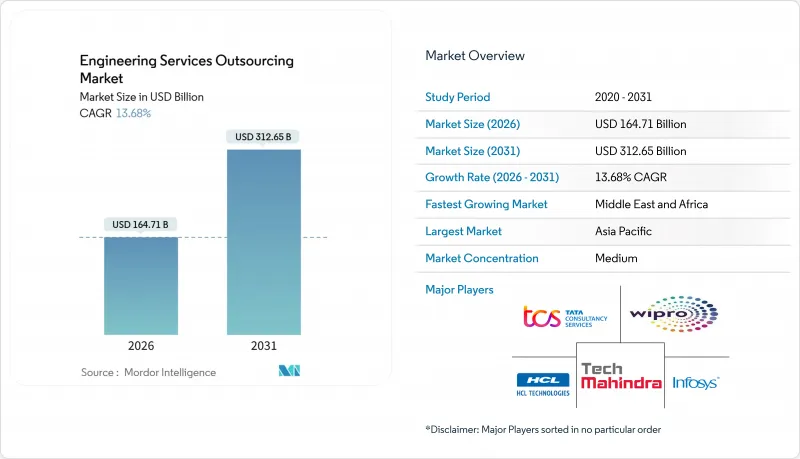
Mordor Intelligence에 의하면, 엔지니어링 서비스 아웃소싱 시장 규모는 2026년에 1,647억 1,000만 달러로 추정되고, 예측 기간(2026-2031년) CAGR 13.68%로 확대될 전망이며, 2031년에는 3,126억 5,000만 달러에 이를 전망입니다.
본 보고서는 서비스 유형별(제품 엔지니어링, 임베디드 엔지니어링 및 전자 등), 최종 사용자별(자동차 및 운송 등), 제공 모델별(온쇼어 등), 고객 규모별(대기업, 중소기업), 지역별(북미, 유럽 등)로 분류되어 있습니다. 시장 전망은 금액(달러) 기준으로 제시되어 있습니다.
세계의 엔지니어링 서비스 아웃소싱 시장 동향 및 인사이트
소프트웨어 정의형 제품의 로드맵 가속화
소프트웨어 중심 아키텍처로 전환하는 OEM 기업들은 현재 연구 개발(R&D) 예산의 최대 40%를 코드 개발에 할애하고 있으며, 이로 인해 임베디드 시스템, 커넥티비티 스택 및 사이버 보안 검증에 지속적인 업무 부하가 발생하고 있습니다. 지속적인 무선(OTA) 업데이트 모델을 실현하기 위해서는 디지털 트윈을 유지하고, 운영 라이프사이클 전반에 걸쳐 애자일 릴리스를 실현할 수 있는 기업과의 제휴가 필수적입니다. 기계, 전자, 소프트웨어 각 계층의 통합이 진행됨에 따라 그 복잡성은 많은 사내 팀이 감당할 수 있는 범위를 넘어섰으며, V2X(Vehicle-to-Everything) 프로토콜과 기존 드라이브트레인 설계를 연결해 주는 풀스택 엔지니어링 파트너에 대한 수요가 높아지고 있습니다.
OEM의 연구개발 예산에 대한 비용 압박 증가
경제 변동과 공급망 혼란으로 인해 제조업체들은 고정된 엔지니어링 인력을 프로젝트 기반의 변동 비용으로 전환해야 하는 상황에 직면해 있습니다. 아웃소싱은 적층 가공 최적화나 IoT 센서 검증과 같은 분야에서 유연한 생산 능력과 전문적인 기술을 제공함으로써 자본 지출(CAPEX)의 변동을 완화합니다. 반도체 업계의 주요 기업들은 FPGA 프론트엔드 설계나 임베디드 펌웨어 작업을, 이미 인증된 툴체인과 경험이 풍부한 인력을 보유한 외부 파트너에게 재할당함으로써 이러한 추세를 반영하고 있습니다. 또한, 서비스 공급업체 간의 통합도 가속화되고 있습니다. 이는 구매자가 턴키 납품이 가능한 소수의 다분야 대응 공급업체로 거래처를 합리화하고 있기 때문입니다.
지적 재산(IP) 및 데이터 주권에 대한 우려
방위, 통신, 의료 분야의 OEM 기업들은 기밀성이 높은 설계 결과물을 규정을 준수하는 관할 구역 내에 보관해야 하므로, 그 결과 공급업체 후보가 좁아지고 조달 주기가 길어지고 있습니다. ITAR(국제무기거래규정)과 같은 규제로 인해 항공우주 프로젝트는 승인된 국내 공급업체로 제한되고 있어, 비용 효율이 뛰어난 해외 기업의 수주 기회가 줄어들고 있습니다. 서비스 파트너들은 제로 트러스트(Zero Trust)형 협업 플랫폼이나 블록체인을 활용한 감사 추적 시스템에 투자하고 있지만, 각국의 정책으로 인해 여전히 국경을 넘는 사업 확장이 저해되고 있으며, 특정 고부가가치 분야는 폐쇄적인 상태가 지속되고 있습니다.
부문 분석
디지털 엔지니어링 및 소프트웨어 분야는 전기차(EV) 운영 체제, 산업용 IoT 스택, 클라우드 네이티브 제품 수명 주기 관리의 도입에 힘입어 29.97%의 연평균 성장률(CAGR)로 가장 빠른 성장세를 보였습니다. 각 공급업체는 DevOps 파이프라인, 모델 기반 시스템 엔지니어링 및 컨테이너화된 마이크로서비스를 통합하여 다중 도메인 제품에 걸친 지속적인 기능 출시를 가능하게 하고 있습니다. 제품 엔지니어링은 엔지니어링 서비스 아웃소싱 시장에서 2025년 매출의 22.42%를 차지하며 그 우위를 유지했습니다. 이는 업종을 불문하고 여전히 필수적인 핵심 기계 설계, 구조 분석, 재료 공학을 뒷받침하는 요소입니다. 현재, 기술 역량 강화 노력의 일환으로 AI를 활용한 유한 요소 분석과 기존 CAD 워크플로우를 융합하여 반복 주기를 가속화하고 있습니다. 엣지 AI 칩의 보급에 따라 임베디드 엔지니어링 및 전자 분야가 성장하고 있습니다. 또한, 자율주행 관련 규제에 대응하여 검증, 타당성 확인 및 규정 준수 서비스가 확대되고 있습니다. 순환형 경제의 요건이 재료 효율을 중시한 재설계를 촉진함에 따라, 지속가능성과 가치 공학의 중요성이 높아지고 있습니다. 전반적으로 각 제공업체들은 사일로화된 서비스 제공에서 통합 플랫폼으로 진화하고 있으며, 이를 통해 고객은 단일 거버넌스 구조 하에서 아이디어 창출부터 제품 출시까지의 전 과정을 조정할 수 있게 됩니다.
엔지니어링 서비스 아웃소싱 시장에서는 애자일 스프린트에 맞춘 모듈형 서비스 번들을 제공하는 기업이 높이 평가받고 있으며, 이를 통해 OEM 기업들은 개별 디지털 자산을 온디맨드로 활용할 수 있게 됩니다. 디지털 트윈 라이브러리는 프로토타입 개발 주기를 단축하고, 자동 테스트 장비는 규정 준수 검증 과정에서 발생하는 인적 오류를 줄여줍니다. 클라우드 네이티브 프로토타이핑은 물리적 실험실에 대한 설비 투자를 줄여주며, 비용의 중점을 하드웨어에서 시뮬레이션의 정확도로 전환시킵니다. 시스템 통합 서비스에는 연결된 자산을 보호하기 위한 사이버 복원력 있는 아키텍처가 점점 더 많이 통합되고 있습니다. 그 결과, 서비스 유형 간의 사일로화가 완화되어 풀스택 파트너가 대규모 교차 판매를 전개할 수 있는 체제가 갖춰졌습니다.
자동차 및 운송 분야의 엔지니어링 서비스 아웃소싱 시장 점유율은 2025년에 18.67%를 기록했으며, 연평균 성장률(CAGR)은 19.79%를 기록했습니다. 이는 전동화, 배터리 열 모델, 자율주행 알고리즘에 힘입은 결과입니다. 소프트웨어 정의 차량(SDV)의 복잡성에 더해, 사이버 보안에 관한 UNECE R-155 등의 규제로 인해 각 OEM 기업들은 하드웨어와 소프트웨어의 융합을 추진하기 위해 외부 전문가에 의존할 수밖에 없는 상황입니다.
항공우주 및 방위 분야에서는 복합재료의 채택, 수소 추진 기술 연구, 차세대 항공 전자 장비로 인해 기체의 현대화가 진행되고 있습니다. 방위 분야의 주요 기업들은 엔지니어링 비용을 내결함성이 높은 위성 통신이나 무인 항공 시스템과 같은 분야로 재분배하고 있으며, 이러한 분야에서는 인증된 공급망과 안전한 데이터 환경이 요구되고 있습니다. 산업용 장비 고객은 예측 유지보수를 위해 디지털 트윈을 활용하는 한편, 소비자용 전자기기 제조업체는 범용적인 기계적 작업을 외부에 위탁함으로써 사내 팀이 사용자 인터페이스의 차별화에 집중할 수 있도록 하고 있습니다. 반도체 기업들은 만성적인 아날로그 설계 인력 부족에 직면해 있으며, 틈새 전문 지식을 확보하기 위해 타 업계보다 높은 보수를 제시하고 있어 해당 마이크로 부문의 보수 수준이 상승하고 있습니다.
에너지 및 유틸리티 분야의 고객은 송전망 최적화 분석 및 재생에너지 통합 모델에 대해 서비스 파트너와 제휴하고 있는 반면, 석유 및 가스 기업은 화학 업계에서 선구적으로 도입된 하류 자산 건전성 관리 프로그램을 모방하고 있습니다. 의료기기 제조업체는 ISO 13485 및 FDA 21 CFR Part 820 감사에 대응하기 위해 제조 적합 설계(DFM) 및 인체공학 테스트를 외부에 위탁하여 부적합 위험을 줄이고 있습니다. 통신 및 네트워크 분야의 고객은 5G O-RAN의 상호 운용성이나 엣지 클라우드 오케스트레이션을 요구하고 있으며, 이러한 분야에서는 RF, 소프트웨어, 보안 등 다양한 분야를 아우르는 학제간 팀이 활약하고 있습니다. 이러한 다양화된 수요 동향으로 인해 각 업계가 독자적인 규정 준수 요건을 부과하고, 이것이 공급업체 선정 전략을 형성하고 있음에도 불구하고, 업계 전반에 걸쳐 견조한 성장이 유지되고 있습니다.
지역별 분석
2025년, 엔지니어링 서비스 아웃소싱 시장에서 아시아태평양은 전 세계 매출의 41.92%를 차지했습니다. 이는 인도의 풍부한 인재 풀과 중국의 제조 엔지니어링 분야에서의 대규모 기반이 뒷받침하고 있습니다. 그러나 임금 상승으로 인해 인건비 격차가 줄어들고 있어, 서비스 제공업체들은 인간의 전문 지식에 자동화를 접목하도록 촉진받고 있습니다. 인도는 국가 AI 센터를 통한 역량 강화에 투자하여 디지털 트윈 및 분석 업무를 수행할 수 있는 인재를 양성하고 있습니다. 중국은 로봇 공학과 클라우드 네이티브 SCADA를 융합한 스마트 팩토리 청사진을 추진하고 있지만, 수출 규제라는 역풍으로 인해 첨단 항공우주 관련 계약이 대체 거점으로 이동하는 상황에 직면해 있습니다. 베트남과 필리핀은 각각 틈새 전문 분야를 육성하고 있습니다. 베트남은 임베디드 펌웨어에, 필리핀은 인포테인먼트용 애니메이션 엔지니어링에 주력하고 있으며, 이를 통해 지역의 사업 포트폴리오가 다양화되고 있습니다.
중동 및 아프리카에서는 걸프 국가들의 ‘비전 2030’ 다각화 프로그램이 원동력이 되고 있습니다. 사우디아라비아의 스마트 시티 프로젝트 NEOM은 그린 수소, IoT 및 지능형 인프라 엔지니어링에 대한 수요를 촉진하고 있습니다. 한편, UAE는 정부 펀드를 항공우주 분야의 MRO(정비·수리·오버홀) 및 첨단 복합재료 연구 개발 거점에 투자하고 있습니다. 남아프리카공화국은 재생에너지 발전소 설계 아웃소싱 시장에 진출한 반면, 이집트는 다국어 구사 인력을 활용하여 유럽을 대상으로 한 니어쇼어 업무에 주력하고 있습니다. STEM 교육에 대한 투자는 가속화되고 있으나, 인력 공급 체계는 여전히 미성숙한 상태이며, 전 세계 대학 및 기술 벤더와의 지속적인 파트너십이 요구되고 있습니다.
북미는 2025년 엔지니어링 서비스 아웃소싱 시장에서 전 세계 매출의 35.07%를 차지했으며, 2031년까지 연평균 성장률(CAGR) 34.12%라는 가장 빠른 성장 궤도를 보이고 있으며,특히 방위 플랫폼 및 자율주행 트럭 시범 사업 분야에서 고부가가치 업무를 지속적으로 발주하고 있습니다. CHIPS법에 따른 우대 조치는 국내 반도체 설계 센터를 활성화시켜, 보안이 확보된 엔클레이브 내에서의 로컬 아웃소싱을 뒷받침하고 있습니다. 유럽에서는 에코디자인 및 순환형 경제 준수가 중시되고 있습니다. 엄격한 GDPR(EU 개인정보보호규정) 및 새롭게 도입된 사이버 복원력에 관한 규제로 인해, 워크로드는 인증된 데이터 환경을 제공하는 지역 공급업체로 유도되고 있습니다. 동유럽 국가들, 특히 폴란드와 루마니아는 EU 규정을 준수하는 규제 체계와 경쟁력 있는 비용 구조 덕분에 서유럽의 파급 효과로 인한 계약을 수주하고 있습니다. 라틴아메리카는 완만한 성장세를 이어가고 있지만, 스페인어로 작성된 기술 문서와 민첩한 협업이 높이 평가받고 있으며, 미국 업무 시간과 겹치는 점도 강점으로 작용하고 있습니다.
기타 혜택 :
- 엑셀 형식 시장 예측(ME) 시트
- 3개월간의 애널리스트 지원
자주 묻는 질문
목차
제1장 서론
제2장 조사 방법
제3장 주요 요약
제4장 시장 구도
제5장 시장 규모 및 성장 예측
제6장 경쟁 구도
제7장 시장 기회 및 향후 전망
AJY 26.09.15According to Mordor Intelligence, the engineering services outsourcing market size is estimated at USD 164.71 billion in 2026, and is expected to reach USD 312.65 billion by 2031, at a CAGR of 13.68% during the forecast period (2026-2031).
This report is Segmented by Service Type (Product Engineering, Embedded Engineering and Electronics, and More), by End User (Automotive and Transportation, and More), by Delivery Model (On-Shore, and More), by Client Size (Large Enterprises, and Small and Mid-Sized Enterprises), and by Geography (North America, Europe, and More). The Market Forecasts are Provided in Terms of Value (USD).
Global Engineering Services Outsourcing Market Trends and Insights
Acceleration of Software-Defined Product Road Maps
OEMs shifting to software-centric architectures now channel as much as 40% of R&D budgets toward code development, creating sustained workloads for embedded systems, connectivity stacks, and cybersecurity validation. Continuous over-the-air update models require partnering with firms that can maintain digital twins and deliver agile releases throughout operating lifecycles. The heightened integration of mechanical, electronic, and software layers raises complexity beyond many in-house teams, elevating demand for full-stack engineering partners that bridge vehicle-to-everything protocols with legacy drivetrain design.
Rising Cost Pressure on OEM R&D Budgets
Economic volatility and supply-chain shocks press manufacturers to convert fixed engineering headcount into variable project-based spending. Outsourcing cushions CAPEX swings by offering elastic capacity and specialized skills for domains such as additive-manufacturing optimization or IoT sensor validation. Semiconductor leaders illustrate the trend by reallocating FPGA front-end design and embedded firmware tasks to external partners that already possess certified toolchains and seasoned staff. Consolidation among service vendors also accelerates as buyers streamline rosters toward fewer, multi-disciplinary suppliers capable of turnkey delivery.
IP and Data-Sovereignty Concerns
Defense, telecom, and healthcare OEMs must keep sensitive design artifacts within compliant jurisdictions, narrowing vendor pools and extending procurement cycles. Regulations like ITAR restrict aerospace projects to approved domestic providers, trimming the accessible pie for cost-efficient offshore shops. Service partners invest in zero-trust collaboration platforms and blockchain-enabled audit trails, yet national policies still slow cross-border scaling, keeping certain high-value segments insular.
Other drivers and restraints analyzed in the detailed report include:
- Near-Shoring Demand amid Geopolitical Risk Diversification
- Talent Shortages in Advanced Engineering Domains
- Fragmented Standards across Industries
For complete list of drivers and restraints, kindly check the Table Of Contents.
Segment Analysis
Digital Engineering and Software generated the fastest trajectory with a 29.97% CAGR, propelled by electric-vehicle operating systems, industrial IoT stacks, and cloud-native product life-cycle management rollouts. Providers embed DevOps pipelines, model-based systems engineering, and containerized microservices that allow continuous feature releases across multi-domain products. Product Engineering maintained its dominance at 22.42% of 2025 revenue in the engineering services outsourcing market, underpinning core mechanical design, structural analysis, and materials engineering, which remain indispensable across industries. Upskilling efforts now blend AI-augmented finite-element analysis with traditional CAD workflows, accelerating iteration cycles. Embedded Engineering and Electronics grows as edge AI chips proliferate; Verification, Validation, and Compliance services expand in response to autonomy regulations. Sustenance and Value Engineering gain relevance as circular-economy mandates spur redesigns aimed at material efficiency. Collectively, providers are evolving toward integrated platforms rather than siloed offerings, enabling clients to orchestrate ideation-to-launch under a single governance structure.
The engineering services outsourcing market rewards firms that deliver modular service bundles aligned to agile sprints, allowing OEMs to consume discrete digital assets on demand. Digital twin libraries shorten prototype loops, while automated test rigs lower human error in compliance validation. Cloud-native prototyping trims capital investment for physical labs, shifting cost focus from hardware to simulation accuracy. System Integration offerings increasingly include cyber-resilient architectures to safeguard connected assets. As a result, service-type silos blur, positioning full-stack partners for cross-selling at scale.
The engineering services outsourcing market share for Automotive and Transportation was 18.67% in 2025, with a 19.79% CAGR, bolstered by electrification, battery-thermal models, and autonomous driving algorithms. The complexity of software-defined vehicles, along with regulations such as UNECE R-155 on cybersecurity, compels OEMs to rely on external specialists to orchestrate hardware-software convergence.
Aerospace and Defense, fleets modernize with composite materials, hydrogen propulsion studies, and next-generation avionics. Defense primes re-channel engineering spend toward resilient satellite communications and unmanned aerial systems, segments that demand certified supply chains and secure data environments. Industrial Equipment clients leverage digital twins for predictive maintenance, whereas Consumer Electronics players outsource commodity mechanical tasks to free in-house teams to focus on user-interface differentiation. Semiconductor firms, facing chronic analog-design shortages, outbid other industries for niche expertise, inflating rates in that micro-segment.
Energy and Utilities customers engage service partners for grid-optimization analytics and renewable-integration models, while Oil and Gas firms emulate downstream asset-integrity programs pioneered in chemicals. Medical Device makers, contending with ISO 13485 and FDA 21 CFR Part 820 audits, outsource design-for-manufacturing and human-factor testing to reduce non-conformance risk. Telecom and Networking clients require 5G O-RAN interoperability and edge-cloud orchestration, areas where cross-disciplinary teams span RF, software, and security competencies. The diversified demand profile sustains robust growth across verticals, even as each vertical applies unique compliance gates that shape provider qualification strategies.
Complete Report Scope:
- By Service Type
- Product Engineering (Mechanical/Mechatronics, Concept and industrial design, CAE/Simulation)
- Embedded Engineering and Electronics (PCB/PCBA, FPGA/ASIC front-end, firmware)
- Digital Engineering and Software
- Verification, Validation and Compliance (V&V, HIL/SIL/MIL, certification)
- Prototyping and NPI
- Sustenance / Value Engineering (VAVE, re-engineering, localization, EOL)
- System Integration
- By End User
- Automotive and Transportation
- Industrial Equipment and Machinery
- Consumer Electronics
- Semiconductors
- Oil and Gas
- Telecom and Networking
- Aerospace and Defense
- Energy and Utilities
- Medical Devices
- Other End Users
- By Delivery Model
- On-shore
- Off-shore
- Hybrid/ Multi-Shore
- By Client Size
- Large Enterprises
- Small and Mid-sized Enterprises (SMEs)
- By Geography
- North America
- United States
- Canada
- Mexico
- South America
- Brazil
- Argentina
- Peru
- Rest of South America
- Europe
- United Kingdom
- Germany
- France
- Italy
- Spain
- BENELUX (Belgium, Netherlands, and Luxembourg)
- NORDICS (Denmark, Finland, Iceland, Norway, and Sweden)
- Rest of Europe
- Asia-Pacific
- China
- India
- Japan
- Australia
- South Korea
- ASEAN (Indonesia, Thailand, Philippines, Malaysia, Vietnam)
- Rest of Asia-Pacific
- Middle East and Africa
- Saudi Arabia
- United Arab Emirates
- Qatar
- Kuwait
- Turkey
- Egypt
- South Africa
- Nigeria
- Rest of Middle East and Africa
- North America
Geography Analysis
Asia Pacific held 41.92% of global revenue in 2025 in the engineering services outsourcing market, anchored by India's expansive talent pool and China's scale in manufacturing engineering. Wage inflation, however, compresses labor-cost differentials, nudging providers to layer automation on top of human expertise. India invests in upskilling through national AI centers, positioning its workforce for digital twin and analytics tasks. China advances smart-factory blueprints, melding robotics with cloud-native SCADA, yet faces export-control headwinds that shift advanced aerospace contracts to alternative sites. Vietnam and the Philippines cultivate specialized niches: Vietnam in embedded firmware, the Philippines in animation engineering for infotainment, diversifying regional portfolios.
The Middle East and Africa are seeded by Gulf-state Vision 2030 diversification programs. Saudi Arabia's NEOM smart-city project catalyzes demand for green hydrogen, IoT, and intelligent infrastructure engineering; the UAE channels sovereign wealth funds into aerospace MRO and advanced composite R&D hubs. South Africa enters renewable-energy plant design outsourcing, while Egypt leverages multilingual talent for European near-shore work. Investment in STEM education accelerates, yet talent pipelines remain immature, requiring ongoing partnerships with global universities and technology vendors.
North America held 35.07% global revenue of 2025 in the engineering services outsourcing market, and exhibits the fastest trajectory at 34.12% CAGR through 2031, continues to purchase high-value scopes, especially for defense platforms and autonomous truck pilots. CHIPS Act incentives stimulate domestic semiconductor design centers, bolstering local outsourcing within secure enclaves. Europe emphasizes eco-design and circular-economy compliance; strict GDPR and emerging cyber-resilience mandates steer workloads to regional providers offering certified data environments. Eastern European countries, notably Poland and Romania, win spillover contracts from Western Europe thanks to EU-aligned regulations and competitive cost structures. Latin America expands slowly but gains recognition for Spanish-language technical documentation and agile collaboration, overlapping U.S. work hours.
- Tata Consultancy Services (TCS)
- Infosys Limited
- HCL Technologies Limited
- Wipro
- Tech Mahindra Limited
- Cognizant
- Capgemini Engineering
- Accenture
- IBM Corporation
- L&T Technology Services Limited.
- Cyient
- Alten Group
- AKKA Technologies (Akkodis)
- QuEST Global
- EPAM Systems, Inc.
- Persistent Systems
- Luxoft (DXC)
- Tata Technologies
- KPIT Technologies
- GlobalLogic Inc.
- RLE International
- ASAP Holdings
Additional Benefits:
- The market estimate (ME) sheet in Excel format
- 3 months of analyst support
TABLE OF CONTENTS
1 INTRODUCTION
- 1.1 Study Assumptions and Market Definition
- 1.2 Scope of the Study
2 RESEARCH METHODOLOGY
3 EXECUTIVE SUMMARY
4 MARKET LANDSCAPE
- 4.1 Market Overview
- 4.2 Market Drivers
- 4.2.1 Acceleration of Software-Defined Product Road-Maps
- 4.2.2 Rising Cost Pressure on OEM R&D Budgets
- 4.2.3 Near-Shoring Demand Amid Geopolitical Risk Diversification
- 4.2.4 Talent Shortages in Advanced Engineering Domains
- 4.2.5 AI-Augmented CAE and Digital Twin Adoption
- 4.2.6 Sustainability-Driven Re-Engineering of Legacy Products
- 4.3 Market Restraints
- 4.3.1 IP and Data-Sovereignty Concerns
- 4.3.2 Fragmented Standards Across Industries
- 4.3.3 Wage Inflation in Traditional Offshore Hubs
- 4.3.4 High Switching Costs for Long-Term Engineering Programs
- 4.4 Industry Value Chain Analysis
- 4.5 Regulatory Landscape
- 4.6 Technological Outlook
- 4.7 Pricing Analysis
- 4.8 Industry Attractiveness - Porter's Five Forces Analysis
- 4.8.1 Bargaining Power of Suppliers
- 4.8.2 Bargaining Power of Buyers
- 4.8.3 Threat of New Entrants
- 4.8.4 Threat of Substitutes
- 4.8.5 Competitive Rivalry
- 4.9 Impact of Geopolitical Events on the Industry
5 MARKET SIZE AND GROWTH FORECASTS (VALUE)
- 5.1 By Service Type
- 5.1.1 Product Engineering (Mechanical/Mechatronics, Concept and industrial design, CAE/Simulation)
- 5.1.2 Embedded Engineering and Electronics (PCB/PCBA, FPGA/ASIC front-end, firmware)
- 5.1.3 Digital Engineering and Software
- 5.1.4 Verification, Validation and Compliance (V&V, HIL/SIL/MIL, certification)
- 5.1.5 Prototyping and NPI
- 5.1.6 Sustenance / Value Engineering (VAVE, re-engineering, localization, EOL)
- 5.1.7 System Integration
- 5.2 By End User
- 5.2.1 Automotive and Transportation
- 5.2.2 Industrial Equipment and Machinery
- 5.2.3 Consumer Electronics
- 5.2.4 Semiconductors
- 5.2.5 Oil and Gas
- 5.2.6 Telecom and Networking
- 5.2.7 Aerospace and Defense
- 5.2.8 Energy and Utilities
- 5.2.9 Medical Devices
- 5.2.10 Other End Users
- 5.3 By Delivery Model
- 5.3.1 On-shore
- 5.3.2 Off-shore
- 5.3.3 Hybrid/ Multi-Shore
- 5.4 By Client Size
- 5.4.1 Large Enterprises
- 5.4.2 Small and Mid-sized Enterprises (SMEs)
- 5.5 By Geography
- 5.5.1 North America
- 5.5.1.1 United States
- 5.5.1.2 Canada
- 5.5.1.3 Mexico
- 5.5.2 South America
- 5.5.2.1 Brazil
- 5.5.2.2 Argentina
- 5.5.2.3 Peru
- 5.5.2.4 Rest of South America
- 5.5.3 Europe
- 5.5.3.1 United Kingdom
- 5.5.3.2 Germany
- 5.5.3.3 France
- 5.5.3.4 Italy
- 5.5.3.5 Spain
- 5.5.3.6 BENELUX (Belgium, Netherlands, and Luxembourg)
- 5.5.3.7 NORDICS (Denmark, Finland, Iceland, Norway, and Sweden)
- 5.5.3.8 Rest of Europe
- 5.5.4 Asia-Pacific
- 5.5.4.1 China
- 5.5.4.2 India
- 5.5.4.3 Japan
- 5.5.4.4 Australia
- 5.5.4.5 South Korea
- 5.5.4.6 ASEAN (Indonesia, Thailand, Philippines, Malaysia, Vietnam)
- 5.5.4.7 Rest of Asia-Pacific
- 5.5.5 Middle East and Africa
- 5.5.5.1 Saudi Arabia
- 5.5.5.2 United Arab Emirates
- 5.5.5.3 Qatar
- 5.5.5.4 Kuwait
- 5.5.5.5 Turkey
- 5.5.5.6 Egypt
- 5.5.5.7 South Africa
- 5.5.5.8 Nigeria
- 5.5.5.9 Rest of Middle East and Africa
- 5.5.1 North America
6 COMPETITIVE LANDSCAPE
- 6.1 Market Concentration
- 6.2 Strategic Moves
- 6.3 Market Share Analysis
- 6.4 Company Profiles (includes Global level Overview, Market level overview, Core Segments, Financials as available, Strategic Information, Products & Services, and Recent Developments)
- 6.4.1 Tata Consultancy Services (TCS)
- 6.4.2 Infosys Limited
- 6.4.3 HCL Technologies Limited
- 6.4.4 Wipro
- 6.4.5 Tech Mahindra Limited
- 6.4.6 Cognizant
- 6.4.7 Capgemini Engineering
- 6.4.8 Accenture
- 6.4.9 IBM Corporation
- 6.4.10 L&T Technology Services Limited.
- 6.4.11 Cyient
- 6.4.12 Alten Group
- 6.4.13 AKKA Technologies (Akkodis)
- 6.4.14 QuEST Global
- 6.4.15 EPAM Systems, Inc.
- 6.4.16 Persistent Systems
- 6.4.17 Luxoft (DXC)
- 6.4.18 Tata Technologies
- 6.4.19 KPIT Technologies
- 6.4.20 GlobalLogic Inc.
- 6.4.21 RLE International
- 6.4.22 ASAP Holdings
7 MARKET OPPORTUNITIES AND FUTURE OUTLOOK
- 7.1 White-space and Unmet-Need Assessment


