

|
시장보고서
상품코드
2124794
발 교정 깔창 : 시장 점유율 분석, 업계 동향과 통계, 성장 예측(2026-2031년)Foot Orthotic Insoles - Market Share Analysis, Industry Trends & Statistics, Growth Forecasts (2026 - 2031) |
||||||
 Mordor Intelligence
Mordor Intelligence에 의하면, 발 교정 깔창 시장 규모는 2025년에 42억 5,000만 달러로 평가되었고, 2026년 45억 2,000만 달러에서 2031년까지 63억 3,000만 달러에 달할 것으로 예측됩니다.
예측 기간(2026-2031년) 동안 연평균 성장률(CAGR)은 6.98%를 기록할 것으로 전망됩니다.
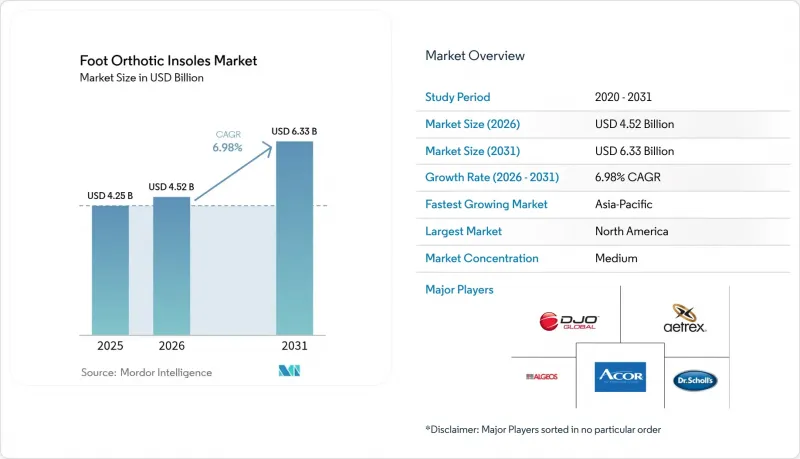
본 보고서는 제품 유형(주문 제작, 기성품, 열성형 가능), 소재(EVA 폼, 열가소성 플라스틱 등), 연령대(성인, 소아),용도(의료용 등), 판매 채널(병원 약국·전문 클리닉 등), 지역(북미, 유럽, 아시아태평양, 중동 및 아프리카, 남미)별로 분류되어 있습니다. 시장 예측은 금액(달러)으로 제시되어 있습니다.
전 세계 발 보조기 깔창 시장 동향 및 인사이트
고령화와 당뇨병 유병률
2030년까지 전 세계 60세 이상 인구는 14억 명에 달할 것으로 예상되며, 이들 중 상당수는 보행 능력을 제한하는 족저근막염, 관절염 또는 신경 장애를 앓고 있습니다. 당뇨병 유병자 수는 2050년까지 13억 명에 달할 것으로 예상되며, 이에 따라 압력을 재분배하는 깔창을 이용한 족부 궤양 예방에 대한 수요가 증가하고 있습니다. 메디케어 파트 B는 당뇨병 환자에게 처방된 맞춤형 보조기 인증 비용의 80%를 부담하고 있어, 사실상 미국 수요를 뒷받침하고 있습니다. 당뇨병을 앓는 고령자는 보행에 있어 복합적인 어려움이 발생하기 때문에 보험사와 임상의들은 조기 보조기 개입에 의견을 같이하고 있으며, 이러한 인구 동향이 족부 보조기 깔창 시장에 구조적인 수요 요인으로 작용하고 있습니다. 다른 국가의 국민건강보험 제도도 이 보상 모델을 따르고 있어, 2031년까지 기초적인 성장이 지속될 것으로 전망됩니다.
스포츠 및 레크리에이션 참여 열풍
Strava의 기록에 따르면, 2024년에는 1억 3,500만 명의 사용자가 153억 건의 활동을 게시했으며, 이는 달리기, 사이클링, 하이킹이 모든 연령대에서 일상적인 습관이 되었음을 입증합니다. 운동선수들은 피로감을 늦추고 관절을 보호하기 위해 적극적으로 보조기를 찾고 있으며, 이러한 경향은 탄소섬유 깔창이 보행 중 에너지 손실을 10% 가까이 줄인다는 것을 보여준 동료 심사를 거친 연구에 의해 뒷받침되고 있습니다. Superfeet사와 Brooks사는 공장에서 카본 플레이트를 내장하고 있으며, 깔창을 애프터마켓용 추가 부품이 아닌 성능 향상을 위한 구성 요소로 포지셔닝하고 있습니다. 소비자들이 개별 기기에 대한 추가 비용이 아닌 신발 패키지에 포함된 프리미엄 가격을 수용함에 따라 이익률은 향상되고 있습니다. 아시아태평양의 신흥 대도시권에서 스포츠가 일상화됨에 따라, 소매업체들은 북미의 상품 도입 방식을 도입하여 발 교정 깔창 수요 기반을 확대되고 있습니다.
높은 비용과 제한된 보험 적용
맞춤형 깔창은 200-800달러에 판매되고 있으며, 이는 자비로 구매하는 편안함을 중시한 깔창의 가격대를 훨씬 상회합니다. 메디케어는 당뇨병 적응증에 대해서만 보험 적용을 하고 있으며, 스포츠나 일반적인 건강 증진 목적의 사용은 대상에서 제외되어 있고, 민간 보험사들도 유사한 규정을 채택하고 있습니다. 북미와 서유럽 이외 지역에서는 보험 보급률이 낮기 때문에 소비자들은 맞춤형 깔창 견적과 약국에서 50달러 정도에 판매되는 대체품을 비교 검토하고 있습니다. 이익 마진이 압박받고 있는 가운데, 각 공급업체들은 리드 타임을 단축하고 유연 지출 계좌(FSA) 청구를 가능하게 하기 위해 수직 통합을 시도하고 있습니다. 그 예로, 7,000만 명의 FSA/HSA 가입자에게 접근할 수 있는 Bilt Labs와 Health-E Commerce의 제휴를 들 수 있습니다. 보다 광범위한 보험 적용이 실현되기 전까지는 이러한 가격 차이가 특히 중소득 국가에서 발 교정 깔창 시장의 성장을 저해하고 있습니다.
부문 분석
2025년 매출액 중,맞춤형 족부 보조기 깔창이 54.62%를 차지했으나, 열성형이 가능한 모델은 구매자가 수 주간에 달하는 실험실 대기 시간을 피하고 매장에서 즉시 피팅을 선택하는 경향이 있어, 제품 유형 중 가장 높은 7.52%의 연평균 성장률(CAGR)을 나타낼 전망입니다. 맞춤형 방식이 주류를 이루는 족부 보조기 깔창 시장은 여전히 당뇨병 환자를 위한 보험 환급의 혜택을 받고 있지만, 편의성을 중시하는 구매자들은 몇 분 만에 자신에게 맞게 성형할 수 있는 열가소성 소재 제품을 선호하는 경향이 있습니다.
열가소성 소재는 80-100°C에서 연화되기 때문에 신발 매장 판매원이 매장에서 발바닥 아치 부분을 성형할 수 있으며, 로열티 앱이 피팅 데이터를 저장하고 재주문 안내를 제공함으로써 브랜드 충성도를 강화하고 있습니다. 기성 깔창은 30-80달러 가격대로 가치 격차를 메우며 약국에서 충동 구매를 유도하는 진열 위치를 차지하고 있지만, Aetrex Lynco L2200과 같은 하이브리드 제품은 기성 아치 부분과 열성형이 가능한 힐컵을 결합하고 있습니다. 카테고리의 경계가 모호해지는 가운데, 규제 당국은 계속해서 모든 제품을 동일한 클래스 I 프레임워크로 묶고 있으며, ‘맞춤형’에 관한 마케팅 표현의 정의가 여전히 모호한 상태이기 때문에 족부 보조기 깔창 시장에서의 브랜딩 경쟁은 격화되고 있습니다.
EVA 폼은 저렴한 단가 덕분에 2025년 매출의 28.91%를 차지했지만, 엘리트 러너와 레크리에이션 러너들이 경량화와 반발력을 추구함에 따라 복합 탄소섬유는 연평균 성장률(CAGR) 8.24%로 성장할 전망입니다. 탄소섬유의 프리미엄 포지셔닝으로 인해 평균 판매 가격이 상승하면서, 판매 쌍 수가 정체되어도 발 교정 깔창 시장 규모는 확대되고 있습니다.
생체역학 연구에 따르면, 카본 삽입재는 달리기 시 보폭에서 발생하는 에너지 손실을 10분의 1 가까이 줄이는 것으로 나타났으며, 이러한 측정 가능한 우위 덕분에 80-150달러에 달하는 고성능 모델의 가격 책정이 정당화되고 있습니다. 열가소성 시트는 열 성형이 가능한 제품 라인을 제공하는 반면, 젤과 실리콘은 압력 재분배라는 관점에서 당뇨병 관리 분야에서 주류를 이루고 있습니다. 가죽 제품은 여전히 정장 구두의 틈새 시장에 머물러 있으며, 지지력보다는 통기성이 중시되고 있습니다. 2024년 오토복(Ottobock)이 달성한 바와 같이, 소재 공급업체의 브랜드 인수는 매출 총이익률을 보호하고, 족부 보조기 깔창 시장에서 시제품 개발을 가속화하며, 업스트림 공정을 장악하기 위한 전환을 시사합니다.
지역별 분석
북미는 2025년 매출의 39.18%를 차지했습니다. 이는 HCPCS 코드 A5512-A5513에 기반한 당뇨병용 보조기에 대한 메디케어 환급이 허용 요금의 80%를 커버하여, 사실상 핵심 고위험 그룹에 대한 보조금 역할을 하고 있기 때문입니다. Volumental, Aetrex, Superfeet을 핵심으로 하는 강력한 혁신 클러스터가 약국 및 스포츠 관련 채널에서 스캐너와 AI 키오스크의 신속한 도입을 뒷받침하고 있습니다. 캐나다의 주 보건 보험 제도에서는 의학적 진단에 기반한 맞춤형 보조기에 대한 보험 급여가 이루어지고 있지만, 스포츠용이나 편안함 향상을 위한 제품은 대상에서 제외되어 있어, 본인 부담에 의한 틈새 시장이 활기를 띠고 있습니다. 멕시코에서는 가처분 소득이 초기 단계이긴 하지만 증가 추세에 있으며, 러닝 이벤트가 늘어남에 따라 당뇨병 환자를 위한 보험 적용 범위가 제한적임에도 불구하고 프리미엄 스포츠용 깔창에 대한 수요가 높아지고 있습니다.
유럽은 시장 규모에서 2위를 차지하고 있으며, 독일, 영국, 프랑스가 주도적인 역할을 하고 있습니다. 이들 국가에서는 족부 전문의 밀도가 높고, 사회보험 제도에 따라 교정용 깔창 처방이 일반화되어 있습니다. EU 의료기기 규정에서는 맞춤형 깔창이 클래스 I로 분류되어 진입 장벽이 비교적 낮게 유지되는 한편, 시판 후 감시를 통해 품질이 보장되고 있습니다. 독일의 주요 기업인 바우어파인드(Bauerfeind)와 오토복(OttoBock)은 수직 통합을 활용하여 열성형이 가능한 제품 시장 출시를 가속화하고 있으며,비르켄스톡(Birkenstock)이 2024년에 3D 프린팅에 투자함에 따라, 풋베드에 관한 전문 지식이 치료용 틈새 시장으로 확대되고 있습니다. NHS(영국 국민건강서비스)가 지원하는 임상시험에서 기성 깔창의 유효성이 입증된 것은 유럽 대륙 전체의 지불자 위원회에 영향을 미쳐, 구매 경향을 맞춤형 제품에서 중저가 대체품으로 전환시키고, 발 교정 깔창 시장에서 소비자의 선택 폭을 넓히고 있습니다.
아시아태평양은 2031년까지 연평균 성장률(CAGR) 7.99%를 나타낼 것으로 예측되며, 이는 지역별로는 가장 빠른 성장 속도입니다. 중국에는 1억 4,090만 명의 성인 당뇨병 환자가 있어 예방 의료의 거대한 대상층을 형성하고 있습니다. 그러나 본인 부담 비용이 도시 외 지역에서의 즉각적인 보급을 저해하고 있습니다. 일본에서는 고령화가 진행되는 가운데, 보행용 신발에 교정 플레이트를 장착하는 추세가 확산되고 있으며, 인도의 국내 브랜드인 타이노르(Tynor)는 약국 체인을 통해 합리적인 가격의 기성품 보급을 확대되고 있습니다. 호주에서는 뿌리 깊은 스포츠 문화와 국민건강보험 제도가 맞물려, 탄소 복합 소재의 조기 도입이 촉진되고 있습니다. 중동 및 아프리카 및 남미는 가격에 대한 민감성과 의료 인력 부족으로 인해 뒤처져 있지만, 스마트폰 스캔을 활용한 전자상거래 시범 프로그램은 인지도와 결제 수단이 개선된다면 향후 따라잡을 가능성이 있음을 시사하고 있습니다.
기타 혜택:
- 엑셀 형식 시장 예측(ME) 시트
- 3개월간의 애널리스트 지원
자주 묻는 질문
목차
제1장 서론
제2장 조사 방법
제3장 주요 요약
제4장 시장 구도
제5장 시장 규모와 성장 예측
제6장 경쟁 구도
제7장 시장 기회와 향후 전망
LSH 26.09.14According to Mordor Intelligence, the foot orthotic insoles market size was valued at USD 4.25 billion in 2025 and is estimated to grow from USD 4.52 billion in 2026 to reach USD 6.33 billion by 2031, at a CAGR of 6.98% during the forecast period (2026-2031).
This report is Segmented by Product Type (Custom, Prefabricated, Heat-Moldable), Material (EVA Foam, Thermoplastics, and More), Age Group (Adults, Pediatrics), Application (Medical, and More), Distribution Channel (Hospital Pharmacies & Specialty Clinics, and More), and Geography (North America, Europe, Asia-Pacific, Middle East & Africa, South America). Market Forecasts are Provided in Value (USD).
Global Foot Orthotic Insoles Market Trends and Insights
Ageing Demographic & Diabetes Prevalence
Global residents aged 60 and older are projected to reach 1.4 billion by 2030, and many experience plantar fasciitis, arthritis, or neuropathy that restricts mobility. Diabetes prevalence is expected to hit 1.3 billion cases by 2050, intensifying pressure to prevent foot ulcers through pressure-redistributing insoles. Medicare Part B covers 80% of allowable costs for custom orthoses prescribed for diabetic patients, effectively underwriting U.S. demand. Because older adults with diabetes face compounded gait challenges, insurers and clinicians align on early orthotic intervention, turning this demographic trend into a structural pull for the foot orthotics insoles market. As national health systems elsewhere follow the reimbursement template, baseline growth continues through 2031.
Sports & Recreational Participation Boom
Strava recorded 135 million users posting 15.3 billion activities in 2024, proof that running, cycling, and hiking have become daily habits across age brackets. Athletes proactively pursue orthoses to delay fatigue and protect joints, a pattern reinforced by peer-reviewed studies showing that carbon-fiber inserts reduce energy loss during gait by nearly 10%. Superfeet and Brooks embed carbon plates at the factory, repositioning insoles as performance components rather than aftermarket add-ons. Margins improve because shoppers accept footwear package premiums instead of stand-alone device surcharges. As sports normalization rises in emerging Asia-Pacific metros, retailers replicate North American merchandising practices, widening the demand funnel for foot orthotic insoles.
High Cost & Limited Reimbursement
Custom pairs sell for USD 200-800, a bracket far above cash-pay comfort inserts. Medicare reimburses only diabetic indications, excluding sports or general wellness uses, and private insurers mirror those rules. Outside North America and Western Europe, insurance penetration is low, so consumers compare custom quotes to USD 50 drugstore alternatives. Margins compress, and vendors experiment with vertical integration to shave lead times and bill to flexible spending accounts, as seen in the Bilt Labs-Health-E Commerce partnership, which accesses 70 million FSA/HSA members. Until broader reimbursement arrives, the pricing gap restrains the foot orthotic insole market, particularly in middle-income economies.
Other drivers and restraints analyzed in the detailed report include:
- Rapid Adoption of 3-D Scanning and Printing
- AI-Enabled Retail Foot-Scan Kiosks
- Counterfeit/Low-Quality Products
For complete list of drivers and restraints, kindly check the Table Of Contents.
Segment Analysis
Custom orthotic insoles accounted for 54.62% of 2025 revenue, yet heat-moldable models are projected to post a 7.52% CAGR, the highest among product types, as shoppers substitute immediate in-store fitting for multi-week lab waits. The foot orthotics insole market, which is attached to custom formats, still benefits from diabetic reimbursement, but convenience-oriented buyers tilt toward thermoplastic units that personalize in minutes.
Thermoplastics soften at 80-100 °C, so footwear associates can shape arches on the sales floor, and loyalty apps then store fit data for re-order prompts, reinforcing brand lock-in. Prefabricated insoles plug the value gap at USD 30-80 and enjoy pharmacy impulse placement, while hybrid lines such as Aetrex Lynco L2200 merge prefab arches with heat-moldable heel cups. As the category blurs, regulators continue to group all versions under the same Class I umbrella, leaving marketing language around "custom" loosely defined, intensifying the branding race in the foot orthotics insoles market.
EVA foam held 28.91% of 2025 revenue thanks to its low unit cost, but composite carbon fiber is set to advance at an 8.24% CAGR as elite and recreational runners pursue weight savings and rebound. Carbon's premium positioning raises average selling price, expanding the foot orthotics insoles market size even when pair counts stay flat.
Biomechanics research shows carbon inserts trim energy loss during running stride by nearly a tenth, a measurable edge that justifies USD 80-150 ticket prices for performance models. Thermoplastic sheets supply heat-moldable lines, while gel and silicone dominate diabetic care for pressure redistribution. Leather remains a dress-shoe niche, valued for breathability more than support. Brand acquisitions of material suppliers, as OttoBock accomplished in 2024, signal a pivot toward upstream control that shields gross margin and accelerates prototyping in the foot orthotics insoles market.
Complete Report Scope:
- By Product Type
- Custom Orthotic Insoles
- Prefabricated Orthotic Insoles
- Heat-Moldable Orthotic Insoles
- By Material
- Ethyl-Vinyl Acetate (EVA) Foam
- Thermoplastics
- Composite Carbon Fiber
- Foam & Memory Foam
- Gel & Silicone
- Leather
- Other Materials
- By Age Group
- Adults
- Pediatrics
- By Application
- Medical
- Sports & Athletics
- Personal Comfort
- Occupational Safety
- By Distribution Channel
- Hospital Pharmacies & Specialty Clinics
- Retail Stores
- Online Pharmacies
- By Geography
- North America
- United States
- Canada
- Mexico
- Europe
- Germany
- United Kingdom
- France
- Italy
- Spain
- Rest of Europe
- Asia-Pacific
- China
- Japan
- India
- Australia
- South Korea
- Rest of Asia-Pacific
- Middle East & Africa
- GCC
- South Africa
- Rest of Middle East & Africa
- South America
- Brazil
- Argentina
- Rest of South America
- North America
Geography Analysis
North America retained 39.18% of 2025 revenue, as Medicare reimbursement for diabetic orthoses under HCPCS codes A5512-A5513 covered 80% of allowable charges, effectively subsidizing the core at-risk group. A deep innovation cluster, anchored by Volumental, Aetrex, and Superfeet, nurtures fast deployment of scanners and AI kiosks across pharmacy and sporting channels. Canada's provincial health plans reimburse custom devices for medical diagnoses, though coverage stops at sports or comfort, keeping cash-pay niches lively. Mexico has early-stage but rising disposable income, and more running events push premium athletic insoles, despite limited diabetic reimbursement frameworks.
Europe sits second by value, propelled by Germany, the United Kingdom, and France, where podiatric density and social-insurance schemes normalize orthotic prescriptions. The EU Medical Device Regulation classifies custom insoles as Class I, so entry barriers stay modest while post-market surveillance safeguards quality. German players Bauerfeind and OttoBock leverage vertical integration to speed heat-moldable launches, and Birkenstock's 2024 investment in 3-D printing extends footbed expertise into therapeutic niches. NHS-backed trials showing prefab efficacy influence payer panels across the continent, nudging purchasing from custom to mid-priced alternatives and widening consumer choice in the foot orthotics insole market.
Asia-Pacific is forecast to post a 7.99% CAGR to 2031, the fastest regional pace. China hosts 140.9 million adults with diabetes, forming a vast preventive-care addressable base. Yet out-of-pocket spending dampens immediate uptake outside urban centers. Japan's aging demographics spur integration of orthotic plates into walking shoes, while India's domestic brand Tynor scales value prefabs through pharmacy chains. Australia blends a strong sports culture with universal health coverage, driving early adoption of carbon composites. Middle East & Africa and South America lag because of price sensitivity and lower clinician coverage, but pilot e-commerce programs with smartphone scanning hint at future catch-up once awareness and payment options improve.
- Acor Orthopedic
- Algeo
- Aetrex Worldwide Inc.
- Amfit
- Bauerfeind
- Birkenstock Digital GmbH
- Blatchford Group Ltd.
- ComfortFit Orthotic Labs Inc.
- Digital Orthotics Laboratories Australia Pty Ltd.
- Dr. Scholl's
- DJO Global
- Euroleathers
- Footbalance Systems Ltd.
- Hanger Inc.
- Implus Footcare LLC
- OttoBock SE & Co. KGaA
- PowerStep (Stable Step LLC)
- Sidas SAS
- Spenco Medical Corporation
- Superfeet Worldwide LLC
- Tynor Orthotics Pvt. Ltd.
- Vionic Group LLC
Additional Benefits:
- The market estimate (ME) sheet in Excel format
- 3 months of analyst support
TABLE OF CONTENTS
1 Introduction
- 1.1 Study Assumptions & Market Definition
- 1.2 Scope of the Study
2 Research Methodology
3 Executive Summary
4 Market Landscape
- 4.1 Market Overview
- 4.2 Market Drivers
- 4.2.1 Ageing Demographic & Diabetes Prevalence
- 4.2.2 Sports & Recreational Participation Boom
- 4.2.3 Rapid Adoption of 3-D Scanning / Printing
- 4.2.4 Employer-Funded Anti-Fatigue Programmes
- 4.2.5 AI-Enabled Retail Foot-Scan Kiosks
- 4.2.6 Smartphones' Lidar Foot-Scan Apis Enabling Home Fitting
- 4.3 Market Restraints
- 4.3.1 High Cost & Limited Reimbursement
- 4.3.2 Counterfeit / Low-Quality Products
- 4.3.3 Short-Term EVA & Resin Supply Shocks
- 4.3.4 Limited Consumer Awareness in Low-Income Regions
- 4.4 Regulatory Landscape
- 4.5 Technological Outlook
- 4.6 Porter's Five Forces Analysis
- 4.6.1 Threat of New Entrants
- 4.6.2 Bargaining Power of Buyers
- 4.6.3 Bargaining Power of Suppliers
- 4.6.4 Threat of Substitute Products
- 4.6.5 Intensity of Competitive Rivalry
5 Market Size & Growth Forecasts
- 5.1 By Product Type
- 5.1.1 Custom Orthotic Insoles
- 5.1.2 Prefabricated Orthotic Insoles
- 5.1.3 Heat-Moldable Orthotic Insoles
- 5.2 By Material
- 5.2.1 Ethyl-Vinyl Acetate (EVA) Foam
- 5.2.2 Thermoplastics
- 5.2.3 Composite Carbon Fiber
- 5.2.4 Foam & Memory Foam
- 5.2.5 Gel & Silicone
- 5.2.6 Leather
- 5.2.7 Other Materials
- 5.3 By Age Group
- 5.3.1 Adults
- 5.3.2 Pediatrics
- 5.4 By Application
- 5.4.1 Medical
- 5.4.2 Sports & Athletics
- 5.4.3 Personal Comfort
- 5.4.4 Occupational Safety
- 5.5 By Distribution Channel
- 5.5.1 Hospital Pharmacies & Specialty Clinics
- 5.5.2 Retail Stores
- 5.5.3 Online Pharmacies
- 5.6 By Geography
- 5.6.1 North America
- 5.6.1.1 United States
- 5.6.1.2 Canada
- 5.6.1.3 Mexico
- 5.6.2 Europe
- 5.6.2.1 Germany
- 5.6.2.2 United Kingdom
- 5.6.2.3 France
- 5.6.2.4 Italy
- 5.6.2.5 Spain
- 5.6.2.6 Rest of Europe
- 5.6.3 Asia-Pacific
- 5.6.3.1 China
- 5.6.3.2 Japan
- 5.6.3.3 India
- 5.6.3.4 Australia
- 5.6.3.5 South Korea
- 5.6.3.6 Rest of Asia-Pacific
- 5.6.4 Middle East & Africa
- 5.6.4.1 GCC
- 5.6.4.2 South Africa
- 5.6.4.3 Rest of Middle East & Africa
- 5.6.5 South America
- 5.6.5.1 Brazil
- 5.6.5.2 Argentina
- 5.6.5.3 Rest of South America
- 5.6.1 North America
6 Competitive Landscape
- 6.1 Market Concentration
- 6.2 Market Share Analysis
- 6.3 Company Profiles (includes Global Level Overview, Market Level Overview, Core Segments, Financials as Available, Strategic Information, Market Rank/Share for Key Companies, Products & Services, and Recent Developments)
- 6.3.1 Acor Orthopedic, Inc.
- 6.3.2 Algeo Limited
- 6.3.3 Aetrex Worldwide Inc.
- 6.3.4 Amfit Inc.
- 6.3.5 Bauerfeind AG
- 6.3.6 Birkenstock Digital GmbH
- 6.3.7 Blatchford Group Ltd.
- 6.3.8 ComfortFit Orthotic Labs Inc.
- 6.3.9 Digital Orthotics Laboratories Australia Pty Ltd.
- 6.3.10 Dr. Scholl's
- 6.3.11 DJO Global Inc.
- 6.3.12 Euroleathers
- 6.3.13 Footbalance Systems Ltd.
- 6.3.14 Hanger Inc.
- 6.3.15 Implus Footcare LLC
- 6.3.16 OttoBock SE & Co. KGaA
- 6.3.17 PowerStep (Stable Step LLC)
- 6.3.18 Sidas SAS
- 6.3.19 Spenco Medical Corporation
- 6.3.20 Superfeet Worldwide LLC
- 6.3.21 Tynor Orthotics Pvt. Ltd.
- 6.3.22 Vionic Group LLC
7 Market Opportunities & Future Outlook
- 7.1 White-space & Unmet-Need Assessment


