

|
시장보고서
상품코드
2124826
반려동물 귀 감염증 치료 : 시장 점유율 분석, 업계 동향 및 통계, 성장 예측(2026-2031년)Companion Animal Ear Infection Treatment - Market Share Analysis, Industry Trends & Statistics, Growth Forecasts (2026 - 2031) |
||||||
 Mordor Intelligence
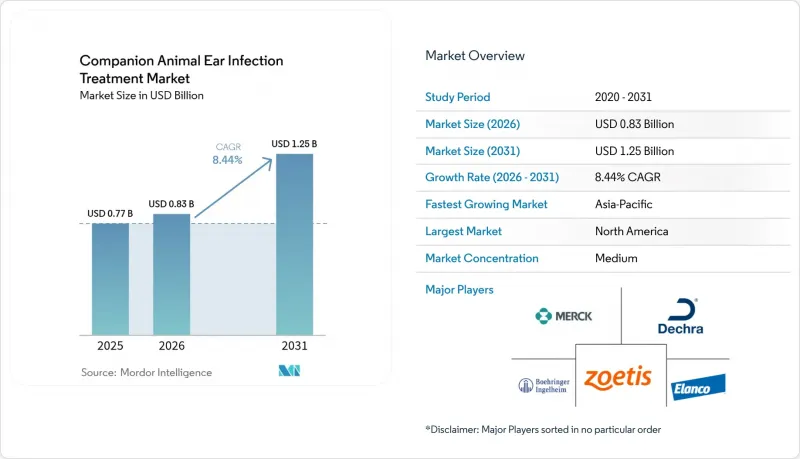
Mordor Intelligence에 의하면, 반려동물 귀 감염증 치료 시장 규모는 2025년 7억 7,000만 달러로 평가되었습니다. 2026년에는 8억 3,000만 달러로 확대되어 2031년까지 12억 5,000만 달러에 이를 것으로 예상되고 2026-2031년에 걸쳐 CAGR 8.44%로 성장할 전망입니다.
본 보고서는 제품 유형(항균제(아미노글리코사이드계, 기타), 기타), 질환 유형(외이염, 기타), 동물 유형(개, 기타), 투여 방법(외용, 기타), 유통 채널(동물병원 및 클리닉, 기타),지역(북미, 유럽, 아시아태평양, 기타)별로 분류되어 있습니다. 시장 예측은 금액(달러) 기준으로 제시되어 있습니다.
세계의 반려동물 귀 감염증 치료 시장 동향 및 인사이트
반려동물 사육률 증가
Z세대 가구 덕분에 2023년부터 2024년에 걸쳐 반려동물 사육률이 43.5% 급증했으며, 미국의 반려동물 사육 가구 수는 9,400만 가구에 달했습니다. 젊은 반려인들은 디지털 우선의 관리 방식을 선호하는 경향이 있어, 이로 인해 처방전이 반려동물 귀 감염증 치료 시장에 필수적인 전자상거래 플랫폼으로 유도되고 있습니다. 중국과 인도의 도시화로 인해 반려동물은 가족의 일원으로 재인식되고 있으며, 귀 치료에 대한 1인당 지출이 증가하고 있습니다. 처진 귀를 가진 견종에서 나타나는 유전적 소인으로 인해 감염 발생률이 높아지고 있어 지속적인 수요가 확보되고 있습니다. 1억 2,900만 명의 미국인에게 영향을 미치고 있는 지방 지역의 수의사 부족은 처방전 발급 건수를 유지하는 원격 의료의 확산을 더욱 촉진하고 있습니다.
증가하는 수의학·헬스케어 지출
2025년 연간 평균 지출액은 개의 경우 598달러, 고양이의 경우 529달러에 달했으나, 지출 양상에는 양극화가 나타났습니다. 부유층 반려인은 전문 의료 서비스를 적극적으로 이용하는 반면, 가격에 민감한 계층은 선택적 치료를 미뤘습니다. 귀 감염증은 미룰 수 없는 치료이기 때문에 수익은 안정적입니다. GCC 지역의 동물병원 개설이나 브라질의 중산층 확대에서도 유사한 경향이 나타나지만, 가격에 민감한 계층에서는 제네릭 항균제가 주류를 이루고 있습니다.
스테로이드의 장기 사용에 따른 부작용
고효능 코르티코스테로이드에 대한 만성적인 노출은 의인성 쿠싱증후군과 관련이 있는 것으로 밝혀졌으며, 2025년 의약품 안전성 모니터링 데이터에 따르면 스테로이드 함유 점이약을 2회 이상 투여받은 개의 귀 염증 사례 중 4.6%에서 보고되었습니다. 이러한 위험을 배경으로, 피부과 전문의들은 베타메타손이나 덱사메타손의 사용을 급성 악화 시에만 제한하고, 광범위한 면역 억제를 동반하지 않으면서 특정 인터루킨 경로를 조절하는 오크라시티닙이나 로키베토맙 등의 사이토카인 억제제로의 전환을 추진하고 있습니다. 보험사들도 고가의 대체 약물을 승인하기 전에 스테로이드 불내성을 입증하도록 요구하는 단계적 치료 규정을 도입하기 시작했으며, 이로 인해 도입 속도는 다소 둔화되고 있지만, 신중한 처방 태도가 강화되고 있습니다.
장기적으로는 지속적인 안전성 심사를 통해 처방 목록 내 선호도가 저용량 복합제, 프로바이오틱스 병용제, 비스테로이드성 항염증제로 이동할 것으로 예상되며, 반려동물의 귀 감염증 치료 시장에서 기존 3성분 복합 점안제의 성장이 억제될 것입니다.
부문별 분석
2025년, 항균제는 반려동물 귀 감염증 치료 시장에서 43.44%의 점유율을 차지했으나, 말라세지아 감염증 증가를 배경으로 항진균제는 연평균 성장률(CAGR) 9.11%로 성장할 전망입니다. 습도가 높은 기후와 귓바퀴가 처진 견종이 진균 감염의 확산을 초래하고 있기 때문에 반려동물 귀 감염증 치료 시장 내 항진균제 시장 규모는 꾸준히 확대될 것으로 예측됩니다. 플루오르페니콜과 말보플록사신, 테르비나핀을 배합한 복합 젤은 프리미엄 제품으로 자리매김하고 있는 반면, 코르티코스테로이드를 배제한 제제는 안전성에 대한 우려를 해소하고 있습니다.
아졸계 약물에 대한 내성은 여전히 드물며, 항진균제에는 추가적인 성장 여지가 있지만, 적정 사용 지침에 따라 플루오로퀴놀론계 약물의 경험적 사용은 감소하고 있습니다. 청색광 광선 요법에 대한 임상시험에서는 항균제를 사용하지 않고도 병원체 부하가 감소하는 것이 확인되었습니다. 마이크로바이옴 관련 제품은 여전히 실험 단계이지만, 투자자들의 높은 관심은 반려동물의 귀 감염증 치료 산업에서 장기적인 변화가 일어날 가능성을 시사하고 있습니다.
외이염은 2025년 매출의 65.12%를 차지하며, 반려동물 귀 감염증 치료 시장에서 그 지배적인 위치를 뒷받침했습니다. 그러나 내이염은 연평균 성장률(CAGR) 9.25%로 성장하고 있습니다. 이는 의뢰 의료기관이 CT나 MRI를 활용하여 내이 질환을 더 조기에 발견하게 되었기 때문입니다. 전정 증상이 전문의의 평가를 유도함에 따라, 첨단 영상 진단 기술의 도입에 힘입어 반려동물 귀 감염증 치료 시장 규모는 확대되고 있습니다.
중증 외이염은 경증과 만성 두 가지 코호트로 분류됩니다. 전자의 경우 저비용 제네릭 의약품이 선호되는 반면, 후자의 경우 복약 순응도에 의존하지 않는 지속형 젤이 선택됩니다. 중이염의 경우, 많은 경우 고막 절개술이 시행되기 때문에 매출은 전문 병원에 집중되어 있습니다.
지역별 분석
북미는 보험 보급률이 높고, 동물병원 밀도가 높으며, 높은 수준의 가격 책정에 힘입어 2025년에는 전 세계 매출의 43.43%를 차지했습니다. 이 지역의 반려동물 귀 감염증 치료 시장 규모는 거시경제적 역풍에도 불구하고 견조한 모습을 유지하고 있습니다. 이는 귀 감염증이 응급 처치가 필요한 질환이기 때문입니다. 항균제 적정 사용 지침에 따라 플루오로퀴놀론계 약제의 사용량은 감소하고 있지만, 배양 검사 및 협역 스펙트럼 약제에 대한 수요는 증가하고 있습니다. 지방 지역의 약품 부족이 원격의료의 보급을 촉진하고 있으며, 접근성을 유지하기 위해 온라인 진료와 통신판매가 결합되고 있습니다.
이어 유럽은 엄격한 항생제 적정 사용 관리와 주요 시장에서 25% 이상의 보험 적용률을 특징으로 하는 성숙한 체계를 갖추고 있습니다. 유럽의약품청(EMA)의 승인 조화를 통해 국경을 넘는 제품 출시가 신속해지고 있지만, 조제 규정의 차이로 인해 유통은 여전히 분절되어 있습니다. 시장 성장은 꾸준하지만, 이미 높은 보급률을 배경으로 아시아태평양보다는 완만한 속도를 보이고 있습니다.
아시아태평양은 중국과 인도의 견인에 힘입어 9.77%라는 가장 높은 연평균 성장률(CAGR)을 기록하고 있습니다. 이들 국가에서는 가처분 소득 증가와 문화적 가치관의 변화로 인해 반려동물이 가족과 다름없는 존재가 되었습니다. 도시 지역에서는 전자상거래 채널이 주류를 이루고 있어, 제조업체들은 고르지 않은 동물병원 네트워크를 우회할 수 있게 되었습니다. Vetoquinol이 2025년에 중국에서 설립할 합작 사업과 같은 현지 생산 파트너십은 규제 대응을 가속화하고 물류 비용을 절감합니다.
남미에서는 양극화된 경향이 나타납니다. 브라질에서는 중산층의 확대가 수요를 끌어올리고 있지만, 가격에 대한 민감성으로 인해 제네릭 의약품이 여전히 주류를 이루고 있습니다. GCC 지역에서는 새로운 동물병원에 대한 투자가 진행되고 있으나, 온난한 기후로 인해 생물학적 제제의 콜드체인 관리에 어려움이 따르고 있습니다. 아프리카는 여전히 시장이 미성숙하고 데이터도 제한적이지만, 남아프리카공화국이나 케냐의 도시 지역 중산층 사이에서는 고급 반려동물 케어 제품이 조기에 받아들여지고 있습니다. 전반적으로 신흥 시장은 반려동물의 귀 감염증 치료 시장에서 수익원을 다각화하고, 성숙한 지역 시장 포화 위험을 완화하는 역할을 하고 있습니다.
기타 혜택
- 엑셀 형식 시장 예측(ME) 시트
- 3개월간의 애널리스트 지원
자주 묻는 질문
목차
제1장 서론
제2장 조사 방법
제3장 주요 요약
제4장 시장 구도
제5장 시장 규모 및 성장 예측
제6장 경쟁 구도
제7장 시장 기회 및 향후 전망
KTH 26.09.14According to Mordor Intelligence, the companion animal ear infection treatment market size is expected to increase from USD 0.77 billion in 2025 to USD 0.83 billion in 2026 and reach USD 1.25 billion by 2031, growing at a CAGR of 8.44% over 2026-2031.
This report is Segmented by Product Type [Antibacterial (Aminoglycosides and More), and More], Disease Type (Otitis Externa, and More), Animal Type (Dogs, and More), Mode of Administration (Topical, and More), Sales Channel (Veterinary Hospitals & Clinics, and More), Geography (North America, Europe, Asia-Pacific, and More). The Market Forecasts are Provided in Terms of Value (USD).
Global Companion Animal Ear Infection Treatment Market Trends and Insights
Increasing Companion Animal Ownership Rates
Gen Z households drove a 43.5% jump in pet adoption between 2023 and 2024, lifting U.S. pet ownership to 94 million homes . Younger owners favor digital-first care, which funnels prescriptions toward e-commerce platforms integral to the companion animal ear infection treatment market. Urbanization in China and India reframes pets as family members, increasing per-capita spending on otic therapeutics. Breed predisposition among dogs with pendulous ears elevates infection incidence, ensuring recurring demand. Rural veterinary shortages affecting 129 million Americans further reinforce telehealth uptake that sustains prescription throughput
Rising Veterinary Healthcare Expenditure
Average annual outlays reached USD 598 for dogs and USD 529 for cats in 2025, but spending polarized: affluent owners embraced specialty services while cost-conscious segments deferred elective care . Ear infections remain non-deferrable, insulating revenue. GCC clinic openings and Brazil's expanding middle class replicate this pattern, though generic antibacterials dominate price-sensitive tiers.
Adverse Effects Associated with Long-Term Steroid Use
Chronic exposure to high-potency corticosteroids has been linked to iatrogenic Cushing-like syndromes, reported in 4.6% of canine otitis cases that required more than two refills of steroid-containing drops in 2025 pharmacovigilance data. These risks prompt dermatologists to reserve betamethasone or dexamethasone for acute flares and to pivot toward cytokine inhibitors such as oclacitinib or lokivetmab, which modulate specific interleukin pathways without broad immunosuppression. Insurers are beginning to impose step-therapy rules that require documentation of steroid intolerance before approving premium alternatives, slightly slowing uptake but reinforcing careful prescribing.
Over time, sustained safety scrutiny is expected to shift formulary preferences toward lower-dose combinations, probiotic adjuncts, and non-steroidal anti-inflammatories, constraining growth for legacy triple-combination drops within the companion animal ear infection treatment market.
Other drivers and restraints analyzed in the detailed report include:
- Growing Availability of Advanced Otic Therapeutics
- Expansion of Pet Telehealth Services
- Low Owner Awareness of Early Ear Disease Symptoms
For complete list of drivers and restraints, kindly check the Table Of Contents.
Segment Analysis
Antibacterials captured 43.44% companion animal ear infection treatment market share in 2025, yet antifungals are set for a 9.11% CAGR on the back of rising Malassezia infections. The companion animal ear infection treatment market size for antifungals is projected to expand steadily as humid climates and floppy-eared breeds drive fungal prevalence. Combination gels blending florfenicol or marbofloxacin with terbinafine illustrate premium positioning, while corticosteroid-sparing formulas answer safety concerns.
Azole resistance remains uncommon, giving antifungals headroom, whereas stewardship guidelines diminish empirical fluoroquinolone use. Blue-light phototherapy trials posted pathogen-load reductions without antimicrobials. Microbiome products remain experimental, but investor interest signals potential long-term disruption to the companion animal ear infection treatment industry.
Otitis externa generated 65.12% of 2025 revenue, confirming its dominance within the companion animal ear infection treatment market. Yet otitis interna is pacing a 9.25% CAGR because referral centers now deploy CT and MRI to detect inner-ear disease earlier. The companion animal ear infection treatment market size attached to advanced imaging referrals is growing as vestibular signs trigger specialist evaluation.
Severe externa splits into mild and chronic cohorts: the first group favors low-cost generics, the second opts for compliance-independent long-acting gels. Otitis media often involves surgical myringotomy, concentrating revenue in specialty hospitals.
Complete Report Scope:
- By Product Type
- Antibacterial
- Aminoglycosides
- Fluoroquinolones
- Other Antibacterial Products
- Antifungal
- Corticosteroids
- Other Product Types
- Antibacterial
- By Disease Type
- Otitis Externa
- Otitis Media
- Otitis Interna
- By Animal Type
- Dogs
- Cats
- Other Animal Types
- By Mode of Administration
- Topical
- Oral
- Otic
- By Sales Channel
- Veterinary Hospitals & Clinics
- Retail Pharmacies & Pet Stores
- Online Pharmacies & Direct-to-Consumer
- By Geography
- North America
- United States
- Canada
- Mexico
- Europe
- Germany
- United Kingdom
- France
- Italy
- Spain
- Rest of Europe
- Asia-Pacific
- China
- India
- Japan
- South Korea
- Australia
- Rest of Asia-Pacific
- Middle East and Africa
- GCC
- South Africa
- Rest of Middle East and Africa
- South America
- Brazil
- Argentina
- Rest of South America
- North America
Geography Analysis
North America generated 43.43% of global revenue in 2025, underpinned by high insurance penetration, strong clinic density, and premium pricing levels. The companion animal ear infection treatment market size in the region remains resilient despite macro headwinds because ear infections are non-elective. Stewardship guidelines reduce fluoroquinolone volume but lift demand for culture tests and narrow agents. Rural shortages drive telehealth uptake, coupling virtual care with mail-order delivery to maintain access.
Europe follows with a mature framework characterized by stringent antimicrobial stewardship and 25%-plus insurance coverage in core markets. Harmonized EMA approvals expedite cross-border launches, yet differences in compounding rules still fragment distribution. Market growth is steady but slower than Asia-Pacific due to already high baseline penetration.
Asia-Pacific posts the fastest 9.77% CAGR, propelled by China and India, where rising disposable incomes and shifting cultural values elevate pets to family status. E-commerce channels dominate urban centers, letting manufacturers sidestep uneven clinic networks. Local production partnerships, such as Vetoquinol's 2025 joint venture in China, accelerate regulatory navigation and cut logistics costs.
South America shows a bifurcated profile: Brazil's middle class expands demand, but price sensitivity keeps generics dominant. GCC states invest in new clinics, yet warm climates raise cold-chain challenges for biologics. Africa remains nascent with limited data, but urban middle classes in South Africa and Kenya show early adoption of premium pet care. Collectively, emerging markets diversify revenue streams and cushion saturation risks in established regions of the companion animal ear infection treatment market.
- Bimeda Animal Health
- Boehringer Ingelheim
- Ceva Sante Animale
- Chanelle Pharma
- Dechra Pharmaceuticals
- Elanco Animal Health Inc.
- Innovet Italia
- Med-Pharmex
- Merck
- Nexvet Biopharma
- Norbrook Laboratories
- Vetoquinol
- Virbac
- Zoetis
- Zymox
Additional Benefits:
- The market estimate (ME) sheet in Excel format
- 3 months of analyst support
TABLE OF CONTENTS
1 Introduction
- 1.1 Study Assumptions & Market Definition
- 1.2 Scope of the Study
2 Research Methodology
3 Executive Summary
4 Market Landscape
- 4.1 Market Overview
- 4.2 Market Drivers
- 4.2.1 Increasing Companion Animal Ownership Rates
- 4.2.2 Rising Veterinary Healthcare Expenditure
- 4.2.3 Growing Availability of Advanced Otic Therapeutics
- 4.2.4 Expansion of Pet Telehealth Services
- 4.2.5 Emerging Microbiome-Based Treatment Approaches
- 4.2.6 Proactive Wellness Programs by Pet Insurers
- 4.3 Market Restraints
- 4.3.1 Adverse Effects Associated with Long-Term Steroid Use
- 4.3.2 Low Owner Awareness of Early Ear Disease Symptoms
- 4.3.3 Escalating Antimicrobial Resistance in Otic Pathogens
- 4.3.4 Regulatory Restrictions on Compounded Otic Formulations
- 4.4 Regulatory Landscape
- 4.5 Porter's Five Forces
- 4.5.1 Threat of New Entrants
- 4.5.2 Bargaining Power of Buyers/Consumers
- 4.5.3 Bargaining Power of Suppliers
- 4.5.4 Threat of Substitute Products
- 4.5.5 Intensity of Competitive Rivalry
5 Market Size & Growth Forecasts (Value, USD)
- 5.1 By Product Type
- 5.1.1 Antibacterial
- 5.1.1.1 Aminoglycosides
- 5.1.1.2 Fluoroquinolones
- 5.1.1.3 Other Antibacterial Products
- 5.1.2 Antifungal
- 5.1.3 Corticosteroids
- 5.1.4 Other Product Types
- 5.1.1 Antibacterial
- 5.2 By Disease Type
- 5.2.1 Otitis Externa
- 5.2.2 Otitis Media
- 5.2.3 Otitis Interna
- 5.3 By Animal Type
- 5.3.1 Dogs
- 5.3.2 Cats
- 5.3.3 Other Animal Types
- 5.4 By Mode of Administration
- 5.4.1 Topical
- 5.4.2 Oral
- 5.4.3 Otic
- 5.5 By Sales Channel
- 5.5.1 Veterinary Hospitals & Clinics
- 5.5.2 Retail Pharmacies & Pet Stores
- 5.5.3 Online Pharmacies & Direct-to-Consumer
- 5.6 By Geography
- 5.6.1 North America
- 5.6.1.1 United States
- 5.6.1.2 Canada
- 5.6.1.3 Mexico
- 5.6.2 Europe
- 5.6.2.1 Germany
- 5.6.2.2 United Kingdom
- 5.6.2.3 France
- 5.6.2.4 Italy
- 5.6.2.5 Spain
- 5.6.2.6 Rest of Europe
- 5.6.3 Asia-Pacific
- 5.6.3.1 China
- 5.6.3.2 India
- 5.6.3.3 Japan
- 5.6.3.4 South Korea
- 5.6.3.5 Australia
- 5.6.3.6 Rest of Asia-Pacific
- 5.6.4 Middle East and Africa
- 5.6.4.1 GCC
- 5.6.4.2 South Africa
- 5.6.4.3 Rest of Middle East and Africa
- 5.6.5 South America
- 5.6.5.1 Brazil
- 5.6.5.2 Argentina
- 5.6.5.3 Rest of South America
- 5.6.1 North America
6 Competitive Landscape
- 6.1 Market Concentration
- 6.2 Market Share Analysis
- 6.3 Company Profiles (includes Global level Overview, Market level overview, Core Segments, Financials as available, Strategic Information, Market Rank/Share for key companies, Products & Services, and Recent Developments)
- 6.3.1 Bimeda Animal Health
- 6.3.2 Boehringer Ingelheim Animal Health
- 6.3.3 Ceva Sante Animale
- 6.3.4 Chanelle Pharma
- 6.3.5 Dechra Pharmaceuticals PLC
- 6.3.6 Elanco Animal Health Inc.
- 6.3.7 Innovet Italia
- 6.3.8 Med-Pharmex
- 6.3.9 Merck & Co., Inc.
- 6.3.10 Nexvet Biopharma
- 6.3.11 Norbrook Laboratories
- 6.3.12 Vetoquinol SA
- 6.3.13 Virbac SA
- 6.3.14 Zoetis Inc.
- 6.3.15 Zymox
7 Market Opportunities & Future Outlook
- 7.1 White-space & Unmet-Need Assessment


