|
시장보고서
상품코드
2124838
상용차 텔레매틱스 : 시장 점유율 분석, 업계 동향 및 통계, 성장 예측(2026-2031년)Commercial Vehicle Telematics - Market Share Analysis, Industry Trends & Statistics, Growth Forecasts (2026 - 2031) |
||||||
 Mordor Intelligence
Mordor Intelligence에 의하면, 상용차 텔레매틱스 시장 규모는 2025년 184억 7,000만 달러로 평가되었습니다. 2026년에는 211억 9,000만 달러로 확대되어 2031년까지 420억 8,000만 달러에 이를 것으로 전망되고 2026-2031년에 걸쳐 CAGR 14.71%를 나타낼 것으로 예측됩니다.
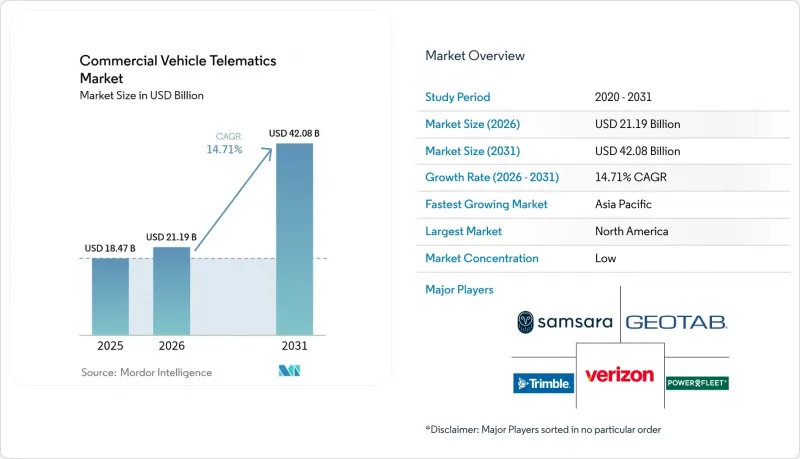
본 보고서는 제공 제품(솔루션, 서비스), 공급자 유형(OEM, 애프터마켓), 차량 등급(대형·중형 상용차, 기타), 통신 기술(셀룰러, 위성, 하이브리드), 최종 사용자 산업(유틸리티, 보험·리스, 기타), 지역별로 분류되어 있습니다. 시장 전망은 금액(달러) 기준으로 제시되어 있습니다.
세계의 상용차 텔레매틱스 시장 동향 및 인사이트
대형 트럭에 대한 공장 출고 시 탑재된 OEM 텔레매틱스 도입 확대
각 트럭 제조업체는 현재 조립 라인에서 텔레매틱스 장치를 출고 시 표준 장비로 장착하고 있으며, 이를 통해 차량 운영사는 사후 장착으로 인한 가동 중단 시간 없이 차량 데이터에 즉시 접근할 수 있게 되었습니다. 예를 들어, 다임러 트럭(Daimler Trucks)은 자사의 ‘TruckCharge’ 소프트웨어를 공장 출하 시 장착된 장치와 연동하여, 사업자가 전기 트랙터의 충전 정지 지점을 미세 조정할 수 있도록 하고 있습니다. 볼보 트럭은 연결된 대형 차량이 100만 대를 돌파했으며, 진단 데이터를 스트리밍함으로써 예기치 못한 고장과 연료 낭비를 줄이고 있습니다. TRATON은 스카니아, MAN, 나비스타 브랜드를 합쳐 115만 대의 연결된 트럭을 보고하고 있으며, 데이터 구독을 이익률 향상 수단으로 활용하고 있습니다. 공장 내 통합을 통해 트럭 1대당 수명 주기 하드웨어 비용은 절감되지만, 차량 함대가 여러 브랜드를 혼합하여 운영할 경우 전환 장벽이 높아지므로, 소프트웨어 공급업체는 여러 OEM의 데이터를 하나의 대시보드로 통합해야 하는 압박을 받고 있습니다.
전자운행기록장치(ELD)와 안전 규제의 의무화
각국 정부는 운전자의 근무 시간을 모니터링하기 위해 전자 기록 장치 장착을 의무화하고 있어, 텔레매틱스는 선택 사항이 아닌 필수 사항이 되었습니다. 연방자동차운송안전청(FMCSA)은 도로변 감사 시 운전석 장치에서 직접 근무 시간 기록 파일을 추출하고 있습니다. 유럽의 스마트 타코그래프 업그레이드는 근로시간 지침을 따르는 것으로, 차량 운용사는 2026년까지 1세대 기록 장치를 교체해야 합니다. 인도 교통부는 트럭과 버스에 위치 추적 기능과 비상 버튼의 장착을 의무화하고 있어, 가격에 민감한 시장 전반에 걸친 도입을 가속화하고 있습니다. 지역별로 다른 기준을 준수하는 것은 엔지니어링 비용을 증가시키지만, 규제의 존재는 공급업체에게 최소한의 기기 수요를 보장해 줍니다.
연결형 상용 차량의 사이버 보안 취약점
바퀴 위를 달리는 컴퓨터는 브레이크, 조향 장치, 적재 시스템을 해커의 공격에 노출시키고 있습니다. 유럽연합(EU)의 WP.29 규정에 따라 트럭 제조업체는 안전한 개발 방법론 인증과 수명 주기 전반에 걸친 패치 적용을 의무화하고 있지만, 수백만 대에 달하는 구형 차량에는 암호화된 부트로더가 탑재되어 있지 않습니다. EU 사이버보안청의 2025년 보고서는 암호 키 관리가 부실할 경우, 무선 업데이트가 새로운 공격 경로를 초래할 우려가 있다고 경고했습니다. 주목받는 보안 침해 사고가 발생하면 차량 운행 중단이나 화물 안전이 위협받을 우려가 있으며, 위험 회피 성향이 강한 소규모 사업자의 투자는 공급업체가 침입 감지 기능이나 사이버 보험을 번들로 제공하기 시작할 때까지 미뤄질 가능성이 있습니다. 보안 강화로 인해 단말기 비용이 상승하는 가운데, 구매자들은 가격 인상분과 잠재적인 법적 책임을 저울질하며 검토하고 있습니다.
부문별 분석
2025년, 상용차 텔레매틱스 시장 매출의 63.42%를 솔루션이 차지했으며, 그 범위에는 추적, 운전자 관리, 보험 텔레매틱스, 규정 준수, V2X, 예측 유지보수, 자산 모니터링이 포함됩니다. 사업자들은 자본 지출보다 예측 가능한 운영 예산을 선호하기 때문에 서비스 부문은 2031년까지 연평균 성장률(CAGR) 15.11%로 성장하여 시장 전체를 상회하는 성장세를 보일 것으로 예측됩니다. 관리형 서비스 부문의 상용차 텔레매틱스 시장은 공급업체가 하드웨어, 통신 요금, 분석, 지원을 하나의 청구서로 통합하고 차량 대수에 따라 요금이 변동하는 방식을 채택함으로써 성장하고 있습니다.
차량 추적은 여전히 가장 큰 솔루션 분야이지만, 가동 중단으로 인한 손실이 확대됨에 따라 예측 유지보수의 중요성이 높아지고 있습니다. 시스템 통합 및 맞춤형 분석과 같은 전문 서비스는 기존 배차 시스템과 최신 클라우드 대시보드를 연동하는 대규모且 다양한 자산을 보유한 차량 군에게 필수적입니다. 매니지드 서비스는 전담 IT 인력을 보유하지 않은 소규모 운송업체들로부터 지지를 받고 있으며, 운영자의 개입을 최소화하면서 가동 시간 보장, 원격 문제 해결, 규정 준수 보고를 제공하는 공급업체와의 계약 체결로 이어지고 있습니다.
2025년에는 OEM 채널이 매출의 58.71%를 차지했습니다. 이는 모든 신형 대형 트럭 플랫폼에 출고 시 해당 장치가 기본 탑재되어 출하되기 때문입니다. 한편, 애프터마켓 공급업체는 많은 지역 운송 및 특수 용도 업무에서 여전히 주류를 차지하고 있는 구형 차량을 현대화하는 개조 설치 키트를 통해 연평균 성장률(CAGR) 15.14%로 성장을 지속하고 있습니다. 상용차 텔레매틱스 시장 점유율은 OEM 장치를 통한 차량과 네트워크의 깊은 통합과, 벤더 중립성 및 신속한 혁신 주기를 특징으로 하는 애프터마켓 플러그인 사이에서 사업자들이 판단을 내려야 하는 상황에서 여전히 양분된 상태를 유지하고 있습니다.
여러 브랜드가 혼재된 차량 함대에서는 OEM 고유의 데이터 피드를 단일 사용자 인터페이스에 통합하여 배차 담당자의 업무 부담을 줄여주는 미들웨어가 환영받고 있습니다. 이에 대응하여 각 OEM 업체는 API를 개방하고, 주요 애프터마켓 대시보드와 연동된 하이브리드 패키지를 공동 판매하고 있습니다. 이러한 ‘협력적 경쟁(coopetition)’ 모델을 통해 트럭 제조업체는 하드웨어 표준화라는 우위를 유지하면서, 다양한 브랜드와 연식에 걸쳐 분석 결과의 통일성을 요구하는 차량 관리 업체의 요구에도 부응할 수 있게 됩니다.
지역별 분석
북미는 엄격한 운전 시간 규제의 시행과 고밀도 휴대전화 네트워크의 보급으로 인해 2025년 상용차 텔레매틱스 시장 매출의 34.66%를 차지했습니다. 대형 운송 기업들은 도입을 거의 완료한 상태이므로, 향후 성장은 소프트웨어를 자체적으로 호스팅하는 것이 아니라 관리형 서비스 계약을 체결하는 지자체, 우편 사업, 소규모 차량 부문에서 비롯될 것입니다. 특히 캘리포니아주의 규제 대상 지역에서 배터리식 전기 배송 트럭의 도입이 진행됨에 따라, 주행 거리를 예측하고 운전자를 충전소로 안내하는 통합형 에너지 관리 대시보드에 대한 수요가 증가하고 있습니다. 국경을 넘는 운송업체들은 캐나다 북부와 멕시코 남부의 농촌 지역 통신망이 미흡함에도 불구하고, 통합된 규정 준수 포털을 통해 미국, 캐나다, 멕시코의 각 사업을 연계하고 있습니다.
아시아태평양은 2031년까지 연평균 성장률(CAGR) 15.78%로 가장 높은 성장세를 보이고 있습니다. 중국에서는 OEM에 장치 탑재를 의무화하는 커넥티드카 목표가 시행되고 있는 반면, 국내 주요 물류 기업들은 텔레매틱스를 창고 자동화 및 라이드셰어형 화물 플랫폼과 통합하고 있습니다. 인도에서 비상 버튼 및 위치 정보 추적 의무화로 인해 비용 측면의 장벽이 제거되어, 수백만 대의 트럭과 버스에 기본 장치가 도입되고 있습니다. 일본은 경로 최적화 알고리즘을 활용하여 운전기사 부족 문제에 대응하고 있으며, 한국은 5G 기반 스마트 물류 회랑에 자금을 투입하고 있습니다. 지방의 통신망 사각지대와 저비용 현지 공급업체의 확산으로 인해 차량당 평균 수익은 억제되고 있지만, 판매량 증가가 가격 측면의 역풍을 상쇄하여 지역 전체의 총 지출을 확대시키고 있습니다.
유럽에서는 텔레매틱스의 성숙한 보급 현황과 엄격한 데이터 개인정보 보호 및 사이버 보안 규제가 공존하고 있습니다. 디지털 타코그래프의 스테이지 II로의 업그레이드, 저배출 구역, 제로 에미션 트럭에 대한 인센티브로 인해 교체 주기가 활발하게 유지되고 있습니다. 사업자들은 하드웨어를 교체하지 않고도 고도화된 분석 기능을 활용할 수 있는 소프트웨어 정의형 서비스의 구매를 늘리고 있으며, 이는 볼보(Volvo)와 다임러(Daimler)의 무선 업데이트 전략과 일맥상통합니다. 대규모 차량 군에 대한 보급이 거의 완료됨에 따라 성장은 둔화되고 있으며, 각 벤더들은 상용차 텔레매틱스 시장과 연계된 관리형 분석 및 배터리 최적화 모듈의 업셀링을 추진하고 있습니다. 동유럽의 운송 경로에서는 도로 화물 운송이 증가하고 있는 미개척 기회가 있지만, 연결성 보급률은 여전히 서유럽 평균보다 낮습니다.
남미, 중동 및 아프리카는 모두 규모는 작지만, 합쳐서 15% 중반대의 성장률을 보이고 있습니다. 브라질의 밀집된 농업 비즈니스 회랑에서는 외딴 지역의 플랜테이션 전반에 걸친 자산 추적이 요구되고 있지만, 거시경제의 변동으로 인해 자본 예산 확대가 둔화되고 있습니다. 걸프협력회의(GCC) 회원국들은 텔레매틱스와 자동 요금 징수, 그린존 규제를 결합한 스마트 시티형 화물 운송 이니셔티브에 투자하고 있습니다. 아프리카의 과제는 여전히 네트워크 커버리지이지만, 남아프리카공화국과 보츠와나의 광업 기업들은 고가 장비를 관리하기 위해 위성 연결형 단말기를 도입하고 있습니다. 이집트와 사우디아라비아의 정부 차량 디지털화 프로그램은 공공 부문의 도입을 촉진하고 있으며, 국제 공급업체들에게 주요 고객 기반을 제공합니다.
기타 혜택
- 엑셀 형식 시장 예측(ME) 시트
- 3개월간의 애널리스트 지원
자주 묻는 질문
목차
제1장 서론
제2장 조사 방법
제3장 주요 요약
제4장 시장 구도
제5장 시장 규모 및 성장 예측
제6장 경쟁 구도
제7장 시장 기회 및 향후 전망
KTHAccording to Mordor Intelligence, the commercial vehicle telematics market size is expected to increase from USD 18.47 billion in 2025 to USD 21.19 billion in 2026 and reach USD 42.08 billion by 2031, growing at a CAGR of 14.71% over 2026-2031.

This report is Segmented by Offering (Solutions and Services), Provider Type (Original Equipment Manufacturer, and Aftermarket), Vehicle Class (Heavy and Medium Commercial Vehicles, and More), Communication Technology (Cellular, Satellite, Hybrid), End-User Vertical (Utilities, Insurance and Leasing, and More), and Geography. The Market Forecasts are Provided in Terms of Value (USD).
Global Commercial Vehicle Telematics Market Trends and Insights
Increasing Adoption of Factory-Installed OEM Telematics in Heavy Trucks
Truck makers now pre-install telematics units on the assembly line, giving fleets instant access to vehicle data without downtime for retrofits. Daimler Truck, for instance, links its TruckCharge software to factory devices so operators fine-tune charging stops for electric tractors. Volvo Trucks surpassed one million connected heavy units, streaming diagnostics that cut surprise breakdowns and fuel waste. TRATON reported 1.15 million connected trucks across its Scania, MAN, and Navistar brands, turning data subscriptions into a margin lever. Factory integration lowers lifetime hardware cost per truck, yet raises switching barriers when fleets run mixed brands, pushing software vendors to aggregate multiple OEM feeds in one dashboard.
Mandatory Electronic Logging-Device and Safety Regulations
Governments require electronic logging devices to police driver hours, making telematics compulsory rather than optional. The Federal Motor Carrier Safety Administration conducts roadside audits that pull hours-of-service files directly from cab units. Europe's smart tachograph upgrade aligns with working-time directives, forcing fleets to replace first-generation recorders by 2026. India's transport ministry mandates location tracking and an emergency button on trucks and buses, accelerating adoption across a price-sensitive market. Complying with different regional standards inflates engineering costs, but the rulebook still guarantees baseline device demand for vendors.
Cyber-Security Vulnerabilities in Connected Commercial Vehicles
Rolling computers on wheels expose braking, steering, and payload systems to hackers. The European Union's WP.29 regulation now obliges truck makers to certify secure development practices and ensure life-cycle patching, but millions of legacy units lack encrypted boot loaders. A 2025 report from the EU Agency for Cybersecurity warns that over-the-air updates introduce new attack vectors if cryptographic keys are poorly managed. High-profile breaches could immobilize fleets or compromise cargo, delaying investment among risk-averse small operators until vendors add intrusion detection and bundled cyber insurance. As security hardening raises device cost, buyers weigh the price premium against potential liability.
Other drivers and restraints analyzed in the detailed report include:
- Demand for AI-Driven Fleet Optimisation to Cut Total Cost of Ownership
- Rapid Expansion of Last-Mile E-Commerce Delivery Fleets
- Fragmented Connectivity Infrastructure in Developing Regions
For complete list of drivers and restraints, kindly check the Table Of Contents.
Segment Analysis
Solutions held 63.42% of commercial vehicle telematics market revenue in 2025, covering tracking, driver management, insurance telematics, compliance, V2X, predictive maintenance, and asset monitoring. Services are projected to outpace the overall market, with a 15.11% CAGR to 2031, as operators prefer predictable operating budgets to capital outlays. The commercial vehicle telematics market for managed services is growing as vendors now bundle hardware, airtime, analytics, and support into a single invoice that scales with fleet count.
Fleet tracking remains the largest solution subset, yet predictive maintenance gains ground as downtime penalties escalate. Professional services such as system integration and custom analytics are critical for large, mixed-asset fleets that link legacy dispatch systems with modern cloud dashboards. Managed offerings resonate with small carriers lacking full-time IT staff, tipping contract awards toward providers that guarantee uptime, remote troubleshooting, and compliance reporting with minimal operator intervention.
OEM channels accounted for 58.71% of revenue in 2025 because factory-installed units are shipped with every new heavy truck platform. Meanwhile, aftermarket vendors post a 15.14% CAGR as retrofit kits modernize older vehicles that still dominate many regional haul and vocational operations. The commercial vehicle telematics market share remains split as operators weigh deep vehicle-network integration from OEM devices against the vendor neutrality and faster innovation cadence of aftermarket plugs.
Mixed-brand fleets welcome middleware that consolidates proprietary OEM data feeds under a single user interface, reducing dispatcher workload. OEMs respond by opening APIs and co-marketing hybrid packages with leading aftermarket dashboards. This coopetition model preserves hardware standardization leverage for truck builders while satisfying fleets that demand analytics uniformity across diverse brands and model years.
Complete Report Scope:
- By Offering
- Solutions
- Fleet Tracking and Monitoring
- Driver Management
- Insurance Telematics
- Safety and Compliance
- V2X Solutions
- Predictive Maintenance and Diagnostics
- Asset and Trailer Tracking
- Services
- Professional Services
- Managed Services
- Solutions
- By Provider Type
- Original Equipment Manufacturer
- Aftermarket
- By Vehicle Class
- Light Commercial Vehicles
- Heavy and Medium Commercial Vehicles
- By Communication Technology
- Cellular
- Satellite
- Hybrid
- By End-User Vertical
- Transportation and Logistics
- Construction and Mining
- Public Sector and Emergency Services
- Utilities
- Insurance and Leasing
- Retail and E-Commerce
- Other End-User Verticals
- By Geography
- North America
- United States
- Canada
- Mexico
- South America
- Brazil
- Argentina
- Rest of South America
- Europe
- United Kingdom
- Germany
- France
- Italy
- Rest of Europe
- Asia Pacific
- China
- Japan
- India
- South Korea
- Rest of Asia Pacific
- Middle East and Africa
- Middle East
- United Arab Emirates
- Saudi Arabia
- Rest of Middle East
- Africa
- South Africa
- Egypt
- Rest of Africa
- Middle East
- North America
Geography Analysis
North America retained 34.66% of the commercial vehicle telematics market revenue in 2025, owing to strict hours-of-service enforcement and dense cellular coverage. Large enterprise haulers have largely completed rollouts, so incremental growth stems from municipal, postal, and small-fleet segments that sign managed-service deals rather than self-hosting software. The rising adoption of battery-electric delivery trucks, particularly in California compliance zones, is boosting demand for integrated energy-management dashboards that forecast range and direct drivers to charging stations. Cross-border carriers link United States, Canadian, and Mexican operations under unified compliance portals despite patchy rural coverage in northern Canada and southern Mexico.
Asia-Pacific carries the fastest 15.78% CAGR through 2031. China enforces connected-vehicle targets that compel OEMs to embed devices, while domestic logistics giants integrate telematics with warehouse automation and ride-hailing style freight platforms. India's emergency-button and location-tracking mandate removes cost-sensitive barriers, pushing basic units into millions of trucks and buses. Japan combats driver shortages with route-optimization algorithms, and South Korea funds 5G-based smart logistics corridors. Rural coverage gaps and the prevalence of low-cost local suppliers temper average revenue per unit, but volume outweighs pricing headwinds, expanding total regional spend.
Europe combines mature adoption with stringent data privacy and cybersecurity rules. Digital tachograph stage-II upgrades, low-emission zones, and zero-emission truck incentives keep replacement cycles brisk. Operators increasingly purchase software-defined services that unlock enhanced analytics without swapping hardware, aligning with over-the-air update strategies from Volvo and Daimler. Growth moderates as large fleets complete full penetration, pushing vendors to upsell managed analytics and battery optimization modules tied to the commercial vehicle telematics market. Eastern European corridors offer white-space opportunities where road freight is rising, but connectivity penetration still trails Western averages.
South America, the Middle East, and Africa collectively post mid-teens growth from smaller bases. Brazil's dense agribusiness corridors demand asset tracking across remote plantations, yet macro-economic volatility slows capital budgets. Gulf Cooperation Council states invest in smart-city freight initiatives that bundle telematics with automated tolling and green-zone enforcement. Africa's challenge remains network coverage, although mining companies in South Africa and Botswana adopt satellite-linked units to manage high-value equipment. Government fleet-digitization programs across Egypt and Saudi Arabia spur public-sector uptake, providing anchor accounts for international vendors.
- Verizon Communications Inc.
- Geotab Inc.
- Samsara Inc.
- Trimble Inc.
- Vontier Corporation
- Powerfleet Inc.
- Omnitracs LLC
- Lytx Inc.
- CalAmp Corp.
- Webfleet Solutions
- PTC Inc.
- Octo Telematics SpA
- Zonar Systems, Inc.
- Gurtam Inc.
- Motive Technologies Inc.
- GPS Insight
- Semtech Corporation
- Cartrack Holdings Limited
- Vehicle Tracking Solutions, LLC
- Azuga Inc.
- Platform Science, Inc.
Additional Benefits:
- The market estimate (ME) sheet in Excel format
- 3 months of analyst support
TABLE OF CONTENTS
1 INTRODUCTION
- 1.1 Study Assumptions and Market Definition
- 1.2 Scope of the Study
2 RESEARCH METHODOLOGY
3 EXECUTIVE SUMMARY
4 MARKET LANDSCAPE
- 4.1 Market Overview
- 4.2 Market Drivers
- 4.2.1 Increasing Adoption of Factory-Installed OEM Telematics in Heavy Trucks
- 4.2.2 Mandatory Electronic Logging-Device and Safety Regulations
- 4.2.3 Demand for AI-Driven Fleet Optimisation to Cut Total Cost of Ownership
- 4.2.4 Rapid Expansion of Last-Mile E-Commerce Delivery Fleets
- 4.2.5 Emergence of Subscription-Based Telematics Data Marketplaces
- 4.2.6 Integration of Telematics with Zero-Emission Truck Energy and Charge Management
- 4.3 Market Restraints
- 4.3.1 Cyber-Security Vulnerabilities in Connected Commercial Vehicles
- 4.3.2 Fragmented Connectivity Infrastructure in Developing Regions
- 4.3.3 Cost and ROI Concerns for Small Fleet Operators
- 4.3.4 Data-Ownership and Privacy-Compliance Hurdles
- 4.4 Industry Value Chain Analysis
- 4.5 Regulatory Landscape
- 4.6 Technological Outlook
- 4.7 Impact of Macroeconomic Factors on the Market
- 4.8 Porter's Five Forces Analysis
- 4.8.1 Threat of New Entrants
- 4.8.2 Bargaining Power of Buyers/Consumers
- 4.8.3 Bargaining Power of Suppliers
- 4.8.4 Threat of Substitute Products
- 4.8.5 Intensity of Competitive Rivalry
5 MARKET SIZE AND GROWTH FORECASTS (VALUE)
- 5.1 By Offering
- 5.1.1 Solutions
- 5.1.1.1 Fleet Tracking and Monitoring
- 5.1.1.2 Driver Management
- 5.1.1.3 Insurance Telematics
- 5.1.1.4 Safety and Compliance
- 5.1.1.5 V2X Solutions
- 5.1.1.6 Predictive Maintenance and Diagnostics
- 5.1.1.7 Asset and Trailer Tracking
- 5.1.2 Services
- 5.1.2.1 Professional Services
- 5.1.2.2 Managed Services
- 5.1.1 Solutions
- 5.2 By Provider Type
- 5.2.1 Original Equipment Manufacturer
- 5.2.2 Aftermarket
- 5.3 By Vehicle Class
- 5.3.1 Light Commercial Vehicles
- 5.3.2 Heavy and Medium Commercial Vehicles
- 5.4 By Communication Technology
- 5.4.1 Cellular
- 5.4.2 Satellite
- 5.4.3 Hybrid
- 5.5 By End-User Vertical
- 5.5.1 Transportation and Logistics
- 5.5.2 Construction and Mining
- 5.5.3 Public Sector and Emergency Services
- 5.5.4 Utilities
- 5.5.5 Insurance and Leasing
- 5.5.6 Retail and E-Commerce
- 5.5.7 Other End-User Verticals
- 5.6 By Geography
- 5.6.1 North America
- 5.6.1.1 United States
- 5.6.1.2 Canada
- 5.6.1.3 Mexico
- 5.6.2 South America
- 5.6.2.1 Brazil
- 5.6.2.2 Argentina
- 5.6.2.3 Rest of South America
- 5.6.3 Europe
- 5.6.3.1 United Kingdom
- 5.6.3.2 Germany
- 5.6.3.3 France
- 5.6.3.4 Italy
- 5.6.3.5 Rest of Europe
- 5.6.4 Asia Pacific
- 5.6.4.1 China
- 5.6.4.2 Japan
- 5.6.4.3 India
- 5.6.4.4 South Korea
- 5.6.4.5 Rest of Asia Pacific
- 5.6.5 Middle East and Africa
- 5.6.5.1 Middle East
- 5.6.5.1.1 United Arab Emirates
- 5.6.5.1.2 Saudi Arabia
- 5.6.5.1.3 Rest of Middle East
- 5.6.5.2 Africa
- 5.6.5.2.1 South Africa
- 5.6.5.2.2 Egypt
- 5.6.5.2.3 Rest of Africa
- 5.6.5.1 Middle East
- 5.6.1 North America
6 COMPETITIVE LANDSCAPE
- 6.1 Market Concentration
- 6.2 Strategic Moves
- 6.3 Market Share Analysis
- 6.4 Company Profiles (includes Global Level Overview, Market Level Overview, Core Segments, Financials as available, Strategic Information, Market Rank/Share, Products and Services, Recent Developments)
- 6.4.1 Verizon Communications Inc.
- 6.4.2 Geotab Inc.
- 6.4.3 Samsara Inc.
- 6.4.4 Trimble Inc.
- 6.4.5 Vontier Corporation
- 6.4.6 Powerfleet Inc.
- 6.4.7 Omnitracs LLC
- 6.4.8 Lytx Inc.
- 6.4.9 CalAmp Corp.
- 6.4.10 Webfleet Solutions
- 6.4.11 PTC Inc.
- 6.4.12 Octo Telematics SpA
- 6.4.13 Zonar Systems, Inc.
- 6.4.14 Gurtam Inc.
- 6.4.15 Motive Technologies Inc.
- 6.4.16 GPS Insight
- 6.4.17 Semtech Corporation
- 6.4.18 Cartrack Holdings Limited
- 6.4.19 Vehicle Tracking Solutions, LLC
- 6.4.20 Azuga Inc.
- 6.4.21 Platform Science, Inc.
7 MARKET OPPORTUNITIES AND FUTURE OUTLOOK
- 7.1 White-Space and Unmet-Need Assessment