

|
시장보고서
상품코드
2124865
의지 및 보조기 : 시장 점유율 분석, 업계 동향과 통계, 성장 예측(2026-2031년)Prosthetics And Orthotics - Market Share Analysis, Industry Trends & Statistics, Growth Forecasts (2026 - 2031) |
||||||
 Mordor Intelligence
Mordor Intelligence에 의하면, 의지 및 보조기 시장 규모는 2025년 73억 1,000만 달러에서 2026년에는 76억 8,000만 달러에 이르고, 2026-2031년 CAGR5.15%로 성장을 지속하여 2031년에는 98억 8,000만 달러에 달할 것으로 예측됩니다.
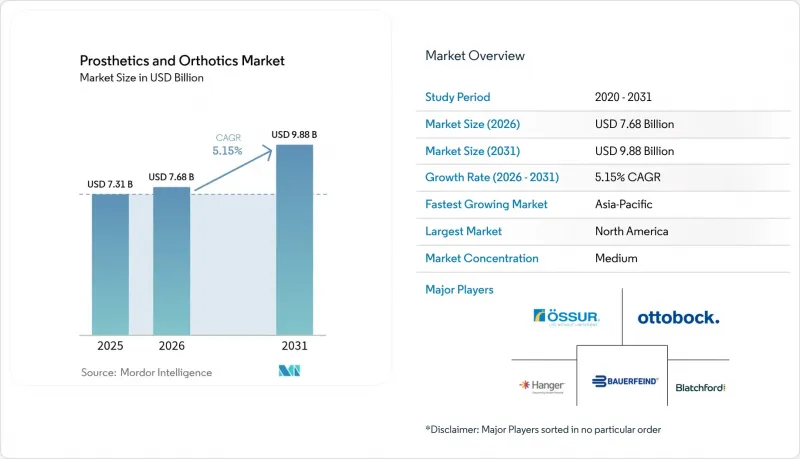
본 보고서는 유형별 (보조기(하지 보조기 등), 의지(하반신 의지 등)), 기술별(기존, 전동식 등), 최종 사용자별(병원, P&O 클리닉, 재활센터, 재택 간호, 군사 시설),지역별(북미, 유럽 등))로 분류되어 있습니다. 시장 예측은 금액(달러) 기준으로 제시되어 있습니다.
전 세계 의지·보조기 시장 동향 및 인사이트
당뇨병 관련 절단 수술의 급증
당뇨병과 관련된 하지 절단은 의지의 기본 수요를 뒷받침하는 한편, 첨단 기기와 사지 보존 성과를 연계하는 보험 급여 확대를 촉진하고 있습니다. 국제당뇨병연맹(IDF)에 따르면, 2024년 당뇨병 환자 수는 5억 8,870만 명이며, 2050년까지 8억 5,250만 명에 달할 것으로 예측됩니다. 미국에서는 매년 약 16만 5,000건의 절단 수술로 인한 입원이 발생하고 있으며, 아프리카계 미국인의 발생률은 현저히 높습니다. 캐나다에서는 최근 보고 주기 동안 7,720건의 당뇨병 관련 절단 수술이 기록되어, 단일 지불자 제도 하에서 이 문제가 주는 부담이 부각되고 있습니다. 잔여 사지의 건강 상태를 측정하는 센서를 탑재한 제조업체들은 가치 기반 의료의 파트너로서의 입지를 확고히 하며, 수익원을 일회성 판매에서 지속적인 분석 서비스 구독으로 전환하고 있습니다.
고령화와 퇴행성 관절염의 부담
세계보건기구(WHO)의 예측에 따르면, 60세 이상 인구는 2024년 14억 명에서 2050년까지 21억 명으로 증가할 전망입니다. 무릎 퇴행성 관절염 환자만 3억 6,500만 명에 달하며, 이는 인공 관절 전치환술을 지연시키는 보조기 처방 수요를 뒷받침하고 있습니다. 인구의 29%가 65세 이상인 일본에서는 초경량 탄소섬유 소재의 발목·족부 보조기가 개발되어 현재 유럽 및 미국 시장에도 보급되고 있습니다. 보조기와 원격 재활 플랫폼을 결합한 업체들은 성과 기반 지불을 요구하는 보험사에게 귀중한 준수 데이터를 수집하고 있습니다.
부문 분석
2025년, 보조기 시장은 의지·보조기 시장 전체의 58.1%를 차지했으며, 3억 6,500만 명의 퇴행성 무릎 관절염 환자를 위한 하지 보조기가 성장의 주역이 되었습니다. 척추 및 상지용 지지대는 전자상거래를 통해 주문되는 기성 SKU의 혜택을 받아 안정적인 수익을 창출하고 있습니다. 한편, 의지 부문 시장 규모는 비교적 작지만, 가변 보행 속도를 가능하게 하는 마이크로프로세서 제어 무릎 관절의 보급에 힘입어 연평균 성장률(CAGR) 6.22%를 기록할 전망입니다. 라이너나 서스펜션 슬리브와 같은 소모품은 교체 주기를 통해 의지·보조기 시장 규모 확대를 뒷받침하며, 정착도가 높은 지속적인 매출을 창출하고 있습니다.
ISO 22523 및 ISO 8549 준수를 통해 CE 마크 취득 및 FDA 510(k) 신청 절차가 효율화되고 있습니다. 3D 프린팅으로 인해 진입 장벽이 낮아짐에 따라 보조기의 상품화 위험이 높아지고 있지만, 한편으로는 독자적인 제어 알고리즘이 의족의 이익률을 지켜주고 있습니다. 디지털 물리치료 컨텐츠를 보조기와 세트로 판매하는 공급업체들은 경쟁이 치열한 시장에서 더욱 차별화를 꾀하고 있습니다.
지역별 분석
북미는 재향군인부(VA)의 자금 지원과 메디케어 개혁을 배경으로 2025년에 의지·보조기 시장의 43.3% 점유율을 차지했습니다. 캐나다의 단일 지불자 모델에서는 임상적으로 필요한 기기에 대해 보험 급여가 이루어지지만, 긴 대기 줄로 인해 병행하여 존재하는 자비 부담 부문이 활성화되고 있습니다. 멕시코는 자선 활동이나 의료 관광 유입에 의존하고 있어 고급 제품의 보급은 제한적입니다.
유럽은 시장 규모에서 2위를 차지하고 있습니다. 독일의 법정 제도에서는 기기에 대한 자금 지원이 이루어지고 있지만, 환급액에는 실비를 하회하는 상한선이 설정되어 있어 판매량은 증가하고 있음에도 불구하고 수익성은 압박받고 있습니다. 유럽연합(EU)의 의료기기 규정(MDR)으로 인해 인증 기관의 처리 능력이 한계에 달하고, 제품 출시가 지연되고 있으며, 단기적으로는 의지·보조기 시장 규모 확대를 둔화시키고 있습니다.
아시아태평양은 2031년까지 연평균 성장률(CAGR) 7.91%가 예상되며, 그 원동력은 인도의 ‘장애인 지원’ 보조금, 중국의 도시 지역에서의 보험 적용 범위 확대, 그리고 경량 보조기를 필요로 하는 일본의 초고령화 사회입니다. 한국과 호주에서는 국민건강보험 제도 하에서 1인당 도입률이 높게 나타나고 있습니다. 동남아시아에서는 여전히 가격에 대한 민감도가 높아, 저비용의 기계식 의수가 선호되고 있습니다. 중동은 고가 기기의 비용을 환급해 주는 GCC 국가들과, NGO의 기부가 주류를 이루는 사하라 이남 아프리카으로 나뉩니다. 남미의 성장은 브라질과 아르헨티나의 재정적 제약으로 인해 억제되고 있습니다.
기타 혜택:
- 엑셀 형식 시장 예측(ME) 시트
- 3개월간 애널리스트 지원
자주 묻는 질문
목차
제1장 서론
제2장 조사 방법
제3장 주요 요약
제4장 시장 구도
제5장 시장 규모와 성장 예측
제6장 경쟁 구도
제7장 시장 기회와 향후 전망
LSH 26.09.14According to Mordor Intelligence, the prosthetics and orthotics market size is expected to grow from USD 7.31 billion in 2025 to USD 7.68 billion in 2026 and is forecast to reach USD 9.88 billion by 2031 at 5.15% CAGR over 2026-2031.
This report is Segmented by Type [Orthotics (Lower-Limb Orthotics, and More), Prosthetics (Lower-Extremity Prosthetics and More), Technology (Conventional, Electric-Powered, and More), End User (Hospitals, P&O Clinics, Rehabilitation Centers, Home-Care, Military Facilities), and Geography (North America, Europe, and More). The Market Forecasts are Provided in Terms of Value (USD).
Global Prosthetics And Orthotics Market Trends and Insights
Rapid Rise in Diabetes-Related Amputations
Diabetes-linked lower-extremity amputations anchor baseline unit demand for prosthetic limbs, but they also catalyze reimbursement advocacy that ties advanced devices to limb-salvage outcomes. The International Diabetes Federation counted 588.7 million people with diabetes in 2024 and projects 852.5 million by 2050 . In the United States, roughly 165,000 amputation hospitalizations occur each year, with Black Americans experiencing a significantly higher incidence. Canada logged 7,720 diabetes-related amputations in its latest reporting cycle, underscoring pressures within single-payer systems. Manufacturers that embed residual-limb health sensors position themselves as partners in value-based care, moving revenue from episodic sales to recurring analytics subscriptions.
Ageing Population & Osteoarthritis Burden
The World Health Organization forecasts 2.1 billion people aged 60+ by 2050, up from 1.4 billion in 2024 . Knee osteoarthritis alone affects 365 million patients, fueling orthotic brace prescriptions that delay total-joint replacement. Japan, where 29% of residents are 65 years or older, incubates ultralight carbon-fiber ankle-foot orthoses now diffusing into Western markets. Vendors that pair braces with telerehabilitation platforms capture adherence data prized by payers seeking outcome-based payments.
Other drivers and restraints analyzed in the detailed report include:
- Advances in Microprocessor & Myoelectric Technologies
- Expanding Reimbursement in Developed Markets
- High Device Cost & Uneven Reimbursement
- Shortage of Certified O&P Clinicians
For complete list of drivers and restraints, kindly check the Table Of Contents.
Segment Analysis
Orthotics captured 58.1% of the Prosthetics and Orthotics market share in 2025, led by lower-limb bracing for 365 million knee-osteoarthritis patients. Spinal and upper-limb supports add stable revenue, benefiting from prefabricated SKUs ordered via e-commerce. Conversely, prosthetics contributed a smaller base yet will post a 6.22% CAGR, propelled by microprocessor-controlled knees that enable variable cadence. Consumables such as liners and suspension sleeves provide sticky recurring sales that anchor the Prosthetics and Orthotics market size growth across replacement cycles.
ISO 22523 and ISO 8549 compliance streamlines CE-marking and FDA 510(k) pathways. Orthotic commoditization risk rises as 3D-printing lowers entry barriers, whereas proprietary control algorithms protect prosthetic margins. Vendors bundling digital physiotherapy content with braces further differentiate in a crowded field.
Complete Report Scope:
- By Type
- Orthotics
- Lower-Limb Orthotics
- Ankle-Foot Orthoses (AFO)
- Knee Orthoses
- Hip Orthoses
- Upper-Limb Orthotics
- Spinal Orthotics
- Lower-Limb Orthotics
- Prosthetics
- Lower-Extremity Prosthetics
- Micro-processor Knees
- Powered Ankles/Feet
- Upper-Extremity Prosthetics
- Liners, Sockets & Modular Components
- Lower-Extremity Prosthetics
- Orthotics
- By Technology
- Conventional / Body-Powered
- Electric-Powered / Myoelectric
- Micro-processor Controlled
- Hybrid
- 3D-Printed / Additive Manufactured
- Robotic / Powered Exoskeletal
- Sensory-Feedback Enabled
- By End User
- Hospitals
- Prosthetics & Orthotics Clinics
- Rehabilitation Centers
- Home-Care Settings
- Other End Users
- By Geography
- North America
- United States
- Canada
- Mexico
- Europe
- Germany
- United Kingdom
- France
- Italy
- Spain
- Rest of Europe
- Asia-Pacific
- China
- India
- Japan
- South Korea
- Australia
- Rest of Asia-Pacific
- Middle East and Africa
- GCC
- South Africa
- Rest of Middle East and Africa
- South America
- Brazil
- Argentina
- Rest of South America
- North America
Geography Analysis
North America held 43.3% of Prosthetics and Orthotics market share in 2025 on the strength of VA funding and Medicare reforms. Canada's single-payer model reimburses clinically necessary devices, yet long queues spur a parallel cash-pay segment. Mexico relies on charitable and medical-tourism flows, limiting premium uptake.
Europe ranks second by value; Germany's statutory system funds devices yet caps tariffs below full cost, driving volume but squeezing profitability. The European Union Medical Device Regulation stretches notified-body capacity, delaying product launches and dampening short-term Prosthetics and Orthotics market size addition.
Asia-Pacific is forecast for a 7.91% CAGR through 2031, fueled by India's Assistance to Disabled Persons subsidy, China's wider urban insurance coverage, and Japan's super-aged demographic looking for lightweight orthoses. South Korea and Australia exhibit high per-capita adoption within universal schemes. Southeast Asia remains cost-sensitive and favors low-cost mechanical limbs. The Middle East bifurcates between GCC states that reimburse premium devices and sub-Saharan Africa, where NGO donations dominate. South America's growth is tempered by fiscal constraints in Brazil and Argentina.
- Bauerfeind
- Blatchford Group
- College Park Industries
- Cyberdyne
- Ekso Bionics
- Enovis
- Fillauer
- Hanger Inc.
- Integrum AB
- Johnson & Johnson
- Ortho Europe
- Ossur
- Ottobock
- Proteor
- Smiths Group
- Spinal Technology Inc.
- Steeper Group
- Stryker
- Thuasne
- Trulife
- WillowWood Global
- Zimmer Biomet
Additional Benefits:
- The market estimate (ME) sheet in Excel format
- 3 months of analyst support
TABLE OF CONTENTS
1 Introduction
- 1.1 Study Assumptions & Market Definition
- 1.2 Scope of the Study
2 Research Methodology
3 Executive Summary
4 Market Landscape
- 4.1 Market Overview
- 4.2 Market Drivers
- 4.2.1 Rapid Rise in Diabetes-Related Amputations
- 4.2.2 Ageing Population & Osteoarthritis Burden
- 4.2.3 Advances In Micro-Processor & Myoelectric Technologies
- 4.2.4 Expanding Reimbursement in Developed Markets
- 4.2.5 AI-Driven Predictive Gait-Analytics Adoption
- 4.2.6 Military R&D Spill-Over Into Civilian Devices
- 4.3 Market Restraints
- 4.3.1 High Device Cost & Uneven Reimbursement
- 4.3.2 Shortage of Certified O&P Clinicians
- 4.3.3 Carbon-Fiber Supply-Chain Volatility
- 4.3.4 Pay-For-Outcome Reimbursement Risk
- 4.4 Supply-Chain Analysis
- 4.5 Regulatory Landscape
- 4.6 Technological Outlook
- 4.7 Porter's Five Forces
- 4.7.1 Threat of New Entrants
- 4.7.2 Bargaining Power of Suppliers
- 4.7.3 Bargaining Power of Buyers
- 4.7.4 Threat of Substitutes
- 4.7.5 Competitive Rivalry
5 Market Size & Growth Forecasts (Value, USD)
- 5.1 By Type
- 5.1.1 Orthotics
- 5.1.1.1 Lower-Limb Orthotics
- 5.1.1.1.1 Ankle-Foot Orthoses (AFO)
- 5.1.1.1.2 Knee Orthoses
- 5.1.1.1.3 Hip Orthoses
- 5.1.1.2 Upper-Limb Orthotics
- 5.1.1.3 Spinal Orthotics
- 5.1.1.1 Lower-Limb Orthotics
- 5.1.2 Prosthetics
- 5.1.2.1 Lower-Extremity Prosthetics
- 5.1.2.1.1 Micro-processor Knees
- 5.1.2.1.2 Powered Ankles/Feet
- 5.1.2.2 Upper-Extremity Prosthetics
- 5.1.2.3 Liners, Sockets & Modular Components
- 5.1.2.1 Lower-Extremity Prosthetics
- 5.1.1 Orthotics
- 5.2 By Technology
- 5.2.1 Conventional / Body-Powered
- 5.2.2 Electric-Powered / Myoelectric
- 5.2.3 Micro-processor Controlled
- 5.2.4 Hybrid
- 5.2.5 3D-Printed / Additive Manufactured
- 5.2.6 Robotic / Powered Exoskeletal
- 5.2.7 Sensory-Feedback Enabled
- 5.3 By End User
- 5.3.1 Hospitals
- 5.3.2 Prosthetics & Orthotics Clinics
- 5.3.3 Rehabilitation Centers
- 5.3.4 Home-Care Settings
- 5.3.5 Other End Users
- 5.4 By Geography
- 5.4.1 North America
- 5.4.1.1 United States
- 5.4.1.2 Canada
- 5.4.1.3 Mexico
- 5.4.2 Europe
- 5.4.2.1 Germany
- 5.4.2.2 United Kingdom
- 5.4.2.3 France
- 5.4.2.4 Italy
- 5.4.2.5 Spain
- 5.4.2.6 Rest of Europe
- 5.4.3 Asia-Pacific
- 5.4.3.1 China
- 5.4.3.2 India
- 5.4.3.3 Japan
- 5.4.3.4 South Korea
- 5.4.3.5 Australia
- 5.4.3.6 Rest of Asia-Pacific
- 5.4.4 Middle East and Africa
- 5.4.4.1 GCC
- 5.4.4.2 South Africa
- 5.4.4.3 Rest of Middle East and Africa
- 5.4.5 South America
- 5.4.5.1 Brazil
- 5.4.5.2 Argentina
- 5.4.5.3 Rest of South America
- 5.4.1 North America
6 Competitive Landscape
- 6.1 Market Concentration
- 6.2 Market Share Analysis
- 6.3 Company Profiles (includes Global level Overview, Market level overview, Core Segments, Financials as available, Strategic Information, Market Rank/Share for key companies, Products & Services, and Recent Developments)
- 6.3.1 Bauerfeind AG
- 6.3.2 Blatchford Group
- 6.3.3 College Park Industries
- 6.3.4 Cyberdyne Inc.
- 6.3.5 Ekso Bionics
- 6.3.6 Enovis (DJO Global)
- 6.3.7 Fillauer LLC
- 6.3.8 Hanger Inc.
- 6.3.9 Integrum AB
- 6.3.10 Johnson & Johnson
- 6.3.11 Ortho Europe
- 6.3.12 Ossur
- 6.3.13 Ottobock
- 6.3.14 Proteor
- 6.3.15 Smith & Nephew
- 6.3.16 Spinal Technology Inc.
- 6.3.17 Steeper Group
- 6.3.18 Stryker Corporation
- 6.3.19 Thuasne
- 6.3.20 Trulife
- 6.3.21 WillowWood Global
- 6.3.22 Zimmer Biomet
7 Market Opportunities & Future Outlook
- 7.1 White-Space & Unmet-Need Assessment


