|
시장보고서
상품코드
2124883
인슐린 글라진 : 시장 점유율 분석, 업계 동향 및 통계, 성장 예측(2026-2031년)Insulin Glargine - Market Share Analysis, Industry Trends & Statistics, Growth Forecasts (2026 - 2031) |
||||||
 Mordor Intelligence
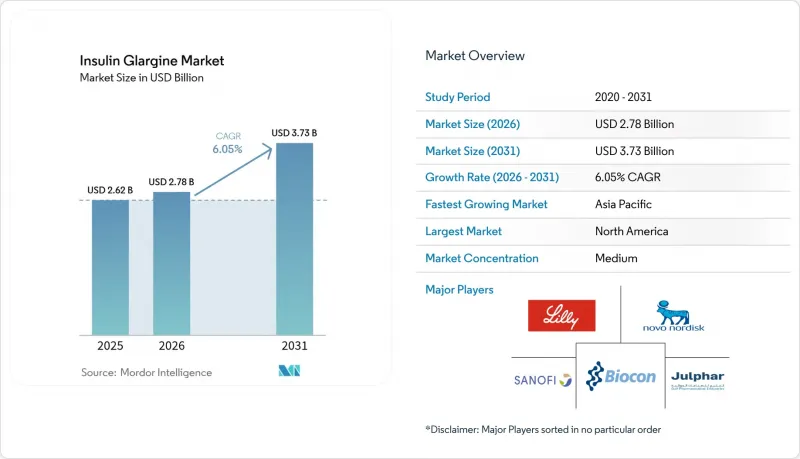
Mordor Intelligence에 의하면, 인슐린 글라진 시장 규모는 2025년에 26억 2,000만 달러로 평가되었습니다. 2026년 27억 8,000만 달러에서 2031년까지 37억 3,000만 달러에 이를 것으로 추정되고 예측 기간(2026-2031년) CAGR은 6.05%를 나타낼 전망입니다.
본 보고서는 브랜드(란타스, 바사글라, 투제오, 솔리쿠아·슬리쿠아, 그랄긴 바이오시밀러), 농도(U100, U300),적응증(1형 당뇨병, 2형 당뇨병), 유통 채널(병원 약국, 소매 약국, 온라인 약국), 지역(북미, 유럽, 아시아태평양, 기타)별로 분류되어 있습니다. 시장 예측은 금액(달러)과 수량(개)의 관점에서 제시되어 있습니다.
세계의 인슐린 글라진 시장 동향 및 인사이트
당뇨병 유병률 증가
세계 당뇨병 유병률은 1990년 이후 4배로 증가하여 현재 5억 명 이상의 성인이 앓고 있으며, 2050년까지 8억 5,200만 건에 달할 것으로 예측됩니다. 전체 사례의 96%를 2형 당뇨병이 차지하고 있으며, 기초 요법을 시작하는 환자의 3분의 2가 글라루긴 제제로 치료를 시작하고 있습니다. 미치료 환자의 90%가 거주하는 저·중소득 국가에서는 발병률이 급증하고 있어 미충족 의료 수요가 더욱 확대되고 있습니다. 지역별로는 중동과 북아프리카 증가율이 가장 높으며, 브라질에서는 2036년까지 400% 증가한 4,300만 건에 달할 가능성이 있습니다. 2024년에 1조 150억 달러로 추정되는 임상적·경제적 부담의 확대에 따라, 보험사들은 비용 대비 효과가 높은 기저 인슐린 대안을 모색하고 있으며, 그랄긴 바이오시밀러에 대한 장기적인 수요가 증가하고 있습니다.
바이오시밀러 인슐린 그랄긴의 등장
FDA가 승인한 3개의 그랄긴 바이오시밀러(이 중 2개는 호환 가능)는 처방약 목록 협상 방식을 완전히 바꾸어 놓았으며, 약국에서의 자동 대체의 길을 열었습니다. 바이오콘 바이오로직스는 생산 능력을 확대했으며, 한편 FDA와 EMA 간의 양자 규제 조정을 통해 심사 기간이 단축되었습니다. 브라질에서는 2024년에 승인 절차가 간소화되어 치료비를 55.9% 절감하는 국내 프로그램이 실현되었습니다. 여러 공급원이 존재함으로써 단일 공급원에 기인하는 위험이 경감되고 예산에 미치는 영향도 줄어들지만, 개발 기업은 여전히 복잡한 특허의 그물망과 치밀한 품질 감사를 극복해야 합니다.
인슐린 요법의 높은 비용
메디케어 상한선 설정 이후에도 수급자의 20%는 파트 D 적용 대상에서 제외되어 고액의 본인 부담금을 계속 지불하고 있으므로, 경제적 부담의 격차는 여전히 존재합니다. 미국 내 인슐린 가격은 여전히 OECD 평균의 10배에 육박합니다. 전 세계적으로 보면, 조사 대상 환자의 19.5%가 경제적 부담을 이유로 투여량을 제한하고 있습니다. 공급 충격이 이 문제를 더욱 심각하게 만들고 있으며, GLP-1 생산 변동에 따른 2024년 남아프리카공화국에서 발생한 펜형 주사기 부족 사태가 그 예입니다. 이러한 비용 및 접근성 문제로 인해 유병률이 상승하고 있음에도 불구하고, 단기적인 수량 증가에는 한계가 있습니다.
부문별 분석
란투스(Lantus)는 2025년 매출의 43.72%를 차지하며, 오랜 기간 쌓아온 임상적 신뢰와 보험 적용 목록 등재를 통해 인슐린 글라진 시장을 주도했습니다. 그러나 그랄긴의 바이오시밀러는 상호 대체성을 활용하여 연평균 성장률(CAGR) 8.25%로 처방 전환을 이끌어내고 있습니다. ‘바사가르(Basaglar)’는 후속 바이오의약품으로 지정되어 가치 기반 가격 책정을 활용하는 반면, ‘투제오(Toujeo)’는 U300 용량으로 차별화를 꾀하고 있습니다. 솔리쿠아/슬리쿠아는 글라루긴과 리키세나티드를 조합하여 다제 병용 요법에 대응하고 있습니다. Gan & Lee와 Biomm의 2세대 바이오시밀러가 라틴아메리카 입찰 제도에 진입하고 있어, 상품화가 가속화되고 있음을 시사합니다. 이에 대응하여 원개발사는 투여 기구 동봉, 디지털 코칭, 본인 부담금 지원 등의 시책으로 대응하고 있습니다.
의사를 대상으로 한 조사에 따르면, 시판 후 조사 결과도 이를 뒷받침하며, 바이오시밀러의 면역원성에 대한 신뢰가 높아지고 있음을 시사하고 있습니다. 보험사는 원약 급여에 앞서 순비용이 낮은 그랄긴 계열 바이오시밀러를 우선적으로 사용하는 단계적 치료를 의무화하고 있으며, 이로 인해 시장에서의 대체가 가속화되고 있습니다. 임상적 관성으로 인해 임산부 등 취약한 환자층에서는 수십 년에 걸친 안전성 실적을 가진 브랜드 제품이 여전히 지지를 받고 있습니다. 따라서 마케팅의 초점은 분자 특성에서 스마트 펜과의 호환성, 디지털을 통한 투여량 조절 지원, 통합형 혈당 대시보드 등을 포함하는 ‘생태계 가치’로 이동하고 있습니다. 이는 가격 합리화가 진행되는 환경에서 시장 점유율을 유지하기 위한 전략입니다.
U100 제품은 2025년 판매량의 70.85%를 차지했으며, 전 세계적으로 여전히 표준 초기 투여량으로 자리 잡고 있습니다. 익숙한 인슐린 대 탄수화물 비율과 확립된 투여 알고리즘이 임상의에게 안정감을 주고 있습니다. 그러나 투제오(Toujeo)와 같은 U300 제품은 주사량 감소와 더 평탄한 약물 동태 곡선 덕분에 복약 순응도에 어려움을 겪는 환자층으로부터 지지를 얻어 연평균 성장률(CAGR) 6.95%를 기록했습니다. 임상 증거에 따르면, U300 요법에서는 야간 저혈당 발생률이 감소하고 공복 혈당 수치 범위가 더 좁아지는 것으로 나타났습니다.
바이오시밀러 개발사들은 두 농도 모두를 포트폴리오에 포함시켜 오리지널 의약품과의 조제상 동등성을 확보하고 있습니다. 의료기기 제조업체들은 두 가지 농도에 대응할 수 있도록 카트리지 사양을 업데이트하여 도입 장벽을 낮추고 있습니다. 비용 차이는 여전히 억제요인으로 작용하고 있습니다. U300의 단가는 U100보다 평균 18% 높지만, 필요한 투여량이 적기 때문에 연간 치료비 차이는 줄어들고 있습니다. 투여량의 혼동은 의도파관 않은 치료 부족으로 이어질 수 있으므로, 환자에 대한 교육이 매우 중요합니다. 전반적으로, 농도의 다양화는 분자의 독점권에서 종합적인 치료 경험으로 나아가는 지속적인 진화를 부각시키고 있습니다.
지역별 분석
북미는 당뇨병 유병률이 높고 프리미엄 가격 책정의 혜택을 받아 2025년에도 시장 점유율 44.98%를 차지하며 계속해서 가장 큰 기여 지역으로 남아 있었습니다. 이 지역에서 바이오시밀러의 상호 대체성이 조기에 도입됨에 따라 경쟁적인 가격 인하가 촉진되었으나 상당한 판매량은 유지되고 있으며, 한편 메디케어의 35달러 상한선 설정으로 접근성이 확대되고 있습니다. 캐나다의 국민건강보험법은 특히 저소득 고령층에서 치료 대상 인구를 더욱 확대할 가능성이 있습니다. 스마트 투여 기기의 혁신 파이프라인은 실리콘밸리와 미니애폴리스에 집중되어 있어, 통합 케어 생태계에서 북미의 리더십을 강화하고 있습니다.
유럽에서는 시장의 성숙도와 비용 통제의 엄격함이 균형을 이루는 모습을 보였습니다. 2024년에 시행된 EMA(유럽의약품청)의 통합 지침에 따라 바이오시밀러 심사 기간이 단축되어 경쟁이 격화되고 있습니다. 독일과 프랑스 등 서유럽 국가들이 수익의 기반을 이루고 있는 반면, 중동부 유럽 국가들은 진단율 상승과 헬스케어 투자 확대에 힘입어 더 높은 성장률을 기록하고 있습니다. ‘Weekly icodec’은 EMA의 승인을 획득하며, 패러다임 전환을 가져올 기저 인슐린 요법에 대한 유럽의 수용성을 보여주고 있습니다. 각국의 조달 기관은 인슐린과 CGM에 대한 보조금을 세트로 제공하는 경우가 늘어나고 있으며, 기기 통합을 제공하는 공급업체에 보상을 주는 종합적인 입찰 기준이 형성되고 있습니다.
아시아태평양은 환자 수의 폭발적인 증가와 경제적 장벽을 완화하기 위한 정책 개입에 힘입어 2031년까지 가장 높은 성장률(9.05%)을 유지할 전망입니다. 중국의 인슐린 조달 프로그램으로 인해 그랄긴의 평균 가격은 약 절반으로 떨어졌고, 단위당 이익률은 압박을 받았지만 치료를 받는 환자 수는 증가했습니다. 인도에서는 무바늘 투여법의 승인과 국내 제조 능력 확립으로 치료 선택지가 확대되었습니다. 동남아시아의 온라인 약국 스타트업은 스마트폰 생태계를 활용하여 몇 시간 이내에 인슐린을 배송함으로써, 자원이 부족한 지방 클리닉을 우회하고 있습니다. 그러나 규제 체제의 파편화와 보험 환급 제도의 불균일성으로 인해 국경을 넘는 제품 출시가 지연되고 있어, 공급업체들은 각국에 맞춘 시장 진출 전략을 수립할 수밖에 없는 실정입니다.
기타 혜택
- 엑셀 형식 시장 예측(ME) 시트
- 3개월간의 애널리스트 지원
자주 묻는 질문
목차
제1장 서론
제2장 조사 방법
제3장 주요 요약
제4장 시장 구도
제5장 시장 규모 및 성장 예측
제6장 경쟁 구도
제7장 시장 기회 및 향후 전망
KTH 26.09.14According to Mordor Intelligence, the insulin glargine market size was valued at USD 2.62 billion in 2025 and estimated to grow from USD 2.78 billion in 2026 to reach USD 3.73 billion by 2031, at a CAGR of 6.05% during the forecast period (2026-2031).
This report is Segmented by Brand (Lantus, Basaglar, Toujeo, Soliqua/Suliqua, Glargine Biosimilars), Concentration (U100, U300), Indication (Type-1 Diabetes, Type-2 Diabetes), Distribution Channel (Hospital Pharmacies, Retail Pharmacies, Online Pharmacies), and Geography (North America, Europe, Asia-Pacific, and More). The Market Forecasts are Provided in Terms of Value (USD) and Volume (Units).
Global Insulin Glargine Market Trends and Insights
Rising Prevalence of Diabetes
Global diabetes prevalence has quadrupled since 1990 and now affects more than 500 million adults, with projections indicating 852 million cases by 2050. Type 2 diabetes comprises 96% of cases, and two-thirds of individuals initiating basal therapy start with glargine formulations. Incidence is surging in low- and middle-income countries where 90% of untreated patients reside, magnifying unmet need. Regional spikes are steepest in the Middle East and North Africa, while Brazil could see a 400% rise to 43 million cases by 2036. The expanding clinical and economic burden, estimated at USD 1,015 billion in 2024, is pushing payers toward cost-effective basal options, strengthening long-run demand for glargine biosimilars.
Emergence of Biosimilar Insulin Glargine
Three FDA-approved glargine biosimilars-two interchangeable-have re-shaped formulary negotiations and unlocked automatic substitution pathways in pharmacies. Biocon Biologics scaled up capac-ity while bilateral regulatory alignment between FDA and EMA reduced review times. Brazil streamlined approvals in 2024, enabling domestic programs that cut treatment expenditures by 55.9%. Multisource supply diminishes single-origin risks and lowers budget impact, although developers must still navigate patent thickets and meticulous quality audits.
High Cost of Insulin Therapy
Even after the Medicare cap, affordability gaps persist because 20% of beneficiaries lack Part D coverage and remain exposed to high out-of-pocket spending. US insulin prices still average nearly 10 times OECD levels. Globally, 19.5% of surveyed patients ration doses due to financial strain. Supply shocks compound the issue, illustrated by South Africa's 2024 pen shortages amid GLP-1 production swings. These cost and availability challenges cap near-term volume growth even as prevalence climbs.
Other drivers and restraints analyzed in the detailed report include:
- Rapid Growth of e-pharmacy Channel Widening Home-care Access
- Technological Advancements in Insulin Delivery
- Complex Regulatory and Approval Pathways
For complete list of drivers and restraints, kindly check the Table Of Contents.
Segment Analysis
Lantus held 43.72% of 2025 revenue, anchoring the insulin glargine market through longstanding clinical trust and formulary placement. However, glargine biosimilars are leveraging interchangeability to capture switching prescriptions at an 8.25% CAGR. Basaglar, designated a follow-on biologic, exploits value-tier pricing, while Toujeo differentiates with U300 dosing. Soliqua/Suliqua combines glargine with lixisenatide to address multi-drug regimens. Second-generation biosimilars from Gan & Lee and Biomm are entering tender systems in Latin America, indicating accelerating commoditization. Originators respond by bundling devices, digital coaching, and co-pay assistance.
Physician surveys suggest confidence in biosimilar immunogenicity is rising, supported by post-marketing surveillance. Payers are mandating step-therapy that prioritizes lower-net-cost glargine biosimilars before covering originators, accelerating displacement. Nonetheless, clinical inertia favors brands with decades of safety records in vulnerable populations such as pregnant women. Marketing focus is therefore pivoting from molecule attributes to ecosystem value, including smart pen compatibility, digital titration support, and integrated glucose dashboards, tactics intended to protect share in a price-rationalizing landscape.
U100 products represented 70.85% of 2025 volume and remain the standard initiation strength worldwide. Familiar insulin-to-carbohydrate ratios and established dosing algorithms give clinicians confidence. However, U300 variants like Toujeo posted a 6.95% CAGR as reduced injection volume and flatter pharmacokinetic curves appealed to adherence-challenged cohorts. Clinical evidence shows lower nocturnal hypoglycemia and tighter fasting glucose ranges with U300 regimens.
Biosimilar developers are expanding portfolios to include both strengths, ensuring formulary parity with originators. Device manufacturers are updating cartridge specifications for dual-strength compatibility, reducing barriers to adoption. Cost differentials remain a restraint: U300 per-unit prices average 18% higher than U100, although lower volume requirements narrow the annual therapy gap. Patient education is critical because dosing confusion can lead to accidental under-treatment. Overall, concentration diversification underscores the ongoing evolution from molecule exclusivity toward holistic treatment experience.
Complete Report Scope:
- By Brand
- Lantus
- Basaglar
- Toujeo
- Soliqua / Suliqua
- Glargine Biosimilars
- By Concentration
- U100
- U300
- By Indication
- Type-1 Diabetes
- Type-2 Diabetes
- By Distribution Channel
- Hospital Pharmacies
- Retail Pharmacies
- Online Pharmacies
- By Geography
- North America
- United States
- Canada
- Mexico
- Europe
- Germany
- United Kingdom
- France
- Italy
- Spain
- Rest of Europe
- Asia-Pacific
- China
- Japan
- India
- Australia
- South Korea
- Rest of Asia-Pacific
- Middle East and Africa
- GCC
- South Africa
- Rest of Middle East and Africa
- South America
- Brazil
- Argentina
- Rest of South America
- North America
Geography Analysis
North America persisted as the largest contributor, with 44.98% market share in 2025, benefiting from high diabetes prevalence and premium pricing. The region's early adoption of biosimilar interchangeability promotes competitive discounts yet preserves substantial volume, while the USD 35 Medicare cap broadens access. Canada's universal-coverage legislation could further expand treated populations, particularly among low-income seniors. Innovation pipelines for smart delivery devices are concentrated in Silicon Valley and Minneapolis, reinforcing North America's leadership in integrated care ecosystems.
Europe displayed balanced market maturity and cost-containment rigor. Harmonized EMA guidelines implemented in 2024 shorten biosimilar review times, intensifying tender competition. Western countries such as Germany and France anchor revenue, while Central and Eastern Europe post higher growth from rising diagnosis rates and healthcare investment. Weekly icodec obtained EMA approval, signaling Europe's receptiveness to paradigm-shifting basal regimens. National procurement agencies increasingly bundle insulin with CGM subsidies, creating holistic tender parameters that reward suppliers offering device integration.
Asia-Pacific remains the fastest-growing (9.05%) territory through 2031, driven by explosive prevalence and policy interventions to alleviate affordability barriers. China's insulin tender program cut average glargine prices almost in half, boosting treated lives despite compressing unit margins. India unlocked needle-free delivery approvals and domestic manufacturing capabilities, widening therapeutic options. Southeast Asian e-pharmacy start-ups leverage smartphone ecosystems to deliver insulin within hours, bypassing under-resourced rural clinics. However, fragmented regulatory capacity and reimbursement heterogeneity slow cross-border launches, compelling suppliers to tailor country-specific market access strategies.
- Sanofi
- Eli Lilly and Company
- Novo Nordisk
- Biocon Biologics Inc.
- Julphar (Gulf Pharmaceutical)
- Gan & Lee Pharmaceuticals
- Tonghua Dongbao Pharmaceutical Co., Ltd.
- Wockhardt
- Viatris (Mylan)
- Boehringer Ingelheim
Additional Benefits:
- The market estimate (ME) sheet in Excel format
- 3 months of analyst support
TABLE OF CONTENTS
1 Introduction
- 1.1 Study Assumptions & Market Definition
- 1.2 Scope of the Study
2 Research Methodology
3 Executive Summary
4 Market Landscape
- 4.1 Market Overview
- 4.2 Market Drivers
- 4.2.1 Rising Prevalence of Diabetes
- 4.2.2 Emergence of Biosimilar Insulin Glargine
- 4.2.3 Rapid Growth of e-pharmacy Channel Widening Home-care Access
- 4.2.4 Technological Advancements in Insulin Delivery
- 4.2.5 Government Initiatives and Healthcare Policies
- 4.2.6 Physician Preference and Brand Trust
- 4.3 Market Restraints
- 4.3.1 High Cost of Insulin Therapy
- 4.3.2 Complex Regulatory and Approval Pathways
- 4.3.3 Clinician Shift Toward Ultra-long Alternatives (e.g., degludec) in High-income Markets
- 4.3.4 Injection-Related Patient Reluctance
- 4.4 Value / Supply-Chain Analysis
- 4.5 Regulatory Outlook
- 4.6 Porter's Five Forces Analysis
- 4.6.1 Bargaining Power of Suppliers
- 4.6.2 Bargaining Power of Buyers
- 4.6.3 Threat of New Entrants
- 4.6.4 Threat of Substitutes
- 4.6.5 Competitive Rivalry
5 Market Size & Growth Forecasts (Value & Volume)
- 5.1 By Brand
- 5.1.1 Lantus
- 5.1.2 Basaglar
- 5.1.3 Toujeo
- 5.1.4 Soliqua / Suliqua
- 5.1.5 Glargine Biosimilars
- 5.2 By Concentration
- 5.2.1 U100
- 5.2.2 U300
- 5.3 By Indication
- 5.3.1 Type-1 Diabetes
- 5.3.2 Type-2 Diabetes
- 5.4 By Distribution Channel
- 5.4.1 Hospital Pharmacies
- 5.4.2 Retail Pharmacies
- 5.4.3 Online Pharmacies
- 5.5 By Geography
- 5.5.1 North America
- 5.5.1.1 United States
- 5.5.1.2 Canada
- 5.5.1.3 Mexico
- 5.5.2 Europe
- 5.5.2.1 Germany
- 5.5.2.2 United Kingdom
- 5.5.2.3 France
- 5.5.2.4 Italy
- 5.5.2.5 Spain
- 5.5.2.6 Rest of Europe
- 5.5.3 Asia-Pacific
- 5.5.3.1 China
- 5.5.3.2 Japan
- 5.5.3.3 India
- 5.5.3.4 Australia
- 5.5.3.5 South Korea
- 5.5.3.6 Rest of Asia-Pacific
- 5.5.4 Middle East and Africa
- 5.5.4.1 GCC
- 5.5.4.2 South Africa
- 5.5.4.3 Rest of Middle East and Africa
- 5.5.5 South America
- 5.5.5.1 Brazil
- 5.5.5.2 Argentina
- 5.5.5.3 Rest of South America
- 5.5.1 North America
6 Competitive Landscape
- 6.1 Market Concentration
- 6.2 Market Share Analysis
- 6.3 Company Profiles (includes Global level Overview, Market level overview, Core Segments, Financials as available, Strategic Information, Market Rank/Share for key companies, Products & Services, and Recent Developments)
- 6.3.1 Sanofi SA
- 6.3.2 Eli Lilly and Company
- 6.3.3 Novo Nordisk A/S
- 6.3.4 Biocon Biologics Inc.
- 6.3.5 Julphar (Gulf Pharmaceutical)
- 6.3.6 Gan & Lee Pharmaceuticals
- 6.3.7 Tonghua Dongbao Pharmaceutical Co., Ltd.
- 6.3.8 Wockhardt Ltd
- 6.3.9 Viatris (Mylan)
- 6.3.10 Boehringer Ingelheim
7 Market Opportunities & Future Outlook
- 7.1 White-space & Unmet-Need Assessment