|
시장보고서
상품코드
2124901
특수 제지 : 시장 점유율 분석, 업계 동향 및 통계, 성장 예측(2026-2031년)Specialty Paper - Market Share Analysis, Industry Trends & Statistics, Growth Forecasts (2026 - 2031) |
||||||
 Mordor Intelligence
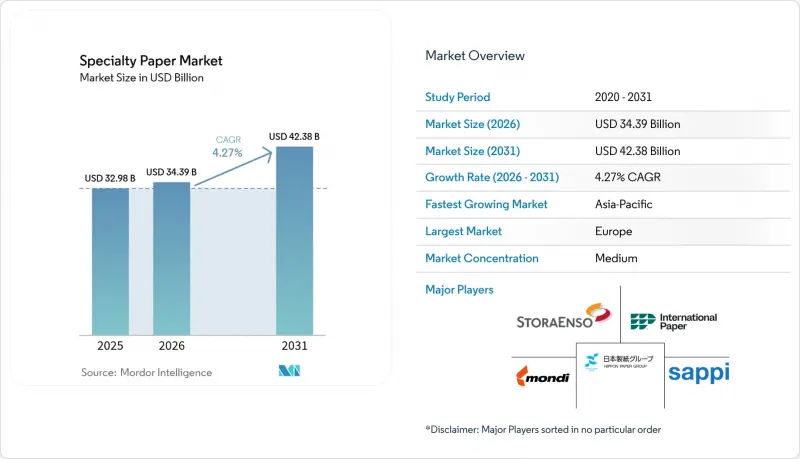
Mordor Intelligence에 의하면, 특수 제지 시장 규모는 2025년에 329억 8,000만 달러로 평가되었습니다. 2026년 343억 9,000만 달러에서 2031년까지 423억 8,000만 달러에 이를 것으로 예상되며, 예측 기간(2026-2031년) CAGR은 4.27%를 나타낼 전망입니다.
본 보고서는 제품 유형별(크래프트지, 이형지, 기타), 원료별(버진 섬유, 재생 섬유, 합성 섬유, 하이브리드 복합 소재), 기능·코팅별(차단성·내유성, 항균, 기타), 최종 사용자 산업별(포장 및 라벨링, 푸드서비스 산업, 기타),형태별(롤, 시트, 기타), 지역별로 분류되어 있습니다. 시장 예측은 금액(달러)으로 표시되어 있습니다.
세계의 특수 제지 시장 동향 및 인사이트
지속 가능한 포장을 촉진하는 전자상거래
온라인 소매의 급속한 성장에 따라, 각 브랜드가 확대 생산자 책임(EPR) 요건을 충족하기 위해 플라스틱 사용을 단계적으로 폐지함에 따라, 2차 및 3차 포장의 ‘종이화’가 가속화되고 있습니다. 소매업체들은 현재 인증된 섬유, 재활용 가능한 형태, 화물의 무결성을 해치지 않으면서 운송 비용을 절감할 수 있는 저평량 크라프트지 등급을 지정하고 있습니다. 지속적인 주문 처리로 인해 인쇄 가능한 크라프트 우편 봉투와 성형 섬유 완충재에 대한 수요가 증가하고 있으며, 이는 모든 배송 부문에서 안정적인 수량 증가를 뒷받침하고 있습니다. 크래프트지 생산 설비를 통합한 제조업체들은 원자재 가격 변동 위험을 완화하는 동시에, 펄프 공급을 급성장하는 전자상거래용 제품으로 유연하게 전환할 수 있어 이익률 향상을 도모하고 있습니다.
푸드서비스 산업에서의 섬유 기반 일회용 제품으로의 전환
유럽, 북미, 아시아의 주요 도시에서 일회용 플라스틱 제품 사용 금지 법안이 제정됨에 따라, 섬유 소재 식기, 컵, 클램쉘 용기로의 급속한 전환이 진행되고 있습니다. 내유성 배리어 기술의 발전으로 종이 용기도 고온의 기름이나 소스를 견딜 수 있게 되어, 패스트푸드점이 퇴비화 목표를 달성할 수 있게 되었습니다. 체인점 수준의 계약에서는 사용 후 재활용 소재의 사용이 우선시되고 있어, 회수 및 재펄프화 인프라 확충을 뒷받침하고 있습니다. 푸드서비스 산업 채널 수요량 가시화를 통해 컵용 원지나 경량 MG지를 전문으로 하는 제지 공장에서는 여러 대의 기계를 개조하는 움직임이 촉진되어 설비 가동률이 향상되고 있습니다.
펄프 가격 변동과 공급 충격
핀란드의 노사 분쟁과 제지 공장의 사고로 인해 공급이 제한되고 특수 용지의 이익률이 압박받은 결과, 2024년 4월에는 벤치마크인 노던 블리치드 소프트우드 크라프트(Northern Bleached Softwood Kraft)의 가격이 톤당 1,380유로에 달했습니다. 현물 가격의 급등으로 인해 비통합형 가공업체들은 분기마다 가격 조정을 할 수밖에 없게 되어, 고객 이탈 위험에 직면해 있습니다. 기후 변화로 인한 섬유 공급 차질과 신규 생산 능력의 한계가 가격 변동의 장기화를 시사하고 있어, 자사 전용 펄프 및 장기 칩 계약의 전략적 가치가 높아지고 있습니다.
부문별 분석
2025년에는 크라프트지 등급이 매출에 가장 크게 기여하여 특수 제지 시장 점유율의 31.60%를 차지했습니다. 이는 산업용 자루, 캐리어 가방, 급성장하는 전자상거래용 봉투에 힘입은 결과입니다. 스웨덴 칼스보르그 공장만 해도 연간 33만 5,000톤의 봉투용 크라프트지를 생산하고 있어, 이러한 입지를 뒷받침하는 규모의 경제성이 두드러지게 나타나고 있습니다. 현재 성장세는 이형지로 이동하고 있으며, RFID 대응 라벨과 디지털 인쇄기의 보급 확대를 배경으로 2031년까지의 연평균 성장률(CAGR)은 6.18%로 예측됩니다. 스마트 라벨에는 매우 매끄러운 표면과 정밀하게 조정된 밀도가 요구되기 때문에 가공업체들은 범용 제품에서 맞춤형 라이너 기판으로 전환하고 있습니다. 장식용지와 라미네이트 용지는 여전히 큰 시장 규모를 유지하고 있지만, 디지털 장식 필름에 의한 시장 점유율 압박에 직면해 있습니다. 한편, 필터 용지와 보안 용지는 엄격한 성능 기준과 내장된 위조 방지 기능 덕분에 틈새 시장에서 그 중요성을 유지하고 있습니다.
고순도 섬유와 더욱 엄격한 수분 관리에 대한 구조적 수요는 라이너의 기술 혁신이 부가가치를 창출하고 있는 가운데에서도 크라프트지의 장기적인 생산 능력 확보를 뒷받침하고 있습니다. 생산자들은 경기 변동에 대한 헤지 수단으로 등급 라인업을 다각화하고 있지만, 라이너 시장의 기회에 대응하기 위해 현재는 코팅의 유연성을 우선시하여 자본을 배분하고 있습니다. 특수 제지 시장의 이러한 양극화로 인해, 기존 크라프트지의 생산량이 차세대 라이너 기술로의 업그레이드를 자금 면에서 뒷받침하는 포트폴리오 구성이 촉진되고 있습니다.
2025년 시점에서 버진 섬유는 프리미엄 라벨, 보안 용지, 의료용 포장재에 요구되는 인장 강도와 기공률 기준을 충족함에 따라 특수 용지 시장 규모의 48.40%를 차지했습니다. 그러나 순환 경제의 요건에 따라 재생 재료의 함유율이 표준화되고, 갈색 재생 펄프 등급이 배리어 코팅된 포장에 적합한 사양을 충족하게 됨에 따라, 재생 섬유는 2031년까지 연평균 성장률(CAGR) 5.15%를 기록할 전망입니다. 합성 및 하이브리드 조성 관련 특수 용지 시장 규모는 여전히 소규모이지만, 이러한 소재는 자동차용 개스킷의 내용제성 등 독자적인 특성을 가능하게 합니다.
대나무와 농업 잔여물을 원료로 하는 비목재 펄프는 실리카 오염을 줄이는 새로운 효소 처리 공정을 통해 발전하고 있습니다. 활엽수 칩과의 비용 면에서의 동등성은 아직 달성되지 않아 생산 규모 확대를 제약하고 있지만, 브랜드 소유자의 탄소 배출량 공개가 시험적인 생산량 증가를 뒷받침하고 있습니다. 듀얼 파이버 시스템을 갖춘 제지 공장은 펄프 가격 급등을 상쇄하기 위해 원료 배합을 전환할 수 있어, 가격 변동이 심한 시기에도 회복력을 높이고 있습니다.
지역별 분석
2025년, 유럽은 특수 제지 시장 점유율의 32.70%를 차지하며 가장 큰 기여 지역으로 남아 있었습니다. 이는 플라스틱에서 섬유로의 전환을 가속화하는 엄격한 환경 규제에 힘입은 결과입니다. 제지 공장이 CHP(열전병급) 구성을 최적화하고 재생 가능 전력 계약을 체결함에 따라, 종이 및 판지의 월간 생산량은 2023년 에너지 충격에서 회복되었습니다. 독일과 프랑스는 에코 잉크 도입과 광물유 단계적 폐지를 주도하고 있으며, 저이행성 라벨 용지에 대한 주문이 집중되고 있습니다. 그러나 에너지 비용 급등으로 인해 2025년 7월 가동이 중단된 UPM의 에트링겐 공장을 비롯해 선택적인 생산 능력 폐쇄가 잇따르고 있습니다. 하인첼 그룹의 슈타이어마르 인수 등 산업 재편은 고수익 등급에 중점을 둔 자산 기반의 효율화를 시사하고 있습니다.
아시아태평양은 2031년까지 연평균 성장률(CAGR)이 6.05%로 가장 빠르게 성장하고 있는 지역입니다. 중국의 골판지 원지 수요 회복과 나인 드래곤스 페이퍼의 말레이시아 사업 확장은 인근 아세안 시장을 활용하기 위한 남쪽 방향의 생산 능력 재편을 나타내며, 골판지 시장은 연간 4%의 성장이 예상됩니다. 일본과 한국의 전자 제품 공급망은 전도성 종이와 정전기 방지 종이 수요를 견인하고 있는 반면, 인도에서는 가처분 소득 수준 상승에 따라 푸드서비스 산업용 특수 등급 종이에 대한 수요가 증가하고 있습니다. 각 지역 정부는 폐지 수거 인프라에 경기 부양책을 투입하고 있으며, 이로 인해 재생 섬유공급이 확대되어 지역 특수 제지 생산을 뒷받침하고 있습니다.
북미에서는 니어쇼어링과 포장 자동화가 성숙기에 접어든 출판 부문의 쇠퇴를 상쇄하며, 안정적인 한 자릿수 중반대의 성장을 기록하고 있습니다. 킴벌리 클라크(Kimberly-Clark)사의 20억 달러 규모 확장 계획과 같은 투자 프로그램은 티슈 및 특수 용지의 장기적인 생산 능력에 대한 경제성을 뒷받침하고 있습니다. 동시에, 스머핏 웨스트록(Smarfit-Westlock)사와 같은 거대 합병을 통해 골판지 산업의 통합이 진행되어 비용 시너지와 고객 기반 확대가 가능해졌습니다. 미국 남부는 산림 지대와의 근접성과 경쟁력 있는 에너지 요금으로 인해 그린필드 펄프 프로젝트를 유치하고 있으며, 펄프 가격 변동에 견딜 수 있는 체제가 갖춰진 통합형 비즈니스 모델을 뒷받침하고 있습니다.
기타 혜택
- 엑셀 형식 시장 예측(ME) 시트
- 3개월간의 애널리스트 지원
자주 묻는 질문
목차
제1장 서론
제2장 조사 방법
제3장 주요 요약
제4장 시장 구도
제5장 시장 세분화
제6장 경쟁 구도
제7장 시장 기회 및 향후 전망
KTH 26.09.14According to Mordor Intelligence, the specialty paper market size was valued at USD 32.98 billion in 2025 and estimated to grow from USD 34.39 billion in 2026 to reach USD 42.38 billion by 2031, at a CAGR of 4.27% during the forecast period (2026-2031).
This report is Segmented by Product Type (Kraft Paper, Release-Liner Paper, and More), Raw Material (Virgin Fiber, Recycled Fiber, Synthetic Fiber, and Hybrid Composites), Functionality (Barrier and Grease-Proof, Anti-Microbial, and More), End-User Industry (Packaging and Labeling, Food Service, and More), Form (Rolls, Sheets, and More), and Geography. The Market Forecasts are Provided in Terms of Value (USD).
Global Specialty Paper Market Trends and Insights
E-commerce Push for Sustainable Packaging
Rapid online retail growth is accelerating the "paperization" of secondary and tertiary packaging as brands phase out plastics to meet Extended Producer Responsibility mandates. Retailers now specify certified fiber, recyclable formats, and lower basis-weight kraft grades that reduce freight costs without compromising load integrity. Continuous order fulfillment drives demand for printable kraft mailers and molded-fiber cushioning, anchoring stable volume gains across shipping categories. Producers with integrated kraft assets capture margin upside because they can flex pulp streams toward high-growth e-commerce variants while mitigating raw-material shocks.
Food-Service Shift to Fiber-Based Disposables
Legislated single-use plastic bans in Europe, North America, and key Asian cities have triggered a swift migration to fiber utensils, cups, and clamshells. Advances in grease-proof barrier chemistries now enable paper containers to tolerate hot oils and sauces, allowing quick-service restaurants to meet compostability targets. Chain-level contracts prioritize post-consumer recycled content, supporting wider collection and re-pulping infrastructure. Volume visibility in food-service channels encourages multi-machine retrofits at mills specializing in cupstock and lightweight MG papers, boosting asset utilization.
Pulp-Price Volatility and Supply Shocks
Benchmark Northern Bleached Softwood Kraft touched EUR 1,380 per metric ton in April 2024 after labor actions in Finland and mill incidents curtailed supply, squeezing specialty margins. Spot price spikes force non-integrated converters to adjust pricing quarterly, risking customer churn. Climate-related fiber disruptions and limited greenfield capacity suggest enduring volatility, reinforcing the strategic value of captive pulp or long-term chip contracts.
Other drivers and restraints analyzed in the detailed report include:
- Smart-Label Release-Liner Demand Surge
- Flexible Printed-Electronics Substrates
- Chemical-Additive Regulatory Tightening
For complete list of drivers and restraints, kindly check the Table Of Contents.
Segment Analysis
Kraft grades generated the largest revenue contribution at 31.60% Specialty Paper market share in 2025, buoyed by industrial sacks, carrier bags, and burgeoning e-commerce mailers. The Karlsborg mill in Sweden alone produces 335,000 tons of sack kraft per year, underscoring the scale economics backing this position. Growth now tilts toward release-liner paper, which is forecast at a 6.18% CAGR through 2031 on the strength of RFID-enabled labels and rising digital press adoption. Smart labels require ultra-smooth calipers and calibrated density, steering converters toward engineered liner substrates and away from commodity options. Decor and laminating papers remain sizeable yet see share pressure from digital decor films, while filter and security papers preserve niche relevance through exacting performance criteria and embedded anti-counterfeit features.
Structural demand for high-purity fiber and tighter moisture control anchors long-term kraft capacity commitments even as liner innovations capture incremental value. Producers diversify grade slates to hedge against cyclical swings, but capital allocations now prioritize coating flexibility to address the liner opportunity. This bifurcation within the Specialty Paper Market fosters a portfolio mix where heritage kraft volumes finance next-wave liner technology upgrades.
Virgin fiber held 48.40% of the Specialty Paper market size in 2025 owing to tensile and porosity thresholds demanded by premium labels, security stock, and medical wraps. Yet recycled fiber is charting a 5.15% CAGR to 2031 as circular-economy mandates normalize recovered-content ratios and as brown recycled pulp grades reach specifications suitable for barrier-coated packaging. The Specialty Paper market size attached to synthetic and hybrid compositions remains modest, but these materials enable unique properties such as solvent resistance for automotive gaskets.
Non-wood pulps drawn from bamboo and agricultural residue are advancing through new enzymatic processes that mitigate silica contamination. Cost parity with hardwood chips remains elusive, constraining scale, yet brand-owner carbon disclosures are incentivizing trial volumes. Mills armed with dual-fiber systems can toggle furnish recipes to offset pulp pricing spikes, enhancing resilience during volatile cycles.
Complete Report Scope:
- By Product Type
- Kraft Paper
- Release-Liner Paper
- Label and Thermal Paper
- Decor and Laminating Paper
- Filter and Security Paper
- Others
- By Raw Material
- Virgin Fiber
- Recycled Fiber
- Synthetic Fiber
- Hybrid Composites
- By Functionality/Coating
- Barrier and Grease-Proof
- Water-Resistant
- Anti-microbial
- Conductive and Antistatic
- Fire-Retardant
- Other functionality/Coating
- By End-user Industry
- Packaging and Labeling
- Food Service
- Printing and Publication
- Building and Construction
- Industrial and Automotive
- Medical and Healthcare
- Other End-user Industries
- By Form
- Rolls
- Sheets
- Converted Products (Bags, Tapes, Cups, and More)
- By Geography
- North America
- United States
- Canada
- Mexico
- Europe
- United Kingdom
- Germany
- France
- Italy
- Spain
- Nordics
- Rest of Europe
- Asia-Pacific
- China
- India
- Japan
- South Korea
- ASEAN
- Australia
- New Zealand
- Rest of Asia-Pacific
- South America
- Brazil
- Argentina
- Rest of South America
- Middle East and Africa
- Middle East
- Saudi Arabia
- United Arab Emirates
- Rest of Middle East
- Africa
- South Africa
- Egypt
- Nigeria
- Rest of Africa
- Middle East
- North America
Geography Analysis
Europe remained the largest regional contributor at 32.70% Specialty Paper market share in 2025, underpinned by strict environmental statutes that accelerate conversion from plastics to fiber. Monthly paper and board output rebounded from the 2023 energy shock as mills optimized CHP configurations and locked in renewable electricity contracts. Germany and France lead eco-ink adoption and mineral-oil phase-outs, directing order flow toward low-migration label stock. Yet energy cost inflation has precipitated selective capacity closures, including UPM's Ettringen site slated to cease operations in July 2025. Consolidation, such as Heinzel Group's acquisition of Steyrermuhl, signals a tightening asset base geared toward higher-margin grades.
Asia-Pacific is the fastest-growing territory at a 6.05% CAGR to 2031. China's rebound in containerboard demand and Nine Dragons Paper's Malaysian expansion illustrate a southward capacity realignment that taps proximate ASEAN markets, predicting 4% cardboard growth per year. Electronics supply chains in Japan and South Korea spur demand for conductive and antistatic papers, while India's rising disposable-income levels lift specialty food-service grades. Regional governments channel stimulus into waste-paper collection infrastructure, broadening recycled-fiber availability that fuels local specialty conversions.
North America records steady mid-single-digit growth as nearshoring and packaging automation offset mature publishing segments. Investment programs such as Kimberly-Clark's USD 2 billion expansion underscore confidence in long-run tissue and specialty capacity economics. Simultaneously, mega-mergers like Smurfit WestRock consolidate corrugated integration, enabling cost synergies and wider customer reach. The US South attracts greenfield pulp projects due to forest proximity and competitive energy tariffs, supporting integrated models better positioned to weather pulp price gyrations.
- Ahlstrom Corporation
- Asia Pulp and Paper (APP) Sinarmas
- BillerudKorsnas AB
- Domtar Corporation
- Fedrigoni S.p.A.
- Georgia-Pacific LLC
- International Paper Company
- ITC Limited (Paperboards and Specialty Papers Division)
- JK Paper Ltd.
- Koehler Paper SE
- LINTEC Corporation
- Mondi plc
- Nippon Paper Industries Co., Ltd.
- Nordic Paper Holding AB
- Oji Holdings Corporation
- SAPPI Limited
- Smurfit WestRock Corporation
- Stora Enso Oyj
- Twin Rivers Paper Company LLC
- UPM-Kymmene Corporation
Additional Benefits:
- The market estimate (ME) sheet in Excel format
- 3 months of analyst support
TABLE OF CONTENTS
1 INTRODUCTION
- 1.1 Study Assumptions and Market Definition
- 1.2 Scope of the Study
2 RESEARCH METHODOLOGY
3 EXECUTIVE SUMMARY
4 MARKET LANDSCAPE
- 4.1 Market Overview
- 4.2 Market Drivers
- 4.2.1 E-commerce push for sustainable packaging
- 4.2.2 Food-service shift to fiber-based disposables
- 4.2.3 Smart-label release-liner demand surge
- 4.2.4 Flexible printed-electronics substrates
- 4.2.5 Security/anti-counterfeit papers in pharma
- 4.2.6 PFAS-free algae-coated grease-proof grades
- 4.3 Market Restraints
- 4.3.1 Pulp-price volatility and supply shocks
- 4.3.2 Chemical-additive regulatory tightening
- 4.3.3 High-clarity mono-material plastic films
- 4.3.4 Slow ink-jet press adoption in EMs
- 4.4 Evaluation of Critical Regulatory Framework
- 4.5 Industry Ecosystem Analysis
- 4.6 Porter's Five Forces Analysis
- 4.6.1 Bargaining Power of Suppliers
- 4.6.2 Bargaining Power of Buyers
- 4.6.3 Threat of New Entrants
- 4.6.4 Threat of Substitutes
- 4.6.5 Competitive Rivalry
- 4.7 Key Use Cases and Case Studies
5 MARKET SEGMENTATION
- 5.1 By Product Type
- 5.1.1 Kraft Paper
- 5.1.2 Release-Liner Paper
- 5.1.3 Label and Thermal Paper
- 5.1.4 Decor and Laminating Paper
- 5.1.5 Filter and Security Paper
- 5.1.6 Others
- 5.2 By Raw Material
- 5.2.1 Virgin Fiber
- 5.2.2 Recycled Fiber
- 5.2.3 Synthetic Fiber
- 5.2.4 Hybrid Composites
- 5.3 By Functionality/Coating
- 5.3.1 Barrier and Grease-Proof
- 5.3.2 Water-Resistant
- 5.3.3 Anti-microbial
- 5.3.4 Conductive and Antistatic
- 5.3.5 Fire-Retardant
- 5.3.6 Other functionality/Coating
- 5.4 By End-user Industry
- 5.4.1 Packaging and Labeling
- 5.4.2 Food Service
- 5.4.3 Printing and Publication
- 5.4.4 Building and Construction
- 5.4.5 Industrial and Automotive
- 5.4.6 Medical and Healthcare
- 5.4.7 Other End-user Industries
- 5.5 By Form
- 5.5.1 Rolls
- 5.5.2 Sheets
- 5.5.3 Converted Products (Bags, Tapes, Cups, and More)
- 5.6 By Geography
- 5.6.1 North America
- 5.6.1.1 United States
- 5.6.1.2 Canada
- 5.6.1.3 Mexico
- 5.6.2 Europe
- 5.6.2.1 United Kingdom
- 5.6.2.2 Germany
- 5.6.2.3 France
- 5.6.2.4 Italy
- 5.6.2.5 Spain
- 5.6.2.6 Nordics
- 5.6.2.7 Rest of Europe
- 5.6.3 Asia-Pacific
- 5.6.3.1 China
- 5.6.3.2 India
- 5.6.3.3 Japan
- 5.6.3.4 South Korea
- 5.6.3.5 ASEAN
- 5.6.3.6 Australia
- 5.6.3.7 New Zealand
- 5.6.3.8 Rest of Asia-Pacific
- 5.6.4 South America
- 5.6.4.1 Brazil
- 5.6.4.2 Argentina
- 5.6.4.3 Rest of South America
- 5.6.5 Middle East and Africa
- 5.6.5.1 Middle East
- 5.6.5.1.1 Saudi Arabia
- 5.6.5.1.2 United Arab Emirates
- 5.6.5.1.3 Rest of Middle East
- 5.6.5.2 Africa
- 5.6.5.2.1 South Africa
- 5.6.5.2.2 Egypt
- 5.6.5.2.3 Nigeria
- 5.6.5.2.4 Rest of Africa
- 5.6.5.1 Middle East
- 5.6.1 North America
6 COMPETITIVE LANDSCAPE
- 6.1 Market Concentration
- 6.2 Strategic Moves
- 6.3 Market Share Analysis
- 6.4 Company Profiles (includes Global level Overview, Market level overview, Core Segments, Financials as available, Strategic Information, Market Rank/Share for key companies, Products and Services, and Recent Developments)
- 6.4.1 Ahlstrom Corporation
- 6.4.2 Asia Pulp and Paper (APP) Sinarmas
- 6.4.3 BillerudKorsnas AB
- 6.4.4 Domtar Corporation
- 6.4.5 Fedrigoni S.p.A.
- 6.4.6 Georgia-Pacific LLC
- 6.4.7 International Paper Company
- 6.4.8 ITC Limited (Paperboards and Specialty Papers Division)
- 6.4.9 JK Paper Ltd.
- 6.4.10 Koehler Paper SE
- 6.4.11 LINTEC Corporation
- 6.4.12 Mondi plc
- 6.4.13 Nippon Paper Industries Co., Ltd.
- 6.4.14 Nordic Paper Holding AB
- 6.4.15 Oji Holdings Corporation
- 6.4.16 SAPPI Limited
- 6.4.17 Smurfit WestRock Corporation
- 6.4.18 Stora Enso Oyj
- 6.4.19 Twin Rivers Paper Company LLC
- 6.4.20 UPM-Kymmene Corporation
7 MARKET OPPORTUNITIES AND FUTURE OUTLOOK
- 7.1 White-space and Unmet-need Assessment