

|
시장보고서
상품코드
2124925
전자 범죄자 모니터링 솔루션 : 시장 점유율 분석, 업계 동향 및 통계, 성장 예측(2026-2031년)Electronic Offender Monitoring Solutions - Market Share Analysis, Industry Trends & Statistics, Growth Forecasts (2026 - 2031) |
||||||
 Mordor Intelligence
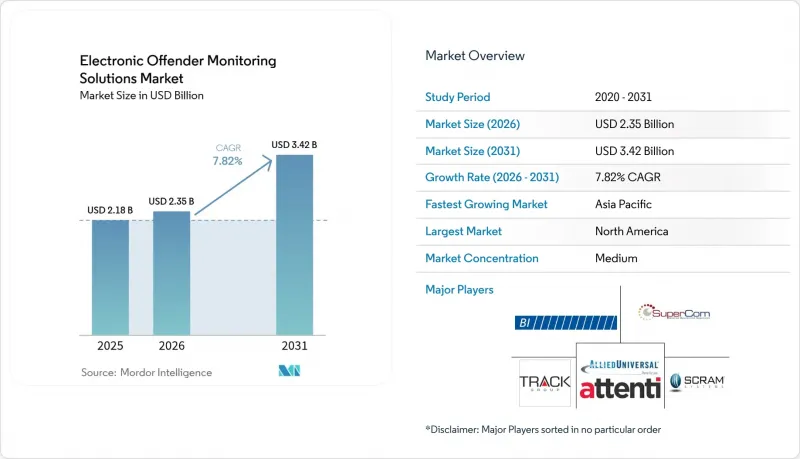
Mordor Intelligence에 의하면, 2026년 전자 범죄자 모니터링 솔루션 시장 규모는 23억 5,000만 달러로 추정되고 2025년 21억 8,000만 달러에서 성장하여 2031년에는 34억 2,000만 달러에 이를 것으로 예측됩니다.
2026년부터 2031년까지의 연평균 성장률(CAGR)은 7.82%가 될 것으로 전망됩니다.

본 보고서는 기술별(무선 주파수(RF), 전지구위치확인시스템(GPS), 기타), 제공 형태별(하드웨어 및 웨어러블, SaaS 플랫폼 및 분석, 기타), 최종 사용자별(성인 가석방·보호관찰 기관, 청소년 사법 부문, 기타),지역별(북미, 남미, 유럽, 기타)로 분류되어 있습니다. 시장 예측은 금액(달러) 기준으로 제시되어 있습니다.
세계의 전자 범죄자 모니터링 솔루션 시장 동향 및 인사이트
발목 착용형 기기에 대한 LTE-M/NB-IoT 통합
듀얼 모드 셀룰러 IoT는 GNSS, Wi-Fi, RF 비콘에 더해 LTE-M 또는 NB-IoT를 병행 사용함으로써, 도시 지역의 고층 빌딩 군, 터널, 외딴 지역의 통로에서도 위치 정보의 가시성을 유지하며, 단일 채널 GPS를 대체합니다. Sequans의 GM02S 모듈은 3GPP Release 14 준수, eSIM 프로비저닝, 일일 충전 주기를 7-10일에 한 번으로 줄여주는 배터리 최적화 기능을 통해 이러한 변화를 구현하고 있습니다. 이러한 기능을 통해 배터리 방전으로 인한 의도파관 않은 규정 위반을 줄이고, 전력 관련 경보로 인한 현장 담당자의 업무 부담을 경감시킵니다. 각 벤더는 향후 주파수 대역의 폐지로 인한 기관의 피해를 방지하고, 기기를 회수하지 않고도 보안 패치를 적용할 수 있는 무선 펌웨어 업데이트 기능을 탑재하고 있습니다. 그 결과, 더욱 엄격한 외출 금지 시간대나 더 좁은 출입 금지 구역 반경에 대응할 수 있는 획기적인 성능 향상이 실현됩니다. 변조 감지 센서나 생체 인증과 결합함으로써, 차세대 셀룰러 IoT 하드웨어는 전자 범죄자 모니터링 솔루션 시장에서 폭력적인 재범자 등 고위험 범주에 속하는 피의자에 대해서도 수감에 대체할 수 있는 확장 가능한 길을 열어줍니다.
비구금형을 권장하는 각국의 법적 정비
세계의 입법 기관들은 전자 감시를 공판 전 구금이나 경미한 징역형을 대체하는 기본 선택지로 법제화하고 있습니다. 일본의 2023년 법률은 도주 우려가 있는 범죄로 기소되어 보석 자격이 인정된 피고인에 대해 법원이 GPS 추적을 명령할 수 있는 권한을 부여하고 있으며, 2028년까지 전면 도입될 예정입니다. 영국에서는 2024년에 시행된 개정법에 따라 모니터링 서비스를 제공하는 민간 사업자에 대한 설명 책임 의무가 명확해졌습니다. 이러한 움직임을 뒷받침하는 것은 재정적인 계산입니다. 1일당 모니터링 비용은 6달러인 반면, 표준 교도소의 수용 침대 1개당 비용은 83달러이므로, 주 차원의 교정 예산에서 수감자 1인당 연간 2만 8,000달러 이상을 절감할 수 있습니다. 장기적인 관점에서 볼 때, 양형 지침에 포함된 의무적인 전자 모니터링 조항으로 인해 조달 절차가 재량적 자금 동결의 영향을 덜 받게 되어, 전자 범죄자 모니터링 솔루션 시장 전체에서 기기, 데이터 요금제, SaaS 라이선스에 대한 기본 수요가 증가할 것입니다.
높은 장비 고장 및 교체 비용
장비의 분실, 파손 또는 변조는 운영 예산을 압박합니다. 특히, 감시 대상자의 빈곤율이 높고 이용료를 통한 비용 회수가 어려운 지방 카운티에서는 그 영향이 두드러집니다. 라크로스 카운티에서는 2년 동안 84대의 기기가 분실되어, 기기가 정상적으로 작동할 때 얻을 수 있는 하루 6달러의 비용 절감 효과가 상쇄되었습니다. 침수에 견디는 밀폐형 케이스나 스트랩 절단 시도에도 견디는 변조 방지 회로와 같은 기술적 진보로 인해 고장 발생 빈도는 감소 추세에 있지만, 한편으로는 보험 풀을 보유하지 않은 소규모 기관에는 설비 투자 위험이 전가되고 있습니다. 민간 보험사의 자금 지원을 받는 단말기 리스 모델이나 사회영향채권(SIB)이 임시적인 해결책으로 부상하고 있지만, 단말기의 내구성이 가석방 기간에 필적할 수준이 될 때까지는 교체에 드는 지출이 전자 범죄자 모니터링 솔루션 시장의 이익률 확대를 제약할 것으로 보입니다.
부문별 분석
2025 회계연도에 GPS 장치는 전자 범죄자 모니터링 솔루션 시장 점유율의 67.60%를 차지했습니다. 이러한 보급은 입증된 정확도와 법원에서의 인지도 덕분이지만, 고층 빌딩이나 지하 교통 기관에서는 여전히 사각지대가 존재합니다. 연평균 성장률(CAGR) 8.49%로 성장하고 있는 LTE-M/NB-IoT 하이브리드는 저대역 이동통신 채널을 병용함으로써, 위성 통신이 두절된 경우에도 팔찌가 기지국에 연결된 상태를 유지하여 인구 밀집 도시 지역에서 위치 정보 단절 시간을 40% 단축합니다. RF 비콘은 외출 금지령 준수에 있어 여전히 가치가 있으며, 당국이 범죄의 심각성이나 예산에 따라 여러 기술을 결합한 솔루션을 도입하는 경우가 많다는 점이 부각되고 있습니다.
도입 동향은 수명 주기 비용에 따라 달라집니다. LTE-M 모듈은 15-20%의 추가 비용이 발생하지만, 수동 재시작이나 배터리 교체에 따른 유지보수 작업을 절반으로 줄여줍니다. ‘펌웨어-어-서비스(FaaS)’를 통해 수사관은 원격으로 지오펜스 라이브러리를 재작성할 수 있어, 기기 재등록을 위해 법원을 방문할 필요가 없어집니다. 이러한 운영 비용 절감으로 인해 조달 팀은 지역별 2G 서비스 종료보다 훨씬 앞서 구형 GSM 팔찌를 단계적으로 폐지하게 되며, 이는 전자 범죄자 모니터링 솔루션 시장 전체에서 기술 공급업체의 총 수익 가시성을 강화합니다.
지역별 분석
북미는 수십 년에 걸친 운영 성숙도와 조정된 공급업체 인증 프로세스에 힘입어 2025년에는 41.80%의 점유율을 차지하며 수익의 주력 지역으로 남았습니다. 미국의 도입 건수는 2005년 모니터링 대상자 5만 3,000명에서 2022년에는 50만 명 가까이 확대되어 그 규모가 9배로 급증함에 따라, 전자 모니터링은 주류 감독 수단으로 자리 잡았습니다. 캐나다에서는 GPS와 경피 알코올 센서를 결합한 주별 프로그램이 도입되어 있으며, 모니터링 대상자 수는 적지만 1인당 지출액은 증가하고 있습니다.
유럽에서는 GDPR(EU 개인정보보호규정)을 준수하는 암호화와 엣지 디바이스에서의 데이터 최소화를 요건으로 하는 표준화된 조달을 통해, 전자 범죄자 모니터링 솔루션 시장 규모에서 상당한 비중을 차지하고 있습니다. 영국에서는 2024년 6월 기준으로 2만 893개의 활성 태그가 보고되었으며, 이는 GPS 기기의 34% 증가와 알코올 태그의 38% 증가에 힘입어 전년 대비 17% 증가한 수치입니다. 프랑스, 독일, 북유럽 국가들은 가정폭력 대책 체계를 확충하고 있으며, 쉥겐 지역 내에서 이주하는 범죄자에 대한 국경 간 상호 운용성을 중시하는 시범 프로그램에 경제 부양 자금을 투입하고 있습니다. 엄격한 개인정보 보호 심사로 인해 입찰 주기가 길어지고 있지만, 온칩 암호화 모듈 및 주권 클라우드 호스팅이 의무화됨에 따라 기기의 평균 판매 가격(ASP)이 상승하고 있어, 규정을 준수하는 공급업체에게는 이익률 향상의 호재가 되고 있습니다.
아시아태평양은 성장 속도 면에서 선두를 달리고 있으며, 2031년까지의 연평균 성장률(CAGR)은 8.86%로 예측됩니다. 일본의 5개년 실행 계획에는 보석 위험이 있는 피고인에 대한 법원 명령에 따른 GPS 부착 및 향후 성범죄자 추적 등이 포함되어 있어, 시장 주기의 초기 단계에서 수익 전망이 확고해졌습니다. 인도의 사법 디지털화 관련 법령에서는 전자 증거 및 화상 심리가 허용되고 있으며, 시범 평가가 종료되는 대로 전자 모니터링 도입을 위한 기반이 구축될 전망입니다. 한국은 폭력 범죄자에 대한 24시간 위성 추적 시스템을 미세 조정하고 있는 반면, 호주는 양방향 통신 기능을 갖춘 장치를 사용하여 주 차원의 가정 폭력 대책 프로그램을 확대되고 있습니다. 규제의 불균일성으로 인해 획일적인 SKU 제공은 어렵지만, 각 지역공급업체들은 정부가 기존의 RF 솔루션을 뛰어넘어 직접 셀룰러 IoT 아키텍처로 전환하려는 의도를 배경으로 혜택을 보고 있으며, 전자 범죄자 모니터링 솔루션 시장 전체의 잠재적 수익을 확대되고 있습니다.
기타 혜택
- 엑셀 형식 시장 예측(ME) 시트
- 3개월간의 애널리스트 지원
자주 묻는 질문
목차
제1장 서론
제2장 조사 방법
제3장 주요 요약
제4장 시장 구도
제5장 시장 규모 및 성장 예측
제6장 경쟁 구도
제7장 시장 기회 및 향후 전망
KTH 26.09.14According to Mordor Intelligence, the electronic offender monitoring solutions market size in 2026 is estimated at USD 2.35 billion, growing from 2025 value of USD 2.18 billion with 2031 projections showing USD 3.42 billion, growing at 7.82% CAGR over 2026-2031.
This report is Segmented by Technology (Radio Frequency (RF), Global Positioning System (GPS), and More), Offering (Hardware and Wearables, Saas Platforms and Analytics, and More), End-User (Adult Parole and Probation Agencies, Juvenile Justice Departments, and More), and Geography (North America, South America, Europe, and More). The Market Forecasts are Provided in Terms of Value (USD).
Global Electronic Offender Monitoring Solutions Market Trends and Insights
Integration of LTE-M / NB-IoT into Ankle Devices
Dual-mode cellular IoT replaces single-channel GPS by layering LTE-M or NB-IoT alongside GNSS, Wi-Fi, and RF beacons to maintain location visibility in urban canyons, tunnels, and remote corridors. Sequans' GM02S modules illustrate this shift with 3GPP Release 14 compliance, eSIM provisioning, and extended battery optimization that lowers daily charge cycles to once every 7-10 days. These attributes reduce inadvertent violations stemming from depleted batteries and diminish field-officer workloads linked to power-related alerts. Vendors are embedding over-the-air firmware updates that shield agencies from future spectrum sunsets and permit security patching without device recall. The net result is a performance step-change that supports more stringent curfew windows and tighter exclusion-zone radii. Coupled with tamper sensors and biometric confirmation, next-generation cellular IoT hardware unlocks a scalable path for the electronic offender monitoring solutions market to substitute incarceration for even high-risk categories such as violent recidivists.
National Mandates Favouring Non-Custodial Sentencing
Legislatures worldwide are codifying electronic monitoring as the default alternative to pre-trial detention or low-level prison terms. Japan's 2023 statute empowers courts to impose GPS tracking on bail-eligible defendants accused of flight-risk offenses, with full rollout scheduled by 2028. In the United Kingdom, amendments enacted in 2024 refine accountability obligations for private providers delivering monitoring services. Fiscal arithmetic drives the momentum: a USD 6 daily monitoring cost compares favorably with USD 83 for a standard prison bed, producing annual savings greater than USD 28,000 per inmate at state-level corrections budgets. Over the long horizon, compulsory electronic supervision clauses written into sentencing guidelines insulate procurement pipelines from discretionary funding pauses, lifting baseline volumes for devices, data plans, and SaaS licenses across the electronic offender monitoring solutions market.
High Device Failure-Replacement Costs
Lost, damaged, or tampered units erode operating budgets, particularly in rural counties where offender poverty rates hinder cost recovery through user fees. La Crosse County documented 84 missing devices over a two-year window, offsetting the USD 6 per-day savings enjoyed when units remain functional. Engineering breakthroughs, such as sealed casings that resist submersion and tamper circuitry that survives attempted strap cut-through, are narrowing failure windows, yet the capital-outlay risk transfers to small agencies that lack insurance pools. Device-leasing models and social-impact bonds financed by private insurers are emerging stopgaps, but until unit durability matches parole-cycle length, replacement spending will constrain margin expansion inside the electronic offender monitoring solutions market.
Other drivers and restraints analyzed in the detailed report include:
- Escalating Domestic-Violence Protection Programs
- Cloud-Native Offender Management SaaS Uptake
- Stringent GDPR-Style Data-Privacy Litigation Exposure
For complete list of drivers and restraints, kindly check the Table Of Contents.
Segment Analysis
GPS devices held 67.60% of the electronic offender monitoring solutions market share in FY2025. Their ubiquity springs from proven accuracy and court familiarity, yet blind spots persist in multistory buildings and underground transit. LTE-M/NB-IoT hybrids, advancing at an 8.49% CAGR, overlay low-band cellular channels so that bracelets stay latched onto network towers even when satellites fail, cutting location-blackout minutes by 40% in dense urban grids. RF beacons retain value for curfew compliance, highlighting that agencies often deploy mixed-technology portfolios tailored to offense severity and budget.
Adoption dynamics pivot on lifecycle economics: LTE-M modules command a 15-20% price premium but halve maintenance call-outs tied to manual reboots or battery swaps. Firmware-as-a-service allows detectives to flash geofence libraries remotely, eliminating courthouse visits for device re-enrollment. These operational savings entice procurement teams to phase out legacy GSM bracelets well ahead of regional 2G sunsets, fortifying total revenue visibility for technology suppliers across the electronic offender monitoring solutions market.
Complete Report Scope:
- By Technology
- Radio Frequency (RF)
- Global Positioning System (GPS)
- LTE-M / NB-IoT Hybrid
- Bluetooth-Low-Energy Tether
- By Offering
- Hardware and Wearables
- SaaS Platforms and Analytics
- Managed Monitoring Services
- By End-user
- Adult Parole and Probation Agencies
- Juvenile Justice Departments
- Immigration and Border Enforcement
- Domestic-Violence Courts
- By Geography
- North America
- United States
- Canada
- Mexico
- South America
- Brazil
- Argentina
- Rest of South America
- Europe
- Germany
- United Kingdom
- France
- Russia
- Rest of Europe
- Asia-Pacific
- China
- Japan
- India
- South Korea
- South-East Asia
- Rest of Asia-Pacific
- Middle East and Africa
- Middle East
- Saudi Arabia
- United Arab Emirates
- Rest of Middle East
- Africa
- South Africa
- Egypt
- Rest of Africa
- Middle East
- North America
Geography Analysis
North America remains the revenue powerhouse with a 41.80% share in 2025, undergirded by multi-decade operational maturity and coordinated vendor certification pipelines. U.S. installations expanded from 53,000 monitored persons in 2005 to nearly 500,000 by 2022, representing a 9X volume surge that normalized electronic monitoring as a mainstream supervision lever. Canada layers provincial programs that pair GPS with transdermal alcohol sensors, deepening per-capita spend despite a smaller supervisee pool.
Europe contributes a sizable slice to the electronic offender monitoring solutions market size through standardized procurements that require GDPR-compliant encryption and edge-device data minimization. The United Kingdom reported 20,893 active tags in June 2024, a 17% annual jump fueled by a 34% expansion in GPS devices and a 38% climb in alcohol tags. France, Germany, and the Nordics broaden domestic-violence frameworks, funneling stimulus funds into pilot programs that emphasize cross-border interoperability for offenders relocating within the Schengen zone. Strict privacy vetting elongates tender cycles but elevates device ASPs owing to mandatory on-chip encryption modules and sovereign-cloud hosting, creating a margin tailwind for compliant suppliers.
Asia-Pacific leads in growth velocity with a 8.86% CAGR projection through 2031. Japan's five-year implementation plan covers court-ordered GPS for bail-risk defendants and prospective sex-offender tracking, anchoring early-cycle revenue visibility. India's justice-digitization statutes recognize electronic evidence and video hearings, constructing foundational rails for e-monitoring deployments once pilot evaluations conclude. South Korea fine-tunes its 24-hour satellite shadowing of violent offenders, while Australia expands state-level domestic-violence programs with bilateral devices. Although regulatory heterogeneity complicates one-size-fits-all SKUs, regional suppliers benefit from governments' appetite to leapfrog legacy RF solutions straight into cellular IoT architectures, expanding addressable revenue across the electronic offender monitoring solutions market.
- Attenti Group (Allied Universal Electronic Monitoring)
- BI Incorporated (The GEO Group, Inc.)
- SCRAM Systems (Alcohol Monitoring Systems, Inc.)
- Track Group, Inc.
- SuperCom Ltd.
- Sentinel Offender Services, LLC
- Buddi Ltd.
- GEOSATIS SA
- Shadowtrack Technologies, Inc.
- Corrisoft LLC
- Tarheel Monitoring LLC
- Laipac Technology, Inc.
- SafeTracks GPS Canada Inc.
- Seahawk Monitoring
- MEGASTEK Ltd.
- Thinkrace Technology Co., Ltd.
- Guardian Ankle Monitoring Service
- Amber360 (Shenzhen Chenqi Technology Co.)
- Trk USA Inc.
- Securus Technologies LLC
- Omnilink Solutions LLC
- Synergye International
- Satellite Tracking of People LLC
- G4S Monitoring Technologies Ltd.
- Guardian RMS (US)
Additional Benefits:
- The market estimate (ME) sheet in Excel format
- 3 months of analyst support
TABLE OF CONTENTS
1 INTRODUCTION
- 1.1 Study Assumptions and Market Definition
- 1.2 Scope of the Study
2 RESEARCH METHODOLOGY
3 EXECUTIVE SUMMARY
4 MARKET LANDSCAPE
- 4.1 Market Overview
- 4.2 Market Drivers
- 4.2.1 Integration of LTE-M / NB-IoT into ankle devices
- 4.2.2 National mandates favouring non-custodial sentencing (e.g., UK Police, US DOJ)
- 4.2.3 Escalating domestic-violence protection programmes
- 4.2.4 Cloud-native offender management SaaS uptake by county courts
- 4.2.5 Insurance-backed cost-sharing models for state parole boards
- 4.2.6 Government climate-driven push for e-mobility trackers (outdoor labour parolees)
- 4.3 Market Restraints
- 4.3.1 High device failure-replacement costs
- 4.3.2 Stringent GDPR-style data-privacy litigation exposure
- 4.3.3 Cellular-dead-zone risk in rural monitoring
- 4.3.4 Public-opinion backlash on continuous biometric tracking
- 4.4 Industry Supply Chain Analysis
- 4.5 Regulatory Landscape
- 4.6 Technological Outlook
- 4.7 Porter's Five Forces Analysis
- 4.7.1 Threat of New Entrants
- 4.7.2 Bargaining Power of Buyers
- 4.7.3 Bargaining Power of Suppliers
- 4.7.4 Threat of Substitute Products
- 4.7.5 Intensity of Competitive Rivalry
- 4.8 Impact of Macroeconomic Factors on the Market
- 4.9 Investment Analysis
5 MARKET SIZE AND GROWTH FORECASTS (VALUE)
- 5.1 By Technology
- 5.1.1 Radio Frequency (RF)
- 5.1.2 Global Positioning System (GPS)
- 5.1.3 LTE-M / NB-IoT Hybrid
- 5.1.4 Bluetooth-Low-Energy Tether
- 5.2 By Offering
- 5.2.1 Hardware and Wearables
- 5.2.2 SaaS Platforms and Analytics
- 5.2.3 Managed Monitoring Services
- 5.3 By End-user
- 5.3.1 Adult Parole and Probation Agencies
- 5.3.2 Juvenile Justice Departments
- 5.3.3 Immigration and Border Enforcement
- 5.3.4 Domestic-Violence Courts
- 5.4 By Geography
- 5.4.1 North America
- 5.4.1.1 United States
- 5.4.1.2 Canada
- 5.4.1.3 Mexico
- 5.4.2 South America
- 5.4.2.1 Brazil
- 5.4.2.2 Argentina
- 5.4.2.3 Rest of South America
- 5.4.3 Europe
- 5.4.3.1 Germany
- 5.4.3.2 United Kingdom
- 5.4.3.3 France
- 5.4.3.4 Russia
- 5.4.3.5 Rest of Europe
- 5.4.4 Asia-Pacific
- 5.4.4.1 China
- 5.4.4.2 Japan
- 5.4.4.3 India
- 5.4.4.4 South Korea
- 5.4.4.5 South-East Asia
- 5.4.4.6 Rest of Asia-Pacific
- 5.4.5 Middle East and Africa
- 5.4.5.1 Middle East
- 5.4.5.1.1 Saudi Arabia
- 5.4.5.1.2 United Arab Emirates
- 5.4.5.1.3 Rest of Middle East
- 5.4.5.2 Africa
- 5.4.5.2.1 South Africa
- 5.4.5.2.2 Egypt
- 5.4.5.2.3 Rest of Africa
- 5.4.5.1 Middle East
- 5.4.1 North America
6 COMPETITIVE LANDSCAPE
- 6.1 Market Concentration
- 6.2 Strategic Moves
- 6.3 Market Share Analysis
- 6.4 Company Profiles (includes Global level Overview, Market level overview, Core Segments, Financials as available, Strategic Information, Market Rank/Share, Products and Services, Recent Developments)
- 6.4.1 Attenti Group (Allied Universal Electronic Monitoring)
- 6.4.2 BI Incorporated (The GEO Group, Inc.)
- 6.4.3 SCRAM Systems (Alcohol Monitoring Systems, Inc.)
- 6.4.4 Track Group, Inc.
- 6.4.5 SuperCom Ltd.
- 6.4.6 Sentinel Offender Services, LLC
- 6.4.7 Buddi Ltd.
- 6.4.8 GEOSATIS SA
- 6.4.9 Shadowtrack Technologies, Inc.
- 6.4.10 Corrisoft LLC
- 6.4.11 Tarheel Monitoring LLC
- 6.4.12 Laipac Technology, Inc.
- 6.4.13 SafeTracks GPS Canada Inc.
- 6.4.14 Seahawk Monitoring
- 6.4.15 MEGASTEK Ltd.
- 6.4.16 Thinkrace Technology Co., Ltd.
- 6.4.17 Guardian Ankle Monitoring Service
- 6.4.18 Amber360 (Shenzhen Chenqi Technology Co.)
- 6.4.19 Trk USA Inc.
- 6.4.20 Securus Technologies LLC
- 6.4.21 Omnilink Solutions LLC
- 6.4.22 Synergye International
- 6.4.23 Satellite Tracking of People LLC
- 6.4.24 G4S Monitoring Technologies Ltd.
- 6.4.25 Guardian RMS (US)
7 MARKET OPPORTUNITIES AND FUTURE OUTLOOK
- 7.1 White-space and Unmet-Need Assessment


