

|
시장보고서
상품코드
2124956
백신 투여 디바이스 : 시장 점유율 분석, 업계 동향 및 통계, 성장 예측(2026-2031년)Vaccine Delivery Devices - Market Share Analysis, Industry Trends & Statistics, Growth Forecasts (2026 - 2031) |
||||||
 Mordor Intelligence
Mordor Intelligence에 의하면, 백신 투여 디바이스 시장 규모는 2025년 62억 1,000만 달러로 평가되었습니다. 2026년에는 66억 3,000만 달러로 확대되어 2026-2031년에 걸쳐 CAGR 6.82%로 성장을 지속하여, 2031년에는 92억 2,000만 달러에 이를 것으로 예측됩니다.
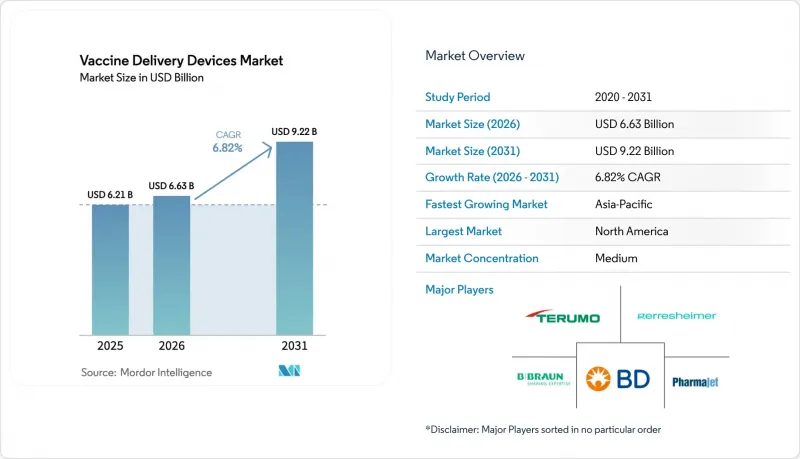
본 보고서는 제품 유형(주사기, 무바늘 주사기, 마이크로니들 패치, 비강 스프레이 기구, 기타), 투여 경로(근육 내, 피내, 피하, 비강 내), 최종 사용자(병원, 클리닉, 예방접종 센터, 기타),지역(북미, 유럽, 아시아태평양, 기타)별로 분류되어 있습니다. 시장 예측은 금액(달러) 기준으로 제시되어 있습니다.
세계의 백신 투여 디바이스 시장 동향 및 인사이트
전 세계 예방접종 자금 증가
공공 부문의 자금 지원 강화로 인해, 병원체 특이적 연구개발 보조금과 기기 혁신을 명시적으로 언급한 인프라 보조금을 결합함으로써 백신 투여 디바이스 시장은 재편되고 있습니다. 2025년 1월, 미국 보건복지부는 mRNA 팬데믹 인플루엔자 백신의 개량을 위해 모더나사에 5억 9,000만 달러를 지원했습니다. 이 합의에 따르면, 그 일부가 새로운 피내 및 비강 내 투여 형태에 대한 연구 개발에 사용될 것으로 규정되어 있습니다. BARDA가 병행하여 추진하는 ‘프로젝트 넥스트젠(Project NextGen)’에서는 콜드체인의 자동화와 실시간 유전체 모니터링을 위해 2억 4,000만 달러를 배정하고 있으며, 이를 통해 신흥 제제가 운송 중 안정성을 유지할 수 있는 투여 디바이스와 결합될 수 있도록 보장하고 있습니다. 유사한 전략은 유럽 보건 비상사태 대비·대응청(EHERA)에서도 볼 수 있는데, 이 기관은 내열성 패치와 백신 프로토타입을 결합한 기업에 마일스톤 달성 시마다 지급금을 제공합니다. 이러한 자금 흐름은 개발 위험을 완화하고, 규제 당국에 대한 신청을 가속화하며, 임상 마일스톤을 달성한 시점에서 제조업체에 기준 구매 수량을 보장하는 것입니다. 중기적으로는 이러한 자금 조달의 물결로 인해 백신 투여 디바이스에 대한 연간 연구개발비가 10억 달러를 지속적으로 상회하며, 최소 3가지 투여 경로를 아우르는 기기의 지속적인 시장 출시가 뒷받침될 것으로 예측됩니다.
바늘 없는 주사기의 급속한 보급
무바늘 플랫폼의 매력은 동등하거나 그 이상의 면역원성과 환자의 높은 수용성을 보여주는 임상시험 데이터에 의해 점점 더 뒷받침되고 있습니다. 2024년 BIO 국제 컨퍼런스에서 PharmaJet은 0.5mL 근육 주사용 주사기와 비교하여, 무바늘을 통한 피내 투여가 광견병 백신과 인플루엔자 백신 모두에서 더 높은 중화 항체가를 유도했음을 보여주는 파트너사의 임상시험 결과를 발표했습니다. 2025년, FDA가 비전동식 액체 주입기를 클래스 II 의료기기로 재분류함에 따라 규제가 명확해졌으며, 그동안 중소기업 시장 진입을 가로막았던 510(k) 승인 절차가 간소화되었습니다. 인센티브와 보다 명확한 표시 지침 덕분에 미국 내 상품화까지 소요되는 기간은 이미 평균 32개월에서 22개월로 단축되어 선점 우위가 더욱 강화되고 있습니다. 유럽에서도 유사한 추세가 나타나고 있습니다. 2024년 7월, 프랑스 정부의 보조금을 통해 Crossject는 z-jet 자동 주사기의 제품 라인을 확장할 수 있었으며, 이는 더 안전한 외래 접종 도구에 대한 정부 차원의 지원이 이루어졌음을 보여줍니다. 이러한 시너지 효과로 인해 병원, 공공 예방접종 센터, 군 기관에서의 장비 교체 주기가 가속화되고 있습니다.
마이크로니들 패치의 높은 제조 비용
임상적 가능성은 매우 높지만, 마이크로니들의 대규모 제조는 여전히 자본 집약적입니다. 이는 레이저 어블레이션, MEMS 에칭, 바이오폴리머 성형 각 공정에서 각각 다른 등급의 클린룸과 인라인 측정 장비가 필요하기 때문입니다. 2023년 PATH의 준비 현황 조사에 따르면, 연간 1,000만 장 이상의 생산량으로 마이크로어레이의 우수 제조 기준(GMP) 인증을 취득한 상업용 생산 라인은 전 세계적으로 5개 미만이며, 이는 팬데믹 시기 수요 예측 상한선을 크게 밑도는 수치입니다. 단가는 표준 주사기와 바이알 세트의 납품 가격의 1.4배에서 3.2배 사이로, 비용에 민감한 각국의 예방접종 프로그램에서의 도입을 제한하고 있습니다. 투자자들은 장기 구매 계약이 구체화될 때까지 신규 공장 건설에 대한 자금 지원에 소극적이며, 이것이 자금 조달의 병목 현상이 되고 있습니다. 향후 2년 동안 BARDA, CEPI, 빌 & 멜린다 게이츠 재단이 시범 플랜트에 대한 자금을 보장함으로써 규모의 경제가 개선될 가능성은 있지만, 1회 투여당 가격이 주사기와 동등한 수준이 되는 것은 2028년 이전에는 어려울 것으로 보입니다.
부문별 분석
2025년, 주사기는 백신 투여 디바이스 시장의 63.94%를 차지하며, 현재 가격 기준으로 약 39억 7,000만 달러 규모에 기여했습니다. 안전 기준을 충족하는 주사기 사용 의무화가 강화되고 있으며, 주요 제조업체에 의한 세계 유통망이 확립되어 있어 기준 수량은 견조한 추세를 보이고 있습니다. 또한, 유니세프(UNICEF) 및 가비(Gavi)와의 대량 조달 계약을 통해 0.5mL형 자동 무효화식 주사기의 처리량은 확보되어 있습니다. 한편, 무바늘 주사기는 다른 어떤 제품 카테고리보다 빠르게 성장하고 있으며, 직업 안전 보건 정책과 통증 완화를 강조하는 환자 중심의 백신 접종 캠페인을 배경으로 연평균 성장률(CAGR) 7.49%로 성장을 지속하고 있습니다. 마이크로니들 패치는 아직 발전 단계에 있지만, 전략적으로 중요한 틈새 시장을 차지하고 있습니다. 초기 임상시험에서 환자 선호도가 70%에 육박했으며, 비용 곡선이 하락하면 강력한 수요가 발생할 것으로 시사되고 있습니다. 또한, Project NextGen의 보조금을 받아 비강용 인플루엔자 및 코로나19 백신 후보가 2상 임상시험 파이프라인을 진행 중이기 때문에 비강용 스프레이 디스펜서도 다시 주목받고 있습니다. 경쟁 구도는 제품 포트폴리오의 폭을 중심으로 전개되고 있습니다. 벡톤 디킨슨(Becton Dickinson)은 안전 설계가 적용된 주사기의 미국 내 생산량을 40% 늘리기 위해 1,000만 달러를 투자하고 있으며, 동시에 무바늘 제품 시장 침투에 대한 리스크 헤지 수단으로 입소메드(Ipsomed)와 고점도용 자동 주사기 개발을 위해 제휴하고 있습니다.
2세대 제트 주사기 및 웨어러블 패치는 ‘기타’ 카테고리를 구성하고 있으며, 절대적인 달러 점유율은 여전히 작지만 투자자들로부터는 재택 예방접종 모델의 진입점 역할을 하는 기술로 간주되고 있습니다. 마이크론 바이오메디컬(Micron Biomedical)의 3,300만 달러 규모의 시리즈 A 추가 자금 조달은 콜드체인의 제약을 제거하고 자가 투여를 가능하게 하는 용해형 마이크로어레이 장치에 대한 벤처 캐피탈의 관심이 높아지고 있음을 보여줍니다. 경쟁 환경에서는 주사기 충전 라인을 패치나 제트 형태의 제조로 전환할 수 있는 기업이 점점 더 유리해지고 있으며, 이를 통해 공중보건 비상사태 발생 시 생산 확대까지 소요되는 시간을 단축할 수 있게 되었습니다.
지역별 분석
북미는 수십억 달러 규모의 연방 정부 프로그램, 유리한 상환 제도, 성숙한 GxP 제조거점 덕분에 2025년에도 37.88%라는 최대 매출 점유율을 유지했습니다. 정부의 조달 계획에서는 주사기, 바이알 스토퍼, 안전 장치가 세트로 발주되는 경우가 많아, 이를 통해 OEM은 안정적인 수주량을 확보하고 설비 투자 위험을 줄일 수 있습니다. 또한, 의료기기·의약품 복합 제품에 관한 FDA의 지침안으로 인해, 과거 플랫폼 실험을 방해하던 규제상의 모호함이 더욱 해소되었습니다. 게다가 OSHA(직업안전보건청)의 규정 준수 감사로 인해 병원들은 차폐 기능이 없는 주사바늘을 교체해야만 하며, 이로 인해 보다 새로운 기술적 솔루션에 대한 예측 가능한 수요가 발생하고 있습니다.
아시아태평양은 급속한 도시화, 중산층의 백신 접종에 대한 인식 제고, APVAX를 통해 자금을 지원받는 인프라 구축에 힘입어 2031년까지 연평균 성장률(CAGR) 7.61%를 기록하며 가장 빠르게 성장하는 지역입니다. 중국과 인도에는 현재 프리필드 주사기의 지역적 리드타임을 단축하는 충전 및 마무리 거점이 여러 곳 존재하며, 한편 동남아시아 국가들에서는 접근이 어려운 섬들에서 마이크로니들의 타당성 조사가 시험적으로 진행되고 있습니다. 규제 체계도 점차 조화를 이루고 있습니다. 인도네시아의 BPOM은 아세안(ASEAN) 공통 신청 서류를 채택하고 있으며, 인도의 CDSCO는 WHO의 사전 인증을 받은 의료기기에 대해 신속 심사 제도를 마련하고 있어, 이를 통해 외국 OEM 업체 시장 진입 장벽이 점차 낮아지고 있습니다.
유럽에서는 산업안전보건지침 및 환경 관련 법규가 구매 우선순위에 영향을 미치며, 한 자릿수 중반대의 성장이 예상됩니다. 각국의 국민건강보험 서비스는 날카로운 폐기물을 줄이기 위해 무바늘 주사기를 우선적으로 채택하고 있으나, 완전히 재활용 가능한 포장을 요구하고 있어 공급망 설계가 복잡해지고 있습니다. 무균 충전 및 마무리 생산 능력에 대한 투자(특히 Aenova가 이탈리아에서 1,600만 유로 규모로 확장한 것이 두드러집니다)는 이 지역이 첨단 의료기기 제조의 현지화를 추진하려는 의도를 뒷받침하고 있습니다. 한편, 동유럽 국가들은 EU의 결속 기금을 활용하여 콜드체인 물류의 현대화를 추진하고 있으며, 국경을 넘는 백신 접종 캠페인에서도 새로운 유형의 의료기기를 확실하게 활용할 수 있도록 보장하고 있습니다.
기타 혜택
- 엑셀 형식 시장 예측(ME) 시트
- 3개월간의 애널리스트 지원
자주 묻는 질문
목차
제1장 서론
제2장 조사 방법
제3장 주요 요약
제4장 시장 구도
제5장 시장 규모 및 성장 예측
제6장 경쟁 구도
제7장 시장 기회 및 향후 전망
KTH 26.09.14According to Mordor Intelligence, the vaccine delivery devices market size is expected to grow from USD 6.21 billion in 2025 to USD 6.63 billion in 2026 and is forecast to reach USD 9.22 billion by 2031 at 6.82% CAGR over 2026-2031.
This report is Segmented by Product Type (Syringes, Needle-Free Injectors, Microneedle Patches, Nasal Spray Devices, Others), Route of Administration (Intramuscular, Intradermal, Subcutaneous, Intranasal), End User (Hospitals, Clinics, Immunization Centers, Others), and Geography (North America, Europe, Asia-Pacific, and More). The Market Forecasts are Provided in Terms of Value (USD).
Global Vaccine Delivery Devices Market Trends and Insights
Growing Global Immunization Funding
Intensified public-sector financing is reshaping the vaccine delivery devices market by coupling pathogen-specific R&D awards with infrastructure grants that explicitly reference device innovation. In January 2025 the U.S. Department of Health and Human Services allocated USD 590 million to Moderna to refine mRNA pandemic influenza vaccines, and the agreement earmarked a portion for novel intradermal and intranasal administration formats. BARDA's parallel Project NextGen has set aside USD 240 million for cold-chain automation and real-time genomic surveillance, ensuring that emerging formulations can be paired with delivery devices able to remain stable in transit. Comparable strategies are visible in the European Health Emergency Preparedness and Response Authority, which offers milestone payments to firms bundling thermostable patches with prototype vaccines. These capital flows smooth development risk, accelerate regulatory submissions and assure manufacturers of baseline purchase volumes once clinical milestones are crossed. Over the medium term the financing wave is expected to keep annual R&D spend on vaccine delivery devices above USD 1 billion, supporting sustained device launch pipelines across at least three administration routes .
Rapid Uptake of Needle-Free Injectors
The appeal of needle-free platforms increasingly rests on clinical-trial data showing equal or superior immunogenicity and better patient acceptance. At the 2024 BIO International Convention, PharmaJet disclosed partner trials in which intradermal needle-free delivery elicited higher neutralizing-antibody titers for both rabies and influenza vaccines when compared with 0.5-milliliter intramuscular syringes. Regulatory clarity strengthened in 2025 when the FDA re-classified nonelectrically powered fluid injectors as Class II devices, thereby streamlining 510(k) pathways that had previously deterred small entrants. Incentives and clearer labeling guidance have already shortened U.S. commercialization timelines from an average 32 months to 22 months, magnifying first-mover advantages. Europe mirrors this trend; a July 2024 French grant enabled Crossject to expand its z-jet auto-injector line, signaling state-level support for safer outpatient vaccination tools. The cumulative effect is an accelerating equipment turnover cycle inside hospitals, public immunization centers and military channels.
High Microneedle-Patch Production Cost
Despite robust clinical promise, large-scale microneedle manufacture remains capital-intensive because laser ablation, MEMS etching and biopolymer molding each require distinct clean-room classes and in-line metrology. A 2023 PATH readiness study documented that fewer than five commercial lines worldwide are certified for Good Manufacturing Practice microarrays at volumes above 10 million patches annually, far below projected pandemic demand ceilings. Unit-cost premiums range from 1.4-times to 3.2-times the delivered price of a standard syringe-plus-vial set, restricting uptake in cost-sensitive national immunization programs. Investors are hesitant to fund green-field plants until long-term purchase agreements crystallize, creating a capital-access bottleneck. Over the next two years, economies of scale could improve as BARDA, CEPI and the Bill & Melinda Gates Foundation underwrite demonstration plants, yet initial per-dose pricing parity with syringes is unlikely before 2028.
Other drivers and restraints analyzed in the detailed report include:
- Pandemic-Preparedness Stockpiles
- Safety-Syringe Regulations (NSIs)
- Sterility Hurdles for Reusable Systems
For complete list of drivers and restraints, kindly check the Table Of Contents.
Segment Analysis
Syringes commanded 63.94% of the vaccine delivery devices market in 2025, translating to a vaccine delivery devices market size contribution of roughly USD 3.97 billion at current prices. Heightened safety-syringe mandates and the entrenched global distribution footprint of top manufacturers keep baseline volumes robust, while bulk tender contracts from UNICEF and Gavi guarantee throughput for 0.5-milliliter auto-disable formats. Needle-free injectors, however, are scaling faster than any other product class, registering a 7.49% CAGR that rides on occupational-safety policies and patient-centric vaccination campaigns that highlight pain reduction. Microneedle patches occupy a nascent yet strategically important niche; early trials have achieved patient preference rates approaching 70%, suggesting a strong behavioral pull once cost curves descend. Nasal spray dispensers also enjoy renewed attention as intranasal influenza and COVID-19 candidates move through Phase II pipelines under Project NextGen grant funding. Competitive dynamics revolve around portfolio breadth: Becton Dickinson is spending USD 10 million to lift U.S. output of safety-engineered injectors by 40%, yet it simultaneously collaborates with Ypsomed on high-viscosity auto-injectors to hedge against needle-free penetration.
Second-generation jet injectors and wearable patches round out the "Others" category, and although their absolute dollar share remains small, investors view them as gateway technologies for at-home immunization models. Micron Biomedical's USD 33 million Series A extension underscores rising venture appetite for dissolvable microarray devices that eliminate cold-chain obligations and empower self-administration. The competitive narrative increasingly rewards firms able to re-purpose syringe filling lines for patch or jet formats, thereby shortening time-to-scale when public-health emergencies arise.
Complete Report Scope:
- By Product Type
- Syringes
- Needle-Free Injectors
- Microneedle Patches
- Nasal Spray Devices
- Others
- By Route of Administration
- Intramuscular
- Intradermal
- Subcutaneous
- Intranasal
- By End User
- Hospitals
- Clinics
- Immunization Centers
- Others
- By Geography
- North America
- United States
- Canada
- Mexico
- Europe
- Germany
- United Kingdom
- France
- Italy
- Spain
- Rest of Europe
- Asia-Pacific
- China
- Japan
- India
- Australia
- South Korea
- Rest of Asia-Pacific
- Middle East and Africa
- GCC
- South Africa
- Rest of Middle East and Africa
- South America
- Brazil
- Argentina
- Rest of South America
- North America
Geography Analysis
North America retained the leading 37.88% revenue share in 2025 due to multi-billion-dollar federal programs, favorable reimbursement and a mature GxP manufacturing base. Government procurement schedules often bundle syringes, vial stoppers and safety devices, assuring OEMs of volume commitments that de-risk capex. FDA draft guidances on device-drug combination products have further lowered the regulatory ambiguity that once discouraged platform experimentation. Moreover, OSHA compliance audits compel hospitals to replace non-shielded needles, channeling predictable demand toward newer engineered solutions.
Asia-Pacific is the fastest-growing region with a 7.61% CAGR to 2031, propelled by rapid urbanization, rising middle-class vaccination awareness and infrastructure build-outs funded through APVAX. China and India now host several fill-finish hubs that shorten regional lead times for pre-filled syringes, while Southeast Asian economies pilot microneedle feasibility studies in hard-to-reach islands. Regulatory pathways are also harmonizing: Indonesia's BPOM has adopted ASEAN Common Submission Dossiers, and India's CDSCO provides accelerated review windows for WHO prequalified devices, slowly reducing market entry friction for foreign OEMs.
Europe exhibits mid-single-digit growth as occupational-safety directives and environmental legislation influence purchasing hierarchies. National health services prioritize needle-free injectors to lower sharps waste, yet they demand fully recyclable packaging that complicates supply-chain design. Investment in sterile fill-finish capacity-Aenova's EUR 16 million Italian expansion stands out-underlines the region's intent to localize advanced-device manufacturing. Eastern European nations, meanwhile, are tapping EU Cohesion Funds to modernize cold-chain logistics, ensuring that new device types remain viable across cross-border vaccination drives.
- Becton Dickinson & Co.
- B. Braun
- Terumo
- Zhejiang Longde Pharma
- Vaxxas Pty Ltd
- Hindustan Syringes & Medical Devices
- Gerresheimer
- SCHOTT
- Enesi Pharma
- PharmaJet
- Mystic Pharmaceuticals
- Bioject Medical Technologies
- West Pharmaceutical Services
- Stevanato Group
- Nipro
- AptarGroup Inc.
- Catalent
- Rommelag Engineering
- Solventum
- Star Syringe Ltd
Additional Benefits:
- The market estimate (ME) sheet in Excel format
- 3 months of analyst support
TABLE OF CONTENTS
1 Introduction
- 1.1 Study Assumptions & Market Definition
- 1.2 Scope of the Study
2 Research Methodology
3 Executive Summary
4 Market Landscape
- 4.1 Market Overview
- 4.2 Market Drivers
- 4.2.1 Growing global immunization funding
- 4.2.2 Rapid uptake of needle-free injectors
- 4.2.3 Pandemic-preparedness stockpiles
- 4.2.4 Safety-syringe regulations (NSIs)
- 4.2.5 Outsourced fill-finish boosts pre-filled vaccine devices
- 4.2.6 Wearable injector patches in field trials
- 4.3 Market Restraints
- 4.3.1 High microneedle-patch production cost
- 4.3.2 Sterility hurdles for re-usable systems
- 4.3.3 COP polymer supply bottlenecks
- 4.3.4 Cold-chain packaging gaps for micro-array patches
- 4.4 Value / Supply-Chain Analysis
- 4.5 Regulatory Landscape
- 4.6 Porters Five Forces Analysis
- 4.6.1 Threat of New Entrants
- 4.6.2 Bargaining Power of Buyers
- 4.6.3 Bargaining Power of Suppliers
- 4.6.4 Threat of Substitutes
- 4.6.5 Competitive Rivalry
5 Market Size & Growth Forecasts (Value, USD)
- 5.1 By Product Type
- 5.1.1 Syringes
- 5.1.2 Needle-Free Injectors
- 5.1.3 Microneedle Patches
- 5.1.4 Nasal Spray Devices
- 5.1.5 Others
- 5.2 By Route of Administration
- 5.2.1 Intramuscular
- 5.2.2 Intradermal
- 5.2.3 Subcutaneous
- 5.2.4 Intranasal
- 5.3 By End User
- 5.3.1 Hospitals
- 5.3.2 Clinics
- 5.3.3 Immunization Centers
- 5.3.4 Others
- 5.4 By Geography
- 5.4.1 North America
- 5.4.1.1 United States
- 5.4.1.2 Canada
- 5.4.1.3 Mexico
- 5.4.2 Europe
- 5.4.2.1 Germany
- 5.4.2.2 United Kingdom
- 5.4.2.3 France
- 5.4.2.4 Italy
- 5.4.2.5 Spain
- 5.4.2.6 Rest of Europe
- 5.4.3 Asia-Pacific
- 5.4.3.1 China
- 5.4.3.2 Japan
- 5.4.3.3 India
- 5.4.3.4 Australia
- 5.4.3.5 South Korea
- 5.4.3.6 Rest of Asia-Pacific
- 5.4.4 Middle East and Africa
- 5.4.4.1 GCC
- 5.4.4.2 South Africa
- 5.4.4.3 Rest of Middle East and Africa
- 5.4.5 South America
- 5.4.5.1 Brazil
- 5.4.5.2 Argentina
- 5.4.5.3 Rest of South America
- 5.4.1 North America
6 Competitive Landscape
- 6.1 Market Concentration
- 6.2 Market Share Analysis
- 6.3 Company Profiles (includes Global level Overview, Market level overview, Core Segments, Financials as available, Strategic Information, Market Rank/Share for key companies, Products & Services, and Recent Developments)
- 6.3.1 Becton Dickinson & Co.
- 6.3.2 B. Braun Melsungen AG
- 6.3.3 Terumo Corporation
- 6.3.4 Zhejiang Longde Pharma
- 6.3.5 Vaxxas Pty Ltd
- 6.3.6 Hindustan Syringes & Medical Devices
- 6.3.7 Gerresheimer AG
- 6.3.8 SCHOTT AG
- 6.3.9 Enesi Pharma
- 6.3.10 PharmaJet Inc.
- 6.3.11 Mystic Pharmaceuticals
- 6.3.12 Bioject Medical Technologies
- 6.3.13 West Pharmaceutical Services
- 6.3.14 Stevanato Group
- 6.3.15 Nipro Corporation
- 6.3.16 AptarGroup Inc.
- 6.3.17 Catalent Inc.
- 6.3.18 Rommelag Engineering
- 6.3.19 Solventum
- 6.3.20 Star Syringe Ltd
7 Market Opportunities & Future Outlook
- 7.1 White-space & Unmet-Need Assessment


