

|
시장보고서
상품코드
2124963
배터리 관리 IC : 시장 점유율 분석, 업계 동향과 통계, 성장 예측(2026-2031년)Battery Management IC - Market Share Analysis, Industry Trends & Statistics, Growth Forecasts (2026 - 2031) |
||||||
 Mordor Intelligence
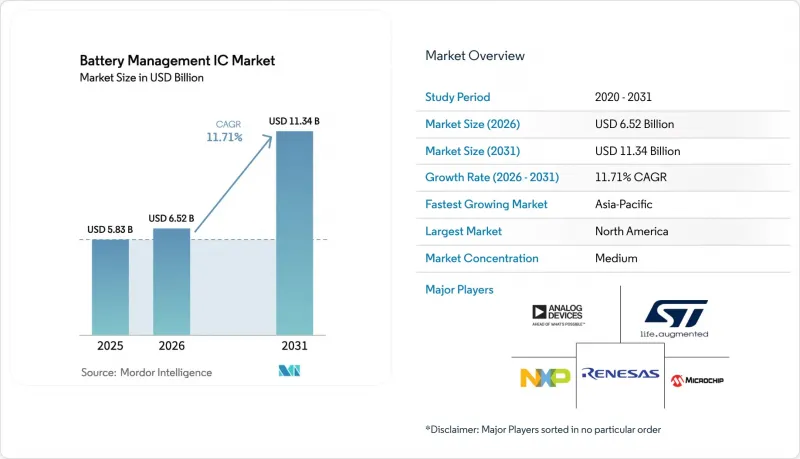
에 의하면, 배터리 관리 IC 시장 규모는 2026년에 65억 2,000만 달러에 이르고, 2031년까지 113억 4,000만 달러에 이를 것으로 예측되며, 예측 기간 중 연평균 복합 성장률(CAGR)은 11.71%를 기록할 전망입니다.
본 보고서는 IC 유형(연료 게이지 IC, 배터리 충전기 IC, 인증 IC 등), 배터리 화학 성분(리튬 이온, 리튬 폴리머, 니켈 수소, 납산),셀 구성(싱글 셀, 멀티 셀), 최종 이용 산업(자동차, 소비자 가전, 산업용 등), 지역별로 분류되어 있습니다. 시장 예측은 금액(달러) 기준으로 제시되어 있습니다.
전 세계 배터리 관리 IC 시장 동향 및 인사이트
EV 생산 목표의 급증
각 자동차 제조업체는 2030년까지 연간 3,000만 대 이상의 배터리식 전기차를 생산하겠다고 공약하고 있습니다. 각 팩에는 모듈 수준 및 팩 수준의 장치가 통합되어 있으므로, 이러한 목표를 달성하려면 연간 약 1억 2,000만 개의 멀티셀 컨트롤러가 필요합니다. OEM 업체들은 현재, 과거에 고액의 보증 청구 원인이 되었던 위조 셀을 배제하기 위해 암호화 인증 IC의 채택을 의무화하고 있습니다. 테슬라가 선구적으로 도입한 ‘셀-투-팩(Cell-to-Pack)’ 아키텍처는 중간 모듈을 제거하고, 배터리 관리 기능을 더 적은 수의 고도화된 IC에 집약함으로써 최대 400개의 직렬 연결 셀을 모니터링할 수 있게 합니다. 고전압 아날로그 프런트엔드, 디지털 신호 처리 및 무선 송수신기를 동일한 다이 위에 통합할 수 있는 공급업체가 파트너로 점점 더 많이 선정되고 있습니다.
모바일 및 웨어러블 기기의 보급 확대
2025년, 전 세계 스마트폰 출하 대수는 10억 대 이상으로 안정화되었으나, 5G 무선 및 AI를 활용한 이미지 처리로 인한 에너지 수요 증가가 배터리 성능 저하를 가속화했습니다. 이에 각 기기 제조업체는 사용자의 행동 패턴을 학습하여 충전 상태 추정 정확도를 높이는 적응형 연료 게이지 IC를 탑재함으로써 대응했습니다. 애플은 이러한 추세를 한층 더 추진하여, 제3자 수리 업체에 자사의 iOS 진단 프레임워크와 연동되는 인증 IC가 내장된 배터리의 장착을 의무화했습니다. 2025년에는 5억 대 이상의 웨어러블 기기가 출하될 전망이며, 각 기기는 가동 시간을 극대화하기 위해 소형화된 보호 및 모니터링 회로가 필요합니다. 폴더블 스마트폰과 플렉서블 배터리는 새로운 고장 모드를 초래하고 있으며, 치명적인 사고가 발생하기 전에 내부 팽창을 감지할 수 있는 임피던스 분광법을 지원하는 모니터링 IC에 대한 수요를 견인하고 있습니다.
고급 SoC에서의 복잡한 통합
스마트폰 및 노트북 플랫폼에서는 기판 공간 절약과 비용 절감을 위해 배터리 충전 및 잔량 측정 기능을 애플리케이션 프로세서에 통합하는 움직임이 시작되고 있습니다. 퀄컴의 ‘Snapdragon’과 애플의 ‘M 시리즈’에는 온다이(on-die) 전원 관리 블록이 내장되어 있어 외부 부품 수를 최대 15%까지 줄이고 있습니다. 이러한 변화는 혼합 신호 공동 설계가 가능한 대형 반도체 제조업체에게는 이점을 가져다주는 반면, 파운드리나 생태계와 긴밀한 파트너십을 맺지 않은 독립 IC 공급업체에게는 어려운 상황이 되고 있습니다. 디지털 노이즈가 많은 실리콘 위에서 1%의 쿨롱 계수 정확도를 유지하는 것은 여전히 과제이며, 반복적인 마스크 스핀이 필요하기 때문에 연구개발비가 증가하고 있습니다.
부문 분석
2024년에 리콜 및 소송을 야기한 위조 배터리를 차단하기 위해 각 브랜드가 암호화 핸드셰이크를 도입함에 따라, 인증 디바이스는 연평균 성장률(CAGR) 12.34%로 확대될 전망이며, 이는 전체 카테고리 중 가장 높은 성장률입니다. 배터리 충전기용 IC는 2025년 매출 점유율에서 여전히 38.63%로 가장 큰 비중을 차지하고 있지만, 시스템 온 칩(SoC) 설계에 기본적인 충전 로직이 통합되면서 성장 속도는 둔화되고 있습니다. 연료 게이지 IC는 1%의 정확도가 생사를 좌우하는 분야, 특히 항공 규제 당국의 감시를 받는 주입 펌프나 배송용 드론에서 여전히 중요한 역할을 하고 있습니다.
가장 오랜 역사를 가진 카테고리인 보호 IC는 소비자용 전자기기의 단일 셀 용도로 계속 활용되고 있지만, 디바이스 제조업체들이 통합형 솔루션으로 전환하고 있어 매출은 정체 상태입니다. 텍사스 기기는 2024년, SHA-256 암호화 해시를 사용하여 배터리의 출처를 검증하는 인증 IC를 발표했습니다. 이 기능은 LG 에너지 솔루션이 인증 서비스 센터를 통해 판매되는 모든 교체용 셀에 대해 의무화한 것입니다. 그 결과, 배터리 관리 IC 시장에서는 단순한 카탈로그 부품을 출하하는 공급업체보다, 보안 펌웨어, 레퍼런스 디자인, 클라우드 분석을 통합한 솔루션을 제공하는 공급업체가 더 높이 평가받고 있습니다.
2025년 매출에서 리튬 이온 배터리가 차지하는 비중은 71.74%에 달하며, 연평균 성장률(CAGR) 13.11%로 시장 점유율을 확대하는 궤도에 올랐습니다. 에너지 밀도 향상, 비용 절감, 재활용 인프라 개선이 이 화학 성분의 우위를 더욱 공고히 하고 있습니다. 열적 안정성 면에서 높은 평가를 받는 인산철 리튬계 배터리는 상용 트럭 및 고정형 에너지 저장 시스템에서의 활용 범위를 넓혀가고 있습니다. 그러나 전압 곡선이 평탄하기 때문에 충전 상태(SOC) 추정이 복잡해지고 있어, 고도화된 알고리즘을 탑재한 모니터링 IC에 대한 수요가 증가하고 있습니다.
CATL의 ‘Qilin’이나 파나소닉의 ‘4680’과 같은 최첨단 셀은 더 신속한 과도 응답이나 더 높은 스파인 온도 등 새로운 전기적 특성을 만들어내고 있으며, 이러한 특성들은 수 밀리초마다 추적해야 합니다. 이러한 셀 개발 혁신 기업과 조기에 제휴하는 IC 벤더는 수년에 걸친 설계 채택을 확보할 수 있으며, 이는 배터리 관리 IC 시장 점유율 확대로 직결됩니다. 고체 배터리는 여전히 상용화 전 단계이지만, 임피던스와 이온 저항을 측정할 수 있는 미래를 내다본 아키텍처의 필요성을 부각시키고 있습니다. 이 기능에 대해서는 극소수공급업체가 대학 파트너와 공동으로 프로토타입 개발을 진행하고 있습니다.
지역별 분석
북미는 2025년 매출의 38.73%를 차지했습니다. 이는 미국 내 배터리 셀 생산을 촉진하고 반도체 조달에 확실성을 부여하는 ‘인플레이션 감축법(Inflation Reduction Act)’의 현지 컨텐츠 우대 조치에 힘입은 결과입니다. 디트로이트 지역의 자동차 제조업체들은 텍사스 기기(Texas Instruments) 및 아날로그 디바이스(Analog Devices)와 다년간공급 계약을 체결하여, 자동차 안전 무결성 수준 D(ASIL-D) 대응 장치의 국내 제조 역량을 확보했습니다. 캐나다의 수산화리튬 정제소와 멕시코에서 확대되고 있는 전기차 조립 거점 덕분에 지역별 공급망 밀도가 높아져 리드타임 단축과 재고 완충량 감소로 이어지며, 북미 배터리 관리 IC 시장을 안정화시키고 있습니다.
아시아태평양은 중국의 기가팩토리 건설 계획의 방대한 규모와 일본 및 한국의 소재 공급업체들의 기술적 리더십에 힘입어, 지역별 가장 높은 연평균 성장률(CAGR) 12.74%를 나타낼 것으로 예측됩니다. 아세안(ASEAN) 국가들에서는 이륜차의 전기화가 가속화됨에 따라 성장세가 더욱 탄력을 받고 있으며, 열대 기후에 맞추어 최적화된 간소화된 모니터 IC가 선호되고 있습니다. 인도에서는 첨단 화학 배터리를 대상으로 한 생산 연계형 인센티브 프로그램(예산 24억 달러)이, 계획 중인 20GWh 규모의 공장이 양산 단계에 도달하는 2027년경 국내 IC 수요를 자극할 것으로 예측됩니다.
유럽은 가장 엄격한 규제 환경을 적용하고 있으며, 디지털 배터리 패스포트와 재활용 소재 함유율 기준을 의무화하고 있어, 이에 대한 인증과 상세한 기록이 요구됩니다. 폭스바겐 파워코, 노스볼트, ACC 등으로 구성된 기가팩토리 컨소시엄은 2030년까지 200GWh 이상의 생산 능력을 구축할 예정이며, 이 계획은 연간 수천만 개의 고전압 컨트롤러 수요로 이어질 것입니다. 한편, 중동 및 아프리카의 마이크로그리드 도입과 아프리카의 Off-grid용 태양광 키트는 비용 중심의 단일 셀 모니터가 주류를 이루는 틈새 시장입니다. 이러한 지리적 분산화를 통해 공급업체는 지역별 정책 변동이나 상품 가격의 급변동에 대한 완충 효과를 얻을 수 있으며, 배터리 관리 IC 시장이 다음 재편 단계에 접어드는 가운데 이러한 탄력성은 매우 중요합니다.
기타 혜택:
- 엑셀 형식 시장 예측(ME) 시트
- 3개월간의 애널리스트 지원
자주 묻는 질문
목차
제1장 서론
제2장 조사 방법
제3장 주요 요약
제4장 시장 구도
제5장 시장 규모와 성장 예측
제6장 경쟁 구도
제7장 시장 기회와 향후 전망
LSH 26.09.14According to Mordor Intelligence, the battery management IC market size reached USD 6.52 billion in 2026 and is projected to advance to USD 11.34 billion by 2031, reflecting an 11.71% CAGR over the forecast period.
This report is Segmented by IC Type (Fuel Gauge IC, Battery Charger IC, Authentication IC, and More), Battery Chemistry (Lithium-Ion, Lithium-Polymer, Nickel-Metal Hydride, and Lead-Acid), Cell Configuration (Single-Cell, and Multi-Cell), End-Use Industry (Automotive, Consumer Electronics, Industrial, and More), and Geography. The Market Forecasts are Provided in Terms of Value (USD).
Global Battery Management IC Market Trends and Insights
Surging EV Production Commitments
Automakers publicly committed to building more than 30 million battery-electric vehicles per year by 2030. Fulfilling those targets requires roughly 120 million multi-cell controllers annually, as each pack integrates both module-level and pack-level devices. Original equipment manufacturers now specify cryptographic authentication ICs to exclude counterfeit cells that previously triggered costly warranty claims. Cell-to-pack architectures, pioneered by Tesla, eliminate intermediate modules and consolidate battery-management intelligence into fewer yet more sophisticated ICs, capable of supervising as many as 400 series cells. Vendors able to blend high-voltage analog front-ends, digital signal processing, and wireless transceivers on the same die are increasingly preferred partners.
Rising Adoption of Mobile and Wearable Devices
Global smartphone shipments stabilized at more than 1 billion units during 2025, but higher energy demand from 5G radios and AI-enhanced imaging accelerated battery degradation. Device brands responded by integrating adaptive fuel-gauge ICs that learn from user behavior to tighten state-of-charge estimates. Apple extended the trend by requiring third-party repair shops to install batteries embedded with authentication ICs that interface with its iOS diagnostic framework. More than 500 million wearable devices shipped in 2025, each needing miniaturized protection and monitoring circuits to maximize runtime. Foldable phones and flexible batteries introduce new failure modes, driving demand for impedance-spectroscopy-enabled monitor ICs able to detect internal swelling before catastrophic events.
Complex Integration in Advanced SoCs
Smartphone and notebook platforms have begun integrating battery-charging and gauging functions into application processors to conserve board space and reduce costs. Qualcomm's Snapdragon and Apple's M-series incorporate on-die power-management blocks, trimming external component count by as much as 15%. While the shift benefits large silicon houses capable of mixed-signal co-design, it squeezes stand-alone IC suppliers that lack tight foundry and ecosystem partnerships. Maintaining 1% coulomb-counting accuracy on digital-noise-heavy silicon remains challenging, necessitating iterative mask spins that increase R&D expenses.
Other drivers and restraints analyzed in the detailed report include:
- Regulatory Push for Battery-Safety IC Integration
- 48-Volt Mild-Hybrid Commercial Vehicles Boom
- Raw-Material Price Volatility
For complete list of drivers and restraints, kindly check the Table Of Contents.
Segment Analysis
Authentication devices are set to expand at a 12.34% CAGR, the fastest among all categories, as brands deploy cryptographic handshakes to block counterfeit batteries that triggered recalls and lawsuits in 2024. Battery charger ICs, while still holding the largest 2025 revenue slice at 38.63%, face slower growth because system-on-chip designs now integrate fundamental charging logic. Fuel-gauge ICs maintain relevance where 1% accuracy is life-critical, notably in infusion pumps and delivery drones monitored by aviation regulators.
Protection ICs, the oldest category, continue to serve single-cell applications in consumer electronics, yet their revenue is stagnant as device manufacturers shift to integrated solutions. Texas Instruments introduced an authentication IC in 2024 that employs SHA-256 cryptographic hashing to verify battery provenance, a feature that LG Energy Solution mandated for all replacement cells sold through authorized service centers. Consequently, the battery management IC market is rewarding suppliers that wrap silicon with secure firmware, reference designs, and cloud analytics, rather than those that ship catalog parts alone.
Lithium-ion variants represented 71.74% of 2025 revenue and are on a trajectory to widen their footprint at a 13.11% CAGR. Energy-density gains, cost reductions, and improvements in recycling infrastructure reinforce the chemistry's hegemony. Lithium iron phosphate blends, prized for their thermal stability, are widening their use in commercial trucks and stationary storage. However, their flatter voltage curves complicate state-of-charge estimation, prompting a demand for algorithm-rich monitor ICs.
Cutting-edge cells, such as CATL's Qilin or Panasonic's 4680, create new electrical signatures, including quicker transient responses and higher spine temperatures, that must be tracked every few milliseconds. IC vendors aligning early with those cell innovators can secure multi-year design wins that directly translate into gains in battery management IC market share. Solid-state batteries remain pre-commercial but underline the need for future-proof architectures that can measure impedance and ionic resistance, a capability a handful of suppliers are prototyping with university partners.
Complete Report Scope:
- By IC Type
- Fuel Gauge IC
- Battery Charger IC
- Authentication IC
- Battery Monitor IC
- Protection IC
- By Battery Chemistry
- Lithium-Ion
- Lithium-Polymer
- Nickel-Metal Hydride
- Lead-Acid
- By Cell Configuration
- Single-Cell
- Multi-Cell
- By End-Use Industry
- Automotive
- Consumer Electronics
- Industrial
- Telecom Equipment
- Medical Devices
- Energy Storage Systems
- Other End-Use Industries
- Geography
- North America
- United States
- Canada
- Mexico
- South America
- Brazil
- Argentina
- Rest of South America
- Europe
- Germany
- United Kingdom
- France
- Italy
- Spain
- Rest of Europe
- Asia-Pacific
- China
- Japan
- India
- South Korea
- ASEAN
- Rest of Asia-Pacific
- Middle East and Africa
- Middle East
- Saudi Arabia
- United Arab Emirates
- Rest of Middle East
- Africa
- South Africa
- Nigeria
- Rest of Africa
- Middle East
- North America
Geography Analysis
North America commanded 38.73% of 2025 revenue, lifted by the Inflation Reduction Act's local-content incentives that encourage U.S. battery cell production and provide certainty for semiconductor sourcing. Detroit-area automakers locked in multi-year supply agreements with Texas Instruments and Analog Devices, guaranteeing domestic fabrication capacity for Automotive Safety Integrity Level D devices. Canada's lithium-hydroxide refineries and Mexico's growing EV assembly base create regional supply-chain density that shortens lead times and lowers inventory buffers, stabilizing the North American battery management IC market.
Asia Pacific is projected to post a 12.74% CAGR, the fastest among regions, due to the sheer scale of China's gigafactory pipeline and the technical leadership of Japanese and South Korean material suppliers. ASEAN nations add momentum as two-wheeler electrification gathers pace, favoring simplified monitor ICs tuned for tropical climates. India's production-linked incentive program for advanced chemistry cells, budgeted at USD 2.4 billion, is set to spur domestic IC demand around 2027 when planned 20 GWh plants reach volume.
Europe enforces the strictest regulatory environment, mandating digital battery passports and recycled-content thresholds that require authentication and extensive logging. Gigafactory consortia such as Volkswagen PowerCo-Northvolt-ACC are building more than 200 GWh of capacity by 2030, a pipeline translating into tens of millions of high-voltage controllers per year. Meanwhile, Middle East and African microgrid deployments and African off-grid solar kits represent niche openings where cost-sensitive single-cell monitors dominate. Collectively, geographic diversification cushions suppliers against regional policy swings and commodity shocks, a resilience critical as the battery management IC market enters its next consolidation phase.
- Texas Instruments Incorporated
- Analog Devices, Inc.
- STMicroelectronics N.V.
- NXP Semiconductors N.V.
- Renesas Electronics Corporation
- Infineon Technologies AG
- onsemi (ON Semiconductor Corporation)
- Microchip Technology Incorporated
- Rohm Co., Ltd.
- Semtech Corporation
- Maxim Integrated Products, Inc.
- Toshiba Electronic Devices and Storage Corporation
- Nordic Semiconductor ASA
- Diodes Incorporated
- Silicon Laboratories Inc.
- Vicor Corporation
- Richtek Technology Corporation
- Nisshinbo Micro Devices Inc.
- Skyworks Solutions, Inc.
- Monolithic Power Systems, Inc.
- ABLIC Inc.
Additional Benefits:
- The market estimate (ME) sheet in Excel format
- 3 months of analyst support
TABLE OF CONTENTS
1 INTRODUCTION
- 1.1 Study Assumptions and Market Definition
- 1.2 Scope of the Study
2 RESEARCH METHODOLOGY
3 EXECUTIVE SUMMARY
4 MARKET LANDSCAPE
- 4.1 Market Overview
- 4.2 Market Drivers
- 4.2.1 Surging EV production commitments
- 4.2.2 Rising adoption of mobile and wearable devices
- 4.2.3 Regulatory push for battery-safety IC integration
- 4.2.4 48-V mild-hybrid commercial vehicles boom
- 4.2.5 Second-life stationary storage deployments
- 4.2.6 SiC/GaN transition enabling high-voltage chargers
- 4.3 Market Restraints
- 4.3.1 Complex integration in advanced SoCs
- 4.3.2 Raw-material price volatility
- 4.3.3 Shortage of battery-test qualification capacity
- 4.3.4 Rising cybersecurity certification costs
- 4.4 Industry Value Chain Analysis
- 4.5 Regulatory Landscape
- 4.6 Technological Outlook
- 4.7 Porter's Five Forces Analysis
- 4.7.1 Bargaining Power of Buyers/Consumers
- 4.7.2 Bargaining Power of Suppliers
- 4.7.3 Threat of New Entrants
- 4.7.4 Threat of Substitute Products
- 4.7.5 Intensity of Competitive Rivalry
- 4.8 Investment Analysis
- 4.9 Impact of Macroeconomic Factors on the Market
5 MARKET SIZE AND GROWTH FORECASTS (VALUE)
- 5.1 By IC Type
- 5.1.1 Fuel Gauge IC
- 5.1.2 Battery Charger IC
- 5.1.3 Authentication IC
- 5.1.4 Battery Monitor IC
- 5.1.5 Protection IC
- 5.2 By Battery Chemistry
- 5.2.1 Lithium-Ion
- 5.2.2 Lithium-Polymer
- 5.2.3 Nickel-Metal Hydride
- 5.2.4 Lead-Acid
- 5.3 By Cell Configuration
- 5.3.1 Single-Cell
- 5.3.2 Multi-Cell
- 5.4 By End-Use Industry
- 5.4.1 Automotive
- 5.4.2 Consumer Electronics
- 5.4.3 Industrial
- 5.4.4 Telecom Equipment
- 5.4.5 Medical Devices
- 5.4.6 Energy Storage Systems
- 5.4.7 Other End-Use Industries
- 5.5 Geography
- 5.5.1 North America
- 5.5.1.1 United States
- 5.5.1.2 Canada
- 5.5.1.3 Mexico
- 5.5.2 South America
- 5.5.2.1 Brazil
- 5.5.2.2 Argentina
- 5.5.2.3 Rest of South America
- 5.5.3 Europe
- 5.5.3.1 Germany
- 5.5.3.2 United Kingdom
- 5.5.3.3 France
- 5.5.3.4 Italy
- 5.5.3.5 Spain
- 5.5.3.6 Rest of Europe
- 5.5.4 Asia-Pacific
- 5.5.4.1 China
- 5.5.4.2 Japan
- 5.5.4.3 India
- 5.5.4.4 South Korea
- 5.5.4.5 ASEAN
- 5.5.4.6 Rest of Asia-Pacific
- 5.5.5 Middle East and Africa
- 5.5.5.1 Middle East
- 5.5.5.1.1 Saudi Arabia
- 5.5.5.1.2 United Arab Emirates
- 5.5.5.1.3 Rest of Middle East
- 5.5.5.2 Africa
- 5.5.5.2.1 South Africa
- 5.5.5.2.2 Nigeria
- 5.5.5.2.3 Rest of Africa
- 5.5.5.1 Middle East
- 5.5.1 North America
6 COMPETITIVE LANDSCAPE
- 6.1 Market Concentration
- 6.2 Strategic Moves
- 6.3 Market Share Analysis
- 6.4 Company Profiles (includes Global level Overview, Market level overview, Core Segments, Financials as available, Strategic Information, Market Rank/Share for key companies, Products and Services, and Recent Developments)
- 6.4.1 Texas Instruments Incorporated
- 6.4.2 Analog Devices, Inc.
- 6.4.3 STMicroelectronics N.V.
- 6.4.4 NXP Semiconductors N.V.
- 6.4.5 Renesas Electronics Corporation
- 6.4.6 Infineon Technologies AG
- 6.4.7 onsemi (ON Semiconductor Corporation)
- 6.4.8 Microchip Technology Incorporated
- 6.4.9 Rohm Co., Ltd.
- 6.4.10 Semtech Corporation
- 6.4.11 Maxim Integrated Products, Inc.
- 6.4.12 Toshiba Electronic Devices and Storage Corporation
- 6.4.13 Nordic Semiconductor ASA
- 6.4.14 Diodes Incorporated
- 6.4.15 Silicon Laboratories Inc.
- 6.4.16 Vicor Corporation
- 6.4.17 Richtek Technology Corporation
- 6.4.18 Nisshinbo Micro Devices Inc.
- 6.4.19 Skyworks Solutions, Inc.
- 6.4.20 Monolithic Power Systems, Inc.
- 6.4.21 ABLIC Inc.
7 MARKET OPPORTUNITIES AND FUTURE OUTLOOK
- 7.1 White-space and Unmet-Need Assessment


