|
시장보고서
상품코드
2125271
미국의 공급망 관리 소프트웨어 : 시장 점유율 분석, 업계 동향과 통계, 성장 예측(2026-2031년)U.S. Supply Chain Management Software - Market Share Analysis, Industry Trends & Statistics, Growth Forecasts (2026 - 2031) |
||||||
 Mordor Intelligence
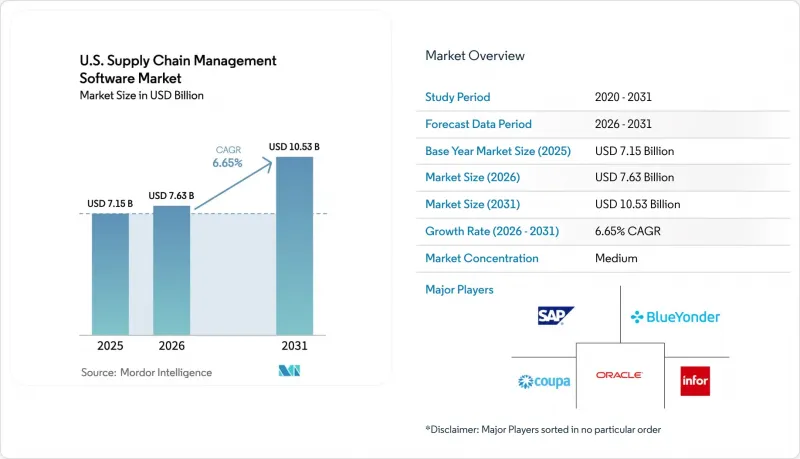
Mordor Intelligence에 따르면 미국의 공급망 관리 소프트웨어 시장 규모는 2025년에 71억 5,000만 달러로 평가되며, 2026년 76억 3,000만 달러에서 2031년까지 105억 3,000만 달러에 달할 것으로 추정되고 있으며, 예측 기간(2026-2031년)에 CAGR은 6.65%에 달할 전망입니다.
이 보고서는 솔루션 유형(공급망 계획(SCP), 조달·소싱 등), 도입 형태(온프레미스 및 클라우드), 조직 규모(대기업 및 중소기업(SME)), 최종사용자(제조, 헬스케어·생명과학, 소매·E-Commerce 등)별로 분류되어 있습니다. 시장 예측은 금액(달러) 기준으로 제시됩니다.
미국 공급망 관리 소프트웨어 시장의 동향 및 인사이트
E-Commerce의 급속한 성장과 클라우드 우선 도입
옴니채널 판매의 급증으로 인해 소매업체와 의료 사업자 모두 피크 시간대에 확장 가능한 탄력적인 클라우드 네이티브 제품군을 요구하고 있습니다. 클라우드 솔루션은 이미 전체 시장의 34%를 차지하고 있으며, 기업이 자본 집약적인 업그레이드에서 사용량 기반의 구독 모델로 전환함에 따라 그 비율은 급속히 상승하고 있습니다. 병원 시스템도 유사한 추세를 보이고 있으며, 약 절반이 중요 품목의 안정적인 공급을 확보하기 위해 클라우드 기반 공급망 툴을 도입하고 있습니다. 이러한 변화는 순전히 기술적인 것이 아니라 전략적인 것으로, 비용을 실제 처리량에 연동시키는 동시에 주요 버전 릴리스에 따른 다운타임을 줄이고 있습니다. 그 결과, 미국의 공급망 관리 소프트웨어 시장에서는 신속한 분석, 자동 패치 적용, 그리고 서비스 수준 계약(SLA)에 통합된 재해 복구 기능을 제공하는 멀티테넌트형 도입이 급증하고 있습니다. 이러한 추세는 벤더 종속의 장벽을 더욱 강화하는 한편, 이전에는 인프라 제약에 얽매여 있던 기업 사이에서 대상 고객 기반을 지속적으로 확대하고 있습니다.
AI 기반 계획 및 분석 플랫폼
실시간 AI 코파일럿 덕분에 수요 계획 주기가 며칠에서 몇 분으로 단축되었으며, 2028년까지 물류 KPI의 4분의 1이 AI에 의해 생성될 것으로 예측됩니다. 예를 들어 Kinaxis는 Maestro 엔진을 핵심 워크플로우에 직접 통합하여, 기획자가 모듈 간을 전환하지 않고도 시나리오 모델링을 자동화할 수 있도록 했습니다. 이러한 네이티브 통합을 통해 공급망 소프트웨어는 단순한 거래 기록 관리 툴에서 혼란이 발생하기 전에 달할 감지하는 예측형 의사결정 시스템으로 진화하고 있습니다. 그러나 미국 공장 중 생산 상황을 실시간으로 가시화하고 있는 곳은 6곳 중 1곳에 불과하여, 분석 툴 도입에는 여전히 큰 여지가 있음을 보여주고 있습니다. 그 결과, 기업이 계산 비용 증가를 억제하기 위해 비용 효율적인 엣지 추론을 실험하는 한편, AI 가속기에 대한 지출은 증가하고 있습니다. 이러한 요인들이 복합적으로 작용하여 미국의 공급망 관리 소프트웨어 시장은 더 높은 부가가치를 지닌 인사이트 중심의 사용 사례로 나아가고 있습니다.
레거시 ERP 통합의 복잡성
제조업체의 60% 미만이 메인스트림 지원 기한까지 노후화된 SAP 환경을 최신 S/4HANA 스택으로 마이그레이션할 전망이 없습니다. 그 결과, 수백 개에 달하는 맞춤형 인터페이스가 그대로 남아 있습니다. 통합 프로젝트에는 데이터 정제, 프로세스 재설계, 그리고 새로운 사이버 보안 계층 구축이 필요합니다. 범죄자들이 패치가 적용되지 않은 모듈을 악용함에 따라 레거시 SAP 시스템에 대한 공격은 2021-2023년 사이에 4배로 급증했습니다. CFO가 단기적인 성과를 보여주기 위해 디지털 투자를 추진하는 가운데, 일정이 연장되면서 프로젝트 예산이 불어나고 있습니다. 위험을 억제하기 위해 많은 기업이 레거시 코어를 감싸는 동시에 새로운 클라우드 분석을 병행하여 실행할 수 있는 ‘API 우선’ 마이크로서비스를 시범 도입하고 있습니다. 이 전략을 통해 가시적인 성과는 빨라지지만, 근본적인 기술 부채가 광범위한 전환을 계속 지연시키고 있으며, 미국 공급망 관리 소프트웨어 시장의 잠재적 성장을 저해하고 있습니다.
부문 분석
공급망 계획은 여전히 수익의 주축으로, 2025년 미국 공급망 관리 소프트웨어 시장의 31.12%를 차지했습니다. 기업이 변동이 심한 수주 패턴에 대한 회복력을 추구하는 가운데, 수요 예측 모듈 및 재고 최적화 엔진에 대한 업그레이드가 지속적으로 이루어지고 있습니다. 이와 동시에, 공급망 분석 및 AI 부문은 연평균 성장률(CAGR) 7.05%로 확대되고 있으며, 기존 계획 기반을 보완하는 ‘처방적 인사이트’로의 전환이 두드러지고 있습니다. 창고 관리 시스템(WMS) 및 운송 관리 시스템(TMS)은 즉각적인 처리 능력 향상을 가져오기 때문에 안정적인 지출을 이끌고 있습니다. 북미의 WMS 공급업체들은 깊은 전문성을 바탕으로 전 세계 매출의 절반 이상을 차지하고 있습니다. 추적 가능성 및 ESG 요건이 엄격해지는 가운데, 조달·소싱 툴이 다시 주목받고 있습니다. 리스크 및 규정 준수를 위한 포인트 솔루션은 계약 규모는 작지만, 미국 세관이 의무화한 강제 노동 심사 기능을 수익화함으로써 과거 평균을 상회하는 성장을 달성하고 있습니다. 쿠파(Coupa)의 연간 매출이 10억 달러에 달한다는 사실은 지출 관리, 소싱, 공급업체 리스크 관리를 통합하는 플랫폼에 대한 수요가 높음을 입증합니다.
고객들은 사후 분석 기능이 아닌 AI 코파일럿을 통합한 제품군을 점점 더 선호하고 있으며, 이러한 추세는 Kinaxis사의 Maestro 출시에서도 분명히 드러납니다. 이러한 변화로 인해 사용자 경험이 간소화되고, 데이터 통합에 따른 마찰이 줄어들며, 분석 기능이 계획의 자연스러운 연장선으로 자리매김하고 있습니다. 그 결과, 미국 공급망 관리 소프트웨어 시장에서 분석 기능이 내장된 제품군 시장 규모는 2031년까지 핵심 트랜잭션 모듈을 능가하는 속도로 확대될 것으로 예측됩니다. 벤더 입장에서는 교차 판매를 통한 시너지 효과로 인해 계약 생애 가치가 향상되고 있습니다. 내장형 분석 기능을 채택한 계획 관리 클라이언트는 연간 구독료를 평균 약 22% 인상하고 있습니다. 한편, 베스트 오브 브리드(Best-of-Breed) 시각화 플랫폼은 풀 스위트형 벤더들이 격차를 좁히기 전에 입지를 공고히 하기 위해 계획 관리 엔진과의 통합을 추진하고 있으며, 이는 전문 분야에서의 혁신 기회를 시사합니다.
2025년에도 온프레미스 시스템은 여전히 매출의 64.10%를 차지하고 있으며, 이는 국방, 의료, 중요 인프라 운영 사업자들 사이에서 정착된 데이터 주권 정책을 반영한 것입니다. 고가용성 클러스터 및 맞춤형 보안 암호화 방식 때문에 ‘리프트 앤 시프트(lift-and-shift)’ 방식의 전환에는 막대한 비용이 소요되므로, 많은 대기업은 계속해서 에버그린 유지보수 예산을 확보하고 있습니다. 그러나 중견 기업과 디지털 성숙도가 높은 기업이 규모 확대와 자본 지출(CAPEX) 감축을 목적으로 일상적인 워크로드를 오프사이트로 이전함에 따라 클라우드 구독은 연평균 성장률(CAGR) 8.15%로 급성장하고 있습니다. 맨해튼 어소시에이츠의 2024년 3분기 클라우드 매출은 8,650만 달러에 달했으며, 이는 레거시 벤더들이 라이선스 마진을 희생하지 않고도 SaaS로 사업 기반을 전환할 수 있음을 보여줍니다.
현재 RFP(제안 요청서)에서는 하이브리드형이 주류를 이루고 있습니다. 기밀성이 높은 마스터 데이터는 온프레미스에 보관되고, AI를 많이 활용하는 분석 툴 및 협업 툴은 클라우드에서 운영됩니다. 운송 관리 및 글로벌 트레이드 모듈은 운송업체와 브로커 간의 네트워크 효과 혜택을 받기 때문에 클라우드로의 전환이 가장 빠르게 진행되고 있습니다. 그 결과, 미국의 공급망 관리 소프트웨어 시장은 단일 스택형 도입이 아닌, 워크로드에 최적화된 토폴로지로 양극화되고 있습니다. 클라우드와 엣지 환경을 아우르는 통합 오케스트레이션 계층을 제공하는 벤더는 프리미엄 가격을 책정하고 있으며, 고객들로부터 이러한 연합형 모델로 전환함으로써 총 소유 비용(TCO)이 19% 절감되었다는 보고가 접수되고 있습니다. 향후에는 사용량 기반 과금 제도를 통해 예산 편성 관행이 변동하는 화물량에 더 적절히 대응할 수 있는 영업 비용 체계로 전환될 것으로 예상됩니다.
기타 혜택:
- 엑셀 형식의 시장 예측(ME) 시트
- 3개월간의 애널리스트 지원
자주 묻는 질문
목차
제1장 서론
제2장 조사 방법
제3장 개요
제4장 시장 구도
제5장 시장 규모와 성장 예측
제6장 경쟁 구도
제7장 시장 기회와 향후 전망
KSA 26.09.08According to Mordor Intelligence, the u.S. supply chain management software market size was valued at USD 7.15 billion in 2025 and estimated to grow from USD 7.63 billion in 2026 to reach USD 10.53 billion by 2031, at a CAGR of 6.65% during the forecast period (2026-2031).
This report is Segmented by Solution Type (Supply Chain Planning (SCP), Procurement and Sourcing, and More), Deployment (On-Premise and Cloud), Organization Size (Large Enterprises and Small and Medium Enterprises (SMEs)), End User (Manufacturing, Healthcare and Life Sciences, Retail and E-Commerce, and More). The Market Forecasts are Provided in Terms of Value (USD).
U.S. Supply Chain Management Software Market Trends and Insights
E-commerce boom and cloud-first adoption
Omnichannel sales spikes are forcing retailers and healthcare operators alike to demand elastic, cloud-native suites that can scale during peak cycles. Cloud solutions already represent 34% of the overall market and are rising swiftly as companies replace capital-heavy upgrades with consumption-based subscriptions. Hospital systems have mirrored the trend, with nearly half adopting cloud supply-chain tools to stabilize critical-item availability. The shift is strategic rather than purely technical, linking cost to actual throughput while reducing downtime tied to major version releases. As a result, the U.S. supply chain management software market is witnessing a surge in multitenant implementations that deliver rapid analytics, automatic patching, and disaster-recovery baked into service-level agreements. The dynamic continues to strengthen vendor lock-in barriers yet broadens the addressable base among firms formerly constrained by infrastructure limitations.
AI-driven planning and analytics platforms
Real-time AI copilots are shortening demand-planning cycles from days to minutes, with a quarter of logistics KPIs now forecast to be AI-generated by 2028. Kinaxis, for example, embedded its Maestro engine directly into core workflows, letting planners automate scenario modeling without toggling between modules. Such native integrations elevate supply-chain software from transactional record-keepers to predictive decision systems that flag disruptions before they materialize. Yet only one in six U.S. factories maintains live production visibility, underscoring ample whitespace for analytics rollouts. Consequently, spending on AI accelerators is climbing even as firms experiment with cost-efficient edge inference to curb rising compute bills. These factors collectively lift the U.S. supply chain management software market toward higher-value, insight-centric use cases.
Legacy ERP integration complexity
Fewer than 60% of manufacturers are on track to shift aging SAP landscapes to modern S/4HANA stacks before mainstream support deadlines, leaving hundreds of custom interfaces in place. Integration projects demand data cleansing, process redesign, and new cybersecurity layers; attacks on legacy SAP systems surged fourfold between 2021 and 2023 as criminals exploited unpatched modules. Extended timelines inflate project budgets just as CFOs push digital investments to show near-term returns. To contain risk, many firms are piloting API-first microservices that wrap legacy cores while letting new cloud analytics run in parallel. Although this tactic speeds up visible wins, the underlying debt continues to slow broader migration, capping potential growth in the U.S. supply chain management software market.
Other drivers and restraints analyzed in the detailed report include:
- SME SaaS penetration surge
- Reshoring incentives boost domestic network orchestration
- Skilled SCM-IT talent shortage
For complete list of drivers and restraints, kindly check the Table Of Contents.
Segment Analysis
Supply Chain Planning remained the revenue cornerstone, accounting for 31.12% of the U.S. supply chain management software market in 2025. Demand-sensing modules and inventory-optimization engines continue to draw upgrades as firms seek resilience against volatile order patterns. In parallel, the Supply Chain Analytics and AI segment is expanding at a 7.05% CAGR, underscoring a pivot toward prescriptive insights that complement existing planning backbones. Warehouse Management Systems and Transportation Management Systems attract steady spend because they offer immediate throughput improvements; North American WMS suppliers capture more than half of worldwide revenue, reflecting deep domain expertise. Procurement and Sourcing tools are regaining attention as traceability and ESG requirements intensify. Risk-and-Compliance point solutions, though smaller in ticket size, are outpacing historical averages by monetizing forced-labor screening functions mandated by U.S. Customs. Coupa's billion-dollar annual billings validate the appetite for integrated platforms uniting spend, sourcing, and supplier risk management.
Increasingly, customers favor suites that embed AI copilots rather than bolt-on analytics, a trend evident from Kinaxis's Maestro launch. This shift streamlines user experience and limits data-integration friction, positioning analytics as a natural extension of planning. As a result, the U.S. supply chain management software market size for analytics-infused suites is projected to swell at a rate that outpaces core transactional modules through 2031. For vendors, cross-selling synergies are improving lifetime contract values: planning clients adopting embedded analytics raise annual subscriptions by roughly 22% on average. Meanwhile, best-of-breed visibility platforms are integrating with planning engines to secure footholds before full-suite vendors close the gap, suggesting a window for specialized innovation.
On-premise systems still commanded 64.10% revenue in 2025, reflecting entrenched data-sovereignty policies among defense, healthcare, and critical-infrastructure operators. High-availability clusters and custom security ciphers make lift-and-shift migration costly, so many large organizations continue to budget for evergreen maintenance. Yet cloud subscriptions are racing ahead at an 8.15% CAGR as mid-market adopters and digitally mature enterprises move routine workloads offsite for scale and lower capex. Manhattan Associates' cloud revenue climbed to USD 86.5 million in Q3 2024, illustrating how legacy vendors can pivot their base to SaaS without sacrificing license margins.
Hybrid patterns now dominate RFPs: sensitive master data resides on premises while AI-heavy analytics and collaboration tools run in the cloud. Transportation Management and Global Trade modules exhibit the fastest cloud uptake because they benefit from network effects across carriers and brokers. The U.S. supply chain management software market is therefore bifurcating into workload-optimized topologies rather than single-stack deployments. Vendors offering unified orchestration layers that span cloud and edge environments are capturing premium pricing, and customers report 19% lower total cost of ownership when they switch to such federated models. Over time, usage-based billing is expected to nudge budgeting practices toward operating-expense frameworks that better align with fluctuating freight volumes.
Complete Report Scope:
- By Solution Type
- Supply Chain Planning (SCP)
- Procurement and Sourcing
- Warehouse Management Systems (WMS)
- Transportation Management Systems (TMS)
- Supply Chain Analytics and AI
- Risk and Compliance Management
- By Deployment
- On-Premise
- Cloud
- By Organization Size
- Large Enterprises
- Small and Medium Enterprises (SMEs)
- By End User
- Manufacturing
- Healthcare and Life Sciences
- Retail and E-commerce
- FMCG and CPG
- Oil and Gas / Energy
- Other Industries
List of Companies Covered in this Report:
- SAP SE
- Oracle Corporation
- Blue Yonder
- Infor Inc.
- Manhattan Associates
- Coupa Software
- E2open
- Descartes Systems Group
- WiseTech Global
- Jaggaer, Inc.
- IBM
- Kinaxis
- Epicor Software
- o9 Solutions
- Logility
- Ivalua
- GEP Worldwide
- SPS Commerce
- NetSuite (Oracle)
- Blue Ridge
Additional Benefits:
- The market estimate (ME) sheet in Excel format
- 3 months of analyst support
TABLE OF CONTENTS
1 INTRODUCTION
- 1.1 Study Assumptions and Market Definition
- 1.2 Scope of the Study
2 RESEARCH METHODOLOGY
3 EXECUTIVE SUMMARY
4 MARKET LANDSCAPE
- 4.1 Market Overview
- 4.2 Market Drivers
- 4.2.1 E-commerce boom and cloud-first adoption
- 4.2.2 AI-driven planning and analytics platforms
- 4.2.3 SME SaaS penetration surge
- 4.2.4 Reshoring incentives boost domestic network orchestration
- 4.2.5 Forced-labor import bans elevate traceability solutions
- 4.2.6 Hybrid/on-prem AI cost-control architectures
- 4.3 Market Restraints
- 4.3.1 Legacy ERP integration complexity
- 4.3.2 Skilled SCM-IT talent shortage
- 4.3.3 GenAI compute cost-driven price inflation
- 4.3.4 Data-sovereignty hurdles in regulated verticals
- 4.4 Value Chain Analysis
- 4.5 Regulatory Landscape
- 4.6 Technological Outlook
- 4.7 Porter's Five Forces Analysis
- 4.7.1 Bargaining Power of Suppliers
- 4.7.2 Bargaining Power of Buyers
- 4.7.3 Threat of New Entrants
- 4.7.4 Threat of Substitutes
- 4.7.5 Intensity of Competitive Rivalry
- 4.8 Assessment of the Impact of Macroeconomic Trends on the Market
5 MARKET SIZE AND GROWTH FORECASTS (VALUE)
- 5.1 By Solution Type
- 5.1.1 Supply Chain Planning (SCP)
- 5.1.2 Procurement and Sourcing
- 5.1.3 Warehouse Management Systems (WMS)
- 5.1.4 Transportation Management Systems (TMS)
- 5.1.5 Supply Chain Analytics and AI
- 5.1.6 Risk and Compliance Management
- 5.2 By Deployment
- 5.2.1 On-Premise
- 5.2.2 Cloud
- 5.3 By Organization Size
- 5.3.1 Large Enterprises
- 5.3.2 Small and Medium Enterprises (SMEs)
- 5.4 By End User
- 5.4.1 Manufacturing
- 5.4.2 Healthcare and Life Sciences
- 5.4.3 Retail and E-commerce
- 5.4.4 FMCG and CPG
- 5.4.5 Oil and Gas / Energy
- 5.4.6 Other Industries
6 COMPETITIVE LANDSCAPE
- 6.1 Market Concentration
- 6.2 Strategic Moves
- 6.3 Market Share Analysis
- 6.4 Company Profiles (includes Global level Overview, Market level overview, Core Segments, Financials as available, Strategic Information, Market Rank/Share for key companies, Products and Services, and Recent Developments)
- 6.4.1 SAP SE
- 6.4.2 Oracle Corporation
- 6.4.3 Blue Yonder
- 6.4.4 Infor Inc.
- 6.4.5 Manhattan Associates
- 6.4.6 Coupa Software
- 6.4.7 E2open
- 6.4.8 Descartes Systems Group
- 6.4.9 WiseTech Global
- 6.4.10 Jaggaer, Inc.
- 6.4.11 IBM
- 6.4.12 Kinaxis
- 6.4.13 Epicor Software
- 6.4.14 o9 Solutions
- 6.4.15 Logility
- 6.4.16 Ivalua
- 6.4.17 GEP Worldwide
- 6.4.18 SPS Commerce
- 6.4.19 NetSuite (Oracle)
- 6.4.20 Blue Ridge
7 MARKET OPPORTUNITIES AND FUTURE OUTLOOK
- 7.1 White-space and Unmet-Need Assessment