|
시장보고서
상품코드
2125320
자동차용 에어백 : 시장 점유율 분석, 업계 동향과 통계, 성장 예측(2026-2031년)Automotive Airbags - Market Share Analysis, Industry Trends & Statistics, Growth Forecasts (2026 - 2031) |
||||||
 Mordor Intelligence
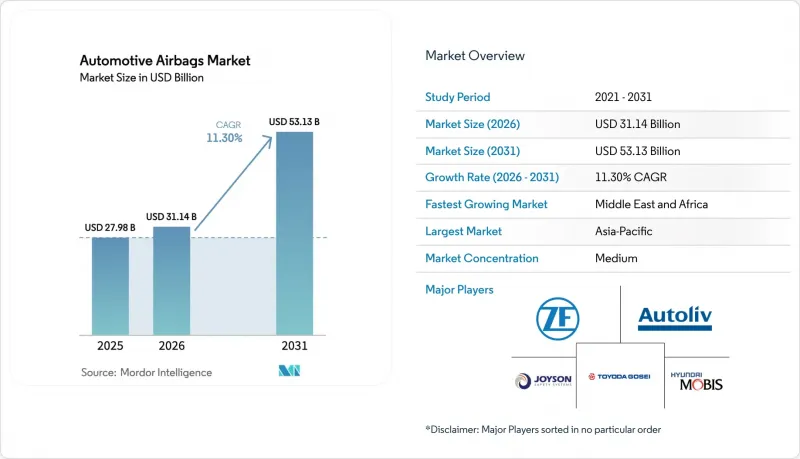
Mordor Intelligence에 따르면 자동차용 에어백 시장 규모는 2025년 279억 8,000만 달러에서 2026년에는 311억 4,000만 달러로 확대하며, 2026-2031년에 CAGR 11.30%로 추이하며, 2031년에는 531억 3,000만 달러에 달할 것으로 예측됩니다.
이 보고서는 차종(승용차 및 상용차), 구동 방식(내연기관 차량 등), 부품(에어백 모듈, 인플레이터 등), 소재(나일론 66 등),설치 위치/에어백 유형(전면 에어백 등), 판매 채널(OEM 등) 및 지역별로 분류되어 있습니다. 시장 예측은 금액(달러) 및 수량(단위)으로 제시되어 있습니다.
세계 자동차용 에어백 시장의 동향 및 인사이트
신흥 국가의 엄격한 정면 및 측면 충돌 안전 기준
규제의 급속한 도입으로 인해 자동차용 에어백 시장의 출하량은 확대되고 있습니다. 2025년 1월부터 모든 승용차에 듀얼 전면 에어백 장착을 의무화하는 인도의 규제만으로도 연간 약 1,000만 개의 수요 증가가 예상됩니다. 브라질의 유사한 규제로 인해 국내 에어백 보급률은 거의 100%에 육박했습니다. 이러한 규제는 소비자 인식 제고 캠페인과 유리한 보험 조건과 맞물려 공장 출고시 기본 장착률을 가속화하고 있습니다. 각 공급업체들은 리드타임 목표를 달성하면서 글로벌 품질 기준을 유지하기 위해 현지 생산을 확대하고 있으며, 가격에 민감한 부문에서 비용의 균일성을 확보하고 있습니다.
EV 플랫폼의 패키징 요건이 다중 모듈 통합을 촉진
EV의 배터리 배치와 평평한 바닥 구조의 실내 공간은 충돌 시의 역학을 변화시켜, 설계자들이 특수한 에어백을 채택하도록 요구하고 있습니다. 오토리브의 ‘베르누이 에어백(Bernoulli Airbag(TM))’은 다양한 실내 형태에 대응하며, 인플레이터의 발열을 30% 저감합니다. 현대모비스의 2025년형 모델과 같은 센터 에어백은 측면 충돌시 운전자와 승객의 충격을 방지합니다. 이러한 맞춤형 모듈을 통해 전기자동차 1대당 평균 에어백 장착 수가 증가하여 자동차용 에어백 시장의 기회를 확대하는 동시에, 고전압 팩 주변의 열적 스트레스를 최소화하는 경량 가스 발생 장치 개발을 위한 연구개발을 추진하고 있습니다.
반도체 부족이 생산에 차질을 빚고 있습니다.
에어백용 ECU는 32비트 마이크로컨트롤러에 의존하고 있으며, 그 공급 부족으로 인해 2024년 전 세계 자동차 생산 대수는 230만 대 감소했습니다. 공급업체들은 28주 분량에 달하는 미처리 주문이 쌓여 있다고 보고하고 있으며, 이에 따라 자동차 제조사들은 수익성이 높은 모델을 우선적으로 생산하고 있습니다. 부품 비용은 2023년 기준치에 비해 12-15% 상승하여 2차 공급업체의 이익률을 압박하고 있습니다. 전략적인 재고 확보와 파운드리 수준의 계약을 통해 공급은 안정화되고 있지만, 이러한 상황은 여전히 자동차 에어백 시장의 단기적인 확장을 억제하고 있습니다.
부문 분석
2025년, 승용차는 생산 대수 증가와 차량 1대당 에어백 장착 수 증가에 힘입어 자동차용 에어백 시장의 71.88%를 차지했습니다. 한편, 상용차는 2031년까지 연평균 성장률(CAGR) 8.12%로 더 빠른 속도로 성장하고 있습니다. 이는 유럽의 ‘일반 안전 규정(General Safety Regulation)’에 따라 2025년 이후 신형 대형 상용차에 첨단 구속 시스템의 탑재가 의무화되었기 때문입니다. 차량 관리자들은 풀 에어백 스위트(Full Airbag Suite)를 통해 부상 관련 가동 중단 시간이 42% 감소했다는 실증 데이터를 높이 평가하고 있으며, 이러한 효과는 초기 비용을 상쇄해 줍니다. 상용차용 에어백 시장 규모는 안전 장비를 갖춘 트럭에 혜택을 주는 텔레매틱스를 활용한 보험 할인이 호재로 작용함에 따라 꾸준히 확대될 것으로 전망됩니다.
E-Commerce의 급속한 성장으로 장거리 화물 운송이 활성화되면서, 교통 체증이 심한 노선에서 운전자의 보호 강화가 요구되고 있습니다. 북미의 플릿에서는 클래스 8 트랙터에 사이드 커튼 에어백과 무릎 에어백의 장착이 의무화되어 있으며, 에어백의 평균 장착 수는 2020년 2개에서 2025년에는 5개로 증가할 전망입니다. 규제 당국이 탑승자 안전성 향상에 더욱 주목하는 가운데, 상용차 플랫폼은 자동차용 에어백 시장에 견실한 성장 기회를 제공하고 있습니다.
2025년 시점에 내연기관 차량이 여전히 판매 대수의 86.65%를 차지하고 있지만, 자동차용 에어백 시장에서 가장 빠른 성장을 보이고 있는 것은 BEV이며, 2031년까지 연평균 성장률(CAGR)은 14.85%에 달할 것으로 전망됩니다. 배터리 팩의 존재로 인해 기존의 충돌 흡수 구역이 제한됨에 따라 외부 프리크래시 에어백 및 저온 인플레이터의 채택이 확대되고 있습니다. 오토리브(Autoliv)사의 저발열 가스 발생 장치는 고전압 시스템 주변의 화재 안전 제약 사항을 해결하고 설계 유연성을 높여줍니다. 2024년에 전 세계 전기자동차 판매 대수가 1,700만 대를 넘어설 것으로 예상됨에 따라 BEV용 자동차 에어백 시장 규모는 확대될 것으로 전망됩니다. 각 차량에는 보조 구속 모듈이 필요하기 때문입니다.
하이브리드차 및 플러그인 하이브리드차 모델은 연평균 성장률(CAGR) 8.85%로 확대되고 있으며, 이는 내연기관과 전기 부품 모두를 지원하는 듀얼 모드 전개 알고리즘에 대한 수요를 견인하고 있습니다. 각 공급업체는 기계학습 로직을 ECU에 통합하여 초당 400개의 데이터 포인트를 분석해 팽창력을 조절하고 있습니다. 이러한 복잡성으로 인해 ECU의 매출 점유율이 상승하고 있으며, 소프트웨어를 중시하는 제품 포트폴리오를 보유한 기업을 중심으로 자동차 에어백 시장이 재편되고 있습니다.
지역별 분석
2025년, 아시아태평양은 자동차 에어백 시장의 42.10%를 차지했습니다. 이는 중국의 2억 2,000만개 이상의 에어백 생산과 인도의 듀얼 에어백 의무화가 주요 요인으로 작용했습니다. 중국의 차량 1대당 평균 에어백 장착 수는 수출 모델에서 Euro NCAP 규격 준수를 목표로 하는 국내 브랜드에 힘입어 2020년 2.3개에서 2025년 4.8개로 증가했습니다. 일본과 한국은 첨단 기술력과 대규모 생산 능력을 바탕으로 전 세계 OEM 플랫폼에 모듈을 공급하고 있습니다. Joyson과 같은 지역 공급업체들은 주요 조립 제조업체와의 지역적 근접성을 활용하여 리드타임을 단축하는 한편, 차세대 전기자동차(EV) 프로그램에서의 협력을 심화하고 있습니다.
중동은 가장 빠르게 성장하는 하위 지역으로, 2031년까지 연평균 성장률(CAGR) 14.90%를 기록할 것으로 예측됩니다. 걸프협력회의(GCC) 회원국들은 안전 규제를 강화하고 대형 SUV를 선호하는 경향이 있으며, 차량 1대당 에어백 수는 세계 평균을 상회하고 있습니다. 사우디아라비아와 아랍에미리트(UAE)의 현지 조립 합작 사업은 Tier 1 공급업체를 유치하여 인플레이터 및 쿠션 제조 거점을 설립하고, 해당 지역을 아프리카 및 유럽 일부로 수출하는 거점으로 자리매김하고 있습니다. 무릎 에어백을 포함한 7개의 에어백을 탑재한 2025년형 닛산 ‘패트롤’은 높아지는 소비자의 기대를 상징하는 사례입니다.
북미와 유럽을 합치면 전 세계 매출의 거의 절반을 차지합니다. 북미의 성장은 SUV의 인기와 FMVSS(미국 연방 자동차 안전 기준)에 따른 측면 충돌에 대한 엄격한 규제 개정에 힘입고 있습니다. 한편, 유럽의 ‘일반 안전 규정’에서는 2026년부터 반대편 에어백 및 보행자용 에어백에 관한 새로운 의무가 부과됩니다. 두 지역은 AI 지원 ECU 및 보다 친환경적인 추진제와 같은 혁신을 주도하고 있으며, 이러한 기술은 이후 신흥 시장으로 확산되어 자동차 에어백 시장의 안전 기준에 대한 전 세계적 일관성을 강화하고 있습니다.
기타 혜택:
- 엑셀 형식의 시장 예측(ME) 시트
- 3개월간의 애널리스트 지원
자주 묻는 질문
목차
제1장 서론
제2장 조사 방법
제3장 개요
제4장 시장 구도
제5장 시장 규모와 성장 예측
제6장 경쟁 구도
제7장 시장 기회와 향후 전망
KSA 26.09.08According to Mordor Intelligence, the automotive airbags market size is expected to grow from USD 27.98 billion in 2025 to USD 31.14 billion in 2026 and is forecast to reach USD 53.13 billion by 2031 at 11.30% CAGR over 2026-2031.
This report is Segmented by Vehicle Type (Passenger Cars and Commercial Vehicles), Propulsion Type (Internal Combustion Engine (ICE) Vehicles and More), Component (Airbag Module, Inflator, and More), Material (Nylon 66 and More), Position/Airbag Type (Front Airbags and More), Sales Channel (OEM and More) and Geography. The Market Forecasts are Provided in Terms of Value (USD) and Volume (Units).
Global Automotive Airbags Market Trends and Insights
Stringent Frontal and Side-Impact Safety Mandates in Emerging Economies
Rapid regulatory rollouts have amplified unit volumes for the automotive airbags market. India's rule requiring dual front airbags on all passenger vehicles from January 2025 alone adds nearly 10 million annual units. Brazil's comparable mandate pushed national airbag penetration close to full coverage. These rules dovetail with consumer awareness campaigns and favorable insurance terms, accelerating factory install rates. Suppliers are ramping localized production to meet lead-time targets while maintaining global quality standards, ensuring cost parity for price-sensitive segments.
EV-Platform Packaging Needs Driving Multi-Module Integration
Battery placement and flat-floor cabins in EVs reshape crash dynamics, compelling designers to adopt specialized airbags. Autoliv's Bernoulli Airbag(TM) accommodates wide cabin geometries and reduces inflator heat by 30%. Center airbags like Hyundai Mobis' 2025 unit prevent driver-passenger contact in side impacts. These bespoke modules increase average airbags per EV, widening the automotive airbags market opportunity while pushing R&D toward lighter gas generators that minimize thermal stress around high-voltage packs.
Semiconductor Shortages Disrupting Output
Airbag ECUs rely on 32-bit microcontrollers, and allocation shortfalls cut 2024 global vehicle output by 2.3 million units. Suppliers reported order backlogs stretching 28 weeks, prompting automakers to favor high-margin models. Component costs climbed 12-15% against 2023 benchmarks, squeezing Tier-2 margins. Strategic buffering and foundry-level agreements are stabilizing supply, yet the situation continues to cap near-term expansion for the automotive airbags market.
Other drivers and restraints analyzed in the detailed report include:
- Rising SUV Mix Spurring Demand for Side-Curtain Airbags in North America
- Mandatory Dual-Airbag Rules in India and Similar Developing Markets
- Counterfeit Aftermarket Airbags Erode Consumer Confidence
For complete list of drivers and restraints, kindly check the Table Of Contents.
Segment Analysis
Passenger cars accounted for 71.88% of the automotive airbags market in 2025, buoyed by larger build counts and rising airbags per car. Commercial vehicles, however, are pacing faster with an 8.12% CAGR through 2031, as Europe's General Safety Regulation mandates advanced restraint systems for new heavy-duty models starting in 2025. Fleet managers value the documented 42% reduction in injury-related downtime delivered by full airbag suites, a payoff that offsets upfront costs. The automotive airbags market size for commercial vehicles is projected to climb steadily, leveraging telematics-driven insurance discounts that reward safety-equipped trucks.
Surging e-commerce has intensified long-haul freight activity, calling for better driver protection in congested corridors. North American fleets are specifying side-curtain and knee airbags in Class 8 tractors, elevating average airbag content from two units in 2020 to five units in 2025. With regulators eyeing further occupant-safety enhancements, commercial platforms present a robust incremental opportunity for the automotive airbags market.
ICE vehicles still dominate volume with an 86.65% share in 2025, yet BEVs exhibit the fastest growth in the automotive airbags market with a 14.85% CAGR through 2031. Battery packs curb traditional crumple zones, prompting the adoption of external pre-crash airbags and lower-temperature inflators. Autoliv's low-heat gas generator addresses fire-safety constraints near high-voltage systems, widening design flexibility. The automotive airbags market size for BEVs is set to compound as global electric-vehicle sales exceed 17 million units in 2024, each requiring supplementary restraint modules.
Hybrid and plug-in hybrid models are growing at a 8.85% CAGR, driving demand for dual-mode deployment algorithms that accommodate both combustion and electric components. Suppliers integrate machine-learning logic into ECUs, parsing 400 data points per second to adjust inflation force. Such complexity lifts ECU revenue share and consolidates the automotive airbags market around players with software-heavy portfolios.
Complete Report Scope:
- By Vehicle Type
- Passenger Cars
- Commercial Vehicles
- By Propulsion Type
- Internal Combustion Engine Vehicles (ICE)
- Battery Electric Vehicles (BEV)
- Hybrid & Plug-in Hybrid Vehicles (HEV/PHEV)
- Fuel-Cell Electric Vehicles (FCEV)
- By Component
- Airbag Module
- Inflator
- Crash Sensor & ECU
- Airbag Fabric
- By Material
- Nylon 66
- Nylon 6
- Polyester
- By Position/Airbag Type
- Front Airbags
- Side Airbags
- Curtain Airbags
- Knee Airbags
- Inflatable Seat-Belts
- By Sales Channel
- Original Equipment Manufacturer (OEM)
- Aftermarket/Replacement
- By Geography
- North America
- United States
- Canada
- Rest of North America
- South America
- Brazil
- Argentina
- Rest of South America
- Europe
- Germany
- United Kingdom
- France
- Spain
- Italy
- Rest of Europe
- Asia-Pacific
- China
- Japan
- India
- South Korea
- Rest of Asia-Pacific
- Middle East and Africa
- Saudi Arabia
- United Arab Emirates
- Turkey
- South Africa
- Egypt
- Rest of Middle East and Africa
- North America
Geography Analysis
Asia-Pacific controlled 42.10% of the automotive airbags market in 2025, anchored by China's production of over 220 million airbag units and India's dual-airbag mandate. Average airbag count per vehicle in China rose from 2.3 in 2020 to 4.8 in 2025, underpinned by domestic brands chasing Euro NCAP compliance for export models. Japan and South Korea contribute engineering depth and manufacturing scale, supplying modules to global OEM platforms. Regional suppliers such as Joyson leverage proximity to major assemblers, shortening lead times and deepening integration in next-generation EV programs.
The Middle East is the fastest-growing sub-region, projected to grow at a 14.90% CAGR through 2031. Gulf Cooperation Council countries tighten safety regulations and favor large SUVs, boosting airbags per vehicle beyond global averages. Local assembly ventures in Saudi Arabia and the United Arab Emirates lure Tier-1s to establish inflator and cushion facilities, positioning the region as an export hub into Africa and parts of Europe. The 2025 Nissan Patrol, fitted with seven airbags including knee units, exemplifies rising consumer expectations.
North America and Europe collectively make up nearly half of global revenue. North American growth rides on SUV popularity and stringent FMVSS side-impact updates, while Europe's General Safety Regulation layers new obligations for far-side and pedestrian airbags starting 2026. Both regions spearhead AI-enabled ECUs and greener propellants, innovations that later cascade to emerging markets, reinforcing global homogeneity in safety standards across the automotive airbags market.
- Autoliv Inc.
- ZF Friedrichshafen AG (ZF TRW)
- Joyson Safety Systems
- Toyoda Gosei Co. Ltd
- Hyundai Mobis Co. Ltd
- Continental AG
- Daicel Corporation
- Nihon Plast Co. Ltd
- Ashimori Industry Co. Ltd
- Sumitomo Corporation (Airbag Fabric)
- Robert Bosch GmbH
- Kolon Industries Inc.
- Yanfeng Automotive Trim Systems Co. Ltd
- Jinzhou Jinheng Automotive Safety System Co. Ltd
- Denso Corporation
Additional Benefits:
- The market estimate (ME) sheet in Excel format
- 3 months of analyst support
TABLE OF CONTENTS
1 Introduction
- 1.1 Study Assumptions & Market Definition
- 1.2 Scope of the Study
2 Research Methodology
3 Executive Summary
4 Market Landscape
- 4.1 Market Overview
- 4.2 Market Drivers
- 4.2.1 Stringent frontal & side-impact safety mandates in emerging economies
- 4.2.2 EV-platform packaging needs driving multi-module integration
- 4.2.3 Rising SUV mix spurring demand for side-curtain airbags in North America
- 4.2.4 Mandatory dual-airbag rule in India and similar developing markets
- 4.2.5 Insurance-telematics-linked incentives for fleet safety upgrades
- 4.2.6 Chinese OEM export push demanding Euro-NCAP-compliant airbags
- 4.3 Market Restraints
- 4.3.1 Semiconductor & inflator propellant shortages disrupting output
- 4.3.2 Counterfeit aftermarket airbags eroding consumer confidence
- 4.3.3 Escalating zero-defect R&D costs squeezing Tier-2 margins
- 4.3.4 EV lightweighting driving exploration of alternative restraints
- 4.4 Value/Supply-Chain Analysis
- 4.5 Regulatory Outlook
- 4.6 Porter's Five Forces Analysis
- 4.6.1 Threat of New Entrants
- 4.6.2 Bargaining Power of Buyers
- 4.6.3 Bargaining Power of Suppliers
- 4.6.4 Threat of Substitutes
- 4.6.5 Intensity of Competitive Rivalry
- 4.7 Supplier Information
5 Market Size & Growth Forecasts (Value (USD) and Volume (Units))
- 5.1 By Vehicle Type
- 5.1.1 Passenger Cars
- 5.1.2 Commercial Vehicles
- 5.2 By Propulsion Type
- 5.2.1 Internal Combustion Engine Vehicles (ICE)
- 5.2.2 Battery Electric Vehicles (BEV)
- 5.2.3 Hybrid & Plug-in Hybrid Vehicles (HEV/PHEV)
- 5.2.4 Fuel-Cell Electric Vehicles (FCEV)
- 5.3 By Component
- 5.3.1 Airbag Module
- 5.3.2 Inflator
- 5.3.3 Crash Sensor & ECU
- 5.3.4 Airbag Fabric
- 5.4 By Material
- 5.4.1 Nylon 66
- 5.4.2 Nylon 6
- 5.4.3 Polyester
- 5.5 By Position/Airbag Type
- 5.5.1 Front Airbags
- 5.5.2 Side Airbags
- 5.5.3 Curtain Airbags
- 5.5.4 Knee Airbags
- 5.5.5 Inflatable Seat-Belts
- 5.6 By Sales Channel
- 5.6.1 Original Equipment Manufacturer (OEM)
- 5.6.2 Aftermarket/Replacement
- 5.7 By Geography
- 5.7.1 North America
- 5.7.1.1 United States
- 5.7.1.2 Canada
- 5.7.1.3 Rest of North America
- 5.7.2 South America
- 5.7.2.1 Brazil
- 5.7.2.2 Argentina
- 5.7.2.3 Rest of South America
- 5.7.3 Europe
- 5.7.3.1 Germany
- 5.7.3.2 United Kingdom
- 5.7.3.3 France
- 5.7.3.4 Spain
- 5.7.3.5 Italy
- 5.7.3.6 Rest of Europe
- 5.7.4 Asia-Pacific
- 5.7.4.1 China
- 5.7.4.2 Japan
- 5.7.4.3 India
- 5.7.4.4 South Korea
- 5.7.4.5 Rest of Asia-Pacific
- 5.7.5 Middle East and Africa
- 5.7.5.1 Saudi Arabia
- 5.7.5.2 United Arab Emirates
- 5.7.5.3 Turkey
- 5.7.5.4 South Africa
- 5.7.5.5 Egypt
- 5.7.5.6 Rest of Middle East and Africa
- 5.7.1 North America
6 Competitive Landscape
- 6.1 Market Concentration
- 6.2 Strategic Moves
- 6.3 Market Share Analysis
- 6.4 Company Profiles (Includes Global level Overview, Market level overview, Core Segments, Financials as available, Strategic Information, Market Rank/Share for key companies, Products & Services, and Recent Developments)
- 6.4.1 Autoliv Inc.
- 6.4.2 ZF Friedrichshafen AG (ZF TRW)
- 6.4.3 Joyson Safety Systems
- 6.4.4 Toyoda Gosei Co. Ltd
- 6.4.5 Hyundai Mobis Co. Ltd
- 6.4.6 Continental AG
- 6.4.7 Daicel Corporation
- 6.4.8 Nihon Plast Co. Ltd
- 6.4.9 Ashimori Industry Co. Ltd
- 6.4.10 Sumitomo Corporation (Airbag Fabric)
- 6.4.11 Robert Bosch GmbH
- 6.4.12 Kolon Industries Inc.
- 6.4.13 Yanfeng Automotive Trim Systems Co. Ltd
- 6.4.14 Jinzhou Jinheng Automotive Safety System Co. Ltd
- 6.4.15 Denso Corporation
7 Market Opportunities & Future Outlook
- 7.1 White-space & Unmet-Need Assessment