

|
시장보고서
상품코드
2125331
유럽의 비즈니스 소프트웨어 : 시장 점유율 분석, 업계 동향과 통계, 성장 예측(2026-2031년)Europe Business Software - Market Share Analysis, Industry Trends & Statistics, Growth Forecasts (2026 - 2031) |
||||||
 Mordor Intelligence
에 따르면 유럽의 비즈니스 소프트웨어 시장 규모는 2026년에 757억 8,000만 달러에 달하며, CAGR 8.21%를 기록하며, 2031년까지 판매량이 1,124억 1,000만 달러에 달할 것으로 예측됩니다.
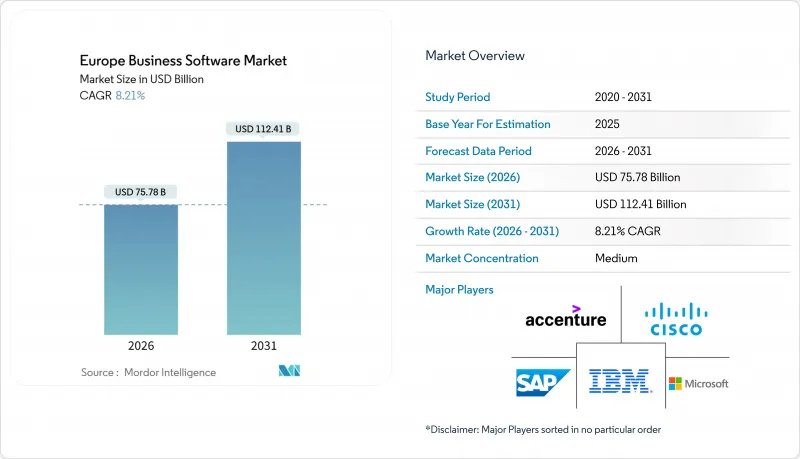
이 보고서는 소프트웨어 유형(ERP, CRM, BI 및 애널리틱스, 공급망 관리, 기타), 도입 모델(클라우드, 온프레미스), 최종사용자 산업 분야(BFSI, 헬스케어 및 생명과학, 공공 부문, 소매 및 E-Commerce, 기타),기업 규모(대기업, 중견기업, 중소기업) 및 지역별로 분류되어 있습니다. 시장 예측은 금액(달러) 기준으로 제시되어 있습니다.
유럽 비즈니스 소프트웨어 시장의 동향 및 인사이트
유럽 중견 기업의 ‘클라우드 퍼스트’ 전환
‘회복·탄력성 기금(REF)’의 보조금으로 자본 측면의 장벽이 낮아지면서, 중견 기업은 노후화된 서버를 폐기하고 구독형 라이선스를 도입할 수 있게 되었습니다. 유로파운드(Eurofound)와 세데포프(Cedefop)의 2025년 조사에 따르면 중소기업의 73%가 기본적인 디지털 활용 수준에 도달한 것으로 나타났으나, 특히 남유럽에서는 지역 간 격차가 여전히 존재하고 있습니다. 영국의 한 조사에 따르면 디지털 툴을 통해 생산성이 1% 향상될 경우 GDP가 940억 파운드(1,190억 달러) 증가할 가능성이 시사되고 있으며, 이에 따라 정책 입안자들은 ‘CTO-as-a-service’ 프로그램에 대한 지원을 강화하고 있습니다. PwC 보고서에 따르면 94%의 조직이 지정학적 현실을 반영하기 위해 클라우드 아키텍처 재설계를 계획하고 있습니다. 그 결과, 하이퍼스케일러의 수익은 증가하고 있지만, 독일과 프랑스의 기업은 기밀 데이터를 EU 영역 내에 보관하기 위해 OVHcloud와 Scaleway가 제공하는 소버린 플랫폼을 점점 더 많이 시험적으로 도입하고 있습니다. 유럽 기업 중 워크로드의 절반 이상을 이미 이전한 곳은 3분의 1에 불과하므로 워크로드의 플랫폼 이전에는 여전히 큰 여지가 남아 있습니다.
ERP 및 SCM 제품군에 통합된 AI를 활용한 의사결정
생성형 AI는 주요 비즈니스 제품군에서 시범 운영 단계에서 본격적인 운영 단계로 전환되어, 사이클 타임 단축과 수작업 감소를 실현하고 있습니다. SAP는 S/4HANA에 ‘Business AI’를 통합했고, 마이크로소프트는 Dynamics 365 공급망 관리에 ‘Copilot’을 도입하여 예측 오차를 최대 30%까지 줄일 수 있다고 주장하고 있습니다. BCG의 추산에 따르면 생성형 모델을 통해 ERP 도입에 소요되는 노력을 20-40% 절감할 수 있다고 합니다. 오라클, 세일즈포스 및 각 지역 벤더들은 이러한 기능을 따라잡기 위해 경쟁을 벌이고 있으며, 예측 분석이 기본 요건이 되도록 구매자의 기대를 변화시키고 있습니다. 유럽의 제조업체들은 초기 도입자로서, AI 기반 시각화 툴을 활용하여 반도체 부족의 영향을 상쇄하고 있습니다. 아폴로 타이어의 유럽 사업부는 배송 경로 최적화를 통해 920만 파운드(1,170만 달러)를 절감했습니다. 신뢰할 수 있는 AI 로드맵을 제시하지 못하는 공급업체는 조달 팀이 지능형 자동화를 제안 요청서(RFP) 템플릿에 포함시키기 시작함에 따라 상품화 위험에 직면하게 될 것입니다.
EU 전역에서 해결되지 않은 로우코드 플랫폼 인력 부족
유럽연합 집행위원회에 따르면 2024년 기준 기업의 77%가 ICT 전문가 채용에 어려움을 겪고 있으며, 시민 개발의 잠재력이 기대됨에도 불구하고 로우코드 확산이 저해되고 있습니다. 인구의 54%만이 기본적인 디지털 기술을 보유하고 있으며, API 설계나 사이버 보안과 같은 고급 기술은 더욱 부족합니다. OECD가 체코의 중소기업을 대상으로 실시한 분석에 따르면 ICT 교육에 투자하는 기업은 고작 16%에 불과하며, 이러한 경향은 중동유럽의 일부 시장에서도 유사하게 나타납니다. 이러한 인재 격차로 인해 시장은 양극화되고 있습니다. 대기업은 누적된 업무량을 해소하기 위해 로우코드를 도입하고 있는 반면, 중견기업은 여전히 개념 증명(PoC) 단계에 머물러 있습니다. 각 벤더사는 아카데미 프로그램을 통해 대응하고 있지만, 진전이 더뎌 라이선스 판매 성장 전망에 제동이 걸리고 있습니다.
부문 분석
기업 자원 계획(ERP) 애플리케이션은 2025년 매출의 34.19%를 차지하며, 유럽 비즈니스 소프트웨어 시장에서 재무, 조달, 인적 자본 거래의 핵심으로서의 역할을 입증하고 있습니다. 비즈니스 인텔리전스 및 분석 제품군은 오픈 데이터 모델을 의무화하는 EU 데이터 법의 요건과 에이전트 기반 대시보드의 보급에 힘입어 9.43%라는 가장 높은 연평균 성장률(CAGR)을 기록할 전망입니다. 각 벤더사는 수동 SQL 조작 없이도 인사이트를 도출할 수 있는 자연 언어 인터페이스와 예측 로직을 통합하고 있으며, 이를 통해 사업 부문 관리자의 의사결정 주기가 단축됩니다.
의사결정 스택에서는 특히 금융 서비스 분야에서 고객 관계 관리(CRM)가 여전히 중요한 반면, 제조업체들이 지정학적 리스크를 관리하기 위해 조달을 현지화함에 따라 공급망 관리의 중요성이 급증하고 있습니다. 환경·사회·지배구조(ESG) 보고와 같은 신흥 틈새 분야에서 유럽 비즈니스 소프트웨어 시장의 규모는 ‘기업 지속가능성 보고 지침’의 시행에 따라 급속히 확대되고 있으며, 이는 전문 특화형 공급업체에게 시장 진입의 발판이 되고 있습니다. 경쟁적 포지셔닝은 컴포저블 아키텍처로 전환되고 있으며, 고객은 SAP, 마이크로소프트, 세일즈포스, 그리고 계속 늘어나는 중견 기업 시장 전문 벤더 중에서 최적의 조합을 구축할 수 있게 되었습니다.
2025년에는 클라우드 배포이 총매출의 72.34%를 차지할 것이며, 이 부문은 2031년까지 연평균 성장률(CAGR) 9.85%를 기록하며 유럽 비즈니스 소프트웨어 시장 전체의 성장률을 상회할 것으로 전망됩니다. 각 하이퍼스케일러 기업은 더블린에서 바르샤바에 이르기까지 데이터센터 거점을 확대하고 있으며, 대부분의 사용자에게 20밀리초 미만의 지연 시간을 보장하고 있습니다. 그러나 공공 조달의 주권 조항에 따라 공급자는 지역내 처리와 유럽의 법적 관할권을 보장해야 할 의무가 있으며, 이에 따라 규정 준수와 혁신의 균형을 맞춘 새로운 보호 계층이 생겨나고 있습니다.
온프레미는 중요 인프라, 국방 및 특정 은행 워크로드에서 여전히 중요한 역할을 하고 있지만, 이러한 사용자들조차도 프라이빗 환경과 퍼블릭 환경 사이를 자유롭게 전환할 수 있는 컨테이너화된 플랫폼을 채택하고 있습니다. 멀티클라우드 구성이 아키텍처 로드맵을 주도하고 있으며, 기업에는 가격과 내결함성을 최적화할 수 있는 유연성이 제공되고 있습니다. 리저브드 인스턴스 계약이 보편화됨에 따라 재무 부서는 예산 외 지출을 억제하기 위해 FinOps 관행을 강화하고 있으며, 이로 인해 하이퍼스케일러의 유럽 비즈니스 소프트웨어 시장 점유율 확대는 둔화되고 있지만, 클라우드는 기본 도입 옵션으로서의 입지를 공고히 하고 있습니다.
기타 혜택:
- 엑셀 형식의 시장 예측(ME) 시트
- 3개월간의 애널리스트 지원
자주 묻는 질문
목차
제1장 서론
제2장 조사 방법
제3장 개요
제4장 시장 구도
제5장 시장 규모와 성장 예측
제6장 경쟁 구도
제7장 시장 기회와 향후 전망
KSA 26.09.08According to Mordor Intelligence, the Europe business software market size stood at USD 75.78 billion in 2026 and is projected to register an 8.21% CAGR, lifting revenue to USD 112.41 billion by 2031.
This report is Segmented by Software Type (ERP, CRM, BI and Analytics, Supply-Chain Management, and Other), Deployment Model (Cloud, and On-Premise), End-User Vertical (BFSI, Healthcare and Life Sciences, Public Sector, Retail and E-Commerce, and More), Enterprise Size (Large, Mid-Sized, and Small), and Geography. Market Forecasts are Provided in Terms of Value (USD).
Europe Business Software Market Trends and Insights
Cloud-First Shift Across European Mid-Market Firms
Recovery and Resilience Facility grants are lowering capital barriers, allowing mid-sized enterprises to decommission aging servers and adopt subscription licenses. Eurofound and Cedefop found in 2025 that 73% of small and medium-sized enterprises had reached basic digital intensity, yet regional disparities persist, especially in Southern Europe. United Kingdom studies suggest that a 1% productivity uplift from digital tools could add GBP 94 billion (USD 119 billion) to GDP, encouraging policymakers to underwrite CTO-as-a-service programs. PwC reported that 94% of organizations plan to redesign cloud architecture to reflect geopolitical realities. Hyperscaler revenue is therefore climbing, yet German and French enterprises increasingly trial sovereign platforms from OVHcloud and Scaleway to keep sensitive data inside the bloc. Because only one-third of European firms have migrated more than half of their workloads, a substantial runway remains for workload re-platforming.
AI-Enabled Decisioning Embedded in ERP and SCM Suites
Generative AI is moving from pilot to production across core business suites, trimming cycle times and reducing manual effort. SAP infused Business AI into S/4HANA, while Microsoft launched Copilot inside Dynamics 365 Supply Chain Management, claiming up to 30% forecast-error reductions. BCG estimates that generative models can cut ERP implementation labour by 20-40%. Oracle, Salesforce, and regional vendors are racing to match these capabilities, shifting buyer expectations so that predictive analytics becomes a baseline requirement. European manufacturers are early adopters, using AI-driven visibility tools to offset semiconductor shortages; Apollo Tyres' European division saved GBP 9.2 million (USD 11.7 million) through route optimization. Vendors unable to release credible AI roadmaps risk commoditization as procurement teams bake intelligent automation into request-for-proposal templates.
Unresolved EU-Wide Skills Shortage in Low-Code Platforms
The European Commission reported that 77% of enterprises struggled to hire ICT specialists in 2024, hindering low-code uptake despite the promise of citizen development. Only 54% of the population has basic digital skills, while advanced competencies such as API design and cybersecurity remain scarcer. OECD analysis of Czech SMEs showed just 16% invest in ICT training, a pattern mirrored across several Central and Eastern European markets. This talent gap bifurcates the market: large enterprises deploy low-code to accelerate backlog reduction, whereas mid-market firms remain stuck at proof-of-concept. Vendors are responding with academy programs, but progress is slow, placing a drag on license growth forecasts.
Other drivers and restraints analyzed in the detailed report include:
- EU Data Act Spurring SaaS Analytics Modernization
- Green-Taxonomies Driving ESG Reporting Module Uptake
- Mounting Sovereignty Concerns over US-Hosted SaaS
For complete list of drivers and restraints, kindly check the Table Of Contents.
Segment Analysis
Enterprise resource planning applications accounted for 34.19% of 2025 revenue, confirming their role as the transactional backbone for finance, procurement, and human capital across Europe Business Software market deployments. Business intelligence and analytics suites are poised to record the fastest 9.43% CAGR, helped by EU Data Act mandates that require open data models and the proliferation of agent-based dashboarding. Vendors are embedding natural language interfaces and predictive logic that surface insights without manual SQL, which shortens decision loops for line-of-business managers.
In the decision stack, customer relationship management remains crucial, especially in financial services, while supply chain management gains urgency as manufacturers localize sourcing to manage geopolitical risk. The Europe Business Software market size for emerging niches such as environmental, social, and governance reporting has grown rapidly following the Corporate Sustainability Reporting Directive, giving pure-play providers an entry wedge. Competitive positioning is shifting toward composable architectures, allowing customers to assemble best-of-breed combinations from SAP, Microsoft, Salesforce, and a growing roster of mid-market specialists.
Cloud installations comprised 72.34% of total revenue in 2025, and the segment is likely to outpace overall Europe Business Software market growth at a 9.85% CAGR through 2031. Hyperscalers are expanding data-center footprints from Dublin to Warsaw, ensuring sub-20-millisecond latency for most users. Yet sovereignty clauses in public tenders oblige providers to guarantee in-region processing and European legal jurisdiction, spawning a new tier of protected instances that balance compliance and innovation.
On-premises remains relevant for critical infrastructure, defense, and certain bank workloads, but even these users are adopting containerized platforms that can shift between private and public environments. Multi-cloud configurations dominate architecture roadmaps, giving enterprises flexibility to arbitrage pricing and resilience. As reserved-instance contracts proliferate, finance teams are sharpening FinOps practices to limit unbudgeted consumption, moderating the Europe Business Software market share gains of hyperscalers but solidifying cloud as the default deployment choice.
Complete Report Scope:
- By Software Type
- ERP Software
- CRM Software
- BI and Analytics Software
- Supply-Chain Management Software
- Other Software Type
- By Deployment Model
- Cloud
- On-premise
- By End-User Vertical
- BFSI
- Healthcare and Life Sciences
- Public Sector and Institutions
- Retail and E-commerce
- Transportation and Logistics
- Manufacturing and Industrials
- Telecom and Media
- By Enterprise Size
- Large Enterprises
- Mid-sized
- Small Businesses
- By Country
- United Kingdom
- Germany
- France
- Italy
- Spain
- Rest of Europe
List of Companies Covered in this Report:
- SAP SE
- Oracle Corporation
- Microsoft Corporation
- Salesforce, Inc.
- International Business Machines Corporation
- The Sage Group plc
- Infor Global Solutions, LLC
- IFS AB
- Unit4 N.V.
- Epicor Software Corporation
- Workday, Inc.
- Dassault Systemes SE
- Siemens Aktiengesellschaft
- Software AG
- QlikTech International AB
- Tableau Software, LLC
- HubSpot, Inc.
- Zoho Corporation
- Odoo S.A.
- Litmos, LLC
- Pipedrive OU
- Kinaxis Inc.
- Manhattan Associates, Inc.
- WiseTech Global Limited
- TOTVS Labs Europe Ltd.
Additional Benefits:
- The market estimate (ME) sheet in Excel format
- 3 months of analyst support
TABLE OF CONTENTS
1 INTRODUCTION
- 1.1 Study Assumptions and Market Definition
- 1.2 Scope of the Study
2 RESEARCH METHODOLOGY
3 EXECUTIVE SUMMARY
4 MARKET LANDSCAPE
- 4.1 Market Overview
- 4.2 Market Drivers
- 4.2.1 Cloud-First Shift Across European Mid-Market Firms
- 4.2.2 AI-Enabled Decisioning Embedded in ERP and SCM Suites
- 4.2.3 Post-BREXIT Compliance Push for Multi-Entity Finance Suites
- 4.2.4 EU Data Act Spurring SaaS Analytics Modernization
- 4.2.5 Green-Taxonomies Driving ESG Reporting Modules Uptake
- 4.2.6 Manufacturing Renaissance Funds (IPCEI) Favouring Vertical ERP
- 4.3 Market Restraints
- 4.3.1 Unresolved EU-Wide Skills Shortage in Low-Code Platforms
- 4.3.2 Mounting Sovereignty Concerns over US-Hosted SaaS
- 4.3.3 Fragmented VAT Regimes Complicating Multi-Country Rollouts
- 4.3.4 Rising Total-Cost-of-Ownership for Hyperscaler Consumption
- 4.4 Industry Value-Chain Analysis
- 4.5 Regulatory Landscape
- 4.6 Technological Outlook
- 4.7 Impact of Macroeconomic Factors on the Market
- 4.8 Porter's Five Forces Analysis
- 4.8.1 Bargaining Power of Buyers
- 4.8.2 Bargaining Power of Suppliers
- 4.8.3 Threat of New Entrants
- 4.8.4 Threat of Substitutes
- 4.8.5 Intensity of Competitive Rivalry
5 MARKET SIZE AND GROWTH FORECASTS (VALUE)
- 5.1 By Software Type
- 5.1.1 ERP Software
- 5.1.2 CRM Software
- 5.1.3 BI and Analytics Software
- 5.1.4 Supply-Chain Management Software
- 5.1.5 Other Software Type
- 5.2 By Deployment Model
- 5.2.1 Cloud
- 5.2.2 On-premise
- 5.3 By End-User Vertical
- 5.3.1 BFSI
- 5.3.2 Healthcare and Life Sciences
- 5.3.3 Public Sector and Institutions
- 5.3.4 Retail and E-commerce
- 5.3.5 Transportation and Logistics
- 5.3.6 Manufacturing and Industrials
- 5.3.7 Telecom and Media
- 5.4 By Enterprise Size
- 5.4.1 Large Enterprises
- 5.4.2 Mid-sized
- 5.4.3 Small Businesses
- 5.5 By Country
- 5.5.1 United Kingdom
- 5.5.2 Germany
- 5.5.3 France
- 5.5.4 Italy
- 5.5.5 Spain
- 5.5.6 Rest of Europe
6 COMPETITIVE LANDSCAPE
- 6.1 Market Concentration
- 6.2 Strategic Moves
- 6.3 Market Share Analysis
- 6.4 Company Profiles (includes Global Level Overview, Market Level Overview, Core Segments, Financials as Available, Strategic Information, Market Rank/Share for Key Companies, Products and Services, and Recent Developments)
- 6.4.1 SAP SE
- 6.4.2 Oracle Corporation
- 6.4.3 Microsoft Corporation
- 6.4.4 Salesforce, Inc.
- 6.4.5 International Business Machines Corporation
- 6.4.6 The Sage Group plc
- 6.4.7 Infor Global Solutions, LLC
- 6.4.8 IFS AB
- 6.4.9 Unit4 N.V.
- 6.4.10 Epicor Software Corporation
- 6.4.11 Workday, Inc.
- 6.4.12 Dassault Systemes SE
- 6.4.13 Siemens Aktiengesellschaft
- 6.4.14 Software AG
- 6.4.15 QlikTech International AB
- 6.4.16 Tableau Software, LLC
- 6.4.17 HubSpot, Inc.
- 6.4.18 Zoho Corporation
- 6.4.19 Odoo S.A.
- 6.4.20 Litmos, LLC
- 6.4.21 Pipedrive OU
- 6.4.22 Kinaxis Inc.
- 6.4.23 Manhattan Associates, Inc.
- 6.4.24 WiseTech Global Limited
- 6.4.25 TOTVS Labs Europe Ltd.
7 MARKET OPPORTUNITIES AND FUTURE OUTLOOK
- 7.1 White-Space and Unmet-Need Assessment


