

|
시장보고서
상품코드
2125335
회수 카본 블랙 : 시장 점유율 분석, 업계 동향과 통계, 성장 예측(2026-2031년)Recovered Carbon Black - Market Share Analysis, Industry Trends & Statistics, Growth Forecasts (2026 - 2031) |
||||||
 Mordor Intelligence
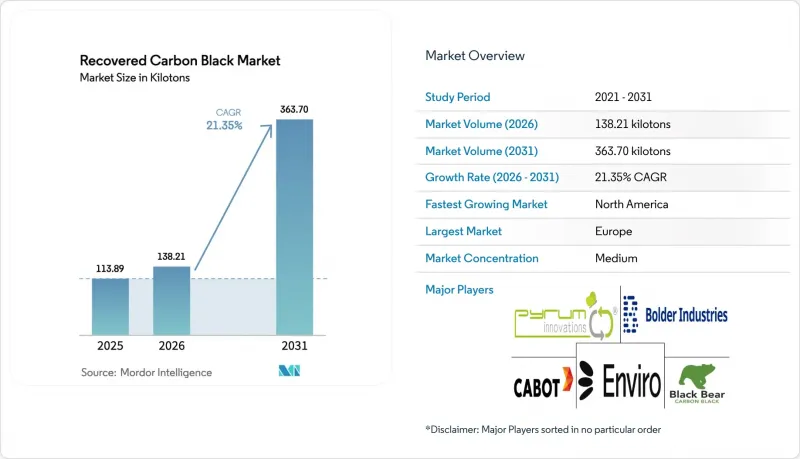
Mordor Intelligence에 따르면 재생 카본 블랙 시장 규모는 2025년 113.89 킬로톤에서 2026년에는 138.21 킬로톤으로 확대하며, 2026-2031년에 CAGR 21.35%로 추이하며, 2031년에는 363.70 킬로톤에 달할 것으로 예측됩니다.
이 보고서는 등급(고무용 카본 블랙(RCB) 및 특수·전도성 등급의 RCB), 제조 기술(열분해, 가스화, 기타 제조 기술), 용도(타이어, 플라스틱 등), 최종사용자 산업(자동차, 인쇄·포장 등),지역(아시아태평양, 북미, 유럽 등)별로 분류되어 있습니다. 시장 예측은 톤 기준으로 제시되어 있습니다.
전 세계 회수 카본 블랙 시장의 동향 및 인사이트
환경 지속가능성 및 순환 경제의 의무화
타이어 회수 의무화 및 탄소 가격 제도는 자발적인 노력에서 법적 구속력을 갖는 조치로 전환되고 있습니다. 인도는 2024-25 회계연도부터 확대 생산자 책임(EPR)의 회수 목표를 100%로 상향 조정하고, 타이어 제조 과정에서 회수 카본 블랙의 사용을 인증함으로써 폐쇄형 루프 인센티브 체계를 확립했습니다. EU의 제품 탄소 저장 규정(규정 2024/3012)은 35년 이상의 모니터링을 의무화하고 있으며, 열분해 사업자는 미사용 원료 공급업체보다 ISO 59014에 기반한 추적 가능성이 확보되어 있다는 점에서 우대받고 있습니다. 2024년 5월에 발효되는 중국의 전국 탄소 시장에서는 배출량이 많은 원료에 벌금이 부과되며, 국내 컴파운더들은 저탄소 필러로 전환해야 하는 압박을 받고 있습니다. 이러한 조치로 인해 ASTM D8474 기준을 준수하면서 트레드 배합에서 버진 카본 블랙의 최대 60%를 재생 카본 블랙으로 대체할 수 있게 됩니다. EPR, 탄소세, 제품 수준 인증이 융합됨에 따라 재생 카본 블랙 시장에는 구조적인 규정 준수상 이점이 주어지고 있습니다.
2030년까지 타이어의 지속가능한 소재 비율을 40% 이상으로 하겠다는 OEM의 목표
1차 타이어 제조사들은 열분해 공정의 자금 조달 위험을 완화하기 위해 수년에 걸친 인수 계약을 체결하고 있습니다. 미쉐린의 ‘지속가능한 소재 40%’ 목표는 스칸디나비안 엔바이로(Scandinavian Environment)사의 우데바라 공장에 대한 공동 출자의 기반이 되고 있으며, 해당 공장은 가동 시작 전 연간 생산량 10 kt를 선판매하고 있습니다. 노키안과 피렐리도 유사한 계약을 체결한 반면, 브리지스톤과 도카이 카본은 2025년 1월에 전용 합작 회사를 설립했습니다. 이러한 구속력 있는 계약들은 일반 시장의 유동성을 흡수하여, 회수된 카본 블랙 시장을 현물 상품이 아닌 전략적인 공급망으로 전환시키고 있습니다.
제한된 인프라와 미성숙한 열분해 기술
자본 집약성과 제품별 수익화 문제 등으로 인해 타이어 회수망이 정비되지 않은 지역에서는 그린필드 공장 건설이 지연되고 있습니다. 블랙 베어 카본의 ‘케메롯’ 프로젝트는 수익성 기준선에 도달하기 위해 바이오연료, 철강, 전력 등 여러 판매 경로가 필요함을 보여주고 있습니다. 고온 가스화는 이론상 높은 효율을 자랑하지만, 더 대규모의 투자가 필요하므로 2025년 생산량의 90% 이상이 열분해에 의해 차지된 이유도 여기에 있습니다. 모듈식 반응 장치는 진입 장벽을 낮추지만, 여전히 견고한 전처리 단계의 선별이 필요하며, 이것이 남미와 아프리카 일부 지역의 약점으로 작용하고 있습니다.
부문 분석
2025년에는 미쉐린, 노키안, 피렐리 각사의 오프테이크로 우데발라의 전체 생산 능력이 사전 판매됨에 따라 고무용 rCB가 수량 기준으로 70.21%를 차지했습니다. 5G 및 전기자동차(EV) 차폐 수요에 힘입어 전도성 등급 및 특수 등급이 2031년까지 연평균 성장률(CAGR) 22.89%로 성장함에 따라 고무용 등급의 회수 카본 블랙 시장 점유율은 소폭 하락할 전망입니다. 회분 5% 미만의 정제 등급은 이미 자동차용 도료 및 잉크 분야에서 15%-25%의 프리미엄 가격을 확립하고 있습니다. 캐보트(Cabot)사의 ‘EVOLVE’와 오리온(Orion)사의 특수 제품 포트폴리오는 결정적인 사용 사례에서 품질이 비용을 상회함을 입증하고 있습니다. 예측 기간 중 특수 등급의 생산량은 크게 증가할 가능성이 있으며, 후처리 공장의 가동률은 높은 수준을 유지할 전망입니다.
2025년에는 세계 생산량의 90.45%를 열분해법이 차지할 것으로 보이며, 연평균 성장률(CAGR)은 22.93%를 기록할 전망입니다. 이는 회수 카본 블랙 시장의 확장을 이끄는 원동력이 되고 있습니다. 스칸디나비안 엔바이로(Scandinavian Environment)사의 5기 반응로를 갖춘 우데바라(Uddebala) 설계나 볼더 인더스트리즈(Boulder Industries)사의 텔레호트(Telehot) 공장은 rCB뿐만 아니라 석유와 철강도 수익화할 수 있는 대규모 반응로 군의 구성을 구현하고 있습니다. 가스화는 여전히 틈새 분야에 머물러 있으며, 제품 등급의 rCB라기보다는 에너지 회수 모델로 한정되어 있습니다. 모듈식 오거 반응로는 유럽의 소규모 시설에서 등장하기 시작하고 있지만, 자금 조달의 확실성은 여전히 실적이 입증된 판매 계약에 달려 있습니다.
지역별 분석
유럽은 정책 주도형 수요의 핵심으로 자리 잡고 있습니다. 2026년에 발효될 CBAM 관세는 현지 OEM 각사에 추가 요금을 피할 수 있는 인증된 rCB로의 전환을 촉진하고 있습니다. 한편, 규정 2024/3012에 따르면 추적 가능한 공급망을 갖춘 열분해 사업자에게 장기적인 탄소 저장 크레딧이 부여됩니다. 현재 우데바라, 도어, 딜링겐의 각 공장이 이 지역의 생산량을 지원하고 있으며, 사전 판매된 생산 능력을 고려할 때 2028년까지 만성적인 공급 부족이 지속될 것으로 보입니다.
북미에서는 생산 능력 확대 움직임이 나타나고 있습니다. 콘티넨탈 카본, 에코 인피닉, CSRC가 참여하는 합작 사업을 통해 자금 조달 위험이 대폭 완화되었습니다. 한편, 볼더 인더스트리즈는 2026년에 인디애나주에 18kt 규모의 공장을 건설하고, 2027년까지 인디애나주 앤트워프 근교에 30kt 규모의 모듈 공장을 계획하고 있습니다. 이 지역의 가격은 운송 비용과 발전하는 타이어 회수 인프라를 모두 반영하여 여전히 세계 최고 수준을 유지하고 있습니다.
아시아태평양에서는 원료의 풍부함과 정책의 복잡성이 서로 상쇄되고 있습니다. 인도의 100% EPR 목표와 한국에서 Woven Capital이 지원하는 LD Carbon 프로젝트는 뚜렷한 추진력을 보이고 있지만, 동남아시아의 회수 품질 편차와 자금 면의 제약이 가동률을 저해하고 있습니다. 2024년에 발효될 중국의 전국 배출권 거래 제도(ETS)에 따라 탄소 비용이 도입됨에 따라 수입된 버진 필러에 비해 국내 생산 재생 탄소(rCB)의 경쟁력이 더욱 높아질 것으로 예상됩니다.
기타 혜택:
- 엑셀 형식의 시장 예측(ME) 시트
- 3개월간의 애널리스트 지원
자주 묻는 질문
목차
제1장 서론
제2장 조사 방법
제3장 개요
제4장 시장 구도
제5장 시장 규모와 성장 예측
제6장 경쟁 구도
제7장 시장 기회와 향후 전망
KSA 26.09.08According to Mordor Intelligence, the recovered carbon black market size is expected to grow from 113.89 kilotons in 2025 to 138.21 kilotons in 2026 and is forecast to reach 363.70 kilotons by 2031 at 21.35% CAGR over 2026-2031.

This report is Segmented by Grade (Rubber Grade RCB and Specialty/Conductive Grade RCB), Production Technology (Pyrolysis, Gasification, and Other Production Technologies), Application (Tires, Plastics, and More), End-User Industry (Automotive, Printing and Packaging, and More), and Geography (Asia-Pacific, North America, Europe, and More). The Market Forecasts are Provided in Terms of Volume (Tons).
Global Recovered Carbon Black Market Trends and Insights
Environmental Sustainability and Circular-Economy Mandates
Mandatory tire-collection rules and carbon-pricing schemes are moving from voluntary to enforceable. India raised its Extended Producer Responsibility (EPR) target to 100% collection from FY 2024-25 and recognized recovered carbon black for tire manufacturing, establishing a closed-loop incentive. The EU's product carbon-storage regulation (Regulation 2024/3012) obliges >=35-year monitoring, rewarding pyrolysis operators with ISO 59014 traceability over virgin suppliers. China's national carbon market, effective May 2024, penalizes high-emission feedstocks, pushing local compounders toward low-carbon fillers. These measures enable tread formulations to replace up to 60% of virgin carbon black without breaching ASTM D8474 benchmarks. The convergence of EPR, carbon fees, and product-level certification gives the recovered carbon black market a structural compliance advantage.
OEM Target of >=40% Sustainable Materials in Tires by 2030
Tier-one tire makers are locking in multi-year offtake to de-risk pyrolysis financing. Michelin's 40% sustainable-materials goal underpins its co-investment in Scandinavian Enviro's Uddevalla plant, pre-selling 10 kt of annual output before commissioning. Nokian and Pirelli have adopted similar agreements, while Bridgestone and Tokai Carbon formed a dedicated venture in January 2025. These binding contracts absorb merchant-market liquidity and convert the recovered carbon black market into a strategic supply chain, not a spot commodity.
Limited Infrastructure and Immature Pyrolysis Technologies
Capital intensity and co-product monetization hurdles delay green-field plants in regions lacking tire-collection grids. Black Bear Carbon's Chemelot project illustrates the need for multi-stream offtake-bio-fuel, steel, electricity-to reach hurdle rates. Higher-temperature gasification offers theoretical efficiency but demands even larger ticket sizes, explaining why pyrolysis captured more than 90% of 2025 output. Module-based reactors lower the entry bar but still require robust front-end sorting, a weak spot in South America and parts of Africa.
Other drivers and restraints analyzed in the detailed report include:
- Cost Advantage Versus Virgin Carbon Black
- EU Carbon Border Adjustment Mechanism (CBAM) Incentives
- Potential REACH Reclassification of Pyrolysis Oils
For complete list of drivers and restraints, kindly check the Table Of Contents.
Segment Analysis
In 2025, rubber-grade rCB held 70.21% volume, driven by Michelin, Nokian, and Pirelli offtakes that pre-sold all Uddevalla capacity. The recovered carbon black market share for rubber-grade is poised to erode modestly as conductive and specialty grades grow 22.89% CAGR through 2031, buoyed by 5G and EV shielding. Purified grades with less than 5% ash already command 15%-25% premiums in automotive coatings and inks. Cabot's EVOLVE and Orion's specialty portfolios validate that quality can outrank cost in decisive use cases. Over the forecast horizon, specialty tonnage could increase substantially, keeping utilization high at post-treatment units.
Pyrolysis supplied 90.45% of global output in 2025 and is on track for 22.93% CAGR, making it the engine behind most recovered carbon black market additions. Scandinavian Enviro's five-reactor Uddevalla design and Bolder Industries' Terre Haute plant exemplify scaled, reactor-train architectures that monetize oil and steel alongside rCB. Gasification remains a niche, constrained to energy-recovery models rather than product-grade rCB. Modular auger reactors are emerging in small European installations, but bankability still hinges on proven offtake agreements.
Complete Report Scope:
- By Grade
- Rubber Grade rCB
- Specialty/Conductive Grade rCB
- By Production Technology
- Pyrolysis
- Gasification
- Other Production Technologies
- By Application
- Tires
- Plastics
- Batteries
- Non-tyre Rubber
- Dyes and Pigments
- By End-user Industry
- Automotive
- Printing and Packaging
- Industrial
- Building and Construction
- Electronics
- Other End-user Industries (Energy Storage)
- By Geography
- Asia-Pacific
- China
- India
- Japan
- South Korea
- ASEAN Countries
- Rest of Asia-Pacific
- North America
- United States
- Canada
- Mexico
- Europe
- Germany
- United Kingdom
- France
- Italy
- Spain
- NORDIC Countries
- Rest of Europe
- South America
- Brazil
- Argentina
- Rest of South America
- Middle-East and Africa
- Saudi Arabia
- United Arab Emirates
- South Africa
- Egypt
- Nigeria
- Rest of Middle-East and Africa
- Asia-Pacific
Geography Analysis
Europe remains the nucleus of policy-driven demand. CBAM tariffs, effective 2026, push local OEMs toward certified rCB that avoids surcharges, while Regulation 2024/3012 awards long-term carbon-storage credits to pyrolysis operators with traceable supply chains. Uddevalla, Dole, and Dillingen plants now anchor regional output, and pre-sold capacity suggests chronic under-supply through 2028.
North America follows a capacity-build narrative. Joint ventures involving Continental Carbon, Eco-Infinic, and CSRC materially de-risk financing, while Bolder Industries brings an 18 kt unit to Indiana in 2026 and plans a 30 kt module near Antwerp, Indiana, by 2027. Regional pricing remains the world's highest, reflecting both freight economics and evolving tire-take-back infrastructure.
Asia-Pacific balances feedstock abundance with policy complexity. India's 100% EPR target and South Korea's Woven Capital-backed LD Carbon project illustrate clear momentum, yet inconsistent collection quality and capital constraints in Southeast Asia drag on utilization rates. China's national ETS, effective 2024, introduces carbon costs that are likely to sharpen the competitive edge of domestically produced rCB over imported virgin fillers.
- Alpha Carbone
- Black Bear Carbon B.V.
- Bolder Industries
- Cabot Corporation
- Carbon Recovery GmbH
- Continental AG
- ENRESTEC
- Klean Industries Inc.
- LD Carbon Co., Ltd.
- Orion Engineered Carbons GmbH
- Orion S.A.
- Pyrolyx AG
- Pyrum Innovations Ltd.
- Reoil Sp. z o.o.
- Scandinavian Enviro Systems AB
- SR2O Holdings LLC
- Strebl Green Carbon Pte Ltd.
Additional Benefits:
- The market estimate (ME) sheet in Excel format
- 3 months of analyst support
TABLE OF CONTENTS
1 Introduction
- 1.1 Study Assumptions and Market Definition
- 1.2 Scope of the Study
2 Research Methodology
3 Executive Summary
4 Market Landscape
- 4.1 Market Overview
- 4.2 Market Drivers
- 4.2.1 Environmental Sustainability and Circular-Economy Mandates
- 4.2.2 OEM Target of >=40 % Sustainable Materials in Tires By 2030
- 4.2.3 Cost Advantage Versus Virgin Carbon Black
- 4.2.4 EU Carbon Border Adjustment Mechanism (CBAM) Incentives
- 4.2.5 rCB Use in Conductive Polymer Composites for 5G and EV EMI Shielding
- 4.3 Market Restraints
- 4.3.1 Limited Infrastructure and Immature Pyrolysis Technologies
- 4.3.2 Feed-Stock Quality Variability from Fragmented Collectors
- 4.3.3 Potential REACH Reclassification of Pyrolysis Oils
- 4.4 Value Chain Analysis
- 4.5 Technological Outlook
- 4.6 Porter's Five Forces
- 4.6.1 Bargaining Power of Suppliers
- 4.6.2 Bargaining Power of Buyers
- 4.6.3 Threat of New Entrants
- 4.6.4 Threat of Substitutes
- 4.6.5 Degree of Competition
5 Market Size and Growth Forecasts (Volume)
- 5.1 By Grade
- 5.1.1 Rubber Grade rCB
- 5.1.2 Specialty/Conductive Grade rCB
- 5.2 By Production Technology
- 5.2.1 Pyrolysis
- 5.2.2 Gasification
- 5.2.3 Other Production Technologies
- 5.3 By Application
- 5.3.1 Tires
- 5.3.2 Plastics
- 5.3.3 Batteries
- 5.3.4 Non-tyre Rubber
- 5.3.5 Dyes and Pigments
- 5.4 By End-user Industry
- 5.4.1 Automotive
- 5.4.2 Printing and Packaging
- 5.4.3 Industrial
- 5.4.4 Building and Construction
- 5.4.5 Electronics
- 5.4.6 Other End-user Industries (Energy Storage)
- 5.5 By Geography
- 5.5.1 Asia-Pacific
- 5.5.1.1 China
- 5.5.1.2 India
- 5.5.1.3 Japan
- 5.5.1.4 South Korea
- 5.5.1.5 ASEAN Countries
- 5.5.1.6 Rest of Asia-Pacific
- 5.5.2 North America
- 5.5.2.1 United States
- 5.5.2.2 Canada
- 5.5.2.3 Mexico
- 5.5.3 Europe
- 5.5.3.1 Germany
- 5.5.3.2 United Kingdom
- 5.5.3.3 France
- 5.5.3.4 Italy
- 5.5.3.5 Spain
- 5.5.3.6 NORDIC Countries
- 5.5.3.7 Rest of Europe
- 5.5.4 South America
- 5.5.4.1 Brazil
- 5.5.4.2 Argentina
- 5.5.4.3 Rest of South America
- 5.5.5 Middle-East and Africa
- 5.5.5.1 Saudi Arabia
- 5.5.5.2 United Arab Emirates
- 5.5.5.3 South Africa
- 5.5.5.4 Egypt
- 5.5.5.5 Nigeria
- 5.5.5.6 Rest of Middle-East and Africa
- 5.5.1 Asia-Pacific
6 Competitive Landscape
- 6.1 Market Concentration
- 6.2 Strategic Moves
- 6.3 Market Share Analysis
- 6.4 Company Profiles (includes Global level Overview, Market level overview, Core Segments, Financials as available, Strategic Information, Products and Services, and Recent Developments)
- 6.4.1 Alpha Carbone
- 6.4.2 Black Bear Carbon B.V.
- 6.4.3 Bolder Industries
- 6.4.4 Cabot Corporation
- 6.4.5 Carbon Recovery GmbH
- 6.4.6 Continental AG
- 6.4.7 ENRESTEC
- 6.4.8 Klean Industries Inc.
- 6.4.9 LD Carbon Co., Ltd.
- 6.4.10 Orion Engineered Carbons GmbH
- 6.4.11 Orion S.A.
- 6.4.12 Pyrolyx AG
- 6.4.13 Pyrum Innovations Ltd.
- 6.4.14 Reoil Sp. z o.o.
- 6.4.15 Scandinavian Enviro Systems AB
- 6.4.16 SR2O Holdings LLC
- 6.4.17 Strebl Green Carbon Pte Ltd.
7 Market Opportunities and Future Outlook
- 7.1 White-space and Unmet-need Assessment
- 7.2 Need for Green Alternatives to Reduce Carbon Footprints


