

|
시장보고서
상품코드
2125339
북미의 산업용 패스너 : 시장 점유율 분석, 업계 동향과 통계, 성장 예측(2026-2031년)North America Industrial Fasteners - Market Share Analysis, Industry Trends & Statistics, Growth Forecasts (2026 - 2031) |
||||||
 Mordor Intelligence
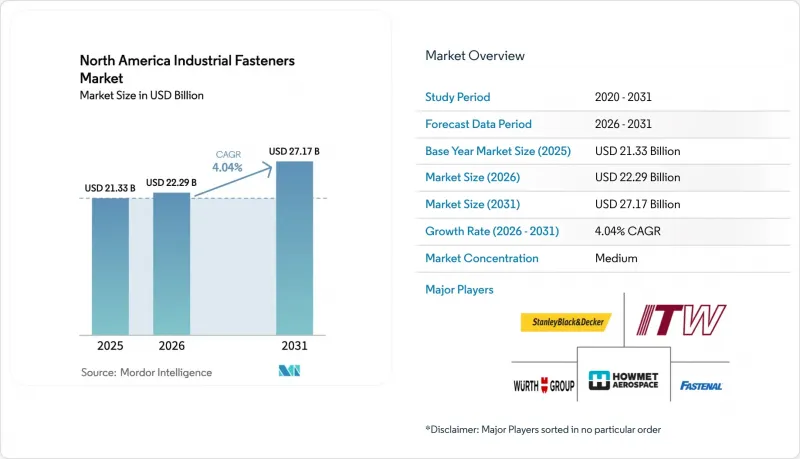
Mordor Intelligence에 따르면 북미의 산업용 패스너 시장 규모는 2025년에 213억 3,000만 달러, 2026년에 222억 9,000만 달러에 달하며, 2031년까지 271억 7,000만 달러에 달할 것으로 예측되고 있으며, 2026-2031년에 CAGR 4.04%로 성장할 것으로 전망되고 있습니다.
이 보고서는 재질(금속, 플라스틱, 복합재 및 특수재), 등급(표준 및 고성능), 제품 유형(수나사, 암나사 등), 최종사용자 용도(OEM, MRO, 건설),코팅/마감(무처리, 아연 도금 등) 및 국가(미국, 캐나다, 멕시코)별로 세분화되어 있습니다. 시장 예측은 금액(달러) 기준으로 제시되어 있습니다.
북미 산업용 패스너 시장의 동향 및 인사이트
자동차 및 항공우주 제조업의 확대
제너럴 모터스(GM)와 스텔란티스의 수십억 달러 규모의 공장 확장이 지속되면서, 배터리 팩 내부의 갈바닉 부식을 방지하는 알루미늄용 볼트 및 셀프락 너트에 대한 장기적인 수주로 이어지고 있습니다. 현대는 미국 역사상 최대 규모의 단일 자동차 복합 단지를 건설 중입니다. 이 투자 프로젝트는 2027년에 가동을 시작할 예정이며, 연간 약 1억 5,000만 개의 패스너를 소비하게 될 것입니다. 항공우주 분야의 생산량도 증가하고 있으며, GE 에어로스페이스가 오하이오주에서 터빈 생산 능력을 확대함에 따라 650°C 이상의 고온을 견딜 수 있는 니켈 기반 합금 ‘인코넬 718’로 제작된 나사에 대한 수요가 높아지고 있습니다. 열처리 로트 추적이 가능하고 NADCAP 감사 요건을 충족하는 인증 공급업체는 경쟁 우위를 점하고 있으며, 설비가 부족한 경쟁사들을 범용 부품의 틈새 시장으로 밀어내고 있습니다. 이러한 움직임이 맞물리면서 북미 산업용 패스너 시장 전반에서 특수 부품의 리드타임이 단축되고, 현지 조달 요건이 더욱 엄격해지고 있습니다.
북미 전기자동차(EV) 공급망의 급속한 성장
2025년에는 배터리 기가팩토리를 통해 58 GWh의 공칭 생산 능력이 추가됨에 따라 ISO 16047 토크 규격에 따라 설계된 스테인리스강 및 알루미늄 패스너에 대한 수요가 발생하고 있습니다. 테슬라의 텍사스 공장만 해도 지난 1년 동안 약 8,000만 개의 패스너가 사용되었으며, 그 중 사용량이 가장 많았던 것은 M6 및 M8 알루미늄 볼트였습니다. EV 파워트레인에서는 내연기관용 나사가 수천개 줄어들었지만, 배터리 케이스, 인버터 하우징, 모터 마운트에는 치열한 열 사이클을 견딜 수 있는 내진 설계가 요구됩니다. 아르곤 국립연구소에 따르면 전기자동차 생산 확대에 단조 생산 능력이 따라가지 못해 맞춤형 부품의 리드타임이 길어지고 있다고 합니다. 그 결과, 드롭인 설계를 지원하거나 지역별 창고 보유가 가능한 공급업체들은 장기적인 대량 발주 확약을 확보하고 있습니다.
구조용 접착제 채택 확대
헨켈의 자동차용 접착제 부문은 2025년에 12%의 성장을 기록했으며, 차량 1대당 최대 12kg의 경량화가 가능한 화이트 바디 조립 과정에서 볼트를 대체하고 있습니다. 접착제는 하중을 분산시키고, 부식을 줄이며, NVH 성능을 향상시키기 때문에 각 OEM 업체들은 접합 구조의 재설계를 추진하고 있습니다. 3M의 아크릴 폼 테이프와 시카(Sika)의 폴리우레탄 시스템은 현재 외장 트림 및 배터리 트레이 고정용으로 사용되고 있으며, 사이클 타임 단축과 금형의 복잡성 경감을 실현하고 있습니다. 유지보수성에 대한 우려가 여전히 남아 있으므로 소수의 체결 부품과 접착제를 결합한 하이브리드 솔루션이 등장하고 있습니다. 체결 부품 제조업체들은 현장에서 경화되는 나사와 접착제의 조합으로 이에 대응하고 있지만, 북미 산업용 체결 부품 업계 전체적으로는 기본 하드웨어에 대한 순수요 압력이 여전히 마이너스 상태입니다.
부문 분석
금속 패스너는 2025년 매출의 84.23%를 차지하며, 자동차 충돌 안전 구조, 기계 외장, 철골 구조에서 그 확고한 역할을 부각시키고 있습니다. 탄소강은 강도 대 비용 비율이 뛰어나 대부분의 생산량 요건을 충족하고 있지만, 합금강과 스테인리스강은 차체 하부의 서스펜션 장착 지점이나 화학 처리 장치 등 더 높은 인장 강도와 내식성이 요구되는 용도에 사용되고 있습니다. 플라스틱 클립과 푸시핀은 높은 인발 강도보다는 유전 절연성이나 흠집 방지가 중시되는 대시보드, 백색 가전, 전자기기 분야에서 널리 채택되고 있습니다. 복합재나 특수 소재 제품은 틈새 시장 분야이긴 하지만, 각 OEM 업체들이 경량화를 추진하는 한편, 금속과 탄소섬유 기판 간의 갈바닉 부식을 방지해야 할 필요성이 있으며, 연평균 성장률(CAGR) 4.62%로 시장이 확대되고 있습니다.
제품 설계의 급속한 변화로 인해 부품표(BOM)의 선정 기준도 재검토되고 있습니다. 에어버스와 보잉은 복합재 제작 동체의 채택률을 높이고 있으며, 기체의 열팽창에 적합하고 갈바닉 커플링을 방지하는 CFRP 나사의 채택을 지원하고 있습니다. 1kg당 50달러 이상 하는 티타늄 5등급 볼트는 생체 적합성과 스테인리스강에 비해 3대 1이라는 뛰어난 강도 대 중량 비율이 여전히 결정적인 요인으로 작용하는 제트 엔진 및 정형외과용 임플란트 분야에서 확고한 입지를 다지고 있습니다. 북미 산업용 패스너 시장에서 PennEngineering사의 얇은 알루미늄 하우징용 셀프 클린칭 스터드는 나사 탈락으로 인한 고장을 30% 감소시켜, 공정 혁신이 특수 용도로의 확산을 얼마나 촉진할 수 있는지 입증했습니다. 한편, PEEK 나사는 수술 후 영상 진단시 X선 투과성이 있으며, 척추 고정 용도로 채택되고 있으며, 이러한 임상적 이점으로 인해 316L 스테인리스강 대체품에 비해 10배에 달하는 가격 차이가 정당화되고 있습니다.
ASTM A307 및 SAE 등급 2를 준수하는 표준 등급 볼트는 2025년 매출의 67.13%를 차지하며, 비용과 즉각적인 가용성이 첨단 기술적 지표보다 더 중요시되는 건설 및 MRO(유지보수·수리·운영) 분야의 주력 제품으로서 수요를 지원하고 있습니다. 이러한 패스너는 팔레트 단위로 유통 허브를 통해 유통되며, 지점 관리자들은 인장 곡선에 대한 지식보다는 품목별 납품률 최적화에 주력하고 있습니다. 가격 하락은 여전히 과제로 남아 있으므로 북미 산업용 패스너 시장의 이 부문에서 이익률을 지키기 위한 유일한 지속가능한 수단으로 대규모 물류 및 자동 피킹이 두드러지고 있습니다.
고성능 등급은 전동화, LNG 프로젝트 및 첨단 민간 항공기를 따라가며 2031년까지 연평균 성장률(CAGR) 4.49%를 기록할 전망입니다. 150,000psi의 인장 강도로 열처리된 8등급 탄소 합금 볼트는 극심한 비틀림 응력에 노출되는 농업용 분무기 및 대형 운송 차량에 널리 채택되고 있습니다. 미터법 등급 10.9 스터드는 현재 전기자동차(EV)의 모터 마운트에 채택되고 있습니다. 이는 회생 제동으로 인해 가솔린 엔진보다 더 높은 역응력 사이클이 접합부에 가해지기 때문입니다. 하우메트(Haumet)사의 2,800만 달러 규모의 인코넬 718 생산 라인은 650°C 이상의 고온 환경에서 터빈 부품을 접합하는 니켈 기반 패스너의 경쟁 우위를 더욱 공고히 하고 있습니다. KAMAX사가 독자적으로 개발한 담금질 후 템퍼링 처리를 통해 피로 수명이 25% 향상되어, OEM 제조사에게는 보증 기간에 여유가 생겼으며 40%의 가격 프리미엄이 실현되고 있습니다. 이를 통해 북미 산업용 패스너 시장의 전반적인 가치가 상승하고 있습니다.
기타 혜택:
- 엑셀 형식의 시장 예측(ME) 시트
- 3개월간의 애널리스트 지원
자주 묻는 질문
목차
제1장 서론
제2장 조사 방법
제3장 개요
제4장 시장 구도
제5장 시장 규모와 성장 예측
제6장 경쟁 구도
제7장 시장 기회와 향후 전망
KSA 26.09.08According to Mordor Intelligence, the North America industrial fasteners market size is projected to be USD 21.33 billion in 2025, USD 22.29 billion in 2026, and reach USD 27.17 billion by 2031, growing at a CAGR of 4.04% from 2026 to 2031.
This report is Segmented by Material (Metal, Plastic, and Composite and Specialty), Grade (Standard, and High-Performance), Product Type (Externally Threaded, Internally Threaded, and More), End-User Application (OEM, MRO, and Construction), Coating/Finish (Plain, Zinc-Plated, and More), and Country (United States, Canada, and Mexico). The Market Forecasts are Provided in Terms of Value (USD).
North America Industrial Fasteners Market Trends and Insights
Expansion Of Automotive and Aerospace Manufacturing
Ongoing multi-billion-dollar plant expansions by General Motors and Stellantis are translating into long-run orders for aluminum-compatible bolts and self-locking nuts that prevent galvanic corrosion inside battery packs. Hyundai is building the largest single automotive complex in U.S. history, an investment scheduled to come online in 2027 and consume roughly 150 million fasteners each year. Aerospace output is also climbing, with GE Aerospace adding turbine capacity in Ohio, which is boosting demand for nickel-based Inconel 718 screws capable of withstanding temperatures above 650 °C. Certified suppliers who can trace heat lots and meet NADCAP audit requirements have a competitive edge, pushing less-equipped rivals toward commodity niches. Collectively, these moves compress lead times for specialty parts and intensify local content requirements across the North America industrial fasteners market.
Rapid Growth Of North American EV Supply Chain
Battery gigafactories added 58 GWh of nameplate capacity in 2025, introducing demand for stainless-steel and aluminum fasteners engineered to ISO 16047 torque standards. Tesla's Texas plant alone used about 80 million fasteners during the year, with M6 and M8 aluminum bolts topping the volume list. EV powertrains eliminate thousands of combustion-engine screws, yet battery enclosures, inverter housings, and motor mounts require vibration-resistant designs that survive intense thermal cycling. Argonne National Laboratory notes that forging capacity is struggling to keep pace with EV ramp-ups, stretching lead times for custom parts. Suppliers capable of drop-in design support and regional warehousing are therefore securing long-term volume commitments.
Rising Adoption Of Structural Adhesives
Henkel's automotive adhesives unit grew 12% in 2025, displacing bolts in body-in-white assemblies where weight savings reach 12 kilograms per vehicle. Adhesives distribute load, reduce corrosion, and enhance NVH, motivating OEMs to redesign joint architectures. 3M acrylic foam tapes and Sika polyurethane systems now secure exterior trims and battery trays, trimming cycle times and tooling complexity. Serviceability concerns persist, so hybrid solutions pairing low-count fasteners with bonding agents are emerging. Fastener makers respond with screw-and-adhesive combos that cure in situ, but net demand pressure remains negative for basic hardware across the North America industrial fasteners industry.
Other drivers and restraints analyzed in the detailed report include:
- Growth Of The Construction Sector
- Advances In Corrosion-Resistant Coatings
- Volatility In Steel And Non-Ferrous Metal Prices
For complete list of drivers and restraints, kindly check the Table Of Contents.
Segment Analysis
Metal fasteners accounted for 84.23% of 2025 revenue, underscoring their entrenched role in automotive crash structures, machinery housings, and steel-frame construction. Carbon steel meets most volume requirements thanks to favorable strength-to-cost ratios, while alloy and stainless grades serve higher-tensile or corrosive applications, such as underbody suspension points and chemical-processing equipment. Plastic clips and push-pins thrive in dashboards, white goods, and electronics where dielectric insulation or scratch avoidance matters more than high pull-out strength. Composite and specialty options, although niche, are expanding at a 4.62% CAGR as OEMs fight weight while guarding against galvanic corrosion between metals and carbon-fiber substrates.
Rapid shifts in product design are recasting bill-of-material choices. Airbus and Boeing have increased their composite fuselage share, driving the adoption of CFRP screws that match the thermal expansion of airframes and avoid galvanic couples. Titanium Grade 5 bolts, priced at more than USD 50 per kilogram, hold a secure position in jet engines and orthopedic implants where biocompatibility and 3:1 strength-to-weight superiority over stainless steel remain decisive. In the North America industrial fasteners market, PennEngineering's self-clinching studs for thin aluminum casings reduced strip-out failures by 30%, demonstrating how process innovation can boost specialty penetration. PEEK screws, meanwhile, win spinal fixation work because they are radiolucent on post-op imaging, a clinical benefit that justifies a tenfold premium over 316L stainless alternatives.
Standard-grade bolts conforming to ASTM A307 and SAE Grade 2 delivered 67.13% of 2025 turnover, riding construction and MRO staples where cost and immediate availability outweigh deeper engineering metrics. These fasteners move through distribution hubs in pallet quantities, with branch managers optimized for line-item fill rate rather than tensile curve education. Price erosion remains an issue, so scale logistics and automated picking stand out as the only sustainable levers for margin defense in this layer of the North America industrial fasteners market.
High-performance grades are charting a 4.49% CAGR into 2031 by shadowing electrification, LNG projects, and advanced civil aircraft. Grade 8 carbon-alloy bolts, heat-treated to 150,000 psi tensile, populate agricultural sprayers and heavy haulers that encounter extreme torsion. Metric Grade 10.9 studs now anchor EV motor mounts because regenerative braking subjects joints to higher reversed-stress cycles than gasoline engines. Howmet's USD 28 million Inconel 718 line widens the moat around nickel-based fasteners that hold turbine sections together above 650 °C. KAMAX's proprietary post-quench temper raised fatigue life 25%, granting OEMs more warranty cushion and fetching 40% price premiums that buoy overall value captured within the North America industrial fasteners market.
Complete Report Scope:
- By Material
- Metal
- Plastic
- Composite and Specialty
- By Grade
- Standard
- High-Performance
- By Product Type
- Externally Threaded
- Internally Threaded
- Non-Threaded
- Application-Specific/Specialty
- By End-User Application
- OEM
- Motor Vehicles/Automotive
- ICE Light Vehicles
- ICE Medium and Heavy Trucks/Buses
- Electric Vehicles
- Aerospace
- Machinery and Capital Goods
- Electrical and Electronics
- Fabricated Metals
- Medical Equipment
- Other OEM Applications
- Motor Vehicles/Automotive
- Maintenance, Repair and Operations (MRO)
- Construction
- OEM
- By Coating/Finish
- Plain (Uncoated)
- Zinc-Plated
- Hot-Dip Galvanized
- PTFE and Specialty Coatings
- By Country
- United States
- Canada
- Mexico
List of Companies Covered in this Report:
- Illinois Tool Works Inc.
- Howmet Aerospace Inc.
- Stanley Black and Decker, Inc.
- Wurth Group
- Fastenal Company
- Fontana Gruppo (Acument Global Technologies, Inc.)
- LISI Group
- Nifco Inc.
- Bulten AB
- ARaymond Group
- Marmon Holdings, Inc. (Berkshire Hathaway)
- Hilti Corporation
- KAMAX Holding GmbH and Co. KG
- Bossard Holding AG
- PennEngineering and Manufacturing Corp.
- Simpson Manufacturing Co., Inc.
- Precision Castparts Corp. (SPS Technologies)
- TriMas Corporation
- Agrati Group
- SFS Group AG
- Optimas Solutions
Additional Benefits:
- The market estimate (ME) sheet in Excel format
- 3 months of analyst support
TABLE OF CONTENTS
1 INTRODUCTION
- 1.1 Study Assumptions and Market Definition
- 1.2 Scope of the Study
2 RESEARCH METHODOLOGY
3 EXECUTIVE SUMMARY
4 MARKET LANDSCAPE
- 4.1 Market Overview
- 4.2 Market Drivers
- 4.2.1 Growth of the Construction Sector
- 4.2.2 Expansion of Automotive and Aerospace Manufacturing
- 4.2.3 Advances in Corrosion-Resistant Coatings
- 4.2.4 Rapid Growth of North American EV Supply Chain
- 4.2.5 Buy-American Acts Driving Local Sourcing
- 4.2.6 Digital Traceability and Smart-Fastener Initiatives
- 4.3 Market Restraints
- 4.3.1 Rising Adoption of Structural Adhesives
- 4.3.2 Volatility in Steel and Non-Ferrous Metal Prices
- 4.3.3 Stringent Environmental Regulations on Plating
- 4.3.4 Reshoring-Led Capacity Bottlenecks for Specials
- 4.4 Industry Value Chain Analysis
- 4.5 Regulatory Landscape
- 4.6 Technological Outlook
- 4.7 Porter's Five Forces Analysis
- 4.7.1 Bargaining Power of Suppliers
- 4.7.2 Bargaining Power of Consumers
- 4.7.3 Threat of New Entrants
- 4.7.4 Threat of Substitutes
- 4.7.5 Intensity of Competitive Rivalry
- 4.8 Impact of Macroeconomic Trends on the Market
5 MARKET SIZE AND GROWTH FORECASTS
- 5.1 By Material
- 5.1.1 Metal
- 5.1.2 Plastic
- 5.1.3 Composite and Specialty
- 5.2 By Grade
- 5.2.1 Standard
- 5.2.2 High-Performance
- 5.3 By Product Type
- 5.3.1 Externally Threaded
- 5.3.2 Internally Threaded
- 5.3.3 Non-Threaded
- 5.3.4 Application-Specific/Specialty
- 5.4 By End-User Application
- 5.4.1 OEM
- 5.4.1.1 Motor Vehicles/Automotive
- 5.4.1.1.1 ICE Light Vehicles
- 5.4.1.1.2 ICE Medium and Heavy Trucks/Buses
- 5.4.1.1.3 Electric Vehicles
- 5.4.1.2 Aerospace
- 5.4.1.3 Machinery and Capital Goods
- 5.4.1.4 Electrical and Electronics
- 5.4.1.5 Fabricated Metals
- 5.4.1.6 Medical Equipment
- 5.4.1.7 Other OEM Applications
- 5.4.1.1 Motor Vehicles/Automotive
- 5.4.2 Maintenance, Repair and Operations (MRO)
- 5.4.3 Construction
- 5.4.1 OEM
- 5.5 By Coating/Finish
- 5.5.1 Plain (Uncoated)
- 5.5.2 Zinc-Plated
- 5.5.3 Hot-Dip Galvanized
- 5.5.4 PTFE and Specialty Coatings
- 5.6 By Country
- 5.6.1 United States
- 5.6.2 Canada
- 5.6.3 Mexico
6 COMPETITIVE LANDSCAPE
- 6.1 Market Concentration
- 6.2 Strategic Moves
- 6.3 Market Share Analysis
- 6.4 Company Profiles (includes Global Level Overview, Market Level Overview, Core Segments, Financials as available, Strategic Information, Market Rank/Share, Products and Services, Recent Developments)
- 6.4.1 Illinois Tool Works Inc.
- 6.4.2 Howmet Aerospace Inc.
- 6.4.3 Stanley Black and Decker, Inc.
- 6.4.4 Wurth Group
- 6.4.5 Fastenal Company
- 6.4.6 Fontana Gruppo (Acument Global Technologies, Inc.)
- 6.4.7 LISI Group
- 6.4.8 Nifco Inc.
- 6.4.9 Bulten AB
- 6.4.10 ARaymond Group
- 6.4.11 Marmon Holdings, Inc. (Berkshire Hathaway)
- 6.4.12 Hilti Corporation
- 6.4.13 KAMAX Holding GmbH and Co. KG
- 6.4.14 Bossard Holding AG
- 6.4.15 PennEngineering and Manufacturing Corp.
- 6.4.16 Simpson Manufacturing Co., Inc.
- 6.4.17 Precision Castparts Corp. (SPS Technologies)
- 6.4.18 TriMas Corporation
- 6.4.19 Agrati Group
- 6.4.20 SFS Group AG
- 6.4.21 Optimas Solutions
7 MARKET OPPORTUNITIES AND FUTURE OUTLOOK
- 7.1 White-Space and Unmet Need Assessment


