|
시장보고서
상품코드
2125375
마스터 데이터 관리 : 시장 점유율 분석, 업계 동향과 통계, 성장 예측(2026-2031년)Master Data Management - Market Share Analysis, Industry Trends & Statistics, Growth Forecasts (2026 - 2031) |
||||||
 Mordor Intelligence
Mordor Intelligence에 따르면 2026년 마스터 데이터 관리 시장의 규모는 216억 3,000만 달러로 추정되고 있으며, 2025년 182억 3,000만 달러에서 성장하며, 2031년에는 508억 5,000만 달러에 달할 것으로 예측됩니다.2026-2031년에는 CAGR 18.66%로 성장할 것으로 전망되고 있습니다.
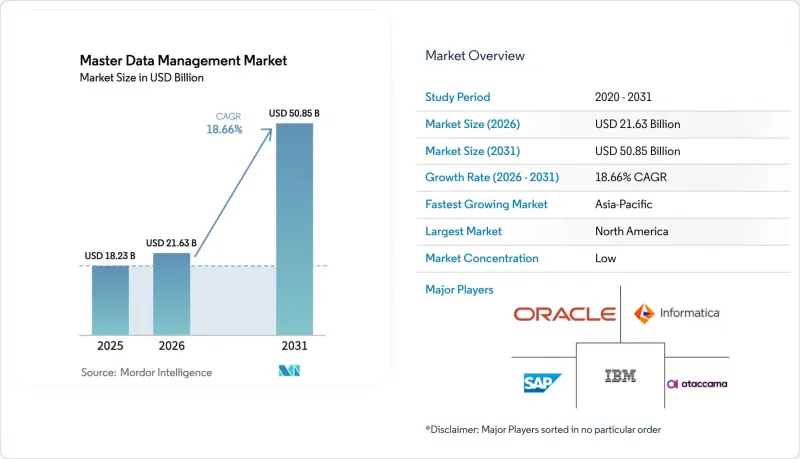
이 보고서는 구성 요소(소프트웨어, 서비스), 도입 모델(온프레미스, 클라우드),기업 규모(대기업, 중소기업), 용도(공급업체, 제품 등), 업종(IT·통신, BFSI 등), 통합 방식(배치 ETL 등), 클라우드 배포 유형(멀티테넌트 SaaS 등), 그리고 지역별로 분류되어 있습니다.
전 세계 마스터 데이터 관리 시장의 동향 및 인사이트
생성형 AI에 대한 대응이 급속히 확대되며, 고품질 훈련 데이터 수요를 견인
생성형 AI 프로젝트는 모델의 정확도와 마스터 데이터의 일관성 사이에 직접적인 상관관계가 있음을 밝혀냈습니다. Informatica의 AI 강화형 클라우드는 86조 건의 트랜잭션을 처리하여, 고객이 데이터 프로그램의 가치를 실현하는 데 걸리는 시간을 40% 단축할 수 있도록 지원했습니다. 의료 및 금융 서비스 분야의 도입 기업은 ChatGPT 스타일의 데이터 보강을 MDM과 결합함으로써 데이터 대조 정확도를 80%까지 높이고, 데이터 품질을 단순한 규정 준수 요건에서 경쟁 우위로 전환하고 있습니다. 그 결과, 마스터 데이터 관리(MDM) 시장에서 지속적인 검증, 보강 및 데이터 계보 추적은 선택적 부가 기능에서 플랫폼의 핵심 요건으로 전환되고 있습니다.
실시간 ESG 공시를 향한 규제 변화
EU의 ‘디지털 운영 복원력 법(Digital Operational Resilience Act)’은 금융 기관에 실시간 ESG 보고를 지원하는 감사 가능한 마스터 데이터 거버넌스를 포함한 포괄적인 ICT 위험 관리를 유지할 것을 의무화하고 있습니다. 기존의 분기별 주기에서는 투자자가 요구하는 수준의 세부 정보로 탄소발자국이나 공급망 윤리 지표를 제공할 수 없기 때문에 기업은 지속가능성 데이터를 재무 장부와 동등한 엄격함으로 정합시키는 플랫폼으로의 전환을 강요받고 있습니다. 또한 여러 관할 구역에 걸쳐 사업을 운영하는 경우 서로 다른 데이터 주권 관련 규정에도 대응해야 하므로, 이는 통합 전략을 복잡하게 만들고 하이브리드형 MDM에 대한 수요를 촉진하고 있습니다.
MDM 역량을 갖춘 데이터 스튜어드 부족
2024년, 제조업체의 75%가 데이터 스튜어드 직책을 채우는 데 어려움을 겪고 있다고 보고했는데, 이는 전문 분야의 인사이트와 AI 및 거버넌스 지식을 겸비한 전문가에 대한 수요를 반영합니다. 자동화를 통해 반복적인 데이터 정제 작업은 줄어들지만, 정책 정의나 예외 처리에는 여전히 사람의 감독이 필수적입니다. 따라서 특히 디지털 전환에 대한 야심에 비해 인재 양성 체계가 따라가지 못하고 있는 신흥 시장에서 임시 대책으로 매니지드 서비스나 내장형 거버넌스 제공이 증가하고 있습니다.
부문 분석
2025년 매출의 67.42%는 소프트웨어가 차지했으나, 서비스 부문은 연평균 성장률(CAGR) 19.26%로 급성장하고 있으며, 마스터 데이터 관리(MDM) 시장이 더 이상 ‘기술 우선’이 아님을 보여줍니다. 의료 및 은행 업계 기업은 복잡한 규정 준수 환경을 극복하기 위해 자문, 데이터 아키텍처 설계 및 변경 관리에 투자하고 있습니다. 전문 서비스는 현재 거버넌스 프레임워크 구축 및 영역을 초월한 정책 통합을 포함하고 있으며, 초기 시스템 통합의 범위를 훨씬 뛰어넘어 확장되고 있습니다.
중견 기업의 매니지드 서비스 도입 현황을 살펴보면, 관리 업무나 플랫폼 운영을 아웃소싱함으로써 제한된 사내 자원과 품질에 대한 기대 사이의 균형을 맞출 수 있음을 알 수 있습니다. 업종별 규제가 엄격해지는 가운데, 해당 분야의 실적을 보유한 서비스 파트너는 소프트웨어 기능을 수익화하는 데 필수적인 존재가 되어, 가치가 지속가능한 거버넌스의 성과에 있다는 경향을 더욱 강화하고 있습니다.
클라우드 배포는 2025년에 60.35%의 점유율을 차지하며 연평균 성장률(CAGR) 20.88%로 확대되고 있으며, 마스터 데이터 관리(MDM) 시장의 벤더 선정 기준을 재정의하고 있습니다. 탄력적인 확장, 자동 패치 적용, 사용량 기반 과금 체계가 진입 장벽을 낮추는 한편, 미리 구축된 커넥터는 분석 팀이 인사이트를 확보하는 데 걸리는 시간을 단축합니다.
규제가 엄격한 산업 분야조차 컨테이너화 및 SaaS 에지 노드를 통해 온프레미스 관리 체계와 클라우드의 민첩성을 융합하고 있습니다. 플랫폼이 클라우드 AI 서비스와 네이티브로 통합되어 대규모 데이터 이동 파이프라인 없이도 실시간 데이터 보강이 가능해짐에 따라 마스터 데이터 관리 업계는 그 혜택을 누리고 있습니다. 이처럼 하이브리드 구성은 단일 아키텍처 내에서 데이터 주권, 지연 시간, 경제성이라는 세 가지 요소를 모두 충족시키고 있습니다.
대기업의 점유율은 여전히 63.25%를 차지하고 있지만, 구독 모델을 통해 마스터 데이터 관리 시장이 보급됨에 따라 중소기업 시장 규모는 연평균 성장률(CAGR) 19.74%로 확대되고 있습니다. 소규모 기업은 일반적으로 사업 범위를 확장하기 전에 고객 데이터 통합이나 제품 카탈로그 정리와 같은 단일 영역에서의 성과를 목표로 삼습니다.
클라우드 네이티브 벤더들은 설정의 번거로움을 줄여주는 템플릿 라이브러리와 가이드가 포함된 워크플로를 제공하고 있으며, 이를 통해 중소기업은 분석 역량 향상을 통해 매출을 15% 증가시키고 위험 노출을 20% 저감할 수 있습니다. 이러한 성과는 견고한 마스터 데이터가 더 이상 글로벌 대기업만의 특권이 아니라는 비즈니스 사례의 주장을 지원합니다.
지역별 분석
2025년, 북미는 엄격한 업계 규제와 AI의 조기 도입에 힘입어 마스터 데이터 관리 시장에서 38.55%의 점유율을 차지하며 1위를 차지했습니다. WeightWatchers와 같은 미국 기업은 Oracle Customer Hub를 활용하여 3,000만 건의 고객 레코드를 간소화함으로써, 성숙한 거버넌스 프로그램이 고객 경험의 마찰을 어떻게 줄여주는지를 보여주고 있습니다. 캐나다 및 멕시코 기업도 이에 뒤를 잇고 있습니다. 이들 기업은 국경을 초월한 상거래와 USMCA(미국·멕시코·캐나다 협정)의 인센티브를 활용하여 데이터 아키텍처 현대화를 추진하고 있습니다.
아시아태평양에서는 데이터 현지화 의무화로 인해 기업 전략이 재편되는 가운데, 2031년까지 연평균 성장률(CAGR)이 19.14%에 달할 것으로 예측됩니다. 중국의 데이터센터 급속한 확충과 국경을 넘는 데이터 전송에 대한 제약이 맞물리면서, 전 세계 공급망 데이터와 상호 운용이 가능한 국내 호스팅 MDM 솔루션에 대한 수요가 높아지고 있습니다. 인도의 ‘2025년 디지털 개인 데이터 보호법’ 초안에서는 동의 관리와 데이터 계보의 투명성에 대한 관심이 높아지고 있으며, 현지 기업은 법 시행 기준에 앞서 거버넌스 기능이 충실한 플랫폼 도입을 서두르고 있습니다. 아세안(ASEAN)의 데이터센터 수익이 20% 증가한 것은 지역 전체의 MDM 도입을 지원하는 용량이 확대되고 있음을 보여줍니다.
유럽에서는 GDPR, DORA 및 향후 시행될 EU AI법에 따라 꾸준한 확대가 이어지고 있으며, 이 지역은 포괄적인 데이터 거버넌스의 세계적 벤치마크로서의 위상을 확립하고 있습니다. 독일 증권거래소(Deutsche Borse)와 같은 기관은 SAP Master Data Governance를 활용하여 마스터 데이터를 중앙 집중화하고, 수작업에 의한 유지 관리를 줄이는 동시에 제품 출시를 가속화했습니다. 네덜란드 등 여러 국가에서 집행 조치가 강화됨에 따라 규제 당국이 감사를 요청할 때 규정 준수를 입증할 수 있는 데이터 계보 기능을 갖춘 솔루션에 대한 투자가 촉진되고 있습니다. 유럽의 로드맵에서는 주권 확보와 글로벌 클라우드 생태계 활용의 필요성 사이에서 균형을 맞추는 하이브리드 아키텍처가 주류를 이루고 있습니다.
기타 혜택:
- 엑셀 형식의 시장 예측(ME) 시트
- 3개월간의 애널리스트 지원
자주 묻는 질문
목차
제1장 서론
제2장 조사 방법
제3장 개요
제4장 시장 구도
제5장 시장 규모와 성장 예측
제6장 경쟁 구도
제7장 시장 기회와 향후 전망
KSA 26.09.08According to Mordor Intelligence, master data management market size in 2026 is estimated at USD 21.63 billion, growing from 2025 value of USD 18.23 billion with 2031 projections showing USD 50.85 billion, growing at 18.66% CAGR over 2026-2031.
This report is Segmented by Component (Software, Service), Deployment Model (On-Premise, Cloud), Enterprise Size (Large Enterprises, Small and Medium Enterprises), Application (Supplier, Product, and More), Industry Vertical (IT and Telecommunication, BFSI, and More), Integration Pattern (Batch ETL and Mor), Cloud Deployment Type (Multi-Tenant SaaS and More) and Geography.
Global Master Data Management Market Trends and Insights
Surging Gen-AI Readiness Drives Need for High-Quality Training Data
Generative-AI projects expose the direct link between model accuracy and master data consistency. Informatica's AI-enhanced cloud processed 86 trillion transactions, helping customers cut data-program time-to-value by 40%. Healthcare and financial services adopters are blending ChatGPT-style enrichment with MDM to raise data-matching accuracy to 80%, turning data quality from a compliance checkbox into a competitive edge. Continuous validation, enrichment, and lineage tracking are therefore moving from optional add-ons to core platform requirements inside the Master Data Management market.
Regulatory Shift to Real-Time ESG Disclosures
The EU's Digital Operational Resilience Act obliges financial entities to maintain exhaustive ICT risk controls, including auditable master data governance that supports real-time ESG reporting. Traditional quarterly cycles cannot supply investors with carbon-footprint or supply-chain-ethics metrics at the required granularity, pushing enterprises toward platforms that reconcile sustainability data with the rigor of financial ledgers. Multi-jurisdictional operations must additionally accommodate differing data-sovereignty rules, complicating centralization strategies and fuelling hybrid-MDM demand.
Shortage of MDM-Skilled Data Stewards
Seventy-five percent of manufacturers reported difficulty filling data-steward roles in 2024, reflecting demand for professionals who blend domain expertise with AI and governance fluency. While automation eases repetitive cleansing, human oversight remains vital for policy definition and exception handling. Managed-service and embedded-governance offerings are therefore rising as stop-gaps, especially in emerging markets where skill pipelines lag digital-transformation ambitions.
Other drivers and restraints analyzed in the detailed report include:
- Data-Fabric & Data-Mesh Architectures Mainstreaming
- Rapid Cloud ERP Migrations in Mid-Market Firms
- Hidden Technical Debt in Legacy Source Systems
For complete list of drivers and restraints, kindly check the Table Of Contents.
Segment Analysis
Software delivered 67.42% of 2025 revenue, but services are accelerating at 19.26% CAGR, signalling that the Master Data Management market is no longer technology-first. Enterprises in healthcare and banking invest in advisory, data-architecture design, and change management to navigate complex compliance landscapes. Professional services now encompass governance framework development and cross-domain policy harmonization, extending far beyond initial system integration.
Managed-service adoption among mid-market organizations shows that outsourcing stewardship and platform operations can balance limited internal capacity with quality expectations. As vertical regulations tighten, service partners with domain credentials become pivotal to monetizing software capabilities, reinforcing a shift where value lies in sustained governance outcomes.
Cloud deployments commanded a 60.35% share in 2025 and are scaling at a 20.88% CAGR, redefining vendor selection criteria inside the Master Data Management market. Elastic scaling, automated patching, and usage-based pricing lower entry barriers, while pre-built connectors shorten time-to-insight for analytics teams.
Even highly regulated sectors now blend on-premise controls with cloud agility through containerized or SaaS edge nodes. The Master Data Management industry benefits as platforms integrate natively with cloud AI services, enabling real-time enrichment without heavyweight data-movement pipelines. Hybrid patterns thus satisfy sovereignty, latency, and economics in one architecture.
Large enterprises still hold a 63.25% share, yet SMEs are growing at a 19.74% CAGR as subscription models democratize the Master Data Management market. Smaller firms typically target single-domain wins-customer data unification or product catalog clarity-before expanding scope.
Cloud-native vendors supply template libraries and guided workflows that cut configuration effort, letting SMEs realize 15% revenue uplift and 20% lower risk exposure from better analytics. These proof points reinforce the business-case narrative that robust master data is no longer a luxury reserved for global conglomerates.
Complete Report Scope:
- By Component
- Software
- Services
- By Deployment Model
- On-premise
- Cloud
- By Enterprise Size
- Large Enterprises
- Small and Medium Enterprises
- By Application Domain
- Customer
- Product
- Supplier
- Finance and Reference Data
- Asset and Location
- By Industry Vertical
- BFSI
- Healthcare and Life Sciences
- Retail and e-Commerce
- Manufacturing
- IT and Telecom
- Government and Public Sector
- Energy and Utilities
- Others (Education, Media, etc.)
- By Integration Pattern
- Batch ETL
- Real-time/Event-driven
- API-led Micro-services
- By Cloud Deployment Type
- Multi-tenant SaaS
- Single-tenant SaaS
- Self-managed Cloud (IaaS)
- Hybrid (Cloud + On-prem)
- By Geography
- North America
- United States
- Canada
- Mexico
- South America
- Brazil
- Argentina
- Chile
- Rest of South America
- Europe
- Germany
- United Kingdom
- France
- Italy
- Spain
- Netherlands
- Russia
- Rest of Europe
- Asia-Pacific
- China
- India
- Japan
- South Korea
- ASEAN
- Rest of Asia-Pacific
- Middle East and Africa
- Middle East
- GCC (Saudi Arabia, UAE, Qatar, etc.)
- Turkey
- Rest of Middle East
- Africa
- South Africa
- Nigeria
- Kenya
- Rest of Africa
- Middle East
- North America
Geography Analysis
North America led with a 38.55% share of the Master Data Management market in 2025, supported by stringent sectoral regulations and early AI adoption. U.S. firms such as WeightWatchers streamlined 30 million client records using Oracle Customer Hub, illustrating how mature governance programs translate into lower customer-experience frictions. Canadian and Mexican enterprises are close behind, exploiting cross-border commerce and USMCA incentives to modernize data architectures.
Asia Pacific is forecast to grow at 19.14% CAGR through 2031 as data-localization mandates reshape enterprise strategies. China's rapid data-center build-out, coupled with constraints on cross-border transfers, drives demand for domestically hosted MDM solutions that interoperate with global supply-chain data . India's 2025 Digital Personal Data Protection Act draft rules intensify the focus on consent management and data-lineage transparency, prompting local firms to adopt governance-rich platforms ahead of enforcement thresholds. ASEAN's 20% data-center revenue growth signals rising capacity to support region-wide MDM rollouts
Europe maintains steady expansion under GDPR, DORA, and the incoming EU AI Act, positioning the region as a global benchmark for comprehensive data governance. Institutions such as Deutsche Borse centralized master data with SAP Master Data Governance to cut manual maintenance and accelerate product launches. Heightened enforcement actions in nations like the Netherlands propel investment in lineage-rich solutions that can evidence compliance when regulators demand audits. Hybrid architectures dominate European roadmaps, balancing sovereignty with the need to tap global cloud ecosystems.
- IBM
- SAP SE
- Oracle Corporation
- Informatica Inc.
- SAS Institute Inc.
- TIBCO Software Inc.
- Talend (Qlik)
- Ataccama
- Stibo Systems
- Profisee
- Reltio
- Semarchy
- Syndigo
- Teradata Corporation
- Riversand (Syndigo)
- Magnitude Software
- Informatica MDM Cloud
- CluedIn
- Pimcore
Additional Benefits:
- The market estimate (ME) sheet in Excel format
- 3 months of analyst support
TABLE OF CONTENTS
1 INTRODUCTION
- 1.1 Study Assumptions and Market Definition
- 1.2 Scope of the Study
2 RESEARCH METHODOLOGY
3 EXECUTIVE SUMMARY
4 MARKET LANDSCAPE
- 4.1 Market Overview
- 4.2 Market Drivers
- 4.2.1 Surging Gen-AI readiness drives need for high-quality training data
- 4.2.2 Regulatory shift to real-time ESG disclosures
- 4.2.3 Data-fabric and data-mesh architectures mainstreaming
- 4.2.4 Rapid Cloud ERP migrations in mid-market firms
- 4.2.5 Expansion of industry-specific 360-MDM SaaS (e.g., Retail, Life Sciences)
- 4.2.6 Cyber-resilience mandates for critical infrastructure (NIS2, DORA)
- 4.3 Market Restraints
- 4.3.1 Shortage of MDM-skilled data stewards
- 4.3.2 Hidden technical debt in legacy source systems
- 4.3.3 Access-control conflicts under emerging data sovereignty laws
- 4.3.4 Rising hyperscaler egress fees inflating total cost of ownership
- 4.4 Value/Supply-Chain Analysis
- 4.5 Regulatory Landscape
- 4.6 Technological Outlook
- 4.7 Porters Five Forces Analysis
- 4.7.1 Bargaining Power of Suppliers
- 4.7.2 Bargaining Power of Buyers
- 4.7.3 Threat of New Entrants
- 4.7.4 Threat of Substitutes
- 4.7.5 Intensity of Rivalry
5 MARKET SIZE AND GROWTH FORECASTS
- 5.1 By Component
- 5.1.1 Software
- 5.1.2 Services
- 5.2 By Deployment Model
- 5.2.1 On-premise
- 5.2.2 Cloud
- 5.3 By Enterprise Size
- 5.3.1 Large Enterprises
- 5.3.2 Small and Medium Enterprises
- 5.4 By Application Domain
- 5.4.1 Customer
- 5.4.2 Product
- 5.4.3 Supplier
- 5.4.4 Finance and Reference Data
- 5.4.5 Asset and Location
- 5.5 By Industry Vertical
- 5.5.1 BFSI
- 5.5.2 Healthcare and Life Sciences
- 5.5.3 Retail and e-Commerce
- 5.5.4 Manufacturing
- 5.5.5 IT and Telecom
- 5.5.6 Government and Public Sector
- 5.5.7 Energy and Utilities
- 5.5.8 Others (Education, Media, etc.)
- 5.6 By Integration Pattern
- 5.6.1 Batch ETL
- 5.6.2 Real-time/Event-driven
- 5.6.3 API-led Micro-services
- 5.7 By Cloud Deployment Type
- 5.7.1 Multi-tenant SaaS
- 5.7.2 Single-tenant SaaS
- 5.7.3 Self-managed Cloud (IaaS)
- 5.7.4 Hybrid (Cloud + On-prem)
- 5.8 By Geography
- 5.8.1 North America
- 5.8.1.1 United States
- 5.8.1.2 Canada
- 5.8.1.3 Mexico
- 5.8.2 South America
- 5.8.2.1 Brazil
- 5.8.2.2 Argentina
- 5.8.2.3 Chile
- 5.8.2.4 Rest of South America
- 5.8.3 Europe
- 5.8.3.1 Germany
- 5.8.3.2 United Kingdom
- 5.8.3.3 France
- 5.8.3.4 Italy
- 5.8.3.5 Spain
- 5.8.3.6 Netherlands
- 5.8.3.7 Russia
- 5.8.3.8 Rest of Europe
- 5.8.4 Asia-Pacific
- 5.8.4.1 China
- 5.8.4.2 India
- 5.8.4.3 Japan
- 5.8.4.4 South Korea
- 5.8.4.5 ASEAN
- 5.8.4.6 Rest of Asia-Pacific
- 5.8.5 Middle East and Africa
- 5.8.5.1 Middle East
- 5.8.5.1.1 GCC (Saudi Arabia, UAE, Qatar, etc.)
- 5.8.5.1.2 Turkey
- 5.8.5.1.3 Rest of Middle East
- 5.8.5.2 Africa
- 5.8.5.2.1 South Africa
- 5.8.5.2.2 Nigeria
- 5.8.5.2.3 Kenya
- 5.8.5.2.4 Rest of Africa
- 5.8.5.1 Middle East
- 5.8.1 North America
6 COMPETITIVE LANDSCAPE
- 6.1 Market Concentration
- 6.2 Strategic Moves
- 6.3 Market Share Analysis
- 6.4 Company Profiles (includes Global level Overview, Market level overview, Core Segments, Financials as available, Strategic Information, Market Rank/Share, Products and Services, Recent Developments)
- 6.4.1 IBM
- 6.4.2 SAP SE
- 6.4.3 Oracle Corporation
- 6.4.4 Informatica Inc.
- 6.4.5 SAS Institute Inc.
- 6.4.6 TIBCO Software Inc.
- 6.4.7 Talend (Qlik)
- 6.4.8 Ataccama
- 6.4.9 Stibo Systems
- 6.4.10 Profisee
- 6.4.11 Reltio
- 6.4.12 Semarchy
- 6.4.13 Syndigo
- 6.4.14 Teradata Corporation
- 6.4.15 Riversand (Syndigo)
- 6.4.16 Magnitude Software
- 6.4.17 Informatica MDM Cloud
- 6.4.18 CluedIn
- 6.4.19 Pimcore
7 MARKET OPPORTUNITIES AND FUTURE OUTLOOK
- 7.1 White-space and Unmet-need Assessment