|
시장보고서
상품코드
2125386
밸브 : 시장 점유율 분석, 업계 동향과 통계, 성장 예측(2026-2031년)Valves - Market Share Analysis, Industry Trends & Statistics, Growth Forecasts (2026 - 2031) |
||||||
 Mordor Intelligence
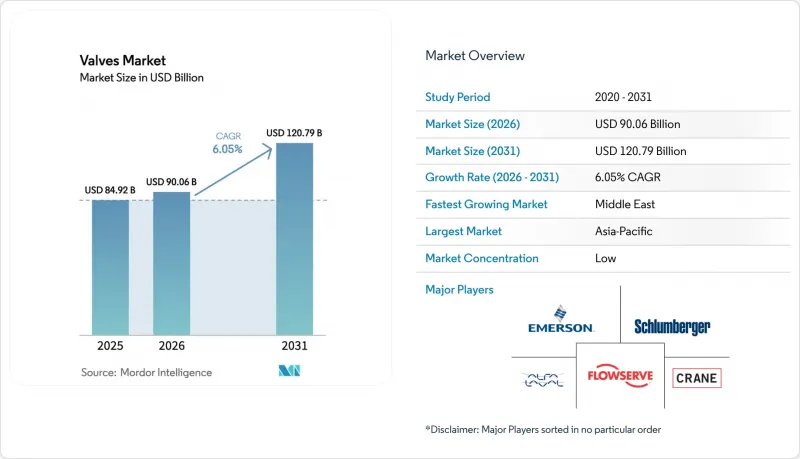
Mordor Intelligence에 따르면 밸브 시장 규모는 2025년 849억 2,000만 달러에서 2026년에는 900억 6,000만 달러로 확대하며, 2026-2031년에 CAGR 6.05%로 추이하며, 2031년에는 1,207억 9,000만 달러에 달할 것으로 예측됩니다.
이 보고서는 밸브의 유형(볼 밸브, 버터플라이 밸브, 게이트 밸브, 글러브 밸브, 체크 밸브, 플러그 밸브, 제어 밸브 등), 재질(스테인리스강, 탄소강, 합금강, 극저온용 등),작동 방식(수동, 전동, 공압, 유압 등), 최종사용자 산업(석유 및 가스, 발전, 화학, 상하수도, 광업 등) 및 지역별로 분류되어 있습니다. 시장 예측은 금액(달러) 기준으로 제시되어 있습니다.
세계 밸브 시장의 동향 및 인사이트
인프라 관련 개발 증가
상수도망, 고속도로, 지역 열공급 시스템의 개보수 및 확장에 투입되는 자본으로 인해 확실한 차단, 캐비테이션 제어 및 긴 수명을 실현하는 밸브의 구매 일정이 앞당겨지고 있습니다. 펜실베이니아 아메리칸 워터(Pennsylvania American Water)사만 해도 2024-2026년에 5억 8,600만 달러 규모의 개보수 계획을 수립했으며,온타리오주에서는 도시 지역의 파이프라인을 보강하기 위해 9억 7,000만 캐나다 달러(7억 1,900만 달러)의 예산을 승인했습니다. 인도의 ‘자르 지반 미션(Jal Jivan Mission)’과 사우디아라비아의 ‘국가 물 전략’에서도 이와 유사한 거액의 예산 배정이 이루어지고 있으며, 이에 따라 각 OEM 업체들은 조립 라인의 현지화를 추진하고, 스테인리스 및 연성 주철의 주조 능력을 확대하고 있습니다. 또한 도시의 회복력 향상을 위한 노력에 따라 사양서 내용도 확대되어, 수격 현상에 내성이 있는 버터플라이 밸브나 지역 SCADA 플랫폼과 원활하게 연동되는 스마트 감압 밸브 등이 포함되고 있습니다.
석유 및 가스 부문의 에너지 프로젝트 확대
상류 및 중류 사업자들은 누출 배출 규제 준수 및 디지털 성능 대시보드가 필수 조건이 되는 복잡하고 고압적인 자산에 자본을 집중하고 있습니다. ADNOC이 연간 150만 톤 규모의 탄소 포집 시설을 위해 플로우서브에 드라이 가스 실 시스템을 위탁하기로 결정한 것은 신뢰성과 첨단 실 기술이 극히 중요시되고 있음을 여실히 보여줍니다. 해양 생산이 더 깊은 해저로 이동함에 따라 15,000psi 이상의 정격을 가진 볼 밸브나 해저용 게이트 밸브에서는 전금속 실과 상태 모니터링 센서의 채택이 표준화되고 있습니다. 동시에 북미의 셰일 생산 업체들은 기존 시설에 저블리드형 공압 컨트롤러를 사후 장착하고 있으며, 이로 인해 변환 키트 및 자가 진단 기능이 탑재된 액추에이터에 대한 애프터마켓 수요가 확대되고 있습니다.
원자재 가격 변동
2024년 한 해 동안 스테인리스강 및 합금강의 가격 지수는 급격하게 변동하여, 수년에 걸친 납기나 상한선이 설정된 가격 인상 조항을 계약에 포함시킨 OEM 업체들에게 큰 과제가 되었습니다. 각 생산 업체는 공급업체의 폭을 넓히거나, 빌렛을 선물로 구매하거나, 거의 동등한 합금으로 대체하는 등의 대응책을 마련했으나, 이러한 대책은 운전 자금 수요를 증가시키고 인증까지의 리드 타임을 발생시키는 결과를 낳았습니다. 가격의 급등락은 엔트리 레벨의 버터플라이 밸브와 게이트 밸브에 가장 큰 타격을 주고 있습니다. 이는 최종사용자가 가격 전가에 저항하기 때문이며, 현물 시장이 안정될 때까지 제조업체는 이익률 하락을 감수할 수밖에 없는 상황에 몰리고 있습니다.
부문 분석
볼 밸브는 낮은 토크에서의 조작성과 멀티포트에 의한 범용성을 강점으로 하여, 2025년에도 37.10%라는 밸브 시장 점유율 1위를 유지했습니다. 제어 밸브는 연속 공정 산업에서 보다 정밀한 루프 제어를 위해 디지털 포지셔너의 채택이 확대되고 있으며, 연평균 성장률(CAGR) 6.65%로 성장을 주도할 것으로 예측됩니다. 이러한 추세에 따라 화학 플랜트 및 발전소에서 첨단 글러브 밸브, V-포트 볼 밸브, 로터리 플러그 밸브 시장 규모 비중이 확대되고 있습니다. 제어 밸브 어셈블리에 자가 진단 기능을 통합함으로써 운영자가 예기치 않은 가동 중지 시간을 줄이는 데 도움이 되며, 이는 측정 가능한 생산성 향상으로 이어지고 있습니다.
제품 혁신은 모든 주요 유형에서 나타납니다. 버터플라이 밸브의 경우, 제로 누출의 양방향 밀봉성을 높이기 위해 트리플 오프셋 형상이 채택되고 있으며, 해저 설치용 게이트 밸브에서는 유지보수를 간소화하기 위한 비침입형 액추에이터가 채택되고 있습니다. 플로우서브(FlowServ)사의 고온용 패킹 재료에 관한 유럽 특허는 연구개발을 통해 안전한 작동 범위가 1,200°F를 넘어 지속적으로 확대되고 있음을 보여줍니다. 한편, 체크 밸브 제조사들은 파이프라인 운송의 에너지 효율 목표를 충족하기 위해 압력 손실을 줄이는 디스크 형상 재설계를 추진하고 있습니다.
2025년에 스테인리스강이 시장 점유율의 45.05%를 차지할 것이라는 점은 정유소, 해수 담수화 시설, 식품 가공 시설에서 범용 용도의 기본 합금으로서의 위상을 지원합니다. 그러나 LNG 수출 터미널과 액체 수소 시범 플랜트가 9% 니켈 합금 및 오스테나이트계 스테인리스강과 같은 극저온용 합금의 연평균 성장률(CAGR)을 7.24%로 끌어올리며, 특수 단조품용 밸브 시장 규모를 확대하고 있습니다. 탄소강 등급은 예산 제약이 조달 결정을 좌우하는 상온의 물 및 비부식성 가스 배관 분야에서 계속해서 경쟁력을 유지하고 있습니다.
적층 제조 기술은 가혹한 사용 조건이 수반되는 틈새 용도로 점차 확산되고 있으며, SAMSON사는 분말 침적 용융법(PBF)을 이용하여 제조된 압력 기기로 EU 최초의 인증을 획득했습니다. 이 획기적인 기술 덕분에 글러브 밸브 본체 내부의 난류와 침식을 줄이는 복잡한 유로 설계를 구현할 수 있게 되었습니다. 기존에는 온도 제한으로 인해 용도가 제한되었던 플라스틱 밸브도, 최대 120°C까지 견딜 수 있는 새로운 불소 수지 블렌드를 채택함으로써 발전을 이루었으며, 염소-알칼리 및 반도체 웨트 벤치에서의 적용 범위가 확대되고 있습니다.
지역별 분석
아시아태평양은 중국과 인도의 상수도 메트로, 초대형 정유소, 반도체 팹 등의 적극적인 인프라 확장을 배경으로, 2025년에도 밸브 시장에서 37.75%라는 압도적인 점유율을 유지했습니다. 각 지역 정부는 고속철도 회랑 및 홍수 조절용 저수지에 수년에 걸친 예산을 배정하고 있으며, 이로 인해 차단 및 제어 장치에 대한 막대한 조달 수요가 발생하고 있습니다. 또한 일본의 원전 재가동 계획으로 인해 ASME BPVC 인증을 획득한 클래스 1 안전밸브에 대한 수요가 회복되고 있는 한편, 한국의 스마트 공장 구상은 디지털 네이티브형 액추에이터의 채택을 촉진하고 있습니다. 호주의 LNG 보충 프로젝트와 인도네시아의 니켈 가공 플랜트도 해당 지역의 판매량을 더욱 지원하고 있습니다.
중동 지역은 사우디아라비아의 ‘비전 2030’에 따른 경제 다각화,카타르의 LNG 노스필드 확장, 그리고 아랍에미리트의 재생 가능 에너지를 활용한 해수 담수화 투자를 원동력으로 하여, 2031년까지 연평균 성장률(CAGR) 7.19%라는 가장 높은 성장률을 기록할 것으로 예측됩니다. 에머슨(Emerson)사가 사우디아라비아에 제조 거점을 설립하기로 결정한 것은 해당 지역이 수입 의존에서 국내 조달 비율 요건을 충족하는 현지 조달로 중심을 옮겨가고 있음을 보여줍니다. ADNOC의 연간 150만 톤 규모 프로젝트를 비롯한 탄소 포집 노력에서는 초저배출형 밸브 어셈블리가 지정되어 있으며, 플로우서브(FlowServ)와 벨란(Berlan)의 엔지니어링 패키지에 있으며, 고부가가치의 비즈니스 기회가 열리고 있습니다.
북미에서는 성숙한 기존 설비와 기술 갱신 주기가 맞물려 있으며, 특히 셰일가스 집가스 네트워크에서는 메탄 배출 강도를 억제하기 위해 벤트리스식 공압 컨트롤러로의 개조가 진행되고 있습니다. 미국의 ‘초당적 인프라법’에 따른 연방 인프라 보조금으로 인해 지방자치단체의 상수도관 교체 작업이 가속화되고 있으며, 버터플라이 밸브 및 에어 릴리스 제품에 대한 수요는 견고한 추세를 보이고 있습니다. 유럽의 탈탄소화 로드맵에서는 수소 회랑 및 CCS 클러스터에 자금이 투입되고 있으며, 극저온용 및 고합금 제품에 대한 수요가 증가하고 있습니다. 지역 난방망 재구축이 진행 중인 동유럽 시장에서는 열 사이클에 대한 내구성을 갖춘 트리플 엑센트릭 버터플라이 밸브의 채택이 점차 확대되고 있습니다.
기타 혜택:
- 엑셀 형식의 시장 예측(ME) 시트
- 3개월간의 애널리스트 지원
자주 묻는 질문
목차
제1장 서론
제2장 조사 방법
제3장 개요
제4장 시장 구도
제5장 시장 규모와 성장 예측
제6장 경쟁 구도
제7장 시장 기회와 향후 전망
KSA 26.09.08According to Mordor Intelligence, the valves market size is expected to grow from USD 84.92 billion in 2025 to USD 90.06 billion in 2026 and is forecast to reach USD 120.79 billion by 2031 at 6.05% CAGR over 2026-2031.
This report is Segmented by Valve Type (Ball, Butterfly, Gate, Globe, Check, Plug, Control, and More), Material (Stainless Steel, Carbon Steel, Alloy Steel, Cryogenic, and More), Actuation Type (Manual, Electric, Pneumatic, Hydraulic, and More), End-User Vertical (Oil and Gas, Power Generation, Chemical, Water and Wastewater, Mining, and More), and Geography. The Market Forecasts are Provided in Terms of Value (USD).
Global Valves Market Trends and Insights
Rise in Infrastructure-Related Developments
Capital committed to repairing and expanding water networks, expressways, and district energy systems is pulling forward purchasing schedules for valves that deliver tight shut-off, cavitation control, and long service life. Pennsylvania American Water alone programmed USD 586 million in upgrades for 2024-2026, while Ontario approved CAD 970 million (USD 719 million) to reinforce municipal pipelines. Similar headline allocations are appearing in India's Jal Jeevan Mission and Saudi Arabia's National Water Strategy, prompting OEMs to localize assembly lines and raise stainless and ductile-iron casting capacities. Urban resilience mandates are also broadening specification sheets to include surge-proof butterfly valves and smart pressure-reducing valves that integrate seamlessly with district SCADA platforms.
Growing Energy Projects in Oil and Gas Sector
Upstream and midstream operators are concentrating capital on complex, high-pressure assets where fugitive-emission compliance and digital performance dashboards are non-negotiable. ADNOC's decision to entrust Flowserve with dry-gas-seal systems for a 1.5 million ton-per-year carbon-capture installation underscores the premium placed on reliability and engineered sealing. As offshore production migrates toward deeper waters, ball and subsea gate valves rated above 15 000 psi are standardizing on all-metal seals and condition-monitoring sensors. Simultaneously, North American shale producers are retrofitting existing sites with low-bleed pneumatic controllers, propelling aftermarket demand for conversion kits and self-diagnosing actuators.
Volatility in Raw-Material Prices
Stainless and alloy-steel indices vacillated sharply throughout 2024, challenging OEMs whose contracts feature multi-year delivery windows and capped escalation clauses. Producers responded by widening supplier pools, forward-buying billet, and substituting near-equivalent alloys, but these tactics inflate working-capital needs and introduce qualification lead times. Pricing turbulence hits entry-level butterfly and gate valves hardest because end-users resist pass-throughs, forcing manufacturers to absorb margin erosion until spot markets stabilize.
Other drivers and restraints analyzed in the detailed report include:
- Investments in Water and Wastewater Treatment
- Industrial Automation and Smart Valves
- Lack of Standardized Global Certification
For complete list of drivers and restraints, kindly check the Table Of Contents.
Segment Analysis
Ball valves retained the highest 37.10% valves market share in 2025 on the strength of their low-torque operation and multi-port versatility. Control valves are projected to lead growth at a 6.65% CAGR because continuous process industries increasingly specify digital positioners for tighter loop control. This preference lifts the valves market size allocation for advanced globe, V-port ball, and rotary plug designs in chemical and power plants. The integration of self-diagnostics into control-valve assemblies is helping operators cut unscheduled downtime, translating into measurable productivity gains.
Product innovation is visible across all major styles: butterfly valves are adopting triple-offset geometries to enhance zero-leak bi-directional sealing, while gate valves destined for subsea positions feature non-intrusive actuators to simplify maintenance. Flowserve's European patent covering high-temperature packing materials demonstrates how R and D continues to push safe operating envelopes beyond 1 200°F. Meanwhile, check-valve makers are re-engineering disc profiles for lower pressure drop, responding to energy-efficiency targets in pipeline transport.
Stainless steel's 45.05% presence in 2025 underlines its status as the default alloy for general service across refineries, desalination, and food processing installations. However, LNG export terminals and liquid hydrogen pilot plants are propelling a 7.24% CAGR in cryogenic alloys such as 9% nickel and austenitic-stainless variants, expanding the Valves market size for specialty forgings. Carbon-steel grades continue to compete in room-temperature water and non-corrosive gas lines where budget discipline dominates procurement decisions.
Additive manufacturing is gradually penetrating niche severe-service applications, with SAMSON earning the first EU certificate for pressure equipment produced via powder-bed fusion. This breakthrough allows intricate flow paths that reduce turbulence and erosion inside globe-valve bodies. Plastic valves, traditionally capped by temperature limits, are also progressing via new fluoropolymer blends that tolerate up to 120 °C, widening their remit in chlor-alkali and semiconductor wet benches.
Complete Report Scope:
- By Valve Type
- Ball Valve
- Butterfly Valve
- Gate Valve
- Globe Valve
- Check Valve
- Plug Valve
- Control Valve
- Other Valve Types
- By Material
- Stainless Steel
- Carbon Steel
- Alloy Steel
- Cryogenic
- Plastic
- Other Materials
- By Actuation Type
- Manual
- Electric
- Pneumatic
- Hydraulic
- Smart (Electro-hydraulic)
- Other Actuation Types
- By End-User Vertical
- Oil and Gas
- Power Generation
- Chemical
- Water and Wastewater
- Mining
- Other End-User Verticals
- By Geography
- North America
- United States
- Canada
- Mexico
- South America
- Brazil
- Argentina
- Rest of South America
- Europe
- Germany
- United Kingdom
- France
- Italy
- Spain
- Russia
- Rest of Europe
- Asia Pacific
- China
- Japan
- India
- South Korea
- Australia and New Zealand
- Rest of Asia Pacific
- Middle East
- Saudi Arabia
- United Arab Emirates
- Turkey
- Rest of Middle East
- Africa
- South Africa
- Nigeria
- Egypt
- Rest of Africa
- North America
Geography Analysis
Asia Pacific maintained a commanding 37.75% Valves market share in 2025 on the back of aggressive infrastructure expansion in China and India, including water metros, mega-refineries, and semiconductor fabs. Regional governments allocate multi-year budgets to high-speed rail corridors and flood-control reservoirs, each generating high-volume requisitions for isolation and control devices. Japan's nuclear restart program is also refreshing demand for Class-1 safety valves certified under the ASME BPVC, whereas South Korea's smart-factory agenda boosts uptake of digitally native actuators. Australia's LNG backfill projects and Indonesia's nickel-processing plants further underpin regional volume.
The Middle East is projected to record the fastest 7.19% CAGR through 2031, energized by Saudi Arabia's Vision 2030 diversification, Qatar's LNG North Field expansion, and the United Arab Emirates' renewable desalination investments. Emerson's decision to establish a Saudi manufacturing hub signals the region's pivot from import reliance toward localized supply that meets in-kingdom content quotas. Carbon-capture initiatives such as ADNOC's 1.5 million tonnes per year project are specifying ultra-low-emission valve assemblies, opening premium opportunities for engineered packages from Flowserve and Velan.
North America combines mature installed bases with technology refresh cycles, particularly in shale gas gathering networks where ventless pneumatic controllers are retrofitted to curb methane intensity. Federal infrastructure grants under the U.S. Bipartisan Infrastructure Law accelerate municipal water replacement, keeping butterfly-valve and air-release product lines buoyant. Europe's decarbonization roadmap channels funds to hydrogen corridors and CCS clusters, pushing cryogenic and high-alloy inquiries. Eastern European markets, rebuilding district heating grids, create incremental adoption of triple-eccentric butterfly valves with thermal-cycling durability.
- Emerson Electric Co.
- Flowserve Corporation
- Schlumberger N.V.
- Alfa Laval AB
- Crane Company
- Rotork plc
- IMI plc
- SAMSON AKTIENGESELLSCHAFT
- KITZ Corporation
- Spirax-Sarco Engineering plc
- AVK Holding A/S
- Velan Inc.
- Metso Oyj
- Baker Hughes Company
- Parker Hannifin Corporation
- The Weir Group PLC
- OMB Valves S.p.A.
- Cla-Val Co.
- CIRCOR International Inc.
- Curtiss-Wright Corporation
- Neway Valve (Suzhou) Co., Ltd.
Additional Benefits:
- The market estimate (ME) sheet in Excel format
- 3 months of analyst support
TABLE OF CONTENTS
1 INTRODUCTION
- 1.1 Study Assumptions and Market Definition
- 1.2 Scope of the Study
2 RESEARCH METHODOLOGY
3 EXECUTIVE SUMMARY
4 MARKET LANDSCAPE
- 4.1 Market Overview
- 4.2 Market Drivers
- 4.2.1 Rise in infrastructure-related developments
- 4.2.2 Growing energy projects in oil and gas sector
- 4.2.3 Investments in water and wastewater treatment
- 4.2.4 Industrial automation and smart valves
- 4.2.5 Hydrogen economy build-out
- 4.2.6 Modular nuclear reactors
- 4.3 Market Restraints
- 4.3.1 Volatility in raw-material prices
- 4.3.2 Lack of standardized global certification
- 4.3.3 Cyber-security risks in intelligent valves
- 4.3.4 Seal material supply-chain concentration
- 4.4 Industry Value Chain Analysis
- 4.5 Regulatory Landscape
- 4.6 Technological Outlook
- 4.7 Impact of Macroeconomic Factors
- 4.8 Porter's Five Forces Analysis
- 4.8.1 Bargaining Power of Suppliers
- 4.8.2 Bargaining Power of Buyers
- 4.8.3 Threat of New Entrants
- 4.8.4 Threat of Substitutes
- 4.8.5 Intensity of Competitive Rivalry
- 4.9 Investment Analysis
5 MARKET SIZE AND GROWTH FORECASTS (VALUE)
- 5.1 By Valve Type
- 5.1.1 Ball Valve
- 5.1.2 Butterfly Valve
- 5.1.3 Gate Valve
- 5.1.4 Globe Valve
- 5.1.5 Check Valve
- 5.1.6 Plug Valve
- 5.1.7 Control Valve
- 5.1.8 Other Valve Types
- 5.2 By Material
- 5.2.1 Stainless Steel
- 5.2.2 Carbon Steel
- 5.2.3 Alloy Steel
- 5.2.4 Cryogenic
- 5.2.5 Plastic
- 5.2.6 Other Materials
- 5.3 By Actuation Type
- 5.3.1 Manual
- 5.3.2 Electric
- 5.3.3 Pneumatic
- 5.3.4 Hydraulic
- 5.3.5 Smart (Electro-hydraulic)
- 5.3.6 Other Actuation Types
- 5.4 By End-User Vertical
- 5.4.1 Oil and Gas
- 5.4.2 Power Generation
- 5.4.3 Chemical
- 5.4.4 Water and Wastewater
- 5.4.5 Mining
- 5.4.6 Other End-User Verticals
- 5.5 By Geography
- 5.5.1 North America
- 5.5.1.1 United States
- 5.5.1.2 Canada
- 5.5.1.3 Mexico
- 5.5.2 South America
- 5.5.2.1 Brazil
- 5.5.2.2 Argentina
- 5.5.2.3 Rest of South America
- 5.5.3 Europe
- 5.5.3.1 Germany
- 5.5.3.2 United Kingdom
- 5.5.3.3 France
- 5.5.3.4 Italy
- 5.5.3.5 Spain
- 5.5.3.6 Russia
- 5.5.3.7 Rest of Europe
- 5.5.4 Asia Pacific
- 5.5.4.1 China
- 5.5.4.2 Japan
- 5.5.4.3 India
- 5.5.4.4 South Korea
- 5.5.4.5 Australia and New Zealand
- 5.5.4.6 Rest of Asia Pacific
- 5.5.5 Middle East
- 5.5.5.1 Saudi Arabia
- 5.5.5.2 United Arab Emirates
- 5.5.5.3 Turkey
- 5.5.5.4 Rest of Middle East
- 5.5.6 Africa
- 5.5.6.1 South Africa
- 5.5.6.2 Nigeria
- 5.5.6.3 Egypt
- 5.5.6.4 Rest of Africa
- 5.5.1 North America
6 COMPETITIVE LANDSCAPE
- 6.1 Market Concentration
- 6.2 Strategic Moves
- 6.3 Market Share Analysis
- 6.4 Company Profiles (includes Global level Overview, Market level overview, Core Segments, Financials as available, Strategic Information, Market Rank/Share for key companies, Products and Services, and Recent Developments)
- 6.4.1 Emerson Electric Co.
- 6.4.2 Flowserve Corporation
- 6.4.3 Schlumberger N.V.
- 6.4.4 Alfa Laval AB
- 6.4.5 Crane Company
- 6.4.6 Rotork plc
- 6.4.7 IMI plc
- 6.4.8 SAMSON AKTIENGESELLSCHAFT
- 6.4.9 KITZ Corporation
- 6.4.10 Spirax-Sarco Engineering plc
- 6.4.11 AVK Holding A/S
- 6.4.12 Velan Inc.
- 6.4.13 Metso Oyj
- 6.4.14 Baker Hughes Company
- 6.4.15 Parker Hannifin Corporation
- 6.4.16 The Weir Group PLC
- 6.4.17 OMB Valves S.p.A.
- 6.4.18 Cla-Val Co.
- 6.4.19 CIRCOR International Inc.
- 6.4.20 Curtiss-Wright Corporation
- 6.4.21 Neway Valve (Suzhou) Co., Ltd.
7 MARKET OPPORTUNITIES AND FUTURE OUTLOOK
- 7.1 White-space and unmet-need assessment