|
시장보고서
상품코드
2125454
골시멘트 시장 : 시장 점유율 분석, 업계 동향 및 통계, 성장 예측(2026-2031년)Bone Cement - Market Share Analysis, Industry Trends & Statistics, Growth Forecasts (2026 - 2031) |
||||||
 Mordor Intelligence
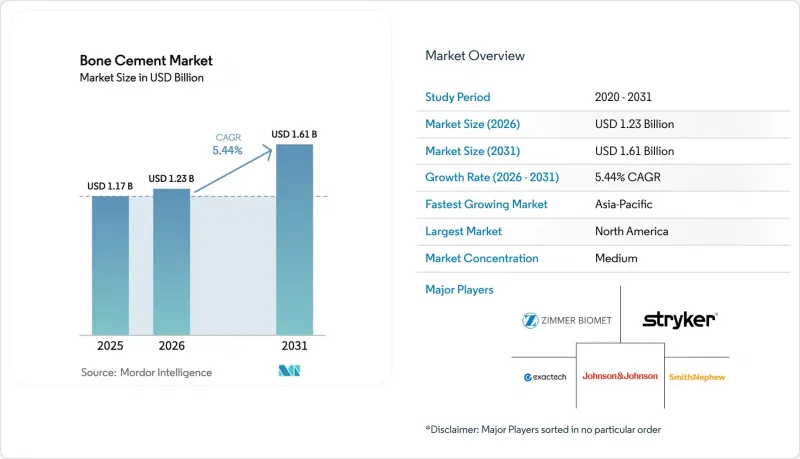
Mordor Intelligence에 의하면, 2026년 골시멘트 시장 규모는 12억 3,000만 달러로 추정되고, 2025년 11억 7,000만 달러에서 확대해, 2031년에는 16억 1,000만 달러에 이를 것으로 예측됩니다.
2026-2031년 연평균 성장률(CAGR) 5.44%로 성장할 것으로 전망됩니다.
본 보고서는 제품 유형별(폴리메틸메타크릴레이트 시멘트, 인산칼슘 시멘트, 유리 폴리아르케노에이트 시멘트, 황산칼슘계 시멘트), 점도별(저, 중, 고), 용도별(관절 성형술, 척추체 성형술, 후만 성형술 등), 최종 사용자별(병원, 정형외과 클리닉 등), 지역별(북미, 유럽 등)로 분류되어 있습니다. 시장 예측은 금액(달러) 단위로 제시되어 있습니다.
세계의 골시멘트 시장 동향 및 인사이트
고령화에 따른 관절 치환술 건수의 급증
65세 이상 인구는 다른 어떤 연령층보다 빠르게 증가하고 있으며, 장애를 안고 생활하기보다는 운동 기능을 회복시키는 수술을 원하는 경향이 강해지고 있습니다. 이러한 증가는 새로운 마취 프로토콜, 내구성이 뛰어난 임플란트, 그리고 조기 개입을 권장하는 가치 기반 지불 모델의 보급을 반영하고 있습니다. 수술 건수의 지속적인 증가는 특히 PMMA의 즉각적인 고정 효과를 누릴 수 있는 골밀도가 낮은 고령자의 뼈에서 시멘트에 대한 지속적인 수요로 직결됩니다. 평균 수명의 연장 또한 재치환 수술 건수를 증가시켜 시멘트 소비량을 더욱 끌어올리고 있습니다. 이러한 인구통계학적 및 임상적 변화가 합쳐져 예측 연평균 성장률(CAGR)에 약 1.8%를 더하게 됩니다.
스포츠 및 교통사고로 인한 외상이 재치환 수술을 증가시키고 있습니다.
레저 스포츠 참여 증가와 도시 지역의 교통 체증으로 인해 고에너지 외상 발생률이 상승하고 있으며, 이는 정형외과 분야의 재수술을 촉진하고 있습니다. 미국에서는 1년 동안 700만 건 이상의 정형외과적 외상과 110만 건의 응급 수술이 보고되고 있으며, 복잡한 외상의 경우 골 결손 부위를 채우기 위해 대량의 골 시멘트가 필요합니다. 중증 골절의 경우, 단계적 고정이나 보강용 시멘트의 사용이 종종 필요하며, 환자 1인당 소비량이 두 배로 증가합니다. 신흥국에서도 오토바이 보유 대수가 급증하는 반면, 도로 교통 안전 단속이 이를 따라가지 못하고 있어 유사한 추세가 나타나고 있습니다. 이러한 요인들이 복합적으로 작용하여 2020년대 중반까지 골 시멘트 시장의 성장률을 추정치 기준 1.2포인트 끌어올릴 것으로 전망됩니다.
FDA 및 MDR의 엄격한 승인 일정
골 시멘트의 개량 및 신제제에 관한 규제의 복잡성은 혁신과 시장 진입에 큰 장벽이 되고 있습니다. 특별한 510(k) 신청 경로라 하더라도 여전히 철저한 실험실 시험 데이터가 요구되며, 유럽의 MDR에서는 더 많은 임상적 증거가 요구되기 때문에 제품 출시가 최대 18개월 지연되고, 시장 출시 전 비용이 대폭 증가하고 있습니다. 이러한 규제상의 장벽은 복잡한 승인 절차를 헤쳐 나갈 자원이 부족한 중소기업이나 혁신적인 스타트업 기업에 불균형적인 영향을 미치며, 골시멘트 분야의 경쟁과 기술 발전을 저해할 가능성이 있습니다. 그 결과, 중기적으로는 골시멘트 시장의 성장률이 1.2퍼센트 포인트 하락하게 될 것입니다.
부문 분석
PMMA는 장기 생존율 데이터와 외과의사들의 높은 친숙도를 강점으로 삼아, 2025년에도 골시멘트 시장에서 72.10%라는 압도적인 점유율을 유지했습니다. 이 부문의 신뢰성 덕분에 조달 부서는 기존 공급업체와의 관계를 유지하고 있으며, 이는 병원 의약품 목록의 기반을 형성하고 있습니다. 나노 탄탈륨 카바이드 도핑과 같은 최근의 기술 혁신으로 인해 생체역학적 특성을 저해하지 않으면서 방사선 불투과성이 향상되고 있습니다. 한편, 칼슘인산 시멘트의 경우, 정형외과 종양 전문의와 외상 외과 의사들이 골 유착을 촉진하는 이 제품의 골전도성을 채택함에 따라 연평균 성장률(CAGR) 6.63%를 나타낼 것으로 예측됩니다. 유리·폴리알케노에이트계 시멘트는 불소 방출이 유익한 치과 및 두개안면 복원 분야에서 입지를 다지고 있는 반면, 황산칼슘 혼합물은 흡수성을 통해 틈새 시장인 감염 관리의 요구를 충족시키고 있습니다.
조기 골유합 및 재수술 감소를 평가하는 보험 환급 제도의 재검토는 생체 활성 대체 제품의 성장을 뒷받침하고 있습니다. 그러나 규모의 경제, 성숙한 공급망, 그리고 보관 조건의 용이성 덕분에 PMMA는 골시멘트 시장에서 우위를 유지하고 있습니다. 저모노머·고점도 변형 제품 등 기존 화학 조성에 대한 지속적인 연구 개발은 PMMA의 수명 주기를 연장하는 것을 목표로 하고 있습니다. 그럼에도 불구하고, 골시멘트 업계에서는 제품의 다양화가 불가피한 것으로 인식되고 있으며, 선구적인 브랜드들은 PMMA를 통한 현금 흐름과 차세대 생체 재료를 융합한 이중 포트폴리오를 구축하고 있습니다.
2025년에는 중점도 시멘트가 매출의 44.65%를 차지했으며, 고관절 및 무릎 관절 치환술의 주력 제품으로서 역할을 수행했습니다. 고점도 등급의 경우, 척추체 성형술에서 누출률이 37.5%에서 15%로 감소했다는 증거에 근거하여 연평균 성장률(CAGR) 6.88%로 확대될 것으로 예측됩니다. 외과의사들은 직물처럼 다루기 쉬운 특성과 낮은 주입 압력을 높이 평가하고 있으며, 이는 척추 수술의 확실성을 높여주고 있습니다. 저점도 혼합물은 심부 해면골에 대한 침투성 측면에서 여전히 선호되고 있지만, 사용량의 감소는 위험 회피 성향이 높아지고 있음을 반영합니다.
시장 홍보 캠페인에서는 냉장 보관으로 인한 작업 시간 연장 후에도 기계적 강도가 유지된다는 점이 강조되고 있습니다. 동시에, 속경화형 배합은 압축 저항성을 저해하지 않으면서 수술 시간을 3-5분 단축시킵니다. 이러한 점도에 따른 혁신 기술이 종합적으로 외과의사의 선택 폭을 넓혀 주면서, 골시멘트 시장은 더욱 세분화되고, 수술의 미묘한 차이에 맞춘 제품이 제공되고 있습니다.
지역별 분석
북미는 2025년 매출의 41.05%를 차지했으며, 많은 수술 건수, 유리한 보험 환급 제도, 그리고 항생제가 풍부하게 함유된 혼합물의 조기 도입이 매출을 뒷받침하고 있습니다. 주요 통합 의료 네트워크는 기존 공급업체와 다년간의 계약을 체결하고 있으며, 이는 시멘트리스 임플란트가 젊은 환자층을 서서히 잠식하고 있는 상황에서도 기본 수요를 안정적으로 유지하고 있습니다. 오피오이드 사용을 억제하기 위한 수술 후 프로토콜을 목표로 하는 수많은 주 및 연방 정부의 이니셔티브 또한 선택적 수술 건수 증가를 뒷받침하며, 시멘트 사용량을 끌어올리고 있습니다.
유럽은 여전히 2위 시장 규모를 유지하고 있으며, MDR(의료기기 규정)에 대한 엄격한 준수가 요구되는 것이 특징으로, 이로 인해 공급업체들은 더 많은 실제 임상 데이터(RE)를 제공해야 하는 압박을 받고 있습니다. 독일, 프랑스, 영국 3개국이 지역 소비량의 절반 이상을 차지하고 있지만, 동유럽 시장에서는 민간 병원 체인이 정형외과 수술실을 현대화하고 있어 현재 두 자릿수의 가치 성장을 기록하고 있습니다. EU 전역에 걸친 조달 제휴에서는 수명 주기 비용 평가가 점점 더 중요시되고 있으며, 이에 따라 재치환율의 저하가 기대되는 항균제 함유형 및 고점도형 제품으로의 전환이 촉진되고 있습니다.
아시아태평양은 중국, 일본, 인도가 관절 치환 수술 수용 능력을 획기적으로 확대하고 있어 연평균 성장률(CAGR) 6.95%라는 가장 높은 성장이 예상됩니다. 정부의 보험 제도 확대, 골다공증 유병률 상승, 그리고 태국과 말레이시아가 의료 관광의 거점으로 부상하고 있는 점이 향후 몇 년 동안 성장의 견인차 역할을 할 것으로 보입니다. 이 지역의 수술 건수 급증은 서유럽 국가들과의 골시멘트 시장 규모 격차를 서서히 좁히는 동시에, 비용 효율성을 중시하면서도 임상적 유효성이 입증된 PMMA 혼합물에 초점을 맞추는 현지 기업 시장 진입을 촉진하고 있습니다. 이러한 동향들이 맞물리면서, 골시멘트 시장은 지리적으로 분산된 성장 궤도를 유지하고 있습니다.
기타 혜택 :
- 엑셀 형식 시장 예측(ME) 시트
- 3개월간의 애널리스트 지원
목차
제1장 서론
제2장 조사 방법
제3장 주요 요약
제4장 시장 구도
제5장 시장 규모 및 성장 예측
제6장 경쟁 구도
제7장 시장 기회 및 향후 전망
AJYAccording to Mordor Intelligence, bone cement market size in 2026 is estimated at USD 1.23 billion, growing from 2025 value of USD 1.17 billion with 2031 projections showing USD 1.61 billion, growing at 5.44% CAGR over 2026-2031.
This report is Segmented by Product Type (Polymethyl Methacrylate Cement, Calcium Phosphate Cement, Glass Polyalkenoate Cement, Calcium-Sulphate-Based Cement), Viscosity (Low, Medium, High), Application (Arthroplasty, Vertebroplasty, Kyphoplasty, and More), End-User (Hospitals, Orthopaedic Clinics, and More), and Geography (North America, Europe, and More). Market Forecasts are Provided in Terms of Value (USD).
Global Bone Cement Market Trends and Insights
Ageing-Related Arthroplasty Volumes Rising Sharply
Populations aged 65 and older are growing faster than any other demographic, and they increasingly seek mobility-restoring surgeries instead of living with disability. The rise reflects new anesthesia protocols, more durable implants, and value-based payment models that favor early intervention. Sustained procedure volumes translate directly into repeat demand for cement, especially in elderly bones of lower density that benefit from PMMA's immediate fixation. Longer life expectancy also increases the pool of revision cases, further amplifying cement consumption. Collectively, these demographic and clinical shifts add roughly 1.8 percentage points to forecast CAGR.
Sports & Road-Traffic Trauma Boosting Revision Surgeries
Greater recreational sports participation and urban congestion elevate high-energy injury rates, driving revision orthopedics. The United States reported more than 7 million orthopedic injuries and 1.1 million emergency surgeries in a single year, with complex trauma requiring larger cement volumes for bone void filling. High-grade fractures often entail staged fixation and augmentative cement, multiplying unit consumption per patient. Emerging economies mirror this trend as motorcycle ownership surges and road-safety enforcement lags. The aggregate effect lifts bone cement market growth by an estimated 1.2 percentage points through mid-decade.
Stringent FDA & MDR Approval Timelines
Regulatory complexity surrounding bone cement modifications and new formulations is creating significant barriers to innovation and market entry. Special 510(k) pathways still require exhaustive bench testing data, and Europe's MDR demands more clinical evidence, delaying launches by up to 18 months and adding significant pre-market costs. These regulatory hurdles disproportionately impact smaller companies and innovative startups that lack the resources to navigate complex approval processes, potentially stifling competition and technological advancement in the bone cement sector. The net effect drags the bone cement market expansion by 1.2 percentage points during the medium term.
Other drivers and restraints analyzed in the detailed report include:
- Surge in Antibiotic-Laden Cement to Curb Post-Operative Infections
- Outpatient Joint-Replacement Expansion in ASCs
- High Exothermic Polymerisation Causing Thermal Necrosis Risk
For complete list of drivers and restraints, kindly check the Table Of Contents.
Segment Analysis
PMMA maintained a commanding 72.10% bone cement market share in 2025 on the strength of long-term survivorship data and surgeon familiarity. The segment's reliability keeps procurement departments aligned with legacy vendors, anchoring hospital formularies. Recent innovations, such as nano-tantalum carbide doping, improve radiopacity without undermining biomechanics. Yet calcium-phosphate cement is projected to post a 6.63% CAGR as orthopedic oncologists and trauma surgeons adopt its osteoconductive chemistry to accelerate bone integration. Glass-polyalkenoate cements find footholds in dental and craniofacial repairs where fluoride release is beneficial, while calcium-sulfate blends satisfy niche infection-management needs through resorbability.
Reimbursement revisions that reward faster union and fewer re-operations favor bioactive alternatives. However, scale economies, mature supply chains, and easier storage conditions preserve PMMA's lead in the bone cement market. Continued R&D inside the conventional chemistry - such as low-monomer, high-viscosity variants - aims to extend PMMA's lifecycle. The bone cement industry nevertheless perceives product diversification as inevitable, with first-mover brands positioning dual portfolios that marry PMMA cash flows to next-generation biomaterials.
Medium-viscosity cement captured 44.65% revenue in 2025, serving as the workhorse for hip and knee arthroplasty. High-viscosity grades are forecast to expand at a 6.88% CAGR on evidence that leakage drops from 37.5% to 15% in vertebroplasty. Surgeons appreciate its dough-like handling and lower injection pressures, boosting operative confidence in spine cases. Low-viscosity mixes still earn favor for deep cancellous infiltration, though their declining usage mirrors heightened risk aversion.
Market education campaigns spotlight mechanical strength retention even after refrigeration-based working-time extensions. At the same time, fast-setting formulas shave theatre time by three to five minutes without sacrificing compressive endurance. Collectively, viscosity-specific innovations broaden surgeon toolkits, making the bone cement market more segmented and tailored to procedural nuance.
Complete Report Scope:
- By Product Type
- Polymethyl Methacrylate (PMMA) Cement
- Calcium Phosphate Cement
- Glass Polyalkenoate Cement
- Calcium-Sulphate-Based Cement
- By Viscosity
- Low Viscosity
- Medium Viscosity
- High Viscosity
- By Application
- Arthroplasty
- Total Knee Arthroplasty
- Total Hip Arthroplasty
- Total Shoulder Arthroplasty
- Vertebroplasty
- Kyphoplasty
- Trauma & Fracture Repair
- Others
- Arthroplasty
- By End-User
- Hospitals
- Orthopaedic Clinics
- Ambulatory Surgical Centres
- Speciality Spine Centres
- By Geography
- North America
- United States
- Canada
- Mexico
- Europe
- Germany
- United Kingdom
- France
- Italy
- Spain
- Rest of Europe
- Asia-Pacific
- China
- Japan
- India
- Australia
- South Korea
- Rest of Asia-Pacific
- Middle East and Africa
- GCC
- South Africa
- Rest of Middle East and Africa
- South America
- Brazil
- Argentina
- Rest of South America
- North America
Geography Analysis
North America generated 41.05% of 2025 revenue, with high procedure density, favorable reimbursement, and early adoption of antibiotic-rich blends anchoring sales. Major integrated delivery networks lock multi-year contracts with incumbent vendors, which stabilizes baseline demand even as cementless implants nibble at the younger-patient tier. Numerous state and federal initiatives targeting opioid-sparing postoperative protocols also fuel wider elective-surgery throughput, reinforcing cement volumes.
Europe remains the second-largest cluster, characterized by stringent MDR compliance that pushes suppliers to furnish more real-world evidence. Germany, France, and the United Kingdom collectively represent over half of regional consumption, but Eastern European markets now post double-digit value growth as private hospital chains modernize orthopedic suites. Pan-EU procurement alliances increasingly evaluate life-cycle cost, thereby bolstering the shift to antibiotic-loaded and high-viscosity variants that promise lower revision rates.
Asia-Pacific holds the fastest 6.95% CAGR outlook as China, Japan, and India dramatically scale joint-replacement capacity. Government insurance expansion, rising osteoporosis prevalence, and medical-tourism corridors in Thailand and Malaysia underpin multi-year tailwinds. The region's surgical-volume surge gradually narrows the bone cement market size gap with Western peers while inviting local entrants that focus on cost-sensitive yet clinically validated PMMA blends. Collectively, these dynamics keep the bone cement market on a geographically diversified growth path.
- Stryker
- Zimmer Biomet
- Johnson & Johnson
- Smiths Group
- Heraeus Holding
- Arthrex
- DJO Global
- Exactech
- Merck KGaA (Palacos)
- Cardinal Health
- Medtronic
- Beckton Dickinson
- AAP Implantate
- Tecres S.p.A.
- G21 S.r.l.
- Teknimed
- Orthofix
- Seikagaku Corp.
- Cook Group
- Synimed
Additional Benefits:
- The market estimate (ME) sheet in Excel format
- 3 months of analyst support
TABLE OF CONTENTS
1 Introduction
- 1.1 Study Assumptions & Market Definition
- 1.2 Scope of the Study
2 Research Methodology
3 Executive Summary
4 Market Landscape
- 4.1 Market Overview
- 4.2 Market Drivers
- 4.2.1 Ageing-Related Arthroplasty Volumes Rising Sharply
- 4.2.2 Sports & Road-Traffic Trauma Boosting Revision Surgeries
- 4.2.3 Surge in Antibiotic-Laden Cement to Curb Post-Operative Infections
- 4.2.4 Outpatient Joint-Replacement Expansion in ASCs
- 4.2.5 AI-Guided Injection Systems Reducing Cement Leakage
- 4.2.6 3D-Printed Patient-Specific Spacers Enabling Custom Mixes
- 4.3 Market Restraints
- 4.3.1 Stringent FDA & MDR Approval Timelines
- 4.3.2 High Exothermic Polymerisation Causing Thermal Necrosis Risk
- 4.3.3 Growing Preference for Cement-Less Implants in Young Patients
- 4.3.4 Environmental Disposal Concerns for PMMA Residues
- 4.4 Value / Supply-Chain Analysis
- 4.5 Regulatory Landscape
- 4.6 Technological Outlook
- 4.7 Porter's Five Forces Analysis
- 4.7.1 Threat of New Entrants
- 4.7.2 Bargaining Power of Buyers
- 4.7.3 Bargaining Power of Suppliers
- 4.7.4 Threat of Substitutes
- 4.7.5 Intensity of Competitive Rivalry
5 Market Size & Growth Forecasts (Value)
- 5.1 By Product Type
- 5.1.1 Polymethyl Methacrylate (PMMA) Cement
- 5.1.2 Calcium Phosphate Cement
- 5.1.3 Glass Polyalkenoate Cement
- 5.1.4 Calcium-Sulphate-Based Cement
- 5.2 By Viscosity
- 5.2.1 Low Viscosity
- 5.2.2 Medium Viscosity
- 5.2.3 High Viscosity
- 5.3 By Application
- 5.3.1 Arthroplasty
- 5.3.1.1 Total Knee Arthroplasty
- 5.3.1.2 Total Hip Arthroplasty
- 5.3.1.3 Total Shoulder Arthroplasty
- 5.3.2 Vertebroplasty
- 5.3.3 Kyphoplasty
- 5.3.4 Trauma & Fracture Repair
- 5.3.5 Others
- 5.3.1 Arthroplasty
- 5.4 By End-User
- 5.4.1 Hospitals
- 5.4.2 Orthopaedic Clinics
- 5.4.3 Ambulatory Surgical Centres
- 5.4.4 Speciality Spine Centres
- 5.5 By Geography
- 5.5.1 North America
- 5.5.1.1 United States
- 5.5.1.2 Canada
- 5.5.1.3 Mexico
- 5.5.2 Europe
- 5.5.2.1 Germany
- 5.5.2.2 United Kingdom
- 5.5.2.3 France
- 5.5.2.4 Italy
- 5.5.2.5 Spain
- 5.5.2.6 Rest of Europe
- 5.5.3 Asia-Pacific
- 5.5.3.1 China
- 5.5.3.2 Japan
- 5.5.3.3 India
- 5.5.3.4 Australia
- 5.5.3.5 South Korea
- 5.5.3.6 Rest of Asia-Pacific
- 5.5.4 Middle East and Africa
- 5.5.4.1 GCC
- 5.5.4.2 South Africa
- 5.5.4.3 Rest of Middle East and Africa
- 5.5.5 South America
- 5.5.5.1 Brazil
- 5.5.5.2 Argentina
- 5.5.5.3 Rest of South America
- 5.5.1 North America
6 Competitive Landscape
- 6.1 Market Concentration
- 6.2 Market Share Analysis
- 6.3 Company Profiles (includes Global level Overview, Market level overview, Core Segments, Financials as available, Strategic Information, Market Rank/Share for key companies, Products & Services, and Recent Developments)
- 6.3.1 Stryker
- 6.3.2 Zimmer Biomet
- 6.3.3 Johnson & Johnson (DePuy Synthes)
- 6.3.4 Smith & Nephew
- 6.3.5 Heraeus Holding
- 6.3.6 Arthrex
- 6.3.7 DJO Global (Enovis)
- 6.3.8 Exactech
- 6.3.9 Merck KGaA (Palacos)
- 6.3.10 Cardinal Health
- 6.3.11 Medtronic
- 6.3.12 BD
- 6.3.13 aap Implantate AG
- 6.3.14 Tecres S.p.A.
- 6.3.15 G21 S.r.l.
- 6.3.16 Teknimed
- 6.3.17 Orthofix
- 6.3.18 Seikagaku Corp.
- 6.3.19 Cook Medical
- 6.3.20 Synimed
7 Market Opportunities & Future Outlook
- 7.1 White-Space & Unmet-Need Assessment