

|
시장보고서
상품코드
2125458
유럽의 홈 보안 시스템 시장 : 시장 점유율 분석, 업계 동향 및 통계, 성장 예측(2026-2031년)Europe Home Security System - Market Share Analysis, Industry Trends & Statistics, Growth Forecasts (2026 - 2031) |
||||||
 Mordor Intelligence
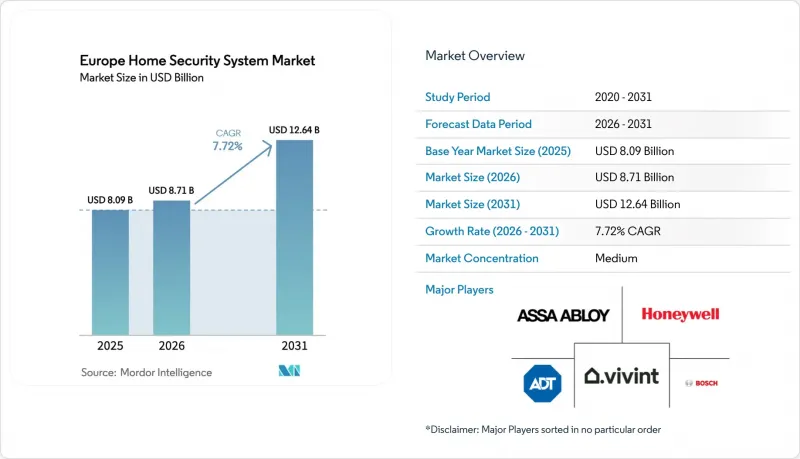
Mordor Intelligence에 의하면, 2026년 유럽의 홈 보안 시스템 시장 규모는 87억 1,000만 달러로 추정되고, 2025년 80억 9,000만 달러에서 확대해, 2031년에는 126억 4,000만 달러에 이를 것으로 예측됩니다.
2026-2031년 연평균 성장률(CAGR) 7.72%로 성장할 것으로 전망됩니다.
본 보고서는 구성 요소별(하드웨어, 소프트웨어, 서비스), 시스템 유형별(영상 감시 시스템, 경보 시스템 등), 설치 유형별(전문 업체 설치, DIY/자가 설치), 통신 기술별(유선, 무선), 판매 채널별(오프라인 매장, 온라인 소매), 최종 사용자별(단독 주택, 공동 주택, 소규모 사업자), 국가별로 분류되어 있습니다.
유럽의 홈 보안 시스템 시장 동향 및 인사이트
IP 카메라로의 급속한 전환
유럽 가정에서는 아날로그 CCTV에서 4메가픽셀 이상의 HDR 영상을 스트리밍하고, AI를 활용한 인물·차량 분류 기능을 갖추며, 클라우드 분석 엔진과 원활하게 연동되는 IP 카메라로의 교체가 급속히 진행되고 있습니다. Ajax Systems사가 ‘IndoorCam Wi-Fi’ 시리즈를 출시한 것은 이러한 변화를 여실히 보여줍니다. 이 카메라는 Wi-Fi 연결이 끊긴 경우에도 자사 고유의 무선 프로토콜로 전환되어 경보 신호의 지속적인 전송을 보장합니다. 독일과 프랑스의 보험사들은 현재 영상 확인 기능을 갖춘 인증된 IP 카메라가 설치된 건물에 대해 최대 15%의 보험료 할인을 적용하고 있으며, 이로 인해 도입이 가속화되고 보급률 향상이라는 선순환이 강화되고 있습니다.
비디오 감시 서비스(VSaaS)의 보급 확대
VSaaS는 대규모 일괄 장비 구매를 하드웨어, 소프트웨어, 스토리지, 전문가의 모니터링을 패키지화한 예측 가능한 월정액 요금제로 전환합니다. 유럽의 통신 사업자들은 카메라 및 분석 기능을 광대역 패키지에 통합하여 이 모델을 활용하고 있으며, 그 결과 사용자 1인당 평균 수익(ARPU)을 향상시키고 해지율을 낮추고 있습니다. 부동산 관리 회사는 여러 세대로 구성된 건물의 관리를 일원화할 수 있다는 점을 높이 평가하고 있으며, 한편 거주자는 고액의 초기 비용을 들이지 않고도 전문가 수준의 보안 서비스를 이용할 수 있습니다. 이러한 지속적인 수익 모델은 투자자들에게도 매력적이며, 그 증거로 Verisure사가 분산된 유럽 각 지역에서의 사업 확장을 위한 자금 조달을 목적으로 기업공개(IPO)를 계획하고 있다는 점을 들 수 있습니다.
분산된 무선 프로토콜 생태계
유럽의 프로젝트에서는 Wi-Fi, Zigbee, Z-Wave, Bluetooth Low Energy, Thread 및 독자적인 주파수가 빈번하게 혼재되어 있어, 통합 업체는 여러 개의 허브를 도입하거나 복잡한 브리지에 투자할 수밖에 없습니다. 호환성 문제는 작업 시간을 늘리고 사후 서비스도 복잡하게 만들어 설치 업체의 이익률을 압박하고 있습니다. Matter 규격이 해결책이 될 것으로 기대되지만, 많은 대형 보안 OEM 제조업체들은 시스템 락인(lock-in)과 구독 수익을 유지하기 위해 독자적인 스택을 우선시하고 있습니다.
부문 분석
2025년, 유럽의 홈 보안 시스템 시장에서 하드웨어는 59.35%의 점유율을 차지했으며, 이는 카메라, 자물쇠, 사이렌, 센서 등 물리적으로 재산을 보호하는 유형 자산에 대한 소비자 수요가 높음을 보여줍니다. 유럽 가정용 보안 시스템 시장의 하드웨어 시장 규모는 2025년에 48억 달러에 달할 것으로 평가되었으며, 아날로그 카메라에서 IP 모델로의 급속한 전환과 멀티 센서 허브에 대한 수요 증가에 힘입어 연평균 성장률(CAGR) 7.26%로 확대될 것으로 전망됩니다. 서비스 부문은 여전히 가장 빠르게 성장하는 분야로, 구독 모델의 보급에 따라 2031년까지 12억 1,000만 달러의 부가가치가 창출될 것으로 전망됩니다.
소프트웨어의 고도화가 하드웨어 설계를 견인하고 있으며, 엣지 디바이스에 내장된 AI 모듈이 현재 로컬에서 물체 인식 및 조기 경보 분석을 실현하여 클라우드 대역폭 요구 사항을 줄이고 있습니다. 공급업체들은 하드웨어, 펌웨어 업데이트 및 수명 주기 모니터링을 5년 리스 계약에 패키지로 묶는 경향이 강해지고 있으며, 이를 통해 수익원을 예측 가능한 연간 수입으로 재구성하고 있습니다.
2025년 매출 중 영상 감시가 42.25%를 차지하여, 유럽 홈 보안 시스템 시장 규모 34억 2,000만 달러에 해당했습니다. 이는 주택 소유자가 침입을 막고 보험금 청구를 원활하게 하기 위해 시각적 확인을 선호함을 보여줍니다. 출입 통제 솔루션, 스마트 잠금 장치, 생체 인식 패드, 비디오 도어벨은 규제에 따라 공동 주택에서 키리스 출입이 권장됨에 따라 연평균 성장률(CAGR) 8.88%를 기록할 전망입니다.
경보 시스템은 여전히 핵심적인 역할을 하며, 자기 접점 및 PIR 센서를 통합하여 즉시 경보를 발령합니다. 화재 방지 플랫폼은 EU 전역에 걸친 인명 안전 관련 법규와, 연기, 열, 일산화탄소를 단일 하우징에서 모니터링하는 다기능 감지기로의 전환에 힘입어 성장하고 있습니다.
기타 혜택 :
- 엑셀 형식 시장 예측(ME) 시트
- 3개월간의 애널리스트 지원
자주 묻는 질문
목차
제1장 서론
제2장 조사 방법
제3장 주요 요약
제4장 시장 구도
제5장 시장 규모 및 성장 예측
제6장 경쟁 구도
제7장 시장 기회 및 향후 전망
AJY 26.09.15According to Mordor Intelligence, Europe home security system market size in 2026 is estimated at USD 8.71 billion, growing from 2025 value of USD 8.09 billion with 2031 projections showing USD 12.64 billion, growing at 7.72% CAGR over 2026-2031.

This report is Segmented by Component (Hardware, Software, and Services), System Type (Video Surveillance Systems, Alarm Systems, and More), Installation Type (Professionally Installed and DIY/Self-Installed), Communication Technology (Wired and Wireless), Distribution Channel (Offline Retail and Online Retail), End User (Single-Family Homes, Multi-Family Apartments, and Small Businesses), and Country.
Europe Home Security System Market Trends and Insights
Rapid Migration to IP-Based Cameras
European households are decisively replacing analog CCTV with IP cameras that stream 4 MP-plus HDR video, offer AI-powered human and vehicle classification, and integrate seamlessly with cloud analytics engines. Ajax Systems' launch of its IndoorCam Wi-Fi line illustrates this shift; the camera falls back to the firm's proprietary radio protocol if Wi-Fi is lost, ensuring continuous alarm signaling. Insurance carriers in Germany and France now grant premium discounts of up to 15% on properties fitted with certified IP cameras that support video verification, accelerating adoption and reinforcing a virtuous cycle of increasing penetration.
Growing Adoption of Video-Surveillance-as-a-Service (VSaaS)
VSaaS converts large one-off equipment purchases into predictable monthly fees that bundle hardware, software, storage, and expert monitoring. European telecom operators have capitalized on this model by integrating cameras and analytics into broadband packages, thereby lifting average revenue per user and reducing churn. Property managers appreciate centralized administration of multi-unit buildings, while residents gain professional-grade security without high upfront costs. The recurring-revenue framework entices investors, as evidenced by Verisure's planned initial public offering aimed at funding expansion in fragmented European territories.
Fragmented Wireless-Protocol Ecosystem
European projects frequently juggle Wi-Fi, Zigbee, Z-Wave, Bluetooth Low Energy, Thread, and proprietary frequencies, forcing integrators to deploy multiple hubs or invest in complex bridges. Compatibility headaches inflate labor hours and complicate after-sales support, eroding installer margins. While the Matter standard promises relief, many major security OEMs prioritize proprietary stacks that preserve system lock-in and subscription revenue.
Other drivers and restraints analyzed in the detailed report include:
- Tightening EU Insurance Discounts for Connected-Home Policies
- Smart-Home Bundling by European Telecom Operators
- End-User Privacy Litigation Risk
For complete list of drivers and restraints, kindly check the Table Of Contents.
Segment Analysis
Hardware held 59.35% of the Europe home security system market share in 2025, underscoring consumers' desire for tangible assets cameras, locks, sirens, and sensors that physically protect property. The European home security system market size for hardware reached USD 4.80 billion in 2025 and is forecast to climb at a 7.26% CAGR, supported by the rapid replacement of analog cameras with IP models and heightened demand for multi-sensor hubs. Services remain the fastest-growing element, expected to add USD 1.21 billion in incremental value by 2031 as subscription models gain favor.
Heightened software sophistication is driving hardware design; AI modules embedded in edge devices now deliver object recognition and early-warning analytics locally, reducing cloud bandwidth requirements. Providers increasingly package hardware, firmware updates, and lifetime monitoring into five-year leasing contracts, reshaping revenue pools toward predictable annuities.
Video surveillance accounted for 42.25% of 2025 revenue, equal to USD 3.42 billion of the European home security system market size, illustrating homeowners' preference for visual verification to deter break-ins and facilitate insurance claims. Access-control solutions, smart locks, biometric pads, and video doorbells are poised to record a 8.88% CAGR as regulations encourage keyless entry for multi-family dwellings.
Alarm systems remain foundational, integrating magnetic contacts and PIR sensors that deliver instant alerts. Fire-protection platforms are benefiting from EU-wide life-safety legislation and the shift toward multi-threat detectors that monitor smoke, heat, and carbon monoxide in a single enclosure.
Complete Report Scope:
- By Component
- Hardware
- Electronic Locks
- Security Cameras
- Fire Sprinklers
- Window Sensors
- Door Sensors
- Other Hardware
- Software
- Services
- Hardware
- By System Type
- Video Surveillance Systems
- Alarm Systems
- Access-Control Systems
- Fire-Protection Systems
- By Installation Type
- Professionally Installed
- DIY/Self-Installed
- By Communication Technology
- Wired
- Wireless
- Wi-Fi
- Zigbee and Z-Wave
- Bluetooth LE
- Cellular / LTE
- By Distribution Channel
- Offline Retail
- Specialty Stores
- Mass Merchandisers
- Online Retail
- Offline Retail
- By End User
- Single-Family Homes
- Multi-Family Apartments
- Small Businesses (<50 employees)
- By Country
- United Kingdom
- Germany
- France
- Italy
- Spain
- Netherlands
- Sweden
- Rest of Europe
List of Companies Covered in this Report:
- Honeywell International Inc.
- ADT Inc.
- ASSA ABLOY AB
- Bosch Service Solutions GmbH
- Vivint Smart Home, Inc.
- Frontpoint Security Solutions, LLC
- Monitronics International, Inc. (Brinks Home Security)
- Verisure Holding AB
- Securitas AB
- Abus August Bremicker Sohne KG
- SimpliSafe, Inc.
- Ring LLC
- Nice S.p.A.
- Somfy SA
- Ajax Systems Holding Ltd.
- Gigaset AG
- Chuango Security Technology Corporation
- Johnson Controls International plc
- Tyco Integrated Fire and Security
- Alarm.com Holdings, Inc.
- Hikvision Europe B.V.
Additional Benefits:
- The market estimate (ME) sheet in Excel format
- 3 months of analyst support
TABLE OF CONTENTS
1 INTRODUCTION
- 1.1 Study Assumptions and Market Definitions
- 1.2 Scope of the Study
2 RESEARCH METHODOLOGY
3 EXECUTIVE SUMMARY
4 MARKET LANDSCAPE
- 4.1 Market Overview
- 4.2 Market Drivers
- 4.2.1 Rapid migration to IP-based cameras
- 4.2.2 Growing adoption of Video-Surveillance-as-a-Service (VSaaS)
- 4.2.3 Tightening EU insurance discounts for connected-home policies
- 4.2.4 Smart-home bundling by European telecom operators
- 4.2.5 Shift to battery-powered, wire-free multisensor hubs
- 4.2.6 Mandatory carbon-monoxide alarm mandates (EU 2026)
- 4.3 Market Restraints
- 4.3.1 Fragmented wireless-protocol ecosystem
- 4.3.2 End-user privacy litigation risk
- 4.3.3 Low retrofit budgets in multi-family dwellings
- 4.3.4 Skilled-installer shortage in rural Europe
- 4.4 Industry Value Chain Analysis
- 4.5 Regulatory Landscape
- 4.6 Technological Outlook
- 4.7 Porter's Five Forces Analysis
- 4.7.1 Bargaining Power of Suppliers
- 4.7.2 Bargaining Power of Buyers
- 4.7.3 Threat of New Entrants
- 4.7.4 Threat of Substitutes
- 4.7.5 Intensity of Competitive Rivalry
- 4.8 Impact of Key Macroeconomic Trends on Market
5 MARKET SIZE AND GROWTH FORECASTS (VALUES)
- 5.1 By Component
- 5.1.1 Hardware
- 5.1.1.1 Electronic Locks
- 5.1.1.2 Security Cameras
- 5.1.1.3 Fire Sprinklers
- 5.1.1.4 Window Sensors
- 5.1.1.5 Door Sensors
- 5.1.1.6 Other Hardware
- 5.1.2 Software
- 5.1.3 Services
- 5.1.1 Hardware
- 5.2 By System Type
- 5.2.1 Video Surveillance Systems
- 5.2.2 Alarm Systems
- 5.2.3 Access-Control Systems
- 5.2.4 Fire-Protection Systems
- 5.3 By Installation Type
- 5.3.1 Professionally Installed
- 5.3.2 DIY/Self-Installed
- 5.4 By Communication Technology
- 5.4.1 Wired
- 5.4.2 Wireless
- 5.4.2.1 Wi-Fi
- 5.4.2.2 Zigbee and Z-Wave
- 5.4.2.3 Bluetooth LE
- 5.4.2.4 Cellular / LTE
- 5.5 By Distribution Channel
- 5.5.1 Offline Retail
- 5.5.1.1 Specialty Stores
- 5.5.1.2 Mass Merchandisers
- 5.5.2 Online Retail
- 5.5.1 Offline Retail
- 5.6 By End User
- 5.6.1 Single-Family Homes
- 5.6.2 Multi-Family Apartments
- 5.6.3 Small Businesses (<50 employees)
- 5.7 By Country
- 5.7.1 United Kingdom
- 5.7.2 Germany
- 5.7.3 France
- 5.7.4 Italy
- 5.7.5 Spain
- 5.7.6 Netherlands
- 5.7.7 Sweden
- 5.7.8 Rest of Europe
6 COMPETITIVE LANDSCAPE
- 6.1 Market Concentration
- 6.2 Strategic Moves
- 6.3 Market Share Analysis
- 6.4 Company Profiles (includes Global level Overview, Market level overview, Core Segments, Financials as available, Strategic Information, Market Rank/Share for key companies, Products and Services, and Recent Developments)
- 6.4.1 Honeywell International Inc.
- 6.4.2 ADT Inc.
- 6.4.3 ASSA ABLOY AB
- 6.4.4 Bosch Service Solutions GmbH
- 6.4.5 Vivint Smart Home, Inc.
- 6.4.6 Frontpoint Security Solutions, LLC
- 6.4.7 Monitronics International, Inc. (Brinks Home Security)
- 6.4.8 Verisure Holding AB
- 6.4.9 Securitas AB
- 6.4.10 Abus August Bremicker Sohne KG
- 6.4.11 SimpliSafe, Inc.
- 6.4.12 Ring LLC
- 6.4.13 Nice S.p.A.
- 6.4.14 Somfy SA
- 6.4.15 Ajax Systems Holding Ltd.
- 6.4.16 Gigaset AG
- 6.4.17 Chuango Security Technology Corporation
- 6.4.18 Johnson Controls International plc
- 6.4.19 Tyco Integrated Fire and Security
- 6.4.20 Alarm.com Holdings, Inc.
- 6.4.21 Hikvision Europe B.V.
7 MARKET OPPORTUNITIES AND FUTURE OUTLOOK
- 7.1 White-space and Unmet-Need Assessment


