

|
시장보고서
상품코드
2125477
자궁내막증 치료 시장 : 시장 점유율 분석, 업계 동향 및 통계, 성장 예측(2026-2031년)Endometriosis Treatment - Market Share Analysis, Industry Trends & Statistics, Growth Forecasts (2026 - 2031) |
||||||
 Mordor Intelligence
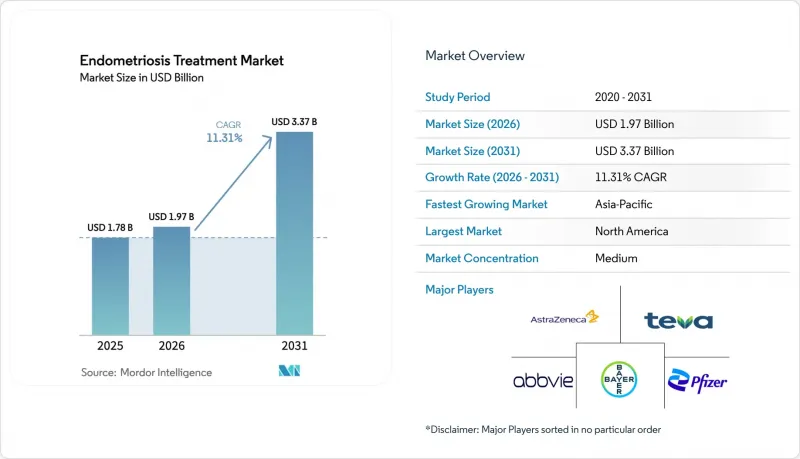
Mordor Intelligence에 의하면, 자궁내막증 치료 시장 규모는 2025년에 17억 8,000만 달러로 평가되었고, 2026년 19억 7,000만 달러에서 2031년까지 33억 7,000만 달러에 이를 것으로 예측되며, 예측 기간(2026-2031년) CAGR은 11.31%를 나타낼 전망입니다.
본 보고서는 치료 유형별(약물 요법, 외과적 개입, 병용/다각적 요법), 약물 분류별(GnRH 작용제 및 길항제, 프로게스틴 등), 투여 경로별(경구 등), 유통 채널별(병원, 소매, 온라인 약국) 및 지역별(북미, 유럽, 아시아태평양, 중동 및 아프리카, 남미)로 분류되어 있습니다. 시장 예측은 금액(달러) 기준으로 제시되어 있습니다.
세계의 자궁내막증 치료 시장 동향 및 인사이트
생식 연령 여성의 유병률 증가
현재 15-49세 여성의 약 10%가 이 질환을 앓고 있으나, 자원이 부족한 지역에서는 진단이 미흡하여 실제 수치는 이보다 더 높을 것으로 추정됩니다. 2024년 백악관 보고서에 따르면, 미국 내 연간 경제적 부담은 780억 달러로 추산되며, 이에 따라 2025년에는 일부 주의 메디케이드 프로그램이 복강경 진단에 대한 보험 적용 범위를 확대하게 되었습니다. 출산 연령의 고령화는 에스트로겐에 대한 누적 노출 기간을 연장함으로써 위험을 증가시키고 있으며, 중국에서는 2024-2025년 자궁내막증과 관련된 불임 진료 건수가 12% 증가했습니다. 이러한 데이터를 종합적으로 볼 때, 해당 자궁내막증 치료 시장 규모를 확대시켜 지속적인 두 자릿수 성장 전망을 뒷받침하고 있습니다.
인식 제고와 조기 진단
2025년 인식 제고 캠페인 기간 동안 ‘#EndoWarrior’와 같은 해시태그는 5,000만 회 이상의 노출을 기록했으며, 환자들의 자발적인 내원 건수가 급증했습니다. 2025년 3월에 발표된 NICE 지침에 따라, 잉글랜드에서 진단까지 걸리는 기간이 2년 이상 단축되었습니다. 프랑스의 전국적인 골반통 전문 클리닉에서는 복강경 수술 건수가 전년 대비 23% 증가했습니다. 유럽 전역에서 실시된 AI를 활용한 증상 클러스터링 시범 사업을 통해 고위험 환자가 영상 진단 대상으로 선별되었으며, 조기 진료를 받은 환자의 수술 후 예후가 개선되고 재발률도 감소하고 있습니다. 이러한 변화들이 맞물리면서 치료 대상이 되는 환자층이 확대되고, 자궁내막증 치료 시장의 수익 창출이 가속화되고 있습니다.
장기 호르몬 요법에 따른 부작용
주사용 GnRH 작용제는 6개월 이내에 골대 골밀도를 5% 이상 저하시킬 가능성이 있어, 에스트로겐 추가 투여 없이 투여 기간을 제한하게 됩니다. 완화 조치가 취해지고 있음에도 불구하고, 영국의 감시 조사에서 레르골릭스를 복용 중인 환자의 12%가 치료 조정이 필요한 돌파성 출혈을 보고했습니다. 불규칙한 출혈은 프로게스틴을 지속적으로 사용하는 환자의 최대 40%에게 영향을 미치며, 이는 약물 복용 순응도 저하와 관련이 있습니다. 또한, 스웨덴의 코호트 연구에 따르면, 노레티нд론을 2년간 사용한 후 인슐린 저항성 지표가 1.3배 증가한 것으로 보고되었습니다. 이러한 안전성 문제로 인해 치료가 주기적으로 반복되며, 그 결과 누적 비용이 증가하고 자궁내막증 치료 시장 전체에서 실제 임상에서의 유효성이 저하되고 있습니다.
부문 분석
수술과 수술 후 호르몬 억제를 통합한 병용 요법은 연평균 성장률(CAGR) 12.17%로 확대되고 있으며, 단일 요법의 우위를 잠식하고 있습니다. 수술 단독의 경우 5년 재발률이 40%를 초과하지만, 보조적인 호르몬 요법을 통해 관해 기간을 최대 2년까지 연장할 수 있습니다. 2025년 시점에서도 약물 요법은 자궁내막증 치료 시장 점유율의 65.12%를 차지했으나, 높은 치료 변경률은 환자의 불만을 반영하고 있습니다. 로봇 보조 복강경 수술에 대한 관심은 높아지고 있지만, 2025년 연구 결과에 따르면 기존 수술법에 비해 통증 완화 측면에서 우월성은 확인되지 않았습니다. 초기 단계부터의 병용 요법은 평생 재수술 횟수를 줄여주기 때문에 지급 기관은 종합적 상환 모델로 전환하고 있으며, 이것이 자궁내막증 치료 시장의 확대로 이어지고 있습니다.
치료 순서의 변화가 나타나기 시작했습니다. 수술 전 호르몬 요법을 통한 자궁 부피 축소는 수술 중 출혈량을 줄일 수 있지만, 확고한 임상시험 결과는 부족한 실정입니다. 신경 보존 절제술은 장기 기능 유지에 도움이 되어, 적응증이 되는 환자층을 넓히고 있습니다. 임신 능력 유지를 희망하는 여성에게는 약물 요법만 포함한 치료법이 여전히 첫 번째 선택이지만, 보험 지급 기관이 치료 효과의 지속성에 중점을 두게 됨에 따라 임상의들은 다각적인 치료 경로로 전환하고 있습니다. 이러한 패러다임의 변화로 인해 자궁내막증 관리는 다른 만성 염증성 질환과 일치하게 되었으며, 지속적인 수익원이 강화되고 있습니다.
2025년에는 GnRH 조절제가 42.07%의 점유율로 1위를 차지했으나, 일반의약품인 NSAID는 2031년까지 연평균 성장률(CAGR) 13.59%를 나타낼 것으로 전망됩니다. 이부프로펜과 나프록센은월10-20달러에 불과하여 1차 선택 통증 관리의 기반이 되고 있습니다. 독일의 실세계 데이터에 따르면, 신규 진단 환자의 68%가 NSAID 단독 요법으로 시작하고 있으며, 비용 대비 효과에 대한 고려가 두드러집니다. 경구 피임약은 약 18%를 차지하고 있으며, 피임과 치료를 모두 원하는 사용자를 대상으로 합니다. 이 약물 군의 혁신은 최소한으로 그치고 있으며, 성장은 주로 진단율 상승에 따른 처방량 증가에 기인하고 있어, 이로 인해 자궁내막증 치료 시장 규모의 기준선에 신규 시장 진출기업들이 합류하고 있습니다.
복부 팽만감이나 위점막 보호에 대응하는 NSAID 복합제가 소매점 진열 공간을 확대되고 있습니다. 또한, 지침 제정 기관들도 수술 후 잔존하는 월경통을 완화하기 위해 NSAID의 지속적 사용을 권장하고 있습니다. 고가의 생물학적 제제가 심한 통증을 겪는 환자층을 대상으로 하는 반면, 합리적인 가격의 진통제는 환자층 전체를 지속적으로 확대하며 자궁내막증 치료 시장에서의 점유율을 강화하고 있습니다.
지역별 분석
북미는 신규 호르몬제에 대한 폭넓은 보험 적용과 소비자 대상 직접 마케팅에 힘입어 2025년 매출의 39.27%를 차지했습니다. 미국 여러 주에서 메디케이드 적용 범위가 확대되어 복강경 진단 및 GnRH 길항제가 적용 대상이 됨에 따라 환자의 본인 부담금이 감소했습니다. 캐나다에서는 제네릭 호르몬제의 비용이 공적 자금으로 충당되고 있지만, 경구용 길항제의 환급 여부는 주마다 다릅니다. 온타리오주에서는 2025년 4월에 렐고릭스가 추가되었습니다. 멕시코의 민간 보험사는 현재 자궁내막증 수술 비용을 지원하고 있지만, 공공 부문에서의 도입은 여전히 제한적입니다.
아시아태평양은 13.42%라는 가장 높은 연평균 성장률(CAGR)을 나타낼 전망입니다. 중국에서는 HMI-115가 획기적인 치료제로 지정되었고, 2선 도시에서 복강경 수술실이 급속히 확충됨에 따라 진단까지의 지연 시간이 단축되고 있습니다. 인도는 환자 수의 절대적 규모가 가장 큰 국가 중 하나이지만, 사회적 편견과 의료 인력 부족이 조기 발견을 방해하고 있습니다. 일본의 국민건강보험 제도에서는 주사용 작용제 비용이 환급되고 있지만, 경구용 약물에 대해서는 협상이 진행 중이며, 이로 인해 바이오시밀러 및 국내 제네릭 의약품의 진입 여지가 생기고 있습니다. 호주에서는 2024년에 디에노게스트가 의약품 급여 제도(Pharmaceutical Benefits Scheme)에 임베디드됨에 따라 본인 부담금이 6.60 호주 달러로 인하되었고, 처방 건수가 35% 급증했습니다.
2025년 3월 및 5월 NICE의 승인으로, 렐고릭스(Relgorix) 및 린자고릭스(Linzagorix)에 대한 국민보건서비스(NHS)의 자금 지원이 가능해졌습니다. 프랑스에서는 골반통 전문 클리닉의 설치가 의무화됨에 따라 수술 건수가 전년 대비 23% 증가했습니다. 독일의 보험사들은 비용 대비 효과가 높은 NSAID를 이용한 초기 치료를 중시하고 있으며, 이는 1차 선택 약물로 이부프로펜의 채택률이 높은 데서 잘 드러납니다. 남미, 중동 및 아프리카은 여전히 발전 단계에 있지만, 도시 지역에서는 여성 특유의 건강 문제에 특화된 급여 제도의 도입이 시작되고 있습니다. 이러한 지리적 다양화가 맞물려 자궁내막증 치료 시장의 확장을 뒷받침하고 있습니다.
기타 혜택 :
- 엑셀 형식 시장 예측(ME) 시트
- 3개월간의 애널리스트 지원
자주 묻는 질문
목차
제1장 서론
제2장 조사 방법
제3장 주요 요약
제4장 시장 구도
제5장 시장 규모 및 성장 예측
제6장 경쟁 구도
제7장 시장 기회 및 향후 전망
AJY 26.09.15According to Mordor Intelligence, the endometriosis treatment market size was valued at USD 1.78 billion in 2025 and is estimated to grow from USD 1.97 billion in 2026 to reach USD 3.37 billion by 2031, at a CAGR of 11.31% during the forecast period (2026-2031).
This report is Segmented by Treatment Type (Drug Therapy, Surgical Intervention, Combined/Multimodal Therapy), Drug Class (GnRH Agonists & Antagonists, Progestins, and More), Route of Administration (Oral, and More), Distribution Channel (Hospital, Retail, Online Pharmacies), and Geography (North America, Europe, Asia-Pacific, MEA, South America). Market Forecasts are Provided in Terms of Value (USD).
Global Endometriosis Treatment Market Trends and Insights
Rising Prevalence Among Reproductive-Age Women
Roughly 10% of women aged 15-49 now live with the condition, yet under-ascertainment in low-resource settings means the real figure is higher. The 2024 White House report valued the annual U.S. economic burden at USD 78 billion, compelling several state Medicaid programs to extend coverage for laparoscopic diagnosis in 2025. Later childbearing amplifies risk by extending cumulative estrogen exposure, while China recorded a 12% jump in endometriosis-related infertility consultations between 2024 and 2025. These datapoints collectively expand the addressable endometriosis treatment market and support sustained double-digit growth prospects.
Growing Awareness & Earlier Diagnosis
Hashtags such as #EndoWarrior generated more than 50 million impressions during the 2025 awareness campaign, triggering self-referral surges. NICE guidelines issued in March 2025 reduced the diagnostic interval in England by over 2 years. France's national pelvic-pain clinics lifted laparoscopic procedure volumes 23% year over year. AI-driven symptom-clustering pilots across Europe triaged high-risk patients for imaging, and patients presenting at earlier stages improve postoperative outcomes and reduce recurrence. Together, these shifts enlarge the treated population and accelerate revenue capture for the endometriosis treatment market.
Adverse Effects of Long-Term Hormone Use
Injectable GnRH agonists can lower trabecular bone density by more than 5% within six months, restricting duration without add-back estrogen. Despite mitigation, 12% of relugolix patients in the U.K. surveillance reported breakthrough bleeding requiring adjustments. Irregular bleeding affects up to 40% of continuous progestin users and is linked to reduced adherence. A Swedish cohort also reported a 1.3-fold increase in insulin resistance markers after 2 years of norethindrone. These safety issues provoke therapy cycling, which raises cumulative costs and softens real-world effectiveness across the endometriosis treatment market.
Other drivers and restraints analyzed in the detailed report include:
- Advances in Minimally Invasive Hormonal Therapies
- Emergence of Non-Hormonal Immunomodulators
- High Treatment Cost & Patchy Insurance Coverage
For complete list of drivers and restraints, kindly check the Table Of Contents.
Segment Analysis
Combined approaches integrating surgery with postoperative hormonal suppression are expanding at a 12.17% CAGR and eroding monotherapy dominance. Surgery alone has a 5-year recurrence rate above 40%, whereas adjuvant hormones can extend remission by up to 2 years. Drug therapy still represented 65.12% of the endometriosis treatment market share in 2025, but high switching rates betray dissatisfaction. Robotic laparoscopy gained visibility, yet 2025 evidence found no superiority in pain relief over conventional techniques. Upfront combination care lowers lifetime revisions, steering payers toward bundled reimbursement models that enlarge the endometriosis treatment market.
Sequencing trends are emerging; pre-operative hormonal downsizing can cut intraoperative blood loss, though robust trials are scarce. Nerve-sparing excision techniques help preserve organ function, broadening candidate eligibility. Drug-only regimens remain first-line for women desiring fertility preservation, but payer focus on durability is nudging clinicians toward multimodal pathways. The paradigm shift aligns endometriosis management with other chronic inflammatory diseases, reinforcing recurring revenue streams.
GnRH modulators led with a 42.07% share in 2025, yet over-the-counter NSAIDs are on track for a 13.59% CAGR through 2031. Ibuprofen and naproxen cost as little as USD 10-20 monthly, anchoring first-line pain control. Real-world German data show 68% of newly diagnosed patients start on NSAID monotherapy, underscoring cost sensitivity. Oral contraceptives account for roughly 18% but cater to users seeking dual contraception. Innovation inside the class is minimal; growth stems chiefly from volume as diagnosis rates rise, adding fresh entrants to the endometriosis treatment market size baseline.
Combination NSAID products addressing bloat or gastroprotection broaden retail shelf space. Guideline bodies also endorse NSAID continuation post-surgery to temper residual dysmenorrhea. While premium biologics court the severe-pain segment, accessible analgesics continue to expand the overall patient pool, reinforcing their share in the endometriosis treatment market.
Complete Report Scope:
- By Treatment Type
- Drug Therapy
- Surgical Intervention
- Combined / Multimodal Therapy
- By Drug Class
- Gonadotropin-Releasing Hormone (GnRH) Agonists & Antagonists
- Progestins
- Non-Steroidal Anti-Inflammatory Drugs (NSAIDs)
- Oral Contraceptives
- Selective Estrogen Receptor Modulators (SERMs)
- By Route of Administration
- Oral
- Parenteral
- Transdermal / Implant
- By Distribution Channel
- Hospital Pharmacies
- Retail Pharmacies & Drug Stores
- Online Pharmacies
- By Geography
- North America
- United States
- Canada
- Mexico
- Europe
- Germany
- United Kingdom
- France
- Italy
- Spain
- Rest of Europe
- Asia-Pacific
- China
- Japan
- India
- Australia
- South Korea
- Rest of Asia-Pacific
- Middle East & Africa
- GCC
- South Africa
- Rest of Middle East & Africa
- South America
- Brazil
- Argentina
- Rest of South America
- North America
Geography Analysis
North America contributed 39.27% of 2025 revenue, supported by robust insurance coverage for novel hormones and direct-to-consumer marketing. U.S. Medicaid expansions in multiple states covered laparoscopic diagnosis and GnRH antagonists, decreasing out-of-pocket costs. Canada funds generic hormones, but provinces differ on reimbursement for oral antagonists; Ontario added relugolix in April 2025. Mexico's private insurers now subsidize endometriosis procedures, yet public-sector uptake remains limited.
Asia-Pacific is projected to post the fastest CAGR of 13.42%. China's breakthrough designation for HMI-115 and rapid rollout of laparoscopic suites across tier-2 cities shorten diagnosis delays. India holds one of the highest absolute patient counts, but stigma and clinician shortages hamper detection. Japan's universal system reimburses injectable agonists while negotiations continue for orals, creating room for biosimilars and domestic generics. Australia's inclusion of dienogest on the Pharmaceutical Benefits Scheme in 2024 reduced co-pays to AUD 6.60, driving a 35% surge in prescriptions.
NICE endorsements in March and May 2025 unlocked National Health Service funding for relugolix and linzagolix. France's mandated pelvic-pain clinics lifted surgical volumes 23% year on year. Germany's insurers lean toward cost-effective NSAID initiation, reflected in high first-line ibuprofen uptake. South America and the Middle East & Africa remain nascent but are beginning to incorporate dedicated women's health benefits in urban centers. Collectively, geographic diversification underpins the widening landscape of endometriosis treatment markets.
- Abbvie
- Arbor Vita
- AstraZeneca
- Bayer
- Beckton Dickinson
- bioMerieux
- Celmatix Inc.
- Eli Lilly and Company
- Endoceutics Inc.
- Ferring Pharmaceuticals
- Guided Therapeutics
- Illumina
- Johnson & Johnson
- LabCorp
- Merck
- Pfizer
- QIAGEN
- Quest Diagnostics
- Roche
- Sansure Biotech
- Seegene
- Siemens Healthineers
- Sun Pharma Industries Ltd.
- Takeda Pharmaceuticals
- Teva Pharmaceutical Industries
- Thermo Fisher Scientific
- Zytovision GmbH
Additional Benefits:
- The market estimate (ME) sheet in Excel format
- 3 months of analyst support
TABLE OF CONTENTS
1 Introduction
- 1.1 Study Assumptions & Market Definition
- 1.2 Scope of the Study
2 Research Methodology
3 Executive Summary
4 Market Landscape
- 4.1 Market Overview
- 4.2 Market Drivers
- 4.2.1 Rising Prevalence Among Reproductive-Age Women
- 4.2.2 Growing Awareness & Earlier Diagnosis
- 4.2.3 Advances in Minimally Invasive Hormonal Therapies
- 4.2.4 Emergence of Non-Hormonal Immunomodulators
- 4.2.5 Venture Capital Inflow into Regenerative Approaches
- 4.2.6 AI-Based Early Detection & Digital Therapeutics
- 4.3 Market Restraints
- 4.3.1 Adverse Effects of Long-Term Hormone Use
- 4.3.2 High Treatment Cost & Patchy Insurance Coverage
- 4.3.3 Clinical-Trial Recruitment Complexity
- 4.3.4 Social Stigma Delaying Care-Seeking
- 4.4 Regulatory Landscape
- 4.5 Technological Outlook
- 4.6 Porter's Five Forces Analysis
- 4.6.1 Threat of New Entrants
- 4.6.2 Bargaining Power of Buyers
- 4.6.3 Bargaining Power of Suppliers
- 4.6.4 Threat of Substitute Products
- 4.6.5 Intensity of Competitive Rivalry
5 Market Size & Growth Forecasts
- 5.1 By Treatment Type
- 5.1.1 Drug Therapy
- 5.1.2 Surgical Intervention
- 5.1.3 Combined / Multimodal Therapy
- 5.2 By Drug Class
- 5.2.1 Gonadotropin-Releasing Hormone (GnRH) Agonists & Antagonists
- 5.2.2 Progestins
- 5.2.3 Non-Steroidal Anti-Inflammatory Drugs (NSAIDs)
- 5.2.4 Oral Contraceptives
- 5.2.5 Selective Estrogen Receptor Modulators (SERMs)
- 5.3 By Route of Administration
- 5.3.1 Oral
- 5.3.2 Parenteral
- 5.3.3 Transdermal / Implant
- 5.4 By Distribution Channel
- 5.4.1 Hospital Pharmacies
- 5.4.2 Retail Pharmacies & Drug Stores
- 5.4.3 Online Pharmacies
- 5.5 By Geography
- 5.5.1 North America
- 5.5.1.1 United States
- 5.5.1.2 Canada
- 5.5.1.3 Mexico
- 5.5.2 Europe
- 5.5.2.1 Germany
- 5.5.2.2 United Kingdom
- 5.5.2.3 France
- 5.5.2.4 Italy
- 5.5.2.5 Spain
- 5.5.2.6 Rest of Europe
- 5.5.3 Asia-Pacific
- 5.5.3.1 China
- 5.5.3.2 Japan
- 5.5.3.3 India
- 5.5.3.4 Australia
- 5.5.3.5 South Korea
- 5.5.3.6 Rest of Asia-Pacific
- 5.5.4 Middle East & Africa
- 5.5.4.1 GCC
- 5.5.4.2 South Africa
- 5.5.4.3 Rest of Middle East & Africa
- 5.5.5 South America
- 5.5.5.1 Brazil
- 5.5.5.2 Argentina
- 5.5.5.3 Rest of South America
- 5.5.1 North America
6 Competitive Landscape
- 6.1 Market Concentration
- 6.2 Market Share Analysis
- 6.3 Company Profiles (includes Global Level Overview, Market Level Overview, Core Segments, Financials as Available, Strategic Information, Market Rank/Share for Key Companies, Products & Services, and Recent Developments)
- 6.3.1 AbbVie Inc.
- 6.3.2 Arbor Vita Corporation
- 6.3.3 AstraZeneca
- 6.3.4 Bayer AG
- 6.3.5 Becton, Dickinson and Company
- 6.3.6 bioMerieux SA
- 6.3.7 Celmatix Inc.
- 6.3.8 Eli Lilly and Company
- 6.3.9 Endoceutics Inc.
- 6.3.10 Ferring Pharmaceuticals
- 6.3.11 Guided Therapeutics
- 6.3.12 Illumina Inc.
- 6.3.13 Johnson & Johnson (Janssen)
- 6.3.14 LabCorp
- 6.3.15 Merck & Co., Inc.
- 6.3.16 Pfizer Inc.
- 6.3.17 Qiagen N.V.
- 6.3.18 Quest Diagnostics
- 6.3.19 Roche Diagnostics
- 6.3.20 Sansure Biotech
- 6.3.21 Seegene Inc.
- 6.3.22 Siemens Healthineers
- 6.3.23 Sun Pharma Industries Ltd.
- 6.3.24 Takeda Pharmaceutical Co. Ltd.
- 6.3.25 Teva Pharmaceutical Industries Ltd.
- 6.3.26 Thermo Fisher Scientific
- 6.3.27 Zytovision GmbH
7 Market Opportunities & Future Outlook
- 7.1 White-space & Unmet-Need Assessment


