

|
시장보고서
상품코드
2125478
회전근개 치료 시장 : 시장 점유율 분석, 업계 동향 및 통계, 성장 예측(2026-2031년)Rotator Cuff Treatment - Market Share Analysis, Industry Trends & Statistics, Growth Forecasts (2026 - 2031) |
||||||
 Mordor Intelligence
Mordor Intelligence에 의하면, 회전근개 치료 시장 규모는 2025년 7억 6,078만 달러로 평가되었고, 2026년에는 7억 9,030만 달러로 추정되고, 2026-2031년 CAGR 4.75%로 성장을 지속할 전망이며, 2031년에는 9억 9,679만 달러에 이를 것으로 예측됩니다.
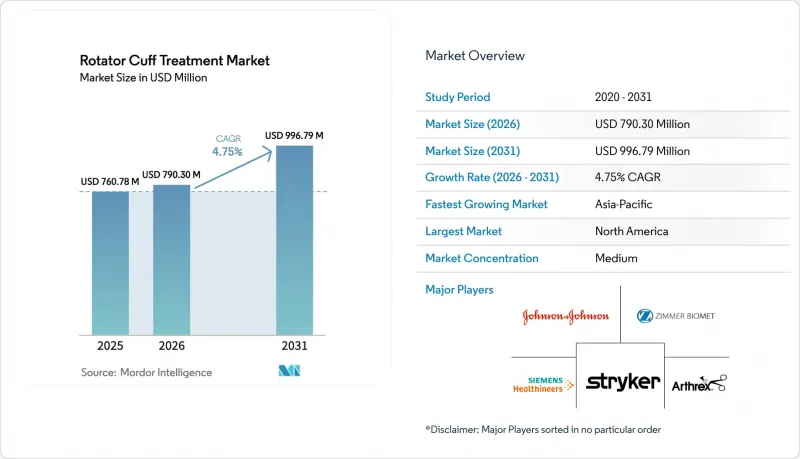
본 보고서는 치료 유형별(외과적 치료(관절경 하 복원술, 기타), 기타), 제품 유형별(임플란트, 수술용 기구, 기타), 환자 연령대별(50세 미만, 기타), 적응증별(스포츠, 기타), 손상 중증도별(부분층 파열, 기타), 최종 사용자별(병원, 기타),지역별(북미, 기타)로 분류되어 있습니다. 시장 예측은 금액(달러)으로 표시되어 있습니다.
세계의 회전근개 치료 시장 동향 및 인사이트
스포츠 및 업무와 관련된 어깨 손상 발생률 증가
머리 위로 팔을 올리는 동작이 수반되는 스포츠나 육체노동에 참여함에 따라, 노동 연령층 성인에서 회전근개 손상 발생률이 상승하고 있으며, 손상이 고령층에만 국한된다는 기존의 인식이 뒤바뀌고 있습니다. 미국 노동통계청 기록에 따르면, 2024년에는 어깨 관련 산재 청구 건수가 14만 2,000건으로, 2023년 대비 9% 증가했습니다. 이 중 건설업, 창고업, 의료 분야가 전체 건수의 61%를 차지하고 있습니다. 35세에서 50세 사이의 레크리에이션 운동선수들 사이에서는 크로스핏, 피클볼, 장애물 코스 경주 등의 영향으로 부분 파열 발생 빈도가 10년 전보다 23% 증가했습니다. 조기 외과적 개입은 생산성과 운동 능력을 유지하고, 진단부터 회복까지의 기간을 단축할 뿐만 아니라, 최소 침습적 수술의 적용 대상을 확대합니다. 고용주가 시행하는 예방 조치는 부상 증가 속도를 따라가지 못하고 있으며, 건당 보상액은 감소하고 있음에도 불구하고 수술 건수는 지속적으로 증가하고 있습니다.
노화에 따른 퇴행성 파열 증가
세계적인 고령화는 가장 지속적인 구조적 호재로 작용하고 있습니다. 65세 이상 환자는 이미 수술 건수의 44.84%를 차지하고 있으며, 유엔의 예측에 따르면 이 연령층은 2050년까지 16억 명으로 두 배로 늘어날 것으로 전망됩니다. 퇴행성 파열은 근력이 저하되어 임상적 평가가 필요해질 때까지 무증상으로 진행되는 경우가 많으며, 영상 검사의 접근성이 확대됨에 따라 잠재적 사례가 축적되어 수술 대상이 되는 사례가 증가할 전망입니다. 일본에서는 2025년, 70세 이상 환자의 어깨 관절경 수술 건수가 12% 증가했다고 보고되었습니다. 이는 외래 진료의 보험 적용 범위 확대와 고령자들이 자립적인 생활을 유지하고자 하는 열망에 기인한 것입니다. 역형 어깨 관절 치환술은 대규모이며 복구 불가능한 파열에 대한 표준적인 치료 옵션으로 자리 잡았으며, 기능 점수 면에서 반관절 치환술보다 우월한 것으로 나타났습니다.
고급 임플란트와 생물학적 제제의 높은 비용
무세포 진피 매트릭스의 비용은 2,500-4,500달러, 혈소판이 풍부한 혈장 키트는 1건당 800-1,200달러가 소요되며, 특히 가격에 민감한 시장에서는 메디케어의 추가 급여액 850달러를 초과합니다. 정형외과 비용의 40-60%를 본인 부담하는 중국이나 인도의 환자들은 수술을 연기하거나 봉합만 하는 치료를 선택하는 경우가 많습니다. 미국의 가치 기반 계약으로 인해 심사가 엄격해지고 있으며, 외과 의사의 68%가 치료 성과 데이터를 활용하여 생물학적 제제의 사용을 정당화해야 한다는 압박을 느끼고 있다고 보고하고 있습니다.
부문 분석
오르토바이오로직스 시장은 2031년까지 연평균 성장률(CAGR) 8.36%로 확대되고 있습니다. 2025년 매출에서 외과적 복원이 여전히 61.53%를 차지했지만, 다혈소판 혈장(PRP), 줄기세포 스캐폴드, 무세포 진피 매트릭스와 관련된 회전근개 치료 시장 규모는 꾸준히 확대되고 있습니다. 현재 외과의들은 재파열 위험을 줄이기 위해 대규모 및 중증 파열의 복구에 생물학적 제제를 이용한 보강을 접목하고 있으며, 이로 인해 앵커만으로는 복구가 어려운 경우가 늘어나면서 기존 공급업체들은 조직 공학 분야로 다각화를 모색하고 있습니다. 부분 파열이나 치료 필요성이 낮은 고령자의 경우, 물리치료나 완화 요법이 여전히 첫 번째 선택이지만, 힘줄의 변성이나 실패율 상승이 보고됨에 따라 코르티코스테로이드의 반복 주사는 제한되고 있습니다.
생물학적 요법의 도입이 진행되는 한편, 복구가 불가능한 대규모 병변을 대상으로 하는 줄기세포를 포함하지 않는 리버스 인공관절 치환술용 임플란트의 견실한 개발 파이프라인도 병행하여 존재하고 있습니다. 미국 어깨·팔꿈치 외과 의사 협회(ASHS)의 등록 자료에 따르면, 2024-2025년 리버스 수술 건수는 연간 19% 증가하고 있습니다. 예방 프로그램이나 편심 근력 훈련은 조기 퇴행을 지연시킬 수는 있지만, 기능 저하가 시작되면 수술을 피할 수 있는 경우는 거의 없습니다. 그 결과, 회전근개 치료 시장은 복구 가능한 파열의 경우 생물학적 제제를 병용한 선택적 관절경 수술을, 구제 사례의 경우 인공관절 치환술을 시행하는 등 두 가지 경로를 유지하고 있습니다.
생체 재료를 사용한 패치와 메쉬는 연평균 성장률(CAGR) 9.24%로 확대되고 있으며, 제품 카테고리 중 가장 빠른 속도로 성장하고 있습니다. 대조적으로, 임플란트 및 고정 기구는 2025년 매출의 39.46%를 차지했지만, 일괄 결제 압력으로 인해 앵커 사용량이 억제되면서 시장은 성숙기에 접어들고 있습니다. 노트리스 시스템은 개당 450-650달러로 기존 앵커보다 비싸지만, 외래수술센터(ASC)는 수술실 회전율 향상을 대가로 이 가격 차이를 상쇄하고 있습니다. 스트라이커(Stryker)사가 2024년에 발표한 증강현실(AR) 관절경 수술 시스템 등의 이미징·내비게이션 플랫폼은 앵커의 오배치를 22% 줄여주어 프리미엄 가격 책정을 뒷받침하고 있습니다.
미국 정형외과학회(AAOS)는 2025년에 수술 적응증 환자에 대한 코르티코스테로이드 주사 권장 등급을 하향 조정했습니다. 이 지침에 따라 의약품 하위 부문은 축소되고, 자본은 재생의료용 스캐폴드로 이동하고 있습니다. 최소한의 가공만 거친 동종 이식편은 고도로 가교된 대체품이 12%인 것에 비해 본래의 성장 인자의 68%를 유지하고 있어 힘줄의 유착을 촉진합니다. 보험사들이 치료 성과 데이터를 요구하는 가운데, 각 공급업체들은 프리미엄 가격 책정을 정당화하기 위해 생체역학적 강도와 치유 프로파일을 강조하고 있습니다.
지역별 분석
북미는 2025년 매출의 39.54%를 차지한 것으로 평가되었으며, 그 원동력은 연간 약 45만 건의 회전근개 복원술과 외래에서 생물학적 제제를 병용하는 관절경 수술을 장려하는 보험사의 정책입니다. 캐나다의 단일 지불자 제도로 인한 제약으로 대기 목록이 길어지고 있지만, 미국 의료기관으로의 국경 간 이동과 보충 보험의 보급으로 환자 유출은 억제되고 있습니다. 멕시코의 의료 기관은 패키지 가격을 40-60% 낮게 책정하여 미국의 본인 부담 환자들을 유치하고 있지만, 사후 관리의 미비로 인해 광범위한 확산이 저해되고 있습니다.
아시아태평양은 연평균 성장률(CAGR) 6.22%로 가장 빠르게 성장하고 있는 지역입니다. 중국에서는 2025년에 어깨 관절경 수술 건수가 17% 증가했습니다. 인도의 외과의사들은 의료기기 비용을 가장 큰 장벽으로 꼽고 있으며, 이로 인해 80-120달러 가격대의 국산 앵커 시스템이 보급되고 있습니다. 일본에서는 PMDA의 엄격한 심사로 인해 첨단 제품 시장 출시가 18-24개월 지연되고 있으며, 이로 인해 기존 공급업체들이 유리한 입지를 점하고 있습니다. 한국과 태국은 의료 관광 수요를 흡수하고 있으며, 방콕의 부무룬라드 병원에서는 2024년에 중동 및 호주에서 온 환자들에 의한 어깨 관절 수술 건수가 22% 증가했습니다.
유럽에서는 MDR(의료기기 규정)로 인한 마찰이 발생하고 있어, 신규 생물학적 제제의 CE 마크 취득에 최대 18개월의 지연이 발생하고 있습니다. 독일, 프랑스, 영국이 해당 지역의 매출의 55%를 차지하고 있습니다. NHS(국민보건서비스)의 대기 기간이 12-18개월에 달함에 따라, 2024년에는 민간 부문에서 어깨 관절 수술 건수가 19% 증가했습니다. 남유럽은 1인당 수술 건수에서는 뒤처지고 있지만, 의료 관광을 활용하여 국내 부족분을 보완하고 있습니다. 중동에서는 높은 소득 수준과 서유럽에서 연수를 받은 외과 의사들의 존재 덕분에 GCC가 도입을 주도하고 있습니다. 한편, 남미에서는 브라질과 아르헨티나에서 틈새 시장의 성장이 나타나고 있지만, 거시경제의 변동이 여전히 걸림돌로 작용하고 있습니다.
기타 혜택
- 엑셀 형식 시장 예측(ME) 시트
- 3개월간의 애널리스트 지원
자주 묻는 질문
목차
제1장 서론
제2장 조사 방법
제3장 주요 요약
제4장 시장 구도
제5장 시장 규모 및 성장 예측
제6장 경쟁 구도
제7장 시장 기회 및 향후 전망
AJY 26.09.15According to Mordor Intelligence, the rotator cuff treatment market size is expected to grow from USD 760.78 million in 2025 to USD 790.30 million in 2026 and is forecast to reach USD 996.79 million by 2031 at 4.75% CAGR over 2026-2031.
This report is Segmented by Treatment Type (Surgical [Arthroscopic Repair and More], and More), Product Type (Implants, Instruments, and More), Patient Age (Less Than 50, and More), Indication (Sports, and More), Injury Severity (Partial, and More), End User (Hospitals, and More), and Geography (North America, and More). Market Forecasts are Provided in Value (USD).
Global Rotator Cuff Treatment Market Trends and Insights
Rising Incidence of Sports & Work-Related Shoulder Injuries
Participation in overhead sports and manual-labor occupations is elevating rotator cuff injury rates among working-age adults, reversing the perception that tears are confined to older cohorts. The U.S. Bureau of Labor Statistics logged 142,000 shoulder-related workers'-comp claims in 2024, a 9% jump from 2023, with construction, warehousing, and healthcare accounting for 61% of cases. Recreational athletes aged 35-50 are presenting with partial-thickness tears 23% more frequently than a decade ago, driven by CrossFit, pickleball, and obstacle-course racing. Early surgical intervention preserves productivity and athletic performance, compressing the diagnostic-to-repair timeline and enlarging the pool of candidates for minimally invasive repair. Employer prevention efforts lag the pace of injuries, ensuring sustained procedure volumes despite declining per-case reimbursement.
Aging Population Driving Degenerative Tears
Global aging is the most durable structural tailwind. Individuals over 65 already represent 44.84% of procedures, and United Nations projections show that cohort doubling to 1.6 billion by 2050. Degenerative tears often progress silently until weakness forces clinical evaluation, generating a backlog of latent cases poised to convert as imaging access broadens. Japan reported a 12% rise in shoulder arthroscopies in patients over 70 during 2025, an outcome of expanded outpatient coverage and seniors' desire to maintain independence. Reverse shoulder arthroplasty has become the default salvage option for massive irreparable tears, overtaking hemiarthroplasty due to superior functional scores.
High Cost of Advanced Implants & Biologics
Acellular dermal matrices cost USD 2,500-4,500, while PRP kits add USD 800-1,200 per case, outstripping the USD 850 Medicare add-on, particularly in price-sensitive markets. Chinese and Indian patients, who pay 40-60% of orthopedic bills out of pocket, often delay surgery or choose suture-only options. U.S. value-based contracts intensify scrutiny; 68% of surgeons report pressure to justify biologic use with outcomes data.
Other drivers and restraints analyzed in the detailed report include:
- Technological Advances in Minimally Invasive & Robotic Surgery
- Growing Adoption of Orthobiologics & Regenerative Therapies
- Re-Tear Risk and Variable Surgical Outcomes
For complete list of drivers and restraints, kindly check the Table Of Contents.
Segment Analysis
Orthobiologics are expanding at an 8.36% CAGR through 2031. Surgical repairs still represented 61.53% of 2025 revenue, yet the rotator cuff treatment market size tied to platelet-rich plasma, stem-cell scaffolds, and acellular dermal matrices is rising steadily. Surgeons now integrate biologic augmentation into repairs of large and massive tears to lower re-tear risk, compressing anchor-only margins and spurring incumbent vendors to diversify into tissue engineering. Physiotherapy and palliative regimens remain first-line for partial tears and low-demand elders, while repeated corticosteroid injections face curbs due to documented tendon degeneration and elevated failure rates.
Biologic adoption coexists with a robust pipeline of stemless reverse arthroplasty implants aimed at massive irreparable pathology. The American Shoulder and Elbow Surgeons registry cites a 19% annual increase in reverse procedures across 2024-2025. Preventive programs and eccentric strengthening slow early degeneration but rarely avert surgery once functional decline sets in. Consequently, the rotator cuff treatment market maintains a dual trajectory: elective arthroscopy fortified by biologics for reparable tears and arthroplasty for salvage cases.
Biologic patches and meshes are advancing at a 9.24% CAGR, the fastest product category pace. In contrast, implants and fixation devices commanded 39.46% of 2025 revenue but are maturing as bundled-payment pressures curb anchor counts. Knotless systems fetch USD 450-650 each-higher than conventional anchors-yet ASCs absorb the premium in exchange for quicker OR turnover. Imaging and navigation platforms, such as Stryker's 2024 augmented-reality arthroscopy suite, reduce anchor misplacement by 22% and support premium pricing.
The American Academy of Orthopaedic Surgeons downgraded corticosteroid injections for surgical candidates in 2025. This guidance shrinks the drugs subsegment and redirects capital toward regenerative scaffolds. Minimal-processing allografts retain 68% of native growth factors versus 12% for heavily cross-linked alternatives, accelerating tendon integration. As payers demand outcome data, vendors emphasize biomechanical strength and healing profiles to justify premium price points.
Complete Report Scope:
- By Treatment Type
- Surgical / Curative Treatment
- Arthroscopic Repair
- Open Repair
- Mini-open Repair
- Shoulder Arthroplasty
- Reverse Shoulder Arthroplasty
- Stemless Shoulder Arthroplasty
- Physiotherapy / Palliative Treatment
- Preventive / Conservative Management
- Orthobiologics
- PRP & Growth-Factor Therapy
- Stem-cell Therapy
- Biological Meshes & Patches
- Pharmaceutical Treatment
- NSAIDs
- Corticosteroid Injections
- Surgical / Curative Treatment
- By Product Type
- Implants & Fixation Devices
- Suture Anchors
- Knot-less Fixation Systems
- Biologic Patches & Meshes
- Tendon Grafts & Scaffolds
- Surgical Instruments & Power Systems
- Rehabilitation Equipment
- Physical-Therapy Devices
- Braces & Supports
- Imaging & Navigation Systems
- Drugs
- Others
- Implants & Fixation Devices
- By Patient Age Group
- < 50 Years
- 50 - 64 Years
- >= 65 Years
- By Indication
- Sports-Related Injuries
- Age-Related Degeneration
- Traumatic Injuries
- By Injury Severity
- Partial-Thickness Tears
- Full-Thickness Tears
- Massive / Irreparable Tears
- By End User
- Hospitals
- Ambulatory Surgical Centers
- Orthopedic Clinics & Physician Offices
- Home-Care Settings
- By Geography
- North America
- United States
- Canada
- Mexico
- Europe
- Germany
- France
- United Kingdom
- Italy
- Spain
- Rest of Europe
- Asia-Pacific
- China
- Japan
- India
- South Korea
- Australia
- Rest of Asia-Pacific
- Middle East & Africa
- GCC
- South Africa
- Rest of Middle East & Africa
- South America
- Brazil
- Argentina
- Rest of South America
- North America
Geography Analysis
North America generated 39.54% of 2025 revenue, anchored by roughly 450,000 annual cuff repairs and payer policies that reward outpatient biologic-augmented arthroscopy. Canada's single-payer constraints prolong waitlists, but cross-border travel to U.S. centers and rising supplemental insurance temper leakage. Mexican providers lure U.S. self-pay patients with 40-60% lower package prices, yet inconsistent follow-up deters broad adoption.
Asia-Pacific is the fastest-growing region at a 6.22% CAGR. China logged a 17% rise in shoulder arthroscopies in 2025. Indian surgeons cite device cost as the top barrier, spurring domestic anchor systems priced at USD 80-120. Japan's stringent PMDA reviews delay high-tech launches 18-24 months, favoring entrenched suppliers. South Korea and Thailand capture medical-tourism flows, with Bangkok's Bumrungrad Hospital posting a 22% rise in shoulder cases from Middle Eastern and Australian patients in 2024.
Europe faces MDR friction that stretches CE marking for novel biologics by up to 18 months. Germany, France, and the United Kingdom account for 55% of regional revenue. NHS waitlists topping 12-18 months catalyzed a 19% uptick in private shoulder procedures in 2024. Southern Europe lags on per-capita volume but leverages medical tourism to mitigate domestic shortfalls. GCC countries lead Middle East adoption thanks to high incomes and Western-trained surgeons, whereas South America remains hampered by macroeconomic volatility despite niche growth in Brazil and Argentina.
- 3S Ortho
- Aevumed
- Anika Therapeutics
- Arthrex
- Atreon Orthopedics
- Bioventus
- Conmed
- DJO Global
- Embody Inc.
- Exactech
- FH ORTHOPEDICS
- Integra LifeSciences
- Johnson & Johnson
- Karl Storz
- LimaCorporate
- Organogenesis
- Ossio
- Parcus Medical
- Shoulder Innovations
- Smiths Group
- Stryker
- Via Surgical
- Xiros Ltd.
- Zimmer Biomet
Additional Benefits:
- The market estimate (ME) sheet in Excel format
- 3 months of analyst support
TABLE OF CONTENTS
1 Introduction
- 1.1 Study Assumptions & Market Definition
- 1.2 Scope of the Study
2 Research Methodology
3 Executive Summary
4 Market Landscape
- 4.1 Market Overview
- 4.2 Market Drivers
- 4.2.1 Rising Incidence of Sports & Work-Related Shoulder Injuries
- 4.2.2 Aging Population Driving Degenerative Tears
- 4.2.3 Technological Advances in Minimally Invasive & Robotic Surgery
- 4.2.4 Growing Adoption of Ortho biologics & Regenerative Therapies
- 4.2.5 Ambulatory-Surgery-Center Shift Boosting Procedure Volumes
- 4.2.6 Reimbursement Updates Favoring Outpatient Cuff Repairs
- 4.3 Market Restraints
- 4.3.1 High Cost of Advanced Implants & Biologics
- 4.3.2 Re-Tear Risk and Variable Surgical Outcomes
- 4.3.3 Strict EU-MDR / FDA Pathways for Novel Biologics
- 4.3.4 Surgeon-Skill Gaps in Emerging Markets
- 4.4 Value / Supply-Chain Analysis
- 4.5 Regulatory Landscape
- 4.6 Technological Outlook
- 4.7 Porter's Five Forces Analysis
- 4.7.1 Threat of New Entrants
- 4.7.2 Bargaining Power of Suppliers
- 4.7.3 Bargaining Power of Buyers
- 4.7.4 Threat of Substitutes
- 4.7.5 Intensity of Competitive Rivalry
5 Market Size & Growth Forecasts (Value in USD)
- 5.1 By Treatment Type
- 5.1.1 Surgical / Curative Treatment
- 5.1.1.1 Arthroscopic Repair
- 5.1.1.2 Open Repair
- 5.1.1.3 Mini-open Repair
- 5.1.1.4 Shoulder Arthroplasty
- 5.1.1.4.1 Reverse Shoulder Arthroplasty
- 5.1.1.4.2 Stemless Shoulder Arthroplasty
- 5.1.2 Physiotherapy / Palliative Treatment
- 5.1.3 Preventive / Conservative Management
- 5.1.4 Orthobiologics
- 5.1.4.1 PRP & Growth-Factor Therapy
- 5.1.4.2 Stem-cell Therapy
- 5.1.4.3 Biological Meshes & Patches
- 5.1.5 Pharmaceutical Treatment
- 5.1.5.1 NSAIDs
- 5.1.5.2 Corticosteroid Injections
- 5.1.1 Surgical / Curative Treatment
- 5.2 By Product Type
- 5.2.1 Implants & Fixation Devices
- 5.2.1.1 Suture Anchors
- 5.2.1.2 Knot-less Fixation Systems
- 5.2.1.3 Biologic Patches & Meshes
- 5.2.1.4 Tendon Grafts & Scaffolds
- 5.2.2 Surgical Instruments & Power Systems
- 5.2.3 Rehabilitation Equipment
- 5.2.3.1 Physical-Therapy Devices
- 5.2.3.2 Braces & Supports
- 5.2.4 Imaging & Navigation Systems
- 5.2.5 Drugs
- 5.2.6 Others
- 5.2.1 Implants & Fixation Devices
- 5.3 By Patient Age Group
- 5.3.1 < 50 Years
- 5.3.2 50 - 64 Years
- 5.3.3 >= 65 Years
- 5.4 By Indication
- 5.4.1 Sports-Related Injuries
- 5.4.2 Age-Related Degeneration
- 5.4.3 Traumatic Injuries
- 5.5 By Injury Severity
- 5.5.1 Partial-Thickness Tears
- 5.5.2 Full-Thickness Tears
- 5.5.3 Massive / Irreparable Tears
- 5.6 By End User
- 5.6.1 Hospitals
- 5.6.2 Ambulatory Surgical Centers
- 5.6.3 Orthopedic Clinics & Physician Offices
- 5.6.4 Home-Care Settings
- 5.7 By Geography
- 5.7.1 North America
- 5.7.1.1 United States
- 5.7.1.2 Canada
- 5.7.1.3 Mexico
- 5.7.2 Europe
- 5.7.2.1 Germany
- 5.7.2.2 France
- 5.7.2.3 United Kingdom
- 5.7.2.4 Italy
- 5.7.2.5 Spain
- 5.7.2.6 Rest of Europe
- 5.7.3 Asia-Pacific
- 5.7.3.1 China
- 5.7.3.2 Japan
- 5.7.3.3 India
- 5.7.3.4 South Korea
- 5.7.3.5 Australia
- 5.7.3.6 Rest of Asia-Pacific
- 5.7.4 Middle East & Africa
- 5.7.4.1 GCC
- 5.7.4.2 South Africa
- 5.7.4.3 Rest of Middle East & Africa
- 5.7.5 South America
- 5.7.5.1 Brazil
- 5.7.5.2 Argentina
- 5.7.5.3 Rest of South America
- 5.7.1 North America
6 Competitive Landscape
- 6.1 Market Concentration
- 6.2 Market Share Analysis
- 6.3 Company Profiles (includes Global level Overview, Market level overview, Core Segments, Financials as available, Strategic Information, Market Rank/Share for key companies, Products and Services, and Recent Developments)
- 6.3.1 3S Ortho
- 6.3.2 Aevumed
- 6.3.3 Anika Therapeutics
- 6.3.4 Arthrex
- 6.3.5 Atreon Orthopedics
- 6.3.6 Bioventus
- 6.3.7 CONMED Corporation
- 6.3.8 DJO Global
- 6.3.9 Embody Inc.
- 6.3.10 Exactech
- 6.3.11 FH ORTHOPEDICS
- 6.3.12 Integra LifeSciences
- 6.3.13 Johnson & Johnson (DePuy Synthes)
- 6.3.14 Karl Storz
- 6.3.15 LimaCorporate
- 6.3.16 Organogenesis
- 6.3.17 Ossio
- 6.3.18 Parcus Medical
- 6.3.19 Shoulder Innovations
- 6.3.20 Smith & Nephew
- 6.3.21 Stryker Corporation
- 6.3.22 Via Surgical
- 6.3.23 Xiros Ltd.
- 6.3.24 Zimmer Biomet
7 Market Opportunities & Future Outlook
- 7.1 White-space & Unmet-Need Assessment


