|
시장보고서
상품코드
2125489
아시아태평양의 인슐린 주사기 시장 : 시장 점유율 분석, 업계 동향 및 통계, 성장 예측(2026-2031년)Asia-Pacific Insulin Syringe - Market Share Analysis, Industry Trends & Statistics, Growth Forecasts (2026 - 2031) |
||||||
 Mordor Intelligence
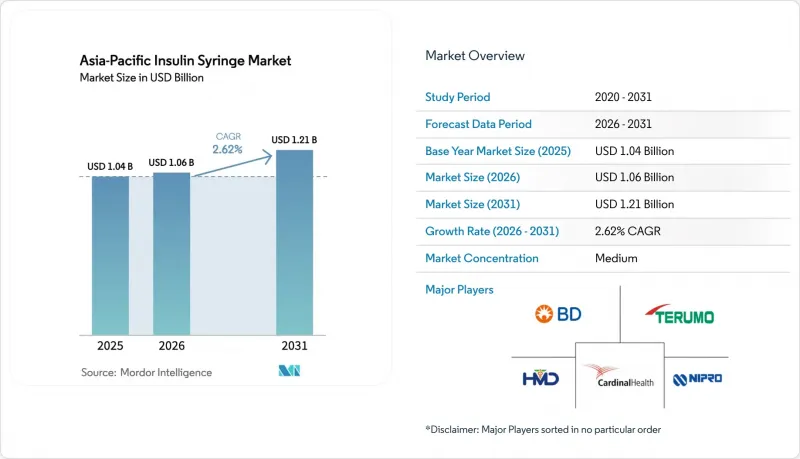
Mordor Intelligence에 의하면, 아시아태평양의 인슐린 주사기 시장 규모는 2025년에 10억 4,000만 달러로 평가되었고, 2026년에 10억 6,000만 달러로 추정되고, 2031년까지 12억 1,000만 달러에 이를 것으로 예측되며, 2026-2031년 CAGR 2.62%로 성장할 전망입니다.
본 보고서는 주사기 용량별(0.3mL, 0.5mL, 1mL, 1mL 초과), 바늘 길이별(4mm, 6mm, 8mm, 10mm 이상), 기술별(기존, 안전형), 최종 사용자별(병원 및 클리닉, 재택치료, 당뇨병 센터, 기타), 지역별(중국, 일본, 인도, 호주, 한국, 기타 아시아태평양)로 분류되어 있습니다. 시장 전망은 금액(달러) 기준으로 제시되어 있습니다.
아시아태평양의 인슐린 주사기 시장 동향 및 인사이트
아시아태평양의 당뇨병 유병률 증가
2024년 기준, 서태평양 및 동남아시아 지역에서는 3억 명 이상의 성인이 당뇨병을 앓았으나, 미진단율은 여전히 50% 전후를 유지하고 있었습니다. 인도네시아의 미진단율은 무려 73.2%에 달하여, 새로운 선별 검사를 통해 발굴할 수 있는 잠재적 수요의 규모를 여실히 보여주고 있습니다. 중국의 1억 4,800만 명과 인도의 9,000만 명에 달하는 진단받은 환자들은 인슐린 펜이 점차 보급되고 있는 상황에서도 아시아태평양 인슐린 주사기 시장의 구조적 수요 하한선을 확보하고 있습니다. 농촌 지역에서는 경제적 제약으로 인해, 콜드체인 인프라가 취약한 지역에서는 여전히 주사기가 기본 선택지로 남아 있습니다. 또한, 젊은 층에서 인슐린 치료 시작 시기가 빨라지고 있는 점도 환자 1인당 평생 의료기기 소비량을 증가시키고 있습니다.
인슐린 요법의 자가 투여 확대
원격의료를 통해 투여량 조정 지원에 대한 지리적 장벽이 제거됨에 따라, 재택 치료 시장은 연간 3.87%의 속도로 성장하고 있습니다. 인도와 인도네시아에서는 주사기 가격이 일회용 인슐린 펜의 5분의 1 수준이어서, 본인 부담금을 지불하는 환자들에게 비용 절감 수단으로서의 역할을 강화하고 있습니다. 인도의 ‘아유슈만 바라트’와 같은 정부 의료비 지원 제도는 현재 인슐린과 투여 기기를 모두 대상으로 하고 있어, 저소득층의 보급을 촉진하고 있습니다. 체계적인 교육 프로그램은 투여 실수의 위험을 줄여주지만, 투여 기술의 향상으로 인해 도시 지역 환자들이 인슐린 펜을 선호하는 경향이 나타나기도 하여, 수요는 사회경제적 상황에 따라 양극화되어 있습니다. 따라서 제조업체들은 가격 경쟁과 환자 중심의 교육 자료 제공 사이에서 균형을 맞추어야 합니다.
인슐린 펜과 펌프의 급속한 보급
2025년, 일본과 호주에서 신규 치료 시작의 60%를 인슐린 펜이 차지했습니다. 이는 보험 환급에서 인슐린 펜과 주사기를 동등하게 취급하는 점과, 눈에 띄지 않고 미리 충전된 기기를 선호하는 환자의 경향을 반영한 것입니다. 뉴질랜드의 공적 보험 기관은 현재 펌프 및 CGM(연속 혈당 모니터링) 시스템 비용을 지원하고 있어, 1형 당뇨병 환자들 사이에서 주사기 수요가 감소하고 있습니다. 중국의 주요 도시에서도 유사한 추세가 나타나, 2024년에는 새로 2형 당뇨병 진단을 받은 환자의 48%가 펜형 인슐린을 선택했습니다. 그러나 농촌 지역에서는 가격 부담과 콜드체인 인프라 부족이 펜형 인슐린의 보급을 저해하고 있어, 주사기가 여전히 주류를 이루고 있습니다. 따라서 공급업체는 도시 지역 시장 점유율을 일부 양보하면서도 가격을 중시하는 부문와 공공 입찰을 공략해야 합니다.
부문 분석
아시아태평양 인슐린 주사기 시장에서 0.5mL 규격 시장 규모는 2025년 매출의 45.67%를 차지했으나, 소아 환자 수 증가와 저용량 조절 요법의 보급을 배경으로, 0.3mL 규격은 2031년까지 연평균 성장률(CAGR) 3.25%로 성장할 것으로 전망됩니다. 내분비 전문의는 1회 투여량이 10단위 이하인 소아 및 고령자 사용자에게 인슐린 낭비를 줄이기 위해 용량이 작은 주사기를 처방하고 있습니다. 중국 규제 당국은 2024년에 6가지 새로운 소아용 디자인을 승인했으며, 이는 생산 능력 다각화에 대한 정책적 지원을 보여줍니다. 그러나 공차 기준이 강화되고 30-32G 바늘이 사용됨에 따라 생산 비용이 8-12% 증가했으며, 인도의 통일 가격 상한제로 인해 이러한 비용 증가분을 소비자에게 전가할 여지는 제한적입니다.
1mL 규격은 30단위를 초과하는 기저 인슐린 요법에 계속 사용되고 있으며, 인슐린 저항성을 동반한 비만 2형 당뇨병 환자군에서도 여전히 일반적입니다. 1mL를 초과하는 주사기는 U-500 인슐린을 취급하는 병원에서 틈새 시장 역할을 하고 있지만, 제약 기업들이 고용량 바이알을 단계적으로 폐지하고 고농도 펜 카트리지로 전환하고 있어 그 중요성은 점차 낮아지고 있습니다. 그 결과, 용량 구성은 1mL 이하 크기로 편중되는 한편, 1mL를 초과하는 용량은 전문 클리닉으로 한정될 것으로 예측됩니다.
2025년, 아시아태평양의 인슐린 주사기 시장에서 6mm 바늘은 31.28%의 시장 점유율을 유지했으나, 근육 내 주사를 방지하기 위해 지침에서 짧은 길이를 권장함에 따라 4mm 바늘은 연간 4.42%의 속도로 점유율을 확대되고 있습니다. 일본, 호주, 중국에서는 2025년 프로토콜에 4mm 규격이 포함되면서 병원에서의 전환이 가속화되고 있습니다. 각 제조업체는 삽입력을 18% 줄여주는 초박형 강철 제품이나 끝부분이 모따기 처리된 형태의 제품을 출시하고 있으며, 주사 바늘을 두려워하는 사용자들로부터 지지를 얻고 있습니다.
8mm 제품은 감소 추세를 보이는 반면, 10mm 이상의 제품은 주로 지방의 기존 재고로 남아 있습니다. 4mm 제품의 도입에는 직각 주입법과 환자에 대한 새로운 지도가 필요하며, 이에 따라 삽화가 포함된 설명서나 QR 코드가 첨부된 동영상에 대한 수요가 증가하고 있습니다. 교육용 보조 도구를 도입한 기업들은 재택 간호 채널에서 고객 유지율을 높이고 있습니다.
기타 혜택
- 엑셀 형식 시장 예측(ME) 시트
- 3개월간 애널리스트의 지원
자주 묻는 질문
목차
제1장 서론
제2장 조사 방법
제3장 주요 요약
제4장 시장 구도
제5장 시장 규모 및 성장 예측
제6장 경쟁 구도
제7장 시장 기회 및 향후 전망
AJY 26.09.15According to Mordor Intelligence, the Asia-Pacific insulin syringe market size is projected to be USD 1.04 billion in 2025, USD 1.06 billion in 2026, and reach USD 1.21 billion by 2031, growing at a CAGR of 2.62% from 2026 to 2031.
This report is Segmented by Syringe Capacity (0. 3 ML, 0. 5 ML, 1 ML, Greater Than 1 ML), Needle Length (4 Mm, 6 Mm, 8 Mm, >=10 Mm), Technology (Conventional, Safety), End User (Hospitals & Clinics, Home-Care, Diabetes Centres, Other), and Geography (China, Japan, India, Australia, South Korea, Rest of Asia-Pacific). Market Forecasts are Provided in Terms of Value (USD).
Asia-Pacific Insulin Syringe Market Trends and Insights
Rising Prevalence of Diabetes Across Asia-Pacific
More than 300 million adults in the Western Pacific and Southeast Asia were living with diabetes in 2024, yet undiagnosed rates still hovered near 50%. Indonesia's undiagnosed share reached a staggering 73.2%, underlining the reservoir of latent demand that new screening programs can unlock. China's 148 million diagnosed patients and India's 90 million ensure a structural demand floor for the Asia-Pacific insulin syringe market even as pens gain ground. Rural affordability constraints keep syringes the default option where cold-chain infrastructure is weak. Earlier insulin initiation among younger cohorts also lengthens each patient's lifetime device consumption.
Expanding Self-Administration of Insulin Therapies
Home-care settings are growing 3.87% per year as telemedicine removes geographic barriers to titration support. Syringes cost one-fifth as much as disposable pens in India and Indonesia, reinforcing their role as a cost-saving measure for out-of-pocket payers. Government reimbursement, such as India's Ayushman Bharat, now covers both insulin and delivery devices, extending reach into low-income segments. Structured education programs mitigate dosing-error risks, although improved technique sometimes nudges urban patients toward pens, segmenting demand along socioeconomic lines. Manufacturers must therefore balance price leadership with patient-centric training materials.
Rapid Uptake of Insulin Pens & Pumps
Insulin pens accounted for 60% of new initiations in Japan and Australia in 2025, reflecting parity reimbursement and patient preference for discreet, pre-filled devices. New Zealand's public funder now supports pump-CGM systems, cutting syringe demand in Type 1 patients. China's tier-1 cities show similar momentum, with 48% of newly diagnosed Type 2 patients opting for pens in 2024. Yet syringes remain dominant in rural markets where affordability and limited cold-chain infrastructure inhibit pen adoption. Suppliers must therefore target value-conscious segments and public tenders while conceding market share in urban areas.
Other drivers and restraints analyzed in the detailed report include:
- Growth of E-Pharmacy Supply Chains
- Near-Shoring of Syringe Manufacturing for Supply Security
- Domestic Price-Cap Policies in Emerging APAC
For complete list of drivers and restraints, kindly check the Table Of Contents.
Segment Analysis
The Asia-Pacific insulin syringe market size for 0.5 mL formats accounted for 45.67% of 2025 revenue, yet 0.3 mL units are set to grow at 3.25% CAGR through 2031, driven by rising pediatric incidence and low-dose titration regimens. Endocrinologists prescribe smaller barrels to reduce insulin waste for children and elderly users who use 10 units or fewer per dose. China's regulator approved six new pediatric designs in 2024, indicating policy support for diversifying capacity. However, tighter tolerances and 30-32G needles increase production costs by 8-12%, and India's uniform price cap limits the ability to pass that premium to consumers.
The 1 mL format continues to be used for basal regimens above 30 units and remains common in obese Type 2 cohorts with insulin resistance. Syringes larger than 1 mL play a niche role in hospitals that handle U-500 insulin, but are losing relevance as pharmaceutical firms phase out high-volume vials in favor of concentrated pen cartridges. Consequently, the capacity mix will tilt toward sub-1 mL sizes while >1 mL volumes retreat to specialty clinics.
Six-millimeter needles retained 31.28% market share of the Asia-Pacific insulin syringe market in 2025, yet 4 mm variants are rising 4.42% per year as guidelines endorse shorter lengths to prevent intramuscular injections. Japan, Australia, and China integrated the 4 mm standard into 2025 protocols, accelerating hospital conversions. Manufacturers roll out ultrathin-wall steel and beveled-tip geometry that lowers insertion force by 18%, appealing to needle-phobic users.
Eight-millimeter products are declining, while >=10 mm devices linger mainly in legacy rural inventories. Uptake of 4 mm requires a perpendicular technique and fresh patient training, driving demand for pictorial instructions and QR-code videos. Firms that embed education aids gain stickiness in the home-care channel.
Complete Report Scope:
- By Syringe Capacity
- 0.3 mL
- 0.5 mL
- 1 mL
- Greater than 1 mL
- By Needle Length
- 4 mm
- 6 mm
- 8 mm
- >=10 mm
- By Technology
- Conventional Insulin Syringes
- Safety Insulin Syringes
- By End User
- Hospitals & Clinics
- Home-care Settings
- Diabetes Centres
- Other End Users
- By Country
- China
- Japan
- India
- Australia
- South Korea
- Rest of Asia-Pacific
List of Companies Covered in this Report:
- Allison Medical
- Artsana Group
- B. Braun
- Beckton Dickinson
- Cardinal Health
- HMD Healthcare
- Jiangsu Excel Medical Instruments
- Medline Industries
- Nipro
- Owen Mumford
- Smiths Group
- Terumo
- Ultimed
- Weigao Group
- Wuxi Yushou Medical Appliances
- Ypsomed
- Zhejiang KangKang Medical
Additional Benefits:
- The market estimate (ME) sheet in Excel format
- 3 months of analyst support
TABLE OF CONTENTS
1 Introduction
- 1.1 Study Assumptions & Market Definition
- 1.2 Scope of the Study
2 Research Methodology
3 Executive Summary
4 Market Landscape
- 4.1 Market Overview
- 4.2 Market Drivers
- 4.2.1 Rising Prevalence of Diabetes Across Asia-Pacific
- 4.2.2 Expanding Self-Administration of Insulin Therapies
- 4.2.3 Favourable Government Reimbursement & Awareness Programmes
- 4.2.4 Ultra-Fine Gauge Innovation Boosting Patient Adherence
- 4.2.5 Growth of E-Pharmacy Supply Chains
- 4.2.6 Near-Shoring of Syringe Manufacturing for Supply Security
- 4.3 Market Restraints
- 4.3.1 Rapid Uptake of Insulin Pens & Pumps
- 4.3.2 Stringent Needle-Safety Compliance Costs
- 4.3.3 Environmental Pressure on Single-Use Plastics
- 4.3.4 Domestic Price-Cap Policies in Emerging APAC
- 4.4 Regulatory Landscape
- 4.5 Technological Outlook
- 4.6 Porter's Five Forces Analysis
- 4.6.1 Threat of New Entrants
- 4.6.2 Bargaining Power of Buyers
- 4.6.3 Bargaining Power of Suppliers
- 4.6.4 Threat of Substitute Products
- 4.6.5 Intensity of Competitive Rivalry
5 Market Size & Growth Forecasts
- 5.1 By Syringe Capacity
- 5.1.1 0.3 mL
- 5.1.2 0.5 mL
- 5.1.3 1 mL
- 5.1.4 Greater than 1 mL
- 5.2 By Needle Length
- 5.2.1 4 mm
- 5.2.2 6 mm
- 5.2.3 8 mm
- 5.2.4 >=10 mm
- 5.3 By Technology
- 5.3.1 Conventional Insulin Syringes
- 5.3.2 Safety Insulin Syringes
- 5.4 By End User
- 5.4.1 Hospitals & Clinics
- 5.4.2 Home-care Settings
- 5.4.3 Diabetes Centres
- 5.4.4 Other End Users
- 5.5 By Country
- 5.5.1 China
- 5.5.2 Japan
- 5.5.3 India
- 5.5.4 Australia
- 5.5.5 South Korea
- 5.5.6 Rest of Asia-Pacific
6 Competitive Landscape
- 6.1 Market Concentration
- 6.2 Market Share Analysis
- 6.3 Company Profiles (includes Global Level Overview, Market Level Overview, Core Segments, Financials as Available, Strategic Information, Market Rank/Share for Key Companies, Products & Services, and Recent Developments)
- 6.3.1 Allison Medical
- 6.3.2 Artsana Group
- 6.3.3 B. Braun Melsungen
- 6.3.4 Becton, Dickinson and Company
- 6.3.5 Cardinal Health Inc.
- 6.3.6 HMD Healthcare Ltd.
- 6.3.7 Jiangsu Excel Medical Instruments
- 6.3.8 Medline Industries
- 6.3.9 Nipro Corporation
- 6.3.10 Owen Mumford
- 6.3.11 Smiths Medical
- 6.3.12 Terumo Corporation
- 6.3.13 UltiMed Inc.
- 6.3.14 Weigao Group
- 6.3.15 Wuxi Yushou Medical Appliances
- 6.3.16 Ypsomed AG
- 6.3.17 Zhejiang KangKang Medical
7 Market Opportunities & Future Outlook
- 7.1 White-space & Unmet-Need Assessment