|
시장보고서
상품코드
2125513
산업용 믹서 시장 : 시장 점유율 분석, 업계 동향 및 통계, 성장 예측(2026-2031년)Industrial Mixers - Market Share Analysis, Industry Trends & Statistics, Growth Forecasts (2026 - 2031) |
||||||
 Mordor Intelligence
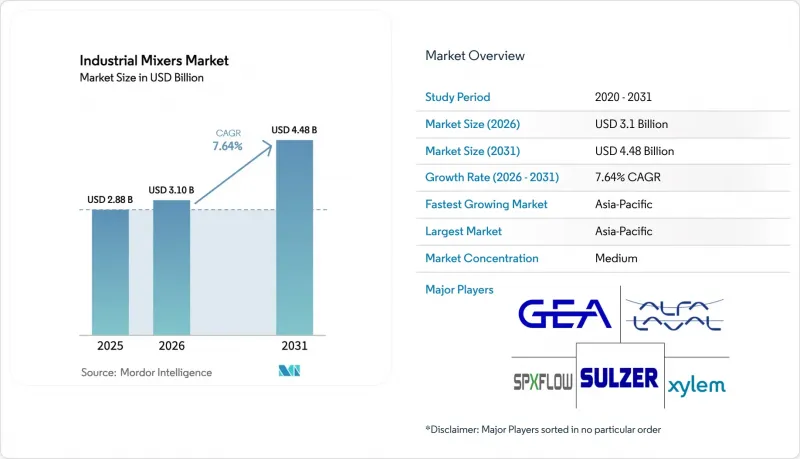
Mordor Intelligence에 의하면, 산업용 믹서 시장 규모는 2025년 28억 8,000만 달러로 평가되었고, 2026년에는 31억 달러로 추정되고, 2026-2031년 CAGR 7.64%로 성장을 지속할 전망이며, 2031년에는 44억 8,000만 달러에 이를 것으로 예측됩니다.
본 보고서는 제품 유형별(교반기, 특수 믹서, 수중 믹서 등), 최종 사용자 산업별(화학, 상하수도, 식품 및 음료, 석유화학, 제약, 에너지 등), 정격 출력별(5kW 미만, 5-15kW, 기타), 지역별(북미, 남미, 유럽, 아시아태평양, 기타)로 분류되어 있습니다. 시장 예측은 금액(달러) 기준으로 제시되어 있습니다.
세계의 산업용 믹서 시장 동향 및 인사이트
식품·제약 업계의 위생 기준 강화
현재 식품·제약 공장에서는 EHEDG 2024개정안 및 FDA 21 CFR 110.35의 요건을 충족하기 위해 전해 연마된 표면, 틈새 없는 용접, 검증된 CIP(정지 세척) 프로토콜이 규정되어 있습니다. 인증된 위생 설계를 제공하는 장비 공급업체는 프리미엄 가격을 확보할 수 있는 반면, 소규모 제조업체는 규정 준수 비용 증가에 직면하고 있습니다. 제약 분야에서는 연속 생산 라인에서 혼합의 균일성이 문서화되어야 하며, 우수 제조 관리 기준(GMP) 감사 하에 검증된 고전단형 및 자기 구동형 믹서의 조달이 촉진되고 있습니다. 구형 교반기를 개조하더라도 검증 기준을 통과하지 못하는 경우가 많아, 그 결과 완전한 교체가 가속화되고 있습니다. 이러한 추세는 경쟁을 심화시키고, 위생 설비를 둘러싼 장기 서비스 계약을 공고히 하고 있습니다.
에너지 효율이 뛰어난 고토크 모터 도입
IE5 동기 릴랙턴스 모터를 가변 주파수 드라이브와 결합함으로써, 기존 유도 모터에 비해 믹서의 에너지 소비를 최대 20% 절감하면서도 고점도 슬러리에 필요한 토크를 공급할 수 있습니다. 규정에 따라 이미 0.75 kW를 초과하는 모터에 대해서는 IE4 이상의 효율이 의무화되어 있으며, 인도와 브라질에서도 유사한 규정이 검토되고 있어 장비 교체가 가속화될 전망입니다. 플랜트 엔지니어들은 인버터를 엣지 분석과 연동하여 저부하 시 회전수를 낮춤으로써, 산업용 믹서 시장 전반에서 씰 수명을 연장하고 전기 요금을 절감하고 있습니다. 모터와 디지털 제어반을 세트로 판매하는 공급업체는 더 높은 이익률을 확보하고, 데이터 기반 서비스 수익을 확대되고 있습니다.
원자재 가격 변동(스테인리스 스틸, 합금)
2024년, 니켈 가격이 톤당 1만 6,500달러에서 2만 달러 사이에서 등락함에 따라 스테인리스 스틸 가격은 15-20% 변동하여 믹서 제조업체의 이익률을 압박했습니다. 하스테로이 C-276 등의 특수 합금도 항공우주 수요에 연동되어 유사한 가격 급등을 보였으며, 각 OEM 업체들은 장기 계약 재협상이나 구매분에 대한 헤지 조치를 취할 수밖에 없었습니다. 대형 공급업체들은 세계 조달 및 재고 통합을 활용하여 비용 충격을 완화하고 있지만, 지역 수탁 제조업체(잡샵)들은 상승한 비용을 가격에 전가하는 데 어려움을 겪고 있으며, 이로 인해 산업용 믹서 업계의 신규 생산 능력 확충이 억제되고 있습니다. 인도네시아나 미국으로 공급망 다각화는 가격을 안정시킬 가능성이 있지만, 그로 인해 기본 원가가 상승하게 되며, 그 비용은 장비 가격에 전가될 것입니다.
부문 분석
교반기는 벌크 화학, 광물 처리, 수처리 업무에서 수십 년에 걸친 성능 데이터를 바탕으로 2025년 산업용 믹서 시장에서 35.85%의 점유율을 차지했습니다. 견고한 프레임과 모듈식 임펠러 라이브러리를 통해 100m3를 초과하는 모든 용기 크기에 대해 경제적인 맞춤 제작이 가능합니다. 교반기의 산업용 믹서 시장 규모는 교체 주기가 점점 더 엄격해지는 위생 및 에너지 기준에 부합함에 따라 꾸준히 성장할 것으로 예측됩니다. 한편, 고전단 믹서는 생명공학 및 첨단 소재 분야의 유화 처리 수요에 힘입어 연평균 성장률(CAGR) 8.05%를 나타낼 것으로 예측됩니다. 인라인형 로터·스테이터 설계를 통해 마이크론 수준의 입자 미세화를 실현하여, 업스트림 공정 장비로는 대응할 수 없는 연속 습식 분쇄 및 사전 분산 처리를 가능하게 하고 있습니다. 각 공급업체는 디지털 트윈에 데이터를 공급하는 실시간 토크 및 온도 센서를 통합하고 있으며, 이를 통해 제약 업계 등 규제 대상 분야에서 스케일업의 정확도가 향상되고 검증 시간이 단축되고 있습니다.
디지털 통합은 모든 제품 라인의 모습을 완전히 바꾸고 있습니다. 교반기 공급업체는 기어박스 하우징과 샤프트에 진동 센서를 내장하여, 그 데이터를 베어링 수명을 예측하는 AI 모델에 제공합니다. 수중 믹서 제조업체는 해수 담수화 플랜트에서 염화물로 인한 응력 균열을 견디면서도 경량화를 도모하기 위해, 복합재로 제작된 슈라우드(shroud)를 채택한 하우징을 재설계하고 있습니다. 일반적으로 에너지 중립적인 정적 믹서나 제트 믹서에는 현재 차압 트랜스미터가 표준으로 장착되어 있어, 운영자는 침입형 프로브를 사용하지 않고도 혼합 강도를 확인할 수 있게 되었습니다. 모든 카테고리에서 IoT 프레임워크를 통해 ‘사용량에 따른 과금(pay-per-mix)’ 방식의 서비스 모델이 가능해졌으며, 각 OEM 업체는 기기 본체뿐만 아니라 가동 시간에 대해서도 과금함으로써 산업용 믹서 시장에서 지속적인 수익원을 확대되고 있습니다.
지역별 분석
아시아태평양은 전 세계 매출의 29.55%를 차지했으며, 2031년까지 연평균 성장률(CAGR) 8.18%를 기록할 전망입니다. 이는 중국과 인도에서 정부 주도로 진행되고 있는 화학 플랜트 설비 증설, 의약품 수출 확대, 지자체 차원의 하수 처리 분야 적극적인 투자를 반영한 결과입니다. 중국에서는 정유시설의 오프가스 수소 재활용을 통해 ATEX 규격의 제트 믹서에 대한 수요가 발생하는 한편, 대규모 막 생물 반응기(MBR) 프로젝트에서는 고효율 수중형 유닛이 지정되고 있습니다. 인도의 원료의약품(API)에 대한 생산 연계형 인센티브 제도는 인라인식 고전단 믹서로 교체하는 것을 촉진하고 있으며, 동남아시아의 팜유 하류 산업 클러스터에서는 탈취 공정을 위해 특수한 교반기가 채택되고 있습니다. 현지 생산을 통해 비용을 절감할 수 있지만, 문서화된 검증이 요구되는 프리미엄 부문에서는 국제적인 OEM 제조업체들이 시장을 독점하고 있습니다.
북미에서는 보스턴, 샌디에이고, 토론토의 생명공학 클러스터를 핵심으로 상당한 규모의 도입 실적이 있습니다. 연속식 생물 제제 제조 라인에는 일회용 유로를 갖춘 위생형 고전단 믹서가 필요한 반면, 셰일 가스 처리에서는 원유의 탈염에 제트 믹서가 활용되고 있습니다. FDA 및 EPA의 엄격한 규제로 인해 에너지 효율이 뛰어난 설계를 우선시하는 갱신 주기가 촉진되고 있습니다. 멕시코의 화학·식품 제조 업계에서는 리드 타임을 최소화하기 위해 니어쇼어 공급망을 활용하여 미국에서 모듈식 교반 스키드를 수입하고 있습니다. 미국의 ‘인플레이션 억제법’에 따라 자금이 지원되는 디지털화 개조를 통해, 산업용 믹서 시장의 기존 설비 전반에 걸쳐 예측 유지보수 모듈에 대한 투자가 촉진되고 있습니다.
유럽에서는 EU 그린딜을 지침으로 삼아 지속가능성과 운영 우수성이 중시되고 있습니다. 각 공장에서는 IE5 모터, 자기 커플링 씰, 환경 제품 선언(EPD)에 따라 인증된 저탄소 스테인리스 합금을 채택하고 있습니다. 독일과 네덜란드의 케미컬 파크에서는 플랜트 전체의 디지털 트윈과 연동되는 믹서가 우선적으로 채택되고 있습니다. 수소 전해 장치에 대한 ATEX·IECEx 규제로 인해 인증 비용은 증가하고 있지만, 견고한 문서 관리 시스템을 갖춘 기존 공급업체를 보호하는 역할도 하고 있습니다. 순환 경제 이니셔티브에 따라 플라스틱 재활용, 혐기성 소화, 유기 비료 생산 분야에서 믹서에 대한 수요가 확대되고 있습니다. 이러한 요인들이 복합적으로 작용하여 유럽의 산업용 믹서 시장에는 균형 잡히고 기술 집약적인 전망이 제시되고 있습니다.
기타 혜택 :
- 엑셀 형식 시장 예측(ME) 시트
- 3개월간의 애널리스트 지원
자주 묻는 질문
목차
제1장 서론
제2장 조사 방법
제3장 주요 요약
제4장 시장 구도
제5장 시장 규모 및 성장 예측
제6장 경쟁 구도
제7장 시장 기회 및 향후 전망
AJY 26.09.15According to Mordor Intelligence, the industrial mixers market size is expected to grow from USD 2.88 billion in 2025 to USD 3.1 billion in 2026 and is forecast to reach USD 4.48 billion by 2031 at 7.64% CAGR over 2026-2031.
This report is Segmented by Product Type (Agitators, Special Mixers, Submersible Mixers, and More), End-User Industry (Chemicals, Water and Wastewater, Food and Beverage, Petrochemicals, Pharmaceuticals, Energy, and More), Power Rating (< 5 KW, 5-15 KW, and More), and Geography (North America, South America, Europe, Asia-Pacific, and More). The Market Forecasts are Provided in Terms of Value (USD).
Global Industrial Mixers Market Trends and Insights
Stricter Sanitary Mandates in Food and Pharma
Food-grade and pharmaceutical plants now specify electropolished surfaces, crevice-free welds, and validated clean-in-place protocols to satisfy EHEDG 2024 updates and FDA 21 CFR 110.35 requirements. Equipment suppliers that deliver certified hygienic designs secure premium pricing while smaller fabricators face rising compliance costs. In pharmaceuticals, continuous production lines rely on documented mixing uniformity, driving the procurement of high-shear and magnetically driven mixers that are validated under good manufacturing practice audits. Retrofits to legacy agitators often fail validation, accelerating outright replacement. This dynamic strengthens competitive barriers and cements long-term service contracts around sanitary assets.
Energy-Efficient High-Torque Motor Adoption
IE5 synchronous reluctance motors, paired with variable-frequency drives, reduce mixer energy draw by up to 20% compared to legacy induction units, while delivering the torque needed for high-viscosity slurries. Regulations already mandate IE4 minimum efficiency above 0.75 kW, and similar rules under discussion in India and Brazil will accelerate fleet renewal. Plant engineers link drives to edge analytics that reduce speed during low-load phases, extending seal life and lowering power bills across the industrial mixer market. Vendors that bundle motors with digital control panels command higher margins and cultivate data-driven service revenues.
Raw-Material Price Volatility (Stainless Steel, Alloys)
Stainless steel prices fluctuated by 15-20% in 2024 as nickel prices traded between USD 16,500 and USD 20,000 per metric ton, eroding margins for mixer fabricators. Specialty alloys, such as Hastelloy C-276, followed similar spikes tied to aerospace demand, forcing OEMs to renegotiate long-term frame contracts and hedge their purchases. Larger vendors leverage global procurement and inventory pooling to buffer cost shocks, but regional job shops struggle to pass increases through, curbing new capacity additions in the industrial mixers industry. Supply-chain diversification into Indonesia and the United States may stabilize pricing, but it introduces higher baseline costs that will be passed through to equipment prices.
Other drivers and restraints analyzed in the detailed report include:
- Surge in Wastewater Recycling Capacity Additions
- Bioreactor Retrofits for Cultivated-Meat Pilots
- High Capex vs. Alternative Inline Dosing Systems
For complete list of drivers and restraints, kindly check the Table Of Contents.
Segment Analysis
Agitators commanded a 35.85% share of the industrial mixers market in 2025, underpinned by decades of performance data in bulk chemical, mineral processing, and water treatment operations. Their robust frames and modular impeller libraries allow economical customization across vessel sizes exceeding 100 m3. The industrial mixers market size for agitators is expected to grow steadily as replacement cycles align with increasingly stringent sanitary and energy norms. High-shear mixers, however, are expected to grow at an 8.05% CAGR, driven by demand for emulsification in biotechnology and advanced materials. Inline rotor-stator designs deliver micron-level particle reduction, supporting continuous wet-milling and pre-dispersion tasks that upstream equipment cannot meet. Suppliers integrate real-time torque and temperature sensors that feed digital twins, thereby improving scale-up accuracy and reducing validation time in regulated segments, such as the pharmaceutical industry.
Digital integration reshapes every product line. Agitator vendors embed vibration sensors on gearbox housings and shafts, feeding AI models that forecast bearing life. Submersible mixer makers redesign housings with composite shrouds that cut weight while resisting chloride stress cracking in seawater desalination plants. Static and jet mixers, which are normally energy-neutral, now ship with differential-pressure transmitters that allow operators to verify mixing intensity without intrusive probes. Across categories, IoT frameworks enable pay-per-mix service models, where OEMs bill for uptime rather than equipment alone, thereby expanding recurring revenue streams within the industrial mixers market.
Complete Report Scope:
- By Product Type
- Agitators
- Special Mixers
- Submersible Mixers
- High-shear Mixers
- Static Mixers
- Jet Mixers
- Other Product Types
- By End-User Industry
- Chemicals
- Water and Wastewater
- Food and Beverage
- Petrochemicals
- Pharmaceuticals
- Pulp and Paper
- Energy (Power and Renewables)
- Mining and Minerals
- Other Process Industries
- By Power Rating
- < 5 kW
- 5 - 15 kW
- 15 - 50 kW
- > 50 kW
- By Geography
- North America
- United States
- Canada
- Mexico
- South America
- Brazil
- Argentina
- Rest of South America
- Europe
- Germany
- United Kingdom
- France
- Italy
- Rest of Europe
- Asia-Pacific
- China
- Japan
- India
- South Korea
- South-East Asia
- Rest of Asia-Pacific
- Middle East and Africa
- Middle East
- Saudi Arabia
- United Arab Emirates
- Rest of Middle East
- Africa
- South Africa
- Egypt
- Rest of Africa
- Middle East
- North America
Geography Analysis
Asia-Pacific holds 29.55% of global revenue and is on track for an 8.18% CAGR through 2031, reflecting government-backed chemical capacity additions, expanding pharmaceutical exports, and aggressive municipal wastewater spending in China and India. In China, refinery off-gas hydrogen recycling creates demand for ATEX-compliant jet mixers, while mega-sized membrane bioreactor projects specify high-efficiency submersible units. India's production-linked incentive scheme for active pharmaceutical ingredients stimulates upgrades to inline high-shear mixers, and Southeast Asia's palm-oil downstream clusters adopt special agitators for deodorization stages. Local fabrication lowers cost, but international OEMs dominate premium tiers that demand documented validation.
North America commands a sizable installed base anchored by biotech clusters in Boston, San Diego, and Toronto. Continuous biologic manufacturing lines require sanitary high-shear mixers with single-use flow paths, while shale gas processing relies on jet mixers for crude desalting. Stringent FDA and EPA regulations promote replacement cycles that favor energy-efficient designs. Mexico's chemical and food manufacturing industries import modular mixing skids from the United States, utilizing near-shore supply chains to minimize lead times. Digital retrofits funded under the U.S. Inflation Reduction Act channel investment toward predictive maintenance modules across legacy fleets within the industrial mixers market.
Europe emphasizes sustainability and operational excellence, guided by the EU Green Deal. Plants adopt IE5 motors, magnetically coupled seals, and low-carbon stainless alloys certified under environmental product declarations. Chemical parks in Germany and the Netherlands prioritize mixers that integrate with plant-wide digital twins. ATEX and IECEx mandates for hydrogen electrolysis units increase certification costs, yet they also protect incumbent suppliers with robust documentation systems. Circular economy initiatives are expanding demand for mixers in plastic recycling, anaerobic digestion, and organic fertilizer production. Collectively, these drivers promote a balanced yet technologically intensive outlook for the industrial mixer market in Europe.
- SPX FLOW Inc.
- Sulzer Ltd.
- Alfa Laval AB
- Xylem Inc.
- GEA Group AG
- EKATO HOLDING GmbH
- Philadelphia Mixing Solutions Ltd.
- Charles Ross & Son Company
- Silverson Machines Inc.
- IKA-Werke GmbH & Co. KG
- amixon GmbH
- Komax Systems Inc.
- Landia A/S
- Satake Chemical Equipment Mfg. Ltd.
- Dynamix Agitators Inc.
- Statiflo International Ltd.
- Scott Turbon Mixer Inc.
- INOXPA S.A.U.
- Enviropax Inc.
- Arde Barinco Inc.
- ITT Bornemann GmbH
- Zhejiang Great Wall Mixers Co., Ltd.
Additional Benefits:
- The market estimate (ME) sheet in Excel format
- 3 months of analyst support
TABLE OF CONTENTS
1 INTRODUCTION
- 1.1 Study Assumptions and Market Definition
- 1.2 Scope of the Study
2 RESEARCH METHODOLOGY
3 EXECUTIVE SUMMARY
4 MARKET LANDSCAPE
- 4.1 Market Overview
- 4.2 Market Drivers
- 4.2.1 Stricter sanitary mandates in food and pharma
- 4.2.2 Energy-efficient high-torque motor adoption
- 4.2.3 Surge in wastewater recycling capacity additions
- 4.2.4 Bioreactor retrofits for cultivated-meat pilots
- 4.2.5 On-site chemical blending for battery-grade materials
- 4.2.6 Modular "mix-on-demand" skids for remote mining camps
- 4.3 Market Restraints
- 4.3.1 Raw-material price volatility (stainless steel, alloys)
- 4.3.2 High capex vs. alternative inline dosing systems
- 4.3.3 Rising ATEX/IECEx certification costs for hydrogen hubs
- 4.3.4 Skilled-operator shortage for large-diameter agitators
- 4.4 Supply-Chain Analysis
- 4.5 Regulatory Landscape
- 4.6 Technological Outlook
- 4.7 Porter's Five Forces Analysis
- 4.7.1 Bargaining Power of Suppliers
- 4.7.2 Bargaining Power of Buyers
- 4.7.3 Threat of New Entrants
- 4.7.4 Threat of Substitutes
- 4.7.5 Intensity of Competitive Rivalry
- 4.8 Impact of Macroeconomic Factors
- 4.9 Investment Analysis
5 MARKET SIZE AND GROWTH FORECASTS (VALUE)
- 5.1 By Product Type
- 5.1.1 Agitators
- 5.1.2 Special Mixers
- 5.1.3 Submersible Mixers
- 5.1.4 High-shear Mixers
- 5.1.5 Static Mixers
- 5.1.6 Jet Mixers
- 5.1.7 Other Product Types
- 5.2 By End-User Industry
- 5.2.1 Chemicals
- 5.2.2 Water and Wastewater
- 5.2.3 Food and Beverage
- 5.2.4 Petrochemicals
- 5.2.5 Pharmaceuticals
- 5.2.6 Pulp and Paper
- 5.2.7 Energy (Power and Renewables)
- 5.2.8 Mining and Minerals
- 5.2.9 Other Process Industries
- 5.3 By Power Rating
- 5.3.1 < 5 kW
- 5.3.2 5 - 15 kW
- 5.3.3 15 - 50 kW
- 5.3.4 > 50 kW
- 5.4 By Geography
- 5.4.1 North America
- 5.4.1.1 United States
- 5.4.1.2 Canada
- 5.4.1.3 Mexico
- 5.4.2 South America
- 5.4.2.1 Brazil
- 5.4.2.2 Argentina
- 5.4.2.3 Rest of South America
- 5.4.3 Europe
- 5.4.3.1 Germany
- 5.4.3.2 United Kingdom
- 5.4.3.3 France
- 5.4.3.4 Italy
- 5.4.3.5 Rest of Europe
- 5.4.4 Asia-Pacific
- 5.4.4.1 China
- 5.4.4.2 Japan
- 5.4.4.3 India
- 5.4.4.4 South Korea
- 5.4.4.5 South-East Asia
- 5.4.4.6 Rest of Asia-Pacific
- 5.4.5 Middle East and Africa
- 5.4.5.1 Middle East
- 5.4.5.1.1 Saudi Arabia
- 5.4.5.1.2 United Arab Emirates
- 5.4.5.1.3 Rest of Middle East
- 5.4.5.2 Africa
- 5.4.5.2.1 South Africa
- 5.4.5.2.2 Egypt
- 5.4.5.2.3 Rest of Africa
- 5.4.5.1 Middle East
- 5.4.1 North America
6 COMPETITIVE LANDSCAPE
- 6.1 Market Concentration
- 6.2 Strategic Moves
- 6.3 Market Share Analysis
- 6.4 Company Profiles (includes Global Level Overview, Market Level Overview, Core Segments, Financials as available, Strategic Information, Market Rank/Share for key companies, Products and Services, and Recent Developments)
- 6.4.1 SPX FLOW Inc.
- 6.4.2 Sulzer Ltd.
- 6.4.3 Alfa Laval AB
- 6.4.4 Xylem Inc.
- 6.4.5 GEA Group AG
- 6.4.6 EKATO HOLDING GmbH
- 6.4.7 Philadelphia Mixing Solutions Ltd.
- 6.4.8 Charles Ross & Son Company
- 6.4.9 Silverson Machines Inc.
- 6.4.10 IKA-Werke GmbH & Co. KG
- 6.4.11 amixon GmbH
- 6.4.12 Komax Systems Inc.
- 6.4.13 Landia A/S
- 6.4.14 Satake Chemical Equipment Mfg. Ltd.
- 6.4.15 Dynamix Agitators Inc.
- 6.4.16 Statiflo International Ltd.
- 6.4.17 Scott Turbon Mixer Inc.
- 6.4.18 INOXPA S.A.U.
- 6.4.19 Enviropax Inc.
- 6.4.20 Arde Barinco Inc.
- 6.4.21 ITT Bornemann GmbH
- 6.4.22 Zhejiang Great Wall Mixers Co., Ltd.
7 MARKET OPPORTUNITIES AND FUTURE OUTLOOK
- 7.1 White-space and Unmet-Need Assessment