

|
시장보고서
상품코드
2125519
팽창성 흑연 : 시장 점유율 분석, 업계 동향 및 통계, 성장 예측(2026-2031년)Expandable Graphite - Market Share Analysis, Industry Trends & Statistics, Growth Forecasts (2026 - 2031) |
||||||
 Mordor Intelligence
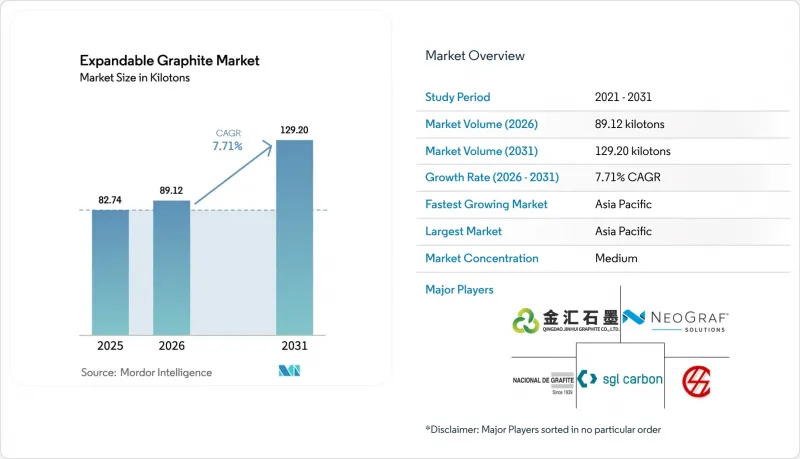
Mordor Intelligence에 의하면, 팽창성 흑연 시장 규모는 2025년 82.74 킬로톤으로 평가되었습니다. 2026년에는 89.12 킬로톤으로 확대되어 2026년부터 2031년에 걸쳐 CAGR 7.71%로 성장을 지속하여, 2031년에는 129.20 킬로톤에 이를 것으로 예측됩니다.
본 보고서는 용도별(난연제, 플렉서블 포일, 전도성 첨가제 등), 최종 이용 산업별(건축 및 건설, 전자·에너지 저장, 자동차 및 운송 등), 지역별(아시아태평양, 북미, 유럽, 남미, 중동 및 아프리카)로 분류되어 있습니다. 시장 예측은 수량(톤) 단위로 표시됩니다.
세계의 팽창성 흑연 시장 동향 및 인사이트
무할로겐 난연제 채택이 급증
대서양을 사이에 둔 양 지역의 규제 당국은 브롬계 및 염소계 첨가제의 단계적 폐지를 추진하고 있습니다. 유럽화학물질청(ECHA)은 2024년, HBCDD에 관한 REACH 부속서 XVII 규제를 확정하고, 배합 제조업체들에게 폴리스티렌 발포체 및 폴리우레탄 코팅에서 팽창성 시스템으로의 전환을 촉구했습니다. 캘리포니아주의 ‘프로포지션 65’ 목록에 따른 유사한 움직임과 미국 환경보호청(EPA)의 지속적인 재검토로 인해, 북미의 전자제품 OEM 기업들은 250 mL/g을 초과하는 팽창률을 실현하는 팽창성 흑연 등급으로의 전환을 강요받고 있습니다. REACH 규정의 대부분이 2024년 중반에 발효됨에 따라, 특히 전선 및 케이블의 절연재나 인쇄회로기판용 라미네이트 분야에서 팽창성 흑연과 폴리인산암모늄의 시너지 효과를 발휘하는 블렌드에 대한 수요가 현재 급속히 증가하고 있습니다. 독일과 네덜란드에서는 공공 인프라에서 할로겐계 난연제 사용이 이미 금지되었으나, 비용에 민감한 남유럽 시장에서는 여전히 기존 첨가제가 선호되고 있어 전환에는 수년이 소요될 것으로 예측됩니다.
EV 배터리와 열 관리의 붐
EV용 배터리 팩은 국부적인 열류를 발생시키지만, 알루미늄이나 구리 재질의 방열판으로는 허용할 수 없는 정도의 중량 증가를 동반하지 않고는 이를 방출할 수 없습니다. 팽창성 흑연을 유연한 박막으로 압축함으로써, 밀도 1.9 g/cm³ 미만에서 300 W/m*K를 초과하는 열전도율을 실현하여, 원통형 또는 각형 셀 간의 인터페이스를 얇게 만들 수 있게 됩니다. 국제에너지기구(IEA)는 넷 제로 시나리오 하에서 2040년까지 배터리 등급 흑연 수요가 4배로 증가할 것으로 예측하고 있으며, 열 관리 용도가 그 점유율을 확대해 나갈 것으로 전망됩니다. 각 자동차 제조업체들은 800볼트 시스템의 셀-투-팩(Cell-to-Pack) 아키텍처를 위해 팽창성 흑연 박의 적합성 평가를 진행하고 있습니다. 한편, 유럽과 미국의 OEM 업체들은 미국의 조달 인센티브에 대응하기 위해 국내 정제 능력에 대한 투자를 진행하고 있으며, Graphite One사의 오하이오주 시설이 그 대표적인 예입니다. 이처럼 배터리와 열 관리공급망이 융합됨에 따라 팽창성 흑연 시장은 지속적인 성장 궤도에 올라섰습니다.
점보 플레이크 흑연공급 제약
팽창성 흑연은 +80 메쉬의 점보 플레이크에 의존하고 있으나, 이는 천연 흑연 생산량의 15% 미만을 차지할 뿐이며, 더 미세한 등급에 비해 30%-50%의 프리미엄 가격이 책정되어 있습니다. 중국은 헤이룽장성과 내몽골 자치구의 매장량을 장악하고 있지만, 환경 검사 및 생산 할당량으로 인해 2024년 이후의 생산 증가율은 5% 미만으로 억제되고 있습니다. 미국은 여전히 전적으로 수입에 의존하고 있으며, 2024년에는 공급량의 43%를 중국에서 조달했습니다. 모잠비크의 바라마 및 탄자니아의 에판코 프로젝트에서 확보된 신규 생산 능력은 대안이 될 수 있으나, 물류 문제, 항만 혼잡, 불규칙한 철도 운행으로 인해 비용이 최대 15%까지 상승하여 난연제 및 호일 제조업체에 대한 공급을 제약하고 있습니다.
부문별 분석
난연제용 컴파운드는 2025년 출하량의 45.97%를 차지하며, 2031년까지 연평균 8.05%의 성장률을 보일 것으로 예측됩니다. 이러한 압도적인 지위는 브롬계 첨가물의 규제에 따른 사용 금지 외에도, 팽창성 흑연이 15%-25%의 배합 비율로 팽창성을 발휘하여 UL 94 V-0 규격을 쉽게 달성할 수 있기 때문입니다. 플렉서블 호일의 용도는 팽창성 흑연 시장 규모에서 차지하는 비중은 작지만, 높은 순도와 캘린더 가공 사양이 요구되기 때문에 가격은 3-5배 더 비쌉니다. 박 시장 성장률은 약 6.5%로 다소 둔화되고 있지만, 전기차(EV)의 열 관리 및 반도체 패키징 분야에서의 채택 확대에 힘입어 호조를 보이고 있습니다.
리튬 이온 배터리 전극 및 폴리머 복합재용 전도성 첨가제는 에너지 저장 분야의 확대와 전기자동차 부품에서 경량 전도성 필러에 대한 수요에 힘입어 가장 빠르게 성장하고 있는 틈새 시장입니다. 한때 천연 흑연의 주요 용도였던 야금 용도는 철강 제조업체들이 입자 크기 분포가 더 좁은 합성 탄소로 전환하고 있기 때문에 현재는 미미한 점유율에 그치고 있습니다. 팽창성 흑연을 이용한 그래핀의 실험적 생산은 수율이 10% 미만이고 용매 비용도 높기 때문에 상업적으로는 아직 미성숙한 상태입니다.
지역별 분석
아시아태평양은 2025년 생산량의 57.51%를 차지했으며, 2031년까지 연평균 8.19%의 성장률을 보일 것으로 예측되어 팽창성 흑연 시장에서 주도적인 입지를 공고히 할 전망입니다. 칭다오의 ‘흑룡·금휘·연신·명하다’ 클러스터는 점보 플레이크 광산과의 근접성과 성숙한 황산 공급망을 활용하여 전 세계 팽창성 흑연 생산량의 70%를 생산하고 있습니다. 2023년 12월 중국이 도입한 수출 허가 제도는 국내 수취를 촉진하고 해외 공급을 위축시켜, 유럽과 미국의 바이어들에게 조달처 다각화를 촉진했습니다. 일본과 한국은 고순도 포일에 주력하고 있으며, 스마트폰 및 반도체 생산량이 증가함에 따라 일본의 흑연 시트 시장은 2030년까지 2배인 4억 달러에 달할 전망입니다. 인도의 ‘생산 연계형 인센티브(PLI)’ 제도는 2026년 말까지 연간 1만 톤의 생산을 목표로 하는 틸파티 그래파이트(Tilpatti Graphite)사의 사갈(Sagar) 프로젝트를 뒷받침하고 있습니다.
북미 시장 점유율은 OEM 각사가 ‘인플레이션 억제법’의 조달 규정을 준수함에 따라 대폭 확대될 전망입니다. 그래파이트 원(Graphite One)사가 2026년 말 완공을 예정하고 있는 4억 3,500만 달러 규모의 오하이오주 가공 공장은 85에이커 부지와 복합 물류 시스템을 활용하여 합성 음극재 및팽창성 흑연을 연간 2만 5,000톤 생산하는 것을 목표로 하고 있습니다. 캐나다에서는 퀘벡주와 온타리오주의 광상이 조사되고 있으나, 상업적 채굴을 시작하기까지는 아직 수년이 소요될 것으로 예상되므로 당분간은 수입에 대한 의존이 지속될 전망입니다. 멕시코의 자동차용 와이어 하네스 시장은 지역 공급망 내에서 무할로겐 난연제에 대한 수요 증가를 여실히 보여주고 있습니다.
유럽 시장 점유율(수량 기준)은 독일, 프랑스, 영국이 주도하고 있습니다. EU의 건설 제품 규정에서는 EN 13501 인증을 취득한 팽창성 도료의 사용이 의무화되어 있어, 인증된 시험 데이터를 보유하지 않은 신규 진출기업에게는 진입 장벽이 높게 작용하고 있습니다. 스칸디나비아 국가들에서는 에너지 절약 건물 개보수에 대한 보조금 제도 덕분에 무할로겐 단열재의 채택이 진행되고 있지만, 남유럽 국가들에서는 여전히 가격에 대한 민감성이 나타나고 있습니다. 동유럽에서는 EU 결속 기금의 자금 지원을 받은 재생에너지용 케이블 부설에 따라 수요가 증가하고 있습니다.
기타 혜택 :
- 엑셀 형식 시장 예측(ME) 시트
- 3개월간의 애널리스트 지원
자주 묻는 질문
목차
제1장 서론
제2장 조사 방법
제3장 주요 요약
제4장 시장 구도
제5장 시장 규모 및 성장 예측(수량)
제6장 경쟁 구도
제7장 시장 기회 및 향후 전망
KTH 26.09.16According to Mordor Intelligence, the expandable graphite market size is expected to grow from 82.74 kilotons in 2025 to 89.12 kilotons in 2026 and is forecast to reach 129.20 kilotons by 2031 at a 7.71% CAGR over 2026-2031.
This report is Segmented by Application (Flame Retardant, Flexible Foils, Conductive Additives, and More), End-Use Industry (Building and Construction, Electronics and Energy Storage, Automotive and Transportation, and More), and Geography (Asia-Pacific, North America, Europe, South America, and the Middle East and Africa). Market Forecasts are Provided in Terms of Volume (tons).
Global Expandable Graphite Market Trends and Insights
Halogen-free Flame-retardant Adoption Surge
Regulators on both sides of the Atlantic are phasing out brominated and chlorinated additives. The European Chemicals Agency finalized REACH Annex XVII restrictions on HBCDD in 2024, compelling formulators to pivot toward intumescent systems in polystyrene foams and polyurethane coatings. Similar momentum in California's Proposition 65 list and ongoing US EPA reviews drives North American electronics OEMs toward expandable graphite grades that deliver expansion ratios above 250 mL/g. Because most REACH provisions entered force in mid-2024, demand for synergistic blends of expandable graphite and ammonium polyphosphate is now ramping quickly, particularly in wire-and-cable insulation and printed-circuit-board laminates. Germany and the Netherlands have already banned halogenated flame retardants in public infrastructure, yet cost-sensitive Southern European markets still favor legacy additives, suggesting a multi-year conversion window.
EV Battery and Thermal-management Boom
EV battery packs produce localized heat fluxes that aluminum or copper spreaders cannot dissipate without unacceptable mass penalties. Compressing expandable graphite into flexible foils achieves thermal conductivities above 300 W/m*K at densities below 1.9 g/cm3, supporting thinner interfaces between cylindrical or prismatic cells. The International Energy Agency projects that battery-grade graphite demand will quadruple by 2040 under net-zero scenarios, with thermal-management applications capturing an increasing slice. Automakers are qualifying expandable-graphite foils for cell-to-pack architectures in 800-volt systems, while Western OEMs finance domestic purification capacity, Graphite One's Ohio facility is a prime example, to align with US sourcing incentives. This convergence of battery and thermal-management supply chains positions the expandable graphite market for durable expansion.
Supply Constraints in Jumbo-flake Graphite
Expandable graphite relies on +80 mesh jumbo flake, which represents less than 15% of natural-graphite output and commands premiums of 30%-50% over finer grades. China dominates reserves in Heilongjiang and Inner Mongolia, yet environmental inspections and output quotas capped production growth below 5% after 2024. The United States remains fully import-reliant, sourcing 43% of its supply from China in 2024. New capacity in Mozambique's Balama and Tanzania's Epanko projects offers alternatives, but logistics challenges, port congestion, and irregular rail services inflate costs by up to 15%, constraining supply for flame-retardant and foil producers.
Other drivers and restraints analyzed in the detailed report include:
- Tightening Global Fire-safety Codes
- Demand for High-conductivity Foils in Electronics
- Price Volatility of Flake and Intercalation Reagents
For complete list of drivers and restraints, kindly check the Table Of Contents.
Segment Analysis
Flame-retardant compounds accounted for 45.97% of the 2025 volume and are projected to expand at 8.05% to 2031. This dominant position stems from regulatory bans on brominated additives and the ability of expandable graphite to deliver intumescence at 15%-25% loading levels, easily achieving UL 94 V-0 ratings. Flexible foil applications, while representing a smaller slice of the expandable graphite market size, command 3-5 times higher pricing because of demanding purity and calendaring specifications. Foil growth lags at roughly 6.5% but benefits from rising EV thermal-management and semiconductor packaging deployments.
Conductive additives for lithium-ion electrodes and polymer composites are the fastest-growing niche, driven by energy-storage expansion and a need for lightweight conductive fillers in electric-vehicle components. Metallurgy applications, once the primary outlet for natural graphite, now contribute a modest share as steelmakers shift to synthetic carbons with tighter particle-size distributions. Experimental graphene production from expandable graphite remains commercially immature because yields are below 10% and solvent costs are high.
Complete Report Scope:
- By Application
- Flame Retardant
- Flexible Foils
- Conductive Additives
- Metallurgy
- Graphene
- By End-use Industry
- Building and Construction
- Electronics and Energy Storage
- Automotive and Transportation
- Chemical and Petrochemical Processing
- Others (Aerospace, Biomedical)
- By Geography
- Asia-Pacific
- China
- Japan
- South Korea
- India
- Rest of Asia-Pacific
- North America
- United States
- Canada
- Mexico
- Europe
- Germany
- United Kingdom
- France
- Italy
- Rest of Europe
- South America
- Brazil
- Argentina
- Rest of South America
- Middle East and Africa
- Saudi Arabia
- South Africa
- Rest of Middle East and Africa
- Asia-Pacific
Geography Analysis
Asia-Pacific commanded 57.51% of 2025 volume and is forecast to grow at 8.19% to 2031, cementing its leadership in the expandable graphite market. Qingdao's cluster of Heilong, Jinhui, Yanxin, and Mingheda leverages proximity to jumbo-flake mines and mature sulfuric-acid supply chains, producing as much as 70% of global expandable-graphite output. China's December 2023 export license regime incentivized local offtake, tightened external supply, and nudged Western buyers to diversify. Japan and South Korea focus on high-purity foils; Japan's graphite-sheet market will double to USD 400 million by 2030 as smartphone and semiconductor output climbs. India's Production-Linked Incentive scheme spurs Tirupati Graphite's Sagar project, aimed at 10,000 tonnes per year by late 2026.
North America's market share should grow substantially as OEMs align with the Inflation Reduction Act sourcing rules. Graphite One's USD 435 million Ohio processing plant, set for late 2026 completion, targets 25,000 tonnes of synthetic anode and expandable graphite, leveraging an 85-acre site with multimodal logistics. Although Canada investigates Quebec and Ontario deposits, commercial extraction remains years away, preserving near-term import reliance. Mexico's automotive wire-harness market illustrates demand growth for halogen-free flame retardants in the regional supply chain.
Europe's market share volume is led by Germany, France, and the United Kingdom. The EU Construction Products Regulation mandates EN 13501-certified intumescent coatings, elevating barriers for entrants lacking accredited test data. Scandinavian retrofit subsidies for energy-efficient buildings drive halogen-free insulation uptake, whereas Southern Europe remains price sensitive. Eastern European demand rises in renewable-energy cable installations financed by EU cohesion funds.
- BariteWorld
- KAIYU INDUSTRIAL (HK) LIMITED (Nanjing GRF Carbon Material Co. Ltd)
- Metachem Manufacturing Company Pvt. Ltd
- Nacional de Grafite
- NeoGraf
- Qingdao Heilong Graphite Group Co., Ltd.
- Qingdao Jinhui Graphite Co. Ltd
- QINGDAO MINGHEDA GRAPHITE NEW MATERIAL CO. LTD
- QINGDAO YANXIN GRAPHITE PRODUCTS CO. LTD
- SGL Carbon
- Shijiazhuang ADT Carbonic Material Factory
- TIRUPATI GRAPHITE PLC
- Yichang Xincheng Graphite Co. Ltd
Additional Benefits:
- The market estimate (ME) sheet in Excel format
- 3 months of analyst support
TABLE OF CONTENTS
1 Introduction
- 1.1 Study Assumptions and Market Definition
- 1.2 Scope of the Study
2 Research Methodology
3 Executive Summary
4 Market Landscape
- 4.1 Market Overview
- 4.2 Market Drivers
- 4.2.1 Increasing adoption as halogen-free flame-retardant additive
- 4.2.2 Rapid growth of EV battery and thermal-management supply chain
- 4.2.3 Construction codes tightening fire-safety requirements globally
- 4.2.4 Demand for high-conductivity foils in consumer electronics
- 4.2.5 Circular-economy push for recycled graphite feedstocks
- 4.3 Market Restraints
- 4.3.1 Supply-constrained natural jumbo flake graphite
- 4.3.2 Price volatility of flake graphite and intercalation reagents
- 4.3.3 Stricter wastewater/acid-emission regulations on intercalation plants
- 4.4 Value Chain Analysis
- 4.5 Porter's Five Forces
- 4.5.1 Bargaining Power of Suppliers
- 4.5.2 Bargaining Power of Buyers
- 4.5.3 Threat of New Entrants
- 4.5.4 Threat of Substitutes
- 4.5.5 Degree of Competition
5 Market Size and Growth Forecasts ( Volume)
- 5.1 By Application
- 5.1.1 Flame Retardant
- 5.1.2 Flexible Foils
- 5.1.3 Conductive Additives
- 5.1.4 Metallurgy
- 5.1.5 Graphene
- 5.2 By End-use Industry
- 5.2.1 Building and Construction
- 5.2.2 Electronics and Energy Storage
- 5.2.3 Automotive and Transportation
- 5.2.4 Chemical and Petrochemical Processing
- 5.2.5 Others (Aerospace, Biomedical)
- 5.3 By Geography
- 5.3.1 Asia-Pacific
- 5.3.1.1 China
- 5.3.1.2 Japan
- 5.3.1.3 South Korea
- 5.3.1.4 India
- 5.3.1.5 Rest of Asia-Pacific
- 5.3.2 North America
- 5.3.2.1 United States
- 5.3.2.2 Canada
- 5.3.2.3 Mexico
- 5.3.3 Europe
- 5.3.3.1 Germany
- 5.3.3.2 United Kingdom
- 5.3.3.3 France
- 5.3.3.4 Italy
- 5.3.3.5 Rest of Europe
- 5.3.4 South America
- 5.3.4.1 Brazil
- 5.3.4.2 Argentina
- 5.3.4.3 Rest of South America
- 5.3.5 Middle East and Africa
- 5.3.5.1 Saudi Arabia
- 5.3.5.2 South Africa
- 5.3.5.3 Rest of Middle East and Africa
- 5.3.1 Asia-Pacific
6 Competitive Landscape
- 6.1 Market Concentration
- 6.2 Strategic Moves
- 6.3 Market Share (%)/Ranking Analysis
- 6.4 Company Profiles (includes Global level Overview, Market level overview, Core Segments, Financials as available, Strategic Information, Market Rank/Share for key companies, Products and Services, and Recent Developments)
- 6.4.1 BariteWorld
- 6.4.2 KAIYU INDUSTRIAL (HK) LIMITED (Nanjing GRF Carbon Material Co. Ltd)
- 6.4.3 Metachem Manufacturing Company Pvt. Ltd
- 6.4.4 Nacional de Grafite
- 6.4.5 NeoGraf
- 6.4.6 Qingdao Heilong Graphite Group Co., Ltd.
- 6.4.7 Qingdao Jinhui Graphite Co. Ltd
- 6.4.8 QINGDAO MINGHEDA GRAPHITE NEW MATERIAL CO. LTD
- 6.4.9 QINGDAO YANXIN GRAPHITE PRODUCTS CO. LTD
- 6.4.10 SGL Carbon
- 6.4.11 Shijiazhuang ADT Carbonic Material Factory
- 6.4.12 TIRUPATI GRAPHITE PLC
- 6.4.13 Yichang Xincheng Graphite Co. Ltd
7 Market Opportunities and Future Outlook
- 7.1 White-space and Unmet-need Assessment


