

|
시장보고서
상품코드
2125554
소형 상용차(LCV) : 시장 점유율 분석, 업계 동향 및 통계, 성장 예측(2026-2031년)Light Commercial Vehicles - Market Share Analysis, Industry Trends & Statistics, Growth Forecasts (2026 - 2031) |
||||||
 Mordor Intelligence
에 의하면, 소형 상용차(LCV) 시장 규모는 2025년 4,954억 4,000만 달러로 평가되었습니다. 2026년에는 5,257억 1,000만 달러로 확대되어 2026년부터 2031년에 걸쳐 CAGR 6.11%로 성장을 지속하여, 2031년에는 7,071억 7,000만 달러에 이를 것으로 예측됩니다.
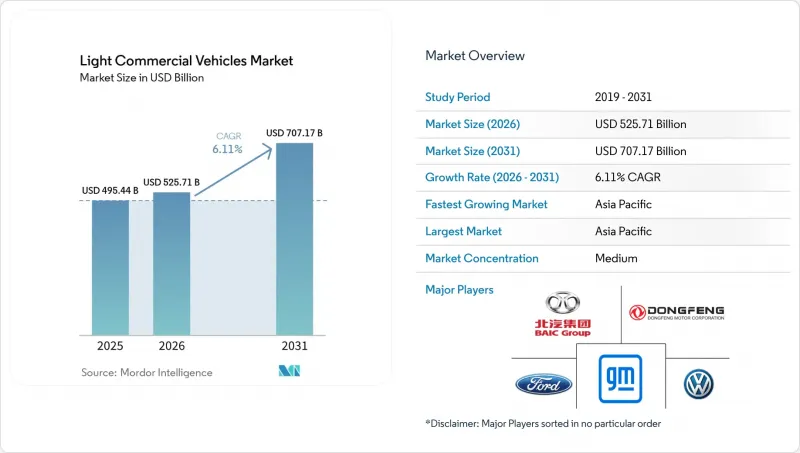
본 보고서는 차량 유형(픽업 트럭·밴), 추진 방식(내연기관차, 하이브리드, 배터리 전기차, 연료전지 전기차), 용도(상업용 배송·물류 등), 소유 형태(플릿 소유 등), 적재량(2.5t 이하·그 이상), 지역별로 분류되어 있습니다. 시장 전망은 금액(달러) 및 수량(대)으로 제시되어 있습니다.
세계의 소형 상용차(LCV) 시장 동향 및 인사이트
재정적 인센티브가 수반되는 엄격한 전 세계 CO₂·NOx 규제
2025년 중반부터 유로 7 규격에서는 실제 주행 시 NOx 배출량을 대폭 감축해야 하며, 기존 유로 6d-TEMP 규격보다 훨씬 낮은 수준이 요구됩니다. 이러한 변경으로 인해 디젤 차량의 후처리 비용이 대폭 증가할 것으로 예상되며, 그 결과 디젤 차량과 배터리식 전기 밴의 가격 차이가 줄어들 것으로 전망됩니다. 중국에서는 듀얼 크레딧 제도를 통해 무공해 소형 상용차(LCV) 1대를 판매할 때마다 추가 크레딧이 부여되어, 제조업체의 의욕을 높이고 신에너지차 생산 증가를 뒷받침하고 있습니다. 향후 모델 연도에 적용될 EPA의 3단계 온실가스 규제는 소형 트럭에 대해 야심찬 CO2 감축 목표를 설정하고 있어, 간접적으로 전기차 시장 점유율 확대를 촉진하고 있습니다. 마찬가지로, 인도의 ‘Bharat Stage VI 2단계’에서는 미세먼지 배출 제한이 더욱 엄격해지고, 차량 진단 시스템의 탑재가 의무화됨에 따라 유로 4 기준을 준수하는 구형 차량의 단계적 폐지가 가속화되고 있습니다. LCV 시장은 이러한 배기가스 규제의 진화와 그 결과로 발생하는 더 깨끗한 차량 기술로의 전환의 영향을 받을 것으로 예측됩니다.
폭발적으로 증가하는 라스트 마일 전자상거래 수요
2024년, 미국의 전자상거래 거래는 중요한 전환점을 맞이하여 전체 소매 매출의 상당 부분을 차지하게 되었습니다. 특히 주목할 점은 이 침투율이 약간만 상승해도 밴과 픽업트럭에 대한 상당한 추가 수요로 이어진다는 것입니다. 플릿 운영 사업자들은 현재 화물 적재 및 하역을 용이하게 하는 낮은 적재함 바닥, 갓길 접근을 편리하게 하는 측면 도어, 그리고 업무 주기를 뒷받침할 충분한 실제 주행 주행거리와 같은 기능을 우선시하고 있습니다. 2024년 중반까지 아마존은 리비안(Rivian)이 제조한 전기 배송 밴을 다수 도입했습니다. 그 결과, 브레이크와 변속기의 마모가 감소하여 개조된 디젤 차량에 비해 마일당 운영 비용을 대폭 절감하는 데 성공했습니다. 활기 넘치는 도시 지역에서 차량 이용률이 계속 상승함에 따라, 차량 교체 주기는 대폭 단축되고 있습니다. 이 소형 상용차(LCV) 시장의 교체 가속화로 인해 주요 자동차 제조업체들의 미결제 주문량이 증가하는 추세입니다.
배터리 가격 하락에도 불구하고 ELCV의 초기 비용은 여전히 높습니다.
전기 밴은 디젤 차량에 비해 상당히 비싸게 느껴집니다. 이는 주로 개발 비용이 더 적은 판매 대수에 분산되고, 보증 적립금이 많이 소요되기 때문입니다. 2024년, 포드의 기본 모델인 ‘E-Transit’은 디젤 버전인 ‘Transit’에 비해 현저히 비쌌습니다. 이러한 큰 가격 차이는 자본 예산에 제약이 있는 사업자들에게 과제가 되고 있습니다. 인도에서는 보조금을 고려한 후에도 타타의 ‘Ace EV’는 기존 내연기관 차량인 ‘Ace’에 비해 상당히 높은 가격으로 책정되어 있으며, 이 격차는 필요한 충전기의 추가 비용으로 인해 더욱 확대되고 있습니다. 유럽에서는 2024년에 중고 전기차(EV) 가격이 현저히 하락했고, 리스 잔존 가치가 떨어지면서 대출 공급이 위축되었습니다.
부문별 분석
2025년, 픽업 트럭은 소형 상용차(LCV) 시장 점유율의 45.57%를 차지했습니다. 한편, 밴은 초저배출 구역의 도입으로 인해 좁은 갓길 공간에도 쉽게 주차할 수 있는 콤팩트하고 공기역학적 특성이 뛰어난 차체가 요구됨에 따라, 2031년까지 연평균 성장률(CAGR) 6.15%로 확대될 것으로 예측됩니다. 밴 부문의 소형 상용차(LCV) 시장 규모는 다른 어떤 차종보다 빠르게 확대될 것으로 예상되며, 현재 150-200마일의 주행 주기를 지원하는 배터리 전기자동차(BEV) 모델의 등장이 이러한 추세를 뒷받침하고 있습니다.
포드의 ‘F-150 라이트닝’은 현장에서의 전력 공급 기능을 통해 픽업 트럭의 역할이 다양화되고 있음을 보여주고 있지만, 한편으로 대형 택배 업체들은 1제곱미터당 적재량을 극대화하는 하이큐브형 밴을 선호하고 있습니다. 유럽에서는 스텔란티스의 ‘e-베를링고’와 같은 소형 모델이 도심에서 활약하는 반면, 중형 밴은 신선식품 및 소포 운송 분야를 주도하고 있습니다. 기술자와 공구를 실을 수 있는 크루 캡형 밴은 카테고리의 경계를 모호하게 만들고 있으며, 소형 상용차(LCV) 시장에서의 이용 사례 융합을 부각시키고 있습니다.
내연기관 차량은 기존 서비스 네트워크와 장거리 주행의 유연성에 힘입어 2025년 생산 대수의 77.81%를 차지했습니다. 그럼에도 불구하고, 섹션 45W 및 유로 7 규제가 총비용 계산에 압박을 가하는 가운데, 전기차(EV) 대체 모델은 2031년까지 연평균 성장률(CAGR) 6.22%로 성장을 지속하고, 있습니다. 리비안의 전기 구동 차량(EDV)은 120마일 도시 순환 주행에서 배터리 경제성을 입증했으나, 하이브리드 밴은 제로 배출 규제를 충족하는 데 어려움을 겪으며 시장 점유율이 하락하고 있습니다.
연료전지차의 판매 대수는 여전히 미미한 수준에 그치고 있습니다. 2024년 미국 내 수소 충전소가 59곳에 불과한 점이 제약 요인으로 작용했지만, 일본과 한국에서는 200마일을 넘는 노선을 위한 파일럿 코리도가 시범적으로 도입되었습니다. 배터리 비용의 하락에 따라 전기 구동 시스템을 탑재한 소형 상용차(LCV) 시장 규모는 확대되고 있으며, 적재량 측면에서의 타협점이 있음에도 불구하고 인구 밀도가 높은 도시 지역에서 점차 시장 점유율을 확대되고 있습니다.
지역별 분석
아시아태평양은 2025년에 소형 상용차(LCV) 시장의 38.62%를 차지했으며, 2031년까지 연평균 성장률(CAGR) 6.18%를 나타낼 것으로 전망됩니다. 2024년, 중국의 듀얼 크레딧 제도와 지역별 보조금 덕분에 신에너지 상용차 판매가 크게 증가하여 상당한 수준에 도달했습니다. 한편, 인도에서는 생산 연계형 인센티브를 통해 막대한 투자가 약속되었습니다. 특히 타타(Tata)사의 ‘Ace EV’는 상당한 가격 프리미엄이 책정되었음에도 불구하고 눈부신 판매 실적을 올렸습니다. 일본은 자율주행 경트럭의 시범 운행을 통해 운전자 고령화 문제에 대응하고 있습니다. 태국은 전략적 조치로 세제 우대 조치의 연장을 도입하여, 현지 조립에 대한 대규모 투자 유치를 성공시켰습니다.
유럽은 구형 차량의 주행을 제한하는 수많은 제로 배출 구역에 힘입어 2025년 시장 규모에서 큰 점유율을 차지했습니다. 2030년까지의 CO2 배출 감축에 관한 엄격한 규제로 인해, 유럽에서는 전기차로의 대폭적인 전환이 진행되고 있으며, 디젤차의 단계적 폐지가 가속화되고 있습니다. 북미도 비슷한 수준 시장 점유율을 확보했으나, 전면적인 금지 대신 보조금에 중점을 두는 다른 접근 방식을 채택했습니다. 예를 들어, 세액 공제를 통해 전기차 가격 차이의 대부분이 보전되고 있으며, 캐나다의 리베이트 제도 덕분에 2024년에는 소형 상용 전기차의 등록 대수가 대폭 증가했습니다. 또한 아마존, 페덱스, 월마트와 같은 대기업들의 차량 도입 약속으로 인해 수년에 걸친 수주 잔고가 유지되고 있습니다.
남미는 중동 및 아프리카와 합쳐서 세계 시장 가치에서 차지하는 비중이 비교적 낮습니다. 브라질의 ‘Rota 2030’ 이니셔티브는 에탄올 대응 플렉스 연료 엔진을 추진하고 있지만, 아르헨티나는 풍부한 리튬 자원을 보유하고 있음에도 불구하고 경제적 과제에 직면해 있어 전기차 투자가 저해되고 있습니다. 남아프리카공화국에서는 전력망 안정화와 민간 충전 인프라 구축이 진행되고 있어, 향후 변화의 가능성을 시사하고 있습니다. 그러나 이 나라의 현재 전기차 보급률은 유럽이나 중국에 비해 여전히 극히 미미한 수준입니다.
기타 혜택 :
- 엑셀 형식 시장 예측(ME) 시트
- 3개월간의 애널리스트 지원
자주 묻는 질문
목차
제1장 서론
제2장 조사 방법
제3장 주요 요약
제4장 업계 주요 동향
제5장 시장 구도
제6장 시장 규모 및 성장 예측
제7장 경쟁 구도
제8장 시장 기회 및 향후 전망
제9장 CEO을 위한 핵심 전략적 질문들
KTH 26.09.16According to Mordor Intelligence, the light commercial vehicles market size is expected to grow from USD 495.44 billion in 2025 to USD 525.71 billion in 2026 and is forecast to reach USD 707.17 billion by 2031 at a 6.11% CAGR over 2026-2031.
This report is Segmented by Vehicle Type (Pick-Up Trucks and Vans), Propulsion Type (ICE, Hybrid, Battery-Electric, and Fuel-Cell Electric), Application (Commercial Delivery & Logistics and More), Ownership Model (Fleet-Owned and More), Payload (Less Than or Equal To 2. 5t and More), and Geography. Market Forecasts are Provided in Terms of Value (USD) and Volume (Units).
Global Light Commercial Vehicles Market Trends and Insights
Stringent Global CO2 & NOx Standards with Fiscal Incentives
Starting mid-2025, Euro 7 mandates a significant reduction in real-world NOx emissions, requiring levels much lower than the previous Euro 6d-TEMP standards. This change is expected to substantially increase diesel after-treatment costs, thereby reducing the price difference between diesel vehicles and battery-electric vans . In China, the dual-credit system encourages manufacturers by offering additional credits for each zero-emission light commercial vehicle sold, driving an increase in new-energy vehicle production. The EPA's Phase 3 greenhouse-gas rule, applicable to future model years, sets ambitious CO2 reduction targets for light trucks, indirectly promoting a notable share of electric vehicles . Similarly, India's Bharat Stage VI Phase 2 enforces stricter particulate emission limits and requires on-board diagnostics, accelerating the phase-out of older fleets that align with Euro 4 standards.The LCV Market is expected to be influenced by these evolving emission regulations and the resulting shift toward cleaner vehicle technologies.
Exploding Last-Mile E-Commerce Demand
In 2024, e-commerce transactions in the U.S. reached a significant milestone, accounting for a substantial portion of total retail sales. Notably, even a small increase in this penetration translates to a considerable demand for additional vans or pickups. Fleet operators are now prioritizing features such as low cargo floors for easier loading, side doors for convenient curbside access, and sufficient real-world range to support their duty cycles. By mid-2024, Amazon had deployed a large number of electric delivery vans from Rivian, realizing notable reductions in operating costs per mile compared to retrofitted diesel counterparts, due to diminished brake and transmission wear. As vehicle utilization in bustling cities continues to rise, replacement cycles have shortened significantly. This accelerated churn in the light commercial vehicle market is leading to growing order backlogs at major OEMs.
High Upfront Cost of ELCVs Despite Falling Battery Prices
Electric vans carry a significant premium over their diesel counterparts, primarily due to development costs being distributed across a smaller volume and elevated warranty reserves. In 2024, Ford's base E-Transit was priced notably higher than its diesel Transit counterpart. This substantial price difference poses challenges for operators with constrained capital budgets. In India, even after accounting for subsidies, Tata's Ace EV was priced at a considerably higher premium compared to the traditional internal-combustion Ace, a disparity further exacerbated by the additional expense of required chargers. In Europe, weak prices for used electric vehicles (EVs) experienced a notable decline in 2024, dampening lease residuals and tightening credit availability.
Other drivers and restraints analyzed in the detailed report include:
- Rapid Battery-Cost Decline Below USD 100/kWh
- Fleet Telematics Lowering TCO & Accelerating Renewal Cycles
- Charging Infrastructure Gaps Outside Depot Environments
For complete list of drivers and restraints, kindly check the Table Of Contents.
Segment Analysis
Pick-up trucks captured 45.57% of the light commercial vehicle market share in 2025. Vans, however, are forecast to expand at a 6.15% CAGR through 2031 as ultra-low-emission zones encourage compact, aerodynamic bodies that slip into tight curb spaces. The light commercial vehicle market size for vans is projected to grow faster than any other vehicle class, reinforced by battery-electric variants that now meet 150-200-mile duty cycles.
Ford's F-150 Lightning shows pickups are diversifying roles with on-site power export, yet parcel giants favor high-cube vans that maximize cargo per square meter. In Europe, compact models such as Stellantis e-Berlingo thrive inside city walls, while medium vans dominate perishables and parcel segments. Crew-cab vans that seat technicians plus tools blur category lines, underscoring converging use cases in the light commercial vehicle market.
Internal-combustion units still supplied 77.81% of 2025 production, supported by existing service networks and long-range flexibility. Electric alternatives nevertheless post a 6.22% CAGR through 2031 as Section 45W and Euro 7 pressure tip total cost calculations. Rivian's EDV validated battery economics on 120-mile urban loops, while hybrid vans struggle to meet zero-emission mandates and lose ground.
Fuel-cell volumes remain marginal, constrained by 59 hydrogen stations in the United States during 2024, though Japan and South Korea pilot corridors for routes beyond 200 miles. As battery costs decline, the light commercial vehicle market size attached to electric drivetrains widens, capturing incremental share in dense city zones despite payload trade-offs.
Complete Report Scope:
- By Vehicle Type
- Pick-up Trucks
- Vans (Compact, Medium, Heavy)
- By Propulsion Type
- ICE
- Hybrid
- Battery-Electric
- Fuel-Cell Electric
- By Application
- Commercial Delivery & Logistics
- Industrial / Construction Support
- Municipal & Public Services
- By Ownership Model
- Fleet-Owned
- Leased
- Subscription / VaaS
- By Payload (GVW Class)
- Less than or equal to 2.5 t
- 2.6 - 3.5 t
- More than 3.5 t
- By Geography
- North America
- United States
- Canada
- Rest of North America
- South America
- Brazil
- Argentina
- Rest of South America
- Europe
- Germany
- France
- United Kingdom
- Spain
- Italy
- Russia
- Rest of Europe
- Asia Pacific
- China
- India
- Japan
- South Korea
- Australia & New Zealand
- Rest of Asia Pacific
- Middle East and Africa
- Saudi Arabia
- United Arab Emirates
- South Africa
- Rest of Middle East and Africa
- North America
Geography Analysis
Asia Pacific held 38.62% of the light commercial vehicle market in 2025 and is expected to register a 6.18% CAGR to 2031. In 2024, China's dual-credit rewards and local subsidies significantly boosted sales of commercial new-energy vehicles to substantial levels. Meanwhile, India's production-linked incentives attracted considerable investment commitments. Notably, Tata's Ace EV achieved notable sales, even commanding a significant price premium. Japan is addressing its aging driver demographic by testing autonomous kei trucks. In a strategic move, Thailand introduced an extended tax holiday, successfully attracting a major investment in local assembly .
Europe accounted for a significant share of the 2025 market volumes, supported by numerous zero-emission zones that restrict older vehicle models. With stringent mandates for CO2 emission reductions by 2030, the continent is driving a substantial shift toward electric vehicles, accelerating the phase-out of diesel. North America captured a comparable market share but adopted a different approach, focusing on subsidies rather than outright bans. For instance, tax credits subsidize a significant portion of the electric premium, and a rebate program in Canada substantially increased light commercial EV registrations in 2024. Furthermore, fleet commitments from major companies like Amazon, FedEx, and Walmart are sustaining order backlogs for several years.
South America, alongside the Middle East & Africa, collectively represents a smaller portion of the global market value. While Brazil's Rota 2030 initiative promotes ethanol-friendly flex-fuel engines, Argentina faces economic challenges that hinder EV investments, despite the nation's abundant lithium resources. South Africa is making progress with grid stabilization and a private charging rollout, signaling a potential shift in the future. However, the country's current EV penetration remains minimal compared to Europe and China.
- Ford Motor Company
- Toyota Motor Corporation
- Stellantis N.V.
- Daimler AG (Mercedes-Benz Vans)
- Renault Group
- General Motors Company
- Volkswagen AG
- Nissan Motor Co. Ltd.
- Hyundai Motor Company
- Tata Motors Limited
- Mahindra & Mahindra Limited
- Isuzu Motors Limited
- BYD Auto Co. Ltd.
- Dongfeng Motor Corporation
- Ashok Leyland Limited
- Volvo Group
- Rivian Automotive Inc.
- BAIC Motor Corporation Ltd.
- Gaz Group
- Iveco Group N.V.
Additional Benefits:
- The market estimate (ME) sheet in Excel format
- 3 months of analyst support
TABLE OF CONTENTS
1 Introduction
- 1.1 Study Assumptions & Market Definition
- 1.2 Scope of the Study
2 Research Methodology
3 Executive Summary
4 Key Industry Trend
- 4.1 Urbanization, Population & Vehicle/Transit Demand
- 4.2 LCV Ownership & Motorization Rate
- 4.3 EV Penetration in LCV Market
- 4.4 Fuel vs Electricity Price Spread (Per km, ICE vs EV)
- 4.5 EV vs ICE Total Cost of Ownership (TCO) Gap
- 4.6 Financing & Ownership Models (Loans, Leasing, Subscription)
- 4.7 Battery Chemistry Mix & Pack Energy Density (LFP vs NMC etc.)
- 4.8 Home, Workplace & Public Charger Access / Density
- 4.9 Fast-Charging Network Coverage & Power Bands
- 4.10 Alternative Fuels Infrastructure (Hydrogen for FCEVs)
- 4.11 Subsidy & Consumer Incentive Value (Purchase, Tax, Toll/Parking Benefits)
- 4.12 OEM EV Line-up & Model Pipeline
- 4.13 Value-Chain & Distribution-Channel Analysis
- 4.14 Regulatory, Fiscal & Industrial Policy Framework
5 Market Landscape
- 5.1 Market Overview
- 5.2 Market Drivers
- 5.2.1 Stringent Global Co2 & NOX Standards With Fiscal Incentives
- 5.2.2 Exploding Last-Mile E-Commerce Demand
- 5.2.3 Rapid Battery-Cost Decline Below USD 100 /Kwh
- 5.2.4 Fleet Telematics Lowering TCO & Accelerating Renewal Cycles
- 5.2.5 Modular Upfitting Ecosystems Shortening Delivery Lead-Time
- 5.2.6 Subscription-Based VAAS Models Unlocking SME Adoption
- 5.3 Market Restraints
- 5.3.1 High Upfront Cost Of ELCVs Despite Falling Battery Prices
- 5.3.2 Charging Infrastructure Gaps Outside Depot Environments
- 5.3.3 Payload Penalties from Heavy Battery Packs
- 5.3.4 Tax-Policy Uncertainty on Double-Cab Pickups
- 5.4 Value / Supply-Chain Analysis
- 5.5 Regulatory Landscape
- 5.6 Technological Outlook
- 5.7 Porter's Five Forces
- 5.7.1 Threat of New Entrants
- 5.7.2 Bargaining Power of Suppliers
- 5.7.3 Bargaining Power of Buyers
- 5.7.4 Threat of Substitutes
- 5.7.5 Competitive Rivalry
6 Market Size & Growth Forecasts (Value (USD) and Volume (Units))
- 6.1 By Vehicle Type
- 6.1.1 Pick-up Trucks
- 6.1.2 Vans (Compact, Medium, Heavy)
- 6.2 By Propulsion Type
- 6.2.1 ICE
- 6.2.2 Hybrid
- 6.2.3 Battery-Electric
- 6.2.4 Fuel-Cell Electric
- 6.3 By Application
- 6.3.1 Commercial Delivery & Logistics
- 6.3.2 Industrial / Construction Support
- 6.3.3 Municipal & Public Services
- 6.4 By Ownership Model
- 6.4.1 Fleet-Owned
- 6.4.2 Leased
- 6.4.3 Subscription / VaaS
- 6.5 By Payload (GVW Class)
- 6.5.1 Less than or equal to 2.5 t
- 6.5.2 2.6 - 3.5 t
- 6.5.3 More than 3.5 t
- 6.6 By Geography
- 6.6.1 North America
- 6.6.1.1 United States
- 6.6.1.2 Canada
- 6.6.1.3 Rest of North America
- 6.6.2 South America
- 6.6.2.1 Brazil
- 6.6.2.2 Argentina
- 6.6.2.3 Rest of South America
- 6.6.3 Europe
- 6.6.3.1 Germany
- 6.6.3.2 France
- 6.6.3.3 United Kingdom
- 6.6.3.4 Spain
- 6.6.3.5 Italy
- 6.6.3.6 Russia
- 6.6.3.7 Rest of Europe
- 6.6.4 Asia Pacific
- 6.6.4.1 China
- 6.6.4.2 India
- 6.6.4.3 Japan
- 6.6.4.4 South Korea
- 6.6.4.5 Australia & New Zealand
- 6.6.4.6 Rest of Asia Pacific
- 6.6.5 Middle East and Africa
- 6.6.5.1 Saudi Arabia
- 6.6.5.2 United Arab Emirates
- 6.6.5.3 South Africa
- 6.6.5.4 Rest of Middle East and Africa
- 6.6.1 North America
7 Competitive Landscape
- 7.1 Market Concentration
- 7.2 Strategic Moves
- 7.3 Market Share Analysis
- 7.4 Company Profiles (includes Global Level Overview, Market Level Overview, Core Segments, Financials as Available, Strategic Information, Market Rank/Share for Key Companies, Products and Services, SWOT Analysis, and Recent Developments)
- 7.4.1 Ford Motor Company
- 7.4.2 Toyota Motor Corporation
- 7.4.3 Stellantis N.V.
- 7.4.4 Daimler AG (Mercedes-Benz Vans)
- 7.4.5 Renault Group
- 7.4.6 General Motors Company
- 7.4.7 Volkswagen AG
- 7.4.8 Nissan Motor Co. Ltd.
- 7.4.9 Hyundai Motor Company
- 7.4.10 Tata Motors Limited
- 7.4.11 Mahindra & Mahindra Limited
- 7.4.12 Isuzu Motors Limited
- 7.4.13 BYD Auto Co. Ltd.
- 7.4.14 Dongfeng Motor Corporation
- 7.4.15 Ashok Leyland Limited
- 7.4.16 Volvo Group
- 7.4.17 Rivian Automotive Inc.
- 7.4.18 BAIC Motor Corporation Ltd.
- 7.4.19 Gaz Group
- 7.4.20 Iveco Group N.V.
8 Market Opportunities & Future Outlook
- 8.1 White-space & Unmet-Need Assessment


