|
시장보고서
상품코드
2125570
북미의 레디믹스 콘크리트 시장 : 점유율 분석, 업계 동향과 통계, 성장 예측(2026-2031년)North America Ready-Mix Concrete - Market Share Analysis, Industry Trends & Statistics, Growth Forecasts (2026 - 2031) |
||||||
 Mordor Intelligence
Mordor Intelligence에 의하면, 북미 레디믹스 콘크리트 시장 규모는 2025년에 726억 3,000만 달러로 평가되었고 2026년 764억 7,000만 달러에서 2031년까지 989억 9,000만 달러에 이를 것으로 예측되며, 예측 기간(2026-2031년) CAGR은 5.29%를 나타낼 전망입니다.

본 보고서는 혼합 유형(트랜짓 혼합, 센트럴 혼합, 슈링크 혼합), 최종 사용자 부문(주택, 상업, 산업·기관, 인프라), 지역(미국, 캐나다, 멕시코)별로 분류되어 있습니다. 시장 예측은 금액(달러) 기준으로 제시되어 있습니다.
북미 레디믹스 콘크리트 시장 동향 및 인사이트
연방 정부의 인프라 부양책이 콘크리트의 지속적인 수요를 견인
IIJA(인프라 투자 및 고용법)에 따른 고속도로 및 교량에 대한 연간 620억 달러의 배분으로 인해, 북미 레디믹스 콘크리트 시장 전체의 생산자들에게 확실한 수주 파이프라인이 마련되었습니다. 예를 들어, 미시간주의 I-69 재건 공사를 담당하는 건설사는 납기 앞당기기에 대응하고 콘크리트 성능을 최적화하기 위해 임시 배치 플랜트를 설치했습니다. 2030년까지의 자금 지출이 확정됨에 따라, 생산자들은 현재 그 어느 때보다 확실한 수요 전망을 확보하고 있으며, 신규 공장 및 차량 도입에 따른 자본 지출 위험을 완화하고 있습니다.
주택 시장 회복이 주택용 콘크리트 소비를 가속화
주택 부문은 억눌렸던 수요의 해방, 유리한 주택 담보 대출 지원, 선벨트 지역의 대도시권으로의 이주로 인해 주택 착공 건수가 증가함에 따라 5.98%라는 최고 연평균 성장률(CAGR)을 기록했습니다. 텍사스주, 플로리다주, 캐롤라이나 양주로의 인구 유입에 따라 기초 공사 및 슬래브 공사의 신속한 시행이 요구되고 있으며, 이러한 용도에서는 레디믹스 콘크리트의 시공 속도와 강도의 일관성이 현장 혼합 콘크리트를 능가하고 있습니다. 또한, 시카고나 필라델피아와 같은 유서 깊은 도시에서 진행되고 있는 개보수 공사도 특수 장식용 및 섬유 보강 콘크리트에 대한 수요를 끌어올리고 있습니다.
시멘트·골재 가격 변동이 이익률을 압박
2024년과 2025년에 에너지 가격에 연동하여 시멘트 가격이 급등하고, 수입 클링커에 대한 관세가 공급 부족을 가속화함에 따라 생산 업체의 이익률이 압박을 받았습니다. 또한, 디젤 가격 변동에 따라 골재 운송 비용도 상승하여, 캐나다 서부의 채석장에서는 배송 비용의 40%를 운임이 차지하고 있는 것으로 보고되고 있습니다. 계약 구조상 비용 전가가 지연되는 경우가 많기 때문에 생산 업체들은 가격 변동이 정점에 달했을 때 투입 비용을 헤지하거나 이익률 감소를 감수할 수밖에 없는 상황에 몰리고 있습니다.
부문별 분석
트랜짓 혼합 콘크리트는 북미 레디믹스 콘크리트 시장에서 46.60%의 점유율을 차지하고 있습니다. 이동식 드럼을 통해 직전에 물의 양을 조정할 수 있기 때문에 시공업체들은 현장 도착 시 슬럼프를 미세 조정할 수 있는 유연성을 높이 평가하고 있으며, 이 형태는 교량의 바닥판이나 중층 건축물의 골조에 필수적입니다. 예측 기간 동안, 이 부문은 확립된 물류 네트워크와 엔진 공회전 시간을 최적화하여 워싱턴주가 의무화한 배기가스 규제 목표를 달성하기 위한 트럭 텔레매틱스를 계속해서 활용할 것으로 보입니다. 센트럴 믹스트 콘크리트는 북미 레디믹스 콘크리트 시장에서 2위의 점유율을 차지하고 있으며, 댐 기초 등 초대량 타설 시 센트럴 배칭을 통해 균일한 품질이 보장된다는 점에서 선호되고 있습니다. 슈링크믹스트 콘크리트는 현재 규모가 작은 프로젝트나 도시 지역의 소규모 배송에서 작업성을 연장하는 혼화제 기술의 발전으로 인해 현장 혼잡을 완화하고 보관 공간을 절감할 수 있어, 혼합 유형 중 가장 높은 연평균 성장률(CAGR) 5.59%로 확대될 것으로 예측됩니다.
수축 혼합 콘크리트 제품에 대한 수요는 소음 및 분진에 관한 조례를 엄격히 적용하는 도시가 늘어나고 있는 점도 뒷받침하고 있으며, 이로 인해 건설업체들은 현장에서 믹서 사용을 피하는 추세입니다. 이에 대응하여 각 제조업체는 유압 구동 시스템과 탄소섬유 드럼을 갖춘 소형 교반차를 도입하여 자중을 대폭 줄이는 동시에 적재량을 늘리고 있습니다. 한편, 중앙 혼합 방식을 채택한 사업자들은 고속철도 프로젝트를 위한 프리캐스트 거더용 초고강도 콘크리트(UHPC)를 제조할 수 있는 고전단 트윈 샤프트 믹서를 공장에 도입하고 있습니다.
기타 혜택:
- 엑셀 형식 시장 예측(ME) 시트
- 3개월간의 애널리스트 지원
자주 묻는 질문
목차
제1장 서론
제2장 조사 방법
제3장 주요 요약
제4장 시장 구도
제5장 시장 규모와 성장 예측
제6장 경쟁 구도
제7장 시장 기회와 향후 전망
JHS 26.09.17According to Mordor Intelligence, the North America ready-Mix concrete market size was valued at USD 72.63 billion in 2025 and estimated to grow from USD 76.47 billion in 2026 to reach USD 98.99 billion by 2031, at a CAGR of 5.29% during the forecast period (2026-2031).
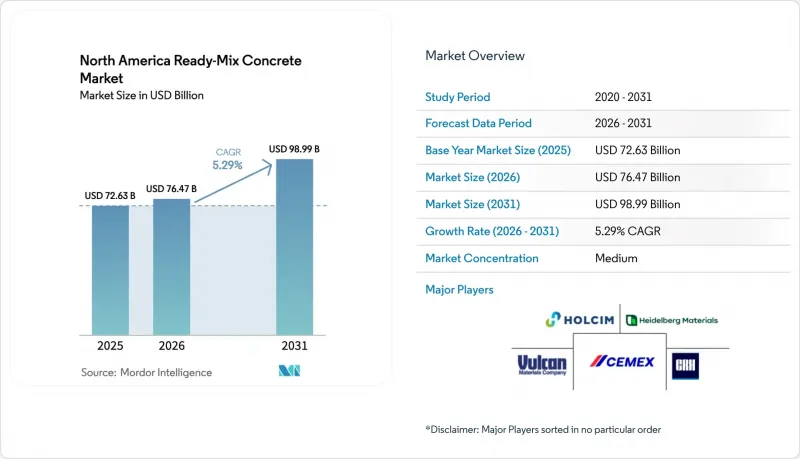
This report is Segmented by Mix Type (Transit Mixed, Central Mixed, and Shrink Mixed), End-User Sector (Residential, Commercial, Industrial and Institutional, and Infrastructure), and Geography (United States, Canada, and Mexico). The Market Forecasts are Provided in Terms of Value (USD).
North America Ready-Mix Concrete Market Trends and Insights
Federal Infrastructure Stimulus Drives Sustained Concrete Demand
Annual IIJA allocations of USD 62 billion for highways and bridges are channeling a reliable order pipeline to producers across the North America Ready-Mix Concrete market. Contractors on Michigan's I-69 rebuild, for example, established temporary batch plants to meet accelerated delivery schedules and optimize mix performance. With disbursements fixed through 2030, producers now operate with unprecedented demand visibility, de-risking capital outlays for new plants and fleets.
Housing Market Recovery Accelerates Residential Concrete Consumption
The residential segment posted the highest 5.98% CAGR as pent-up demand, favorable mortgage support, and migration to Sun Belt metros lifted housing starts. Population inflows into Texas, Florida, and the Carolinas require rapid foundation and slab work-applications where ready-mix's speed and strength consistency eclipse site-mixed alternatives. Parallel retrofit activity in legacy cities such as Chicago and Philadelphia is boosting demand for specialty decorative and fiber-reinforced mixes.
Cement and Aggregate Price Volatility Pressures Margins
Energy-linked cement price spikes in 2024 and 2025 strained producer margins as tariffs on imported clinker compounded supply tightness. Aggregate haulage costs also rose amid diesel price volatility, with western Canadian quarries citing freight as 40% of delivered cost. Contract structures often delay pass-through, forcing producers to hedge input costs or absorb margin compression during peak volatility.
Other drivers and restraints analyzed in the detailed report include:
- Technology Integration Transforms Operational Efficiency
- State Decarbonization Mandates Reshape Product Specifications
- Precast and Modular Construction Systems Gain Market Share
For complete list of drivers and restraints, kindly check the Table Of Contents.
Segment Analysis
Transit-Mixed concrete accounted for a 46.60% North America Ready-Mix Concrete market share. As mobile drums enable last-minute water adjustments, contractors value the flexibility to fine-tune slump on arrival, making the format indispensable for bridge decks and mid-rise frames. Over the forecast horizon, the segment continues to leverage established logistics networks and truck telematics that optimize engine idle time and Washington-mandated emissions targets. Central-Mixed concrete holds the second-largest portion of the North America Ready-Mix Concrete market, favored for mega-volume pours such as dam footings, where central batching ensures homogeneous quality. Shrink-Mixed concrete, though currently smaller, is projected to expand at 5.59% CAGR-the highest among mix types-thanks to admixture advancements that prolong workability for small urban deliveries, cutting site congestion and storage footprints.
Demand for Shrink-Mixed products is also being fueled by cities tightening noise and dust ordinances, prompting contractors to avoid on-site mixers. Producers are responding with mini-fleet agitator trucks that feature hydraulic drive systems and carbon-fiber drums, slashing tare weight and boosting payload. Central-Mixed operators, meanwhile, are retrofitting plants with high-shear twin-shaft mixers capable of ultra-high-performance concrete (UHPC) for precast girders on high-speed rail projects.
Complete Report Scope:
- By Mix Type
- Transit Mixed
- Central Mixed
- Shrink Mixed
- By End-user Sector
- Residential
- Commercial
- Industrial and Institutional
- Infrastructure
- By Geography
- United States
- Canada
- Mexico
List of Companies Covered in this Report:
- Argos USA LLC
- Buzzi SpA
- CEMEX SAB de CV
- Colas
- CRH
- GCC
- Heidelberg Materials
- HOLCIM
- Martin Marietta Materials
- R.W. Sidley Inc.
- Sika AG
- SRM Concrete
- Thomas Concrete Group
- Titan Cement
- Vicat SA
- Vulcan Materials Company
Additional Benefits:
- The market estimate (ME) sheet in Excel format
- 3 months of analyst support
TABLE OF CONTENTS
1 Introduction
- 1.1 Study Assumptions and Market Definition
- 1.2 Scope of the Study
2 Research Methodology
3 Executive Summary
4 Market Landscape
- 4.1 Market Overview
- 4.2 Market Drivers
- 4.2.1 Federal-level infrastructure stimulus packages
- 4.2.2 Housing starts rebound and residential retrofits
- 4.2.3 Superior consistency and speed versus site-mixed concrete
- 4.2.4 State decarbonisation mandates driving low-carbon mixes
- 4.2.5 AI-optimised dispatch and batching platforms
- 4.3 Market Restraints
- 4.3.1 Cement and aggregate price volatility
- 4.3.2 Competition from precast and modular systems
- 4.3.3 Truck-driver capacity and Hours-of-Service limits
- 4.4 Value Chain Analysis
- 4.5 Porter's Five Forces
- 4.5.1 Bargaining Power of Suppliers
- 4.5.2 Bargaining Power of Buyers
- 4.5.3 Threat of New Entrants
- 4.5.4 Threat of Substitutes
- 4.5.5 Degree of Competition
5 Market Size and Growth Forecasts (Value)
- 5.1 By Mix Type
- 5.1.1 Transit Mixed
- 5.1.2 Central Mixed
- 5.1.3 Shrink Mixed
- 5.2 By End-user Sector
- 5.2.1 Residential
- 5.2.2 Commercial
- 5.2.3 Industrial and Institutional
- 5.2.4 Infrastructure
- 5.3 By Geography
- 5.3.1 United States
- 5.3.2 Canada
- 5.3.3 Mexico
6 Competitive Landscape
- 6.1 Market Concentration
- 6.2 Strategic Moves
- 6.3 Market Share (%)/Ranking Analysis
- 6.4 Company Profiles (includes Global Level Overview, Market Level Overview, Core Segments, Financials as available, Strategic Information, Market Rank/Share, Products and Services, Recent Developments)
- 6.4.1 Argos USA LLC
- 6.4.2 Buzzi SpA
- 6.4.3 CEMEX SAB de CV
- 6.4.4 Colas
- 6.4.5 CRH
- 6.4.6 GCC
- 6.4.7 Heidelberg Materials
- 6.4.8 HOLCIM
- 6.4.9 Martin Marietta Materials
- 6.4.10 R.W. Sidley Inc.
- 6.4.11 Sika AG
- 6.4.12 SRM Concrete
- 6.4.13 Thomas Concrete Group
- 6.4.14 Titan Cement
- 6.4.15 Vicat SA
- 6.4.16 Vulcan Materials Company
7 Market Opportunities and Future Outlook
- 7.1 White-Space and Unmet-Need Assessment