
|
시장보고서
상품코드
2125571
유럽의 태양전지판 재활용 시장 : 점유율 분석, 업계 동향과 통계, 성장 예측(2026-2031년)Europe Solar Panel Recycling - Market Share Analysis, Industry Trends & Statistics, Growth Forecasts (2026 - 2031) |
||||||
 Mordor Intelligence
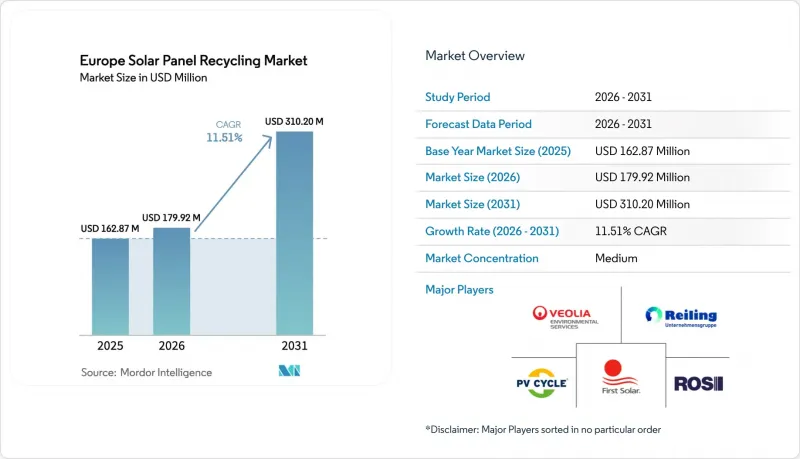
Mordor Intelligence에 의하면, 유럽 태양전지판 재활용 시장 규모는 2025년 1억 6,287만 달러에서 2026년에는 1억 7,992만 달러로 확대되어 2026년부터 2031년까지 CAGR 11.51%로 성장을 지속하여, 2031년에는 3억 1,020만 달러에 이를 것으로 예측됩니다.
본 보고서는 처리 방법(열처리, 기계, 레이저), 패널 유형(결정질 실리콘, 박막), 수명(일반 열화, 조기 열화), 회수 재료(유리, 실리콘 웨이퍼, 은 알루미늄, 기타 금속), 지역(영국, 프랑스, 이탈리아,스페인, 네덜란드, 벨기에, 폴란드, 스웨덴, 노르웨이, 러시아, 기타 유럽)별로 분류되어 있습니다.
유럽 태양전지판 재활용 시장 동향 및 인사이트
EU의 태양광 발전 설비 도입량이 급속히 확대되어 연간 70GW 이상에 달할 전망이며
태양광 발전 설비 도입량은 2024년에 70GW를 넘어설 전망이며, 앞으로도 비슷한 수준의 연간 증가 속도를 유지할 것으로 예측됩니다. 이에 따라 2031년까지 250만 톤으로 추정되는 미처리 폐기물의 급증 시기가 앞당겨지게 될 것입니다. 처리량 증가는 재활용 업체에 10년 이상의 플랜트 가동 기간을 뒷받침할 장기적인 전망을 제공합니다. 2024년에는 독일과 스페인이 각각 14GW 이상을 차지하며, 설비 철거를 사전에 준비할 수 있는 회수 파트너십의 필요성을 가속화하고 있습니다. 또한, 환경 당국이 설치 등록부와 대조하여 모듈의 이동을 추적하게 됨에 따라, 이러한 성장으로 인해 매립 규제도 더욱 엄격해지고 있습니다. 이러한 요인들이 복합적으로 작용하여 예측 가능하고 대규모의 원료 공급원이 생겨났으며, 이로 인해 채권자들이 대규모 재활용 시설에 대한 자금 조달을 진행하도록 유도되고 있습니다.
WEEE·EPR에 기반한 제조업체 부담의 의무적 재활용
2012년 WEEE 개정 및 각국의 EPR을 국내법에 반영함에 따라, 제조업체는 모든 회수 및 처리 비용을 부담할 의무가 있습니다. 이로 인해 재활용 업체의 처리량에 대한 리스크는 제거되지만, 처리 시설까지의 거리가 400km를 초과하는 경우 수수료 이익 마진이 압박받게 됩니다. 프랑스의 SOREN 제도에서는 2024년에 6,200톤의 태양광 발전 폐기물이 회수되어 2023년 대비 40% 증가했습니다. 이는 규제 장치가 완벽하게 기능하고 있음을 증명합니다. 독일의 Stiftung EAR는 미등록 수입에 대해 벌금을 부과함으로써, 소극적인 규정 준수는 더 이상 용납되지 않음을 보여주었습니다. 이러한 제재 조치는 모듈이 분해되기 쉽도록 재설계를 촉진하여, 간접적으로 재활용 수율 향상으로 이어지고 있습니다.
EU 역내를 횡단하는 대형 모듈의 높은 물류 비용
모듈이 300km 이상 운송될 경우, 비용 구조의 대부분을 운송비가 차지하며, 폴란드에서 프랑스로 향하는 일부 노선에서는 1kg당 0.12유로에 달할 전망입니다. 바젤 협약에 따른 서류 절차와 납·카드뮴 검사로 인해 약 1주일 정도의 지연이 발생하여 재활용 업체의 현금 흐름을 압박하고 있습니다. 지역 파쇄 시설에서는 무게를 최대 70%까지 줄일 수 있지만, 10-15곳의 위성 시설에 유사한 설비를 도입하는 것은 소규모 사업자에게 재정적 부담을 가중시키는 요인이 되고 있습니다.
부문별 분석
2025년 매출의 65.8%는 기계식 파쇄가 차지했습니다. 이는 기존 라인이 이미 감가상각을 마쳤고, 운영이 여전히 용이하기 때문입니다. 그러나 레이저 시스템은 연평균 성장률(CAGR) 16.9%로 확대되고 있으며, 이는 모든 공정 중 가장 높은 성장률입니다. 이는 95%의 유리 순도와 잔류물이 없는 웨이퍼를 얻을 수 있어 더 높은 판매 가격을 받을 수 있기 때문입니다. 달러로 환산할 때, 레이저 도입 공장은 톤당 25-30달러의 부가가치를 창출하고 있으며, 연간 처리량이 5,000톤을 초과할 경우 300만 유로의 설비 투자를 상각하기에 충분한 차액이 됩니다. ROSI Solar사의 하이브리드 플로우는 알루미늄 제거를 위한 저비용 파쇄와 고품질 분획을 얻기 위한 레이저 마무리를 결합한 것으로, 진화하는 WEEE(폐전기전자기기) 대기 배출 기준에 부합하는 실용적인 과도기 전략을 제시하고 있습니다. 예측 기간 동안 박막 모듈 및 소규모 공급업체의 경우 여전히 기계적 처리 방법이 사용될 것이지만, 레이저 장비는 고품질 분획물을 주도하며 유럽 태양전지판 재활용 시장에서 환경 규정 준수의 새로운 기준을 수립할 태세를 갖추고 있습니다.
도입에 대한 결정적인 판단 기준은 여전히 운영 규모입니다. 연간 2,500톤 미만인 경우, 단순한 슈레더가 설비 투자액이나 가동률 측면에서 우위를 차지하며, 동유럽 및 지중해 연안의 소규모 시장에서는 확고한 기반을 구축하고 있습니다. 그러나 각국의 입찰에서는 회수율이 평가 기준으로 중시되고 있어, 조달 동향은 점차 레이저식이나 열화학적 처리 라인으로 전환되고 있습니다. EU 혁신 기금에 의한 공공 자금은 특히 회수율 85% 이상을 우선시하고 있으며, 이로 인해 향후 처리 능력은 사실상 고도화된 구성으로 유도될 것이며, 유럽 태양전지판 재활용 시장 시장 상황 속에서 기본적인 기계식 플랜트의 장기적인 점유율은 축소될 것입니다.
2025년에는 결정질 실리콘 모듈이 회수 폐기물의 81.6%를 차지하며, 이는 설치 점유율을 반영하고 있습니다. 유리, 알루미늄, 실리콘, 은 등 다양한 재료 구성으로 인해 결정질 실리콘 모듈은 계속해서 유럽 태양전지판 재활용 시장의 경제적 기반을 형성하고 있습니다. 한편, 박막 CIGS는 1세대 전력 회사용 어레이의 상당수가 예상보다 빨리 고장나고 있어 연평균 성장률(CAGR) 19.1%로 성장하고 있습니다. CIGS 패널에는 은이 포함되어 있지 않지만, 인듐과 갈륨이 포함되어 있으며, 이 물질들은 ‘중요 원자재법’에 따라 전략적 원자재로 지정됨에 따라 독일과 이탈리아에서 전문적인 회수 사업의 원동력이 되고 있습니다. 퍼스트 솔라(First Solar)와 같은 초기 도입 기업들은 테룰화 카드뮴 소재의 90%를 회수하여 재사용함으로써 폐쇄형 재활용의 실현 가능성을 보여주고 있습니다.
규제 비용의 편차도 각 부문의 경제성에 추가적인 영향을 미치고 있습니다. 박막 재활용 업체는 유해 폐기물 처리 허가를 관리해야 하며, 이로 인해 톤당 50-100유로의 추가 비용이 발생합니다. 결정질 처리 업체는 이러한 추가 비용을 피할 수 있지만, 최신 모듈에서는 메탈라이제이션의 함유량이 감소하고 있어 은의 회수량이 줄어들 가능성이 있습니다. 패널 OEM 각사는 자사의 재활용 실증 사업과 연계된 회수 프로그램으로 이에 대응하고 있으며, 이러한 동향을 상징하는 것이 트리나 솔라의 2024년산 완전 재활용 모듈입니다. 이는 제조업체의 관리가 자재 순환 주기를 단축하고, 유럽 태양전지판 재활용 시장에서 각 패널 카테고리 간경쟁 구도를 재편할 수 있음을 보여줍니다.
기타 혜택:
- 엑셀 형식 시장 예측(ME) 시트
- 3개월간의 애널리스트 지원
자주 묻는 질문
목차
제1장 서론
제2장 조사 방법
제3장 주요 요약
제4장 시장 구도
제5장 시장 규모와 성장 예측
제6장 경쟁 구도
제7장 시장 기회와 향후 전망
JHS 26.09.17According to Mordor Intelligence, the Europe solar panel recycling market size is expected to grow from USD 162.87 million in 2025 to USD 179.92 million in 2026 and is forecast to reach USD 310.20 million by 2031 at 11.51% CAGR over 2026-2031.
This report is Segmented by Process (Thermal, Mechanical, and Laser), Panel Type (Crystalline Silicon and Thin Film), Shelf Life (Normal Loss and Early Loss), Material Recovered (Glass, Silicon Wafers, Silver, Aluminium, and Other Metals), and Geography (United Kingdom, France, Italy, Spain, Netherlands, Belgium, Poland, Sweden, Norway, Russia, and Rest of Europe).
Europe Solar Panel Recycling Market Trends and Insights
Rapid Growth of EU PV Installations Reaching >70 GW Annually
Photovoltaic build-outs exceeded 70 GW in 2024 and remain on pace for similar yearly additions, front-loading a deferred waste surge estimated at 2.5 million tonnes by 2031. Rising volumes give recyclers long-term visibility that supports 10-plus-year plant lifetimes. Germany and Spain contributed over 14 GW each in 2024, accelerating the need for collection partnerships that pre-book fleet decommissioning. The growth also tightens landfill restrictions because environmental agencies now track module flows against installation registries. Collectively, these forces create a predictable, sizable feedstock that encourages creditors to underwrite large-scale capacity.
Mandatory Producer-Financed Recycling Under WEEE & EPR
The 2012 WEEE amendment, and its country-specific EPR transpositions, compel manufacturers to absorb all collection and processing costs, eliminating volume risk for recyclers but compressing fee margins when the distance to the plant exceeds 400 km. France's SOREN scheme gathered 6,200 tonnes of PV waste in 2024, a 40% increase over 2023, proving regulatory teeth are now fully in place. Germany's Stiftung EAR issued fines for non-registered imports, signaling that passive compliance is no longer tolerated. These penalties encourage module redesign for easier disassembly, indirectly improving recycling yields.
High Logistics Cost for Bulky Modules Across EU Borders
Transport dominates cost structures when modules travel beyond 300 km, reaching EUR 0.12 per kilogram on some Poland-to-France routes. Basel Convention paperwork and lead-cadmium testing add week-long delays, eroding recycler cash flow. Regional shredding hubs cut weight by up to 70%, but replicating equipment across 10-15 satellite sites strains balance sheets for small operators.
Other drivers and restraints analyzed in the detailed report include:
- Commercialization of High-Value Silicon & Silver Recovery Technologies
- EU Critical Raw Materials Act Prioritizing PV Waste Streams
- Slow Scale-Up of Purpose-Built Recycling Lines (< 30 kt/yr)
For complete list of drivers and restraints, kindly check the Table Of Contents.
Segment Analysis
Mechanical shredding controlled 65.8% of 2025 revenue because legacy lines are fully depreciated and remain easy to operate. However, laser systems are expanding at a 16.9% CAGR, the sharpest among all processes, thanks to 95% glass purity and residue-free wafer output that garners higher sale prices. In USD terms, laser-enabled plants add USD 25-30 per tonne in incremental value, a differential sufficient to amortize EUR 3 million equipment packages when annual volumes exceed 5,000 tonnes. ROSI Solar's hybrid flow pairs low-cost shredding for aluminum removal with laser finishing for high-grade fractions, demonstrating a pragmatic bridging strategy that aligns with evolving WEEE air-emission norms. Over the forecast horizon, mechanical methods will still serve thin-film modules and small-scale feeders, but laser units are poised to command premium fractions and set new benchmarks for environmental compliance within the European solar panel recycling market.
Operational scale remains the decisive adoption filter. Below 2,500 tonnes per year, simple shredders outcompete in capex and uptime, giving them an embedded base in smaller Eastern European and Mediterranean markets. Yet national tenders increasingly score bids on recovery rates, gradually shifting procurement in favor of laser or thermo-chemical lines. Public funding under the EU Innovation Fund specifically prioritizes > 85% recovery thresholds, effectively nudging future capacity toward advanced configurations and trimming the long-term share of basic mechanical plants within the European solar panel recycling market landscape.
Crystalline silicon modules represented 81.6% of inbound waste in 2025, mirroring their installation share. Their diversified material mix, glass, aluminum, silicon, and silver, keeps them the economic backbone of the European solar panel recycling market. Thin-film CIGS, however, is growing at a 19.1% CAGR because many first-wave utility arrays are failing earlier than projected. Although CIGS panels lack silver, they contain indium and gallium, which the Critical Raw Materials Act now ranks as strategic, propelling specialized recovery ventures in Germany and Italy. Early adopters such as First Solar illustrate closed-loop viability, recovering 90% of cadmium-telluride material for re-use.
Variations in regulatory costs further shape segment economics. Thin-film recyclers must manage hazardous-waste permits, adding EUR 50-100 per tonne. Crystalline processors steer clear of these surcharges, but they may face diminishing silver returns as modern modules adopt lower metallization loadings. Panel OEMs are responding with take-back programs that interlock with their own recycling pilots, a trend exemplified by Trina Solar's 2024 fully recycled module, which showcases how manufacturer control can shorten material loops and reshape competition across panel categories within the European solar panel recycling market.
Complete Report Scope:
- By Process
- Thermal
- Mechanical
- Laser
- By Panel Type
- Crystalline Silicon
- Thin Film
- By Shelf Life
- Normal Loss (Above 25 yr)
- Early Loss (Below 10 yr)
- By Material Recovered
- Glass
- Silicon Wafers
- Silver
- Aluminium
- Other Metals (Cu, Indium, etc.)
- By Geography
- United Kingdom
- France
- Italy
- Spain
- Netherlands
- Belgium
- Poland
- Sweden
- Norway
- Russia
- Rest of Europe
List of Companies Covered in this Report:
- Veolia Environnement S.A.
- Reiling PV-Recycling GmbH
- ROSI Solar
- PV Cycle
- First Solar Inc.
- SunPower Corporation
- JA Solar Holdings Co. Ltd.
- Trina Solar Co. Ltd.
- Canadian Solar Inc.
- Renesola Ltd.
- Suez SA
- 9-Tech Srl
- Soren (PV Cycle France)
- Envaris GmbH
- Iberia Solar Recycling (Endesa)
- REC Solar EMEA GmbH
- SMA Solar Technology AG
- Enel Green Power (3Sun recycling)
- Greenmet Solar
- Solarglass Recycling BV
- Norsk Solar Recycling AS
- Apellix Laser Ablation
Additional Benefits:
- The market estimate (ME) sheet in Excel format
- 3 months of analyst support
TABLE OF CONTENTS
1 Introduction
- 1.1 Study Assumptions & Market Definition
- 1.2 Scope of the Study
2 Research Methodology
3 Executive Summary
4 Market Landscape
- 4.1 Market Overview
- 4.2 Market Drivers
- 4.2.1 Rapid growth of EU PV installations reaching >70 GW p.a.
- 4.2.2 Mandatory producer-financed recycling under WEEE & EPR
- 4.2.3 Commercialisation of high-value silicon & silver recovery technologies
- 4.2.4 EU Critical Raw Materials Act prioritising PV waste streams
- 4.2.5 Automotive OEM demand for recycled solar-grade silicon for EV batteries
- 4.3 Market Restraints
- 4.3.1 High logistics cost for bulky modules across EU borders
- 4.3.2 Slow scale-up of purpose-built recycling lines (<30 kt/yr capacity)
- 4.3.3 Silver price volatility undermining recycler ROI
- 4.4 Supply-Chain Analysis
- 4.5 Regulatory Landscape (WEEE, Ecodesign, EPR)
- 4.6 Technological Outlook (Mechanical, Thermal, Chemical, Laser, and Thermo-mechanical)
- 4.7 Porter's Five Forces
- 4.7.1 Bargaining Power of Suppliers
- 4.7.2 Bargaining Power of Buyers
- 4.7.3 Threat of New Entrants
- 4.7.4 Threat of Substitutes
- 4.7.5 Intensity of Rivalry
5 Market Size & Growth Forecasts
- 5.1 By Process
- 5.1.1 Thermal
- 5.1.2 Mechanical
- 5.1.3 Laser
- 5.2 By Panel Type
- 5.2.1 Crystalline Silicon
- 5.2.2 Thin Film
- 5.3 By Shelf Life
- 5.3.1 Normal Loss (Above 25 yr)
- 5.3.2 Early Loss (Below 10 yr)
- 5.4 By Material Recovered
- 5.4.1 Glass
- 5.4.2 Silicon Wafers
- 5.4.3 Silver
- 5.4.4 Aluminium
- 5.4.5 Other Metals (Cu, Indium, etc.)
- 5.5 By Geography
- 5.5.1 United Kingdom
- 5.5.2 France
- 5.5.3 Italy
- 5.5.4 Spain
- 5.5.5 Netherlands
- 5.5.6 Belgium
- 5.5.7 Poland
- 5.5.8 Sweden
- 5.5.9 Norway
- 5.5.10 Russia
- 5.5.11 Rest of Europe
6 Competitive Landscape
- 6.1 Market Concentration
- 6.2 Strategic Moves (M&A, Partnerships, PPAs)
- 6.3 Market Share Analysis (Market Rank/Share for key companies)
- 6.4 Company Profiles (includes Global level Overview, Market level overview, Core Segments, Financials as available, Strategic Information, Products & Services, and Recent Developments)
- 6.4.1 Veolia Environnement S.A.
- 6.4.2 Reiling PV-Recycling GmbH
- 6.4.3 ROSI Solar
- 6.4.4 PV Cycle
- 6.4.5 First Solar Inc.
- 6.4.6 SunPower Corporation
- 6.4.7 JA Solar Holdings Co. Ltd.
- 6.4.8 Trina Solar Co. Ltd.
- 6.4.9 Canadian Solar Inc.
- 6.4.10 Renesola Ltd.
- 6.4.11 Suez SA
- 6.4.12 9-Tech Srl
- 6.4.13 Soren (PV Cycle France)
- 6.4.14 Envaris GmbH
- 6.4.15 Iberia Solar Recycling (Endesa)
- 6.4.16 REC Solar EMEA GmbH
- 6.4.17 SMA Solar Technology AG
- 6.4.18 Enel Green Power (3Sun recycling)
- 6.4.19 Greenmet Solar
- 6.4.20 Solarglass Recycling BV
- 6.4.21 Norsk Solar Recycling AS
- 6.4.22 Apellix Laser Ablation
7 Market Opportunities & Future Outlook
- 7.1 White-space & Unmet-need Assessment