|
시장보고서
상품코드
2125583
알루미늄 단조 시장 : 시장 점유율 분석, 산업 동향 및 통계 데이터, 성장 예측(2026-2031년)Aluminium Forging - Market Share Analysis, Industry Trends & Statistics, Growth Forecasts (2026 - 2031) |
||||||
 Mordor Intelligence
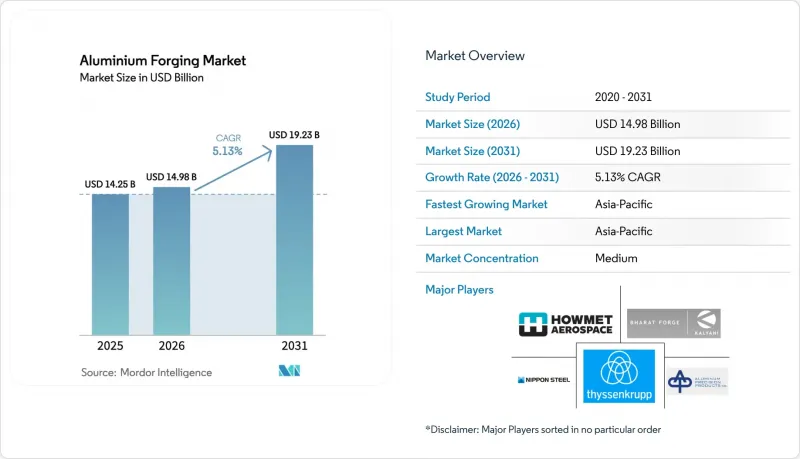
Mordor Intelligence에 의하면, 2026년 알루미늄 단조 시장 규모는 149억 8,000만 달러로 추정되고, 2025년 142억 5,000만 달러에서 확대해, 2031년에는 192억 3,000만 달러에 이를 것으로 예측됩니다.
2026-2031년 연평균 성장률(CAGR)은 5.13%를 나타낼 전망입니다.
본 보고서는 단조 유형별(오픈 다이, 클로즈드 다이, 링 롤), 최종 이용 산업별(항공우주 및 방위, 자동차 및 운송, 산업기계, 건설, 기타 최종 이용 산업), 지역별(아시아태평양, 북미, 유럽, 남미, 중동 및 아프리카)로 분류되어 있습니다. 시장 전망은 금액(달러) 기준으로 제시되어 있습니다.
세계의 알루미늄 단조 시장 동향 및 인사이트
전 산업 분야에서의 경량 소재 활용 확대
자동차 및 항공우주 OEM 업체들에 따르면, 알루미늄 단조품을 강재로 대체함으로써 부품 중량이 40-50% 감소하고, 75kWh의 EV 배터리 팩의 경우 주행 거리가 6-8% 연장된다고 보고되고 있습니다. 최첨단 고장력 강종이라 하더라도 알루미늄에 비해 밀도가 2.9배 높기 때문에 적재량과 연비 사이에서 타협을 할 수밖에 없습니다. 산업용 로봇 제조업체들은 암의 관성을 줄이기 위해 단조 알루미늄으로 제작된 매니폴드와 조인트를 채택하고 있으며, 이를 통해 픽 앤 플레이스 사이클 시간을 200밀리초 단축하고 3교대 근무에 걸친 처리량을 향상시키고 있습니다. 건설 기계 제조업체는 축 하중 제한을 준수하기 위해 붐과 지브에 단조 알루미늄을 지정하고 있으며, 이를 통해 고속도로 통행 허가와 관련된 벌칙을 받지 않으면서 법적으로 허용되는 적재량을 늘리고 있습니다. 항공우주 분야는 여전히 무게에 가장 민감한 사용자입니다. 기체에서 1Kg이 경량화될 때마다 20년 수명 기간 동안 약 3,000달러의 연료비가 절감되므로, 극저온 탱크의 돔이나 동체 프레임에는 복합재료보다 알루미늄·리튬 단조재가 선호되고 있습니다.
EV를 중심으로 한 자동차 및 운송 장비 OEM 수요 급증
람크리슈나 포징스(Ramakrishna Forgings)는 2024년, 전기차용 서스펜션 암 및 배터리 트레이 브래킷을 위해 연간 3,000톤 규모의 알루미늄 단조 생산 능력을 구축하기 위해 5억 7,500만 루피(약 690만 달러)를 투자했습니다. 2024년 10월에 발표된 일진(ILJIN)사의 1억 달러 규모 앨라배마주 그린필드 공장은 2026년 3분기까지 제너럴 모터스(GM) 및 스텔란티스(Stellantis)사에 단조 컨트롤 암을 공급할 예정입니다. 경량화는 여전히 중요한 판매 포인트이며, 비서스펜션 부품의 무게를 20kg 줄임으로써 주행 거리 400km의 전기차에서 8km의 주행 거리 향상이 기대되며, 이는 소비자의 구매 결정에 있어 매우 중요한 요소가 됩니다. 상용차의 전동화에서도 차량 운영 사업자들은 유사한 비용 절감 효과를 기대하고 있으며, 알루미늄 단조 휠 허브와 스티어링 너클을 통해 구름 저항과 톤킬로미터당 총비용이 감소합니다.
알루미늄 LME 가격의 변동성과 헤지 비용
LME 가격은 2024년 초 톤당 2,600달러에서 12월에는 2,080달러로 20% 하락하여, 현물 가격에 노출된 단조 업체들의 이익률을 압박했습니다. 12개월 만기 콜 옵션의 프리미엄은 2024년에 명목 금액의 4.5%로 확대되었습니다(전년은 2.8%). 한편, 관세로 인한 물류 혼란으로 인해 2025년 6월에는 미국 중서부 지역의 프리미엄이 톤당 1,323달러까지 급등했습니다. 동남아시아와 라틴아메리카의 중소 공급업체들은 정교한 헤지 수단을 이용할 수 없어, 위탁 가공(트롤링) 구조로 인해 이익률의 8-12%를 희생하고 있습니다. 일본에서는 고철 부족과 LNG 연동 전력 비용으로 인해 2025년 1분기 분기 프리미엄이 30% 상승하여 톤당 228달러를 기록했습니다.
부문별 분석
2025년, 클로즈드 다이 공정은 알루미늄 단조 시장에서 62.93%의 점유율을 차지한 것으로 평가되었으며, 대량 생산되는 자동차 및 항공우주 부품에서 2차 가공이 불필요한 ±0.5mm의 공차에 힘입어 연평균 성장률(CAGR) 5.24%로 확대될 것으로 전망됩니다. 2027년 가동을 시작할 예정인 오베르 뒤발(Auber Duval)사의 7,500만 유로를 투자한 60 MN 프레스기 등의 투자는 항공기 엔진 수주 잔고가 지속될 것이라는 전망을 뒷받침하고 있습니다.
링 롤 단조는 용접이 없는 형상이 필수적인 베어링이나 압력 용기용 링 분야에서 여전히 틈새 시장을 유지하고 있습니다. 50kg을 초과하는 초대형 부품 제조에는 오픈 다이 단조가 여전히 선호되는 방식입니다. 중국에 위치한 1만 6,500톤 규모의 타이안 프레스는 중국이 원자력 및 석유화학 시장을 지원하고 있음을 뒷받침합니다. FORGE NxT 4.1과 같은 디지털 시뮬레이션 플랫폼을 통해 시제품 제작 주기가 5회에서 2회로 단축되어, 모든 단조 유형에서 스크랩 및 에너지 비용 절감으로 이어집니다.
지역별 분석
아시아태평양은 2025년에 37.97%의 점유율로 알루미늄 단조 시장을 주도했으며, 2031년까지 연평균 성장률(CAGR) 6.35%로 그 우위를 더욱 확대할 것으로 예측됩니다. 2024년 12월 중국이 알루미늄 반제품에 대한 13% 환급 조치를 폐지함에 따라, 아세안(ASEAN) 구매업체의 입고 비용이 증가하여 장기적인 위탁 가공 계약 체결을 촉진하고 있습니다. 인도의 알루미늄 단조 시장은 1인당 소비량이 세계 평균의 4분의 1 수준에 그치고 있다는 점을 배경으로 성장세를 보이고 있습니다. 2030년까지 연간 1,000만 톤 수요를 충족시키기 위해서는 제련 능력 확대를 위한 400억 달러의 투자가 필요합니다.
북미 시장 전망은 일진(ILJIN)사가 앨라배마주에 건설 중인 1억 달러 규모의 공장으로 인해 개선되고 있습니다. 이 공장은 2026년 3분기부터 전기차용 컨트롤 암을 공급하여 멕시코에 빼앗겼던 생산량을 회복할 전망입니다. 유럽에서는 항공우주 분야를 중심으로 시장이 통합되고 있습니다. 오베르 뒤발(Auber Duval)사의 신규 프레스 설비와 독일 EGA사가 건설 중인 연간 3만 톤 규모의 재활용 빌렛 생산 라인은 현지 순환 경제 관련 규제 요건을 충족시키는 데 기여할 것입니다. 남미 및 중동에서는 복잡한 클로즈드 다이 성형 부품에 대해 여전히 수입 의존 상태가 지속되고 있지만, 사우디아라비아의 NEOM 프로젝트와 브라질의 방위 오프셋 제도를 통해 합작 투자가 촉진되어 2026년 이후에는 해당 지역 내 시장 점유율이 확대될 것으로 예측됩니다.
기타 혜택 :
- Excel 형식 시장 예측(ME) 시트
- 3개월간의 애널리스트 지원
자주 묻는 질문
목차
제1장 서론
제2장 분석 방법
제3장 주요 요약
제4장 시장 구도
제5장 시장 규모 및 성장률 예측
제6장 경쟁 구도
제7장 시장 기회 및 향후 전망
AJY 26.09.15According to Mordor Intelligence, aluminium forging market size in 2026 is estimated at USD 14.98 billion, growing from 2025 value of USD 14.25 billion with 2031 projections showing USD 19.23 billion, growing at 5.13% CAGR over 2026-2031.
This report is Segmented by Forging Type (Open Die, Closed Die, and Ring Rolled), End-Use Industry (Aerospace and Defense, Automotive and Transportation, Industrial Machinery, Construction, and Other End-User Industries), and Geography (Asia-Pacific, North America, Europe, South America, and Middle East and Africa). Market Forecasts are Provided in Terms of Value (USD).
Global Aluminium Forging Market Trends and Insights
Growing Use of Lightweight Materials Across Industrial Sectors
Automotive and aerospace OEMs report a 40-50% reduction in component weight when aluminium forgings replace steel, resulting in a 6-8% range extension on 75 kWh EV packs Even advanced high-strength steel grades remain 2.9 times denser than aluminium, forcing trade-offs between payload and fuel economy. Industrial robotics firms are adopting forged aluminum manifolds and joints to reduce arm inertia, thereby shortening pick-and-place cycles by 200 ms and increasing throughput over three shifts. Construction equipment manufacturers specify forged aluminum for booms and jibs to comply with axle-load limits, thereby unlocking higher legal payloads without incurring highway permit penalties. Aerospace remains the most weight-sensitive user; each kilogram trimmed from an airframe saves about USD 3,000 in fuel during a 20-year life, making aluminium-lithium forgings preferable to composites for cryogenic tank domes and fuselage frames.
Surging Demand from EV-Oriented Automotive and Transportation OEMs
Ramkrishna Forgings invested INR 57.5 crore (approximately USD 6.9 million) in 2024 to create a 3,000 tpa aluminium forging capacity for EV suspension arms and battery-tray brackets. ILJIN's USD 100 million Alabama greenfield plant, announced in October 2024, will supply forged control arms to General Motors and Stellantis by Q3 2026. Mass reduction remains a key selling point; a 20 kg weight cut in unsprung parts yields an 8 km range gain on a 400-km EV, a critical margin in consumer purchase decisions. Fleet operators see analogous savings in commercial-vehicle electrification, as forged aluminium wheel hubs and steering knuckles lower rolling resistance and total cost per tonne-kilometer.
Aluminium LME Price Volatility and Hedging Costs
LME prices fell 20% from USD 2,600 per tonne in early 2024 to USD 2,080 in December, squeezing margins for spot-exposed forgers. Options premiums on 12-month collars widened to 4.5% of notional in 2024 versus 2.8% a year earlier, while the U.S. Midwest premium spiked to USD 1,323 per tonne in June 2025 on tariff-driven logistics snarls. Smaller Southeast Asian and Latin American suppliers lack access to sophisticated hedges and forfeit 8-12% of their margin to tolling structures. Japan's quarterly premium jumped 30% to USD 228 per tonne in Q1 2025 on scrap scarcity and LNG-linked power costs.
Other drivers and restraints analyzed in the detailed report include:
- Rising Aero-Engine Backlog Driving Closed-Die Orders
- Hydrogen-Ready Gas-Turbine Build-Out
- Stringent Defect-Detection Standards in Aerospace Supply Chains
For complete list of drivers and restraints, kindly check the Table Of Contents.
Segment Analysis
Closed-die processes held a 62.93% share of the aluminium forging market in 2025 and are projected to expand at a 5.24% CAGR, driven by +-0.5 mm tolerances that eliminate secondary machining in high-volume automotive and aerospace parts. Investments such as Aubert & Duval's EUR 75 million 60-MN press, due online in 2027, underline expectations of a sustained aero-engine backlog.
Ring-rolled forging retains niche status for bearings and pressure-vessel rings where weld-free geometry is indispensable. Open-die forging remains the preferred method for producing ultra-large parts exceeding 50 kg; China's 16,500-tonne Tai'an press underscores the state's support for the nuclear and petrochemical markets. Digital simulation platforms, such as FORGE NxT 4.1, reduce prototype cycles from five to two, thereby reducing scrap and energy costs across all forging types.
Complete Report Scope:
- By Forging Type
- Open Die Forging
- Closed Die Forging
- Ring Rolled Forging
- By End-Use Industry
- Aerospace and Defense
- Automotive and Transportation
- Industrial Machinery
- Construction
- Other End-user Industries
- By Geography
- Asia-Pacific
- China
- India
- Japan
- South Korea
- Malaysia
- Thailand
- Indonesia
- Vietnam
- Rest of Asia-Pacific
- North America
- United States
- Canada
- Mexico
- Europe
- Germany
- United Kingdom
- France
- Italy
- Spain
- Nordic Countries
- Turkey
- Russia
- Rest of Europe
- South America
- Brazil
- Argentina
- Colombia
- Rest of South America
- Middle East and Africa
- Saudi Arabia
- Qatar
- United Arab Emirates
- Nigeria
- Egypt
- South Africa
- Rest of Middle East and Africa
- Asia-Pacific
Geography Analysis
The Asia-Pacific region dominated the aluminium forging market with a 37.97% share in 2025, a position expected to widen at a 6.35% CAGR through 2031. China's withdrawal of its 13% aluminium semi-finished products rebate in December 2024 increased landed costs for ASEAN buyers, prompting them to consider long-term tolling deals. India's aluminium forging market is gaining momentum, driven by a per-capita consumption that lags behind the global average by a factor of four. A USD 40 billion investment in smelting expansion is needed to meet a demand of 10 million tonnes per annum by 2030.
North America's outlook improves with ILJIN's USD 100 million Alabama plant, which will supply EV control arms starting in Q3 2026, recapturing volume lost to Mexico. Europe consolidates around aerospace; Aubert & Duval's new press and EGA's 30,000 tpa recycled billet line in Germany support local circular-economy mandates. South America and the Middle East remain import-led for complex, closed-die parts, although Saudi Arabia's NEOM and Brazil's defense offsets are expected to foster joint ventures that will increase in-region share post-2026.
- Accurate Steel Forgings (INDIA) Limited
- Al Forge Tech Co., Ltd
- All Metals & Forge Group
- Aluminum Precision Products
- Anchor Harvey
- Anderson Shumaker Company
- Bharat Forge
- Ellwood Group Inc.
- Howmet Aerospace
- ILJIN co., ltd.
- KOBE STEEL, LTD.
- NIPPON STEEL CORPORATION
- Norsk Hydro ASA
- Ramkrishna Forgings LTD
- Scot Forge Company
- Thyssenkrupp AG
- Wheel India Limited
Additional Benefits:
- The market estimate (ME) sheet in Excel format
- 3 months of analyst support
TABLE OF CONTENTS
1 Introduction
- 1.1 Study Assumptions and Market Definition
- 1.2 Scope of the Study
2 Research Methodology
3 Executive Summary
4 Market Landscape
- 4.1 Market Overview
- 4.2 Market Drivers
- 4.2.1 Growing use of lightweight materials across industrial sectors
- 4.2.2 Surging demand from EV-oriented automotive and transportation OEMs
- 4.2.3 Rising aero-engine backlog driving closed-die orders
- 4.2.4 Hydrogen-ready gas-turbine build-out
- 4.2.5 Local-content mandates in emerging economies
- 4.3 Market Restraints
- 4.3.1 Aluminium LME price volatility and hedging costs
- 4.3.2 Stringent defect-detection standards in aerospace supply chains
- 4.3.3 Energy-intensive hammer/press operations facing carbon taxes
- 4.4 Value Chain Analysis
- 4.5 Porter's Five Forces
- 4.5.1 Bargaining Power of Suppliers
- 4.5.2 Bargaining Power of Buyers
- 4.5.3 Threat of New Entrants
- 4.5.4 Threat of Substitutes
- 4.5.5 Degree of Competition
5 Market Size and Growth Forecasts (Value)
- 5.1 By Forging Type
- 5.1.1 Open Die Forging
- 5.1.2 Closed Die Forging
- 5.1.3 Ring Rolled Forging
- 5.2 By End-Use Industry
- 5.2.1 Aerospace and Defense
- 5.2.2 Automotive and Transportation
- 5.2.3 Industrial Machinery
- 5.2.4 Construction
- 5.2.5 Other End-user Industries
- 5.3 By Geography
- 5.3.1 Asia-Pacific
- 5.3.1.1 China
- 5.3.1.2 India
- 5.3.1.3 Japan
- 5.3.1.4 South Korea
- 5.3.1.5 Malaysia
- 5.3.1.6 Thailand
- 5.3.1.7 Indonesia
- 5.3.1.8 Vietnam
- 5.3.1.9 Rest of Asia-Pacific
- 5.3.2 North America
- 5.3.2.1 United States
- 5.3.2.2 Canada
- 5.3.2.3 Mexico
- 5.3.3 Europe
- 5.3.3.1 Germany
- 5.3.3.2 United Kingdom
- 5.3.3.3 France
- 5.3.3.4 Italy
- 5.3.3.5 Spain
- 5.3.3.6 Nordic Countries
- 5.3.3.7 Turkey
- 5.3.3.8 Russia
- 5.3.3.9 Rest of Europe
- 5.3.4 South America
- 5.3.4.1 Brazil
- 5.3.4.2 Argentina
- 5.3.4.3 Colombia
- 5.3.4.4 Rest of South America
- 5.3.5 Middle East and Africa
- 5.3.5.1 Saudi Arabia
- 5.3.5.2 Qatar
- 5.3.5.3 United Arab Emirates
- 5.3.5.4 Nigeria
- 5.3.5.5 Egypt
- 5.3.5.6 South Africa
- 5.3.5.7 Rest of Middle East and Africa
- 5.3.1 Asia-Pacific
6 Competitive Landscape
- 6.1 Market Concentration
- 6.2 Strategic Moves
- 6.3 Market Share (%)/Ranking Analysis
- 6.4 Company Profiles (includes Global level Overview, Market level overview, Core Segments, Financials as available, Strategic Information, Market Rank/Share for key companies, Products and Services, and Recent Developments)
- 6.4.1 Accurate Steel Forgings (INDIA) Limited
- 6.4.2 Al Forge Tech Co., Ltd
- 6.4.3 All Metals & Forge Group
- 6.4.4 Aluminum Precision Products
- 6.4.5 Anchor Harvey
- 6.4.6 Anderson Shumaker Company
- 6.4.7 Bharat Forge
- 6.4.8 Ellwood Group Inc.
- 6.4.9 Howmet Aerospace
- 6.4.10 ILJIN co., ltd.
- 6.4.11 KOBE STEEL, LTD.
- 6.4.12 NIPPON STEEL CORPORATION
- 6.4.13 Norsk Hydro ASA
- 6.4.14 Ramkrishna Forgings LTD
- 6.4.15 Scot Forge Company
- 6.4.16 Thyssenkrupp AG
- 6.4.17 Wheel India Limited
7 Market Opportunities and Future Outlook
- 7.1 Advanced forging simulation and digitised press controls
- 7.2 Aluminium-Li alloy adoption in space and launch vehicles
- 7.3 White-space and Unmet-need Assessment