

|
시장보고서
상품코드
2125586
푸드 트럭 시장 : 시장 점유율 분석, 산업 동향 및 통계 데이터, 성장 예측(2026-2031년)Food Truck - Market Share Analysis, Industry Trends & Statistics, Growth Forecasts (2026 - 2031) |
||||||
 Mordor Intelligence
Mordor Intelligence에 의하면, 푸드 트럭 시장 규모는 2025년 44억 1,000만 달러로 평가되었고, 2026년에는 47억 1,000만 달러로 추정되고, 2031년까지 64억 6,000만 달러에 이를 것으로 예측됩니다. 이것은 예측 기간(2026-2031년) CAGR 6.52%를 나타내는 것입니다.

본 보고서는 차종별(밴, 트레일러 등), 전장별(14피트 이하, 14-22피트, 기타), 요리/메뉴별(패스트푸드 등), 소유 형태별(독립 사업자 등), 파워트레인별(내연기관 등), 서비스 모델별(순회/이벤트형, 반영구적 포드 파크), 지역별로 분류되어 있습니다. 시장 예측은 금액(달러) 및 수량(대수)으로 제시되어 있습니다.
세의계 푸드 트럭 시장 동향 및 인사이트
제로 배출/전기식 푸드 트럭의 도입으로 운영 비용(OPEX)이 절감됩니다.
규제와 연비 효율성이라는 두 가지 요인이 맞물려 배터리식 전기자동차의 도입이 진행되고 있습니다. EU의 ‘청정 차량 지침’에서는 제로 배출 소형 차량만이 공공 조달 대상이 되도록 의무화하고 있습니다. 미국 국립재생에너지연구소(NREL)는 충전 일정과 가동 주기를 고려할 때, 전기식 대형 차량 플랫폼이 디젤 차량에 비해 총 소유 비용을 절감할 수 있다고 지적하고 있습니다. 메릴랜드주 몽고메리 카운티에서 Joule Case 시스템을 도입한 시범 사업에서는 발전기 없이 가동할 수 있는 시간이 연장되어, 연료비가 대폭 절감된 것으로 보고되었습니다. 런던과 캘리포니아 두 지역 모두에서 배기가스 규제에 따른 벌칙 강화로 인해 내연기관의 초기 비용 측면에서의 우위는 급속히 상쇄되고 있습니다. 지자체들이 행사장에 충전소 설치를 추진하고 있는 만큼, 푸드트럭 시장에서는 당초 예상보다 빠른 속도로 전기 구동 시스템이 도입될 것으로 전망됩니다.
초기 투자(CAPEX)가 낮은 프랜차이즈 모델에 대한 지지가 높아지고 있습니다.
프랜차이즈 시스템은 진입 장벽을 완화함으로써 탄력을 받고 있습니다. ‘Kona Ice’는 설비와 지원을 패키지로 묶은 플랜을 활용하여 전미에서 사업을 대폭 확장했습니다. ‘King of Pops’는 낮은 프랜차이즈 수수료에 더해 독자적인 레시피와 공급망 네트워크를 제공함으로써 개업까지 걸리는 시간을 대폭 단축하고 있습니다. ‘Carvel’은 프랜차이즈 공개 문서에서 기존 오프라인 매장 운영 비용보다 현저히 낮은 개업 비용 범위를 명시하고 있으며, 자사의 중앙 조리 시설이 사업자가 식재료 가격 변동에 대응할 수 있도록 지원하고 있습니다. 인건비와 식재료비 급등으로 인해 독립 사업자들은 프랜차이즈를 통해 규모의 경제를 추구하게 되었습니다. 이러한 인사이트은 푸드 트럭 업계에서 턴키 모델의 채택이 확대되고 있음을 여실히 보여줍니다.
제3자 온라인 배달 플랫폼과의 경쟁
미국에서는 DoorDash나 Uber Eats와 같은 애그리게이터가 배달 시장을 독점하고 있으며, 매출의 상당 부분을 차지하고 있습니다. 이러한 플랫폼들은 소비자가 식사를 이용하는 방식을 완전히 바꾸어 놓았으며, 과거에는 노점 상인에게만 국한되었던 앱 기반의 편의성을 전면에 내세웠습니다. 높은 수수료율로 어려움을 겪는 사업자들은 본래 좁았던 이익률이 더욱 압박받는 상황에 처해 있습니다. 그러나 매장 밖 수요가 급증함에 따라 이러한 플랫폼의 광범위한 도달 범위에 대한 의존도도 높아지고 있습니다. 배달 앱들은 광고비를 늘리고 있어, 푸드트럭의 고객 유치 예산에 부담을 주고 있습니다. 게다가 플랫폼의 알고리즘이 자체 가상 브랜드를 우선시하고 등록 판매업체를 뒷전으로 밀어냄에 따라, 푸드트럭 업계에 불어오는 역풍은 더욱 거세지고 있습니다.
부문 분석
2025년, 이동식 음식점 시장 점유율의 46.20%를 밴이 차지했으며, 인구 밀도가 높은 도시 지역의 노선이나 주차 규제가 비교적 완화된 지역에서의 적합성이 입증되었습니다. 앞으로 푸드 트럭 시장의 추가적인 성장이 예상되는 부문은 전기 밴으로, 공공 부문의 조달 제한이 무공해 소형 차량을 우선시하는 경향을 보이고 있어 2031년까지 연평균 성장률(CAGR) 12.25%를 나타낼 것으로 예측됩니다. 사업자들은 밴의 조리 공간과 기동성의 균형을 높이 평가하고 있지만, 트레일러는 견인차가 현장에서 분리되는 것이 허용되는 축제 노선에 적합합니다. 풀사이즈 트럭은 복잡한 주방 설비를 위한 충분한 공간을 제공하지만, 연료비와 주차 비용도 높습니다. 카트나 툭툭은 커피, 디저트, 단품 판매와 같은 틈새 시장을 훨씬 낮은 초기 투자 비용으로 충족시키고 있습니다.
NREL의 T3CO 모델링 도구는 소유주가 배터리 용량과 충전 시간을 최적화할 수 있도록 도와주며, 도입 결정에 도움을 줍니다. 메릴랜드주에서 실시된 실증 시험에서 Joule Case를 탑재한 밴이 발전기 없이 풀서비스 영업일을 소화한 결과, 연료 소비량이 60-70% 감소했습니다. 이러한 증거는 푸드 트럭 시장에서 전기 밴이 디젤 차량으로부터 시장 점유율을 빼앗기 시작하는 전환점이 다가오고 있음을 시사합니다.
2025년에는 14-22피트 차량이 푸드트럭 시장 점유율의 53.75%를 차지했습니다. 이는 표준 주차 공간과의 호환성을 중시하는 지자체의 전장 제한을 반영한 것입니다. 22피트 이상의 차량군은 2031년까지 연평균 성장률(CAGR) 10.45%를 나타낼 것으로 예측되며, 더 대규모의 생산 라인을 필요로 하는 기업 캠퍼스나 며칠에 걸쳐 열리는 축제를 주요 타겟으로 하고 있습니다.
중형 차량은 워싱턴주 파스코시의 2024년 규정과 같은 조례의 혜택을 받고 있습니다. 이 규정에서는 푸드 트럭 전용 주차 공간이 지정되어 있어, 반복적으로 신청할 필요 없이 연중 내내 영업이 가능합니다. 몬태나주 보즈먼시의 프로그램에서는월800-1,050달러의 요금이 책정되어 있으며, 공과금이 포함된 주차 공간이 일일 수익성을 향상시키고 손익분기점 도달 기간을 단축할 수 있음이 확인되었습니다.
지역별 분석
2025년, 북미는 푸드트럭 시장 점유율의 40.80%를 차지했습니다. 미국은 추첨제를 통한 노상 판매 상한선을 실적 기반 라이선스 제도로 대체한 도시 차원의 개혁을 통해 지역 수익의 대부분을 차지하고 있습니다. 샬럿, 신시내티, 캘거리와 같은 2차 대도시권에서는 요리 분야의 창업을 촉진하기 위해 공동 조리 시설에 보조금을 제공하고 있으며, 로스앤젤레스나 뉴욕과 같은 기존의 중심지를 넘어 그 지리적 범위를 확대되고 있습니다. 캐나다의 다문화 도시 지역에서는 다양한 요리 선택지가 계속해서 수용되고 있는 반면, 추운 기후로 인해 5월부터 9월에 걸쳐 계절적 매출 정점이 발생하고 있습니다.
아시아태평양은 도시 인구 증가와 뿌리 깊은 길거리 음식 전통이 맞물려 2031년까지 연평균 성장률(CAGR)이 10.50%에 달하며 가장 빠르게 성장하는 지역입니다. 중국에서는 ‘이동식 스낵 스트리트’의 시범 도입을 통해 기존에 비공식적이었던 노점상들이 합법화되었으며, QR 코드 결제의 보급과 현대적인 위생 관리가 결합되고 있습니다. 인도의 ‘스마트 시티 미션’은 폐기물, 상수도, 전력을 공유하는 시설을 갖춘 모듈식 판매 구역에 자금을 지원하여 기본적인 운영 기준을 높이고 있습니다. 인도네시아, 태국, 베트남에서도 관광 산업의 회복과 중산층의 음식에 대한 호기심 덕분에 비슷한 성장세가 나타나고 있습니다. 규제 차이는 여전히 장벽으로 작용하고 있지만, 낮은 인건비와 국내 섀시 생산 덕분에 창업 비용을 절감할 수 있습니다.
유럽의 지속가능성 관련 규제가 이러한 상황을 새롭게 바꾸고 있습니다. EU의 ‘청정 차량 지침’은 회원국에 제로 배출 차량 조달 할당량을 의무화하여 사업자들이 배터리식 전기차를 도입하도록 유도하고 있습니다. 포르투갈에서는 공급업체 신고 절차가 간소화되어 창업자가 무료로 온라인 등록을 할 수 있게 되었습니다. 한편, 영국에서는 환경위생 담당 직원 감소로 인해 허가 취득에 지연이 발생하고 있습니다.
남미에서는 브라질과 아르헨티나가 노상 판매를 공식적으로 허용하는 새로운 연방 규정을 도입했습니다. 이러한 규정은 수입 절차의 효율화와 중복 검사를 줄이는 것을 목적으로 하며, 이 지역이 급성장하는 시장으로서의 잠재력을 보여주고 있습니다. 중동 및 아프리카는 아직 발전의 초기 단계에 있지만, 특히 두바이와 요하네스버그 같은 관광지를 중심으로 주목을 받고 있습니다.
기타 혜택 :
- Excel 형식 시장 예측(ME) 시트
- 3개월간의 애널리스트 지원
자주 묻는 질문
목차
제1장 서론
제2장 분석 방법
제3장 주요 요약
제4장 시장 구도
제5장 시장 규모 및 성장률 예측
제6장 경쟁 구도
제7장 시장 기회 및 향후 전망
AJY 26.09.15According to Mordor Intelligence, the food truck market size is expected to grow from USD 4.41 billion in 2025 to USD 4.71 billion in 2026 and is forecast to reach USD 6.46 billion by 2031, reflecting a 6.52% CAGR during the forecast period (2026-2031).
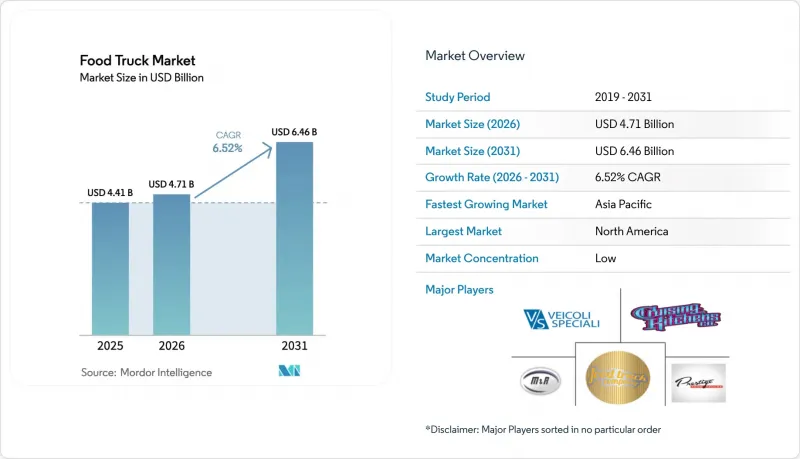
This report is Segmented by Vehicle Type (Vans, Trailers, and More), Length (Up To 14 Ft, 14 To 22 Ft, and More), Cuisine/Menu (Fast Food and More), Ownership Model (Independent Operators and More), Powertrain (Internal-Combustion and More), Service Model (Roaming/Event-Based and Semi-Permanent Pods and Parks), and Geography. The Market Forecasts are Provided in Terms of Value (USD) and Volume (Units).
Global Food Truck Market Trends and Insights
Adoption of Zero-Emission / Electric Food Trucks Cuts OPEX
Battery-electric fleets are gaining traction, driven by a combination of regulations and fuel economics. The EU Clean Vehicles Directive mandates that only zero-emission light-duty vehicles will qualify for public procurement. The National Renewable Energy Laboratory highlights that electric heavy-duty platforms, when considering charging schedules and duty cycles, can provide a lower total cost of ownership compared to diesel alternatives. Pilots in Montgomery County, Maryland, using Joule Case systems, report extended generator-free operation and significant fuel savings. In both London and California, increasing emission penalties quickly offset any initial cost advantages of internal-combustion engines. As municipalities continue to install charging stations in event spaces, the food truck market is expected to adopt electric drivetrains at a faster pace than previously anticipated.
Growing Preference for Low-CAPEX Franchising Models
Franchise systems are making headway by easing entry barriers. Kona Ice, leveraging a bundled equipment and support package, has expanded significantly nationwide. King of Pops offers a low franchise fee, along with proprietary recipes and supplier networks, which substantially reduces the time to launch. Carvel outlines a startup range in its Franchise Disclosure Document that is notably lower than traditional brick-and-mortar costs, and its central commissaries help operators manage fluctuations in ingredient prices. Rising labor and food costs have driven independent owners to seek economies of scale through franchising. These insights highlight the growing adoption of turnkey models in the food truck sector.
Competition from Third-Party Online Delivery Platforms
In the United States, aggregators such as DoorDash and Uber Eats dominate the delivery landscape, accounting for a significant share of sales. These platforms have transformed the way consumers access food, bringing app-based convenience to the forefront, a service once exclusive to street vendors. Operators, grappling with high commission rates, find their already-narrow profit margins further squeezed. Yet, as off-premises demand surges, so does their reliance on the expansive reach of these platforms. Delivery apps have increased their advertising expenditure, straining the customer acquisition budgets of food trucks. The challenge deepens as platform algorithms prioritize proprietary virtual brands, sidelining listed vendors and amplifying headwinds for the food truck sector.
Other drivers and restraints analyzed in the detailed report include:
- Social-Media-Driven Location Discovery and Impulse Buying
- Rising Consumption of Fast-Food and Street-Food Culture
- Stringent Food-Safety Regulations and Multi-Agency Compliance
For complete list of drivers and restraints, kindly check the Table Of Contents.
Segment Analysis
Vans accounted for 46.20% of the food truck market share in 2025, confirming their suitability for dense urban routes and easier parking regulations. Larger food truck market size prospects now lie in electric vans, forecasted to grow at a 12.25% CAGR through 2031, as public-sector procurement limits favor zero-emission light-duty vehicles. Operators appreciate the balance of galley capacity and maneuverability in vans, while trailers are more suitable for festival routes that permit the on-site detachment of prime movers. Full-size trucks offer ample space for complex kitchens, but they also incur higher fuel and parking costs. Carts and tuk-tuks fill coffee, dessert, and single-item niches at substantially lower capital outlays.
NREL's T3CO modeling tool helps owners optimize battery sizing and charging windows, supporting adoption decisions. In Maryland field trials, Joule Case-equipped vans logged full-service days without generators, resulting in a 60-70% reduction in fuel consumption. Such evidence suggests a tipping point at which electric vans will begin to shift market share away from diesel platforms in the food truck market.
Units between 14 and 22 feet captured 53.75% of the food truck market share in 2025, reflecting municipal length caps that favor standard parking bay compatibility. The 22-plus-foot cohort, projected to grow at a 10.45% CAGR through 2031, targets corporate campuses and multi-day festivals where throughput demands larger production lines.
Mid-size units benefit from ordinances such as Pasco, Washington's 2024 rule, which designates dedicated food-truck parks, allowing year-round trade without the need for repeated applications. Bozeman, Montana's program, priced at USD 800-1,050 per month, confirms that utilities-inclusive pads can improve daily economics and shorten breakeven timelines.
Complete Report Scope:
- By Vehicle Type
- Vans
- Trailers
- Trucks
- Carts and Tuk-tuks
- By Length
- Up to 14 ft
- 14 to 22 ft
- Above 22 ft
- By Cuisine/Menu
- Fast Food
- Vegan/Plant-based
- Bakery and Desserts
- Ethnic/Fusion
- Beverage-only
- By Ownership Model
- Independent Operators
- Franchise Chains
- Corporate / Institutional Fleets
- By Powertrain
- Internal-Combustion
- All-Electric
- Hybrid
- By Service Model
- Roaming/Event-based
- Semi-Permanent Pods and Parks
- By Geography
- North America
- United States
- Canada
- Rest of North America
- South America
- Brazil
- Argentina
- Rest of South America
- Europe
- Germany
- United Kingdom
- France
- Italy
- Spain
- Russia
- Rest of Europe
- Asia-Pacific
- China
- India
- Japan
- South Korea
- Australia and New Zealand
- Rest of Asia-Pacific
- Middle East and Africa
- United Arab Emirates
- Saudi Arabia
- Turkey
- South Africa
- Rest of Middle East and Africa
- North America
Geography Analysis
North America accounted for 40.80% of the food truck market share in 2025; the United States accounted for the majority of regional revenue, owing to city-level reforms that replaced lottery-based street-vending caps with merit-based licensing. Secondary metropolitan areas, such as Charlotte, Cincinnati, and Calgary, are offering commissary grants to promote culinary entrepreneurship, expanding their geographical reach beyond traditional hubs like Los Angeles and New York. Canada's multicultural urban centers continue to embrace diverse cuisine options, while its colder climate creates seasonal revenue peaks from May to September.
The Asia-Pacific region is the fastest-growing region, with a 10.50% CAGR through 2031, as urban population growth meets an ingrained street-food heritage. China's pilot "mobile snack streets" legalize previously informal vendors, pairing the ubiquity of QR-code payments with modern hygiene oversight. India's Smart City Mission funds modular vending zones outfitted with shared waste, water, and electricity, elevating baseline operating standards. Indonesia, Thailand, and Vietnam display similar momentum, buoyed by tourism rebounds and middle-class dietary experimentation. Fragmented regulations remain a hurdle; however, lower labor expenses and domestic chassis manufacturing help temper start-up costs.
Europe's sustainability mandates are reshaping its landscape. The EU's Clean Vehicles Directive requires member states to adopt zero-emission procurement quotas, steering operators towards battery-electric fleets. Portugal has simplified vendor notification processes, allowing entrepreneurs to register online for free. Meanwhile, the United Kingdom is experiencing permit delays due to a decline in staffing in environmental health.
In South America, Brazil and Argentina are introducing new federal regulations to formalize street vending. These rules aim to streamline import procedures and reduce redundant inspections, signaling the region's potential as a burgeoning growth corridor. While the Middle East and Africa are still in their infancy, they are drawing attention, particularly around tourism hotspots such as Dubai and Johannesburg.
- Prestige Food Trucks
- Cruising Kitchens, LLC
- VS Veicoli Speciali
- M&R Specialty Trailers and Trucks
- Food Truck Company BV
- United Food Trucks United LLC
- MSM Catering Manufacturing Inc.
- Shanghai Mobile Kitchen Solutions
- Karpatia Trucks
- Custom Concessions
- Futuristo Trailers
- Legion Food Trucks
Additional Benefits:
- The market estimate (ME) sheet in Excel format
- 3 months of analyst support
TABLE OF CONTENTS
1 Introduction
- 1.1 Study Assumptions and Market Definition
- 1.2 Scope of the Study
2 Research Methodology
3 Executive Summary
4 Market Landscape
- 4.1 Market Overview
- 4.2 Market Drivers
- 4.2.1 Rising Consumption of Fast-Food and Street-Food Culture
- 4.2.2 Growing Preference for Low-CAPEX Franchising Models
- 4.2.3 Social-Media-Driven Location Discovery and Impulse Buying
- 4.2.4 Gourmet and Artisanal Menu Differentiation
- 4.2.5 Municipal Shared-Commissary Programs Accelerating Permitting"
- 4.2.6 Adoption of Zero-Emission / Electric Food Trucks Cuts OPEX
- 4.3 Market Restraints
- 4.3.1 Competition From Third-Party Online Delivery Platforms
- 4.3.2 Stringent Food-Safety Regulations and Multi-Agency Compliance
- 4.3.3 Shortage of Certified Mobile Food-Safety Inspectors
- 4.3.4 Inflation-Driven Spike in Used Truck Chassis Prices
- 4.4 Technological Outlook
- 4.5 Porter's Five Forces Analysis
- 4.5.1 Bargaining Power of Suppliers
- 4.5.2 Bargaining Power of Buyers
- 4.5.3 Threat of New Entrants
- 4.5.4 Threat of Substitutes
- 4.5.5 Intensity of Competitive Rivalry
5 Market Size & Growth Forecasts (Value (USD) and Volume (Units))
- 5.1 By Vehicle Type
- 5.1.1 Vans
- 5.1.2 Trailers
- 5.1.3 Trucks
- 5.1.4 Carts and Tuk-tuks
- 5.2 By Length
- 5.2.1 Up to 14 ft
- 5.2.2 14 to 22 ft
- 5.2.3 Above 22 ft
- 5.3 By Cuisine/Menu
- 5.3.1 Fast Food
- 5.3.2 Vegan/Plant-based
- 5.3.3 Bakery and Desserts
- 5.3.4 Ethnic/Fusion
- 5.3.5 Beverage-only
- 5.4 By Ownership Model
- 5.4.1 Independent Operators
- 5.4.2 Franchise Chains
- 5.4.3 Corporate / Institutional Fleets
- 5.5 By Powertrain
- 5.5.1 Internal-Combustion
- 5.5.2 All-Electric
- 5.5.3 Hybrid
- 5.6 By Service Model
- 5.6.1 Roaming/Event-based
- 5.6.2 Semi-Permanent Pods and Parks
- 5.7 By Geography
- 5.7.1 North America
- 5.7.1.1 United States
- 5.7.1.2 Canada
- 5.7.1.3 Rest of North America
- 5.7.2 South America
- 5.7.2.1 Brazil
- 5.7.2.2 Argentina
- 5.7.2.3 Rest of South America
- 5.7.3 Europe
- 5.7.3.1 Germany
- 5.7.3.2 United Kingdom
- 5.7.3.3 France
- 5.7.3.4 Italy
- 5.7.3.5 Spain
- 5.7.3.6 Russia
- 5.7.3.7 Rest of Europe
- 5.7.4 Asia-Pacific
- 5.7.4.1 China
- 5.7.4.2 India
- 5.7.4.3 Japan
- 5.7.4.4 South Korea
- 5.7.4.5 Australia and New Zealand
- 5.7.4.6 Rest of Asia-Pacific
- 5.7.5 Middle East and Africa
- 5.7.5.1 United Arab Emirates
- 5.7.5.2 Saudi Arabia
- 5.7.5.3 Turkey
- 5.7.5.4 South Africa
- 5.7.5.5 Rest of Middle East and Africa
- 5.7.1 North America
6 Competitive Landscape
- 6.1 Market Concentration
- 6.2 Strategic Moves
- 6.3 Market Share Analysis
- 6.4 Company Profiles (Includes Global Level Overview, Market Level Overview, Core Segments, Financials, Strategic Information, Market Rank/Share, Products and Services, Recent Developments)
- 6.4.1 Prestige Food Trucks
- 6.4.2 Cruising Kitchens, LLC
- 6.4.3 VS Veicoli Speciali
- 6.4.4 M&R Specialty Trailers and Trucks
- 6.4.5 Food Truck Company BV
- 6.4.6 United Food Trucks United LLC
- 6.4.7 MSM Catering Manufacturing Inc.
- 6.4.8 Shanghai Mobile Kitchen Solutions
- 6.4.9 Karpatia Trucks
- 6.4.10 Custom Concessions
- 6.4.11 Futuristo Trailers
- 6.4.12 Legion Food Trucks


