

|
시장보고서
상품코드
2125591
강재 단면 시장 : 시장 점유율 분석, 산업 동향 및 통계 데이터, 성장 예측(2026-2031년)Steel Sections - Market Share Analysis, Industry Trends & Statistics, Growth Forecasts (2026 - 2031) |
||||||
 Mordor Intelligence
Mordor Intelligence에 의하면, 강재 단면 시장 규모는 2025년에 3,699억 4,000만 달러로 평가되었고, 2026년 3,849억 5,000만 달러에서 2031년까지 4,792억 6,000만 달러에 이를 것으로 예측되며, 예측 기간(2026-2031년) CAGR은 4.48%를 나타낼 전망입니다.
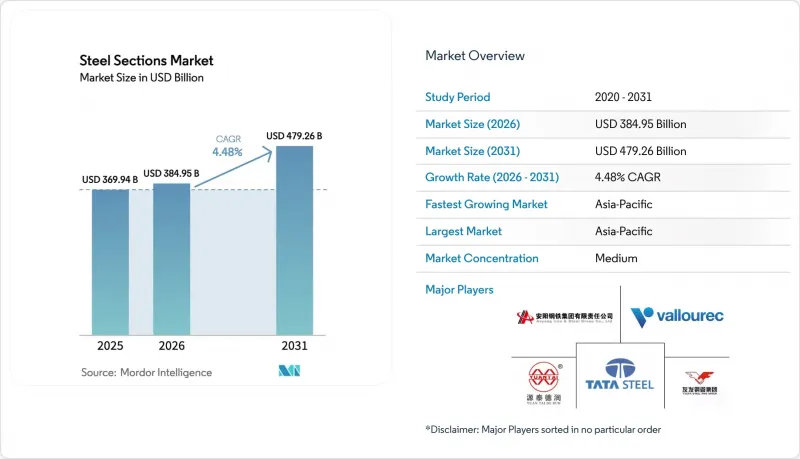
본 보고서에서는 업계를 제품 유형별(중구조용 강재, 경구조용 강재, 철근), 최종 사용자 산업별(주택 건설, 제조업 등), 제조/성형 방법별(열간 압연 강재 단면, 기타), 지역별(아시아태평양, 북미 등)로 분류하고 있습니다. 본 보고서에서는 상기 모든 부문에 대해 시장 규모 및 예측치(달러)를 제시하고 있습니다.
세계의 강재 단면 시장 동향 및 인사이트
인프라 메가 프로젝트가 지역 수요 동향을 재편
아시아태평양 및 중동에서는 제철소의 생산량을 안정화하기 위한 장기 공급 계약이 체결되어 있습니다. 인도의 국가 인프라 계획에서는 2025년까지 교통, 에너지, 도시 개발 프로젝트에 1조 4,000억 달러를 배정하고 있으며, 이로 인해 매년 20만 톤 이상의 구조용 강재 단면이 소비될 전망입니다. 사우디아라비아의 ‘비전 2030’에서는 NEOM 및 관련 사업에 5,000억 달러를 투자하겠다고 공약하고 있으며, 이는 향후 10년간 누적 1,000만 톤 이상의 구조용 강재 단면 수요에 해당합니다. 모리타니아의 새로운 철광석 철도 연결선 등 사하라 이남 아프리카에 대한 투자는 수요를 더욱 다각화시키고 있으며, 제철소가 프로젝트 사양에 맞추어 제품 구성을 조정하도록 촉진하고 있습니다. 생산자들은 예측 가능한 인수량이라는 이점을 통해 더 유리한 원자재 계약을 체결할 수 있으며, 현물 가격 변동에 따른 위험을 완화할 수 있습니다. 이러한 요인은 민간 건설 사이클이 둔화되더라도 기초 소비량을 뒷받침함으로써 강재 단면 시장을 지속적으로 지탱하고 있습니다.
모듈식 건축이 냉간 성형 제품의 채택을 가속화
오프사이트 제조를 통해 건설 공기를 30%-40% 단축하고 현장 인력을 줄일 수 있기 때문에 경량 냉간 성형 강재 단면에 대한 수요가 증가하고 있습니다. 영국에서는 오프사이트 제조 비중이 50%를 초과하는 프로젝트에 대해 15%의 자본 비용 보조금이 지급됨에 따라, 모듈식 공법을 활용한 주택 착공 건수 비중이 2020년 3%에서 2024년에는 7%로 상승했습니다. 30%-40%의 경량화를 통해 기초에 가해지는 하중과 크레인 필요성이 줄어들 뿐만 아니라, 네스트 구조의 프레임 시스템을 통해 운송 폭 제한을 피할 수 있습니다. 일본의 내화 규정 개정에 따라 10층 건물에서도 냉간 성형 단면재의 사용이 허용되면서 대상 시장이 약 40% 확대되었습니다. 공급망이 성숙해짐에 따라 많은 중층 건축 용도에서 열간 압연 보와의 비용 평준화가 기대되며, 강재 단면 시장에는 명확한 성장의 길이 열리고 있습니다.
원자재 가격 변동이 이익률을 압박
2024년에는 기상 악화로 인한 혼란과 중국의 생산 할당량으로 인해 해상 운송 흐름이 바뀌면서, 철광석과 코크스용 석탄 가격은 연내 20%-25%의 변동폭을 보였습니다. 스크랩에 의존하는 전기 아크로(EAF)는 튀르키예의 수출 제한 조치로 인해 유럽의 스크랩 가격이 18% 급등하는 사태에 직면했습니다. 런던 금속 거래소(LME)의 신규 선물 계약을 통해 헤지가 가능해졌지만, 유동성이 낮아 중견 제조업체 입장에서는 활용하기 어려운 상황입니다. 운전 자금 부족으로 인해 소규모 생산자들은 생산량을 줄일 수밖에 없었고, 이는 공급 부족을 더욱 심화시키고 가격 변동을 지속시켜 결과적으로 강재 단면 시장의 성장 전망을 둔화시키고 있습니다.
부문별 분석
2025년, 철근은 강재 단면 시장의 매출의 48.07%를 차지했으며, 고층 주택, 교량, 교통 인프라 프로젝트에서 철근 콘크리트가 차지하는 확고한 역할을 반영하고 있습니다. 이 부문은 기록적인 속도로 도시화가 진행되고 있는 아시아태평양과 아프리카의 협력적인 유틸리티 지출의 혜택을 받고 있습니다. 인도의 지하철 확장 공사 같은 대규모 계약은 제철소의 가동률을 안정시키고, 엄격한 내진 요건을 충족하기 위한 미세합금 봉강에 대한 투자를 촉진하고 있습니다. 그러나 2024년 유럽의 경기 침체에서 볼 수 있듯이, 민간 주택 시장 사이클이 위축되면 성장은 둔화됩니다. 차별화를 꾀하기 위해 각 제조업체는 현재 철근에 디지털 추적 태그를 동봉하여 주조 로트 번호와 기계적 특성을 확인할 수 있도록 함으로써 대규모 건설 현장에서의 위조 위험을 줄이고 있습니다.
중구조용 강재는 규모는 작지만 2031년까지 연평균 성장률(CAGR) 5.36%를 기록할 전망이며, 이 부문에서 가장 높은 성장률을 보일 것으로 예측됩니다. 이러한 수요는 배터리의 무게를 상쇄하기 위해 항공우주 및 자동차 분야가 첨단 고강도 강재 단면으로의 전환을 추진하고 있기 때문입니다. 열기계적 제어 가공을 통해 제철소는 후공정에서 열처리가 필요 없이 700 MPa를 초과하는 항복 강도를 실현할 수 있으며, 에너지 사용량을 15% 절감할 수 있습니다. 풍력 터빈 타워 및 송전 철탑용 중공 강재 단면 역시 재생에너지의 확대에 힘입어 성장하고 있습니다. 이러한 동향들이 맞물려 강재 단면 시장은 견조한 전망을 확보하고 있습니다.
지역별 분석
아시아태평양은 중국의 ‘일대일로’ 확대, 인도의 1조 4,000억 달러 규모의 ‘국가 인프라 파이프라인’, 그리고 동남아시아의 지하철 건설에 힘입어 2025년 강재 단면 시장 매출의 70.22%를 차지했습니다. 2024년에는 중국의 부동산 부문에서 레버리지 축소로 인해 철근 수요가 1,200만 톤 감소했으나, 고속철도 및 재생에너지 프로젝트가 그 감소분을 일부 상쇄하여 해당 지역 수요 다양성을 보여주고 있습니다. 일본과 한국은 최첨단 야금 기술을 선도하며, 베트남 및 인도네시아의 파트너 기업에 담금질 및 자가 템퍼링 노하우를 수출하고 있습니다. 급속한 도시화가 진행됨에 따라 아시아태평양은 2031년까지 강형재 시장의 주축으로 남을 것입니다.
중동 및 아프리카은 사우디아라비아의 5,000억 달러 규모 ‘비전 2030’ 프로젝트와 걸프 국가들의 국경을 초월한 철도 회랑에 힘입어, 지역별 최고 수준인 6.45%의 연평균 성장률(CAGR)을 나타낼 전망입니다. 아프리카 각국 정부는 광물 자원 수출을 효율적으로 수행하기 위해 항만 및 물류 네트워크 구축을 추진하고 있으며, 모리타니의 총 길이 42km에 달하는 철광석 전용 철도가 그 한 예입니다. 국내 생산 능력의 한계로 인해 이 지역은 여전히 수입에 의존하고 있으며, 아시아 및 유럽의 제철소 입장에서는 시장 침투를 심화하기 위한 합작 투자나 서비스 센터 설립을 위한 호기가 되고 있습니다.
유럽과 북미에서는 서로 다른 동향이 나타나고 있습니다. 금융 긴축 정책으로 인해 유럽의 주택 착공 건수가 위축되면서 2024년 지역 소비량은 3.5% 감소했습니다. CBAM(탄소 국경 조정 메커니즘)과 관련된 불확실성으로 인해 저탄소 강재의 조기 도입이 촉진되어 판매량은 감소했으나, 가격은 견조한 수준을 유지하고 있습니다. 북미에서는 녹색 세액 공제 대상이 되는 데이터센터 및 제조 공장에 대한 투자가 견인 역할을 하여 비주거용 건설이 2.1% 증가를 기록했습니다. 라틴아메리카의 회복세에 힘입어 공급량은 증가하고 있으나, 환율 변동과 정치적 리스크가 장기적인 전망을 제약하고 있습니다. 이러한 동향들이 복합적으로 작용하여 지리적으로 분산된 강재 단면 시장이 유지되는 동시에, 아시아의 주도적 입지가 더욱 공고해지고 있습니다.
기타 혜택 :
- Excel 형식 시장 예측(ME) 시트
- 3개월간의 애널리스트 지원
자주 묻는 질문
목차
제1장 서론
제2장 분석 방법
제3장 주요 요약
제4장 시장 구도
제5장 시장 규모 및 성장률 예측
제6장 경쟁 구도
제7장 시장 기회 및 향후 전망
AJY 26.09.15According to Mordor Intelligence, the steel sections market size was valued at USD 369.94 billion in 2025 and is estimated to grow from USD 384.95 billion in 2026 to reach USD 479.26 billion by 2031, at a CAGR of 4.48% during the forecast period (2026-2031).
This report Segments the Industry Into by Product Type (Heavy Structural Steel, Light Structural Steel, and Rebar), by End-User Industry (Residential Construction, Manufacturing, and More), by Manufacturing / Formation Route(Hot-Rolled Sections, and Others), and by Geography (Asia-Pacific, North America, and More). The Report Offers Market Size and Forecasts in Value (USD) for all the Above Segments.
Global Steel Sections Market Trends and Insights
Infrastructure Mega-Projects Reshape Regional Demand Profiles
Asia-Pacific and Middle East programs are locking in long-duration supply contracts that stabilize mill output. India's National Infrastructure Pipeline sets aside USD 1.4 trillion for transport, energy, and urban projects through 2025, absorbing over 200,000 tonnes of structural sections every year. Saudi Arabia's Vision 2030 pledges USD 500 billion to NEOM and related ventures, translating to a cumulative requirement exceeding 10 million tonnes of structural sections over the decade. Sub-Saharan investments, such as Mauritania's new iron-ore rail link, further diversify demand and encourage mills to align product mix with project specifications. Producers benefit from predictable offtake volumes, allowing more favorable raw-material contracts and reducing exposure to spot-price swings. This driver sustains the steel sections market by underpinning baseline consumption even when private construction cycles soften.
Modular Construction Accelerates Cold-Formed Adoption
Off-site fabrication trims build schedules by 30%-40% and reduces site labor, driving preference for lightweight cold-formed profiles. In the United Kingdom, residential starts using modular techniques rose to 7% in 2024 from 3% in 2020, bolstered by a 15% capital-cost subsidy for projects exceeding 50% off-site content. Weight savings of 30%-40% curb foundation loads and crane requirements, while nested framing systems sidestep transport width limits. Japan's revised fire-resistance rules now permit cold-formed sections in 10-story buildings, expanding the addressable market by roughly 40%. As supply chains mature, cost parity with hot-rolled beams is expected in many medium-rise applications, providing a clear growth corridor for the steel sections market.
Raw-Material Price Volatility Compresses Margins
Iron ore and coking coal prices swung 20%-25% intra-year in 2024 as weather disruptions and Chinese production quotas reshaped seaborne flows. Scrap-dependent electric-arc furnaces faced an 18% jump in European scrap prices after Turkey restricted exports. Although new futures contracts on the London Metal Exchange offer hedging, low liquidity limits accessibility for mid-tier mills. Tight working capital forces smaller producers to throttle output, further tightening supply and perpetuating volatility, thereby tempering growth prospects for the steel sections market.
Other drivers and restraints analyzed in the detailed report include:
- Decarbonization Premiums Reward Low-Carbon Producers
- Tightening seismic codes driving section upgrades
- Trade-Remedy Measures Fragment Global Supply Chains
For complete list of drivers and restraints, kindly check the Table Of Contents.
Segment Analysis
Rebar captured 48.07% of the steel sections market revenue in 2025, reflecting its entrenched role in reinforced concrete for residential towers, bridges, and transit projects. The segment benefits from synchronized public works outlays in Asia-Pacific and Africa, where urbanization continues to set new records. High-volume contracts, such as India's metro expansions, guarantee steady mill loading and encourage investment in micro-alloyed bar to meet stringent seismic requirements. However, growth moderates when private housing cycles cool, as witnessed in Europe's 2024 downturn. To differentiate, producers now bundle rebar with digital tracking tags that confirm heat numbers and mechanical properties, reducing counterfeit risk on large job sites.
Heavy structural steel, though holding a smaller base, is set to record a 5.36% CAGR to 2031, the fastest in this category. Demand stems from aerospace and automotive platforms shifting toward advanced high-strength profiles to offset battery mass. Thermo-mechanical control processing lets mills deliver yield strengths above 700 MPa without downstream heat treatment, slashing energy use by 15%. Hollow sections for wind-turbine towers and transmission pylons also ride the renewable-energy build-out. Collectively, these trends secure a robust outlook for the steel sections market.
Complete Report Scope:
- By Product Type
- Heavy Structural Steel
- Light Structural Steel
- Rebar
- By End-user Industry
- Residential Construction
- Manufacturing
- Power & Utilities
- Commercial & Infrastructure Construction
- Oil & Gas
- Others (aerospace, automotive, etc.)
- By Manufacturing / Formation Route
- Hot-rolled sections
- Cold-formed sections
- Others (welded, built up)
- By Geography
- North America
- United States
- Canada
- Mexico
- South America
- Brazil
- Argentina
- Peru
- Rest of South America
- Europe
- United Kingdom
- Germany
- France
- Italy
- Spain
- BENELUX (Belgium, Netherlands, and Luxembourg)
- NORDICS (Denmark, Finland, Iceland, Norway, and Sweden)
- Rest of Europe
- Asia-Pacific
- China
- India
- Japan
- Australia
- South Korea
- ASEAN (Indonesia, Thailand, Philippines, Malaysia, Vietnam)
- Rest of Asia-Pacific
- Middle East and Africa
- Saudi Arabia
- United Arab Emirates
- Qatar
- Kuwait
- Turkey
- Egypt
- South Africa
- Nigeria
- Rest of Middle East and Africa
- North America
Geography Analysis
Asia-Pacific generated 70.22% of the steel sections market revenue in 2025, powered by China's Belt and Road extensions, India's USD 1.4 trillion National Infrastructure Pipeline, and Southeast Asian metro builds. Even as China's real-estate deleveraging cut rebar demand by 12 million tonnes in 2024, high-speed rail and renewable projects partially offset the decline, demonstrating the region's diversified pull. Japan and South Korea push metallurgical frontiers, exporting quenching and self-tempering know-how to partners in Vietnam and Indonesia. Rapid urban growth means that Asia-Pacific will remain the anchor for the steel sections market through 2031.
The Middle East and Africa will post the fastest regional CAGR at 6.45%, lifted by Saudi Arabia's USD 500 billion Vision 2030 projects and Gulf cross-border rail corridors. African governments pursue port and logistics networks to move mineral exports efficiently, illustrated by Mauritania's 42 km iron-ore railway. Limited domestic capacity keeps the region reliant on imports, creating opportunities for Asian and European mills to establish joint ventures or service centers that deepen market penetration.
Europe and North America trace divergent paths. Tight monetary policy squeezed European residential starts, pushing regional consumption down 3.5% in 2024. CBAM-related uncertainty encourages early adoption of low-carbon grades, supporting price resilience despite weaker volumes. North America recorded a 2.1% uptick in non-residential construction, led by data-center and manufacturing plant investments eligible for green tax credits. Latin America's rebound adds incremental tons, although currency swings and political risk temper long-range forecasts. Collectively, these dynamics sustain a geographically diversified steel sections market while reinforcing Asia's leadership.
- ArcelorMittal SA
- China Baowu Steel Group
- Nippon Steel Corp.
- POSCO Holdings Inc.
- Tata Steel Ltd.
- Nucor Corp.
- JFE Steel Corp.
- Gerdau S.A.
- Hyundai Steel
- Evraz plc
- Vallourec
- Anyang Steel Group
- Youfa Steel Pipe Group
- Yuantai Derun Group
- SSAB AB
- APL Apollo Tubes
- Liberty Steel Group
- China Steel Corp.
- Qatar Steel
- Benxi Steel
- Steel Dynamics Inc.
Additional Benefits:
- The market estimate (ME) sheet in Excel format
- 3 months of analyst support
TABLE OF CONTENTS
1 Introduction
- 1.1 Study Assumptions & Market Definition
- 1.2 Scope of the Study
2 Research Methodology
3 Executive Summary
4 Market Landscape
- 4.1 Market Overview
- 4.2 Market Drivers
- 4.2.1 Infrastructure mega-projects in Asia & MENA
- 4.2.2 Tightening seismic codes driving section upgrades
- 4.2.3 Modular/off-site construction adoption
- 4.2.4 Decarbonisation premium for low-carbon sections
- 4.2.5 Digital design (BIM/digital twins) reducing waste
- 4.2.6 Advanced HSLA & weather-resistant steels
- 4.3 Market Restraints
- 4.3.1 Volatile iron-ore & scrap prices
- 4.3.2 Rising trade-remedy barriers
- 4.3.3 Carbon-intensity penalties (CBAM-type)
- 4.3.4 Skilled welder/fabricator shortages
- 4.4 Value / Supply-Chain Analysis
- 4.5 Regulatory Landscape
- 4.6 Technological Outlook
- 4.7 Industry Attractiveness - Porter's Five Force Analysis
- 4.7.1 Threat of New Entrants
- 4.7.2 Bargaining Power of Buyers
- 4.7.3 Bargaining Power of Suppliers
- 4.7.4 Threat of Substitutes
- 4.7.5 Intensity of Rivalry
5 Market Size & Growth Forecasts (Values, In USD Billion)
- 5.1 By Product Type
- 5.1.1 Heavy Structural Steel
- 5.1.2 Light Structural Steel
- 5.1.3 Rebar
- 5.2 By End-user Industry
- 5.2.1 Residential Construction
- 5.2.2 Manufacturing
- 5.2.3 Power & Utilities
- 5.2.4 Commercial & Infrastructure Construction
- 5.2.5 Oil & Gas
- 5.2.6 Others (aerospace, automotive, etc.)
- 5.3 By Manufacturing / Formation Route
- 5.3.1 Hot-rolled sections
- 5.3.2 Cold-formed sections
- 5.3.3 Others (welded, built up)
- 5.4 By Geography
- 5.4.1 North America
- 5.4.1.1 United States
- 5.4.1.2 Canada
- 5.4.1.3 Mexico
- 5.4.2 South America
- 5.4.2.1 Brazil
- 5.4.2.2 Argentina
- 5.4.2.3 Peru
- 5.4.2.4 Rest of South America
- 5.4.3 Europe
- 5.4.3.1 United Kingdom
- 5.4.3.2 Germany
- 5.4.3.3 France
- 5.4.3.4 Italy
- 5.4.3.5 Spain
- 5.4.3.6 BENELUX (Belgium, Netherlands, and Luxembourg)
- 5.4.3.7 NORDICS (Denmark, Finland, Iceland, Norway, and Sweden)
- 5.4.3.8 Rest of Europe
- 5.4.4 Asia-Pacific
- 5.4.4.1 China
- 5.4.4.2 India
- 5.4.4.3 Japan
- 5.4.4.4 Australia
- 5.4.4.5 South Korea
- 5.4.4.6 ASEAN (Indonesia, Thailand, Philippines, Malaysia, Vietnam)
- 5.4.4.7 Rest of Asia-Pacific
- 5.4.5 Middle East and Africa
- 5.4.5.1 Saudi Arabia
- 5.4.5.2 United Arab Emirates
- 5.4.5.3 Qatar
- 5.4.5.4 Kuwait
- 5.4.5.5 Turkey
- 5.4.5.6 Egypt
- 5.4.5.7 South Africa
- 5.4.5.8 Nigeria
- 5.4.5.9 Rest of Middle East and Africa
- 5.4.1 North America
6 Competitive Landscape
- 6.1 Market Concentration
- 6.2 Strategic Moves
- 6.3 Market Share Analysis
- 6.4 Company Profiles (includes Global level Overview, Market level overview, Core Segments, Financials as available, Strategic Information, Products & Services, and Recent Developments)
- 6.4.1 ArcelorMittal SA
- 6.4.2 China Baowu Steel Group
- 6.4.3 Nippon Steel Corp.
- 6.4.4 POSCO Holdings Inc.
- 6.4.5 Tata Steel Ltd.
- 6.4.6 Nucor Corp.
- 6.4.7 JFE Steel Corp.
- 6.4.8 Gerdau S.A.
- 6.4.9 Hyundai Steel
- 6.4.10 Evraz plc
- 6.4.11 Vallourec
- 6.4.12 Anyang Steel Group
- 6.4.13 Youfa Steel Pipe Group
- 6.4.14 Yuantai Derun Group
- 6.4.15 SSAB AB
- 6.4.16 APL Apollo Tubes
- 6.4.17 Liberty Steel Group
- 6.4.18 China Steel Corp.
- 6.4.19 Qatar Steel
- 6.4.20 Benxi Steel
- 6.4.21 Steel Dynamics Inc.
7 Market Opportunities & Future Outlook
- 7.1 White-space & Unmet-need Assessment


