
|
시장보고서
상품코드
2125593
표면 처리용 화학제품 시장 : 시장 점유율 분석, 산업 동향 및 통계 데이터, 성장 예측(2026-2031년)Surface Treatment Chemicals - Market Share Analysis, Industry Trends & Statistics, Growth Forecasts (2026 - 2031) |
||||||
 Mordor Intelligence
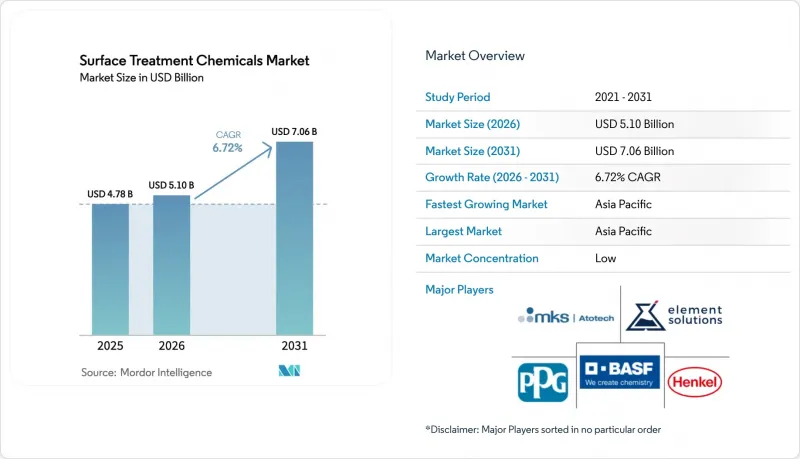
Mordor Intelligence에 의하면, 표면 처리용 화학제품 시장 규모는 2025년에 47억 8,000만 달러로 평가되었고, 2026년 51억 달러에서 2031년까지 70억 6,000만 달러에 이를 것으로 예측되며, 예측 기간(2026-2031년) CAGR은 6.72%를 나타낼 전망입니다.
본 보고서는 화학제품 유형별(세정제, 화학 코팅, 양극 산화 처리용 화학제품, 기타), 기판별(금속, 플라스틱, 기타 기판), 최종 사용자 산업별(자동차 및 운송 기계, 건설, 전자 기기, 산업기계, 기타), 지역별(아시아태평양, 북미, 기타)로 분류되어 있습니다. 시장 전망은 금액(달러) 기준으로 제시되어 있습니다.
세계의 표면 처리용 화학제품 시장 동향 및 인사이트
아시아의 자동차 생산 급증
2024년, 중국에서는 많은 신에너지차를 포함한 차량이 시장에 출시되었습니다. 이러한 생산량의 급증으로 인해 전처리 라인에서는 강철 차체와 알루미늄 차체 간의 전환이 신속하게 이루어지게 되었습니다. 한편, 인도의 FAME 이니셔티브는 2030년까지 연간 전기차 판매 대수를 대폭 늘리는 것을 목표로 하고 있습니다. 이 목표를 달성하기 위해서는 배터리 트레이 및 모터 하우징용 화성 코팅의 생산 능력 증강이 필요합니다. 2024년, 아세안(ASEAN) 국가들은 자동차 및 전자기기 공장에 대한 신규 투자를 유치하며 현지 조달되는 화학 약품에 대한 수요를 높였습니다. 업계가 다중 소재 차체 구조로 전환됨에 따라, 인산염 슬러지의 단점 없이 동등한 부식 방지 효과를 제공하는 지르코늄 코팅으로의 뚜렷한 전환이 관찰됩니다. 지역 OEM 연구소와 제휴하여 화학제품을 공동 개발하고 있는 공급업체들은 모두가 원하는 우선 공급업체로서의 입지를 확보해 가고 있습니다.
전자 기기의 소형화에 따른 고정밀 도금 수요 촉진
2024년, TSMC의 첨단 패키징 사업 매출은 구리 TSV 및 마이크로 범프 도금에 대한 수요에 힘입어 증가했습니다. 이 두 가지 모두 10nm 미만의 균일성이 요구됩니다. 한편, 삼성의 3D 집적 전략은 니켈·금 및 구리·주석 합금의 사용을 핵심으로 하고 있으며, 이는 대전류 라인에서 보이드 발생을 방지하기 위한 조치입니다. 웨이퍼당 도금 표면적이 대폭 증가함에 따라, 서프레서, 레벨러, 브라이트너에 대한 수요도 급증하고 있습니다. 그러나 일반적인 계면활성제에 대한 EU의 PFAS 규제가 임박함에 따라, 2027년 기한에 앞서 첨가제의 재조성이 요구되고 있습니다. 그 결과, 파운드리 각사는 실적이 입증된 PFAS 프리 시스템과 유기물 분해를 모니터링하기 위한 인라인 욕 분석 기능을 갖춘 공급업체를 모색하고 있습니다.
6가 크롬에 대한 규제 강화
2026년 적용 기한이 다가오는 가운데, EU의 REACH 규정은 12유형의 6가 크롬 염을 지정했습니다. 이러한 움직임으로 인해 항공우주, 방위, 중장비 업계의 각 기업은 ASTM B117 사이클을 준수하는 대체품의 재인증을 받아야만 하며, 이 작업에는 18-24개월이 소요됩니다. 한편, 미국 환경보호청(EPA)은 특정 Cr(VI) 화합물을 유해 대기 오염 물질로 지정할 예정입니다. 이 분류에 따라 지속적인 모니터링이 의무화되어 각 사업장에서 막대한 자원을 소모할 가능성이 있습니다. 캘리포니아주에서는 프로포지션 65에 따라 소비자용 경고 라벨 표시가 의무화됨에 따라, 가전 제조업체들은 도금 공정을 해외로 이전하는 움직임을 보이고 있습니다. 3가 크롬은 내마모성이 떨어지는 반면, 고구리 함유 알루미늄용 실란 커플링제에 의존하는 지르코늄계 시스템은 특수 용도에서 6가 크롬 공정에 대한 수요가 여전히 뿌리 깊음을 보여줍니다.
부문 분석
화성 코팅은 자동차 및 가전제품 라인에서 주요 접착 촉진제로 계속 사용되고 있어, 2025년에는 표면 처리용 화학제품 시장의 42.45%를 차지했습니다. 세정제 시장은 기존 윤활제가 코팅된 상태로 반입되는 재활용 알루미늄 원료의 영향을 받아, 2031년까지 연평균 성장률(CAGR) 7.12%를 나타낼 것으로 예측됩니다. 전자기기 분야에서는 고알칼리성이 구리 배선을 부식시킬 우려가 있어 산성 세정제의 도입이 진행되고 있습니다. 표면 처리용 화학제품 시장 규모는 여전히 소규모이긴 하지만 견조한 추세를 보이고 있으며, 유형 II 착색 가능 산화물이 필요한 건축용 클래딩 및 스마트폰 케이스에 의해 지탱되고 있습니다.
전기차(EV) 조립 라인에서는 인산철 욕조 대신 지르코늄계 약제가 채택되어, 헹굼 온도 저하 및 슬러지 감축을 도모하고 있습니다. BASF사의 ‘Gardobond’와 Chemetall사의 ‘Oxsilan’ 시리즈는 실온에서 처리가 가능하며, 폐수량 감축에도 기여하고 있습니다. 세정제 수요는 순환형 경제의 흐름을 타고 있습니다. 테슬라의 4680형 재활용 알루미늄 캔은 양극 산화 처리 전에 3단계 세정 공정을 거치기 때문에 수요 증가가 예상됩니다. 루브르 아부다비의 염색 브론즈 외장 패널과 같이 경질 양극 산화 처리가 적용된 건축용 패널은 고급 디자인이 양극 산화 처리용 화학 약품을 고수익률의 틈새 시장으로 계속 유지하고 있음을 보여줍니다.
지역별 분석
아시아태평양은 2025년 표면 처리용 화학제품 시장 점유율의 42.95%를 차지했으며, 2031년까지 연평균 7.05%의 성장률을 보이고 있습니다. 중국에서 전환 코팅에 대한 수요 급증은 신에너지 차량에 의해 주도되고 있는 반면, 인도의 야심 찬 반도체 이니셔티브는 추가 전기도금 라인에 대한 수요를 뒷받침하고 있습니다. 2024년, 아세안(ASEAN)은 자동차 및 전자기기 공장들에게 더욱 매력적인 지역으로 부상하며, 현지 조달 클러스터의 거점으로서의 입지를 공고히 했습니다. 반면, 일본과 한국은 반도체 소재용 고순도 틈새 제품 공급에 기여하고 있지만, 자동차 생산이 이미 성숙기에 접어들었기 때문에 절대적인 성장에는 한계가 있습니다. 2025년 초, 지역적으로 지르코늄 전구체가 부족하고 리드 타임이 길어짐에 따라 OEM 기업들은 듀얼 소싱 전략을 채택하기 시작했습니다.
북미는 매출 점유율에서 큰 비중을 차지하고 있습니다. 이 지역의 전기차(EV)에 대한 집중은 ‘인플레이션 억제법(Inflation Reduction Act)’에 의해 뒷받침되고 있으며, 이 법은 EV 및 배터리 공장에 대한 막대한 투자를 촉진했습니다. 이러한 급증에 따라 미시간주, 오하이오주, 테네시주, 조지아주 등 각 주에서 새로운 전처리 라인이 설립되었습니다. 2024년, 몬테레이의 테슬라와 산루이스포토시의 BMW의 존재에 힘입어 멕시코는 자동차를 시장에 출시하며 자동차 산업의 강세를 보여주었습니다. 이러한 자동차 붐은 이후 더욱 친환경적인 전기도금 솔루션의 판매를 견인했습니다. 그러나 캘리포니아주 규정 1469호(초안)는 과제를 안겨주고 있으며, 일부 위탁 가공업체는 3가 크롬으로 전환해야 하거나 사업 자체를 중단해야 할 수도 있습니다. 이는 단기적으로는 생산량을 감소시킬 가능성이 있지만, 새로운 규정을 준수하는 공급업체에게는 이점이 될 수 있습니다. 게다가 인력 부족도 설비 가동률을 더욱 압박하고 있습니다.
2025년 지출에서 유럽은 눈에 띄는 점유율을 차지했습니다. 영국의 해상 풍력 발전 프로젝트는 중요한 이정표를 넘어섰으며, 야심 찬 프로젝트가 계획되고 있습니다. 이러한 확장에 따라 험버사이드 조선소에서는 C5-M 코팅 시스템의 사용이 필수적입니다. 에너지 가격 급등이라는 과제에 직면해 있음에도 불구하고, 독일에서는 자동차 조립이 순조롭게 진행되고 있으며, 그중 상당 부분을 배터리식 전기차(BEV)가 차지하고 있습니다. 프랑스의 에어버스는 A320neo 생산을 확대하고 있지만, 공급망 차질로 인해 이에 따른 화학제품 수요가 저해되고 있습니다. 남유럽은 태양광 패널용 유리 처리 기술을 활용하여 독자적인 틈새 시장을 개척하고 있습니다. 한편, 남미 및 중동 및 아프리카도 시장에 기여하고 있으며, 브라질의 자동차 생산과 사우디아라비아의 하류 프로젝트가 이를 주도하고 있습니다.
기타 혜택 :
- Excel 형식 시장 예측(ME) 시트
- 3개월간의 애널리스트 지원
자주 묻는 질문
목차
제1장 서론
제2장 분석 방법
제3장 주요 요약
제4장 시장 구도
제5장 시장 규모 및 성장률 예측
제6장 경쟁 구도
제7장 시장 기회 및 향후 전망
AJY 26.09.15According to Mordor Intelligence, the surface treatment chemicals market size was valued at USD 4.78 billion in 2025 and is estimated to grow from USD 5.10 billion in 2026 to reach USD 7.06 billion by 2031, at a CAGR of 6.72% during the forecast period (2026-2031).
This report is Segmented by Chemical Type (Cleaner, Chemical Conversion Coating, Anodizing Chemicals, and Other Types), Base Material (Metal, Plastic, and Other Base Materials), End-User Industry (Automotive and Transportation, Construction, Electronics, Industrial Machinery, and Others), and Geography (Asia-Pacific, North America, and More). Market Forecasts are Provided in Terms of Value (USD).
Global Surface Treatment Chemicals Market Trends and Insights
Rapid Expansion of Automotive Production in Asia
In 2024, China rolled out vehicles, with many being new-energy units. This surge in production has led pretreatment lines to swiftly alternate between steel and aluminum bodies. Meanwhile, India's FAME initiative aims for significant annual EV sales by 2030. This ambition necessitates an increase in conversion-coating capacity for battery trays and motor housings. In 2024, ASEAN attracted fresh investments for automotive and electronics plants, heightening the demand for localized chemical supplies. As the industry pivots towards multi-material body structures, there's a notable shift to zirconium coatings, which offer comparable corrosion protection without the downsides of phosphate sludge. Suppliers collaborating with regional OEM labs to co-develop chemistries are securing a coveted preferred-vendor status.
Electronics Miniaturization Demanding High-Precision Plating
In 2024, TSMC's advanced packaging revenue grew, fueled by the demand for copper TSV and micro-bump plating, both requiring sub-10 nm uniformity. Meanwhile, Samsung's 3D integration strategy is anchored on using nickel-gold and copper-tin alloys, a move aimed at preventing voids in high-current lines. With the plated surface area per wafer having significantly increased, there's a corresponding surge in demand for suppressors, levelers, and brighteners. However, looming EU PFAS restrictions on common surfactants are pushing for additive reformulations ahead of the 2027 deadline. As a result, foundries are on the lookout for suppliers boasting proven PFAS-free systems and inline bath analytics to monitor organic breakdown.
Regulatory Clamp-Down on Hexavalent Chromium
With sunset windows closing in 2026, the EU REACH has flagged 12 hexavalent chromium salts. This move compels players in aerospace, defense, and heavy equipment to requalify alternatives that align with ASTM B117 cycles, a task stretching over 18-24 months. Meanwhile, the U.S. EPA is set to designate specific Cr(VI) compounds as hazardous air pollutants. This classification mandates continuous monitoring, a process that could drain significant resources for each site. In California, under Proposition 65, consumer-warning labels are now a requirement, leading appliance manufacturers to shift their plating processes overseas. While trivalent chromium falls short on abrasion resistance, zirconium systems, reliant on silane coupling agents for high-copper aluminum, underscore the enduring demand for hexavalent processes in specialized applications.
Other drivers and restraints analyzed in the detailed report include:
- Stringent Anti-Corrosion Standards in Wind-Turbine Towers
- On-Site 3D-Printed Metal Parts Requiring Post-Print Surface Prep
- Shift Toward Bio-Based Coatings Reduces Legacy Chemical Demand
For complete list of drivers and restraints, kindly check the Table Of Contents.
Segment Analysis
Conversion coatings captured 42.45% of the surface treatment chemicals market share in 2025 as they remain the principal adhesion promoter for automotive and appliance lines. Cleaners are projected to deliver a 7.12% CAGR to 2031, reflecting recycled-aluminum feedstocks that arrive coated with legacy lubricants. Acidic cleaners gain traction in electronics because high alkalinity can undercut copper traces. The surface treatment chemicals market size for anodizing chemicals remains modest yet resilient, supported by architectural cladding and smartphone housings that demand Type II colorable oxides.
Zirconium formulations are replacing iron-phosphate baths on EV assembly lines, lowering rinse temperatures and sludge. BASF's Gardobond and Chemetall's Oxsilan series run at room temperature and cut wastewater. Cleaner demand rides the circular-economy trend; Tesla's 4680 recycled-aluminum cans pass through three cleaning stages before anodizing, underscoring volume upside. Hard-anodized architectural panels, such as the Louvre Abu Dhabi's dyed bronze cladding, illustrate how premium design keeps anodizing chemicals in high-margin niches.
Complete Report Scope:
- By Chemical Type
- Cleaner
- Chemical Conversion Coating
- Anodizing Chemicals
- Other Types of Chemicals
- By Base Material
- Metal
- Plastic
- Other Base Materials (Glass, Alloys, Wood)
- By End-User Industry
- Automotive and Transportation
- Construction
- Electronics
- Industrial Machinery
- Others (Oil and Gas Pipeline, Power, Military, Packaging, etc.)
- Geography
- Asia-Pacific
- China
- India
- Japan
- South Korea
- ASEAN
- Rest of Asia-Pacific
- North America
- United States
- Canada
- Mexico
- Europe
- Germany
- United Kingdom
- France
- Italy
- Spain
- Russia
- Rest of Europe
- South America
- Brazil
- Argentina
- Rest of South America
- Middle-East and Africa
- Saudi Arabia
- South Africa
- Rest of Middle-East and Africa
- Asia-Pacific
Geography Analysis
Asia-Pacific accounted for 42.95% of the 2025 surface treatment chemicals market share and is growing at 7.05% through 2031. China's burgeoning demand for conversion coatings is driven by its new-energy vehicles, while India's ambitious semiconductor initiative is fueling the need for additional electroplating lines. In 2024, ASEAN's allure for auto and electronics plants solidified its status as a hub for localized supply clusters. Meanwhile, Japan and South Korea, while contributing high-purity niche volumes for semiconductor materials, face limitations on absolute growth due to their already mature automotive outputs. Early 2025 witnessed regional shortages of zirconium precursors, leading to stretched lead times and prompting OEMs to adopt a dual-sourcing strategy.
North America commands a significant revenue share. The region's commitment to electric vehicles (EVs) is underscored by the Inflation Reduction Act, which catalyzed a substantial investment in EV and battery plants. This surge has led to the establishment of new pretreatment lines across states like Michigan, Ohio, Tennessee, and Georgia. In 2024, Mexico's automotive prowess was evident as it rolled out vehicles, bolstered by the presence of Tesla in Monterey and BMW in San Luis Potosi. This automotive boom has subsequently driven sales in cleaner and electro-coating solutions. However, California's draft Rule 1469 poses challenges, potentially compelling a portion of job shops to pivot to trivalent chromium or cease operations altogether. While this may dampen near-term volumes, it could benefit suppliers who align with the new regulations. Additionally, labor shortages are further constraining capacity utilization.
Europe accounted for a notable share of the spending in 2025. The UK's offshore wind initiatives have surpassed significant milestones, with ambitious projects in the pipeline. This expansion necessitates the use of C5-M coating systems at the Humberside yards. Despite facing energy-price challenges, Germany successfully assembled vehicles, with a commendable share being battery electric vehicles (BEVs). France's Airbus is ramping up its A320neo output, but supply chain snags are hindering the corresponding chemical demand. Southern Europe is carving out a niche, benefiting from treatments for solar-panel glass. Meanwhile, both South America and the Middle-East Africa regions contribute to the market, with Brazil's production of vehicles and downstream projects in Saudi Arabia leading the charge.
- Aalberts Surface Technologies GmbH
- ALANOD GmbH and Co. KG
- Asterion LLC
- BASF
- Bulk Chemicals Inc.
- ChemTech Surface Finishing Pvt. Ltd.
- Dow
- Element Solutions Inc
- Henkel AG and Co. KGaA
- MKS | Atotech
- Nihon Parkerizing Co., Ltd.
- Nippon Paint Holdings Co. Ltd.
- OC Oerlikon Management AG
- PPG Industries, Inc.
- Quaker Chemical Corporation
- The Sherwin-Williams Company
- YUKEN INDUSTRY CO.,LTD.
Additional Benefits:
- The market estimate (ME) sheet in Excel format
- 3 months of analyst support
TABLE OF CONTENTS
1 Introduction
- 1.1 Study Assumptions and Market Definition
- 1.2 Scope of the Study
2 Research Methodology
3 Executive Summary
4 Market Landscape
- 4.1 Market Overview
- 4.2 Market Drivers
- 4.2.1 Rapid Expansion of Automotive Production in Asia
- 4.2.2 Electronics Miniaturisation Demanding High-Precision Plating
- 4.2.3 Stringent Anti-Corrosion Standards in Wind-Turbine Towers
- 4.2.4 On-Site 3D-Printed Metal Parts Requiring Post-Print Surface Prep
- 4.2.5 Surge in Aluminium Use in EV Platforms Necessitating Multi-Metal Cleaners
- 4.3 Market Restraints
- 4.3.1 Regulatory Clamp-Down on Hexavalent Chromium
- 4.3.2 Shift Toward Bio-Based Coatings Reduces Legacy Chemical Demand
- 4.3.3 Rising Total-Cost-of-Ownership of Captive Metal Finishing Lines
- 4.4 Value Chain Analysis
- 4.5 Porter's Five Forces
- 4.5.1 Bargaining Power of Suppliers
- 4.5.2 Bargaining Power of Buyers
- 4.5.3 Threat of New Entrants
- 4.5.4 Threat of Substitutes
- 4.5.5 Degree of Competition
5 Market Size and Growth Forecasts (Value)
- 5.1 By Chemical Type
- 5.1.1 Cleaner
- 5.1.2 Chemical Conversion Coating
- 5.1.3 Anodizing Chemicals
- 5.1.4 Other Types of Chemicals
- 5.2 By Base Material
- 5.2.1 Metal
- 5.2.2 Plastic
- 5.2.3 Other Base Materials (Glass, Alloys, Wood)
- 5.3 By End-User Industry
- 5.3.1 Automotive and Transportation
- 5.3.2 Construction
- 5.3.3 Electronics
- 5.3.4 Industrial Machinery
- 5.3.5 Others (Oil and Gas Pipeline, Power, Military, Packaging, etc.)
- 5.4 Geography
- 5.4.1 Asia-Pacific
- 5.4.1.1 China
- 5.4.1.2 India
- 5.4.1.3 Japan
- 5.4.1.4 South Korea
- 5.4.1.5 ASEAN
- 5.4.1.6 Rest of Asia-Pacific
- 5.4.2 North America
- 5.4.2.1 United States
- 5.4.2.2 Canada
- 5.4.2.3 Mexico
- 5.4.3 Europe
- 5.4.3.1 Germany
- 5.4.3.2 United Kingdom
- 5.4.3.3 France
- 5.4.3.4 Italy
- 5.4.3.5 Spain
- 5.4.3.6 Russia
- 5.4.3.7 Rest of Europe
- 5.4.4 South America
- 5.4.4.1 Brazil
- 5.4.4.2 Argentina
- 5.4.4.3 Rest of South America
- 5.4.5 Middle-East and Africa
- 5.4.5.1 Saudi Arabia
- 5.4.5.2 South Africa
- 5.4.5.3 Rest of Middle-East and Africa
- 5.4.1 Asia-Pacific
6 Competitive Landscape
- 6.1 Market Concentration
- 6.2 Strategic Moves
- 6.3 Market Share(%)/Ranking Analysis
- 6.4 Company Profiles (includes Global Overview, Market Overview, Core Segments, Financials, Strategic Information, Products and Services, Recent Developments)
- 6.4.1 Aalberts Surface Technologies GmbH
- 6.4.2 ALANOD GmbH and Co. KG
- 6.4.3 Asterion LLC
- 6.4.4 BASF
- 6.4.5 Bulk Chemicals Inc.
- 6.4.6 ChemTech Surface Finishing Pvt. Ltd.
- 6.4.7 Dow
- 6.4.8 Element Solutions Inc
- 6.4.9 Henkel AG and Co. KGaA
- 6.4.10 MKS | Atotech
- 6.4.11 Nihon Parkerizing Co., Ltd.
- 6.4.12 Nippon Paint Holdings Co. Ltd.
- 6.4.13 OC Oerlikon Management AG
- 6.4.14 PPG Industries, Inc.
- 6.4.15 Quaker Chemical Corporation
- 6.4.16 The Sherwin-Williams Company
- 6.4.17 YUKEN INDUSTRY CO.,LTD.
7 Market Opportunities and Future Outlook
- 7.1 White-space and Unmet-Need Assessment