

|
시장보고서
상품코드
2125608
인도의 제조 시장 : 점유율 분석, 업계 동향과 통계, 성장 예측(2026-2031년)India Manufacturing - Market Share Analysis, Industry Trends & Statistics, Growth Forecasts (2026 - 2031) |
||||||
 Mordor Intelligence
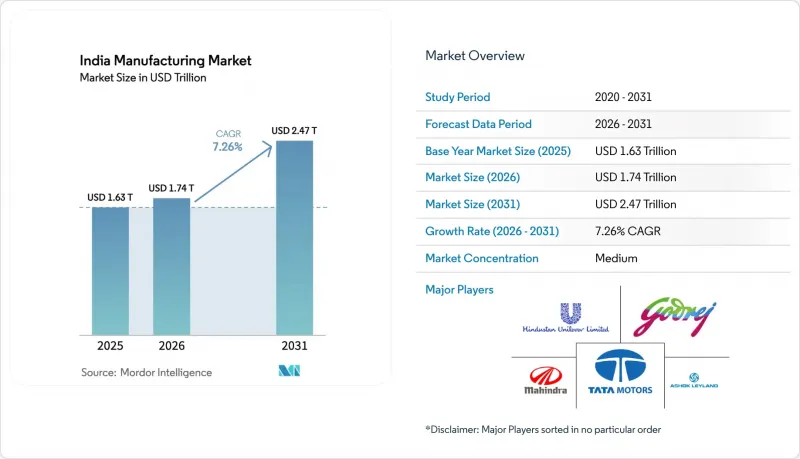
Mordor Intelligence에 의하면, 인도 제조 시장 규모는 2025년에 1조 6,300억 달러, 2026년에 1조 7,400억 달러가 되어, 2031년까지 2조 4,700억 달러에 이를 것으로 예측되며, 2026년부터 2031년까지 CAGR 7.26%로 성장할 전망입니다.
본 보고서는 소유 형태별(공공 부문, 기타), 최종 사용자 산업별(자동차·자동차 부품, 기타), 공장 규모별(대기업), 지역별(북인도, 기타)로 분류되어 있습니다. 시장 예측은 금액(달러)으로 표시되어 있습니다.
인도 제조 시장 동향 및 인사이트
그린 수소, 첨단 화학 배터리, 반도를 대상으로 한 확대판 PLI 2.0 인센티브
PLI 2.0은 신흥 분야에 260억 달러를 배정하고 있으며, 보조금의 50%를 매출 증대와 연계하고 있기 때문에 수혜자는 착공 전에 장기 구매 계약을 체결해야 합니다. 구자라트주와 카르나타카주에 건설이 계획된 3개의 웨이퍼 공장으로 인해 2027년까지 월간 생산 능력은 8만 5,000장으로 확대될 전망이며, 한편,배터리 관련 인센티브를 통해 2028년까지 50GWh 규모의 셀 생산 계획이 뒷받침되고 있습니다. 수소 분야의 지원 대상은 연간 120만 톤 규모의 전해조까지 확대되며, 이미 40억 달러 규모의 민간 투자 확약을 이끌어 냈습니다. 지급의 단계적 시행(선급금 20%, 실적 연동형 80%)을 통해 재정적 위험은 줄어들겠지만, 중소규모 기업은 생산 확대기에 자금 조달 곤란에 직면할 가능성이 있습니다. 전반적으로 이 제도는 수년에 걸친 국내 수요의 하한선을 보장하는 것이며, 그 파급 효과는 부품 공급망 전체에 미칠 것입니다.
‘쿼드’에 의한 공급망 재편(‘중국+1’)이 OEM 수주를 인도로 유도
애플과 삼성이 인도 내 조립 거점을 확대함에 따라, 2025년 제조업에 대한 외국인 직접 투자(FDI)는 전년 대비 34% 증가한 220억 달러에 달했습니다. 쿼드공급망 회복탄력성 이니셔티브에서는 50억 달러의 우대 대출이 배정되었으며, 중견 전자기기 및 자동차 부품 발주가 인도 공급업체로 이동하고 있습니다. 폭스콘과 페가트론은 현재 8만 7,000명의 직원을 고용하고 있으며, 삼성은 전 세계 세탁기 생산량의 30%를 노이다로 이전했습니다. 그러나 디스플레이와 센서가 수입에 의존하고 있어, 휴대전화의 부가가치 중 현지에서 창출되는 비율은 38%에 그치고 있으며, 이는 더 깊은 후방 통합의 여지가 있음을 보여줍니다.
고질적인 물류 병목 현상: 항만 체류 시간 및 내륙 철도 수송 비율 30% 미만
2025년에는 평균 항만 체류 일수가 2.8일로 단축되었지만, 여전히 콜롬보의 2배, 싱가포르의 3배 수준에 머물러 있어 수출업체의 재고 비용을 상승시키고 있습니다. 자와할랄 네루 항구에서는 몬순 성수기에 7일간의 대기 행렬이 발생하여, 전자제품 화주들은 비용이 많이 드는 항공 운송을 선택할 수밖에 없습니다. 철도 화물 점유율이 27.3%에 그치는 이유는 산업단지의 불과 5분의 1에만 부설선이 있고, 열차 편성 회전 기간이 5.2일인 반면, 중국은 2.8일이기 때문입니다. 토지 분쟁으로 인해 동부 화물 회랑의 완공이 18개월 지연되면서, 예상되었던 화물 비용 30% 절감도 미뤄지게 되었습니다. 라스트 마일 연결이 간선 회랑 정비 속도를 따라잡지 못하는 한, 인도의 물류 비용이 상대적으로 비싸다는 인상은 해소되지 않을 것입니다.
부문 분석
2025년, 인도 제조 시장 점유율의 71.68%를 민간 기업이 차지하고 있으며, 민간 중소·영세 기업(MSME)은 2031년까지 연평균 성장률(CAGR) 10.04%로 시장 전체를 상회하는 성장이 예상됩니다. 디지털 청구서 할인 및 PLI 보조금 덕분에 딕슨 테크놀로지스는 14개의 세계 브랜드를 확보하여 매출을 20억 4,000만 달러까지 끌어올렸습니다. 기존 연금 제도의 부담으로 어려움을 겪고 있는 공공 부문 기업의 경우, 바라트 헤비 일렉트리컬즈의 2025 회계연도 신규 수주량이 11% 감소했습니다. 혼합 소유제 기업과 협동조합의 합산 점유율은 간신히 10%에 그치고 있지만, 자금 조달에는 제약이 있습니다. 따라서 인도의 제조 시장은 성장 동력으로서 기동성이 높은 민간 기업에 의존하는 한편, 국영 기업은 중공업의 기반을 안정시키는 역할을 담당하고 있습니다.
100% 외국인 직접 투자(FDI)의 자동 허용 및 대부분의 부문에서 라이선스 제도 폐지를 포함한 규제 완화로 인해 민간 기업의 우위가 공고해지고 있습니다. 딕슨(Dixon)이나 아사(Assa) 및 이와 유사한 기업들이 창출하는 인도 제조 시장 규모는 현지 조달이 증가함에 따라 계속해서 확대되고 있습니다. 반면, 협동조합은 사탕수수 가격 통제로 인해 어려움을 겪고 있으며, 농가에 대한 미지급금이 26억 4,000만 달러에 달하고, 기술 업그레이드를 저해하고 있습니다. 앞으로 중소기업 및 영세기업(MSME)은 디지털 신용 및 GST(상품·서비스세) 준수 실적을 활용하여 OEM으로부터 수주를 확보함으로써, 기동력 있는 공급업체가 대규모 통합업체를 뒷받침하는 이중 구조를 확고히 다져나갈 것입니다.
기타 혜택:
- 엑셀 형식 시장 예측(ME) 시트
- 3개월간의 애널리스트 지원
자주 묻는 질문
목차
제1장 서론
제2장 조사 방법
제3장 주요 요약
제4장 시장 구도
제5장 시장 규모와 성장 예측
제6장 경쟁 구도
제7장 시장 기회와 향후 전망
JHS 26.09.11According to Mordor Intelligence, the India manufacturing market size is projected to be USD 1.63 trillion in 2025, USD 1.74 trillion in 2026, and reach USD 2.47 trillion by 2031, growing at a CAGR of 7.26% from 2026 to 2031.
This report is Segmented by Ownership (Public Sector, and Others), by End-User Industry (Automotive & Auto Components, and Others), by Plant Size (Large Enterprises), and by Geography (North India, and Others). The Market Forecasts are Provided in Terms of Value (USD).
India Manufacturing Market Trends and Insights
Expanded PLI 2.0 Incentives Covering Green Hydrogen, Advanced Chemistry Batteries & Semiconductors
PLI 2.0 has lined up USD 26 billion for sunrise sectors and ties 50% of subsidies to incremental sales, so recipients must close long-term offtake deals before ground-breaking. Three wafer fabs targeted for Gujarat and Karnataka will lift monthly capacity to 85,000 wafers by 2027, while battery incentives backed plans for 50 GWh of cells by 2028. Hydrogen awards cover 1.2 million t/y of electrolyzers and have already drawn USD 4 billion of private spending pledges. Staggered payouts (20% upfront, 80% performance-linked) lower fiscal risk, yet smaller firms face liquidity gaps during ramp-up. Overall, the scheme locks in a multi-year domestic-demand floor that will ripple across component supply chains.
Quad Supply-Chain Realignment ("China + 1") Funnelling OEM Orders to India
FDI in manufacturing climbed to USD 22 billion in 2025, 34% above the previous year, as Apple and Samsung deepened India assembly footprints. The Quad supply-chain-resilience initiative earmarks USD 5 billion of concessional credit, tilting orders for mid-tier electronics and auto parts toward Indian vendors. Foxconn and Pegatron now employ 87,000 workers, while Samsung moved 30% of global washer output to Noida. Yet imported displays and sensors mean only 38% of handset value is locally added, indicating scope for deeper backward integration.
Persistent Logistics Bottlenecks: Port Dwell Times & Hinterland Rail Share less than 30%
Average port dwell fell to 2.8 days in 2025, yet remains double Colombo's and triple Singapore's, hiking inventory costs for exporters. Jawaharlal Nehru Port saw seven-day queues in monsoon peaks, pushing electronics shippers to costly air freight. Rail's cargo share languishes at 27.3% because only one-fifth of parks have sidings, while rake turnaround is 5.2 days versus China's 2.8 days. Completion of the Eastern Freight Corridor slipped 18 months due to land disputes, delaying anticipated 30% freight-cost cuts. Unless last-mile links keep pace with trunk corridors, India's logistics penalty will persist.
Other drivers and restraints analyzed in the detailed report include:
- Domestic Consumption Surge from Tier-2/3 Urbanization and E-Commerce Warehousing Growth
- Fast-Track Industrial-Corridor Connectivity via Gati Shakti Projects
- Land-Acquisition Delays Despite State Reforms, Prolonging Project Lead Times
For complete list of drivers and restraints, kindly check the Table Of Contents.
Segment Analysis
Private firms commanded a 71.68% India manufacturing market share in 2025, while private MSMEs will outpace the broader market at 10.04% CAGR through 2031. Digital invoice discounting and PLI subsidies let Dixon Technologies lift revenue to USD 2.04 billion by onboarding 14 global brands. Public-sector units, burdened by legacy pensions, saw Bharat Heavy Electricals' new orders dip 11% in FY 2025. Joint-sector and cooperative ventures together held barely 10% but face restricted capital access. The India manufacturing market, therefore, leans on agile private players for growth while state enterprises stabilize heavy-industry baselines.
Regulatory liberalization, including automatic 100% FDI and licensing abolition for most categories, has entrenched private dominance. The India manufacturing market size generated by Dixon, Ather, and similar firms keeps broadening as localized sourcing climbs. Cooperatives struggle under controlled cane pricing, amassing USD 2.64 billion in farmer arrears that crimp tech upgrades. Looking ahead, MSMEs will exploit digital credit and GST compliance histories to win OEM mandates, cementing a two-tier structure of nimble suppliers feeding scale integrators.
Complete Report Scope:
- By Ownership
- Public Sector
- Private Sector
- Joint Sector
- Cooperative Sector
- By End-user Industry
- Automotive & Auto Components
- Textile & Apparel
- Electronics & Electricals
- Food & Beverages
- Pharmaceuticals & Healthcare
- Construction Materials
- Chemicals
- Aerospace & Defence
- Metals
- Machinery and Capital Goods
- Others (Furniture, etc.)
- By Plant Size
- Large Enterprises
- Medium Enterprises
- Small & Micro (MSMEs)
- By Geography
- North India
- West India
- South India
- East & North-East India
List of Companies Covered in this Report:
- Reliance Industries Ltd
- Tata Motors Ltd
- Mahindra & Mahindra Ltd
- Maruti Suzuki India Ltd
- Tata Steel Ltd
- Larsen & Toubro Ltd
- JSW Steel Ltd
- Hindustan Unilever Ltd
- Godrej Group
- Ashok Leyland Ltd
- Hero MotoCorp Ltd
- TVS Motor Company Ltd
- Bharat Forge Ltd
- Bharat Electronics Ltd
- Bosch Ltd (India)
- Dixon Technologies (India) Ltd
- Vedanta Ltd
- Aditya Birla Group (Hindalco, UltraTech)
- Apollo Tyres Ltd
- MRF Ltd
- Ather Energy Pvt Ltd
Additional Benefits:
- The market estimate (ME) sheet in Excel format
- 3 months of analyst support
TABLE OF CONTENTS
1 Introduction
- 1.1 Study Assumptions & Market Definition
- 1.2 Scope of the Study
2 Research Methodology
3 Executive Summary
4 Market Landscape
- 4.1 Market Overview
- 4.2 Market Drivers
- 4.2.1 Expanded PLI 2.0 incentives covering green hydrogen, advanced chemistry batteries & semiconductors
- 4.2.2 Quad supply-chain realignment ("China + 1") funnelling OEM orders to India
- 4.2.3 Domestic consumption surge from tier-2/3 urbanisation and e-commerce warehousing growth
- 4.2.4 Fast-track industrial-corridor connectivity via Gati Shakti multimodal logistics projects
- 4.2.5 Defence-procurement offset obligations catalysing precision-manufacturing capacity
- 4.2.6 Mandatory ESG disclosure (BRSR) accelerating investment in energy-efficient Industry 4.0 retrofits
- 4.3 Market Restraints
- 4.3.1 Persistent logistics bottlenecks port dwell times & hinterland rail share less than 30 %
- 4.3.2 Land-acquisition delays despite state reforms, prolonging project lead times
- 4.3.3 Volatile critical-mineral prices (copper, lithium) squeezing input-cost margins
- 4.3.4 Acute shortage of semiconductor-fab talent & clean-room engineers
- 4.4 Government Initiatives & Schemes
- 4.5 Recent Investments & Developments
- 4.6 Manufacturing Clusters (state-wise)
- 4.7 Historical Evolution of Indian Manufacturing
- 4.8 Impact of Geopolitical Events on the Market
- 4.9 Value / Supply-Chain Analysis
- 4.10 Regulatory Landscape
- 4.11 Technological Outlook (Industry 4.0, Additive Mfg, AI)
- 4.12 Industry Attractiveness - Porter's Five Forces
- 4.12.1 Threat of New Entrants
- 4.12.2 Bargaining Power of Buyers
- 4.12.3 Bargaining Power of Suppliers
- 4.12.4 Threat of Substitutes
- 4.12.5 Competitive Rivalry
5 Market Size & Growth Forecasts (Value, In USD Billion)
- 5.1 By Ownership
- 5.1.1 Public Sector
- 5.1.2 Private Sector
- 5.1.3 Joint Sector
- 5.1.4 Cooperative Sector
- 5.2 By End-user Industry
- 5.2.1 Automotive & Auto Components
- 5.2.2 Textile & Apparel
- 5.2.3 Electronics & Electricals
- 5.2.4 Food & Beverages
- 5.2.5 Pharmaceuticals & Healthcare
- 5.2.6 Construction Materials
- 5.2.7 Chemicals
- 5.2.8 Aerospace & Defence
- 5.2.9 Metals
- 5.2.10 Machinery and Capital Goods
- 5.2.11 Others (Furniture, etc.)
- 5.3 By Plant Size
- 5.3.1 Large Enterprises
- 5.3.2 Medium Enterprises
- 5.3.3 Small & Micro (MSMEs)
- 5.4 By Geography
- 5.4.1 North India
- 5.4.2 West India
- 5.4.3 South India
- 5.4.4 East & North-East India
6 Competitive Landscape
- 6.1 Market Concentration
- 6.2 Strategic Moves
- 6.3 Market Share Analysis
- 6.4 Company Profiles (includes Global level Overview, Market level overview, Core Segments, Financials as available, Strategic Information, Products & Services, and Recent Developments)
- 6.4.1 Reliance Industries Ltd
- 6.4.2 Tata Motors Ltd
- 6.4.3 Mahindra & Mahindra Ltd
- 6.4.4 Maruti Suzuki India Ltd
- 6.4.5 Tata Steel Ltd
- 6.4.6 Larsen & Toubro Ltd
- 6.4.7 JSW Steel Ltd
- 6.4.8 Hindustan Unilever Ltd
- 6.4.9 Godrej Group
- 6.4.10 Ashok Leyland Ltd
- 6.4.11 Hero MotoCorp Ltd
- 6.4.12 TVS Motor Company Ltd
- 6.4.13 Bharat Forge Ltd
- 6.4.14 Bharat Electronics Ltd
- 6.4.15 Bosch Ltd (India)
- 6.4.16 Dixon Technologies (India) Ltd
- 6.4.17 Vedanta Ltd
- 6.4.18 Aditya Birla Group (Hindalco, UltraTech)
- 6.4.19 Apollo Tyres Ltd
- 6.4.20 MRF Ltd
- 6.4.21 Ather Energy Pvt Ltd
7 Market Opportunities & Future Outlook
- 7.1 White-space & Unmet-need Assessment


