|
시장보고서
상품코드
2125611
오가노이드 시장 : 시장 점유율 분석, 산업 동향 및 통계 데이터, 성장 예측(2026-2031년)Organoids - Market Share Analysis, Industry Trends & Statistics, Growth Forecasts (2026 - 2031) |
||||||
 Mordor Intelligence
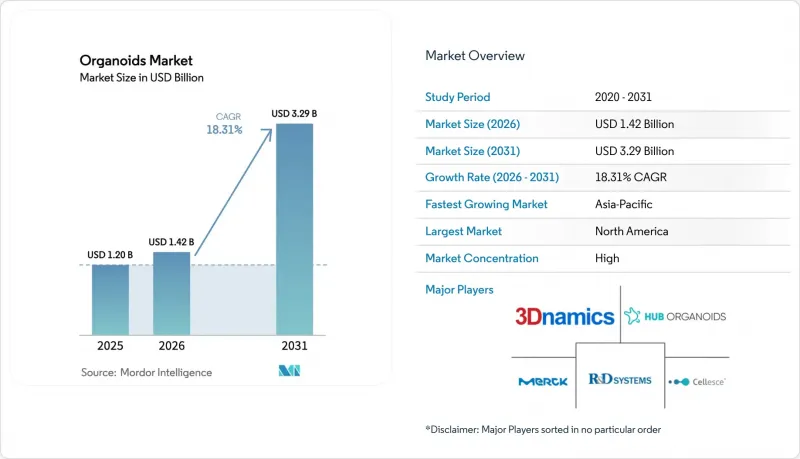
Mordor Intelligence에 의하면, 오가노이드 시장 규모는 2025년 12억 달러로 평가되었고, 2026년 14억 2,000만 달러에서 2031년까지 32억 9,000만 달러로 확대될 것으로 예측되며, 2026-2031년 연평균 복합 성장률(CAGR)은 18.31%를 나타낼 전망입니다.
본 보고서는 공급원별(다능성 줄기세포 유래 등), 장기 유형별(장, 간, 뇌, 신장 등), 용도별(신약 개발·스크리닝 등), 최종 사용자별(학술·연구 기관 등), 기술별(3D 바이오 프린팅 활용 등), 지역별(북미, 유럽, 아시아태평양 등)로 분류되어 있습니다. 시장 예측은 금액(달러) 기준으로 제시되어 있습니다.
세계의 오가노이드 시장 동향 및 인사이트
암 치료제 신약 개발에서 오가노이드의 채택 확대
2025년 『Nature Medicine』지에 게재된 연구에 따르면, 대장암 오가노이드가 84%의 사례에서 화학요법 반응을 예측하여 기존 세포주를 능가하는 성능을 보임에 따라, 제약 업계에서의 채택이 더욱 확대되고 있습니다. 로슈(Roche)의 2025년 연차 보고서에 따르면, 12가지 종양 유형에 걸쳐 1,000개가 넘는 환자 유래 모델을 보유한 사내 바이오뱅크가 공개되었으며, 이는 현재 선도 화합물 최적화 스크리닝의 기반이 되고 있습니다. 미국 국립암연구소(NCI)는 ‘휴먼 톰어 아틀라스 네트워크(Human Tumor Atlas Network)’에 1억 달러를 지원했습니다. 이 네트워크는 오가노이드 분석과 통합하여 병용 요법 설계에 정보를 제공하는 공간 전사체학 지도를 작성했습니다. 각 후원사는 전임상 단계 기간을 6-12개월 단축하고, 후기 단계에서의 탈락률을 낮추며, 연구개발 투자의 수익성을 높이고 있다고 보고하고 있습니다. 이러한 성과는 오가노이드 시장을 종양학의 일상적인 워크플로로 추진하는 경제적 근거를 더욱 공고히 하고 있습니다.
정밀 의학을 위한 임상시험 및 맞춤형 치료의 확대
프린세스 막시마 센터에서는 오가노이드를 기반으로 한 치료 개입을 통해 재발한 소아 고형암의 객관적 반응률이 23퍼센트 포인트 상승했습니다. 이 데이터를 바탕으로 네덜란드의 각 보험사는 보험 급여 절차의 시범 도입을 결정했습니다. 일본 후생노동성은 2025년 3월, 환자 유래 배양 세포를 기반으로 한 최초의 동반 진단제를 승인했습니다. 이를 통해 조직병리학 검사만으로는 얻을 수 없는 14일간의 기능적 평가 결과를 확보할 수 있게 되었습니다. 현재 바스켓 임상시험에는 오가노이드 분석법이 포함되어 있으며, 공통된 분자 표적을 가진 환자를 등록함으로써 희귀암 적응증에 대한 선별 비용을 절감하고 피험자 모집을 가속화하고 있습니다. 보험사가 증거 기준을 엄격히 적용하는 가운데, 오가노이드를 통해 생성된 기능적 반응 데이터는 보험 급여 협상을 뒷받침하는 근거가 되어 오가노이드 시장의 도입 확대를 촉진하고 있습니다.
특수 매트릭스 및 성장 인자의 높은 비용
매트릭젤의 가격은 1밀리리터당 400-600달러이며, 대규모 스크리닝에서는 5-10밀리리터가 필요한 경우가 많아 실험 1회당 시약비는 6,000달러에 달할 전망입니다. R-스폰딘이나 Wnt3a와 같은 필수 재조합 단백질은 1밀리그램당 300-800달러의 추가 비용이 들며, 반감기가 짧아 소비량도 많습니다. 2024년 ISSCR 조사에 따르면, 응답자의 62%가 시약비를 주요 장벽으로 꼽았으며, 일부 연구실에서는 2차원 모델로 회귀하는 현상이 나타나고 있습니다. 각 공급업체는 동물 유래 성분을 포함하지 않는 하이드로겔이나 대량 구매 할인 제도를 도입하고 있지만, 비용 절감은 점진적인 수준에 그치고 있어 자원이 제한된 지역에서의 보급을 저해하고, 결과적으로 오가노이드 시장의 성장률을 둔화시키고 있습니다.
부문 분석
성체 줄기세포 유래 오가노이드는 규제 당국이 인정하고 충분히 검증된 소화관 및 간 모델을 제공함으로써 2025년 매출의 58.43%를 차지했습니다. 다능성 줄기세포주는 발생 과정 및 희귀질환에 대한 인사이트를 제공하지만, 분화에 시간이 걸리기 때문에 처리 능력에는 한계가 있습니다. 종양 유래 배양 세포는 2031년까지 연평균 성장률(CAGR) 20.65%를 나타낼 것으로 예측되며, 오가노이드 시장에서 가장 빠르게 성장하는 분야가 될 것입니다. 노바티스는 현재 15가지 종양 유형에 걸친 800개 이상의 환자 유래 균주를 유지하고 있으며, 이를 통해 병행 약물 스크리닝이 가능해져 선도 화합물의 최적화 기간을 단축하고 있습니다. 『Nature Biotechnology』지는 2025년, 종양 오가노이드가 10회에 걸친 계대를 거쳐도 유전체 충실성을 유지했다고 보고하며, 종단적 연구에서 그 안정성을 입증했습니다. 바이오 뱅킹의 확대에 따라 종양 유래 모델은 10년 이내에 절대 매출액 측면에서 성체 줄기세포주를 추월할 것으로 예상되며, 이는 정밀 종양학으로의 전략적 전환을 여실히 보여줍니다.
CRISPR 유전자 편집과 종양 오가노이드의 융합은 합성 치사성의 발견을 지원하며, AI를 활용한 이미징은 표현형 판독을 가속화합니다. 이러한 진전은 보다 조기 개념 증명을 추구하는 제약 업계 수요와 부합하며, 오가노이드 시장의 이 공급 부문에서 구조적인 성장을 뒷받침하고 있습니다. 종양 계통에 맞추어 조정된 독자적인 배양 배지는 공급업체에 지속적인 추가 수익을 가져다줄 것으로 기대되지만, 중견 제약사의 예산을 확보하기 위해서는 여전히 비용 억제가 필수적입니다. 그 결과, 경쟁적 차별화는 유래, 스크리닝, 생물정보학, 규제 대응을 단일 계약으로 통합한 서비스 번들로 전환되고 있습니다.
2025년에는 염증성 장 질환, 미생물군집 연구, 장 병원체 분석 등 광범위한 용도를 통해 장 모델이 장기별 매출의 28.65%를 차지했습니다. 간 오가노이드는 간독성 스크리닝에 탁월한 반면, 뇌 모델은 배양이 복잡함에도 불구하고 신경 발달 연구를 가능하게 합니다. 췌장 모델은 2026-2031년 연평균 성장률(CAGR) 20.76%를 나타낼 것으로 예측되며, 이 부문 내에서 가장 강력한 성장 궤도를 보이고 있습니다. 2024년 『Cell Metabolism』지에 게재된 연구에서는 β세포의 인슐린 분비 장애가 충실하게 재현되었음이 입증되어, 당뇨병 치료제 개발 파이프라인의 진전으로 이어졌습니다. 또한, 낭포성 섬유증 재단(Cystic Fibrosis Foundation)은 2025년에 1,500만 달러를 투자하여 췌장 오가노이드 저장소를 500건의 환자 샘플 규모로 확대하고, CFTR 조절제 임상시험을 촉진했습니다.
현재, 현탁형 바이오리액터를 통해 센티미터 규모의 췌장 배양이 가능해지면서, 세포 치료용 시드주 개발의 가능성이 넓어지고 있습니다. 규제 당국이 임상 등급 제조 프로토콜을 평가하는 가운데, 췌장 오가노이드는 약물 스크리닝과 재생 의학 양면에서 전략적 중요성이 커지고 있습니다. 스케일업 기술을 습득한 공급업체는 오가노이드 시장 중에서도 이 고성장 분야에서 선점 우위를 확보하게 될 것입니다.
지역별 분석
2025년에는 NIH의 4,800만 달러 규모의 ‘Tissue Chip’ 보조금과 FDA의 관대한 규제 태도에 힘입어 북미가 매출의 43.65%를 차지하며 1위를 차지했습니다. 캐나다는 국가 바이오뱅크에 1,200만 캐나다 달러를 투자한 반면, 멕시코는 미국 제약 기업 고객을 대상으로 한 수탁 오가노이드 서비스의 니어쇼어링 거점으로 부상했습니다. 보스턴과 샌프란시스코 베이 지역에 집중된 벤처 캐피탈은 매트릭스, 이미징, 바이오리액터 각 분야의 스타트업에 대한 투자를 지속하며, 오가노이드 시장의 지역 수요를 뒷받침하고 있습니다.
유럽은 ‘호라이즌 유럽(Horizon Europe)’의 950억 유로 규모 프레임워크의 혜택을 받고 있으며, 독일 연방 교육연구부는 표준화된 프로토콜을 보급하는 역량 센터에 3,000만 유로를 추가로 지원했습니다. 영국 의학연구위원회(MRC)는 인간 발생 생물학 자원을 오가노이드 모델로 확대하기 위해 1,800만 파운드를 투입하고, 다국적 기업과의 공동 연구를 유치하고 있습니다. 프랑스, 이탈리아, 스페인은 유럽 구조 기금을 활용하여 희귀질환에 대한 응용을 지원하고, 지역 내 도입을 확대되고 있습니다. 이러한 노력들이 어우러져 유럽 오가노이드 시장의 경쟁력을 높이는 통합적인 공급망이 조성되고 있습니다.
아시아태평양은 2031년까지 연평균 성장률(CAGR) 19.43%를 나타낼 것으로 예측됩니다. 중국은 지역 센터에 5억 위안을 투자하여 프로토콜 표준화와 인재 양성을 추진하고 있습니다. 일본에서는 오가노이드용 동반 진단제가 승인되었고, 한국에서는 250억 원 규모의 프로그램이 시행되는 등 임상 수요가 확대되고 있습니다. 인도는 낮은 인건비를 무기로 위탁 서비스를 유치하고 있으며, 호주는 원주민의 건강을 목적으로 한 바이오뱅크에 1,000만 호주 달러를 투입하고 있습니다. 이러한 프로그램들이 어우러져 지역의 역량을 높이고, 전 세계 오가노이드 시장의 기반을 확대되고 있습니다.
중동 및 아프리카, 남미는 여전히 발전 단계에 있지만, 인프라 구축의 초기 조짐이 보입니다. 브라질의 상파울루 연구 재단과 남아프리카공화국의 의학연구평의회는 프로토콜 현지화를 위한 시범 사업을 시작했으며, 이는 향후 보급 가능성을 시사합니다. 현재 유럽과 북미에서 동결보존된 오가노이드 균주의 수출이 공급 격차를 메우고 있어, 물류 사업자에게 초기 단계의 비즈니스 기회가 있음을 시사하고 있습니다.
기타 혜택 :
- Excel 형식 시장 예측(ME) 시트
- 3개월간의 애널리스트 지원
자주 묻는 질문
목차
제1장 서론
제2장 분석 방법
제3장 주요 요약
제4장 시장 구도
제5장 시장 규모 및 성장률 예측
제6장 경쟁 구도
제7장 시장 기회 및 향후 전망
AJY 26.09.15According to Mordor Intelligence, the organoids market size is projected to expand from USD 1.20 billion in 2025 and USD 1.42 billion in 2026 to USD 3.29 billion by 2031, registering a CAGR of 18.31% between 2026 to 2031.

This report is Segmented by Source (Pluripotent Stem-Cell-Derived, and More), Organ Type (Intestinal, Liver, Brain, Kidney, and More), Application (Drug Discovery & Screening, and More), End User (Academic & Research Institutes, and More), Technology (3-D Bioprinting-Assisted, and More), and Geography (North America, Europe, Asia-Pacific, and More). The Market Forecasts are Provided in Terms of Value (USD).
Global Organoids Market Trends and Insights
Rising Adoption of Organoids in Oncology Drug Discovery
Colorectal tumor organoids predicted chemotherapy response in 84% of cases during a 2025 Nature Medicine study, outperforming traditional cell lines and spurring broader pharmaceutical uptake. Roche's 2025 annual report disclosed an internal biobank exceeding 1,000 patient-derived models spanning 12 tumor types, which now underpins lead-optimization screens. The U.S. National Cancer Institute allocated USD 100 million to the Human Tumor Atlas Network, which created spatial transcriptomic maps that integrate with organoid assays to inform combination-therapy design. Sponsors report preclinical timeline compression of 6-12 months and lower late-stage attrition, reinforcing return on R&D capital. These gains strengthen the economic rationale that propels the organoids market toward routine oncology workflows.
Expansion of Precision Medicine Trials and Personalized Therapies
Organoid-guided interventions raised objective response rates by 23 percentage points in relapsed pediatric solid tumors at the Princess Maxima Center, a data point that convinced Dutch insurers to test reimbursement pathways. Japan's Ministry of Health, Labour and Welfare cleared the first companion diagnostic based on patient-derived cultures in March 2025, providing a 14-day functional readout unattainable with histopathology alone. Basket trials now embed organoid assays to enroll patients with shared molecular targets, shrinking screening costs and accelerating recruitment in rare oncology indications. As payers tighten evidence standards, functional response data generated by organoids further underpins reimbursement negotiations, boosting adoption in the organoids market.
High Cost of Specialized Matrices and Growth Factors
Matrigel ranges from USD 400-600 per milliliter, and large screens often require 5-10 milliliters, pushing reagent bills to USD 6,000 per experiment. Essential recombinant proteins such as R-spondin and Wnt3a cost another USD 300-800 per milligram, with high turnover owing to short half-lives. A 2024 ISSCR survey found 62% of respondents citing reagent expense as a primary barrier, prompting some labs to revert to two-dimensional models. Suppliers are rolling out animal-free hydrogels and bulk-pricing schemes, but cost compression remains incremental, holding back uptake in resource-constrained regions and thereby tempering the organoids market growth rate.
Other drivers and restraints analyzed in the detailed report include:
- Government Funding for 3-D Cell Culture Infrastructure
- Shift Away from Animal Testing in Preclinical Research
- Lack of Standardized Reproducibility Protocols
For complete list of drivers and restraints, kindly check the Table Of Contents.
Segment Analysis
Adult stem-cell-derived organoids anchored 58.43% of 2025 revenue by offering well-validated gastrointestinal and hepatic models that regulators recognize. Pluripotent stem-cell lines supply developmental and rare-disease insights, although longer differentiation timelines limit throughput. Tumor-derived cultures are forecast to log a 20.65% CAGR through 2031, the fastest-growing slice of the organoids market. Novartis now maintains more than 800 patient-derived lines across 15 tumor types, enabling parallel drug screens that shorten lead optimization windows. Nature Biotechnology reported in 2025 that tumor organoids retained genomic fidelity across 10 passages, validating stability for longitudinal studies. As biobanking expands, tumor-derived models are positioned to overtake adult stem-cell lines in absolute revenue within a decade, underscoring the strategic shift toward precision oncology.
The convergence of CRISPR gene editing with tumor organoids supports synthetic-lethal discovery, while AI-enabled imaging accelerates phenotypic readouts. These advances align with pharmaceutical demand for earlier proof-of-concept, reinforcing structural growth in this source segment of the organoids market. Proprietary culture media tailored to tumor lineages promise additional recurring revenue for suppliers, although cost containment remains essential to penetrate mid-tier pharma budgets. Consequently, competitive differentiation is migrating toward service bundles that integrate derivation, screening, bioinformatics, and regulatory support into a single contract.
Intestinal models captured 28.65% of organ-type revenue in 2025 through applications spanning inflammatory bowel disease, microbiome studies, and enteric pathogen assays. Liver organoids excel in hepatotoxicity screens, while brain models, despite culture complexity, enable neurodevelopmental research. Pancreas models are projected to book a 20.76% CAGR over 2026-2031, the strongest trajectory inside this segmentation. A 2024 Cell Metabolism study demonstrated faithful recapitulation of beta-cell insulin secretion defects, advancing diabetes drug pipelines. The Cystic Fibrosis Foundation's USD 15 million outlay in 2025 expanded its pancreatic organoid repository to 500 patient samples, facilitating CFTR modulator testing.
Suspension bioreactors now enable centimeter-scale pancreatic cultures, opening potential for cell-therapy seed stocks. As regulatory agencies evaluate clinical-grade manufacturing protocols, pancreas organoids gain strategic relevance for both drug screening and regenerative approaches. Suppliers that master scale-up technologies will secure early-mover advantage in this high-growth pocket of the organoids market size.
Complete Report Scope:
- By Source
- Pluripotent Stem-Cell-Derived Organoids
- Adult Stem-Cell-Derived Organoids
- Tumor-Derived Patient Organoids
- By Organ Type
- Intestinal
- Liver
- Brain
- Kidney
- Lung
- Pancreas
- Cardiac
- Other Organ Types
- By Application
- Drug Discovery & Screening
- Disease & Toxicology Modelling
- Precision & Personalised Medicine
- Regenerative Medicine
- Organoid Biobanking Services
- Other Applications
- By End User
- Academic & Research Institutes
- CROs & CDMOs
- Hospitals & Diagnostics Labs
- Pharmaceutical & Biotech Companies
- By Technology
- 3-D Bioprinting-Assisted Organoids
- AI-Guided Automated Platforms
- Micro-Fluidic Organ-On-Chip Integrated
- Scaffold-Based 3-D Culture
- Suspension / Scaffold-Free Culture
- Geography
- North America
- United States
- Canada
- Mexico
- Europe
- Germany
- United Kingdom
- France
- Italy
- Spain
- Rest of Europe
- Asia-Pacific
- China
- Japan
- India
- Australia
- South Korea
- Rest of Asia-Pacific
- Middle East & Africa
- GCC
- South Africa
- Rest of Middle East & Africa
- South America
- Brazil
- Argentina
- Rest of South America
- North America
Geography Analysis
North America led with 43.65% revenue in 2025, propelled by NIH's USD 48 million Tissue Chip grants and the FDA's permissive regulatory stance. Canada injected CAD 12 million into a national biobank while Mexico emerged as a near-shoring destination for contract organoid services catering to U.S. pharma clients. Venture capital concentrations in Boston and the San Francisco Bay Area continue to seed start-ups across matrices, imaging, and bioreactors, underpinning local demand in the organoids market.
Europe benefits from Horizon Europe's EUR 95 billion framework, with Germany's Federal Ministry of Education and Research adding EUR 30 million for competence centers that disseminate harmonized protocols. The United Kingdom's Medical Research Council deployed GBP 18 million to extend its Human Developmental Biology Resource into organoid models, attracting multinational collaborations. France, Italy, and Spain leverage European Structural Funds to support rare-disease applications, expanding regional uptake. Together, these initiatives foster an integrated supply chain that boosts European organoids market competitiveness.
Asia-Pacific is forecast to clock a 19.43% CAGR to 2031. China's CNY 500 million investment in regional centers seeks to standardize protocols and train personnel. Japan's approval of an organoid companion diagnostic and South Korea's KRW 25 billion program expand clinical demand. India lures contract services through lower labor costs, while Australia channels AUD 10 million into biobanks targeting indigenous health. These programs collectively elevate regional capacity, broadening the global organoids market base.
Middle East, Africa, and South America remain nascent but show early signs of infrastructure build-out. Brazil's Sao Paulo Research Foundation and South Africa's Medical Research Council launched pilot initiatives to localize protocols, hinting at future uptake. Export of cryopreserved organoid lines from Europe and North America currently fills supply gaps, indicating early-stage opportunity for logistics providers.
- Advanced BioMatrix Inc.
- ATCC
- BICO Group AB
- Cellesce
- CN Bio Innovations Ltd
- Corning
- Emulate
- Eppendorf
- Greiner Bio One International
- HeartBeat.bio AG
- Hubrecht Organoid Technology
- InSphero
- Lonza Group
- Merck
- Mimetas
- Miltenyi Biotec B.V. & Co. KG
- QGel SA
- Sartorius
- Stem Cell Technologies
- Thermo Fisher Scientific
Additional Benefits:
- The market estimate (ME) sheet in Excel format
- 3 months of analyst support
TABLE OF CONTENTS
1 Introduction
- 1.1 Study Assumptions & Market Definition
- 1.2 Scope Of The Study
2 Research Methodology
3 Executive Summary
4 Market Landscape
- 4.1 Market Overview
- 4.2 Market Drivers
- 4.2.1 Rising Adoption of Organoids in Oncology Drug Discovery
- 4.2.2 Expansion of Precision Medicine Trials and Personalized Therapies
- 4.2.3 Government Funding for 3-D Cell Culture Infrastructure
- 4.2.4 Shift Away from Animal Testing in Preclinical Research
- 4.2.5 Commercialization of Large-Scale Organoid Biobanks
- 4.2.6 Integration of Gene-Editing and Advanced Microfluidics Platforms
- 4.3 Market Restraints
- 4.3.1 High Cost of Specialized Matrices and Growth Factors
- 4.3.2 Lack of Standardized Reproducibility Protocols
- 4.3.3 Ethical and Regulatory Ambiguity Around Complex Human Models
- 4.3.4 Limited Cold-Chain Logistics for Live Organoid Transport
- 4.4 Value / Supply-Chain Analysis
- 4.5 Regulatory Landscape
- 4.6 Technological Outlook
- 4.7 Organoid Biobank Landscape
- 4.8 Porter's Five Forces Analysis
- 4.8.1 Threat Of New Entrants
- 4.8.2 Bargaining Power Of Suppliers
- 4.8.3 Bargaining Power Of Buyers
- 4.8.4 Threat Of Substitutes
- 4.8.5 Competitive Rivalry
5 Market Size & Growth Forecasts (Value, USD)
- 5.1 By Source
- 5.1.1 Pluripotent Stem-Cell-Derived Organoids
- 5.1.2 Adult Stem-Cell-Derived Organoids
- 5.1.3 Tumor-Derived Patient Organoids
- 5.2 By Organ Type
- 5.2.1 Intestinal
- 5.2.2 Liver
- 5.2.3 Brain
- 5.2.4 Kidney
- 5.2.5 Lung
- 5.2.6 Pancreas
- 5.2.7 Cardiac
- 5.2.8 Other Organ Types
- 5.3 By Application
- 5.3.1 Drug Discovery & Screening
- 5.3.2 Disease & Toxicology Modelling
- 5.3.3 Precision & Personalised Medicine
- 5.3.4 Regenerative Medicine
- 5.3.5 Organoid Biobanking Services
- 5.3.6 Other Applications
- 5.4 By End User
- 5.4.1 Academic & Research Institutes
- 5.4.2 CROs & CDMOs
- 5.4.3 Hospitals & Diagnostics Labs
- 5.4.4 Pharmaceutical & Biotech Companies
- 5.5 By Technology
- 5.5.1 3-D Bioprinting-Assisted Organoids
- 5.5.2 AI-Guided Automated Platforms
- 5.5.3 Micro-Fluidic Organ-On-Chip Integrated
- 5.5.4 Scaffold-Based 3-D Culture
- 5.5.5 Suspension / Scaffold-Free Culture
- 5.6 Geography
- 5.6.1 North America
- 5.6.1.1 United States
- 5.6.1.2 Canada
- 5.6.1.3 Mexico
- 5.6.2 Europe
- 5.6.2.1 Germany
- 5.6.2.2 United Kingdom
- 5.6.2.3 France
- 5.6.2.4 Italy
- 5.6.2.5 Spain
- 5.6.2.6 Rest of Europe
- 5.6.3 Asia-Pacific
- 5.6.3.1 China
- 5.6.3.2 Japan
- 5.6.3.3 India
- 5.6.3.4 Australia
- 5.6.3.5 South Korea
- 5.6.3.6 Rest of Asia-Pacific
- 5.6.4 Middle East & Africa
- 5.6.4.1 GCC
- 5.6.4.2 South Africa
- 5.6.4.3 Rest of Middle East & Africa
- 5.6.5 South America
- 5.6.5.1 Brazil
- 5.6.5.2 Argentina
- 5.6.5.3 Rest of South America
- 5.6.1 North America
6 Competitive Landscape
- 6.1 Market Concentration
- 6.2 Market Share Analysis
- 6.3 Company Profiles (Includes Global-Level Overview, Market-Level Overview, Core Segments, Financials As Available, Strategic Information, Market Rank/Share For Key Companies, Products & Services, And Recent Developments)
- 6.3.1 Advanced BioMatrix Inc.
- 6.3.2 ATCC
- 6.3.3 BICO Group AB
- 6.3.4 Cellesce Ltd
- 6.3.5 CN Bio Innovations Ltd
- 6.3.6 Corning Inc.
- 6.3.7 Emulate Inc.
- 6.3.8 Eppendorf SE
- 6.3.9 Greiner Bio-One International GmbH
- 6.3.10 HeartBeat.bio AG
- 6.3.11 Hubrecht Organoid Technology
- 6.3.12 InSphero AG
- 6.3.13 Lonza Group AG
- 6.3.14 Merck KGaA
- 6.3.15 MIMETAS BV
- 6.3.16 Miltenyi Biotec B.V. & Co. KG
- 6.3.17 QGel SA
- 6.3.18 Sartorius AG
- 6.3.19 STEMCELL Technologies Inc.
- 6.3.20 Thermo Fisher Scientific Inc.
7 Market Opportunities & Future Outlook
- 7.1 White-Space & Unmet-Need Assessment