
|
시장보고서
상품코드
2125626
상용차 ADAS 시장 : 시장 점유율 분석, 산업 동향 및 통계 데이터, 성장 예측(2026-2031년)Commercial Vehicle ADAS - Market Share Analysis, Industry Trends & Statistics, Growth Forecasts (2026 - 2031) |
||||||
 Mordor Intelligence
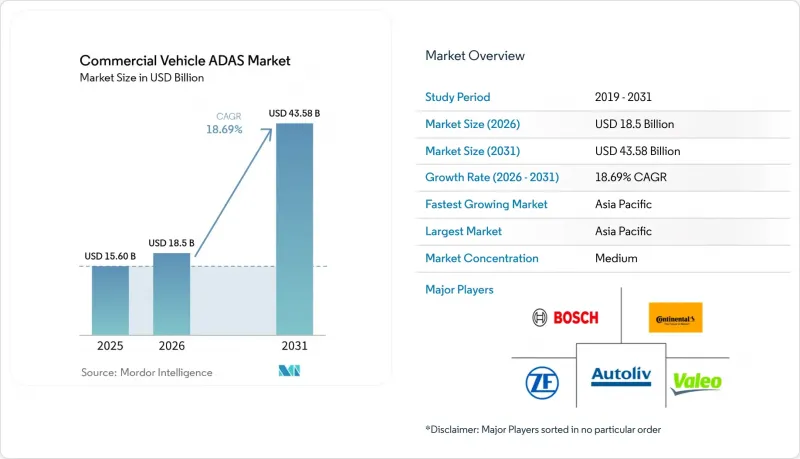
Mordor Intelligence에 의하면, 상용차 ADAS(첨단 운전 지원 시스템) 시장 규모는 2025년에 156억 달러로 평가되었고, 2026년 185억 달러에서 2031년까지 435억 8,000만 달러로 확대될 전망이며, 2026-2031년 CAGR 18.69%를 나타낼 것으로 예측됩니다.
본 보고서는 시스템별(ACC, 사각지대 감지 등), 센서별(레이더, 라이더 등), 차종별(소형 상용차, 중형·대형 상용차), 유통 채널별(OEM 장착, 애프터마켓), 지역별(북미, 남미 등)로 분류되어 있습니다. 시장 예측은 금액(달러) 기준으로 제시되어 있습니다.
세계의 상용차 ADAS 시장 동향 및 인사이트
도로 안전 규제 강화
일반 안전 규정 2022/1426에 따르면, EU 지역 내의 모든 신형 상용차에 운전자 졸음 경보, 자동 제동 및 사각지대 감지 기능의 탑재가 의무화되어 있습니다. 이 규정에 따라 EU 회원국 27개국 모두의 사양이 통일됩니다. 인도는 이에 발맞추어 AIS-162, AIS-186 및 AIS-188의 의무화를 시행할 예정입니다. 이 규정은 신차 모델의 경우 2026년 4월, 기존 플랫폼의 경우 2026년 10월에 발효됩니다. 이러한 의무화로 인해 비용 효율을 중시하는 부문에서도 해당 기능의 표준 장착이 촉진될 것입니다. 중국의 GB 39901-2025에 따르면, 2028년 1월부터 N1 등급 밴에도 자동 긴급 제동 요건이 적용됩니다. 또한, 중국의 자율주행 관련 규정에 따라 2027년 7월부터 레벨 3 주행이 허용되어, 사실상 단계적인 성능 기준이 확립될 것입니다. 미국에서는 NHTSA가 제안한 대형 차량 제동에 관한 규정이 2023년의 공고 및 의견 수렴 기간을 거쳐 현재 최종 심사 단계에 있습니다. UNECE 규정 R131, R152, R171 및 R157은 서명국 간에 조화로운 기술 기준을 제공하여 규정 준수상의 편차를 줄이고, 국경을 초월한 차량 도입을 촉진합니다.
자율주행/ADAS 스택의 기술적 진보
센서 퓨전은 비용 대비 성능의 균형이 뛰어난 레이더·카메라·LiDAR를 결합한 하이브리드 형태로 수렴되고 있습니다. PlusAI의 ‘SuperDrive 6.0’은 100억 개의 파라미터를 가진 기반 모델을 5천만 개의 파라미터를 가진 엣지 버전으로 압축하여, 클라우드 지연 없이 실시간 물체 분류를 가능하게 합니다. 발레오(Valeo)는 시속 130km에서 레벨 3 고속도로 자율주행을 지원할 수 있는 이미징 레이더 수주를 확보했습니다. 이를 통해 구조화된 이용 사례에서 4D 레이더가 라이다(LiDAR)를 대체하여 부품 비용을 대폭 절감할 수 있음이 입증되었습니다. 2028년까지 마이크로비전(Microvision)의 ‘Movia S LiDAR’는 905 nm MEMS 스캔 모듈을 활용하여 경쟁력 있는 가격 책정을 실현하는 것을 목표로 하고 있습니다. 이러한 움직임으로 인해 해당 제품의 적용 범위는 고급 트럭에만 국한되지 않게 될 것입니다. 초기 융합 기법은 레이더, 라이다, 카메라에서 얻은 원시 데이터를 결합하여 인식 능력을 향상시키지만, 더 많은 연산 능력을 필요로 합니다. 반면, 후기 융합은 지연 시간을 줄여주지만, 각 모달리티 간에 위치 오차가 발생할 위험이 있습니다. OEM 업체들은 성능과 비용의 적절한 균형을 찾기 위해 두 가지 기법 모두를 실험하고 있습니다.
ADAS 부품의 높은 초기 비용
인도나 브라질에서는 표준 77GHz 레이더와 모노 카메라 세트가 소형 트럭의 가격을 끌어올리고 있지만, 그 비율은 공장 출하 가격의 극히 일부에 불과합니다. 기계식 회전 LiDAR는 여전히 고가이지만, 마이크로비전(Microvision)의 솔리드 스테이트 기술 로드맵에서는 향후 3년 내에 대폭적인 비용 절감을 목표로 하고 있습니다. 발레오(Valeo)의 이미징 레이더는 잘 정비된 고속도로에서 라이다를 대체함으로써 시스템 비용을 대폭 절감할 수 있다고 강조하고 있습니다. 그러나 차량 보유 기업들은 ADAS 비용과 전동화 및 운전자 교육 비용 간의 균형을 맞추려고 노력하고 있습니다. 재정적 부담을 줄이기 위해 리스나 보험 연계형 금융을 통해 자본 지출을 운영비로 전환하고 있습니다. 이 전략 덕분에 광범위한 경제 변동 속에서도 상용차 ADAS 시장의 성장세를 유지할 수 있습니다.
부문 분석
상용차 ADAS 시장 중 운전자 모니터링 시스템 분야는 유럽연합(EU) 및 인도의 규제 의무화를 배경으로 2031년까지 연평균 성장률(CAGR) 20.05%로 확대될 것으로 예측됩니다. 한편, 어댑티브 크루즈 컨트롤(ACC)은 2025년에 상용차 ADAS 시장 점유율의 26.15%를 차지할 것으로 예상되지만, 기술의 대중화에 따라 단가 마진은 하락 추세를 보이고 있습니다. 자동 긴급 제동 시스템은 많은 UNECE 관할 지역에서 의무화되어 있으며, 오감지율이 낮은 인식 알고리즘에 대한 관심이 높아지고 있습니다. 사각지대 감지 기능은 특히 아시아태평양의 대중교통 차량에서 사후 장착 키트를 통해 보급이 확대되고 있습니다. 한편, 주차 보조 및 야간 투시 기능 등은 열화상 카메라로 인해 대당 비용이 지속적으로 상승하고 있어, 프리미엄 관광 버스 부문 이외의 도입은 제한적이며 여전히 틈새 시장으로 남아 있습니다.
통합 도메인 컨트롤러는 여러 ADAS 기능을 하나의 카메라에 집약함으로써 차량당 비용을 절감하고, 무선(OTA)을 통한 업그레이드를 간소화합니다. 이러한 통합으로 인해 상용차 ADAS 시장은 하드웨어 기반의 수익에서 소프트웨어 주도형 가치 창출로 전환되고 있습니다. 각 OEM 업체들은 운전자 모니터링 시스템을 차선 유지 보조 및 전방 충돌 경고와 묶어 제공함으로써 하드웨어에 대한 추가 투자를 대폭 줄이고 있습니다.
레이더는 계속해서 차량 인식 시스템의 기반이 될 것이며, 2025년에는 상용차 ADAS 시장 점유율의 49.05%를 차지했습니다. 그러나 LiDAR는 연평균 성장률(CAGR) 19.72%를 나타낼 것으로 예측되며, 단가가 200달러 미만으로 떨어짐에 따라 그 강력한 성장 잠재력이 반영되고 있습니다. 점 구름 깊이 데이터를 제공하는 이미징 레이더는 기존 센서 분류의 경계를 모호하게 만들며, 회전식 LiDAR 없이도 구조화된 고속도로에서 레벨 3 자율 주행을 실현하고 있습니다. 카메라는 여전히 가장 비용 효율적인 모달리티이며, 운전자 모니터링, 교통 표지판 인식 및 물체 분류에 필수적입니다. 다중 모드 데이터의 조기 융합은 안개나 저조도 조건에서 시스템의 견고성을 향상시키지만, 계산 비용을 증가시키기 때문에 실리콘에 최적화된 추론 엔진의 도입 기회를 창출하고 있습니다.
라이더 가격의 하락으로 인해 고급 장거리 버스부터 대량 생산되는 중형 트럭에 이르기까지 라이더 채택이 진행되어 상용차 ADAS 시장이 확대될 전망입니다. 다만, 유럽 대도시권의 레이더 스펙트럼 혼잡으로 인해 2030년 이후에는 고주파 대역인 140GHz 레이더에 대한 수요가 발생할 가능성이 있습니다.
지역별 분석
아시아태평양은 상용차 ADAS 시장에서 39.26%라는 최대 점유율을 차지하고 있으며, 연평균 18.97%의 성장률을 보이고 있습니다. 인도의 2025년 12월 상용차 판매 대수는 전년 동월 대비 24.6% 증가한 8만 3,666대를 기록했으며, 2026년 4월부터는 모든 신형 대형 트럭 및 버스에 ADAS 탑재가 의무화됩니다. 중국의 GB 39901-2025 규격에 따르면, 2028년까지 N1급 밴에 자동 제동 장치 탑재가 의무화되며, 또한 레벨 3 프레임워크에 따라 2027년 7월부터는 부분적인 자율주행이 합법화됩니다. 이러한 종합적인 규모 확대가 공급업체의 현지화를 촉진하고 있으며, 안후이성, 마하라슈트라주, 나고야에서 카메라, 레이더, 라이다(LiDAR) 공장이 확장되고 있습니다.
유럽에서는 엄격한 일정이 부과되어 소프트웨어 정의 아키텍처의 도입이 가속화되고 있습니다. 2028년까지 TRATON의 ‘ONE OS’는 MAN, 스카니아, 인터내셔널의 트럭용 소프트웨어 스택을 통합하는 것을 목표로 하고 있습니다. 한편, 마드리드-사라고사 구간에서 레벨 4로 운행되고 있는 IVECO의 시범 사업은 해당 지역이 레벨 3의 광범위한 도입 단계를 건너뛸 가능성을 시사하고 있습니다. 동유럽의 구형 차량은 여전히 개조에 대한 의존도가 높으며, 규제 집행이 미흡한 점이 시장 침투를 저해하고 있습니다.
북미에서는 NHTSA의 대형 차량 제동에 관한 최종 규정 발표를 기다리고 있는 상황입니다. 그럼에도 불구하고, 이미 레벨 4 시범 사업이 상용화되었습니다. 보쉬와 코디악은 2026년 말까지 퍼미안 분지에 무인 트럭 100대를 도입할 예정이며, 본격적인 확대에 앞서 경로 제어형 자율주행의 가능성을 입증하고 있습니다. 캐나다에서는 장거리 운송 경로가 미국의 경제 패턴을 반영하고 있어, 유지보수로 인한 가동 중단 시간이 ADAS의 투자 수익률(ROI)을 크게 끌어올리고 있습니다. 남미와 중동 및 아프리카은 여전히 초기 단계에 있지만, 브라질의 야심 찬 인프라 구축 계획과 UAE가 물류 허브로 도약하기 위한 노력이 조기 실험의 길을 열어주고 있습니다. 또한, 보험 텔레매틱스를 활용한 이니셔티브를 통해 ADAS가 가동되는 동안 주행 거리에 따른 할인이 제공되어, 이러한 시스템의 도입 비용을 절감할 수 있게 되었습니다.
기타 혜택 :
- Excel 형식 시장 예측(ME) 시트
- 3개월간의 애널리스트 지원
자주 묻는 질문
목차
제1장 서론
제2장 분석 방법
제3장 주요 요약
제4장 시장 구도
제5장 시장 규모 및 성장률 예측
제6장 경쟁 구도
제7장 시장 기회 및 향후 전망
AJY 26.09.15According to Mordor Intelligence, the commercial vehicle ADAS market size was valued at USD 15.60 billion in 2025, and is projected to grow from USD 18.50 billion in 2026 to USD 43.58 billion by 2031, growing at a CAGR of 18.69% from 2026 to 2031.
This report is Segmented by System (Adaptive Cruise Control, Blind Spot Detection, and More), Sensor (Radar, Lidar, and More), Vehicle Type (Light Commercial Vehicles, Medium and Heavy Commercial Vehicles), Distribution Channel (OEM-Fitment, Aftermarket), and Geography (North America, South America, and More). Market Forecasts are Provided in Terms of Value (USD).
Global Commercial Vehicle ADAS Market Trends and Insights
Increasing Road-Safety Regulations
The General Safety Regulation 2022/1426 mandates that all new commercial vehicles in the EU must feature driver-drowsiness alerts, automated braking, and blind-spot detection. This regulation aligns specifications across all 27 EU member states. India follows with AIS-162, AIS-186, and AIS-188 mandates, which took effect in April 2026 for new models and will take effect in October 2026 for existing platforms. These mandates will drive baseline inclusion, even in cost-sensitive segments. China's GB 39901-2025 will extend automatic emergency braking requirements to N1 vans from January 2028. In addition, its autonomous driving code will permit Level 3 operations from July 2027, effectively establishing a progressive performance ladder.. In the United States, NHTSA's proposed heavy-vehicle braking rule is under final review after the 2023 notice-and-comment period. UNECE regulations R131, R152, R171, and R157 provide harmonized technical criteria among signatories, reducing compliance fragmentation and facilitating cross-border fleet deployment.
Technological Advances in Autonomous/ADAS Stacks
Sensor fusion is converging on hybrid radar-camera-LiDAR formats that strike a cost-performance balance. PlusAI's SuperDrive 6.0 compresses a 10-billion-parameter foundation model into a 0.5-billion-parameter edge variant, enabling real-time object classification without cloud latency. Valeo won orders for imaging radar capable of supporting Level 3 highway pilot at 130 km/h, proving that 4D radar can substitute for LiDAR in structured use cases and significantly trim the bill of materials . By 2028, MicroVision's Movia S LiDAR aims to achieve competitive pricing, utilizing 905-nm MEMS scanning modules. This move expands its reach beyond just premium trucks. Early-fusion methods combine raw data from radar, LiDAR, and cameras, enhancing perception but requiring more computing power. In contrast, late fusion reduces latency but risks misalignment between modalities. OEMs are experimenting with both methods to find the right balance between performance and cost.
High Initial ADAS Component Cost
In India and Brazil, a baseline 77-GHz radar and mono-camera suite adds to the price of light trucks, accounting for a small percentage of their ex-factory price. While mechanical spinning LiDAR remains expensive, MicroVision's solid-state roadmap targets significant cost reductions over the next three years. Valeo's imaging radar claims to offer substantial savings in system costs by substituting LiDAR on structured highways. However, fleets are balancing the costs of ADAS with those of electrification and driver training. To ease the financial burden, leasing and insurance-linked financing are converting capital expenditures into operational expenditures. This strategy is helping to maintain momentum in the commercial vehicle ADAS market, even amidst broader economic fluctuations.
Other drivers and restraints analyzed in the detailed report include:
- Fleet TCO Optimization Mandates
- Insurance-Telematics-Linked ADAS Incentives
- Retrofit Complexity for Pre-CAN Vehicles
For complete list of drivers and restraints, kindly check the Table Of Contents.
Segment Analysis
The commercial vehicle ADAS market segment for driver-monitoring systems is projected to expand at a CAGR of 20.05% through 2031, driven by regulatory mandates in the European Union and India. By comparison, adaptive cruise control is expected to account for 26.15% of the commercial vehicle ADAS market share in 2025, although unit margins are declining as the technology becomes commoditized. Automatic emergency braking is mandatory in many UNECE territories, shifting the focus toward perception algorithms with low false-positive rates. Blind-spot detection is gaining traction through retrofit kits, particularly among public transport fleets in the Asia-Pacific. Functions such as park assist and night vision remain niche, as thermal cameras continue to add high cost per truck, limiting adoption beyond premium tour bus segments.
Integrated domain controllers consolidate multiple ADAS functions into a single camera, reducing per-vehicle costs and simplifying over-the-air upgrades. This integration supports the Commercial Vehicle ADAS Market's shift from hardware-based revenue toward software-driven value capture. OEMs are bundling driver monitoring systems with lane-keeping assistance and forward-collision warning, significantly reducing incremental hardware spending.
Radar continues to anchor vehicle perception systems, accounting for 49.05% of the commercial vehicle ADAS market share in 2025. However, LiDAR is expected to register a 19.72% CAGR, reflecting strong growth potential as unit prices fall below USD 200. Imaging radar, which delivers point-cloud depth data, is blurring traditional sensor categories and enabling Level 3 autonomy on structured highways without the need for spinning LiDAR. Cameras remain the most cost-effective modality and are essential for driver monitoring, traffic sign recognition, and object classification. Early fusion of multimodal data improves system robustness in fog and low-light conditions but increases computing costs, creating opportunities for silicon-optimized inference engines.
Declining LiDAR prices will drive adoption of LiDAR from luxury motorcoaches to high-volume medium-duty trucks, expanding the commercial vehicle ADAS market. However, radar spectrum congestion in European metropolitan areas could create opportunities for higher-frequency 140 GHz radar after 2030.
Complete Report Scope:
- By System
- Adaptive Cruise Control
- Blind Spot Detection
- Lane Departure Warning System
- Automatic Emergency Braking
- Forward Collision Warning
- Night Vision System
- Driver Monitoring
- Tire-Pressure Monitoring System
- Head-Up Display
- Park Assist System
- Others
- By Sensor
- Radar
- LiDAR
- Ultrasonic
- Image
- Others
- By Vehicle Type
- Light Commercial Vehicles
- Medium and Heavy Commercial Vehicles
- By Distribution Channel
- Original Equipment Manufacturer (OEM)-Fitment
- Aftermarket
- By Geography
- North America
- United States
- Canada
- Rest of North America
- South America
- Brazil
- Argentina
- Rest of South America
- Europe
- Germany
- United Kingdom
- France
- Italy
- Spain
- Rest of Europe
- Asia-Pacific
- China
- Japan
- India
- South Korea
- Australia
- Rest of Asia-Pacific
- Middle East and Africa
- United Arab Emirates
- Saudi Arabia
- South Africa
- Rest of Middle East and Africa
- North America
Geography Analysis
Asia-Pacific holds the largest Commercial vehicle ADAS market share at 39.26% and is expanding 18.97% annually. India's December 2025 commercial-vehicle sales rose 24.6% year-on-year to 83,666 units, and April 2026 mandates that ADAS be fitted to every new heavy truck and bus . China's GB 39901-2025 makes automatic braking compulsory on N1 vans by 2028, while its Level 3 framework legalizes partial autonomy from July 2027. The combined scale drives supplier localization, with camera, radar, and LiDAR plants expanding in Anhui, Maharashtra, and Nagoya.
Europe is enforcing tight timelines, driving the adoption of software-defined architectures. By 2028, TRATON's ONE OS aims to unify the truck stacks of MAN, Scania, and International. Meanwhile, IVECO's pilot in Madrid-Zaragoza, operating at Level 4, suggests the region may bypass widespread Level 3 adoption. Eastern Europe's older fleets remain heavily reliant on retrofitting, but weaker enforcement continues to hinder market penetration.
North America awaits NHTSA's final heavy-vehicle braking rule. Still, it is already commercializing Level 4 pilots. Bosch and Kodiak are deploying 100 driverless trucks in the Permian Basin by the end of 2026, demonstrating the potential of controlled-route autonomy ahead of broader deployment. In Canada, long-haul corridors reflect U.S. economic patterns, where maintenance-related downtimes significantly boost the ROI for ADAS. While South America and the Middle East-Africa regions are still in their infancy, Brazil's ambitious infrastructure initiatives and the UAE's aspirations as a logistics hub are paving the way for early experiments. Furthermore, insurance-telematics initiatives offer pay-per-kilometer discounts during active ADAS use, making these systems more affordable.
- Robert Bosch GmbH
- Continental AG
- ZF Friedrichshafen AG
- Autoliv Inc.
- Valeo SA
- Daimler Truck AG
- Volvo Group
- MAN Truck & Bus SE
- HL Mando Corporation
- Harman International
- Applied Intuition
- Imagination Technologies
- Vignal Group
- Gauzy Ltd.
Additional Benefits:
- The market estimate (ME) sheet in Excel format
- 3 months of analyst support
TABLE OF CONTENTS
1 Introduction
- 1.1 Study Assumptions & Market Definition
- 1.2 Scope of the Study
2 Research Methodology
3 Executive Summary
4 Market Landscape
- 4.1 Market Overview
- 4.2 Market Drivers
- 4.2.1 Increasing Road-Safety Regulations
- 4.2.2 Technological Advances in Autonomous/ADAS Stacks
- 4.2.3 Fleet TCO Optimization Mandates
- 4.2.4 Insurance-Telematics-Linked ADAS Incentives
- 4.2.5 EU Driver-Monitoring Mandate Post-2026
- 4.2.6 Standardized Retrofit Kits for Legacy Fleets
- 4.3 Market Restraints
- 4.3.1 High Initial ADAS Component Cost
- 4.3.2 Retrofit Complexity for Pre-CAN Vehicles
- 4.3.3 Urban Radar-Spectrum Congestion
- 4.3.4 Driver Disengagement and Skills Gap
- 4.4 Value / Supply-Chain Analysis
- 4.5 Supplier Landscape
- 4.6 Regulatory Landscape
- 4.7 Technological Outlook
- 4.8 Porter's Five Forces
- 4.8.1 Threat of New Entrants
- 4.8.2 Bargaining Power of Suppliers
- 4.8.3 Bargaining Power of Buyers
- 4.8.4 Threat of Substitutes
- 4.8.5 Competitive Rivalry
5 Market Size & Growth Forecasts (Value (USD))
- 5.1 By System
- 5.1.1 Adaptive Cruise Control
- 5.1.2 Blind Spot Detection
- 5.1.3 Lane Departure Warning System
- 5.1.4 Automatic Emergency Braking
- 5.1.5 Forward Collision Warning
- 5.1.6 Night Vision System
- 5.1.7 Driver Monitoring
- 5.1.8 Tire-Pressure Monitoring System
- 5.1.9 Head-Up Display
- 5.1.10 Park Assist System
- 5.1.11 Others
- 5.2 By Sensor
- 5.2.1 Radar
- 5.2.2 LiDAR
- 5.2.3 Ultrasonic
- 5.2.4 Image
- 5.2.5 Others
- 5.3 By Vehicle Type
- 5.3.1 Light Commercial Vehicles
- 5.3.2 Medium and Heavy Commercial Vehicles
- 5.4 By Distribution Channel
- 5.4.1 Original Equipment Manufacturer (OEM)-Fitment
- 5.4.2 Aftermarket
- 5.5 By Geography
- 5.5.1 North America
- 5.5.1.1 United States
- 5.5.1.2 Canada
- 5.5.1.3 Rest of North America
- 5.5.2 South America
- 5.5.2.1 Brazil
- 5.5.2.2 Argentina
- 5.5.2.3 Rest of South America
- 5.5.3 Europe
- 5.5.3.1 Germany
- 5.5.3.2 United Kingdom
- 5.5.3.3 France
- 5.5.3.4 Italy
- 5.5.3.5 Spain
- 5.5.3.6 Rest of Europe
- 5.5.4 Asia-Pacific
- 5.5.4.1 China
- 5.5.4.2 Japan
- 5.5.4.3 India
- 5.5.4.4 South Korea
- 5.5.4.5 Australia
- 5.5.4.6 Rest of Asia-Pacific
- 5.5.5 Middle East and Africa
- 5.5.5.1 United Arab Emirates
- 5.5.5.2 Saudi Arabia
- 5.5.5.3 South Africa
- 5.5.5.4 Rest of Middle East and Africa
- 5.5.1 North America
6 Competitive Landscape
- 6.1 Market Concentration
- 6.2 Strategic Moves
- 6.3 Market Share Analysis
- 6.4 Company Profiles (Includes Global Level Overview, Market Level Overview, Core Segments, Financials as Available, Strategic Information, Market Rank/Share for Key Companies, Products and Services, SWOT Analysis, and Recent Developments)
- 6.4.1 Robert Bosch GmbH
- 6.4.2 Continental AG
- 6.4.3 ZF Friedrichshafen AG
- 6.4.4 Autoliv Inc.
- 6.4.5 Valeo SA
- 6.4.6 Daimler Truck AG
- 6.4.7 Volvo Group
- 6.4.8 MAN Truck & Bus SE
- 6.4.9 HL Mando Corporation
- 6.4.10 Harman International
- 6.4.11 Applied Intuition
- 6.4.12 Imagination Technologies
- 6.4.13 Vignal Group
- 6.4.14 Gauzy Ltd.
7 Market Opportunities & Future Outlook
- 7.1 White-Space & Unmet-Need Assessment