
|
시장보고서
상품코드
2125667
산업용 로 시장 : 시장 점유율 분석, 업계 동향 및 통계, 성장 예측(2026-2031년)Industrial Furnace - Market Share Analysis, Industry Trends & Statistics, Growth Forecasts (2026 - 2031) |
||||||
 Mordor Intelligence
산업용 로 시장 규모는 2025년 129억 3,000만 달러로 평가되었고, 2026년에는 135억 4,000만 달러로 추정되고, 2026-2031년 CAGR 4.68%로 성장을 지속할 전망이며, 2031년에는 170억 1,000만 달러에 이를 것으로 예측됩니다.
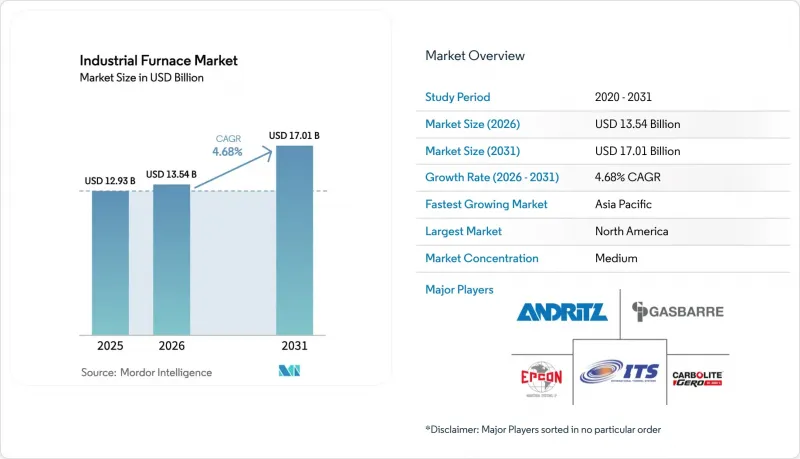
본 보고서는 용광로 유형별(가스/연료식 롤러 하스, 전기식 롤러 하스 등), 구조 및 형식별(박스/챔버/머플, 튜브/클램쉘 등), 가열 방식별(연소식, 전기 저항식 등), 온도 범위별(1000°C 미만 등), 최종 사용자 산업별(화학, 금속 및 광업 등), 지역별로 분류되어 있습니다. 시장 예측은 금액(달러) 기준으로 제시되어 있습니다.
세계의 산업용 로 시장 동향 및 인사이트
자동차 제조 분야의 열처리 수요 급증
전기차(EV) 생산으로의 전환에 따라 전 세계 조립 공장의 열처리 요건이 재편되고 있습니다. 배터리 하우징, 트랙션 모터 코어 및 경량 차체 구조에는 변형을 최소화하고 더 엄격한 공차를 충족할 수 있는 열처리 프로파일이 요구됩니다. 따라서 자동차 제조업체들은 ISO 26262 준수를 위해 각 사이클을 기록할 수 있고, 급속 냉각 기능, 불활성 분위기, 폐쇄 루프 제어를 갖춘 용광로를 지정하고 있습니다. 예지보전 분석을 통합한 공급업체는 가동률을 높이고 총 소유 비용을 절감하는 동시에, 장기 조달 계약에서 경쟁력 있는 입찰을 강화하고 있습니다.
금속 및 광업 분야의 생산 능력 확대를 위한 투자 확대
중국, 인도 및 걸프협력회의(GCC) 회원국의 철강 및 비철금속 제조업체들은 인프라 구축 및 에너지 전환을 위한 지출에 대응하기 위해 설비 건설 및 개조를 추진하고 있습니다. 기존 고로 대신 전기 아크로(EAF)를 장려하는 정책이 업데이트 수요를 견인하는 한편, 저품위 광석 처리를 통해 처리 능력을 유지하면서 에너지 소비를 절감하는 첨단 내화물 라이닝과 고산소 분위기를 갖춘 용광로에 대한 수요가 증가하고 있습니다. 모듈식 플랜트를 통해 사업자는 설비 투자를 단계적으로 분산시켜 미래의 상품 주기에 대응할 수 있게 됩니다.
1,500°C를 초과하는 설비의 높은 자본 비용 및 운영 비용
극고온 용광로의 설치 비용은 1,000만 달러 이상에 달하며, 플랜트 운영 예산의 15-20%를 차지합니다. 고급 내화물, 특수 주문 합금, 강화된 안전 시스템이 초기 투자를 부풀리는 한편, 초고온 운영을 전문으로 하는 기술자의 세계적 부족이 인건비를 상승시키고 있습니다. 보험료와 엄격한 인허가 절차는 추가적인 간접비가 되어 투자 회수 기간을 연장시키고, 중소기업의 도입을 방해하고 있습니다.
부문 분석
유럽과 일본의 정책 체계가 탄소 중립적인 공정 열을 규정하고 있기 때문에 수소 대응 설계는 2031년까지 연평균 성장률(CAGR) 6.59%를 기록하며 가장 빠르게 성장하는 부문이 되었습니다. 그럼에도 불구하고, 가스/연료식 롤러 하스 설비는 신뢰성과 기존 인프라가 높이 평가되어 2025년에도 산업용 로 시장 점유율 44.10%를 유지했습니다. 수소의 단계적 대체를 가능하게 하는 하이브리드 버너는 사용자의 선택 폭을 넓혀 주며, 전환 기간 동안 기존 설비가 생산성을 유지할 수 있도록 보장합니다.
재생에너지가 풍부한 지역에서 전기식 롤러 하스 용광로의 보급이 확대됨에 따라, 각 OEM 업체들은 에너지 손실을 줄여주는 고출력 변압기 및 첨단 자기장 제어 시스템의 공동 개발을 추진하고 있습니다. 유도 가열 장치는 급속 가열이나 미세한 온도 구배가 필요한 틈새 야금 용도에서 여전히 최적의 선택지로 남아 있습니다. 한편, 태양열로는 특수 세라믹 제조를 위해 집광형 태양열 발전을 활용하려는 일사량이 많은 지역에서 아직 발전 단계에 있기는 하지만 유망한 틈새 시장을 차지하고 있습니다.
박스형/챔버형/머플형 구성은 금속, 기계, 세라믹 분야의 배치 처리에 대응함으로써 2025년 산업용로 시장 규모의 37.45%를 차지했습니다. 튜브형/클램쉘형 시스템은 체류 시간과 에너지 소비를 최소화하는 연속 흐름 레이아웃으로의 전환이 진행됨에 따라 연평균 성장률(CAGR) 6.51%로 성장을 지속하고, 있습니다. 카보텀형 및 바텀 로딩형 설계는 초대형 주물이 견고한 자재관리 솔루션을 필요로 하는 중장비 제조 분야에서 여전히 중요한 위치를 차지하고 있습니다.
진공 및 제어 분위기 장치는 항공우주 및 반도체 백엔드 공정에서 점유율을 확대하고 있으며, 이는 오염 없는 표면에 대한 관리 이력(체인 오브 커스터디) 요건을 반영한 것입니다. 현재 산업용 로 업계에서는 장기간의 현장 작업 없이도 생산 규모를 확대할 수 있는 플러그 앤 플레이형 스키드가 중시되고 있으며, 이는 린 생산 방식의 이념과 중견 공급업체들 사이에서 높아지고 있는 자본 위험 회피 경향과 부합합니다.
지역별 분석
2025년, 북미는 산업용 로 시장 규모의 35.10%를 차지했습니다. 이는 미국의 자동차 및 항공우주 산업 거점에서의 열처리 수주가 견조했던 점과 에너지부의 최신 기준 준수가 뒷받침한 결과입니다. Nucor사의 30억 달러 규모의 전기 아크로(EAF) 프로그램과 캐나다의 광업 투자와 같은 확장 프로젝트로 인해 대용량 유닛에 대한 기초 수요가 증가하고 있습니다. 숙련된 기술자들이 애프터서비스 수익을 뒷받침하고 있지만, 천연가스 및 전력 가격 변동은 여전히 경영상의 우선 과제로 남아 있습니다.
아시아태평양은 구형 고로를 전기 아크로(EAF)로 교체하는 중국 철강 부문의 현대화와,기계·전자기기 생산 능력에 대한 설비 투자를 앞당기는 인도의 ‘생산 연계형 인센티브(PLI)’ 제도 덕분에 6.24%라는 가장 높은 연평균 성장률(CAGR)을 기록하고 있습니다. 일본은 수소 대응 야금 기술의 선구자로서, 2035년 기후 목표에 부합하는 용광로 업그레이드에 3,294억 엔을 배정하고 있습니다. 한국, 싱가포르, 호주는 반도체 백엔드 공정 및 광물 가공 라인 확충을 통해 이 지역의 성장을 견인하고 있습니다.
유럽은 기후 정책 준수를 기반으로 한 자릿수 중반대의 성장률을 유지하고 있습니다. 독일은 수소 버너에 대한 공공 연구 보조금을 투입하고 있는 반면, 이탈리아는 특수강 및 자동차 공급망을 위한 열처리 설비를 현대화하고 있습니다. 탄소 국경 조정 메커니즘(CBAM)은 스코프 1 배출량을 줄이는 용광로 개조를 촉진하고 있으며, 산업 배출 지침은 내화물, 제어 시스템 및 폐열 회수 분야에서 ‘최적 가용 기술(BAT)’로의 업데이트를 의무화하고 있습니다. 동유럽 시장, 특히 폴란드와 체코에서는 저탄소 용광로를 갖춘 배터리 부품 공장에 대한 그린필드 투자가 유치되고 있습니다.
기타 혜택 :
- 엑셀 형식 시장 예측(ME) 시트
- 3개월간의 애널리스트 지원
자주 묻는 질문
목차
제1장 서론
제2장 조사 방법
제3장 주요 요약
제4장 시장 구도
제5장 시장 규모 및 성장 예측
제6장 경쟁 구도
제7장 시장 기회 및 향후 전망
AJY 26.09.15According to Mordor Intelligence, the industrial furnace market size is expected to grow from USD 12.93 billion in 2025 to USD 13.54 billion in 2026 and is forecast to reach USD 17.01 billion by 2031 at 4.68% CAGR over 2026-2031.
This report is Segmented by Furnace Type (Gas/Fuel Roller Hearth, Electric Roller Hearth, and More), Arrangement/Format (Box/Chamber/Muffle, Tube/Clamshell, and More), Heating Method (Combustion-Fired, Resistance Electric, and More), Temperature Range (Below 1000°C, and More), End-User Industry (Chemicals, Metal and Mining, and More), and Geography. The Market Forecasts are Provided in Terms of Value (USD).
Global Industrial Furnace Market Trends and Insights
Surging Demand for Heat-Treatment in Automotive Manufacturing
The pivot to electric vehicle production is reshaping thermal-processing requirements across global assembly plants. Battery housings, traction-motor cores, and lightweight body structures need heat-treatment profiles that minimize distortion and support tighter tolerances. Automakers therefore specify furnaces with rapid quench rates, inert atmospheres, and closed-loop controls that document every cycle for ISO 26262 compliance. Suppliers integrating predictive-maintenance analytics achieve higher uptime, reducing total cost of ownership and strengthening competitive bids for long-term sourcing contracts.
Rising Investments in Metal and Mining Capacity Expansion
Steel and non-ferrous producers in China, India, and the Gulf Cooperation Council are building or revamping assets to meet infrastructure and energy-transition spending. Policies encouraging electric-arc furnaces (EAFs) over legacy blast furnaces drive replacement demand, while lower-grade ore processing boosts the need for furnaces with advanced refractory linings and oxygen-rich atmospheres that preserve throughput yet cut energy use. Modular plants allow operators to stagger capital outlays and match future commodity cycles.
High Capital and Running Costs for> 1,500 °C Installations
Extreme-temperature furnaces cost upward of USD 10 million to install and consume 15-20% of plant operating budgets. Advanced refractories, custom alloys, and enhanced safety systems inflate upfront investment, while a global shortage of technicians specialized in ultra-high-temperature operations raises labor costs. Insurance premiums and stringent permitting add further overhead, extending payback periods and deterring adoption in smaller firms.
Other drivers and restraints analyzed in the detailed report include:
- Accelerated Adoption of Electric Furnaces for Decarbonization Mandates
- Stringent Energy-Efficiency Norms Driving Furnace Retrofits
- Volatility in Natural Gas and Electricity Prices
For complete list of drivers and restraints, kindly check the Table Of Contents.
Segment Analysis
Hydrogen-ready designs form the fastest-moving segment with a 6.59% CAGR to 2031 as policy frameworks in Europe and Japan stipulate carbon-neutral process heat. Gas/fuel roller hearth equipment nonetheless retained 44.10% of the industrial furnace market share in 2025, favored for reliability and existing infrastructure. Hybrid burners allowing incremental hydrogen substitution widen user options, ensuring legacy assets remain productive throughout the transition.
Wider adoption of electric roller hearth furnaces in renewable-rich regions encourages OEMs to co-develop high-power transformers and sophisticated magnetic-field controls that reduce energy loss. Induction units remain the tool of choice for niche metallurgical applications requiring rapid heating and fine temperature gradients, whereas solar furnaces occupy a nascent but promising niche in high-irradiance zones willing to leverage concentrated solar power for specialty ceramics.
Box/chamber/muffle configurations delivered 37.45% of the industrial furnace market size in 2025 by serving batch processes across metals, machinery, and ceramics. Tube/clamshell systems are recording a 6.51% CAGR as producers switch to continuous-flow layouts that minimize dwell time and energy consumption. Car-bottom and bottom-loading designs retain importance in heavy-equipment production where oversized castings demand robust material-handling solutions.
Vacuum and controlled-atmosphere units capture rising share in aerospace and semiconductor back-end processing, reflecting chain-of-custody requirements for contamination-free surfaces. The industrial furnace industry now emphasizes plug-and-play skids that scale production without lengthy site work, aligning with lean manufacturing philosophies and reduced capital-risk appetites among mid-tier suppliers.
Complete Report Scope:
- By Furnace Type
- Gas/Fuel Roller Hearth Furnace
- Electric Roller Hearth Furnace
- Induction Furnace
- Hydrogen-ready Furnace
- Solar Furnace
- By Arrangement / Format
- Box/Chamber/Muffle Furnace
- Tube/Clamshell Furnace
- Bottom Loading/Car Bottom Loading Furnace
- Top Loading Furnace
- Vacuum/Atmosphere/Heat-Treatment Furnace
- By Heating Method
- Combustion-Fired
- Resistance Electric
- Induction Electric
- Hybrid (Gas plus Electric)
- By Temperature Range
- Below 1 000 °C
- 1 000 - 1 500 °C
- Above 1 500 °C
- By End-user Industry
- Chemicals
- Metal and Mining
- Automotive Manufacturing
- Construction Machinery
- Aerospace
- Electronics and Semiconductors
- Other End-user Industries
- By Geography
- North America
- United States
- Canada
- Mexico
- South America
- Brazil
- Argentina
- Rest of South America
- Europe
- Germany
- United Kingdom
- France
- Italy
- Spain
- Rest of Europe
- Asia-Pacific
- China
- Japan
- South Korea
- India
- Singapore
- Australia
- Rest of Asia-Pacific
- Middle East and Africa
- Middle East
- Saudi Arabia
- United Arab Emirates
- Turkey
- Rest of Middle East
- Africa
- South Africa
- Nigeria
- Egypt
- Rest of Africa
- Middle East
- North America
Geography Analysis
North America contributed 35.10% of the industrial furnace market size in 2025, driven by strong heat-treatment orders from U.S. automotive and aerospace hubs and compliance with updated Department of Energy standards. Expansion projects such as Nucor's USD 3.0 billion EAF program and Canadian mining investments elevate baseline demand for high-capacity units. Skilled technical labor supports after-sales service revenue, though price volatility in natural gas and electricity remains a management priority.
Asia-Pacific records the quickest 6.24% CAGR, thanks to China's steel sector modernization that replaces outdated blast furnaces with EAFs and India's Production-Linked Incentive scheme that pulls forward capital spending on machinery and electronics capacity. Japan pioneers hydrogen-ready metallurgy, allocating JPY 329.4 billion to furnace upgrades that align with 2035 climate goals. South Korea, Singapore, and Australia round out regional growth by boosting semiconductor back-end and mineral-processing lines.
Europe sustains mid-single-digit growth anchored in climate policy compliance. Germany funnels public research grants toward hydrogen burners, while Italy modernizes heat-treatment fleets for specialty steel and automotive supply chains. The Carbon Border Adjustment Mechanism incentivizes furnace retrofits that cut Scope-1 emissions, and the Industrial Emissions Directive mandates best-available-technology upgrades in refractory, control systems, and waste-heat recovery. Eastern European markets, particularly Poland and Czechia, attract green-field investments in battery-component plants equipped with low-carbon furnaces.
- Andritz AG
- Carbolite Gero Limited
- Epcon Industrial Systems LP
- Gasbarre Products Inc.
- International Thermal Systems LLC
- Ipsen International GmbH
- Nutec Industries S.A. de C.V. (Nutec Bickley)
- Seco/Warwick S.A.
- Thermcraft Inc.
- Nabertherm GmbH
- Elino Industrie-Ofenbau GmbH
- CAN-ENG Furnaces International Ltd.
- Inductotherm Corp.
- Despatch Industries LLC
- Surface Combustion Inc.
- Lenton Furnaces and Ovens Ltd.
- Keith Company Inc.
- Dowa Thermotech Co., Ltd.
- CM Furnaces Inc.
- SOLO Swiss Group SA
- Tenova S.p.A.
Additional Benefits:
- The market estimate (ME) sheet in Excel format
- 3 months of analyst support
TABLE OF CONTENTS
1 INTRODUCTION
- 1.1 Study Assumptions and Market Definition
- 1.2 Scope of the Study
2 RESEARCH METHODOLOGY
3 EXECUTIVE SUMMARY
4 MARKET LANDSCAPE
- 4.1 Market Overview
- 4.2 Market Drivers
- 4.2.1 Surging demand for heat-treatment in automotive manufacturing
- 4.2.2 Rising investments in metal and mining capacity expansion
- 4.2.3 Accelerated adoption of electric furnaces for decarbonisation mandates
- 4.2.4 Stringent energy-efficiency norms driving furnace retrofits
- 4.2.5 Shift towards hydrogen-ready furnace designs in Europe and Japan
- 4.2.6 Micro-scale modular furnaces enabling distributed manufacturing
- 4.3 Market Restraints
- 4.3.1 High capital and running costs for >1500 °C installations
- 4.3.2 Volatility in natural gas and electricity prices
- 4.3.3 Skilled-operator shortage for complex heat-treat processes
- 4.3.4 Regulatory uncertainty on future carbon-pricing schemes
- 4.4 Industry Value Chain Analysis
- 4.5 Regulatory Landscape
- 4.6 Technological Outlook
- 4.7 Impact of Macroeconomic Factors
- 4.8 Porter's Five Forces Analysis
- 4.8.1 Bargaining Power of Suppliers
- 4.8.2 Bargaining Power of Buyers
- 4.8.3 Threat of New Entrants
- 4.8.4 Threat of Substitutes
- 4.8.5 Intensity of Competitive Rivalry
5 MARKET SIZE AND GROWTH FORECASTS (VALUES)
- 5.1 By Furnace Type
- 5.1.1 Gas/Fuel Roller Hearth Furnace
- 5.1.2 Electric Roller Hearth Furnace
- 5.1.3 Induction Furnace
- 5.1.4 Hydrogen-ready Furnace
- 5.1.5 Solar Furnace
- 5.2 By Arrangement / Format
- 5.2.1 Box/Chamber/Muffle Furnace
- 5.2.2 Tube/Clamshell Furnace
- 5.2.3 Bottom Loading/Car Bottom Loading Furnace
- 5.2.4 Top Loading Furnace
- 5.2.5 Vacuum/Atmosphere/Heat-Treatment Furnace
- 5.3 By Heating Method
- 5.3.1 Combustion-Fired
- 5.3.2 Resistance Electric
- 5.3.3 Induction Electric
- 5.3.4 Hybrid (Gas plus Electric)
- 5.4 By Temperature Range
- 5.4.1 Below 1 000 °C
- 5.4.2 1 000 - 1 500 °C
- 5.4.3 Above 1 500 °C
- 5.5 By End-user Industry
- 5.5.1 Chemicals
- 5.5.2 Metal and Mining
- 5.5.3 Automotive Manufacturing
- 5.5.4 Construction Machinery
- 5.5.5 Aerospace
- 5.5.6 Electronics and Semiconductors
- 5.5.7 Other End-user Industries
- 5.6 By Geography
- 5.6.1 North America
- 5.6.1.1 United States
- 5.6.1.2 Canada
- 5.6.1.3 Mexico
- 5.6.2 South America
- 5.6.2.1 Brazil
- 5.6.2.2 Argentina
- 5.6.2.3 Rest of South America
- 5.6.3 Europe
- 5.6.3.1 Germany
- 5.6.3.2 United Kingdom
- 5.6.3.3 France
- 5.6.3.4 Italy
- 5.6.3.5 Spain
- 5.6.3.6 Rest of Europe
- 5.6.4 Asia-Pacific
- 5.6.4.1 China
- 5.6.4.2 Japan
- 5.6.4.3 South Korea
- 5.6.4.4 India
- 5.6.4.5 Singapore
- 5.6.4.6 Australia
- 5.6.4.7 Rest of Asia-Pacific
- 5.6.5 Middle East and Africa
- 5.6.5.1 Middle East
- 5.6.5.1.1 Saudi Arabia
- 5.6.5.1.2 United Arab Emirates
- 5.6.5.1.3 Turkey
- 5.6.5.1.4 Rest of Middle East
- 5.6.5.2 Africa
- 5.6.5.2.1 South Africa
- 5.6.5.2.2 Nigeria
- 5.6.5.2.3 Egypt
- 5.6.5.2.4 Rest of Africa
- 5.6.5.1 Middle East
- 5.6.1 North America
6 COMPETITIVE LANDSCAPE
- 6.1 Market Concentration
- 6.2 Strategic Moves
- 6.3 Market Share Analysis
- 6.4 Company Profiles (includes Global level Overview, Market level overview, Core Segments, Financials as available, Strategic Information, Market Rank/Share for key companies, Products and Services, and Recent Developments)
- 6.4.1 Andritz AG
- 6.4.2 Carbolite Gero Limited
- 6.4.3 Epcon Industrial Systems LP
- 6.4.4 Gasbarre Products Inc.
- 6.4.5 International Thermal Systems LLC
- 6.4.6 Ipsen International GmbH
- 6.4.7 Nutec Industries S.A. de C.V. (Nutec Bickley)
- 6.4.8 Seco/Warwick S.A.
- 6.4.9 Thermcraft Inc.
- 6.4.10 Nabertherm GmbH
- 6.4.11 Elino Industrie-Ofenbau GmbH
- 6.4.12 CAN-ENG Furnaces International Ltd.
- 6.4.13 Inductotherm Corp.
- 6.4.14 Despatch Industries LLC
- 6.4.15 Surface Combustion Inc.
- 6.4.16 Lenton Furnaces and Ovens Ltd.
- 6.4.17 Keith Company Inc.
- 6.4.18 Dowa Thermotech Co., Ltd.
- 6.4.19 CM Furnaces Inc.
- 6.4.20 SOLO Swiss Group SA
- 6.4.21 Tenova S.p.A.
7 MARKET OPPORTUNITIES AND FUTURE OUTLOOK
- 7.1 White-space and Unmet-need Assessment