|
시장보고서
상품코드
2125695
램프 및 조명 시장 : 시장 점유율 분석, 업계 동향 및 통계, 성장 예측(2026-2031년)Lamps And Lighting - Market Share Analysis, Industry Trends & Statistics, Growth Forecasts (2026 - 2031) |
||||||
 Mordor Intelligence
Mordor Intelligence에 의하면, 2026년 램프 및 조명 시장 규모는 1,395억 7,000만 달러로 추정되고, 2025년 1,341억 4,000만 달러에서 확대해, 2031년에는 1,702억 5,000만 달러에 이를 것으로 예측됩니다.
2026-2031년 연평균 성장률(CAGR) 4.05%로 성장할 것으로 전망됩니다.
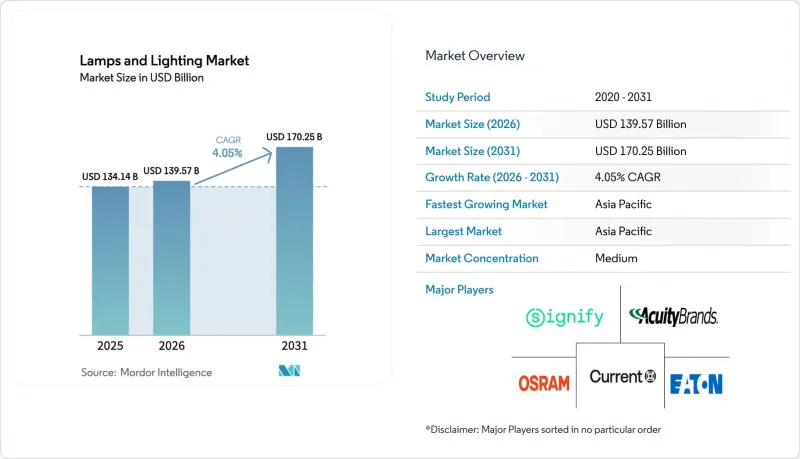
본 보고서에서는 산업을 제품별(테이블 램프·플로어 램프, 천장 조명·샹들리에, 벽걸이형 조명 기구, 기타), 광원별(LED, 형광등, 백열등, 기타), 용도별(주거용, 상업시설, 산업·창고, 기타), 지역별(북미, 남미, 기타) 및 기타 부문으로 분류하고 있습니다. 시장 예측은 금액(달러) 기준으로 제시되어 있습니다.
세계의 램프 및 조명 시장 동향 및 인사이트
LED 램프의 2차 교체 수요 급증
산업 분야에서는 2024년 2차 교체 수요가 58억 개에 달할 것으로 예측되며, 조명 기구의 수명인 25,000-40,000시간에 가까워짐에 따라 2025-2028년에 걸쳐 교체 수요가 정점에 달할 것으로 전망됩니다. 소비자의 선호도는 단순한 LED 교체에 그치지 않고, 높은 연색성 지수(CRI), 무선 조광 기능, 음성 제어 기능과 같은 고급 기능에 대한 수요가 높아지고 있습니다. 이러한 프리미엄 기능에 대한 중요성이 커지고 있는 것이, 표준 램프의 평균 판매 가격(ASP)이 계속 하락하고 있음에도 불구하고 가격 안정화에 기여하고 있습니다. 또한, 이러한 동향에 따라 서비스 계약 도입이 확대되고 있으며, 시설 관리자들은 현장에서 안정적인 가동 시간을 확보할 수 있는 구독형 모델을 점점 더 많이 선택하고 있습니다. 이러한 동향은 부가가치가 높은 솔루션과 장기적인 서비스 신뢰성을 지향하는 산업 전반의 움직임을 여실히 보여주고 있습니다.
정부의 형광등 및 할로겐 램프 단계적 폐지
캘리포니아주는 2025년 1월 1일부터 형광등 판매를 중단했으며, EU의 RoHS 지침에 따라 2025년 2월 24일부터 수은 함유 형광등이 금지되었습니다. 캐나다가 2026년에 미나마타 협약에 따라 단계적 폐지를 시행하는 것은 조명 시장에 있어 매우 중요한 규제적 진전입니다. 이러한 동시적인 금지 조치로 인해 판매 파트너들은 구형 재고의 처분을 가속화하고, LED 기반 솔루션으로의 완전한 전환을 추진해야 할 필요가 생깁니다. 이 정책 프레임워크가 제공하는 규제 확실성 덕분에 제조업체는 예상되는 수요에 부응하기 위해 고체 조명 생산 능력을 전략적으로 확대할 수 있게 됩니다. 지역을 아우르는 이러한 조화로운 접근 방식은 비효율적인 조명 기술의 일관되고 효율적인 단계적 폐지를 보장하며, 장기적인 시장 예측 가능성을 높입니다. 2030년까지 이러한 조치로 인해 상당한 에너지 절감 효과가 나타날 것으로 예상되며, 유럽연합(EU)에서는 연간 34TWh의 전력 절감이 예상되어 고효율 조명 제품으로 시장 전환이 더욱 가속화될 것으로 보입니다.
LED 이익률을 압박하는 원자재 가격 상승 압력
중국의 갈륨 및 게르마늄 수출 규제 가능성은 반도체 시장의 비용 구조에 중대한 영향을 미칠 것으로 예상되며, 미국 지질조사국(USGS)은 GDP가 34억 달러 감소할 가능성이 있다고 추정하고 있습니다. 미국이 희토류 자석에 25%의 관세를 부과할 계획이라는 점도 우려를 더욱 심화시키고 있으며, 공급망과 가격 동향에 추가적인 압박을 가하고 있습니다. 이러한 과제에 대응하기 위해 각 LED 제조업체들은 대체 공급원 확보, 형광체 배합 변경, 재활용 기업과의 제휴와 같은 전략적 조치를 취하며 리스크 완화를 꾀하고 있습니다. 규모의 경제가 제한적인 중소 시장 진출기업들은 재무적 압박이 가중될 가능성이 있으며, 그 결과 시장 철수나 산업 재편으로 이어질 우려가 있습니다. 이러한 움직임은 특히 중견 부문에서 시장 집중도를 높여 산업의 경쟁 구도에 변화를 가져올 가능성이 있습니다.
부문 분석
LED 부문은 2025년 매출의 63.45%를 차지했으며, 램프 및 조명 시장의 주력으로서 그 입지를 확고히 하고 있습니다. 지속적인 효율 향상, 평균 판매 가격(ASP) 하락, 성숙해 가는 스마트 제어 생태계가 그 주도적 지위를 뒷받침하고 있습니다. 기타 광원(HID, OLED, 레이저)은 LED가 아직 완전히 커버하지 못하는 고출력, 디스플레이, 특수한 틈새 시장을 공략함으로써 총 6.05%라는 가장 높은 연평균 성장률(CAGR)을 기록하고 있습니다. 규제에 따른 기한 설정이 형광등의 쇠퇴를 가속화하는 한편, 백열등과 할로겐등은 장식용이나 고열이 필요한 용도에서만 남아 있습니다. 마이크로 LED 프로토타입이 디스플레이 연구소에서 일반 조명 파일럿 라인으로 전환됨에 따라 기술의 융합이 두드러지고 있습니다. 양자점을 통한 색상 변환과 높은 CRI 형광체 혼합 덕분에 LED 제품은 할로겐 램프의 색상 품질에 필적하거나 이를 능가하게 되어, 전면적인 채택을 가로막던 남은 장벽이 점차 제거되고 있습니다. 니치아 화학 공업의 H6 시리즈는 고효율로 Ra 90 이상을 실현하여, 설계자가 활용할 수 있는 프리미엄 제품의 선택 폭을 넓히고 있습니다. 이러한 기술적 진보를 고려할 때, LED 램프 및 조명 시장 규모는 꾸준한 속도로 확대될 것으로 예측됩니다. 또한 공급업체들은 블루투스 및 매터 칩을 탑재한 제품을 제공함으로써 스마트 홈 생태계의 통합 비용을 절감하고 있습니다. 풀 스펙트럼 및 조광 가능한 백색 조명 옵션이 증가함에 따라, LED는 특수 광원으로부터 점차 시장 점유율을 빼앗아 가며 표준 플랫폼으로서의 입지를 공고히 할 전망입니다.
천장 조명과 샹들리에는 2025년 전 세계 매출의 31.30%를 차지한 것으로 평가되었으며, 기본 조명을 제공함으로써 건물 에너지 전략에서 여전히 중심적인 역할을 수행하고 있습니다. 조명 기구 OEM 업체들은 센서와 무선 통신 기능을 트로퍼 및 다운라이트에 직접 통합하고 있으며, 천장 그리드는 재실 감지 및 자연광 활용을 위한 디지털 신경계 역할을 하고 있습니다. 테이블 램프와 플로어 램프는 규모는 작지만, 재택근무가 정착되고 소비자들이 개인 맞춤형 작업 조명을 요구함에 따라 연평균 성장률(CAGR) 5.05%라는 가장 높은 성장률을 기록할 전망입니다. 정전이 발생하기 쉬운 계절에는 배터리 백업이나 무선 충전 슬롯을 갖춘 휴대용 디자인이 프리미엄 제품의 차별화 요소가 됩니다. 벽걸이형이나 트랙 시스템은 액센트 조명이 브랜드의 주변 분위기를 형성하는 호텔·리조트 산업 및 소매 산업에서 활발히 채택되고 있습니다. 전구 소켓은 여전히 리모델링 및 설치 수요를 뒷받침하고 있지만, 형태는 색온도 조절이 가능한 LED가 기본으로 탑재된 램프로 전환되고 있습니다. 램프 및 조명 시장은 범용 전구 교체에서 음성 비서와 원활하게 연동되는 커넥티드 조명 기구로 계속해서 전환되고 있습니다. 교체 가능한 드라이버나 업그레이드 가능한 통신 칩과 같은 제품의 모듈성은 수명 주기를 연장할 뿐만 아니라, EU에서 부상하고 있는 ‘수리권’ 관련 법규에도 부합합니다.
지역별 분석
아시아태평양은 2025년에 전 세계 매출의 35.60%를 차지하며 1위를 차지했으며, 2031년까지 연평균 성장률(CAGR) 5.45%로 램프 및 조명 시장을 주도할 것으로 예측됩니다. 중국은 공급과 수요를 모두 뒷받침하고 있으며, 구강 공장에는 LED 램프 전용 생산 라인 192개가 설치되어 있습니다. 이 지역은 스마트 시티의 적극적인 전개와 정부의 LED 조달로 혜택을 보고 있지만, 희토류에 대한 의존도가 지정학적 리스크를 초래하고 있습니다. 일본은 고연색성(CRI) 레이저 및 마이크로 LED 패키징 개발을 추진하며, 포토닉스 분야의 혁신 기업으로서의 평가를 유지하고 있습니다. 인도의 ‘UJALA’ 후속 보조금 프로그램과 동남아시아의 도시화도 기초적인 판매량 확대에 기여하고 있습니다.
북미에서는 규제 준수를 원동력으로 한 강력한 성장세가 유지되고 있습니다. 캘리포니아주의 형광등 사용 금지 조치와 미국 에너지부의 ‘루멘/와트’ 기준치 상향 조정으로 인해 수요가 고체 광원 제품으로 집중되고 있습니다. 뉴욕시의 ‘로컬 로 88’은 임대인에게 올해 안으로 조명 설비를 교체할 것을 의무화하고 있으며, 이에 따라 PoE(전원 공급형) 및 스마트 센서가 탑재된 조명 기구의 미수주 물량이 증가하고 있습니다. 정치적 반발도 존재합니다(상원에서는 백열전구 사용 자유화를 요구하는 제안이 정기적으로 제기되고 있습니다)만, 주 차원의 시책이 여전히 결정적인 역할을 하고 있습니다.
유럽에서는 수리 가능성과 재활용 가능성을 의무화하는 2024/1781 에코디자인 규정을 통해 지속가능성이 추진되고 있습니다. 2025년 수은 램프 금지 조치는 완전히 시행되어, 형광등 사용을 끝까지 이어오던 사업자들도 전환을 서둘러야 하는 상황입니다. CEN-CENELEC 표준에서는 현재 디지털 인터페이스가 중시되고 있어, 새로운 조명 기구가 도입 첫날부터 빌딩 관리 소프트웨어와 연동될 수 있도록 되어 있습니다. 신흥 동유럽 시장에서는 지자체의 LED 가로등을 지원하는 EU 자금 지원의 혜택을 받아, 지역 내 도입이 확대되고 있습니다.
기타 혜택
- 엑셀 형식 시장 예측(ME) 시트
- 3개월간의 애널리스트 지원
목차
제1장 서론
제2장 조사 방법
제3장 주요 요약
제4장 시장 구도
제5장 시장 규모 및 성장 예측
제6장 경쟁 구도
제7장 시장 기회 및 향후 전망
AJYAccording to Mordor Intelligence, lamps and lighting market size in 2026 is estimated at USD 139.57 billion, growing from 2025 value of USD 134.14 billion with 2031 projections showing USD 170.25 billion, growing at 4.05% CAGR over 2026-2031.
This report Segments the Industry Into by Product (Table & Floor Lamps, Ceiling Lights & Chandeliers, Wall-Mounted Fixtures, and More), by Light Source (LED, Fluorescent, Incandescent, and More), by Application (Residential, Commercial, Industrial & Warehouse, and More), by Geography (North America, South America, and More), and More Segments. The Market Forecasts are Provided in Terms of Value (USD).
Global Lamps And Lighting Market Trends and Insights
Surging secondary-replacement demand for LED lamps
The industry forecasts a secondary-replacement demand of 5.8 billion units in 2024, with peak replacement activity anticipated between 2025 and 2028 as fixtures approach their operational lifespans of 25,000-40,000 hours . Consumer preferences have shifted beyond basic LED replacements, with increasing demand for advanced features such as higher color rendering index (CRI), wireless dimming capabilities, and voice-activated controls. This growing emphasis on premium functionalities has contributed to price stabilization, even as the average selling prices (ASPs) for standard lamps continue to decline. Additionally, the trend has driven the adoption of service contracts, as facility managers increasingly opt for subscription-based models that ensure consistent on-site operational uptime. These developments highlight a broader industry movement toward value-added solutions and long-term service reliability.
Government-mandated fluorescent & halogen phase-outs
California halted fluorescent sales on 1 January 2025, while the EU's RoHS directive banned mercury-containing fluorescents on 24 February 2025 . Canada's implementation of its Minamata Convention-aligned phase-out in 2026 represents a pivotal regulatory development for the lighting market. These synchronized bans will necessitate that channel partners accelerate the clearance of outdated inventory and fully transition to LED-based solutions. The regulatory certainty provided by this policy framework allows manufacturers to strategically scale their solid-state production capacities to meet anticipated demand. This harmonized approach across regions ensures a consistent and efficient phase-out of less efficient lighting technologies, fostering long-term market predictability. By 2030, these measures are projected to deliver significant energy savings, with the European Union expected to conserve 34 TWh of electricity annually, reinforcing the market's shift toward high-efficiency lighting products.
Commodity-price pressure eroding LED margins
China's potential export restrictions on gallium and germanium are expected to significantly impact the cost structures within the semiconductor market, with the USGS estimating a potential GDP loss of USD 3.4 billion. The planned 25% tariffs by the United States on rare-earth magnets further exacerbate concerns, creating additional pressure on supply chains and pricing dynamics. In response to these challenges, LED manufacturers are adopting strategic measures such as securing alternative supply sources, modifying phosphor formulations, and forming partnerships with recycling firms to mitigate risks. Smaller market participants, constrained by limited economies of scale, may face heightened financial pressures, leading to potential market exits or consolidation activities. Such developments could result in increased market concentration, particularly within mid-tier segments, altering competitive dynamics in the industry.
Other drivers and restraints analyzed in the detailed report include:
- Rapid retrofit programs in commercial real estate
- PoE and smart-building integration
- Supply-chain risks for rare-earth phosphors
For complete list of drivers and restraints, kindly check the Table Of Contents.
Segment Analysis
The LED segment accounted for 63.45% of 2025 revenue, underscoring its status as the mainstream engine of the lamps and lighting market. Continuous efficiency gains, declining ASPs, and maturing smart-control ecosystems sustain its leadership. Other Light Sources-HID, OLED, and laser-collectively deliver the swiftest 6.05% CAGR by serving high-power, display, and specialty niches that LEDs do not yet fully cover. Regulatory deadlines hasten fluorescent decline, while incandescent and halogen lights persist only in decorative or high-heat applications. Technology convergence is evident as micro-LED prototypes transition from display labs to general illumination pilot lines.Quantum-dot color-conversion and high-CRI phosphor blends now enable LED products to match or surpass halogen color quality, eroding remaining barriers to full adoption. Nichia's H6 series delivers Ra >= 90 at high efficacy, widening the premium range available to designers. The lamps and lighting market size for LEDs is projected to expand at a steady pace, given these technical advances. Suppliers also bundle embedded Bluetooth or Matter chips, lowering integration costs for smart-home ecosystems. As full-spectrum and tunable white options proliferate, LEDs are set to capture incremental share from specialized sources, reinforcing their position as the reference platform.
Ceiling Lights & Chandeliers contributed 31.30% of worldwide revenue in 2025 and remain central to building energy strategies because they provide baseline illumination. Fixture OEMs integrate sensors and radios directly into troffers and downlights, making the ceiling grid the digital nervous system for occupancy and daylight harvesting. Table & Floor Lamps, though smaller, are on track for the quickest 5.05% CAGR as remote work normalizes and consumers seek personalized task lighting. Portable designs with battery backup and wireless charging slots differentiate premium offerings during blackout-prone weather seasons.Wall-mounted and track systems flourish in hospitality and retail where accent lighting shapes brand ambience. Light-bulb sockets still support retrofit demand, but form factors shift toward lamps that natively host color-tunable LEDs. The lamps and lighting market continues to pivot from commodity bulb replacement to connected luminaires that integrate seamlessly with voice assistants. Product modularity-such as replaceable drivers and upgradable communication chips-extends life cycles and aligns with emerging right-to-repair statutes in the EU.
Complete Report Scope:
- By Product (Placement & Form-factor)
- Table & Floor Lamps
- Ceiling Lights & Chandeliers
- Wall-Mounted Fixtures
- Light Bulbs & Fittings
- Other Products (Spot, Track, Portable etc.)
- By Light Source
- LED
- Fluorescent
- Incandescent
- Halogen
- Other Light Sources (HID, OLED, laser, etc.)
- By Application
- Residential
- Commercial (Offices, Retail, Hospitality)
- Industrial & Warehouse
- Outdoor & Public Infrastructure
- Horticulture & Agriculture
- Healthcare & Surgical
- Other Applications
- By Distribution Channel
- B2C/Retail Channels
- Hypermarkets and Supermarkets
- Home Centers
- Specialty Lighting Stores
- Online
- Other Distribution Channels
- B2B/Direct Sales & Projects
- B2C/Retail Channels
- By Geography
- North America
- Canada
- United States
- Mexico
- South America
- Brazil
- Peru
- Chile
- Argentina
- Rest of South America
- Europe
- United Kingdom
- Germany
- France
- Spain
- Italy
- BENELUX
- NORDICS
- Rest of Europe
- Asia-Pacific
- India
- China
- Japan
- Australia
- South Korea
- South East Asia
- Rest of Asia-Pacific
- Middle East and Africa
- United Arab Emirates
- Saudi Arabia
- South Africa
- Nigeria
- Rest of Middle East and Africa
- North America
Geography Analysis
Asia-Pacific led with 35.60% of global revenue in 2025 and will pace the lamps and lighting market at a 5.45% CAGR through 2031. China anchors both supply and demand, with the Jiujiang factory featuring 192 lines dedicated to LED lamps. The region benefits from aggressive smart-city deployments and governmental LED procurement, although rare-earth dependence introduces geopolitical risk. Japan advances high-CRI lasers and micro-LED packages, sustaining its reputation as a photonics innovator. India's UJALA-successor subsidy programs and Southeast Asian urbanization also expand baseline volumes.
North America maintains strong compliance-driven momentum. California's fluorescent ban and the US Department of Energy's increasing lumen-per-watt thresholds funnel demand into solid-state options. Local Law 88 in New York City obliges landlords to finalize upgrades this year, driving a project backlog for PoE and smart-sensor fixtures. Although political pushback exists-Senate proposals to restore incandescent freedom emerge periodically-state-level policies remain decisive.
Europe champions sustainability through 2024/1781 Eco-design rules that enforce reparability and recyclability. The 2025 mercury-lamp ban is fully in force, compelling late-stage fluorescent holdouts to convert. CEN-CENELEC standards now emphasize digital interfaces, ensuring new luminaires can integrate with building management software from day one. Emerging Eastern markets benefit from EU funding that supports municipal LED streetlights, widening regional adoption.
- Signify (Philips Lighting)
- Acuity Brands
- Osram Licht AG
- GE Current (Daintree)
- Eaton (Copper Lighting)
- Cree Lighting
- Hubbell Lighting
- Zumtobel Group
- Nichia Corporation
- Samsung Electronics (LED)
- Panasonic Lighting
- Legrand SA
- Wipro Lighting
- Havells India
- Bajaj Electricals
- Thorn Lighting
- Fagerhult Group
- Delta Electronics
- Syska LED
- Luxxbox
- LumiGrow (Horticulture)
- Heliospectra
Additional Benefits:
- The market estimate (ME) sheet in Excel format
- 3 months of analyst support
TABLE OF CONTENTS
1 Introduction
- 1.1 Study Assumptions & Market Definition
- 1.2 Scope of the Study
2 Research Methodology
3 Executive Summary
4 Market Landscape
- 4.1 Market Overview
- 4.2 Market Drivers
- 4.2.1 Surging secondary-replacement demand for LED lamps
- 4.2.2 Government-mandated fluorescent & halogen phase-outs in major economies
- 4.2.3 Rapid retrofit programs in commercial real estate (post-COVID ESG mandates)
- 4.2.4 Power Over Ethernet (PoE) and smart-building integration accelerating fixture upgrades
- 4.2.5 Growth of controlled-environment agriculture (CEA) driving horticultural lighting
- 4.2.6 Micro-LED & human-centric lighting unlocking premium pricing niches
- 4.3 Market Restraints
- 4.3.1 Commodity-price pressure eroding LED margins
- 4.3.2 Supply-chain risks for critical rare-earth phosphors
- 4.3.3 Fragmented retrofit standards causing interoperability issues
- 4.3.4 Legislative pushback on incandescent bans in parts of the U.S.
- 4.4 Industry Value Chain Analysis
- 4.5 Porter's Five Forces Analysis
- 4.5.1 Threat of New Entrants
- 4.5.2 Bargaining Power of Suppliers
- 4.5.3 Bargaining Power of Buyers
- 4.5.4 Threat of Substitutes
- 4.5.5 Competitive Rivalry
- 4.6 Insights into the Latest Trends and Innovations in the Market
- 4.7 Insights on Recent Developments (New Product Launches, Strategic Initiatives, Investments, Partnerships, JVs, Expansion, M&As, etc.) in the Market
5 Market Size & Growth Forecasts
- 5.1 By Product (Placement & Form-factor)
- 5.1.1 Table & Floor Lamps
- 5.1.2 Ceiling Lights & Chandeliers
- 5.1.3 Wall-Mounted Fixtures
- 5.1.4 Light Bulbs & Fittings
- 5.1.5 Other Products (Spot, Track, Portable etc.)
- 5.2 By Light Source
- 5.2.1 LED
- 5.2.2 Fluorescent
- 5.2.3 Incandescent
- 5.2.4 Halogen
- 5.2.5 Other Light Sources (HID, OLED, laser, etc.)
- 5.3 By Application
- 5.3.1 Residential
- 5.3.2 Commercial (Offices, Retail, Hospitality)
- 5.3.3 Industrial & Warehouse
- 5.3.4 Outdoor & Public Infrastructure
- 5.3.5 Horticulture & Agriculture
- 5.3.6 Healthcare & Surgical
- 5.3.7 Other Applications
- 5.4 By Distribution Channel
- 5.4.1 B2C/Retail Channels
- 5.4.1.1 Hypermarkets and Supermarkets
- 5.4.1.2 Home Centers
- 5.4.1.3 Specialty Lighting Stores
- 5.4.1.4 Online
- 5.4.1.5 Other Distribution Channels
- 5.4.2 B2B/Direct Sales & Projects
- 5.4.1 B2C/Retail Channels
- 5.5 By Geography
- 5.5.1 North America
- 5.5.1.1 Canada
- 5.5.1.2 United States
- 5.5.1.3 Mexico
- 5.5.2 South America
- 5.5.2.1 Brazil
- 5.5.2.2 Peru
- 5.5.2.3 Chile
- 5.5.2.4 Argentina
- 5.5.2.5 Rest of South America
- 5.5.3 Europe
- 5.5.3.1 United Kingdom
- 5.5.3.2 Germany
- 5.5.3.3 France
- 5.5.3.4 Spain
- 5.5.3.5 Italy
- 5.5.3.6 BENELUX
- 5.5.3.7 NORDICS
- 5.5.3.8 Rest of Europe
- 5.5.4 Asia-Pacific
- 5.5.4.1 India
- 5.5.4.2 China
- 5.5.4.3 Japan
- 5.5.4.4 Australia
- 5.5.4.5 South Korea
- 5.5.4.6 South East Asia
- 5.5.4.7 Rest of Asia-Pacific
- 5.5.5 Middle East and Africa
- 5.5.5.1 United Arab Emirates
- 5.5.5.2 Saudi Arabia
- 5.5.5.3 South Africa
- 5.5.5.4 Nigeria
- 5.5.5.5 Rest of Middle East and Africa
- 5.5.1 North America
6 Competitive Landscape
- 6.1 Market Concentration
- 6.2 Strategic Moves & M&A Analysis
- 6.3 Market Share Analysis
- 6.4 Company Profiles (includes Global level Overview, Market level overview, Core Segments, Financials as available, Strategic Information, Market Rank/Share for key companies, Products & Services, Recent Developments)
- 6.4.1 Signify (Philips Lighting)
- 6.4.2 Acuity Brands
- 6.4.3 Osram Licht AG
- 6.4.4 GE Current (Daintree)
- 6.4.5 Eaton (Copper Lighting)
- 6.4.6 Cree Lighting
- 6.4.7 Hubbell Lighting
- 6.4.8 Zumtobel Group
- 6.4.9 Nichia Corporation
- 6.4.10 Samsung Electronics (LED)
- 6.4.11 Panasonic Lighting
- 6.4.12 Legrand SA
- 6.4.13 Wipro Lighting
- 6.4.14 Havells India
- 6.4.15 Bajaj Electricals
- 6.4.16 Thorn Lighting
- 6.4.17 Fagerhult Group
- 6.4.18 Delta Electronics
- 6.4.19 Syska LED
- 6.4.20 Luxxbox
- 6.4.21 LumiGrow (Horticulture)
- 6.4.22 Heliospectra
7 Market Opportunities & Future Outlook
- 7.1 Accelerating transition to energy-efficient lighting
- 7.2 Modular, personalized, and flexible lighting is becoming mainstream
- 7.3 New models such as "Lighting as a Service (LAAS)" gaining traction