|
시장보고서
상품코드
2125705
냉장고용 압축기 시장 : 시장 점유율 분석, 업계 동향 및 통계, 성장 예측(2026-2031년)Refrigerator Compressor - Market Share Analysis, Industry Trends & Statistics, Growth Forecasts (2026 - 2031) |
||||||
 Mordor Intelligence
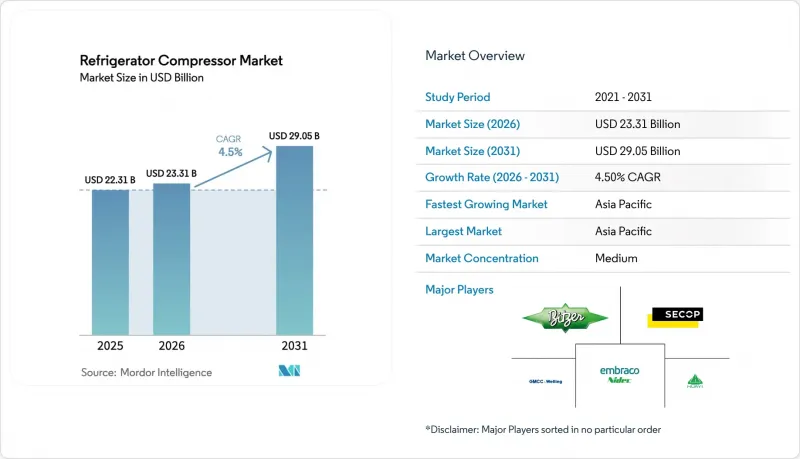
Mordor Intelligence에 의하면, 냉장고용 압축기 시장 규모는 2025년에 223억 1,000만 달러로 평가되었고, 2026년 233억 1,000만 달러에서 2031년까지 290억 5,000만 달러에 이를 것으로 예측되며, 예측 기간(2026-2031년) CAGR은 4.50%를 나타낼 전망입니다.
본 보고서는 제품 유형별(왕복식, 원심식, 기타), 냉매 유형별(HFC, 천연 냉매 : 탄화수소, 천연 냉매 : CO₂, HFO·혼합 냉매), 냉각 용량별(1kW 이하, 1-15kW, 15kW 이상), 회전수 기술별(정속 및 가변속/인버터), 용도별(가정용 냉장고·냉동고, 기타), 지역별(북미, 아시아태평양, 기타)로 분류되어 있습니다.
세계의 냉장고용 압축기 시장 동향 및 인사이트
전자상거래 콜드체인 인프라 확장에 따른 압축기 수요 견인
온라인 식료품 구매의 폭발적인 확산으로 인해, 물류 센터 운영업체들은 전례 없는 속도로 냉장 창고의 건설 및 개보수를 진행하고 있습니다. 전 세계 냉장 창고 매출액은 연평균 성장률(CAGR) 13.6%를 기록하며, 2030년까지 320억 달러를 넘어설 전망입니다. 도심에 위치한 자동화 지원 마이크로 풀필먼트 허브에는 제한된 설치 공간에 들어갈 수 있는 소형 고효율 압축기가 요구됩니다. 미국에서는 냉장 창고에 대한 투자액이 2023년 432억 달러에서 2031년까지 1,188억 달러로 증가할 것으로 예측됩니다. 북미의 시설은 노후화가 진행되고 있으며(대부분 지은 지 20-30년), 현재 교체 주기가 가속화되고 있어 가변 속도와 낮은 GWP(지구 온난화 지수)를 갖춘 플랫폼이 뚜렷한 우위를 보이고 있습니다. 중국의 중견 도시(2선 도시)에서도 투기적인 개발이 확산되고 있으며, 스타트업 기업들은 주변 온도 -40°C의 환경에서도 작동하는 견고한 압축기를 탑재한 자율 주행형 냉장 트럭의 실증 테스트를 진행하고 있습니다. 이러한 요인들이 복합적으로 작용하여 냉장용 압축기 시장의 견고한 장기 수요 추세를 뒷받침하고 있습니다.
엄격한 식품 안전 규제에 따른 고도 냉동 시스템 도입 의무화
신흥 시장의 각국 정부는 식품 폐기물을 줄이고 수출을 보호하기 위해 온도 관리 규제를 강화하고 있습니다. 중국의 구형 제품 교체 보조금은 2024년에 냉장고 판매 대수를 5.4%, 판매액을 8.5% 끌어올렸으며, 이는 해당 정책이 얼마나 급속한 기기 교체를 촉진하는지 보여줍니다. 새로운 규제에서는 차량 내 데이터 로깅, 이중화된 냉각 루프, 실시간 경보 등이 요구되는 경우가 많으며, 이 모든 요소가 기존 기계식 장치보다 디지털 제어 방식의 압축기 플랫폼에 유리하게 작용하고 있습니다. 브라질과 인도네시아의 유사한 법규로 인해 프리미엄 제품의 대상 시장이 확대되고 있습니다. 보관뿐만 아니라 운송 규제도 수산물과 의약품에 대해 더 좁은 온도 범위가 지정됨에 따라, 차량 소유자는 장거리 운송 중 ±1°C의 정확도를 유지할 수 있는 멀티존 인버터 시스템으로의 업그레이드를 강요받고 있습니다.
자본 비용 장벽으로 인한 신흥 시장 진출 저해
가변 속도 시스템의 비용은 고정 속도 장치보다 40% 더 높아, 인도에서는 예산에 부담을 주고 있습니다. 인도에서는 국내 조립 생산이 1,500만 대 수요 중 고작 600만 대만 충족하고 있어, 60-70%를 수입에 의존하고 있습니다. 미쓰비시의 켄튀르키예 공장 건설비는 연간 생산 능력 1단위당 143달러에 달하며, 이는 생산의 현지화에 막대한 초기 투자가 필요함을 여실히 보여줍니다. 압축기 부품의 대부분은 달러로 결제되는 반면, 현지 수익은 변동이 심한 현지 통화로 결제되기 때문에 환율 변동이 이러한 부담을 더욱 가중시키고 있습니다. 인도의 ‘생산연동형 인센티브(PLI)’ 제도가 일부 부담을 경감시키고 있지만, 중소기업은 여전히 장기 자금 확보에 어려움을 겪고 있습니다.
부문별 분석
2025년, 냉장고용 압축기 시장 규모의 68.90%를 왕복식 유닛이 차지했습니다. 이는 저렴한 비용은 물론, 가정용 및 소규모 상업용 냉장고에서 입증된 신뢰성 덕분입니다. 중국 내 생산 라인의 지속적인 자동화로 인해 인버터 제어를 통해 계절별 효율이 향상되고 있음에도 불구하고, 비용 면에서의 우위는 유지되고 있습니다. 원심식 압축기는 시장 점유율은 낮지만, 3,000TR 이상의 용량이 필요한 데이터센터 냉각, 지역 난방 공급 플랜트,대규모 식품 가공 시설 덕분에 연평균 성장률(CAGR) 10.3%로 시장 점유율을 확대되고 있습니다. 가변 속도 구동 장치를 통해 더욱 부드러운 턴다운 범위가 실현되어, 원심식 압축기는 부분 부하 운전에서 매력적인 선택지가 되고 있습니다. 스크롤식 및 로터리 스크류식 모델은 슈퍼마켓의 냉장 진열대나 아이스크림 공장에서 이용되고 있지만, 베인식이나 리니어식 기술은 저소음 및 이동형 용도로 한정된 틈새 시장 수준에 머물러 있습니다. 산업 재편이 진행되고 있습니다. 아틀라스콥코의 경원 인수로 제약 산업의 순도 기준을 준수하는 오일프리 스크류 기술이 도입되었습니다. 모든 유형에 IoT 센서가 통합됨에 따라 기계적 구조가 더 이상 유일한 차별화 요소가 아니게 되었으며, 수명 주기 분석이 냉장고용 압축기 시장에서 새로운 경쟁의 장으로 부상하고 있습니다.
2025년에도 HFC 냉매는 여전히 냉장고용 압축기 시장 점유율의 77.20%를 차지했지만, 할당량 감축이 엄격해짐에 따라 그 전망은 축소될 것으로 보입니다. HFO 및 혼합 냉매는 주로 직접 교체가 가능하여 서비스 시간을 단축할 수 있는 칠러 개조 프로젝트에서 연평균 성장률(CAGR) 14.9%라는 가장 빠른 속도로 성장하고 있습니다. R290 등 탄화수소계 냉매는 높은 열역학적 효율과 적은 충전량으로 평가받으며, 플러그인식 소매용 쇼케이스에서 보급이 확대되고 있습니다. CO2 트랜스크리티컬 루프는 고온 기후에서 성능 계수(COP)를 향상시키는 이젝터 및 병렬 압축 기술의 혁신에 힘입어 스칸디나비아와 일본의 슈퍼마켓 시장에서 점유율을 확대되고 있습니다. 파나소닉이 2025년에 출시할 70개 기종의 제품 라인업을 통해, 유럽의 각 OEM 업체들은 천연가스 대응용으로 공장에서 이미 인증을 받은 압축기를 안정적으로 조달할 수 있게 될 것입니다. 도입상의 과제로는 방폭 릴레이나 누출 센서 등의 추가 안전 부품으로 인해 부품 비용이 증가한다는 점이 꼽히지만, HFC 할당량 감축에 따라 대체 냉매로의 착실한 전환이 확실시되고 있습니다.
지역별 분석
2025년, 아시아태평양은 전 세계 출하량의 42.80%를 차지했습니다. 이는 중국의 풀스택 공급망과 인도 내 수요 격차 확대에 힘입은 결과입니다. 중국의 주요 기업인 Midea는 전 세계 가정용 에어컨용 압축기 생산량의 45%, 냉장고용 압축기 생산량의 16%를 차지하고 있으며, 매출의 41.9%는 이미 해외에서 창출되고 있습니다. 인도의 생산 부족은 세제 혜택에 힘입은 합작 투자 및 기존 시설 확장의 여지를 남겨두고 있습니다. 일본과 한국은 하이엔드 가변속 IP(인버터) 기술을 제공하고 있으며, 삼성의 Flakt Group 인수는 연간 18% 성장이 예상되는 하이퍼스케일 데이터센터용 HVAC 제품 라인업을 확대하기 위한 것입니다.
기업들이 지정학적 리스크와 운송 리스크를 헤지하는 가운데, 북미는 전략적 중요성을 되찾아가고 있습니다. 미쓰비시 중공업이 켄튀르키예주의 기존 공장을 개조하는 사업은 5,000만 달러 규모의 연방 에너지 보조금을 지원받아 미국 최초의 인버터 압축기 공장이 될 것입니다. LG는 멕시코에 스크롤 압축기 생산 라인을 증설하고, USMCA(미국·멕시코·캐나다 협정) 규정을 활용하여 자동차 및 가전 부문 모두에서 계약을 확보했습니다. 선벨트 지역에서는 급속한 인구 유입과 온라인 식료품 서비스의 확산을 반영하여 콜드체인 관련 건설이 활기를 띠고 있습니다.
유럽의 강점은 엄격한 지속가능성 규제에 있습니다. 파나소닉이 70유형의 저GWP 제품을 출시한 것은 2027년 할당량의 급격한 감축에 맞추어 현지 OEM이 사업 지속성을 유지할 수 있도록 지원하기 위한 것입니다. 또한, EU 제조업체들은 CO₂ 이젝터 연구 분야에서도 주도적인 입지를 차지하고 있으며, 냉각기의 탈탄소화를 목표로 하는 중동의 호텔 체인에 그 전문 지식을 수출하고 있습니다.
남미와 중동 및 아프리카는 시장 규모 면에서는 뒤처져 있지만, 두 자릿수 성장을 보이는 부문도 곳곳에서 발견됩니다. 미디아(Midea)가 브라질에 1억 2,200만 달러를 투자해 건설한 냉장고 공장은 라틴아메리카 최대의 백색 가전 시장에서 현지 조달을 통한 우위를 확보하기 위한 경쟁이 격화되고 있음을 보여줍니다. AI 클라우드 수요에 힘입어 걸프 국가들의 데이터센터 건설이 활발해지면서 대용량 원심식 압축기에 대한 수요가 발생하고 있지만, 현재로서는 해당 지역의 시스템 통합사업자들이 아직 공급을 따라가지 못하고 있습니다.
기타 혜택
- 엑셀 형식 시장 예측(ME) 시트
- 3개월간의 애널리스트 지원
자주 묻는 질문
목차
제1장 서론
제2장 조사 방법
제3장 주요 요약
제4장 시장 구도
제5장 시장 규모 및 성장 예측
제6장 경쟁 구도
제7장 시장 기회 및 향후 전망
AJY 26.09.15According to Mordor Intelligence, the refrigerator compressor market size was valued at USD 22.31 billion in 2025 and estimated to grow from USD 23.31 billion in 2026 to reach USD 29.05 billion by 2031, at a CAGR of 4.50% during the forecast period (2026-2031).

This report is Segmented by Product Type (Reciprocating, Centrifugal, and More), Refrigerant Type (HFCs, Natural: Hydrocarbons, Natural: CO2, and HFOs and Blends), Cooling Capacity (Up To 1 KW, 1 To 15 KW, and Above 15 KW), Speed Technology (Fixed-Speed and Variable-Speed/Inverter), Application (Residential Refrigerators and Freezers, and More), and Geography (North America, Asia-Pacific, and More).
Global Refrigerator Compressor Market Trends and Insights
E-commerce Cold-Chain Infrastructure Expansion Drives Compressor Demand
Explosive online grocery adoption is driving warehouse operators to build or retrofit cold storage at an unprecedented rate. Global cold storage revenues are on course to surpass USD 32 billion by 2030, registering a 13.6% CAGR. Automation-ready micro-fulfillment hubs inside cities require compact, high-efficiency compressors that fit tight footprints. In the United States, cold storage spending is projected to increase from USD 43.2 billion in 2023 to USD 118.8 billion by 2031. Aging North-American facilities-many 20-30 years old-now face accelerated replacement cycles, giving variable-speed and low-GWP platforms a clear advantage. Speculative development is spreading to tier-2 Chinese cities, where startups are testing autonomous reefer vehicles equipped with ruggedized compressors that function at -40 °C ambient conditions. Together, these factors reinforce a robust long-run demand stream for the refrigerator compressor market.
Stringent Food-Safety Regulations Mandate Advanced Refrigeration Systems
Emerging-market governments are tightening temperature-control rules to curb food waste and safeguard exports. China's trade-in subsidies revived refrigerator sales volume by 5.4% and value by 8.5% in 2024, illustrating how policy can spur rapid equipment turnover. New mandates often require onboard data logging, redundant cooling loops, and real-time alarms-all of which favor digitally controlled compressor platforms over legacy mechanical units. Comparable legislation in Brazil and Indonesia is widening the addressable base for premium products. Beyond storage, transport regulations now specify narrower temperature bands for seafood and pharmaceuticals, compelling fleet owners to upgrade to multi-zone inverter systems that maintain a precision of +-1 °C during long hauls.
Capital Cost Barriers Constrain Market Penetration in Emerging Economies
Variable-speed systems cost 40% more than fixed-speed units, stretching budgets in India, where domestic assembly meets only 6 million of the 15 million units demanded, leaving a 60-70% reliance on imports. Mitsubishi's Kentucky plant price tag amounts to USD 143 per annual unit of capacity, underscoring the significant upfront investment required to localize production. Currency swings amplify the burden because most compressor components are dollar-denominated while local revenues are in a volatile domestic tender. Although India's Production-Linked Incentive scheme offers partial relief, small firms still struggle to secure long-term financing.
Other drivers and restraints analyzed in the detailed report include:
- Variable-Speed Compressor Technology Redefines Energy-Efficiency Standards
- Last-Mile Electrification Transforms Transportation Refrigeration
- Raw Material Price Volatility Pressures Manufacturing Economics
For complete list of drivers and restraints, kindly check the Table Of Contents.
Segment Analysis
Reciprocating units accounted for 68.90% of the refrigerator compressor market size in 2025, due to their low cost and proven reliability in residential and light-commercial refrigerators. Continual line automation in China sustains its cost edge even as inverter controls lift seasonal efficiency. Centrifugal designs, although holding a modest share, are gaining at a 10.3% CAGR, thanks to data-center cooling, district-energy plants, and large food-processing sites that require more than 3,000 TR capacity. Variable-speed drives unlock smoother turndown ranges, making centrifugal machines attractive for partial-load operation. Scroll and rotary-screw models serve supermarket racks and ice-cream factories, while vane and linear technologies remain niche, reserved for low-noise or portable applications. Consolidation is evident: Atlas Copco's acquisition of Kyungwon introduces oil-free screw technology, aligning with pharmaceutical purity standards. Integration of IoT sensors across all types indicates that mechanical layout is no longer the sole differentiator; lifecycle analytics is emerging as the new battleground within the refrigerator compressor market.
HFC fluids still represented 77.20% of the refrigerator compressor market share in 2025, but their outlook is set to contract as quota cuts tighten. HFO blends are growing at the fastest rate, with a 14.9% CAGR, primarily in retrofit chiller projects where direct drop-in compatibility reduces service time. Hydrocarbons, such as R290, advance in plug-in retail cabinets, appreciated for their thermodynamic efficiency and minimal charge volumes. CO2 trans-critical loops are climbing supermarket hilltops in Scandinavia and Japan, aided by ejector and parallel compression innovations that raise the coefficient of performance in hot climates. Panasonic's 70-model portfolio launch in 2025 provides European OEMs with a ready supply of compressors factory-qualified for natural gas. Implementation hurdles include additional safety components-such as spark-proof relays and leak sensors-that increase the bill of materials, yet declining HFC quotas ensure a steady shift toward alternatives.
Complete Report Scope:
- By Product Type
- Reciprocating
- Scroll
- Rotary Screw
- Centrifugal
- Others (Vane, Linear)
- By Refrigerant Type
- HFCs (R-134a, R-404A)
- Natural: Hydrocarbons (R-290/600a)
- Natural: CO2 (R-744)
- HFOs and Blends (A2L)
- By Cooling Capacity
- Up to 1 kW
- 1 to 15 kW
- Above 15 kW
- By Speed Technology
- Fixed-Speed
- Variable-Speed/Inverter
- By Application
- Residential Refrigerators and Freezers
- Commercial (Retail, Supermarkets, HoReCa)
- Healthcare and Pharma Cold-Chain
- Industrial Processing and Cold Storage
- Transportation Refrigeration (Road, Marine, Rail)
- By Geography
- North America
- United States
- Canada
- Mexico
- Europe
- Germany
- United Kingdom
- France
- Italy
- NORDIC Countries
- Russia
- Rest of Europe
- Asia-Pacific
- China
- India
- Japan
- South Korea
- ASEAN Countries
- Rest of Asia-Pacific
- South America
- Brazil
- Argentina
- Chile
- Rest of South America
- Middle East and Africa
- Saudi Arabia
- United Arab Emirates
- South Africa
- Egypt
- Rest of Middle East and Africa
- North America
Geography Analysis
Asia-Pacific controlled 42.80% of global shipments in 2025, powered by China's full-stack supply chain and India's widening demand gap. Chinese champion Midea accounts for 45% of the global home AC compressor output and 16% of refrigerators, with 41.9% of its revenue already generated offshore. India's production shortfall leaves room for joint ventures and brownfield expansions encouraged by tax holidays. Japan and South Korea contribute high-end variable-speed IP; Samsung's FlaktGroup deal broadens its applied HVAC offering to serve hyperscale data centers, projected to grow at 18% annually.
North America is regaining strategic weight as firms hedge geopolitical and freight risks. Mitsubishi's Kentucky retrofit is the first inverter compressor factory on U.S. soil, supported by USD 50 million in federal energy grants. LG added scroll-compressor lines in Mexico, leveraging USMCA rules to secure contracts for both the automotive and appliance sectors. Cold-chain construction is booming in the Sun Belt, mirroring the rapid influx of population and the increasing adoption of online grocery services.
Europe's niche lies in stringent sustainability rules. Panasonic's 70-model low-GWP rollout aligns with the 2027 quota cliff, ensuring local OEMs maintain continuity. EU manufacturers also lead in CO2 ejector research, exporting their expertise to Middle East hotel chains seeking to decarbonize their chillers.
South America and MEA trail on value but show pockets of double-digit growth. Midea's USD 122 million Brazilian fridge plant illustrates the race to secure local content advantages in Latin America's largest white-goods market. Gulf-state datacenter builds, spurred by AI cloud demand, are opening high-capacity centrifugal opportunities that regional integrators cannot yet supply.
- GMCC-Welling (Midea)
- Nidec (Embraco)
- Secop GmbH
- Huayi Compressor (Highly)
- Bitzer SE
- Panasonic Appliances
- Daikin Industries
- Mitsubishi Electric
- Emerson Climate Technologies
- Danfoss A/S
- Carrier Commercial Refrigeration
- LG Electronics
- Johnson Controls (York)
- Tecumseh Products
- Frascold SpA
- Mayekawa Mfg.
- Samsung Electronics
- Hitachi Global Life Solutions
- Cubigel Compressors
- Kulthorn Kirby
Additional Benefits:
- The market estimate (ME) sheet in Excel format
- 3 months of analyst support
TABLE OF CONTENTS
1 Introduction
- 1.1 Study Assumptions & Market Definition
- 1.2 Scope of the Study
2 Research Methodology
3 Executive Summary
4 Market Landscape
- 4.1 Market Overview
- 4.2 Market Drivers
- 4.2.1 Booming e-commerce-driven cold-chain build-out
- 4.2.2 Stringent food-safety regulations in emerging markets
- 4.2.3 Shift toward energy-efficient variable-speed (inverter) compressors
- 4.2.4 Rapid electrification of last-mile refrigerated vans (plug-in hybrid cabinets)
- 4.2.5 Mandated global HFC phase-down accelerating low-GWP retrofit demand
- 4.2.6 AI-enabled predictive-maintenance services lowering total cost of ownership
- 4.3 Market Restraints
- 4.3.1 High capital cost and financing gaps in developing economies
- 4.3.2 Volatile copper & electrical-steel prices inflating BoM costs
- 4.3.3 Shortage of technicians certified for flammable natural refrigerants
- 4.3.4 Cyber-security risks in IoT-connected compressor fleets
- 4.4 Supply-Chain Analysis
- 4.5 Regulatory Landscape
- 4.6 Technological Outlook (Digital twin, oil-free magnetic bearing, 3D-printed impellers)
- 4.7 Porter's Five Forces
- 4.7.1 Bargaining Power of Suppliers
- 4.7.2 Bargaining Power of Buyers
- 4.7.3 Threat of New Entrants
- 4.7.4 Threat of Substitutes
- 4.7.5 Intensity of Competitive Rivalry
5 Market Size & Growth Forecasts
- 5.1 By Product Type
- 5.1.1 Reciprocating
- 5.1.2 Scroll
- 5.1.3 Rotary Screw
- 5.1.4 Centrifugal
- 5.1.5 Others (Vane, Linear)
- 5.2 By Refrigerant Type
- 5.2.1 HFCs (R-134a, R-404A)
- 5.2.2 Natural: Hydrocarbons (R-290/600a)
- 5.2.3 Natural: CO2 (R-744)
- 5.2.4 HFOs and Blends (A2L)
- 5.3 By Cooling Capacity
- 5.3.1 Up to 1 kW
- 5.3.2 1 to 15 kW
- 5.3.3 Above 15 kW
- 5.4 By Speed Technology
- 5.4.1 Fixed-Speed
- 5.4.2 Variable-Speed/Inverter
- 5.5 By Application
- 5.5.1 Residential Refrigerators and Freezers
- 5.5.2 Commercial (Retail, Supermarkets, HoReCa)
- 5.5.3 Healthcare and Pharma Cold-Chain
- 5.5.4 Industrial Processing and Cold Storage
- 5.5.5 Transportation Refrigeration (Road, Marine, Rail)
- 5.6 By Geography
- 5.6.1 North America
- 5.6.1.1 United States
- 5.6.1.2 Canada
- 5.6.1.3 Mexico
- 5.6.2 Europe
- 5.6.2.1 Germany
- 5.6.2.2 United Kingdom
- 5.6.2.3 France
- 5.6.2.4 Italy
- 5.6.2.5 NORDIC Countries
- 5.6.2.6 Russia
- 5.6.2.7 Rest of Europe
- 5.6.3 Asia-Pacific
- 5.6.3.1 China
- 5.6.3.2 India
- 5.6.3.3 Japan
- 5.6.3.4 South Korea
- 5.6.3.5 ASEAN Countries
- 5.6.3.6 Rest of Asia-Pacific
- 5.6.4 South America
- 5.6.4.1 Brazil
- 5.6.4.2 Argentina
- 5.6.4.3 Chile
- 5.6.4.4 Rest of South America
- 5.6.5 Middle East and Africa
- 5.6.5.1 Saudi Arabia
- 5.6.5.2 United Arab Emirates
- 5.6.5.3 South Africa
- 5.6.5.4 Egypt
- 5.6.5.5 Rest of Middle East and Africa
- 5.6.1 North America
6 Competitive Landscape
- 6.1 Market Concentration
- 6.2 Strategic Moves (M&A, Partnerships, PPAs)
- 6.3 Market Share Analysis (Market Rank/Share for key companies)
- 6.4 Company Profiles (includes Global level Overview, Market level overview, Core Segments, Financials as available, Strategic Information, Products & Services, and Recent Developments)
- 6.4.1 GMCC-Welling (Midea)
- 6.4.2 Nidec (Embraco)
- 6.4.3 Secop GmbH
- 6.4.4 Huayi Compressor (Highly)
- 6.4.5 Bitzer SE
- 6.4.6 Panasonic Appliances
- 6.4.7 Daikin Industries
- 6.4.8 Mitsubishi Electric
- 6.4.9 Emerson Climate Technologies
- 6.4.10 Danfoss A/S
- 6.4.11 Carrier Commercial Refrigeration
- 6.4.12 LG Electronics
- 6.4.13 Johnson Controls (York)
- 6.4.14 Tecumseh Products
- 6.4.15 Frascold SpA
- 6.4.16 Mayekawa Mfg.
- 6.4.17 Samsung Electronics
- 6.4.18 Hitachi Global Life Solutions
- 6.4.19 Cubigel Compressors
- 6.4.20 Kulthorn Kirby
7 Market Opportunities & Future Outlook
- 7.1 White-Space & Unmet-Need Assessment