
|
시장보고서
상품코드
2125745
보안 물류 시장 : 점유율 분석, 업계 동향과 통계, 성장 예측(2026-2031년)Secure Logistics - Market Share Analysis, Industry Trends & Statistics, Growth Forecasts (2026 - 2031) |
||||||
 Mordor Intelligence
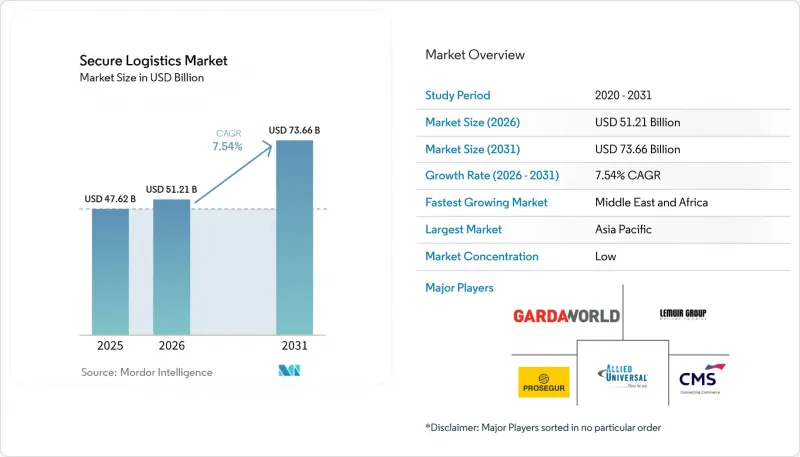
Mordor Intelligence에 의하면, 보안 물류 시장 규모는 2025년에 476억 2,000만 달러로 평가되었고 2026년 512억 1,000만 달러에서 2031년까지 736억 6,000만 달러에 이를 것으로 예측되며, 예측 기간(2026-2031년) CAGR은 7.54%를 나타낼 전망입니다.
본 보고서는 용도별(현금 관리, 다이아몬드, 보석 및 귀금속, 기타), 유형별(고정형 및 이동형), 물류 기능별(운송, 창고·유통, 기타), 최종 사용자 산업별(은행 및 금융기관, 소매 및 전자상거래, 기타),지역별(북미, 유럽, 기타)로 분류되어 있습니다. 시장 예측은 금액(달러)으로 표시되어 있습니다.
세계 보안 물류 시장 동향 및 인사이트
신흥 경제국에서의 ATM 설치 대수 증가
각국 정부가 현금 유통 네트워크에 의존하는 금융 포용 프로그램을 추진하는 가운데, 아시아태평양 및 아프리카에서는 ATM 인프라 확장이 계속되고 있습니다. 새로 설치되는 각 단말기에는 장갑차를 통한 정기적인 보충이 필요하며, 이는 보안 물류 시장에 안정적인 수요를 가져오고 있습니다. 성숙한 경제권에서는 ATM 설치 밀도가 감소하고 있는 반면, 신흥 지역의 성장이 그 감소분을 상쇄하고 있어 차량 가동률을 유지하는 동시에 수년에 걸친 서비스 계약을 뒷받침하고 있습니다. 또한 사업자들은 중견 은행을 대상으로 화이트 라벨 ATM을 도입하고 있으며, 이를 통해 비용 효율성이 향상되고 네트워크의 도달 범위가 확대되고 있습니다. 이러한 설치는 예측 가능한 현금 취급 수익의 기반이 되며, 공급업체의 금고 용량 및 전자 감시 시스템에 대한 투자를 보완합니다. 장기적인 현금 순환에 대한 가시성이 높아짐에 따라 운송업체는 경로 계획을 최적화하고 카세트당 비용을 절감할 수 있어 수익성 향상을 도모할 수 있습니다.
전자상거래 분야의 대금 수취 모델의 급속한 성장
대금 상환 방식은 카드 보급률이 낮거나 디지털 채널에 대한 신뢰가 아직 확립되고 있는 많은 신흥 전자상거래 시장에서 여전히 주요 결제 수단으로 자리 잡고 있습니다. 따라서 보안성이 뛰어난 물류 사업자는 매일 수천 곳의 배송 거점에서 분산된 현금 수익을 회수하기 위한 역물류 루프를 구축해야 합니다. 대도시권을 중심으로 한 배송 경로의 고밀도화는 사이클 타임 단축과 서비스 수익성 향상에 기여합니다. 각 사업자는 휴대용 계수 단말기와 디지털 대조 플랫폼을 통합하여 온라인 판매업체에 대한 입금 절차를 신속하게 처리하고 있습니다. 모바일 지갑의 보급에 따라 이 모델의 입지는 점차 위협받고 있지만, 전자상거래가 두 자릿수의 높은 성장률을 유지하고 있어 현금의 절대량은 여전히 높은 수준을 유지하고 있습니다. 그 결과, 보안 물류 시장은 물리적 거래와 전자 거래의 균형이 잡힌 하이브리드 환경으로부터 계속해서 혜택을 받고 있습니다.
성숙한 경제권에서의 ‘캐시 라이트’ 정책 지속 추진
스칸디나비아와 호주의 중앙은행은 현금 유통을 억제하기 위해 디지털 결제를 적극적으로 추진하고 있으며, 이로 인해 보안 물류 시장을 지탱하는 운송량이 감소하고 있습니다. 소매업체들은 이에 대응하여 하루당 현금 회수 횟수를 줄이고 있는 반면, 정부는 현금 거래 상한액에 대한 논의를 진행하고 있습니다. 사업자 측은 귀금속 물류, 가상화폐 하드웨어 지갑의 안전한 보관, ATM의 재사용 관리 서비스로 사업을 전환함으로써 이러한 추세에 대응하고 있습니다. 현금 취급량은 감소하고 있지만, 고가 상품이 그 부족분을 부분적으로 보충하고 있어, 이를 통해 운송업체는 선진국 시장에서 배송 노선의 밀도를 유지할 수 있습니다. 또한, 중앙은행 디지털 통화(CBDC)를 둘러싼 규제 당국과의 대화도 사업자들에게 물리적 금고 보관과 디지털 토큰 보관을 결합한 하이브리드 서비스 모색을 촉진하고 있어, 향후 수익원을 확대되고 있습니다.
부문 분석
2025년, 현금 관리는 정기적인 ATM 현금 보충 및 소매점에서의 현금 회수에 힘입어 보안 물류 시장 규모의 49.22%를 차지했습니다. 은행들은 디지털 채널에 집중하기 위해 대량의 지폐 처리 및 대조 업무를 외부에 위탁하고 있습니다. 소매업체들은 예치 금액을 실시간으로 전송하고 매일 지점을 방문하는 횟수를 줄여주는 스마트 금고를 도입하고 있습니다. 한편, 지정학적 혼란 속에서 투자자들이 안전 자산을 찾음에 따라, 보석 및 귀금속 분야는 2026년부터 2031년까지 연평균 성장률(CAGR) 9.52%를 나타낼 것으로 예측됩니다. 운송업체들은 온도 조절이 가능한 보관소, 보세 창고 용량, 귀금속 수송을 위한 당일 통관 서비스를 제공함으로써 이러한 수요 증가를 뒷받침하고 있습니다. 또한, 각 명품 브랜드는 운송 중 고가의 상품을 보호하기 위해 위변조 방지 포장 및 GPS 비콘을 활용하고 있습니다. 그 결과, 귀금속 운송 경로는 현재 보안 물류 시장의 수익 다각화에 크게 기여하고 있습니다.
제조 및 제약 업계는 고가 부품의 배송과 규제를 준수하는 의료 물류를 통해 안정적인 기본 운송량을 확보하고 있습니다. CEIV Pharma 인증은 엄격한 온도 관리를 요구하는 백신 제조업체들을 끌어들이고 있는 반면, 반도체 기업들은 정전기 방지 포장 및 보관 이력의 투명성을 필요로 하고 있습니다. Tracr과 같은 다이아몬드 추적성 플랫폼은 블록체인에 수백만 개의 원석을 등록하고 있으며, 이러한 추세로 인해 운송업체에 대한 디지털 문서 관리 기준이 높아지고 있습니다. 이러한 추세들이 결합되면서 서비스 포트폴리오가 확대되고, 현금 취급량에 대한 의존도가 낮아지고 있습니다. 그 결과, 보안 물류 시장은 단일 품목의 현금 취급 업무에서 다양한 품목을 다루는 전문 지식이 필요한 업무로 지속적으로 전환되고 있습니다.
스마트 금고 및 현금 처리 센터와 같은 고정 시설은 2025년 보안 물류 시장 규모의 60.35%를 차지했습니다. 이러한 허브는 은행 및 소매업체를 위한 야간 지폐 분류 및 동전 포장을 지원하고 있습니다. 각 공급업체는 보험 인수 기준을 충족하기 위해 생체 인증을 통한 접근 제어, 다단계 소화 시스템, 전용 LTE 네트워크 등에 투자하고 있습니다. 동시에 고객이 운송 경로의 유연성과 실시간 추적을 요구하는 가운데, 모바일 서비스는 연평균 성장률(CAGR) 8.55%로 성장을 지속하고, 있습니다. 전동 장갑차는 연료비 및 유지보수 비용을 절감하여 총 소유 비용(TCO)을 낮추고, 화물 원격 측정 플랫폼은 분 단위의 위치 정보를 제공합니다. 경로 최적화 소프트웨어는 정차 지점을 그룹화하여 주행 시간과 온실가스 배출량을 줄이고, ESG(환경·사회·지배구조)에 대한 노력을 강화합니다.
하드웨어와 소프트웨어의 업그레이드가 융합됨에 따라, 운송 사업자는 차량을 예측 분석 엔진에 데이터를 공급하는 ‘이동식 데이터 허브’로 탈바꿈시킬 수 있습니다. 관리자는 체류 시간의 이상 현상을 분석하여 일정을 최적화하고 자산 활용률을 극대화합니다. 원격 감시로 뒷받침되는 1인 승무 체제는 보안을 저해하지 않으면서 인건비를 절감합니다. 그 결과로 얻게 되는 효율성을 통해, 보안이 철저한 물류 시장에서 기술 주도형 사업자의 경쟁력이 강화됩니다.
지역별 분석
아시아태평양은 급속한 경제 성장, 견조한 송금 흐름, 그리고 전자상거래에서 높은 대금 상환 비율에 힘입어 2025년 보안 물류 시장 규모의 31.60%를 차지했습니다. 인도네시아, 필리핀, 베트남 각국 정부는 정기적인 현금 보충이 필요한 새로운 민간 ATM에 대한 인허가를 계속하고 있습니다. 운송업체들은 규제상 소유 한도를 충족하기 위해 방탄 운송 능력을 확대하고 현지 은행과 합작 회사를 설립하고 있습니다. 불안정한 투자 환경 속에서 홍콩과 싱가포르 간의 귀금속 국경 간 거래가 가속화되고 있어, 이 지역의 예상 연평균 성장률(CAGR)은 다른 모든 지역을 상회하고 있습니다.
북미가 2위를 차지한 이유는 현금 관리 아웃소싱이 성숙 단계에 접어들었고, 고가 상품의 거래 규모가 크며, 확립된 운송업체에 유리한 엄격한 규정 준수 체계가 갖춰져 있기 때문입니다. 각 공급업체는 POS 데이터를 통합하는 분석 플랫폼을 도입하고 있으며, 이를 통해 소매 체인은 수거 빈도를 미세 조정할 수 있게 되었습니다. 유럽은 꾸준한 성장세를 보이고 있지만, 북유럽 국가들의 무현금화 정책으로 인해 취급량은 감소하고 있습니다. 차량 텔레메트리 및 국경을 넘는 귀중품 운송에 관한 EU 규제는 기술 지향적인 사업자에게 새로운 서비스 기회를 창출하고 있습니다.
남미에서는 금융 포용 프로그램, 광물 자원 수출, 그리고 소매 업계의 보안 수요 증가가 호재로 작용하고 있습니다. 산악 지대 주행에 대응할 수 있도록 장갑차 설계가 진화하는 한편, 브라질과 콜롬비아에서는 신생 민간 은행을 지원하기 위해 현금 처리 센터에 고속 지폐 선별기가 도입되고 있습니다. 중동 및 아프리카는 인프라 프로젝트와 두바이 등의 귀금속 거래 허브에 힘입어 계속해서 유망한 지역으로 자리 잡고 있습니다. 지정학적 긴장이 고조됨에 따라 리스크 관리의 복잡성이 증가하고 있으며, 이에 따라 위성 추적 및 화물 호송 서비스에 대한 수요가 높아지면서 보안 물류 시장을 활성화시키고 있습니다.
기타 혜택:
- 엑셀 형식 시장 전망(ME) 시트
- 3개월간의 애널리스트 지원
자주 묻는 질문
목차
제1장 서론
제2장 조사 방법
제3장 주요 요약
제4장 시장 구도
제5장 시장 규모 및 성장 예측(금액, 10억 달러)
제6장 경쟁 구도
제7장 시장 기회와 향후 전망
JHSAccording to Mordor Intelligence, the secure logistics market size was valued at USD 47.62 billion in 2025 and estimated to grow from USD 51.21 billion in 2026 to reach USD 73.66 billion by 2031, at a CAGR of 7.54% during the forecast period (2026-2031).
This report is Segmented by Application (Cash Management, Diamonds, Jewelry and Precious Metal, and More), by Type (Static and Mobile), by Logistics Function(Transportation, Warehousing & Distribution, and More), by End-User Industry (Banking & Financial Institutions, Retail & E-Commerce and More), by Geography (North America, Europe, and More ). The Market Forecasts are Provided in Terms of Value (USD).
Global Secure Logistics Market Trends and Insights
Rising ATM Deployments in Emerging Economies
ATM infrastructure continues to expand in Asia-Pacific and Africa as governments pursue financial-inclusion programs that rely on cash distribution networks. Each new device requires recurring armored-car replenishment, adding stable volumes to the secure logistics market. While ATM density in mature economies is shrinking, the offsetting growth in emerging regions sustains fleet utilization rates and supports multi-year service contracts. Operators also deploy white-label ATMs for mid-tier banks, improving cost efficiency and extending network reach. Such installations underpin predictable cash-handling revenue that complement providers' investments in vault capacity and electronic monitoring. The clear visibility of long-term cash cycles helps carriers optimize route planning and lower per-cassette costs, thereby reinforcing profitability.
Rapid Growth of E-commerce Cash-on-Delivery Models
Cash-on-delivery remains a dominant payment mode in many emerging e-commerce markets where card penetration lags or trust in digital channels is still developing economictimes. Secure logistics carriers must therefore orchestrate reverse-logistics loops that collect fragmented cash receipts from thousands of deliveries points each day. Route densification around metropolitan clusters helps compress cycle times and enhances service profitability. Providers integrate handheld counting devices and digital reconciliation platforms to accelerate deposit timelines for online merchants. The model faces gradual erosion as mobile wallets gain popularity, yet high double-digit e-commerce growth keeps absolute cash volumes elevated. Consequently, the secure logistics market continues to benefit from a hybrid landscape that balances physical and electronic transactions.
Persistent Cash-Lite Policy Pushes in Mature Economies
Central banks in Scandinavia and Australia actively promote digital payments to curb cash circulation, trimming shipment volumes that feed the secure logistics market . Retailers respond by reducing daily cash pickups, while governments discuss upper cash-transaction limits. Providers counter this trend by pivoting toward precious-metals logistics, secure storage for cryptocurrency hardware wallets, and ATM second-life management services. Although cash volumes dip, high-value commodities partially fill the gap, ensuring that carriers retain route density in developed markets. Regulatory dialogues around central-bank digital currencies also encourage operators to explore hybrid services that combine physical vaulting with digital token custody, broadening future revenue streams.
Other drivers and restraints analyzed in the detailed report include:
- Bank Branch Outsourcing of Cash-in-Transit Services
- Regulation-Driven Upgrades to Armored Fleet Telemetry
- Labor Shortages of Certified Armored-Car Guards
For complete list of drivers and restraints, kindly check the Table Of Contents.
Segment Analysis
Cash management generated 49.22% of the secure logistics market size in 2025, buoyed by regular ATM replenishments and retail cash pickups. Banks outsource bulk note processing and reconciliation to focus on digital channels. Retailers employ smart safes that transmit deposit values in real time and reduce daily branch visits. Conversely, jewelry & precious metals is projected to post a 9.52% CAGR between 2026-2031 as investors seek safe-haven assets during geopolitical turbulence. Carriers support this uptick by offering temperature-controlled vaults, bonded warehouse capacity, and same-day customs clearance for bullion shipments. Luxury brands also use tamper-evident packaging and GPS beacons to safeguard high-value pieces in transit. As a result, precious-metal lanes now contribute materially to revenue diversification within the secure logistics market.
The manufacturing and pharmaceutical verticals add stable baseline volumes through high-value component deliveries and regulatory-compliant medical logistics. CEIV Pharma certification attracts vaccine producers that demand temperature integrity, while semiconductor firms require antistatic packaging and chain-of-custody transparency. Diamond traceability platforms such as Tracr register millions of stones on blockchain, a development that elevates digital paperwork standards for carriers. Together these trends broaden the service portfolio and reduce dependence on cash volumes. Consequently, the secure logistics market continues to shift from mono-line cash operations toward multi-commodity expertise.
Static facilities, including smart vaults and cash-processing centers, controlled 60.35% of the secure logistics market size in 2025. Such hubs underpin overnight note sorting and coin wrapping for banks and retailers. Providers invest in biometric access, multilevel fire suppression, and private LTE networks to meet insurance underwriting standards. Simultaneously, mobile services record an 8.55% CAGR as clients demand on-route flexibility and real-time tracking. Electric armored vehicles lower total cost of ownership by cutting fuel and maintenance spend, while cargo telemetry platforms deliver minute-by-minute location data. Route optimization software clusters stops shaving drive-time and greenhouse-gas emissions, enhancing ESG credentials.
Converging hardware and software upgrades allow carriers to convert vehicles into rolling data hubs that feed predictive analytics engines. Managers analyze dwell-time anomalies to refine schedules and maximize asset utilization. One-person crew configurations supported by remote monitoring reduce labor requirements without compromising security. The resulting efficiencies strengthen the competitive position of technology-driven operators in the secure logistics market.
Complete Report Scope:
- By Application
- Cash Management
- Diamonds
- Jewelry & Precious Metals
- Manufacturing
- Others
- By Type
- Static
- Mobile
- By Logistics Function
- Transportation
- Road
- Air
- Sea and Inland Waterways
- Rail
- Warehousing & Distribution
- Value-added Services (Labelling, Kitting, Consulting)
- Transportation
- By End-User Industry
- Banking & Financial Institutions
- Government & Public Sector
- Retail & E-commerce
- Mining & Metals
- Luxury Goods
- Pharmaceuticals & Healthcare
- Others
- Geography
- North America
- United States
- Canada
- Mexico
- South America
- Brazil
- Peru
- Chile
- Argentina
- Rest of South America
- Asia Pacific
- India
- China
- Japan
- Australia
- South Korea
- South East Asia (Singapore, Malaysia, Thailand, Indonesia, Vietnam, and Philippines)
- Rest of Asia-Pacific
- Europe
- United Kingdom
- Germany
- France
- Spain
- Italy
- BENELUX (Belgium, Netherlands, and Luxembourg)
- NORDICS (Denmark, Finland, Iceland, Norway, and Sweden)
- Rest of Europe
- Middle East And Africa
- United Arab of Emirates
- Saudi Arabia
- South Africa
- Nigeria
- Rest of Middle East And Africa
- North America
Geography Analysis
Asia-Pacific held 31.60% of the secure logistics market size in 2025, supported by rapid economic expansion, robust remittance flows, and high e-commerce cash-on-delivery ratios. Governments in Indonesia, the Philippines, and Vietnam continue to license new private ATMs that need recurring cash replenishment. Carriers expand armoring capacity and establish joint ventures with local banks to meet regulatory ownership caps. The region's forecast CAGR outpaces all others as cross-border precious-metal trade between Hong Kong and Singapore accelerates in a volatile investment climate.
North America ranks second because of mature cash management outsourcing, sizable high-value-goods trade, and strict compliance regimes that favor established carriers . Providers deploy analytics platforms that integrate point-of-sale data, enabling retail chains to fine-tune pickup frequencies. Europe posts steady growth although cash-lite policies in the Nordics reduce volume. EU rules around fleet telemetry and cross-border valuables transit create service opportunities for technology-oriented operators.
South America benefits from financial-inclusion programs, mining exports, and rising retail security needs. Armored-car design evolves to manage mountainous terrain, while cash centers introduce high-speed note sorters to support new private banks in Brazil and Colombia. Middle East and Africa remain opportunity regions, driven by infrastructure projects and precious-metal trading hubs such as Dubai. Risk management complexity rises amid geopolitical tensions, prompting demand for satellite tracking and cargo escort services that enrich the secure logistics market.
- Brinks
- GardaWorld
- Loomis
- Prosegur
- G4S
- Securitas AB
- Allied Universal
- CMS Info Systems
- Lemuir Group
- Secure Logistics LLC
- Malca-Amit
- Cash Connect
- Empyreal Logistics
- Tri-State Secured Trucking
- Parcel Pro
- Loomis Schweiz AG
- Armaguard
- General Secure Logistic Services (GSLS)
- Cash Logistik Security AG
- Radiant Cash Management Services*
Additional Benefits:
- The market estimate (ME) sheet in Excel format
- 3 months of analyst support
TABLE OF CONTENTS
1 Introduction
- 1.1 Study Assumptions & Market Definition
- 1.2 Scope of the Study
2 Research Methodology
3 Executive Summary
4 Market Landscape
- 4.1 Market Overview
- 4.2 Market Drivers
- 4.2.1 Rising ATM deployments in emerging economies
- 4.2.2 Rapid growth of e-commerce cash-on-delivery models
- 4.2.3 Bank branch outsourcing of cash-in-transit (CIT) services
- 4.2.4 Regulation-driven upgrades to armored fleet telemetry
- 4.2.5 Supply-chain cyber-theft forcing integrated physical-digital security
- 4.2.6 Tokenized blockchain tracking for high-value diamonds & bullion
- 4.3 Market Restraints
- 4.3.1 Persistent cash-lite" policy pushes in mature economies"
- 4.3.2 Labor shortages of certified armored-car guards
- 4.3.3 Escalating insurance premiums for conflict-zone routes
- 4.3.4 Growing adoption of virtual/crypto asset transfer replacing physical shipment
- 4.4 Value / Supply-Chain Analysis
- 4.5 Regulatory Landscape
- 4.6 Technological Outlook
- 4.7 Porter's Five Forces
- 4.7.1 Threat of New Entrants
- 4.7.2 Bargaining Power of Suppliers
- 4.7.3 Bargaining Power of Buyers
- 4.7.4 Threat of Substitutes
- 4.7.5 Competitive Rivalry
- 4.8 Spotlight on Transport Rates
5 Market Size & Growth Forecasts (Value, USD Bn)
- 5.1 By Application
- 5.1.1 Cash Management
- 5.1.2 Diamonds
- 5.1.3 Jewelry & Precious Metals
- 5.1.4 Manufacturing
- 5.1.5 Others
- 5.2 By Type
- 5.2.1 Static
- 5.2.2 Mobile
- 5.3 By Logistics Function
- 5.3.1 Transportation
- 5.3.1.1 Road
- 5.3.1.2 Air
- 5.3.1.3 Sea and Inland Waterways
- 5.3.1.4 Rail
- 5.3.2 Warehousing & Distribution
- 5.3.3 Value-added Services (Labelling, Kitting, Consulting)
- 5.3.1 Transportation
- 5.4 By End-User Industry
- 5.4.1 Banking & Financial Institutions
- 5.4.2 Government & Public Sector
- 5.4.3 Retail & E-commerce
- 5.4.4 Mining & Metals
- 5.4.5 Luxury Goods
- 5.4.6 Pharmaceuticals & Healthcare
- 5.4.7 Others
- 5.5 Geography
- 5.5.1 North America
- 5.5.1.1 United States
- 5.5.1.2 Canada
- 5.5.1.3 Mexico
- 5.5.2 South America
- 5.5.2.1 Brazil
- 5.5.2.2 Peru
- 5.5.2.3 Chile
- 5.5.2.4 Argentina
- 5.5.2.5 Rest of South America
- 5.5.3 Asia Pacific
- 5.5.3.1 India
- 5.5.3.2 China
- 5.5.3.3 Japan
- 5.5.3.4 Australia
- 5.5.3.5 South Korea
- 5.5.3.6 South East Asia (Singapore, Malaysia, Thailand, Indonesia, Vietnam, and Philippines)
- 5.5.3.7 Rest of Asia-Pacific
- 5.5.4 Europe
- 5.5.4.1 United Kingdom
- 5.5.4.2 Germany
- 5.5.4.3 France
- 5.5.4.4 Spain
- 5.5.4.5 Italy
- 5.5.4.6 BENELUX (Belgium, Netherlands, and Luxembourg)
- 5.5.4.7 NORDICS (Denmark, Finland, Iceland, Norway, and Sweden)
- 5.5.4.8 Rest of Europe
- 5.5.5 Middle East And Africa
- 5.5.5.1 United Arab of Emirates
- 5.5.5.2 Saudi Arabia
- 5.5.5.3 South Africa
- 5.5.5.4 Nigeria
- 5.5.5.5 Rest of Middle East And Africa
- 5.5.1 North America
6 Competitive Landscape
- 6.1 Market Concentration
- 6.2 Strategic Moves
- 6.3 Market Share Analysis
- 6.4 Company Profiles (includes Global level Overview, Market level overview, Core Segments, Financials, Strategic Info, Market Rank/Share, Products & Services, Recent Developments)
- 6.4.1 Brinks
- 6.4.2 GardaWorld
- 6.4.3 Loomis
- 6.4.4 Prosegur
- 6.4.5 G4S
- 6.4.6 Securitas AB
- 6.4.7 Allied Universal
- 6.4.8 CMS Info Systems
- 6.4.9 Lemuir Group
- 6.4.10 Secure Logistics LLC
- 6.4.11 Malca-Amit
- 6.4.12 Cash Connect
- 6.4.13 Empyreal Logistics
- 6.4.14 Tri-State Secured Trucking
- 6.4.15 Parcel Pro
- 6.4.16 Loomis Schweiz AG
- 6.4.17 Armaguard
- 6.4.18 General Secure Logistic Services (GSLS)
- 6.4.19 Cash Logistik Security AG
- 6.4.20 Radiant Cash Management Services*
7 Market Opportunities & Future Outlook
- 7.1 White-space & Unmet-Need Assessment