

|
시장보고서
상품코드
2154214
유럽의 전동 카고 바이크 : 시장 점유율 분석, 업계 동향과 통계, 성장 예측(2026-2031년)Europe E-Cargo Bike - Market Share Analysis, Industry Trends & Statistics, Growth Forecasts (2026 - 2031) |
||||||
 Mordor Intelligence
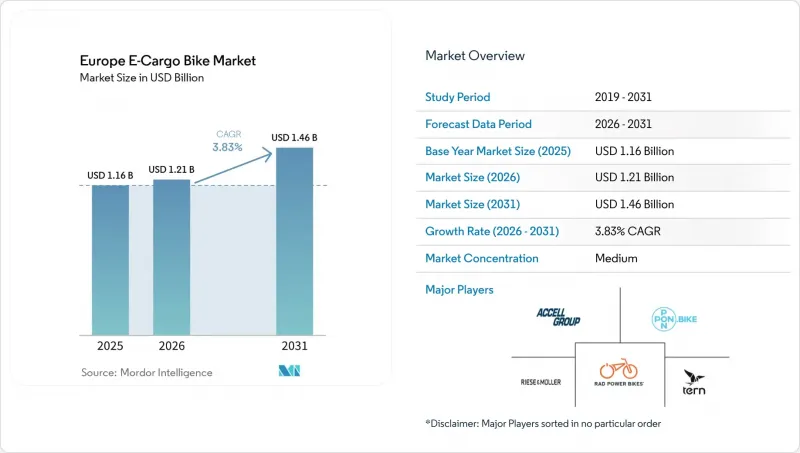
에 따르면 유럽의 전동 카고 바이크 시장은 2025년에 11억 6,000만 달러 규모에 달하며, 2026년에는 12억 1,000만 달러로 추정되어 예측 기간(2026-2031년)에 CAGR 3.83%로 추이하며, 2031년까지 14억 6,000만 달러에 달할 것으로 전망되고 있습니다.
유럽 전기 카고바이크 시장의 동향 및 인사이트
도시 물류 분야의 무공해 규제
현재 유럽의 30개 이상의 도시에서 디젤 밴에 대한 규제와 벌금이 부과되고 있으며, 이로 인해 사업자들은 정체 요금이나 주차 위반 벌금을 피할 수 있는 페달 보조식 카고바이크로의 전환을 사실상 강요받고 있습니다. 암스테르담의 2025년 도입, 파리의 2011년 이전 디젤 차량 금지, 런던의 ULEZ(초저배출구역) 확대는 모두 도심 순환도로에서 밴의 주행 거리를 대폭 줄인 시범 운영 차량의 도입으로 이어졌습니다. EU의 도시 이동성 프레임워크가 보다 광범위한 일관성을 시사하는 가운데, 물류 기업은 현재 전기 카고 바이크를 단순한 실험이 아닌 규제 준수에 필수적인 수단으로 인식하고 있습니다. 차량 관리자들은 자전거라면 주차 공간을 찾아 이리저리 돌아다닐 필요가 없고, 갓길에 주차할 수 있으므로 화물 1건당 작업 시간이 단축되어 배송 밀도가 현저히 향상되었다고 보고하고 있습니다. 이러한 규제 조치와 업무 효율화의 시너지 효과로 인해 2031년까지 견고한 수요 기반이 확립될 전망입니다.
상업용 전동 카고바이크 차량단에 대한 보조금
현금 인센티브를 통해 초기 비용이 절감되고 투자 회수 기간이 단축되고 있습니다. 이탈리아의 2024년 에코 보너스 제도는 1대당 막대한 지원을 제공하고 있으며, 독일도 상당한 보조금을 제공하고 있습니다. 네덜란드는 지원액이 적지만, 지자체 보조금과 병용할 수 있습니다. 이러한 프로그램은 예산이 조기에 소진되는 경우가 많아, 재정 예측을 뛰어넘는 높은 수요가 부각되고 있습니다. 프랑스는 국가 예산을 전기자동차에 할당하고 있지만, 주요 도시들도 독자적인 지원책을 내놓고 있으며, 조달 팀은 이러한 복잡한 상황을 잘 헤쳐나가야 합니다. 행정상 과제는 있지만, 이러한 인센티브 덕분에 자주 사용되는 차량의 감가상각 기간이 단축되어 경영진의 의사결정이 전기자전거 도입으로 이어지고 있습니다.
도로상 충전 시설 부족
암스테르담에서는 화물용 프레임에 대응하는 공공 자전거 충전기가 제한된 수량밖에 없으며, 밀라노에는 그러한 시설이 전혀 없어 충전은 차고에서만 이루어지고, 하루 주행 거리가 제한되고 있습니다. 배터리 팩은 고가이기 때문에 배터리 도난 우려로 야간 노상 주차를 피하게 되어, 네덜란드와 덴마크 이외의 지역에서는 다중 교대 근무 운영이 어려워지고 있습니다. 코펜하겐의 태양광발전식 허브에는 가능성이 있지만, 현재는 플릿의 수요 중 극히 일부만 충족하고 있으며, 이용률을 저해하는 중기적인 인프라 격차가 두드러지고 있습니다.
부문 분석
EU 규정 168/2013에 따라 250와트 미만의 시스템이 등록 면제 대상이 됨에 따라 2025년 판매 대수의 92.15%를 페달 보조 자전거가 차지했습니다. 스로틀 보조형 플랫폼은 슈투트가르트와 뮌헨의 물류 사업자들이 L1e-A 등록을 수용하고, 라이더의 피로 없이 6% 경사면을 오를 수 있는 351-500와트 모터의 사용이 가능해짐에 따라 소규모 기반에서 성장하고 있으며, 예측 기간 중 4.81%의 성장률을 기록하고 있습니다. 규제 준수를 위해서는 연간 고액의 비용이 소요되지만, 기복이 심한 노선에서의 처리 능력 향상으로 인해 특정 틈새 시장에서는 이러한 전환이 정당화되고 있습니다.
따라서 규제로 인해 이중 구조가 정착되고 있습니다. 주류 차량은 번거로운 절차를 피하기 위해 페달 어시스트를 선호하는 반면, 전문 사용자는 절차의 번거로움을 감수하고서라도 출력을 중시하고 있습니다. 이러한 추세로 인해 페달 어시스트가 지배적인 위치를 유지하고 있음에도 불구하고 L1e-A 공급업체에게는 안정적이고 수익성 높은 틈새 시장이 확보되어, 유럽의 전기 카고바이크 시장에서 제품 다양성이 확대되고 있습니다.
리튬이온 배터리는 2025년에 91.21%의 점유율을 차지하며, 계속해서 주력 화학계 배터리로 연평균 성장률(CAGR) 4.45%로 성장하고 있습니다. 2031년까지 유럽의 전기 카고바이크 시장, 특히 LFP 배터리를 채택한 모델은 꾸준히 성장할 것으로 예측됩니다. LFP 배터리 팩은 NMC 배터리 팩에 비해 무게는 무겁지만, 셀 가격이 저렴하고 내구성이 뛰어나기 때문에 차량 대여 업체 대상 입찰에서 채택되고 있습니다. 한편, 납축전지는 여전히 저가형 모델에 채택되어 있으며, 주로 폴란드와 헝가리에서 판매되고 있습니다.
상업용 판매에서는 듀얼 배터리 구성이 주목받고 있으며, 장거리 배송 업체가 근무 중 충전을 하지 않고도 주행 거리를 연장할 수 있게 되었습니다. 탈착식 배터리는 실내 충전을 통해 도난 위험을 줄일 수 있다는 점에서 시장을 휩쓸고 있습니다. 그러나 프리미엄 모델의 경우, 차량 대여 사업자가 뛰어난 방수 성능을 우선시하고 거점에서의 충전만 허용하는 제약을 수용하는 경향이 있으며, 일체형 튜브가 인기를 얻고 있습니다.
2025년에는 허브 구동 시스템이 57.03%의 점유율을 차지했으나, 차량 대여 업체 구매자들이 토크와 효율성을 중시함에 따라 미드 드라이브 시스템은 연평균 6.12%의 성장률을 기록하고 있습니다. 미드 드라이브 시스템은 2025년 유럽의 전기 카고바이크 시장에서 큰 성장세를 보였으며, 2029년까지 허브 시스템과 어깨를 나란히 할 전망입니다. Riese &Muller와 같은 브랜드들은 Bosch Cargo Line 모터를 사용함으로써 기복이 심한 지형에서의 주행 거리가 향상된다는 점을 강조하고 있습니다. 장기적인 배터리 비용 절감으로 인해 구매시 높은 초기 비용이 정당화됩니다.
동유럽의 가격에 민감한 택배 업체들은 특히 평탄한 지형에서 여전히 리어 허브를 선호하고 있지만, 서유럽의 지자체에서는 공공 조달시 미드 드라이브 시스템을 우선시하는 경향이 강해지고 있습니다. 배터리 가격 하락이 지속되는 가운데, 사업자들은 신뢰성과 토크를 더욱 중시하게 되었으며, 이것이 미드 드라이브 시스템의 보급을 지원하고 있습니다.
기타 장점:
- 엑셀 형식의 시장 예측(ME) 시트
- 3개월간의 애널리스트 지원
자주 묻는 질문
목차
제1장 서론
- 조사 전제조건과 시장 정의
- 조사 범위
제2장 조사 방법
제3장 개요
제4장 주요 업계 동향
- 자전거 연간 판매 대수
- 평균 판매 가격과 가격대 구성
- 전기자전거 및 부품의 국경간 무역(수입/수출)
- 자전거 총판매대수에서 차지하는 전기자전거의 비율
- 편도 5-15km 통근자(%)
- 자전거·전기자전거 렌탈 시장 규모
- 전기자전거 배터리 팩의 가격
- 배터리 화학 조성의 가격 비교
- 라스트마일(하이퍼로컬) 배송량
- 보호형 자전거 레인(km)
- 전기자전거 배터리 용량(Wh)
- 도시 교통 정체 지수
- 규제 프레임워크
제5장 시장 구도
- 시장 개요
- 시장 성장 촉진요인
- 시장 성장 억제요인
- 밸류·공급망 분석
- 기술 전망
- Porter's Five Forces
제6장 시장 규모와 성장 예측
- 추진 유형별
- 페달 어시스트식
- 스로틀 어시스트식
- 배터리 유형별
- 납축전지
- 리튬이온 배터리
- 기타
- 모터 배치별
- 허브(프런트/리어)
- 미드 드라이브
- 구동 시스템별
- 체인 구동
- 벨트 구동
- 모터 출력별
- 250W 미만
- 251-350W
- 351-500W
- 501-600W
- 600W 이상
- 가격별
- 1,000달러 이하
- 1,000-1,499달러
- 1,500-2,499달러
- 2,500-3,499달러
- 3,500-5,999달러
- 6,000달러 이상
- 판매 채널별
- 온라인
- 오프라인
- 최종 용도별
- 상용 배송
- 소매 및 상품 배송
- 식품 및 음료 배달
- 서비스 프로바이더
- 기타
- 상용 배송
- 지역별
- 서유럽
- 독일
- 프랑스
- 영국
- 네덜란드
- 벨기에
- 룩셈부르크
- 남유럽
- 이탈리아
- 스페인
- 포르투갈
- 그리스
- 북유럽
- 덴마크
- 스웨덴
- 노르웨이
- 핀란드
- 동유럽
- 폴란드
- 체코
- 헝가리
- 슬로바키아
- 스위스
- 기타 유럽 국가
- 서유럽
제7장 경쟁 구도
- 시장 집중도
- 전략적 동향
- 시장 점유율 분석
- 기업 개요
- Accell Group
- Bakfiets.nl
- CUBE Bikes
- Douze Factory SAS
- Giant Manufacturing Co. Ltd.
- Pon Holdings B.V.(incl. Urban Arrow)
- Rad Power Bikes Inc.
- Riese & Muller GmbH
- RYTLE GmbH
- Yubabikes Inc.
- Tern Bicycles
- Benno Bikes LLC
- Larry vs Harry
- Butchers & Bicycles(EventyrCykler)
- Triobike A/S
- ONOMOTION GmbH
제8장 시장 기회와 향후 전망
- 화이트 스페이스 및 미충족 수요 평가
제9장 전기자전거 기업 CEO 대상 주요 전략적 과제
KSAAccording to Mordor Intelligence, the European e-cargo bike market was valued at USD 1.16 billion in 2025, is estimated at USD 1.21 billion in 2026, and is projected to reach USD 1.46 billion by 2031, at a CAGR of 3.83% during the forecast period (2026-2031).
Europe E-Cargo Bike Market Trends and Insights
Urban-Logistics Zero-Emission Mandates
More than 30 European cities now restrict or fine diesel vans, effectively pushing operators toward pedal-assist cargo bikes that avoid congestion charges and parking fines . Amsterdam's 2025 roll-out, Paris' ban on pre-2011 diesels, and London's ULEZ expansion have each led to pilot fleets that significantly reduced van kilometers in inner-city rings. With the EU Urban Mobility Framework indicating a wider alignment, logistics firms are now viewing e-cargo bikes as essential for compliance rather than mere experiments. Fleet managers report notable improvements in drop density, as bikes can park curb-side without the need to circle for space, thus reducing labor time per parcel. This combination of regulatory measures and operational efficiencies establishes a solid demand foundation through 2031.
Subsidies for Commercial E-Cargo Fleets
Cash incentives are reducing upfront prices and speeding up payback periods. Italy's 2024 ecobonus offers significant support per unit, while Germany provides notable reimbursements . The Netherlands, though offering smaller amounts, allows these to be combined with municipal bonuses. These programs often deplete their budgets quickly, highlighting a demand that outstrips fiscal forecasts. France has redirected national funds towards electric vehicles, but major cities are stepping in with local assistance, necessitating procurement teams to navigate this complex landscape. Even with the administrative challenges, these incentives are reducing amortization periods for frequently used fleets, swaying boardroom decisions towards bike adoption.
Limited Secure On-Street Charging
In Amsterdam, only a limited number of public bike chargers accommodate cargo frames, while Milan lacks any such facilities, leading to depot-only recharging and limiting daily range. Battery theft, with packs being highly valuable, discourages overnight street parking, making multi-shift operations difficult outside the Netherlands and Denmark. While solar-powered hubs in Copenhagen hold potential, they currently meet only a small portion of fleet demand, highlighting a medium-term infrastructure gap that hampers utilization rates.
Other drivers and restraints analyzed in the detailed report include:
- Rapid Drop in Battery USD/KWH Below EUR 100
- Dense Micro-Fulfillment Network Growth
- Payload and Range Trade-Offs Versus Vans
For complete list of drivers and restraints, kindly check the Table Of Contents.
Segment Analysis
Pedal-assist bikes captured 92.15% of 2025 sales after EU Regulation 168/2013 exempted sub-250-watt systems from registration. Throttle-assist platforms grow from a small base as logistics operators in Stuttgart and Munich accept L1e-A registration to unlock 351-500 watt motors that climb 6% grades without rider fatigue, and it is registering a growth rate of 4.81% during the forecast period. While compliance adds high costs in annual fees, the throughput gains on hilly routes justify the shift for specific niches.
Regulations therefore lock in a two-tier structure: mainstream fleets favor pedal-assist to avoid red tape, while specialized users trade bureaucracy for power. This dynamic keeps pedal-assist dominant but allows a stable, profitable pocket for L1e-A suppliers, widening product variety within the European e-cargo bike market.
Lithium-ion commanded a 91.21% share in 2025 and remains the anchor chemistry, growing at a 4.45% CAGR. By 2031, the market for e-cargo bikes in Europe, particularly those utilizing LFP batteries, is projected to grow steadily. Despite LFP packs being heavier than their NMC counterparts, their lower cell prices and impressive durability have secured them fleet tenders. Meanwhile, lead-acid batteries are still found in models priced at the lower end, predominantly sold in Poland and Hungary.
Commercial sales now see dual-battery configurations gaining traction, enabling long-haul couriers to achieve extended ranges without the need for mid-shift charging. Removable batteries dominate the market due to their ability to mitigate theft risks through indoor charging. However, integrated tubes are becoming popular in premium models, where fleets are willing to compromise on depot-only charging for enhanced water sealing.
Hub units held a 57.03% share in 2025, yet mid-drive systems are growing 6.12% annually as fleet buyers chase torque and efficiency. Mid-drive systems gained significant traction in the European e-cargo bike market in 2025 and are expected to achieve equal footing with hub systems by 2029. Brands like Riese & Muller emphasize the enhanced range on hilly terrain when using Bosch Cargo Line motors. The long-term battery savings justify the initial premium cost at purchase.
Price-sensitive couriers in Eastern Europe continue to prefer rear hubs, especially on flat terrain, while municipalities in Western Europe increasingly prioritize mid-drive systems in public tenders. As battery prices continue to decline, operators are focusing more on reliability and torque, driving the adoption of mid-drive systems.
Complete Report Scope:
- By Propulsion Type
- Pedal Assisted
- Throttle Assisted
- By Battery Type
- Lead Acid Battery
- Lithium-ion Battery
- Others
- By Motor Placement
- Hub (Front/Rear)
- Mid-drive
- By Drive Systems
- Chain Drive
- Belt Drive
- By Motor Power
- Below 250 W
- 251-350 W
- 351-500 W
- 501-600 W
- Above 600 W
- By Price Band
- Up to USD 1,000
- USD 1,000-1,499
- USD 1,500-2,499
- USD 2,500-3,499
- USD 3,500-5,999
- Above USD 6,000
- By Sales Channel
- Online
- Offline
- By End Use
- Commercial Delivery
- Retail and Goods Delivery
- Food and Beverage Delivery
- Service Providers
- Others
- Commercial Delivery
- By Geography
- Western Europe
- Germany
- France
- United Kingdom
- Netherlands
- Belgium
- Luxembourg
- Southern Europe
- Italy
- Spain
- Portugal
- Greece
- Northern Europe
- Denmark
- Sweden
- Norway
- Finland
- Eastern Europe
- Poland
- Czech Republic
- Hungary
- Slovakia
- Switzerland
- Rest of Europe
- Western Europe
List of Companies Covered in this Report:
- Accell Group
- Bakfiets.nl
- CUBE Bikes
- Douze Factory SAS
- Giant Manufacturing Co. Ltd.
- Pon Holdings B.V. (incl. Urban Arrow)
- Rad Power Bikes Inc.
- Riese & Muller GmbH
- RYTLE GmbH
- Yubabikes Inc.
- Tern Bicycles
- Benno Bikes LLC
- Larry vs Harry
- Butchers & Bicycles (EventyrCykler)
- Triobike A/S
- ONOMOTION GmbH
Additional Benefits:
- The market estimate (ME) sheet in Excel format
- 3 months of analyst support
TABLE OF CONTENTS
1 Introduction
- 1.1 Study Assumptions and Market Definition
- 1.2 Scope of the Study
2 Research Methodology
3 Executive Summary
4 Key Industry Trends
- 4.1 Annual Bicycle Sales
- 4.2 Average Selling Price & Price-Band Mix
- 4.3 Cross-Border Trade in E-Bikes & Parts (Imports/Exports)
- 4.4 E-Bike Share of Total Bicycle Sales
- 4.5 Commuters with 5-15 km One-Way Trips (%)
- 4.6 Bicycle/E-Bike Rental Market Size
- 4.7 E-Bike Battery Pack Price
- 4.8 Battery Chemistry Price Comparison
- 4.9 Last-Mile (Hyper-Local) Delivery Volume
- 4.10 Protected Bicycle Lanes (km)
- 4.11 E-Bike Battery Capacity (Wh)
- 4.12 Urban Traffic Congestion Index
- 4.13 Regulatory Framework
- 4.13.1 Homologation & Certification of E-Bicycles
- 4.13.2 Export-Import and Trade Regulation
- 4.13.3 Classification, Road Access and User Rules
- 4.13.4 Battery, Charger and Charging Safety
5 Market Landscape
- 5.1 Market Overview
- 5.2 Market Drivers
- 5.2.1 Urban-Logistics Zero-Emission Mandates
- 5.2.2 Subsidies for Commercial E-Cargo Fleets
- 5.2.3 Rapid Drop in Battery USD/KWH Below EUR 100
- 5.2.4 Dense Micro-Fulfillment Network Growth
- 5.2.5 Corporate ESG Procurement Targets
- 5.2.6 Insurance Incentives for Low-Speed EVs
- 5.3 Market Restraints
- 5.3.1 Limited Secure On-Street Charging
- 5.3.2 Payload and Range Trade-Offs Versus Vans
- 5.3.3 Fragmented Component Standards
- 5.3.4 Skilled-Mechanic Shortage for Mid-Drive Systems
- 5.4 Value / Supply-Chain Analysis
- 5.5 Technological Outlook
- 5.6 Porter's Five Forces
- 5.6.1 Threat of New Entrants
- 5.6.2 Bargaining Power of Suppliers
- 5.6.3 Bargaining Power of Buyers
- 5.6.4 Threat of Substitutes
- 5.6.5 Competitive Rivalry
6 Market Size and Growth Forecasts (Value (USD) and Volume (Units))
- 6.1 By Propulsion Type
- 6.1.1 Pedal Assisted
- 6.1.2 Throttle Assisted
- 6.2 By Battery Type
- 6.2.1 Lead Acid Battery
- 6.2.2 Lithium-ion Battery
- 6.2.3 Others
- 6.3 By Motor Placement
- 6.3.1 Hub (Front/Rear)
- 6.3.2 Mid-drive
- 6.4 By Drive Systems
- 6.4.1 Chain Drive
- 6.4.2 Belt Drive
- 6.5 By Motor Power
- 6.5.1 Below 250 W
- 6.5.2 251-350 W
- 6.5.3 351-500 W
- 6.5.4 501-600 W
- 6.5.5 Above 600 W
- 6.6 By Price Band
- 6.6.1 Up to USD 1,000
- 6.6.2 USD 1,000-1,499
- 6.6.3 USD 1,500-2,499
- 6.6.4 USD 2,500-3,499
- 6.6.5 USD 3,500-5,999
- 6.6.6 Above USD 6,000
- 6.7 By Sales Channel
- 6.7.1 Online
- 6.7.2 Offline
- 6.8 By End Use
- 6.8.1 Commercial Delivery
- 6.8.1.1 Retail and Goods Delivery
- 6.8.1.2 Food and Beverage Delivery
- 6.8.2 Service Providers
- 6.8.3 Others
- 6.8.1 Commercial Delivery
- 6.9 By Geography
- 6.9.1 Western Europe
- 6.9.1.1 Germany
- 6.9.1.2 France
- 6.9.1.3 United Kingdom
- 6.9.1.4 Netherlands
- 6.9.1.5 Belgium
- 6.9.1.6 Luxembourg
- 6.9.2 Southern Europe
- 6.9.2.1 Italy
- 6.9.2.2 Spain
- 6.9.2.3 Portugal
- 6.9.2.4 Greece
- 6.9.3 Northern Europe
- 6.9.3.1 Denmark
- 6.9.3.2 Sweden
- 6.9.3.3 Norway
- 6.9.3.4 Finland
- 6.9.4 Eastern Europe
- 6.9.4.1 Poland
- 6.9.4.2 Czech Republic
- 6.9.4.3 Hungary
- 6.9.4.4 Slovakia
- 6.9.5 Switzerland
- 6.9.6 Rest of Europe
- 6.9.1 Western Europe
7 Competitive Landscape
- 7.1 Market Concentration
- 7.2 Strategic Moves
- 7.3 Market Share Analysis
- 7.4 Company Profiles (Includes Global Level Overview, Market Level Overview, Core Segments, Financials as Available, Strategic Information, Market Rank/Share for Key Companies, Products and Services, SWOT Analysis, and Recent Developments)
- 7.4.1 Accell Group
- 7.4.2 Bakfiets.nl
- 7.4.3 CUBE Bikes
- 7.4.4 Douze Factory SAS
- 7.4.5 Giant Manufacturing Co. Ltd.
- 7.4.6 Pon Holdings B.V. (incl. Urban Arrow)
- 7.4.7 Rad Power Bikes Inc.
- 7.4.8 Riese & Muller GmbH
- 7.4.9 RYTLE GmbH
- 7.4.10 Yubabikes Inc.
- 7.4.11 Tern Bicycles
- 7.4.12 Benno Bikes LLC
- 7.4.13 Larry vs Harry
- 7.4.14 Butchers & Bicycles (EventyrCykler)
- 7.4.15 Triobike A/S
- 7.4.16 ONOMOTION GmbH
8 Market Opportunities & Future Outlook
- 8.1 White-space & Unmet-need Assessment


