

|
시장보고서
상품코드
2154226
페사리 : 시장 점유율 분석, 업계 동향과 통계, 성장 예측(2026-2031년)Pessary - Market Share Analysis, Industry Trends & Statistics, Growth Forecasts (2026 - 2031) |
||||||
 Mordor Intelligence
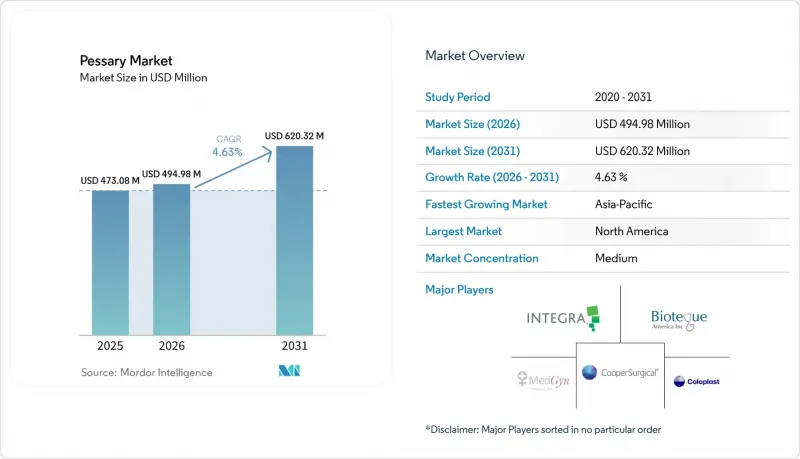
에 따르면 페사리 시장 규모는 2025년 4억 7,308만 달러에서 2026년에는 4억 9,498만 달러로 확대하며, 2026-2031년에 CAGR 4.63%로 추이하며, 2031년에는 6억 2,032만 달러에 달할 것으로 예측됩니다.
전 세계 페사리 시장의 동향 및 인사이트
골반 장기 탈출증(POP) 및 요실금 유병률 증가
골반 장기 탈출증(POP)의 환자 수는 2050년까지 46% 증가할 것으로 예측되며, 특히 70-79세 여성에서 가장 급격한 증가가 예상됩니다. 삶의 질(QOL)에 관한 연구에 따르면 이 질환을 앓고 있는 여성의 56%가 요실금을 경험하고, 52%가 골반 장기 탈출증을 앓고 있으며, 충족되지 않은 수요가 부각되고 있습니다. 미국내 연간 수술 비용은 이미 15억 2,300만 달러를 초과하고 있으며, 보험사들의 비수술적 치료법에 대한 관심이 높아지고 있습니다. 현재 탈출증 수술의 82%는 외래 진료 센터에서 이루어지고 있으며, 이러한 시설에서는 페사리 삽입을 쉽게 병행할 수 있습니다. 이러한 임상적·경제적 사실들이 보존적 치료에 대한 꾸준한 수요를 지원하고 있으며, 페사리 시장의 장기적인 기반을 공고히 하고 있습니다. 출처: Taryn Hall, "골반저 장애 증상 부담에 관한 조사(Pelvic Floor Disorder Symptom Burden Survey)", 'Frontiers in Public Health', frontiersin.org
비수술적·외래 치료로의 전환
전향적 연구에 따르면 페사리 사용자의 경우 배뇨시 증상이 40% 완화되었고, 요절박감이 38% 감소했으며, 절박성 요실금이 29% 감소한 것으로 보고되었습니다. 미국 비뇨부인과학회(American Urogynecologic Society)의 2024년 합의문에서는 기존 지침의 미비점을 해소하고, 치료 경로가 공식적으로 수립되었습니다. 접이식 링 등 인체공학에 기반한 개선을 통해 삽입시 통증이 완화되고, 자가 관리가 촉진되고 있습니다. 원격 비뇨기과·부인과 플랫폼에서는 소프트웨어 워크플로우에 추적 관찰 프로토콜이 통합되어, 원격으로 처방전을 발급할 수 있게 되었습니다. HCPCS 코딩에 따른 보험 급여 승인은 외래에서의 보존적 치료가 임상적 및 경제적으로 실행 가능함을 더욱 지원하고 있습니다.
환자의 불편감, 합병증 및 불안
최근 다기관 공동 연구에 따르면 합병증 발생률은 21%였으며, 그중 40.8%는 치료 중도 탈락, 26.6%는 통증이었습니다. 복잡한 사례의 34.2%에서는 외과적 시술이 필요했으며, 이로 인해 임상의들은 신중한 대응을 하고 있습니다. 적격 여성의 최대 30%가 불편감이나 탈락에 대한 불안을 이유로 시험적 치료를 거부하고 있습니다. 해부학적 제약(질 길이가 7.5cm 미만 등)은 치료 중단을 예측하는 요인이지만, 이를 평가하기 위해서는 일차 진료에서는 널리 보급되지 않은 전문적인 평가 툴이 필요합니다. 또한 특정 지역에서는 문화적 금기가 도입을 더욱 방해하고 있습니다. 접이식이나 맞춤형 기기가 많은 문제를 완화하고 있지만, 가격이나 의료진의 숙련도는 기술적 가능성을 따라가지 못하고 있습니다.
부문 분석
2025년에는 링형 페사리가 페사리 시장 점유율의 45.98%를 차지할 것으로 예상되며, 이는 의료진의 깊은 이해와 폭넓은 적응 범위에 기인합니다. 반면, 큐브형 장치는 진행된 탈출증 사례에서 선호되므로 2031년까지 연평균 성장률(CAGR) 6.12%로 페사리 시장 전체를 상회하는 성장이 예상됩니다. 겔혼형이나 도넛형 페사리는 특정 해부학적 요구를 충족시키는 반면, 새롭게 등장한 접이식이나 3D 프린팅 모델은 최첨단 기술을 선도하고 있습니다.
맞춤형 제조는 임상 프로토콜의 방식을 재정의하고 있습니다. 코스움 메디컬(Cosum Medical)사의 FDA 승인을 받은 ‘Gynethotics’ 플랫폼은 해부학적 영상, AI를 활용한 설계, 그리고 진료소내 3D 프린팅을 실현하고 있으며, 이 과정을 통해 시행착오 기간을 단축하고 착용감을 향상시킵니다. 프린팅 비용의 하락과 임상 데이터의 축적에 따라 링형 페사리의 우위는 약화될 가능성이 있습니다. 그럼에도 불구하고 링형 디자인은 여전히 최저 단가와 확립된 보험 급여 코드의 혜택을 받고 있으며, 페사리 시장 전체에서 개인화가 진행되는 가운데에서도 기본 솔루션으로서의 입지를 확고히 하고 있습니다.
의료용 실리콘은 타의 추종을 불허하는 생체 적합성, 인장 탄성 및 멸균 가능성으로 인해 2025년 페사리 시장 규모의 78.02%를 계속 차지했습니다. 라텍스/고무의 연평균 성장률(CAGR) 6.45%는 의료 시스템의 비용 제약과 신흥 지역의 환자들 사이에서 저렴한 옵션에 대한 수요를 반영합니다. 열가소성 엘라스토머는 재활용 가능하다는 장점이 있지만, 여전히 틈새 시장 수준에 머물러 있습니다. 생체흡수성 폴리머와 복합 3D 프린팅 제품은 연구개발의 최전선에 있으며, 지속가능성과 맞춤형 형상을 결합하고 있습니다.
EU의 환경 평가 기준에 따라 조달 담당자는 임상적 유효성뿐만 아니라 탄소발자국 및 사용 후 폐기 문제도 고려할 수밖에 없게 되었습니다. 수명주기를 고려한 입찰 방식을 채택하는 의료 시스템에서는 보다 친환경적인 소재로의 전환이 점진적으로 진행될 가능성이 있습니다. 그렇긴 하지만, 실리콘은 오랜 기간 쌓아온 실적으로 인해 규제상의 장벽이 낮고 도입시 마찰도 최소화되어 있으므로, 페사리 시장에서 단기적인 우위는 유지될 전망입니다.
지역별 분석
북미는 광범위한 비뇨기과 및 산부인과 네트워크, 여성 건강에 초점을 맞춘 자금 지원, 그리고 명확한 FDA 승인 절차에 힘입어 2025년에는 매출 점유율 38.11%로 페사리 시장을 주도했습니다. 미국 정부의 1억 달러 연구 예산 배정은 수요를 지원하는 임상 시험 및 의료 종사자 교육을 촉진하고 있습니다. 쿠퍼 서지컬(Cooper Surgical)의 2024년 매출은 12억 8,600만 달러에 달했으며, 이는 기존 주요 기업이 임상의와의 관계 및 보험 환급 제도에 대한 전문 지식을 활용함으로써 여전히 10%의 성장이 가능함을 보여줍니다. 보험사의 보상 축소와 보험 적용 범위의 불균형은 여전히 장벽으로 작용하고 있지만, 원격의료에 대한 규제 정상화로 인해 환자에 대한 접근성은 확대되고 있습니다. 캐나다와 멕시코에서는 의료 시스템의 현대화를 통해 추가적인 성장 여지가 생겨나고 있습니다.
아시아태평양은 2031년까지 연평균 성장률(CAGR) 5.18%를 기록하며, 다른 모든 지역을 능가하는 성장이 예상됩니다. 일본과 한국의 고령화는 서구 국가의 동향을 반영하는 반면, 중국에서는 중산층의 확대와 병원 건설 붐이 수요 확대의 가능성을 내포하고 있습니다. 이 지역의 의료 기술(메드테크) 매출은 2030년까지 2,250억 달러에 달할 가능성이 있으며, 페사리 시장에 유리한 환경을 제공하고 있습니다. 규제상의 차이 및 문화적 편견이 보급을 복잡하게 만들고 있지만, 소셜 커머스와의 통합 및 펨테크에 대한 지식 향상으로 인해 도입은 점차 용이해지고 있습니다. 2024년의 사모펀드 투자와 공공 인프라에 대한 자금 투입으로 국내 공급망이 강화되어 지속가능한 성장의 기반이 마련되었습니다.
유럽의 국민건강보험 제도와 근거 기반 의료 관행 문화는 안정적인 한 자릿수 중반대의 성장을 지원하고 있습니다. EU의 MDR(의료기기 규정) 및 IVDR(체외진단용 의료기기 규정)의 품질 기준은 규정 준수 비용을 높이는 한편, 확립된 품질관리 시스템(QMS)을 갖춘 기존 기업을 보호하고 있습니다. 지속가능성에 관한 지침에 따라 제조업체는 생분해성 소재 및 순환 경제에 부합하는 포장으로의 전환을 요구받고 있으며, 이는 소재 혁신으로 이어질 가능성이 있습니다. 중동 및 아프리카 및 남미의 시장 상황은 아직 초기 단계이지만, 성장 잠재력이 높으며, 인프라 구축, 의료 종사자 교육, 그리고 보험 적용 범위 확대에 따라 세계 페사리 시장에서 점유율을 확대해 나갈 것으로 기대됩니다.
기타 혜택:
- 엑셀 형식의 시장 예측(ME) 시트
- 3개월간의 애널리스트 지원
자주 묻는 질문
목차
제1장 서론
- 조사 전제조건과 시장 정의
- 조사 범위
제2장 조사 방법
제3장 개요
제4장 시장 구도
- 시장 개요
- 시장 성장 촉진요인
- 시장 성장 억제요인
- 규제 상황
- Porter's Five Forces 분석
- 합병증 및 리콜 분석
제5장 시장 규모와 성장 예측
- 유형별
- 소재별
- 용도별
- 최종사용자별
- 지역
제6장 경쟁 구도
- 시장 집중도
- 시장 점유율 분석
- 기업 개요
- CooperSurgical Inc.
- Coloplast A/S
- MedGyn Products, Inc.
- Bioteque America, Inc.
- Panpac Medical Corp.
- Dr. Arabin GmbH & Co. KG
- Artisan Medical(Milex)
- Personal Medical Corp.
- Cosm Medical
- Mediplus Ltd.
- Integra LifeSciences
- Bray Group Ltd.
- Thomas Medical
- Bliss GVS Pharma Ltd.
- Shanghai Medical Corp.
- Cook Medical
- FEG Textiltechnik
- Pelican Feminine Healthcare
- Utah Medical Products
- SRS Medical
제7장 시장 기회와 향후 전망
KSA 26.10.23According to Mordor Intelligence, the pessary market size is expected to grow from USD 473.08 million in 2025 to USD 494.98 million in 2026 and is forecast to reach USD 620.32 million by 2031 at 4.63% CAGR over 2026-2031.
Global Pessary Market Trends and Insights
Growing Prevalence of POP & Urinary Incontinence
Pelvic organ prolapse (POP) cases are projected to climb 46% by 2050, with the steepest gains in women aged 70-79. Quality-of-life studies show 56% of affected women experience incontinence and 52% develop prolapse, highlighting unmet need. Annual U.S. surgical costs already top USD 1.523 billion, heightening payer interest in non-surgical alternatives. Eighty-two percent of prolapse surgeries now occur in ambulatory centers, settings that readily integrate pessary fitting. These clinical and economic facts underpin steady demand for conservative therapy, strengthening the long-term foundation of the pessary market. Source: Taryn Hall, "Pelvic Floor Disorder Symptom Burden Survey," Frontiers in Public Health, frontiersin.org
Shift Toward Non-Surgical Outpatient Management
Prospective studies record 40% symptom relief in voiding, 38% drop in urgency, and 29% reduction in urge incontinence among pessary users. The American Urogynecologic Society's 2024 consensus formalized care pathways, addressing earlier guideline gaps. Ergonomic upgrades such as collapsible rings cut insertion pain and support self-care. Tele-urogynecology platforms now permit remote prescribing, with follow-up protocols embedded in software workflows. Reimbursement recognition through HCPCS coding further validates outpatient conservative management as both clinically and economically viable.
Patient Discomfort, Complications & Fear
Recent multicenter work notes a 21% complication incidence; expulsion makes up 40.8%, and pain 26.6% of those events. Surgical resolution becomes necessary in 34.2% of complex cases, shaping clinicians' caution. Up to 30% of eligible women decline a trial due to anxiety over discomfort or dislodgment. Anatomical constraints, vaginal length under 7.5 cm, predict discontinuation yet require specialized assessment tools not ubiquitous in primary care. Cultural taboos further dampen uptake in certain geographies. Although collapsible and customized devices mitigate many issues, price and practitioner familiarization lag behind technical possibilities.
Other drivers and restraints analyzed in the detailed report include:
- Rising Awareness & Women-Health Initiatives
- Advances in Medical-Grade Silicone & Ergonomic Design
- Limited Reimbursement Coverage
For complete list of drivers and restraints, kindly check the Table Of Contents.
Segment Analysis
Ring pessaries generated 45.98% of pessary market share in 2025, underscoring deep provider familiarity and broad indication coverage. Cube devices, however, are projected to outpace the broader pessary market at a 6.12% CAGR to 2031, favored for advanced prolapse scenarios. Gellhorn and donut variants fill specific anatomical niches, whereas emerging collapsible and 3D-printed models inhabit the technological frontier.
Custom manufacturing is redefining clinical protocols. Cosm Medical's FDA-cleared Gynethotics platform delivers anatomical imaging, AI-assisted design and in-clinic 3D printing, a process that trims trial-and-error timelines and improves fit. As printing costs fall and clinical data mount, ring dominance could erode. Yet ring designs still benefit from lowest unit cost and entrenched reimbursement coding, positioning them as baseline solutions even as personalization gains ground across the pessary market.
Medical-grade silicone retained 78.02% of the pessary market size in 2025 owing to unrivaled biocompatibility, tensile resilience, and sterilizability. Latex/rubber's 6.45% CAGR reflects health-system cost constraints and patient demand for lower-priced options in emerging regions. Thermoplastic elastomers offer recyclability advantages but remain niche. Bio-resorbable polymers and composite 3D-prints lie at the R&D horizon, melding sustainability with individualized geometry.
EU environmental scoring is compelling procurement teams to weigh carbon footprint and end-of-life disposal alongside clinical efficacy. Health systems that adopt lifecycle tenders could gradually divert volume toward greener materials. Nevertheless, silicone's legacy validation keeps regulatory hurdles low and adoption friction minimal, sustaining its near-term primacy within the pessary market.
Complete Report Scope:
- By Type
- Ring
- Gellhorn
- Donut
- Cube
- Other Types
- By Material
- Medical-grade Silicone
- Thermoplastic Elastomer
- Latex / Rubber
- Bio-resorbable & 3-D printed Composites
- By Application
- POP - Stage I-II
- POP - Stage III-IV
- Stress Urinary Incontinence
- Other Applications
- By End User
- Hospitals
- Ambulatory Surgical Centers & Uro-gyn Clinics
- Other End Users
- Geography
- North America
- United States
- Canada
- Mexico
- Europe
- Germany
- United Kingdom
- France
- Italy
- Spain
- Rest of Europe
- Asia-Pacific
- China
- Japan
- India
- Australia
- South Korea
- Rest of Asia-Pacific
- Middle East & Africa
- GCC
- South Africa
- Rest of Middle East & Africa
- South America
- Brazil
- Argentina
- Rest of South America
- North America
Geography Analysis
North America led the pessary market with a 38.11% revenue share in 2025, buoyed by widespread urogynecology networks, targeted women-health funding and clear FDA pathways. The U.S. government's USD 100 million research allocation is fostering clinical trials and provider training that feed demand. CooperSurgical's 2024 revenue reached USD 1.286 billion, proof that established players can still grow 10% by harnessing clinician relationships and reimbursement savvy. Insurer fee compression and coverage disparities pose lingering obstacles, yet telehealth's regulatory normalization broadens patient reach. Canada and Mexico add incremental upside through healthcare system modernization.
Asia-Pacific is forecast to outpace all regions at a 5.18% CAGR to 2031. Aging demographics in Japan and South Korea mirror Western trends, while China's middle-class expansion and hospital build-outs unlock volume potential. The region's medtech revenues could touch USD 225 billion by 2030, supplying favorable context for the pessary market. Regulatory heterogeneity and cultural stigma complicate rollout, but social-commerce integration and rising FemTech literacy are easing adoption. Private-equity investment and public infrastructure funding in 2024 fortified domestic supply chains, setting a foundation for sustained gains.
Europe's universal healthcare coverage and evidence-based practice culture support stable, mid-single-digit growth. EU MDR and IVDR quality thresholds elevate compliance costs yet protect incumbents with established QMS footprints. Sustainability directives press manufacturers toward biodegradable inputs and circular-economy packaging, potentially sparking material innovation. Market conditions in the Middle East & Africa and South America remain nascent but promising, dependent on infrastructure upgrades, clinician education and broadened payer coverage to unlock their share of the global pessary market.
- The Cooper Companies
- Coloplast
- MedGyn Products
- Bioteque America, Inc.
- Panpac Medical Corp.
- Dr. Arabin
- Artisan Medical (Milex)
- Personal Medical Corp.
- Cosm Medical
- Mediplus Ltd.
- Integra LifeSciences
- Bray Group Ltd.
- Thomas Medical
- Bliss GVS Pharma Ltd.
- Shanghai Medical Corp.
- Cook Group
- FEG Textiltechnik
- Pelican Feminine Healthcare
- Utah Medical Products
- SRS Medical
Additional Benefits:
- The market estimate (ME) sheet in Excel format
- 3 months of analyst support
TABLE OF CONTENTS
1 Introduction
- 1.1 Study Assumptions & Market Definition
- 1.2 Scope of the Study
2 Research Methodology
3 Executive Summary
4 Market Landscape
- 4.1 Market Overview
- 4.2 Market Drivers
- 4.2.1 Growing Prevalence of POP & Urinary Incontinence
- 4.2.2 Shift Toward Non-Surgical Outpatient Management
- 4.2.3 Rising Awareness & Women-Health Initiatives
- 4.2.4 Advances In Medical-Grade Silicone & Ergonomic Design
- 4.2.5 AI-Driven 3D-Printed Custom Pessaries
- 4.2.6 Tele-Urogynecology Enabling Remote Self-Management
- 4.3 Market Restraints
- 4.3.1 Patient Discomfort, Complications & Fear
- 4.3.2 Limited Reimbursement Coverage
- 4.3.3 Medical-Grade Silicone Supply Fragility
- 4.3.4 Sustainability Pressure on Single-Use Plastics
- 4.4 Regulatory Landscape
- 4.5 Porter's Five Forces Analysis
- 4.5.1 Threat of New Entrants
- 4.5.2 Bargaining Power of Buyers
- 4.5.3 Bargaining Power of Suppliers
- 4.5.4 Threat of Substitute Products
- 4.5.5 Intensity of Competitive Rivalry
- 4.6 Complication & Recall Analysis
5 Market Size & Growth Forecasts (Value, USD)
- 5.1 By Type
- 5.1.1 Ring
- 5.1.2 Gellhorn
- 5.1.3 Donut
- 5.1.4 Cube
- 5.1.5 Other Types
- 5.2 By Material
- 5.2.1 Medical-grade Silicone
- 5.2.2 Thermoplastic Elastomer
- 5.2.3 Latex / Rubber
- 5.2.4 Bio-resorbable & 3-D printed Composites
- 5.3 By Application
- 5.3.1 POP - Stage I-II
- 5.3.2 POP - Stage III-IV
- 5.3.3 Stress Urinary Incontinence
- 5.3.4 Other Applications
- 5.4 By End User
- 5.4.1 Hospitals
- 5.4.2 Ambulatory Surgical Centers & Uro-gyn Clinics
- 5.4.3 Other End Users
- 5.5 Geography
- 5.5.1 North America
- 5.5.1.1 United States
- 5.5.1.2 Canada
- 5.5.1.3 Mexico
- 5.5.2 Europe
- 5.5.2.1 Germany
- 5.5.2.2 United Kingdom
- 5.5.2.3 France
- 5.5.2.4 Italy
- 5.5.2.5 Spain
- 5.5.2.6 Rest of Europe
- 5.5.3 Asia-Pacific
- 5.5.3.1 China
- 5.5.3.2 Japan
- 5.5.3.3 India
- 5.5.3.4 Australia
- 5.5.3.5 South Korea
- 5.5.3.6 Rest of Asia-Pacific
- 5.5.4 Middle East & Africa
- 5.5.4.1 GCC
- 5.5.4.2 South Africa
- 5.5.4.3 Rest of Middle East & Africa
- 5.5.5 South America
- 5.5.5.1 Brazil
- 5.5.5.2 Argentina
- 5.5.5.3 Rest of South America
- 5.5.1 North America
6 Competitive Landscape
- 6.1 Market Concentration
- 6.2 Market Share Analysis
- 6.3 Company Profiles (includes Global level Overview, Market level overview, Core Business Segments, Financials, Headcount, Key Information, Market Rank, Market Share, Products and Services, and analysis of Recent Developments)
- 6.3.1 CooperSurgical Inc.
- 6.3.2 Coloplast A/S
- 6.3.3 MedGyn Products, Inc.
- 6.3.4 Bioteque America, Inc.
- 6.3.5 Panpac Medical Corp.
- 6.3.6 Dr. Arabin GmbH & Co. KG
- 6.3.7 Artisan Medical (Milex)
- 6.3.8 Personal Medical Corp.
- 6.3.9 Cosm Medical
- 6.3.10 Mediplus Ltd.
- 6.3.11 Integra LifeSciences
- 6.3.12 Bray Group Ltd.
- 6.3.13 Thomas Medical
- 6.3.14 Bliss GVS Pharma Ltd.
- 6.3.15 Shanghai Medical Corp.
- 6.3.16 Cook Medical
- 6.3.17 FEG Textiltechnik
- 6.3.18 Pelican Feminine Healthcare
- 6.3.19 Utah Medical Products
- 6.3.20 SRS Medical
7 Market Opportunities & Future Outlook
- 7.1 White-space & Unmet-need Assessment


