

|
시장보고서
상품코드
2154243
유럽, 중동 및 아프리카(EMEA)의 엘라스토머 : 시장 점유율 분석, 업계 동향과 통계, 성장 예측(2026-2031년)Europe, Middle East and Africa (EMEA) Elastomers - Market Share Analysis, Industry Trends & Statistics, Growth Forecasts (2026 - 2031) |
||||||
 Mordor Intelligence
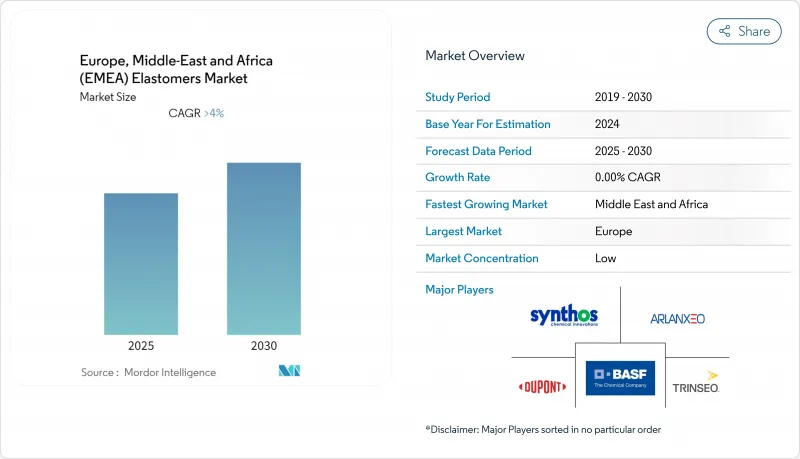
에 따르면 유럽, 중동 및 아프리카(EMEA) 지역의 엘라스토머 시장 규모는 2025년에 386억 6,000만 달러로 평가되며, 2026년 406억 4,000만 달러에서 2031년까지 521억 6,000만 달러에 달할 것으로 추정되고 있으며, 예측 기간(2026-2031년)에 CAGR은 5.12%에 달할 전망입니다.
유럽·중동 및 아프리카(EMEA)의 엘라스토머 시장의 동향 및 인사이트
전기자동차(EV)의 경량화 및 고전압 부품 채택
차량의 전동화로 인해 유럽·중동 및 아프리카(EMEA)의 엘라스토머 시장 전반에 걸쳐 소재 업그레이드 사이클이 형성되고 있습니다. 이는 새로운 파워트레인 시스템이 기존 차량 시스템과는 다른 요구 사항, 즉 밀봉성, 절연성, 열 제어 및 난연성을 요구하기 때문입니다. 800볼트 배터리 팩에는 기존의 웨더 스트립 용도보다 더 높은 절연 내력과 난연성이 요구되므로, 소재 선정은 주로 외장용 실을 위해 설계된 등급의 범위를 넘어 진행되고 있습니다. 그 결과, 실리콘, 플루오로엘라스토머, 열가소성 폴리우레탄은 커넥터 실, 배터리용 열 인터페이스 개스킷, 그리고 전기적·열 관리 요구 사항을 충족해야 하는 기타 부품에서 그 중요성이 커지고 있습니다. 독일에서는 2025년에 54만 5,000대의 배터리식 전기자동차가 등록되어 시장 점유율이 19.1%에 달했습니다. 2026년에는 등록 대수가 74만 대, 시장 점유율은 25%에 달할 것으로 예측됩니다. 이러한 변화로 인해 기존 엔진 마운트용 수요가 감소하는 분야에서도 특정 엘라스토머의 가치가 높아지고 있으며, 엄격한 요구 사항을 부과하는 자동차 프로그램을 위한 소재 인증을 획득하고, 부품 설계자를 지원하며, 자동차 생산과 관련된 문서 요건을 충족할 수 있는 공급업체의 중요성이 커지고 있습니다.
의료용 등급의 PVC 프리 튜브 및 의료기기 수요
의료 분야의 조달 수요는 유럽·중동 및 아프리카(EMEA)의 엘라스토머 시장에서 특수 용도 수요를 지원하고 있습니다. 특히 유체 처리 시스템에서는 일관된 성능, 환자 안전을 보장하는 인증, 그리고 추적 가능한 생산 관리가 요구되는 소재가 필요합니다. 병원과 의료기기 제조업체들은 유체 처리 어셈블리에 사용되는 가소화 폴리염화비닐(PVC)을 특정 가공 및 용도 요건에 맞춰 선정할 수 있는 열가소성 엘라스토머나 실리콘으로 대체하고 있습니다. 이러한 전환은 단일 제품 카테고라기보다는 수액 튜브, 카테터 시스템 및 진단 기기의 구성 부품에 적용됩니다. 소재 선정 과정은 화학적 안전성에 대한 기대, 신뢰할 수 있는 가공의 필요성, 그리고 규제 환경에서 요구되는 엄격한 문서화에 의해 형성됩니다. 즉, 공급업체는 가격뿐만 아니라 적합성 평가를 통해 성능을 입증해야 합니다. 프탈레이트가 포함되지 않은 튜브에 대한 영국 국민보건서비스(NHS)의 조달 기준은 유럽의 입찰에서 유사한 요건이 더 광범위하게 고려되도록 촉진하고 있으며, 인증 획득 능력의 상업적 중요성을 높이고 있습니다. 국제표준화기구(ISO) 10993 및 ISO 13485의 요건은 의료 공급업체에 계속해서 높은 적격성 기준을 부과하고 있으며, 확립된 검증 및 품질관리 시스템을 갖춘 기업에 유리하게 작용하고 있습니다.
원유, 단량체, 석유화학 원료의 가격 변동
합성 소재는 석유화학 원료에 의존하고 있으며, 판매 계약이 조정되기 전에 가격이 변동할 가능성이 있으므로 원료 가격 변동 위험은 유럽·중동 및 아프리카(EMEA) 지역의 엘라스토머 시장에 여전히 중대한 제약 요인으로 작용하고 있습니다. 합성 엘라스토머 제조업체는 부타디엔, 스티렌, 에틸렌·프로필렌계 모노머에 의존하고 있으며, 이러한 원자재 비용은 더 광범위한 화학 밸류체인 내의 원유 및 나프타 가격 변동을 반영합니다. 이 문제는 통합된 원자재 조달 체계를 갖추지 못한 기업에게 가장 심각합니다. 왜냐하면 이러한 기업은 상황이 급변할 때 사내에서 원가 리스크를 관리하거나 공급을 확보할 능력이 부족하기 때문입니다. 주요 중간체를 자체적으로 확보할 수 있는 제조사는 투입 원가가 급변하더라도 더 견고한 보호를 받을 수 있으며, 전략적으로 중요한 고객에 대한 공급 연속성을 보다 적절하게 관리할 수 있습니다. 특수 모노머나 고순도 등급의 공급이 집중되어 있다는 점은, 아시아에서 조달을 진행하는 EMEA 지역의 컴파운더에게 더 장기적인 조달 리스크를 초래합니다. 특히 유럽·중동 및 아프리카(EMEA)의 엘라스토머 시장에서 소재 인증 요건으로 인해 공급업체를 신속하게 변경하는 데 제약이 있는 경우, 그 위험은 더욱 커집니다.
부문 분석
2025년, 열가소성 엘라스토머는 유럽·중동 및 아프리카(EMEA)의 엘라스토머 시장 점유율의 81.12%를 차지할 것으로 예상되며, 2031년까지 연평균 성장률(CAGR) 5.67%로 확대될 것으로 전망됩니다. 이러한 위상은 가공상 이점, 폭넓은 용도 기반, 그리고 사용 후 회수 가능한 소재에 대한 관심 증가를 반영합니다. 열가소성 엘라스토머의 각 등급은 단주기 사출성형, 인라인 디버링, 소재 회수, 그리고 탄성 성능과 효율적인 생산을 모두 필요로 하는 용도에 대응할 수 있습니다. 이러한 특성 덕분에 자동차 웨더 실, 보닛 내부의 호스 어셈블리, 인테리어의 소프트 터치 표면 등 제조업체가 기능적 성능과 효율적인 생산을 모두 요구하는 분야에서 채택이 확대되고 있습니다. 이 범주를 대표하는 유럽·중동 및 아프리카(EMEA)의 엘라스토머 시장 규모는 순환형 소재 요건을 충족한다는 점과, 확립된 대량 생산 라인에서 가공 가능한 소재에 대한 수요 덕분에 성장하고 있습니다.
열경화성 엘라스토머는 타이어, 중하중용 컨베이어 벨트 및 산업용 실 시스템에서 계속해서 활용되고 있습니다. 이러한 용도에서는 제품 요구 사항을 충족하는 직접적인 대체재를 찾는 것이 여전히 어려운 경우가 많습니다. 이러한 용도에서는 가교를 통해 얻어지는 동적 기계적 특성이 요구되는 경우가 많으며, 사용 조건에서 장기적인 탄력성이 중시되는 용도에서 그 역할은 여전히 중요합니다. 그러나 가교 EPDM은 많은 열가소성 소재와 같은 재활용 옵션을 제공하지 않으며, 이는 고객이 제품 수명 종료 후의 소재 처리 경로를 검토할 때 중요한 요소가 됩니다. 이러한 격차로 인해 가혹한 사용 사례에서 열경화성 수지의 역할을 배제하지 않으면서도, 인접한 용도에서 열가소성 수지의 대체재에 대한 관심이 계속해서 높아지고 있습니다. 쿠라레의 ‘셉톤 바이오’ 시리즈는 사탕수수 유래 β-파르네센을 사용하여, 석유 유래 수소화 스티렌 블록 공중합체에 특유한 특성을 유지하면서 최대 80%의 바이오 기반 함량을 실현하고 있습니다.
기타 혜택:
- 엑셀 형식의 시장 예측(ME) 시트
- 3개월간의 애널리스트 지원
자주 묻는 질문
목차
제1장 서론
- 조사 전제조건과 시장 정의
- 조사 범위
제2장 조사 방법
제3장 개요
제4장 시장 구도
- 시장 개요
- 시장 성장 촉진요인
- 시장 성장 억제요인
- 밸류체인 분석
- Porter's Five Forces 분석
제5장 시장 규모와 성장 예측
- 제품 유형별
- 최종사용자 산업별
- 지역별
- 유럽
- 독일
- 영국
- 프랑스
- 이탈리아
- 스페인
- 북유럽 국가
- 러시아
- 기타 유럽 국가
- 중동 및 아프리카
- 사우디아라비아
- 아랍에미리트
- 남아프리카공화국
- 이집트
- 나이지리아
- 기타 중동 및 아프리카 국가
- 유럽
제6장 경쟁 구도
- 시장 집중도
- 전략적 동향
- 시장 점유율·순위 분석
- 기업 개요
- Arkema
- ARLANXEO
- BASF
- Covestro AG
- Dow
- Exxon Mobil Corporation
- Huntsman International LLC
- KCC Corporation
- KURARAY CO., LTD.
- LANXESS
- LG Chem
- Mitsui Chemicals, Inc.
- Momentive
- Shin-Etsu Chemical Co., Ltd.
- Wacker Chemie AG
제7장 시장 기회와 향후 전망
KSA 26.10.23According to Mordor Intelligence, the Europe, Middle East and Africa (EMEA) elastomers market size was valued at USD 38.66 billion in 2025 and is estimated to grow from USD 40.64 billion in 2026 to reach USD 52.16 billion by 2031, at a CAGR of 5.12% during the forecast period (2026-2031).
Europe, Middle East and Africa (EMEA) Elastomers Market Trends and Insights
EV Lightweighting and High-Voltage Component Adoption
Vehicle electrification is creating a material upgrade cycle across the Europe, Middle East and Africa (EMEA) elastomers market, because new powertrain systems place different demands on sealing, insulation, thermal control, and flame resistance than conventional vehicle systems. An 800-volt battery pack requires higher dielectric strength and flame resistance than conventional weatherstrip applications, so material selection is moving beyond grades designed mainly for exterior sealing. Silicone, fluoroelastomer, and thermoplastic polyurethane are therefore gaining relevance in connector seals, battery thermal-interface gaskets, and other components exposed to electrical and heat-management demands. Germany recorded 545,000 battery electric vehicle registrations in 2025, equal to a 19.1% share, and registrations are projected to reach 740,000 units in 2026, or 25% of the total. The change raises the value of specified elastomers even where conventional engine-mount demand declines, and it increases the importance of suppliers that can qualify materials for demanding vehicle programs, support component designers, and meet the documentation requirements associated with automotive production.
Medical-Grade PVC-Free Tubing and Device Demand
Medical procurement is supporting specialty demand in the Europe, Middle East and Africa (EMEA) elastomers market, particularly where fluid-handling systems need materials with consistent performance, patient-safety credentials, and traceable production controls. Hospitals and device manufacturers are replacing plasticized polyvinyl chloride (PVC) in fluid-handling assemblies with thermoplastic elastomers and silicone, which can be selected for specific processing and application requirements. This transition applies to infusion tubing, catheterization systems, and diagnostic-device components, rather than to a single product category. The material selection process is shaped by chemical safety expectations, the need for reliable processing, and the strict documentation expected in regulated settings, which means that suppliers must demonstrate performance through qualification rather than through price alone. British National Health Service procurement benchmarks for phthalate-free tubing support wider consideration of similar requirements in European tenders and make certification capability more commercially relevant. International Organization for Standardization (ISO) 10993 and International Organization for Standardization 13485 requirements continue to create a high qualification threshold for healthcare suppliers, which favors companies with established validation and quality systems.
Crude Oil, Monomer and Petrochemical Feedstock Volatility
Feedstock exposure remains a material constraint for the Europe, Middle East and Africa (EMEA) elastomers market, because synthetic materials depend on petrochemical inputs that can change in price before selling contracts are adjusted. Synthetic elastomer producers depend on butadiene, styrene, and ethylene-propylene monomers whose costs reflect crude oil and naphtha movements across the wider chemical value chain. This issue is most acute for companies without integrated feedstock positions, since they have less ability to manage cost exposure internally or secure supply when conditions change quickly. Producers with captive access to key intermediates have more protection during abrupt changes in input costs and can better manage continuity of supply for strategically important customers. The supply concentration for specialty monomers and high-purity grades adds a longer-term procurement risk for EMEA compounders that source from Asia, especially where material qualifications limit the ability to switch suppliers quickly in the Europe, Middle East and Africa (EMEA) elastomers market.
Other drivers and restraints analyzed in the detailed report include:
- Asia-Pacific Construction and Infrastructure Expansion
- Demand for Recyclable and Circular-Ready Elastomer Grades
- Microplastic, Tire-Wear and Synthetic-Rubber Regulations
For complete list of drivers and restraints, kindly check the Table Of Contents.
Segment Analysis
Thermoplastic elastomers held 81.12% of the Europe, Middle East and Africa (EMEA) elastomers market share in 2025 and are projected to advance at a 5.67% CAGR through 2031. The position reflects processing advantages, a broad application base, and growing interest in materials that can be recovered after use. Thermoplastic elastomer grades can support short-cycle injection molding, in-line deburring, material recovery, and applications requiring both elastic performance and efficient production. These characteristics have helped them gain use in automotive weather seals, under-hood hose assemblies, and interior soft-touch surfaces, where manufacturers seek both functional performance and efficient fabrication. The Europe, Middle East and Africa (EMEA) elastomers market size represented by this category benefits from its fit with circular-material requirements and from demand for materials that can be processed in established high-volume manufacturing operations.
Thermoset elastomers continue to serve tires, heavy-duty conveyor belts, and industrial sealing systems, where product requirements often remain difficult to meet through direct substitution. These uses often require the dynamic mechanical properties provided through crosslinking, and their role remains relevant in applications where operating conditions place a premium on long-term resilience. However, crosslinked EPDM does not offer the same recovery options as many thermoplastic materials, which is relevant where customers are considering end-of-life material pathways. The gap supports continuing interest in thermoplastic alternatives in adjacent applications without eliminating the role of thermosets in demanding use cases. KURARAY CO., LTD.'s SEPTON BIO series uses sugarcane-sourced beta-farnesene and can contain up to 80% bio-based content while retaining properties associated with petroleum-derived hydrogenated styrene block copolymers.
Complete Report Scope:
- By Product Type
- Thermoplastic Elastomers
- Thermoset Elastomers
- By End-User Industry
- Automotive and Transportation
- Electrical and Electronics
- Medical and Healthcare
- Industrial Machinery and Equipment
- Consumer Goods and Footwear
- Adhesives, Sealants and Coatings
- Other End-User Industries
- By Geography
- Europe
- Germany
- United Kingdom
- France
- Italy
- Spain
- NORDIC Countries
- Russia
- Rest of Europe
- Middle East and Africa
- Saudi Arabia
- United Arab Emirates
- South Africa
- Egypt
- Nigeria
- Rest of Middle East and Africa
- Europe
List of Companies Covered in this Report:
- Arkema
- ARLANXEO
- BASF
- Covestro AG
- Dow
- Exxon Mobil Corporation
- Huntsman International LLC
- KCC Corporation
- KURARAY CO., LTD.
- LANXESS
- LG Chem
- Mitsui Chemicals, Inc.
- Momentive
- Shin-Etsu Chemical Co., Ltd.
- Wacker Chemie AG
Additional Benefits:
- The market estimate (ME) sheet in Excel format
- 3 months of analyst support
TABLE OF CONTENTS
1 Introduction
- 1.1 Study Assumptions and Market Definition
- 1.2 Scope of the Study
2 Research Methodology
3 Executive Summary
4 Market Landscape
- 4.1 Market Overview
- 4.2 Market Drivers
- 4.2.1 EV Lightweighting and High-Voltage Component Adoption
- 4.2.2 Medical-Grade PVC-Free Tubing and Device Demand
- 4.2.3 Asia-Pacific Construction and Infrastructure Expansion
- 4.2.4 Demand for Recyclable and Circular-Ready Elastomer Grades
- 4.2.5 Hydrogen Electrolyzer and Fuel-Cell Sealing Requirements
- 4.3 Market Restraints
- 4.3.1 Crude Oil, Monomer and Petrochemical Feedstock Volatility
- 4.3.2 Microplastic, Tire-Wear and Synthetic-Rubber Regulations
- 4.3.3 Concentrated Supply of Specialty Monomers and High-Purity Grades
- 4.4 Value Chain Analysis
- 4.5 Porter's Five Forces Analysis
- 4.5.1 Bargaining Power of Suppliers
- 4.5.2 Bargaining Power of Buyers
- 4.5.3 Threat of New Entrants
- 4.5.4 Threat of Substitutes
- 4.5.5 Degree of Competition
5 Market Size and Growth Forecasts (Value)
- 5.1 By Product Type
- 5.1.1 Thermoplastic Elastomers
- 5.1.2 Thermoset Elastomers
- 5.2 By End-User Industry
- 5.2.1 Automotive and Transportation
- 5.2.2 Electrical and Electronics
- 5.2.3 Medical and Healthcare
- 5.2.4 Industrial Machinery and Equipment
- 5.2.5 Consumer Goods and Footwear
- 5.2.6 Adhesives, Sealants and Coatings
- 5.2.7 Other End-User Industries
- 5.3 By Geography
- 5.3.1 Europe
- 5.3.1.1 Germany
- 5.3.1.2 United Kingdom
- 5.3.1.3 France
- 5.3.1.4 Italy
- 5.3.1.5 Spain
- 5.3.1.6 NORDIC Countries
- 5.3.1.7 Russia
- 5.3.1.8 Rest of Europe
- 5.3.2 Middle East and Africa
- 5.3.2.1 Saudi Arabia
- 5.3.2.2 United Arab Emirates
- 5.3.2.3 South Africa
- 5.3.2.4 Egypt
- 5.3.2.5 Nigeria
- 5.3.2.6 Rest of Middle East and Africa
- 5.3.1 Europe
6 Competitive Landscape
- 6.1 Market Concentration
- 6.2 Strategic Moves
- 6.3 Market Share (%)/Ranking Analysis
- 6.4 Company Profiles (includes Global Overview, Market Overview, Core Segments, Financials as available, Strategic Information, Products and Services, and Recent Developments)
- 6.4.1 Arkema
- 6.4.2 ARLANXEO
- 6.4.3 BASF
- 6.4.4 Covestro AG
- 6.4.5 Dow
- 6.4.6 Exxon Mobil Corporation
- 6.4.7 Huntsman International LLC
- 6.4.8 KCC Corporation
- 6.4.9 KURARAY CO., LTD.
- 6.4.10 LANXESS
- 6.4.11 LG Chem
- 6.4.12 Mitsui Chemicals, Inc.
- 6.4.13 Momentive
- 6.4.14 Shin-Etsu Chemical Co., Ltd.
- 6.4.15 Wacker Chemie AG
7 Market Opportunities and Future Outlook
- 7.1 White-Space and Unmet-Need Assessment


