

|
시장보고서
상품코드
2154293
승용차용 시트 : 시장 점유율 분석, 업계 동향과 통계, 성장 예측(2026-2031년)Passenger Car Seat - Market Share Analysis, Industry Trends & Statistics, Growth Forecasts (2026 - 2031) |
||||||
 Mordor Intelligence
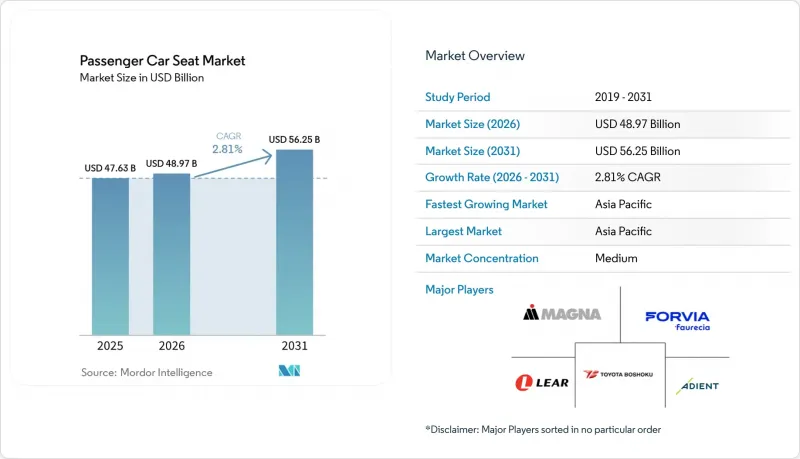
에 따르면 승용차용 시트 시장 규모는 2025년에 476억 3,000만 달러로 평가되며, 2026년 489억 7,000만 달러에서 2031년까지 562억 5,000만 달러에 달할 것으로 추정되고 있으며, 예측 기간(2026-2031년)에 CAGR은 2.81%에 달할 전망입니다.
전 세계 승용차용 시트 시장의 동향 및 인사이트
프리미엄급 편안함과 전동 시트의 보급
각 자동차 제조사들은 인테리어 차별화를 꾀하고 소프트웨어를 통한 지속적인 수입원을 개발하기 위해 중급 모델에 마사지 기능, 히터, 환기 기능, 제로 그래비티 리클라이닝 기능을 탑재하고 있습니다. 아디엔트(Adient)는 2025년 7월, GAC-Trumpchi의 PHEV M8을 위해 3D 주무르기 기능 모듈과 유연한 안전 구조, OTA 업데이트 기능을 결합한 기계식 마사지 솔루션을 출시했습니다. 이는 3열 시트 구성에서 피로 감소를 목적으로 합니다. 현대 트랜시스는 2026년 1월, ‘서큘러 모빌리티 시스템’을 발표했습니다. 이 시스템은 BASF사의 ‘엘라스토란(Elastollan)’ TPU를 채택한 모듈식 시트를 특징으로 하며, 재활용 가능성과 경량화를 실현하는 초임계 유체 발포 기술을 적용하고 있습니다. 2025년 상하이 모터쇼에서 공개된 폴비아의 ‘트랜스포머 시트’는 알고리즘을 통한 조절 기능을 활용하여 무중력 자세를 구현하며, 쾌적성을 고정된 하드웨어 사양이 아닌 소프트웨어로 정의되는 기능으로 자리매김하고 있습니다. 이러한 추세에 따라 각 OEM 업체들의 ‘시트-어즈-어-서비스(Seat-as-a-Service)’ 모델 도입이 가속화되고 있습니다. 이 모델에서는 구매자가 월정액을 지불함으로써 앱을 통해 마사지 모드 해제나 경도 조절이 가능해지며, 이는 공급업체와 자동차 제조사에게 연금과 같은 수입원을 창출하고 있습니다.
EV가 주도하는 시트 아키텍처의 재설계
배터리식 전기자동차(BEV) 플랫폼에서는 트랜스미션 터널이 불필요해져 평평한 바닥이 실현되는 한편, 경량화 요건이 더욱 중요시되고 있습니다. 바닥 아래에 배터리를 배치함에 따라 시트 설계자들은 프레임의 형상, 무게 배분 및 열 관리의 통합에 대해 재고해야 하는 상황에 직면해 있습니다. 마그나(Magna)의 ‘Cell-to-Seat’ 컨셉은 배터리 셀을 시트 구조에 직접 통합하는 것으로, 이를 통해 실내 용적을 최대 20% 확대하고 충돌시 에너지 흡수 성능을 향상시키고 있습니다. 포르비아(Volvia)가 태국에 신설한 제조 시설은 해당 지역에서 수출될 전기자동차를 위해 경량 프레임 및 통합형 전자 장치를 생산하도록 특별히 설계되었습니다. 이러한 동향은 각 공급업체들이 OEM이 수립한 전동화 전략에 맞춰 생산 능력을 전략적으로 재편하고 있음을 여실히 보여줍니다. 이 시설이 첨단 경량 소재와 내장형 전자 시스템에 중점을 두고 있다는 점은, 전기자동차 시장의 진화하는 수요에 부응하는 데 있으며, 혁신과 효율성이 점점 더 중요해지고 있음을 보여줍니다.
첨단 시스템의 높은 비용과 무게
마사지 기능, 탑승자 모니터링, 적응형 안전 기능을 시트 구조에 통합하면 차량당 200-500달러의 비용이 추가되어, 부품 명세서(BOM) 목표가 엄격하게 관리되는 양산 부문에서는 이러한 첨단 기능의 도입이 어려워지고 있습니다. 아디엔트(Adient)사의 ‘ModuGo’ 플랫폼은 조립 효율을 36.3% 향상시키고 생산 라인 길이를 72% 단축한다고 홍보하고 있지만, 초기 금형 투자와 설계의 복잡성으로 인해 그 도입은 상각 기간이 수년에 달하는 대량 생산 프로그램으로 제한되고 있습니다. 뮌헨에서 개최된 ‘Automotive Seating Innovation 2025’ 컨퍼런스에서는 바이오 유래 폼, 비건 소재 트림, 재활용 프레임을 채택한 완전한 지속가능한 시트는 현재 기존 설계에 비해 4-5배의 비용이 든다는 점이 지적되어, 3만 달러 미만의 가격대를 목표로 하는 OEM 업체들에게는 장벽이 되고 있습니다. 전동 시트 메커니즘은 차량 1대당 8-12킬로그램의 중량 증가를 초래하여, 전기자동차(EV)의 주행 거리를 추정치로 0.5%-1.0% 단축시키게 됩니다. 이러한 영향을 상쇄하기 위해 공급업체들은 경량 액추에이터와 탄소 복합재 프레임에 투자할 수밖에 없는 상황입니다.
부문 분석
2025년, 합리적인 가격과 수리 용이성을 바탕으로 표준 시트는 승용차용 시트 시장의 65.18%를 차지했습니다. 비용에 민감한 지역, 공공기관의 차량 조달, 그리고 기본적인 조절 기능으로 기능적 요건을 충족하는 엔트리 레벨 등급에서는 여전히 표준 시트가 주류를 이루고 있습니다. 대규모 생산을 통해 단가는 최소화되었으며, 프레임 경량화 및 폼 패드 얇아짐과 같은 지속적인 개선을 통해 원자재 가격 변동에도 불구하고 이익률은 유지되고 있습니다. 또한 표준 설계는 모듈식 업그레이드도 지원하므로, 각 OEM 업체는 완전한 재설계를 거치지 않고도 히터, 쿠션, 센서 등의 기능을 통합할 수 있습니다.
2026-2031년까지 연평균 성장률(CAGR) 4.54%가 예상되는 전동 시트는 메모리 프로필, 허리 마사지, 급속 가열 기능을 통해 차량내 기능성을 향상시킵니다. 합리화된 모터 어셈블리와 통합형 전자제어 장치로 인해 비용이 절감되어, 고급차 부문 이외의 분야로의 채택도 촉진되고 있습니다. 소프트웨어 주도 아키텍처가 진화함에 따라 전동 모듈은 펌웨어 지원 상태로 출하되게 되어, 향후 업그레이드를 통해 수명 주기 가치를 높일 수 있게 됩니다. 이로 인해 전동 시트는 2030년 이후, 특히 그 가치가 고가 대와 부합하는 SUV 부문에서 판매량 격차를 좁힐 수 있는 위치에 있습니다.
2025년에는 인체공학에 기반한 형태, 횡방향 지지력, 일체형 에어백과의 호환성 덕분에 버킷 시트 구성이 승용차 시트 시장 점유율의 60.21%를 차지했습니다. 이러한 설계에는 통기성 쿠션, 액티브 볼스터, 그리고 플랫폼과의 간섭을 최소화한 생체인식 센서가 통합되어 있습니다. 이러한 기능은 주로 스포츠카나 고성능 차량에 채택되고 있지만, 승차감과 브랜드 이미지 향상을 위해 주류 크로스오버 차량에서도 채택이 확대되고 있습니다. 일체형 통풍구는 쿠션 내부의 습기를 줄여주어 쾌적성과 위생 요건을 충족시킵니다.
버킷 시트 시장은 출퇴근시 피로를 줄여주는 웰니스 기능에 주력하는 각 OEM 업체들의 움직임에 힘입어, 예측 기간(2026-2031년) 동안 연평균 성장률(CAGR) 4.79%로 성장할 것으로 전망됩니다. 신흥 시장에서는 승차 정원과 비용 효율성을 우선시하므로 상용 밴과 소형차에서 벤치 시트가 여전히 주류를 이루고 있습니다. 벤치 시트의 3분의 2에 조각 같은 윤곽을 더한 하이브리드 디자인은 다용도성과 인체공학을 겸비하여, 합리적인 가격을 유지하면서도 가족용 차량의 요구를 충족시키고 있습니다.
지역별 분석
2025년, 아시아태평양은 승용차용 시트 시장 점유율의 48.42%를 차지하고 있으며, 2026-2031년에 연평균 성장률(CAGR) 3.37%로 성장할 것으로 예측됩니다. 중국의 전기자동차에 대한 집중 투자가 경량화되고 소프트웨어 연동이 가능한 시트에 대한 수요를 견인하고 있습니다. 동남아시아 각국 정부는 세제 혜택 및 관세 면제 수출 경로를 통해 해외 투자를 유치하고 있습니다. 포르비아(FORVIA)의 태국 공장은 이 지역이 생산 및 혁신의 중심지로서 역할을 수행하고 있음을 보여줍니다. 일본의 1차 공급업체들은 지역 무역 협정을 활용하여 알루미늄 프레임을 관세 없이 운송하고 있으며, 상품 가격 변동에도 불구하고 비용 경쟁력을 유지하고 있습니다.
북미에서는 거래 가격이 높은 수준을 유지하고 있는 점을 활용하여, 시트 기반 생체인식 모니터링 등의 프리미엄 기능을 탑재하고 있습니다. 금속에 대한 관세 규제 가능성이 비용 측면의 불확실성을 야기하고 있으며, 공급업체들은 부품의 현지 조달을 추진하고, 프레스 가공 파트너를 다각화하려고 하고 있습니다. 뒷좌석 안전벨트 착용 알림 기능을 포함한 더욱 엄격해진 미국의 안전 규제로 인해 버클 상태 센서 및 아동 존재 감지 알고리즘의 도입이 가속화되고 있습니다. 이러한 요구 사항으로 인해 좌석당 탑재되는 전자 부품의 양이 증가함에 따라 임베디드 소프트웨어 전문 지식을 갖춘 공급업체가 유리한 입지를 점하고 있습니다.
유럽에서는 수명 주기 평가 및 재생 재료 사용 기준을 의무화함으로써 지속가능성에 주력하고 있으며, 합성 가죽의 채택이 확대되고 있습니다. 독일과 스웨덴의 고급 자동차 제조사들은 자율주행 차량 실내 공간에 관한 규제가 명확해지기 전에 회전 시트나 라운지 시트와 같은 구성을 도입하고 있으며, 향후 더욱 보급이 확대될 것으로 예상됩니다. EU의 넷제로 공급망 지원금은 시트용 폼을 바인더가 없는 음향 패드로 재활용하는 시범 프로젝트를 지원하여 순환 경제 목표 달성에 기여하고 있습니다. 중동 및 아프리카, 남미의 신흥 시장에서는 현지 조립 공장의 확장이 진행되고 있으며, 현재는 비용 효율이 뛰어난 표준 시트가 요구되고 있지만, 가처분 소득의 증가에 따라 전동식 시트의 수요 확대가 예상됩니다.
기타 혜택:
- 엑셀 형식의 시장 예측(ME) 시트
- 3개월간의 애널리스트 지원
자주 묻는 질문
목차
제1장 서론
- 조사 전제조건과 시장 정의
- 조사 범위
제2장 조사 방법
제3장 개요
제4장 시장 구도
- 시장 개요
- 시장 성장 촉진요인
- 시장 성장 억제요인
- 밸류·공급망 분석
- 규제 상황
- 기술 전망
- Porter's Five Forces 분석
제5장 시장 규모·성장 예측 및 수량(단위)
- 기술별
- 좌석 유형별
- 트림재별
- 컴포넌트별
- 추진 유형별
- 차종별
- 지역별
- 북미
- 미국
- 캐나다
- 기타 북미 국가
- 남미
- 브라질
- 아르헨티나
- 기타 남미 국가
- 유럽
- 영국
- 독일
- 프랑스
- 이탈리아
- 스페인
- 기타 유럽 국가
- 아시아태평양
- 중국
- 인도
- 일본
- 한국
- 기타 아시아태평양 국가
- 중동 및 아프리카
- 아랍에미리트
- 사우디아라비아
- 튀르키예
- 이집트
- 남아프리카공화국
- 기타 중동 및 아프리카 국가
- 북미
제6장 경쟁 구도
- 시장 집중도
- 전략적 동향
- 시장 점유율 분석
- 기업 개요
- Adient plc
- Toyota Boshoku
- NHK Spring
- Grammer AG
- Brose Group
- Martur Fompak
- Lear Corporation
- Magna International
- Hyundai Transys
- Tachi-S
- Continental AG
- Katzkin Leather
- Fisher and Company
- Faurecia(FORVIA)
- TS Tech
- AISIN Corporation
- Ningbo Jifeng
제7장 시장 기회와 향후 전망
KSAAccording to Mordor Intelligence, the passenger car seat market size was valued at USD 47.63 billion in 2025 and is estimated to grow from USD 48.97 billion in 2026 to reach USD 56.25 billion by 2031, at a CAGR of 2.81% during the forecast period (2026-2031).
Global Passenger Car Seat Market Trends and Insights
Premium Comfort and Powered-Seat Adoption
Automakers are embedding massage, heating, ventilation, and zero-gravity recline into mid-tier models to differentiate interiors and unlock recurring software revenue. Adient launched a mechanical massage solution in July 2025 for GAC-Trumpchi's PHEV M8, combining 3D kneading modules with flexible safety structures and OTA update capability, targeting fatigue relief in three-row configurations. Hyundai Transys unveiled its Circular Mobility System in January 2026, featuring modular seats with BASF Elastollan TPU that enable recyclability and supercritical-fluid foaming for weight reduction. FORVIA's Transformer Seat, showcased at Auto Shanghai 2025, uses algorithm-driven adjustments to create zero-gravity postures, positioning comfort as a software-defined feature rather than a fixed hardware specification. This trend is accelerating OEM adoption of seat-as-a-service models, where buyers pay monthly fees to unlock massage modes or adjust firmness via an app, creating annuity-like revenue streams for suppliers and automakers.
EV-Driven Seat-Architecture Redesign
Battery electric platforms eliminate the need for transmission tunnels, provide flat floors, and place greater emphasis on weight reduction requirements. Battery packaging beneath the floor is forcing seat designers to rethink frame geometry, weight distribution, and thermal integration. Magna's Cell-to-Seat concept integrates battery cells directly into the seat structure, freeing up to 20% more cabin volume and improving crash-energy absorption. FORVIA's newly established manufacturing facility in Thailand has been specifically designed to produce lightweight frames and integrated electronics intended for regional electric vehicle exports. These developments highlight how suppliers are strategically repositioning their production capacities to align with the electrification strategies outlined by original equipment manufacturers (OEMs).The facility's focus on advanced lightweight materials and embedded electronic systems underscores the growing importance of innovation and efficiency in meeting the evolving demands of the electric vehicle market.
High Cost and Weight of Advanced Systems
Integrating massage, occupant monitoring, and adaptive safety into seat structures adds USD 200 to USD 500 per unit, pricing advanced features out of volume segments where bill-of-materials (BOM) targets are tightly controlled. Adient's ModuGo platform claims a 36.3% assembly-efficiency gain and 72% reduction in production-line length, yet the upfront tooling investment and engineering complexity limit adoption to high-volume programs with multi-year amortization horizons. The Automotive Seating Innovation 2025 conference in Munich highlighted that fully sustainable seats-using bio-based foams, vegan trim, and recycled frames-currently cost 4 to 5 times more than conventional designs, creating a barrier for OEMs targeting sub-USD 30,000 price points. Powered-seat mechanisms add 8 to 12 kilograms per unit, eroding EV range by an estimated 0.5% to 1.0% and forcing suppliers to invest in lightweight actuators and carbon-composite frames to offset the penalty.
Other drivers and restraints analyzed in the detailed report include:
- Health-Monitoring Sensor Seats
- Safety-Regulation Integration of Airbags and Seat Belts
- Raw-Material Price Volatility
For complete list of drivers and restraints, kindly check the Table Of Contents.
Segment Analysis
In 2025, standard seats accounted for 65.18% of the passenger car seat market, driven by affordability and ease of repair. Their prominence persists in cost-sensitive regions, public fleet acquisitions, and entry-level trims, where basic adjustability meets functional requirements. Large-scale manufacturing minimizes unit costs, while ongoing improvements, such as lighter frames and thinner foam pads, maintain profit margins despite commodity price fluctuations. Standard designs also support modular upgrades, enabling OEMs to incorporate features like heaters, cushions, or sensors without requiring a complete redesign.
Powered seats, with a 4.54% CAGR during 2026-2031, enhance cabin functionality through memory profiles, lumbar massage, and rapid warming. Streamlined motor assemblies and integrated electronic control units reduce costs, facilitating adoption beyond luxury segments. As software-driven architectures advance, powered modules are shipped firmware-ready, allowing future upgrades that increase lifetime value. This positions powered seats to narrow the volume gap post-2030, particularly in SUVs, where their value aligns with higher price points.
In 2025, bucket seat configurations accounted for 60.21% of the passenger car seat market share due to their ergonomic contouring, lateral support, and compatibility with integrated airbags. These designs incorporate ventilated cushions, active bolsters, and biometric sensors with minimal platform intrusion. Sports and performance vehicles primarily utilize these features, while mainstream crossovers increasingly adopt them to improve ride quality and brand perception. Integrated air vents reduce cushion humidity, addressing comfort and hygiene requirements.
The bucket seats segment is projected to grow at a 4.79% CAGR during the forecast period (2026-2031), driven by OEMs focusing on wellness features to mitigate fatigue during commutes. Bench seats remain prevalent in commercial vans and compact cars in emerging markets, prioritizing passenger capacity and cost efficiency. Hybrid designs with sculpted contours on two-thirds of a bench combine versatility and ergonomics, catering to family vehicles while maintaining affordability.
Complete Report Scope:
- By Technology
- Standard Seats
- Powered Seats
- By Seat Type
- Bucket Seats
- Bench Seats
- By Trim Material
- Fabric
- Genuine Leather
- Synthetic Leather
- By Component
- Armrest
- Seat Frame and Structure
- Recliner
- Pneumatic System
- Headrest
- Seat Track
- Seat Belt
- Height Adjuster
- Side/Curtain Airbag
- Others
- By Propulsion Type
- Internal Combustion Engine
- Battery Electric Vehicle (BEV)
- Hybrid Electric Vehicle (HEV)
- Plug-In Hybrid Electric Vehicle (PHEV)
- Fuel Cell Electric Vehicle (FCEV)
- By Vehicle Type
- Hatchbacks
- Sedans
- Sport-Utility Vehicles (SUVs)
- Multi-Purpose Vehicles (MPVs)
- By Geography
- North America
- United States
- Canada
- Rest of North America
- South America
- Brazil
- Argentina
- Rest of South America
- Europe
- United Kingdom
- Germany
- France
- Italy
- Spain
- Rest of Europe
- Asia-Pacific
- China
- India
- Japan
- South Korea
- Rest of Asia-Pacific
- Middle East and Africa
- United Arab Emirates
- Saudi Arabia
- Turkey
- Egypt
- South Africa
- Rest of Middle East and Africa
- North America
Geography Analysis
In 2025, the Asia-Pacific region accounted for 48.42% of the passenger car seat market share and is projected to grow at a 3.37% CAGR from 2026 to 2031. China's focus on electric vehicles is driving demand for lightweight, software-enabled seating. Southeast Asian governments are attracting foreign investments through tax incentives and tariff-free export corridors. FORVIA's Thailand facility highlights the region's role as a production and innovation center. Japanese tier-one suppliers utilize regional trade agreements to transport aluminum frames tariff-free, maintaining cost competitiveness despite fluctuating commodity prices.
North America benefits from high transaction prices to incorporate premium features like seat-based biometric monitoring. Potential tariff regulations on metals create cost uncertainties, prompting suppliers to localize content and diversify stamping partnerships. Stricter U.S. safety regulations, including rear-seat belt reminders, are accelerating the adoption of buckle-status sensors and child-presence detection algorithms. These requirements increase electronics content per seat and favor suppliers with embedded software expertise.
Europe focuses on sustainability by enforcing life-cycle assessments and recycled-material thresholds, boosting synthetic leather adoption. Premium OEMs in Germany and Sweden are introducing swivel and lounge seat configurations, anticipating broader adoption with regulatory clarity on autonomous interiors. EU grants for net-zero supply chains support pilot projects recycling seat foam into binder-free acoustic pads, advancing circular economy goals. Emerging markets in the Middle East, Africa, and South America are expanding local assembly plants, currently demanding cost-effective standard seats but showing potential for powered variants as disposable incomes rise.
- Adient plc
- Toyota Boshoku
- NHK Spring
- Grammer AG
- Brose Group
- Martur Fompak
- Lear Corporation
- Magna International
- Hyundai Transys
- Tachi-S
- Continental AG
- Katzkin Leather
- Fisher and Company
- Faurecia (FORVIA)
- TS Tech
- AISIN Corporation
- Ningbo Jifeng
Additional Benefits:
- The market estimate (ME) sheet in Excel format
- 3 months of analyst support
TABLE OF CONTENTS
1 Introduction
- 1.1 Study Assumptions and Market Definition
- 1.2 Scope of the Study
2 Research Methodology
3 Executive Summary
4 Market Landscape
- 4.1 Market Overview
- 4.2 Market Drivers
- 4.2.1 Premium Comfort and Powered-Seat Adoption
- 4.2.2 EV-Driven Seat Architecture Redesign
- 4.2.3 Health-Monitoring Sensor Seats
- 4.2.4 Safety-Regulation Integration of Airbags and Seat-Belts
- 4.2.5 Sustainable/Vegan Upholstery Demand
- 4.2.6 OTA Feature-on-Demand Monetization
- 4.3 Market Restraints
- 4.3.1 High Cost and Weight of Advanced Seat Systems
- 4.3.2 Raw-Material Price Volatility
- 4.3.3 Cyber-Security and Privacy Risks from Connected Seats
- 4.3.4 Longer Replacement Cycles from Durability Gains
- 4.4 Value/Supply-Chain Analysis
- 4.5 Regulatory Landscape
- 4.6 Technological Outlook
- 4.7 Porter's Five Forces Analysis
- 4.7.1 Threat of New Entrants
- 4.7.2 Bargaining Power of Suppliers
- 4.7.3 Bargaining Power of Buyers
- 4.7.4 Threat of Substitutes
- 4.7.5 Intensity of Competitive Rivalry
5 Market Size and Growth Forecasts (Value (USD)) and Volume in Units
- 5.1 By Technology
- 5.1.1 Standard Seats
- 5.1.2 Powered Seats
- 5.2 By Seat Type
- 5.2.1 Bucket Seats
- 5.2.2 Bench Seats
- 5.3 By Trim Material
- 5.3.1 Fabric
- 5.3.2 Genuine Leather
- 5.3.3 Synthetic Leather
- 5.4 By Component
- 5.4.1 Armrest
- 5.4.2 Seat Frame and Structure
- 5.4.3 Recliner
- 5.4.4 Pneumatic System
- 5.4.5 Headrest
- 5.4.6 Seat Track
- 5.4.7 Seat Belt
- 5.4.8 Height Adjuster
- 5.4.9 Side/Curtain Airbag
- 5.4.10 Others
- 5.5 By Propulsion Type
- 5.5.1 Internal Combustion Engine
- 5.5.2 Battery Electric Vehicle (BEV)
- 5.5.3 Hybrid Electric Vehicle (HEV)
- 5.5.4 Plug-In Hybrid Electric Vehicle (PHEV)
- 5.5.5 Fuel Cell Electric Vehicle (FCEV)
- 5.6 By Vehicle Type
- 5.6.1 Hatchbacks
- 5.6.2 Sedans
- 5.6.3 Sport-Utility Vehicles (SUVs)
- 5.6.4 Multi-Purpose Vehicles (MPVs)
- 5.7 By Geography
- 5.7.1 North America
- 5.7.1.1 United States
- 5.7.1.2 Canada
- 5.7.1.3 Rest of North America
- 5.7.2 South America
- 5.7.2.1 Brazil
- 5.7.2.2 Argentina
- 5.7.2.3 Rest of South America
- 5.7.3 Europe
- 5.7.3.1 United Kingdom
- 5.7.3.2 Germany
- 5.7.3.3 France
- 5.7.3.4 Italy
- 5.7.3.5 Spain
- 5.7.3.6 Rest of Europe
- 5.7.4 Asia-Pacific
- 5.7.4.1 China
- 5.7.4.2 India
- 5.7.4.3 Japan
- 5.7.4.4 South Korea
- 5.7.4.5 Rest of Asia-Pacific
- 5.7.5 Middle East and Africa
- 5.7.5.1 United Arab Emirates
- 5.7.5.2 Saudi Arabia
- 5.7.5.3 Turkey
- 5.7.5.4 Egypt
- 5.7.5.5 South Africa
- 5.7.5.6 Rest of Middle East and Africa
- 5.7.1 North America
6 Competitive Landscape
- 6.1 Market Concentration
- 6.2 Strategic Moves
- 6.3 Market Share Analysis
- 6.4 Company Profiles (Includes Global level Overview, Market level overview, Core Segments, Financials as available, Strategic Information, Market Rank/Share for key companies, Products and Services, and Recent Developments)
- 6.4.1 Adient plc
- 6.4.2 Toyota Boshoku
- 6.4.3 NHK Spring
- 6.4.4 Grammer AG
- 6.4.5 Brose Group
- 6.4.6 Martur Fompak
- 6.4.7 Lear Corporation
- 6.4.8 Magna International
- 6.4.9 Hyundai Transys
- 6.4.10 Tachi-S
- 6.4.11 Continental AG
- 6.4.12 Katzkin Leather
- 6.4.13 Fisher and Company
- 6.4.14 Faurecia (FORVIA)
- 6.4.15 TS Tech
- 6.4.16 AISIN Corporation
- 6.4.17 Ningbo Jifeng
7 Market Opportunities and Future Outlook
- 7.1 White-space and Unmet-need Assessment


