

|
시장보고서
상품코드
2154317
알코올성 간염 치료 : 시장 점유율 분석, 업계 동향과 통계, 성장 예측(2026-2031년)Alcoholic Hepatitis Treatment - Market Share Analysis, Industry Trends & Statistics, Growth Forecasts (2026 - 2031) |
||||||
 Mordor Intelligence
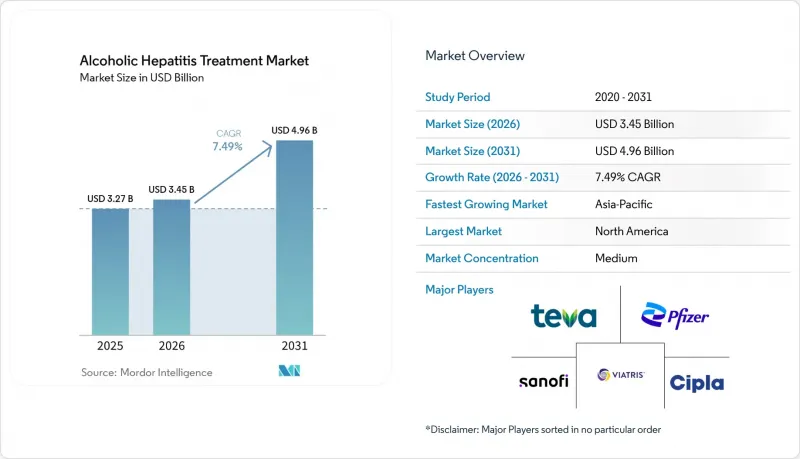
에 따르면 알코올성 간염 치료 시장 규모는 2025년 32억 7,000만 달러에서 2026년에는 34억 5,000만 달러로 확대하며, 2031년까지 49억 6,000만 달러에 달할 것으로 예상되고 있으며, 2026-2031년에 CAGR 7.49%로 성장할 것으로 전망되고 있습니다.
전 세계 알코올성 간염 치료 시장의 동향 및 인사이트
알코올 관련 간 질환의 부담 증가
알코올 관련 간 질환의 부담이 증가함에 따라 알코올성 간염 치료 시장의 환자층이 확대되고 있습니다. 전 세계에서 알코올 사용 장애의 유병률이 높아지고 있는 것이 수요와 시장 성장을 지원하고 있습니다. 미국 간 재단(American Liver Foundation)에 따르면 알코올 관련 간 질환(ALD)은 전 세계 질병 및 부상 부담의 5.1%를 차지합니다. 기존 연구가 주로 남성을 대상으로 진행된 경우가 많았기 때문에 이러한 변화는 치료법 개발을 복잡하게 만들고 있습니다. 미국내 알코올 관련 간 질환의 예상 경제적 영향은 대책이 마련되지 않을 경우 2040년까지 2배로 증가할 가능성이 있으며, 이는 예방, 입원 치료 및 치료 경로에 대한 지속적인 수요를 지원합니다.
질환 수정 요법에 대한 임상 투자 확대
임상 투자의 확대에 따라 알코올성 간염 치료 시장의 파이프라인이 확충되고 있습니다. 라르스코스테롤의 3상 임상시험 ‘LCAH3141’은 알코올 관련 간염 환자 350명을 대상으로 피험자를 모집 중이며, 이는 현재 가장 진척된 승인 신청 프로그램입니다. FDA는 1건의 성공적인 주요 임상시험 결과만으로도 라르스코스테롤의 신약 승인 신청(NDA)을 지지하기로 합의했으며, 이로 인해 일반적으로 요구되는 2건의 긍정적 임상시험 요건이 완화되었습니다. 이 후보 약물은 FDA로부터 ‘브레이크스루 테라피(Breakthrough Therapy)’ 및 ‘패스트 트랙(Fast Track)’ 지정을 받아, 이를 통해 심사 절차의 효율화가 도모됩니다. 알데이라 테라퓨틱스(Aldeira Therapeutics)는 2025년 10월, ADX-629를 통해 MELD 점수가 통계적으로 유의미하게 개선되었다고 보고했으며, 이를 통해 임상 파이프라인에 새로운 작용 기전이 추가되었습니다.
승인된 질병 수정 치료제의 부재
승인된 질환 수정 요법이 존재하지 않는다는 점은 알코올성 간염 치료 시장에서 여전히 주요 제약 요인으로 작용하고 있습니다. FDA와 EMA 모두 알코올 관련 간염에 대한 특정 치료법을 승인하지 않았기 때문에 임상의들은 적응증 외 사용인 코르티코스테로이드나 지지요법에 의존할 수밖에 없습니다. 이로 인해 체계적인 상용화가 제한되고, 특히 가격에 민감한 의료 시스템에서는 보험 급여 전망을 예측하기 어렵습니다. 또한 유럽 및 아시아태평양의 의료 기술 평가 기관들도 적응증 외 치료를 대규모로 지지하기 전에 확고한 비교 데이터를 요구하고 있습니다. 인터셉트 파마슈티컬스(Intercept Pharmaceuticals)는 INT-787에 대한 2a상 FRESH 임상시험에서 잠재적 유효성을 입증할 명확한 증거를 확보하지 못해 2026년 3월에 시험을 종료했습니다. 이 결과는 알코올성 간염 치료 시장이 현재의 치료 모델에서 벗어나기 위해서는 지속적인 임상적 근거가 필수적인 이유를 보여줍니다.
부문 분석
2025년, 약물 요법은 알코올성 간염 치료 시장의 73.23% 점유율을 차지했습니다. 병원 진료 현장에서 코르티코스테로이드를 기반으로 한 치료 프로토콜이 확립되어 있고, 대체요법이 아직 대규모로 이용 가능하지 않기 때문에 이 부문은 여전히 중심적인 위치를 차지하고 있습니다. 영양 요법 및 지지요법은 장내 영양 공급과 아연 보충을 통해 안정적인 기반을 제공하고 있습니다.
줄기세포 치료는 2026-2031년까지 연평균 성장률(CAGR) 12.34%로 성장할 것으로 예측됩니다. 이 치료법은 알코올 관련 간 질환에서 안전성 데이터와 초기 유효성 징후가 보고된 중간엽 줄기세포 프로그램을 통해 주목받고 있습니다. 2025년 실제 임상 연구에서는 보상 부전성 간경변증을 가진 매칭 코호트를 대상으로, 골수 유래 중간엽 줄기세포 이식 후 5년 사망률에 대해 조정 후 위험비(HR)가 0.14인 것으로 보고되었습니다.
2025년, 알코올성 간염 치료 시장에서 코르티코스테로이드는 38.34%의 점유율을 차지했습니다. 중증 질환 기준을 충족하는 환자에 대한 확립된 치료 프로토콜에서는 프레드니솔론이 여전히 주요 약물로 자리 잡고 있습니다. 펜톡시필린을 포함한 혈액 유동성 개선제의 경우, 코르티코스테로이드 단독 요법을 능가하는 효능에 의문을 제기하는 증거가 제시됨에 따라 사용 빈도가 감소하고 있습니다. 항산화제 및 간 보호제는 보조적인 역할을 유지하고 있으며, 특히 PROCORNAc 임상시험에서 나타난 N-아세틸시스테인이 그 대표적인 예입니다.
모노클로널 항체는 2031년까지 연평균 성장률(CAGR) 13.42%로 확대될 것으로 예측됩니다. 이 계열의 개발 프로그램에는 IL-1, TNF, 섬유화 경로, 장-간 축 및 후성유전적 조절 이상을 표적으로 하는 약제가 포함됩니다. 카나키누맙이 2상 임상시험에서 임상적 및 생화학적 결과의 개선을 보여주지 못했으므로 상업적 전망은 여전히 불투명합니다.
2025년에는 급성 알코올성 간염이 질환 유형 부문의 78.34%를 차지했습니다. 또한 2026-2031년까지 연평균 성장률(CAGR) 8.78%를 기록하며 가장 빠르게 성장하는 질환 유형 하위 부문로 보고되고 있습니다. 급성기는 환자가 입원 치료를 필요로 하는 경우가 많고, 치료 임상시험의 대상이 되므로 임상적 개입의 주요 초점이 됩니다. 중증 사례는 일반적으로 MDF 점수 32 이상 또는 MELD 점수 21-30과 같은 지표를 사용하여 정의됩니다. 이처럼 정의된 임상 프로필을 통해 연구자들은 환자를 등록하고 치료 성과를 일관되게 평가할 수 있습니다. 그 결과, 급성 질환은 알코올성 간염 치료 시장에서 상업적 개발의 주요 초점으로 계속 자리 잡고 있습니다.
만성 알코올성 간염은 지속적인 알코올 사용 장애 치료, 간 보호제 및 영양 프로그램을 통해 수요를 창출하고 있습니다. 급성기 질환과 같이 즉각적인 입원의 긴급성이 수반되지 않기 때문에 고액의 입원 의료비 지출은 제한적입니다. 2026년 6월의 자연 경과 연구에 따르면 알코올 관련 간염 발병 후 6개월 이내에 간 손상과 알코올 사용과 관련된 사건이 동반될 확률이 높은 것으로 보고되었습니다.
지역별 분석
2025년, 북미는 알코올성 간염 치료 시장 규모의 42.34%를 차지했습니다. 미국에서는 알코올 관련 간염으로 인해 연간 약 16만 4,000건의 입원이 발생하며, 이러한 위치를 지원하고 있습니다. 이 지역은 라르스코스테롤이 FDA의 ‘획기적 치료제(Breakthrough Therapy) 지정’을 받았으며, 미국을 중심으로 한 규제 경로를 통해 연구가 진행되고 있으며, 개발 환경이 유리합니다.
유럽은 독일, 프랑스, 영국, 이탈리아가 주도하는 원료 공급 측면에서 2위 규모를 자랑하는 지역 블록입니다. EASL(유럽간학회)에 부합하는 임상 실무를 통해 의료 시스템은 중증 질환의 식별 및 관리를 위한 일관된 체계를 갖추고 있습니다. 릴 대학병원은 2026년 5월에 PROCORNAC 3상 임상시험을 시작했으며, 이는 유럽의 학술적 임상시험 인프라가 탄탄함을 보여줍니다.
아시아태평양은 2031년까지 연평균 성장률(CAGR) 11.36%로 성장할 것으로 예측되며, 이는 알코올성 간염 치료 시장에서 지역별 가장 높은 성장률입니다. 중국과 인도는 알코올 사용 장애 유병률이 증가하고 있으며, 병원 간내과 진료 체계가 정비되고 있으며, 중요한 시장 기회가 되고 있습니다. 중앙아시아는 알코올 관련 간 질환의 유병률 및 사망률이 전 세계에서 가장 높은 수준입니다.
기타 혜택:
- 엑셀 형식의 시장 예측(ME) 시트
- 3개월간의 애널리스트 지원
자주 묻는 질문
목차
제1장 서론
- 조사 전제조건과 시장 정의
- 조사 범위
제2장 조사 방법
제3장 개요
제4장 시장 구도
- 시장 개요
- 시장 성장 촉진요인
- 시장 성장 억제요인
- 공급망 분석
- 규제 상황
- 기술 전망
- Porter's Five Forces
제5장 시장 규모와 성장 예측
- 치료 유형별
- 약제 클래스별
- 질환 유형별
- 질환 중증도별
- 투여 경로별
- 최종사용자별
- 유통 채널별
- 지역별
- 북미
- 미국
- 캐나다
- 멕시코
- 유럽
- 독일
- 영국
- 프랑스
- 이탈리아
- 스페인
- 기타 유럽 국가
- 아시아태평양
- 중국
- 인도
- 일본
- 호주
- 한국
- 기타 아시아태평양 국가
- 중동 및 아프리카
- GCC
- 남아프리카공화국
- 기타 중동 및 아프리카 국가
- 남미
- 브라질
- 아르헨티나
- 기타 남미 국가
- 북미
제6장 경쟁 구도
- 시장 집중도
- 시장 점유율 분석
- 기업 개요
- AbbVie Inc.
- Alkermes plc
- AstraZeneca plc
- Bausch Health Companies Inc.
- Cipla Limited
- DURECT Corporation
- F. Hoffmann-La Roche Ltd
- Genfit S.A.
- Gilead Sciences, Inc.
- Intercept Pharmaceuticals, Inc.
- Johnson & Johnson
- Mallinckrodt Pharmaceuticals
- Merck & Co., Inc.
- Novartis AG
- Pfizer Inc.
- Sanofi
- Teva Pharmaceutical Industries Ltd.
- Viatris Inc.
- Viking Therapeutics, Inc.
- Zydus Lifesciences Limited
제7장 시장 기회와 향후 전망
KSAAccording to Mordor Intelligence, the alcoholic hepatitis treatment market size is expected to increase from USD 3.27 billion in 2025 to USD 3.45 billion in 2026 and reach USD 4.96 billion by 2031, growing at a CAGR of 7.49% over 2026-2031.
Global Alcoholic Hepatitis Treatment Market Trends and Insights
Rising Alcohol-Associated Liver Disease Burden
The growing burden of alcohol-related liver disease enlarges the patient pool for the alcoholic hepatitis treatment market. The rising prevalence of alcohol use disorder across the globe is boosting the demand and market growth. According to the American Liver Foundation, alcohol-associated liver disease (ALD) accounted for 5.1% of the global burden of disease and injury. This change complicates treatment development because earlier studies often enrolled predominantly male populations. The projected economic impact of alcohol-related liver disease in the United States could double by 2040 without intervention, which supports continued demand for prevention, hospital care, and treatment pathways.
Increasing Clinical Investment in Disease-Modifying Therapies
Clinical investment is widening the development pipeline for the alcoholic hepatitis treatment market. The Phase 3 LCAH3141 study of larsucosterol is recruiting 350 participants with alcohol-associated hepatitis, making it the most advanced registrational program. The FDA has agreed that one successful pivotal study could support a New Drug Application for larsucosterol, which reduces the usual requirement for two positive trials. The candidate has FDA Breakthrough Therapy and Fast Track designations, which can support a more efficient review process. Aldeyra Therapeutics reported statistically significant MELD score improvement with ADX-629 in October 2025, adding another mechanism to the clinical pipeline.
Absence of an Approved Disease-Modifying Therapy
The lack of an approved disease-modifying therapy remains the main constraint on the alcoholic hepatitis treatment market. Clinicians rely on off-label corticosteroids and supportive care because neither the FDA nor the EMA has approved a specific therapy for alcohol-associated hepatitis. This limits structured commercialization and makes reimbursement less predictable, especially in price-sensitive health systems. Health technology assessment bodies in Europe and Asia-Pacific also need strong comparative data before supporting off-label treatment at scale. Intercept Pharmaceuticals ended the Phase 2a FRESH study of INT-787 in March 2026 after finding no clear evidence of potential benefit. The result shows why durable clinical evidence is necessary before the alcoholic hepatitis treatment market can move beyond its current care model.
Other drivers and restraints analyzed in the detailed report include:
- Guideline-Based Severity Scoring and Treatment Adoption
- Expansion of Hospital-Based Severe Disease Management
- Limited Durability and Infection Risk of Corticosteroids
For complete list of drivers and restraints, kindly check the Table Of Contents.
Segment Analysis
Pharmacological therapy held 73.23% of the alcoholic hepatitis treatment market share in 2025. The segment remains central because corticosteroid-based protocols are established in hospital practice and alternative therapies are not yet available at scale. Nutritional and supportive care supplies a stable base through enteral nutrition and zinc supplementation.
Stem cell therapy is forecast to grow at a 12.34% CAGR from 2026 to 2031. This treatment type has drawn interest from mesenchymal stem cell programs that have reported safety findings and early efficacy signals in alcohol-related liver disease. A 2025 real-world study reported an adjusted hazard ratio of 0.14 for 5-year mortality after bone marrow-derived mesenchymal stem cell transplantation in matched cohorts with decompensated liver cirrhosis.
Corticosteroids held 38.34% of the alcoholic hepatitis treatment market share in 2025. Prednisolone remains the main drug in established treatment protocols for patients meeting severe-disease criteria. Hemorheologic agents, including pentoxifylline, have seen lower use after evidence questioned their benefit beyond corticosteroids alone. Antioxidants and hepatoprotective agents retain an adjunct role, particularly N-acetylcysteine in the PROCORNAC study.
Monoclonal antibodies are forecast to expand at a 13.42% CAGR through 2031. Programs in this class include agents that target IL-1, TNF, fibrosis pathways, the gut-liver axis, and epigenetic dysregulation. The commercial outlook remains uncertain because canakinumab did not improve clinical or biochemical outcomes in a Phase 2 study.
Acute alcoholic hepatitis accounted for 78.34% of the disease-type segment in 2025. It was also reported as the fastest-growing disease-type sub-segment, with a 8.78% CAGR from 2026 to 2031. Acute episodes are the main point for clinical intervention because patients often require hospital treatment and are eligible for therapeutic trials. Severe cases are typically defined using measures such as MDF scores of 32 or higher or MELD scores of 21 to 30. This defined clinical profile helps investigators enroll patients and assess treatment outcomes consistently. As a result, acute disease remains the primary focus for commercial development in the alcoholic hepatitis treatment market.
Chronic alcoholic hepatitis generates demand through ongoing alcohol use disorder treatment, hepatoprotective medicines, and nutrition programs. It does not carry the same immediate inpatient urgency as acute disease, which limits high-value hospitalization spending. A June 2026 natural-history study reported a high incidence of combined liver and alcohol-use events within 6 months of an alcohol-associated hepatitis presentation.
Complete Report Scope:
- By Treatment Type
- Pharmacological Therapy
- Stem Cell Therapy
- Nutritional & Supportive Care
- By Drug Class
- Corticosteroids
- Hemorheologic Agents
- Monoclonal Antibodies
- Antioxidants & Hepatoprotective Agents
- Alcohol Use Disorder Medications
- Other Drug Classes
- By Disease Type
- Acute Alcoholic Hepatitis
- Chronic Alcoholic Hepatitis
- By Disease Severity
- Mild Alcoholic Hepatitis
- Moderate Alcoholic Hepatitis
- Severe Alcoholic Hepatitis
- By Route of Administration
- Oral
- Parenteral
- By End User
- Hospitals
- Specialty Liver Clinics
- Transplant Centers
- Private Treatment Centers
- Other End Users
- By Distribution Channel
- Hospital Pharmacies
- Retail Pharmacies
- Online Pharmacies
- Other Distribution Channels
- By Geography
- North America
- United States
- Canada
- Mexico
- Europe
- Germany
- United Kingdom
- France
- Italy
- Spain
- Rest of Europe
- Asia-Pacific
- China
- India
- Japan
- Australia
- South Korea
- Rest of Asia-Pacific
- Middle East and Africa
- GCC
- South Africa
- Rest of Middle East and Africa
- South America
- Brazil
- Argentina
- Rest of South America
- North America
Geography Analysis
North America held 42.34% of the alcoholic hepatitis treatment market size in 2025. The United States supports this position through an estimated 164,000 annual hospital admissions for alcohol-associated hepatitis. The region has a favorable development setting because larsucosterol has an FDA Breakthrough Therapy Designation and is being studied in a U.S.-focused regulatory pathway.
Europe is the second-largest regional block in the supply of material, led by Germany, France, the United Kingdom, and Italy. EASL-aligned clinical practice gives health systems a consistent framework for identifying and managing severe disease. University Hospital Lille began the PROCORNAC Phase 3 study in May 2026, showing the strength of Europe's academic trial infrastructure.
Asia-Pacific is forecast to grow at an 11.36% CAGR through 2031, the fastest regional rate in the alcoholic hepatitis treatment market. China and India are important opportunities because alcohol use disorder prevalence is rising, and hospital hepatology capacity is improving. Central Asia had the highest global incidence and death rates for alcohol-related liver disease.
- Abbvie
- Alkermes plc
- AstraZeneca
- Bausch Health
- Cipla
- DURECT Corporation
- Roche
- Genfit S.A.
- Gilead Sciences
- Intercept Pharmaceuticals
- Johnson & Johnson
- Mallinckrodt Pharmaceuticals
- Merck
- Novartis
- Pfizer
- Sanofi
- Teva Pharmaceutical Industries
- Viatris
- Viking Therapeutics, Inc.
- Zydus Lifesciences Limited
Additional Benefits:
- The market estimate (ME) sheet in Excel format
- 3 months of analyst support
TABLE OF CONTENTS
1 Introduction
- 1.1 Study Assumptions & Market Definition
- 1.2 Scope of the Study
2 Research Methodology
3 Executive Summary
4 Market Landscape
- 4.1 Market Overview
- 4.2 Market Drivers
- 4.2.1 Rising Alcohol-Associated Liver Disease Burden
- 4.2.2 Expansion of Hospital-Based Severe Disease Management
- 4.2.3 Increasing Clinical Investment in Disease-Modifying Therapies
- 4.2.4 Guideline-Based Severity Scoring and Treatment Adoption
- 4.2.5 Integrated Alcohol Use Disorder and Hepatology Care Pathways
- 4.2.6 Earlier Referral for Selected Liver Transplantation Candidates
- 4.3 Market Restraints
- 4.3.1 Absence of an Approved Disease-Modifying Therapy
- 4.3.2 Limited Durability and Infection Risk of Corticosteroids
- 4.3.3 Underdiagnosis and Low Uptake of Alcohol Use Disorder Treatment
- 4.3.4 Trial Endpoint and Patient-Heterogeneity Risk
- 4.4 Supply-Chain Analysis
- 4.5 Regulatory Landscape
- 4.6 Technological Outlook
- 4.7 Porter's Five Forces
- 4.7.1 Threat of New Entrants
- 4.7.2 Bargaining Power of Suppliers
- 4.7.3 Bargaining Power of Buyers
- 4.7.4 Threat of Substitutes
- 4.7.5 Industry Rivalry
5 Market Size & Growth Forecasts (Value, USD)
- 5.1 By Treatment Type
- 5.1.1 Pharmacological Therapy
- 5.1.2 Stem Cell Therapy
- 5.1.3 Nutritional & Supportive Care
- 5.2 By Drug Class
- 5.2.1 Corticosteroids
- 5.2.2 Hemorheologic Agents
- 5.2.3 Monoclonal Antibodies
- 5.2.4 Antioxidants & Hepatoprotective Agents
- 5.2.5 Alcohol Use Disorder Medications
- 5.2.6 Other Drug Classes
- 5.3 By Disease Type
- 5.3.1 Acute Alcoholic Hepatitis
- 5.3.2 Chronic Alcoholic Hepatitis
- 5.4 By Disease Severity
- 5.4.1 Mild Alcoholic Hepatitis
- 5.4.2 Moderate Alcoholic Hepatitis
- 5.4.3 Severe Alcoholic Hepatitis
- 5.5 By Route of Administration
- 5.5.1 Oral
- 5.5.2 Parenteral
- 5.6 By End User
- 5.6.1 Hospitals
- 5.6.2 Specialty Liver Clinics
- 5.6.3 Transplant Centers
- 5.6.4 Private Treatment Centers
- 5.6.5 Other End Users
- 5.7 By Distribution Channel
- 5.7.1 Hospital Pharmacies
- 5.7.2 Retail Pharmacies
- 5.7.3 Online Pharmacies
- 5.7.4 Other Distribution Channels
- 5.8 By Geography
- 5.8.1 North America
- 5.8.1.1 United States
- 5.8.1.2 Canada
- 5.8.1.3 Mexico
- 5.8.2 Europe
- 5.8.2.1 Germany
- 5.8.2.2 United Kingdom
- 5.8.2.3 France
- 5.8.2.4 Italy
- 5.8.2.5 Spain
- 5.8.2.6 Rest of Europe
- 5.8.3 Asia-Pacific
- 5.8.3.1 China
- 5.8.3.2 India
- 5.8.3.3 Japan
- 5.8.3.4 Australia
- 5.8.3.5 South Korea
- 5.8.3.6 Rest of Asia-Pacific
- 5.8.4 Middle East and Africa
- 5.8.4.1 GCC
- 5.8.4.2 South Africa
- 5.8.4.3 Rest of Middle East and Africa
- 5.8.5 South America
- 5.8.5.1 Brazil
- 5.8.5.2 Argentina
- 5.8.5.3 Rest of South America
- 5.8.1 North America
6 Competitive Landscape
- 6.1 Market Concentration
- 6.2 Market Share Analysis
- 6.3 Company Profiles {(includes Global level Overview, Market level overview, Core Segments, Financials as available, Strategic Information, Market Rank/Share for key companies, Products & Services, and Recent Developments)}
- 6.3.1 AbbVie Inc.
- 6.3.2 Alkermes plc
- 6.3.3 AstraZeneca plc
- 6.3.4 Bausch Health Companies Inc.
- 6.3.5 Cipla Limited
- 6.3.6 DURECT Corporation
- 6.3.7 F. Hoffmann-La Roche Ltd
- 6.3.8 Genfit S.A.
- 6.3.9 Gilead Sciences, Inc.
- 6.3.10 Intercept Pharmaceuticals, Inc.
- 6.3.11 Johnson & Johnson
- 6.3.12 Mallinckrodt Pharmaceuticals
- 6.3.13 Merck & Co., Inc.
- 6.3.14 Novartis AG
- 6.3.15 Pfizer Inc.
- 6.3.16 Sanofi
- 6.3.17 Teva Pharmaceutical Industries Ltd.
- 6.3.18 Viatris Inc.
- 6.3.19 Viking Therapeutics, Inc.
- 6.3.20 Zydus Lifesciences Limited
7 Market Opportunities & Future Outlook
- 7.1 White-space & unmet-need assessment


