

|
시장보고서
상품코드
2154318
스마트 전구 : 시장 점유율 분석, 업계 동향과 통계, 성장 예측(2026-2031년)Smart Bulbs - Market Share Analysis, Industry Trends & Statistics, Growth Forecasts (2026 - 2031) |
||||||
 Mordor Intelligence
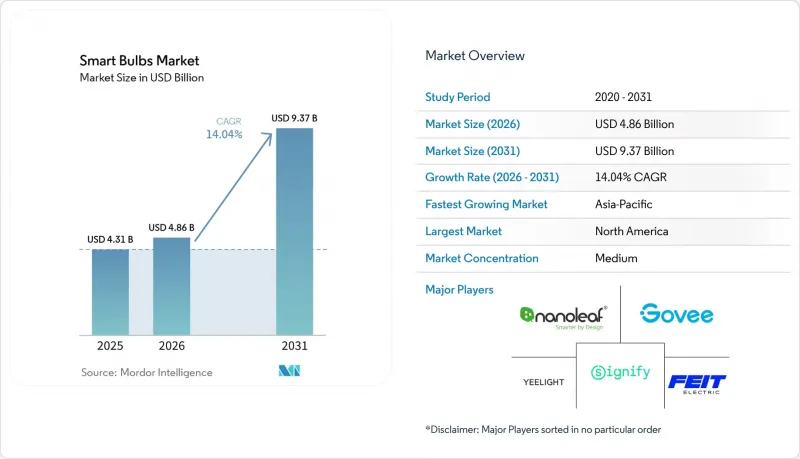
에 따르면 스마트 전구 시장 규모는 2025년에 43억 1,000만 달러로 평가되며, 2026년 48억 6,000만 달러에서 확대하며, 2031년까지 93억 7,000만 달러에 달할 것으로 예측됩니다.
2026-2031년까지의 예측 기간 중 연평균 성장률(CAGR)은 14.04%에 달할 것으로 전망됩니다.
글로벌 스마트 전구 시장의 동향 및 인사이트
스마트홈 보급률 상승
2025년, 미국 및 캐나다의 조사 대상 가구에서 스마트홈 기술 도입률은 59%에 달하여, 2024년의 49%에서 상승했습니다. 합리적인 가격의 Matter 호환 기기와 더욱 간소화된 자동화 기능 덕분에 커넥티드 제품이 일반 가정에 더욱 친숙해지고 있습니다. 스마트 전구는 표준 E26 및 E27 소켓에 호환되며, 배선 공사가 필요 없고 기존 스마트폰 앱을 통해 제어할 수 있습니다. 설치된 각 전구는 앱 사용 습관을 정착시켜, 향후 온도 조절기, 카메라, 센서를 구매할 때의 진입 장벽을 낮출 수 있습니다. 따라서 스마트 전구 시장은 음성 비서 플랫폼 및 커넥티드 홈 기기의 도입 대수 증가로 인한 혜택을 누리고 있습니다. 이러한 플랫폼이 보급됨에 따라 조명은 단순한 에너지 절약을 위한 옵션이 아니라, 홈 오토메이션으로의 진입점이 되는 필수 제품으로 자리 잡고 있습니다.
에너지 효율 규제와 LED로의 전환
미국 에너지부는 2028년 7월 이후 새로 제조되거나 수입되는 전구에 대해 120 lm/W 이상의 광속 효율을 의무화하는 일반용 램프 기준을 최종 확정했습니다. 동 부서는 이 기준을 통해 향후 30년간 출하되는 제품에 대해 4경 영국 열량 단위의 에너지 절감 효과를 얻을 수 있을 것으로 전망하고 있습니다. DesignLights Consortium의 SSL V6.0 및 LUNA V2.0 요건은 2026년 1월 5일에 발효되었으며, 비주거용 LED 조명에 대해 더욱 엄격한 광속 효율, 제어성 문서화 및 수명 주기 보고 요건이 부과되었습니다. 유럽에서도 광원에 대한 에코디자인 규정이 적용되고 있으며, EN 15193-1:2026은 건물의 에너지 성능에 관한 시스템 수준의 평가를 지원하고 있습니다. 이러한 규정은 높은 광속 효율 요건을 충족하는 LED 제품으로 구형 램프를 교체하도록 촉진하고 있습니다. 연결형 LED 제품은 효율성 요건을 충족하면서 리모델링 공사나 신축 현장에서 제어성을 높일 수 있으므로, 스마트 전구 시장에 이점이 될 것입니다.
사이버 보안 및 개인정보 보호 위험
CISA는 2025년 6월, TrendMakers Sight Bulb Pro에 존재하는 두 가지 고위험 취약점에 대해 권고안 ICSA-25-177-02를 발표했습니다. 이 권고에서는 설정시 AES 암호화 키가 평문으로 전송되는 문제와, 인접 네트워크상의 공격자가 임의의 명령을 실행할 수 있는 명령 주입 취약점이 확인되었습니다. NIST는 필립스 조명 기기가 Wi-Fi 인증 정보를 기기 펌웨어 내에 평문으로 저장하고 있던 문제(CVE-2024-9991)를 기록했습니다. SSTIC 2026에서 발표된 연구에 따르면 Zigbee 공격 경로를 통해 Philips Hue Bridge에 원격 및 무선으로 루트 액세스가 가능한 것으로 나타났습니다. 이러한 사례로 인해 호텔, 기업 및 소비자들은 클라우드 연결형 전구를 평가할 때 더욱 신중해질 가능성이 있습니다. EU의 사이버 복원력 법에 따르면 2027년까지 ‘보안 설계(Security by Design)’ 의무가 도입되어 제조사에 대한 인증 및 규정 준수 요건이 강화될 예정입니다.
부문 분석
Wi-Fi 지원 스마트 전구는 라우터가 거의 보편적으로 보급되어 있고, 전용 허브가 필요 없는 설정 과정이 지원되며, 2025년에는 매출의 53.23%를 차지했습니다. 스마트 전구 시장에서 이러한 입지를 바탕으로, Wi-Fi 제품은 간단한 앱 기반 제어를 원하는 일반 가정 사이에서 폭넓은 고객 기반을 구축하고 있습니다. 블루투스 지원 스마트 전구는 로컬 제어, 낮은 지연 시간, 클라우드 인프라에 대한 의존도가 낮은 것이 특징입니다. 이러한 기능들은 특정 방이나 집 안에서 기본적인 제어를 선호하는 구매자들에게 어필하고 있습니다. Zigbee 및 Z-Wave는 메시 네트워크의 신뢰성이나 빌딩 관리 시스템과의 통합이 중요한 상업용 설치 분야에서 여전히 중요한 역할을 하고 있습니다.
그 밖의 연결 프로토콜, 주로 Thread 네이티브 및 Matter-over-Thread 지원 제품은 2026-2031년까지 연평균 성장률(CAGR) 16.45%로 성장할 것으로 예측됩니다. 이러한 전망은 독자적인 사양의 허브에 대한 의존도를 낮출 수 있는 개방형 표준 및 아키텍처에 대한 제조업체들의 관심을 반영하고 있습니다. Aqara의 LED 전구 T2는 Zigbee와 Thread를 모두 지원하므로, 구매자는 전구를 교체하지 않고도 프로토콜을 전환할 수 있습니다. Matter 1.6은 공유 네트워크 기능과 커미셔닝 기능을 제공하여 멀티 플랫폼에서의 설치 관리를 용이하게 합니다. 스마트 전구 시장에서는 간편한 설정과 신뢰성 높은 로컬 및 크로스 플랫폼 작동을 겸비한 제품이 선호될 전망입니다.
2025년 현재, LED 스마트 전구는 스마트 전구 시장의 97.57%를 차지하고 있으며, 2031년까지 연평균 성장률(CAGR) 16.32%로 성장할 것으로 예측됩니다. 이러한 요인들이 복합적으로 작용하여 LED는 소비자용 가격대의 스마트 전구 시장에서 핵심 기술로 자리매김하고 있습니다. 시그니파이(Signify)의 보고서에 따르면 2026년 1분기 전 세계 연결형 조명 기기는 1억 7,100만 대로, 2025년 말의 1억 6,700만 대에서 증가했습니다. 이러한 도입 대수는 LED 기반 연결형 조명에 대한 수요가 지속되고 있음을 반영합니다. 램프 효율 기준의 상향 조정은 LED 기술이 성능 요건과 소비자의 비용 기대치를 모두 충족시키기 때문에 추가적인 성장 동력이 되고 있습니다.
OLED 스마트 전구는 호텔 및 소매 공간에서 확산성이 높고 눈부심이 적은 조명이 중시되는 프리미엄 용도로만 국한되어 있습니다. 루멘당 비용이 여전히 LED 어레이보다 높기 때문에 일반적인 교체용 전구 형식에서의 광범위한 보급이 제한되고 있습니다. 다른 광원 유형은 동등한 가격대에서 효율 요건이 LED의 성능을 우선시하므로 여전히 미미한 존재에 그치고 있습니다. LED 카테고리 내에서 제품의 차별화는 현재 색조 조정, 연색성 지수, 조광 특성 및 색온도 선택지에 크게 의존하고 있습니다. 따라서 스마트 전구 업계에서는 광원 기술의 변화보다는 조명의 품질이나 제어 기능 측면에서 경쟁의 여지가 더 크다고 할 수 있습니다.
지역별 분석
북미는 2025년 매출의 35.21%를 차지했으며, 광대역 연결 가구, 음성 비서, 그리고 에너지 규제의 성숙한 기반에 힘입었습니다. 2025년, 미국 및 캐나다의 조사 대상 가구에서 스마트홈 기술 도입률은 59%에 달했습니다. 시그니파이(Signify)는 2025년 미국 소비자 사업 부문에서 두 자릿수 매출 성장을 기록했으며, 성수기에는 커넥티드 홈 사업이 견고한 실적을 보였습니다. AT&T는 2025년 12월 ‘Connected Life’를 출시하여 Google Home 기기와 Abode의 모니터링 서비스를 무선 및 광대역 계약과 결합했습니다. 캐나다에서는 공공사업자가 지원하는 LED 조명 개조 프로그램이 시장 확대에 기여하고 있으며, 멕시코에서는 도시화가 진행됨에 따라 지역 스마트 전구 시장이 확대되고 있습니다.
아시아태평양은 2026-2031년까지 연평균 성장률(CAGR) 17.46%로 확대될 것으로 예측되며, 이는 지역별 부문 중 가장 높은 성장률입니다. 중국은 스마트 전구 시장에서 주요 제조 거점이자 대규모 소비자 기반을 모두 갖추고 있으며, 플랫폼 기반의 소매 채널을 통해 서비스가 제공되고 있습니다. 인도는 도시화, 스마트 시티 추진, 그리고 커넥티드 홈 제품에 대한 소비자 기반의 확대라는 혜택을 누리고 있습니다. 한국은 품질을 중시하는 소비자층, 높은 광대역 보급률, 그리고 가전제품과 홈 플랫폼 간의 긴밀한 연동이 특징입니다.
유럽, 중동 및 아프리카, 남미에서는 정책, 인프라, 소득 수준이 다르기 때문에 도입 진척도에 차이가 나타납니다. 사우디아라비아는 대규모 인프라 프로젝트의 사양서에 커넥티드 조명이 포함되어 있으며, 중동 지역의 주요 시장으로 자리 잡고 있습니다. 한편, UAE에는 호텔·레스토랑 업계와 상업 수요를 지원하는 스마트 시티 구역이 존재합니다. 남미에서는 도입이 아직 초기 단계에 있으며, 브라질과 아르헨티나가 주요 소비 시장으로 자리 잡고 있지만, 수입 비용과 현지 언어로된 생태계 지원의 부족이 단기적인 보급을 제한하고 있습니다. 이 지역의 수요는 규제에 따른 장비 교체 주기, 도시화, 그리고 광대역 이용 현황이 어떻게 전개되느냐에 따라 좌우될 것입니다.
기타 혜택:
- 엑셀 형식의 시장 예측(ME) 시트
- 3개월간의 애널리스트 지원
자주 묻는 질문
목차
제1장 서론
- 조사 전제조건과 시장 정의
- 조사 범위
제2장 조사 방법
제3장 개요
제4장 시장 구도
- 시장 개요
- 시장 성장 촉진요인
- 시장 성장 억제요인
- 업계 밸류체인 분석
- 규제 상황
- 기술 전망
- 거시경제 요인이 시장에 미치는 영향
- Porter's Five Forces 분석
제5장 시장 규모와 성장 예측
- 기술/ 접속 프로토콜별
- 광원 유형별
- 유통 채널별
- 최종사용자 산업별
- 지역별
- 북미
- 미국
- 캐나다
- 멕시코
- 남미
- 브라질
- 아르헨티나
- 기타 남미 국가
- 유럽
- 독일
- 영국
- 프랑스
- 이탈리아
- 스페인
- 기타 유럽 국가
- 아시아태평양
- 중국
- 일본
- 인도
- 한국
- 기타 아시아태평양 국가
- 중동 및 아프리카
- 중동
- 사우디아라비아
- 아랍에미리트
- 튀르키예
- 기타 중동 국가
- 아프리카
- 남아프리카공화국
- 나이지리아
- 기타 아프리카 국가
- 중동
- 북미
제6장 경쟁 구도
- 시장 집중도
- 전략적 동향
- 시장 점유율 분석
- 기업 개요
- Nanoleaf Inc.
- Govee Home Appliance Co., Ltd.
- Shenzhen Yeelight Technology Co., Ltd.
- Signify N.V.
- Feit Electric Company, Inc.
- Sengled Co., Ltd.
- LEDVANCE GmbH
- Leedarson IoT Technology Inc.
- TP-Link Systems Inc.
- SATCO Products, Inc.
- Lutron Electronics Co., Inc.
- Xiaomi Communications Co., Ltd.
- Lumi United Technology Co., Ltd.(Aqara)
- IKEA Supply AG
- Shenzhen Opple Lighting Co., Ltd.(OPPLE Lighting)
- Tuya Smart Inc.
- Miboxer(FUTLIGHT OPTOELECTRONICS CO., LTD.)
- AiDot Inc.(Linkind)
- Shenzhen Homa Technology Co., Ltd.
제7장 시장 기회와 향후 전망
KSAAccording to Mordor Intelligence, the smart bulbs market size was valued at USD 4.31 billion in 2025 and is estimated to expand from USD 4.86 billion in 2026 to reach USD 9.37 billion by 2031, at a CAGR of 14.04% during the forecast period 2026-2031.
Global Smart Bulbs Market Trends and Insights
Rising Smart-Home Penetration
Smart home technology adoption reached 59% among surveyed households in the United States and Canada in 2025, compared with 49% in 2024. Affordable Matter-compatible devices and simpler automation are making connected products more accessible to households. Smart bulbs fit standard E26 and E27 sockets, need no rewiring, and can be controlled through existing smartphone applications. Each installed bulb can establish an application habit that lowers the barrier to purchasing thermostats, cameras, and sensors later. The smart bulbs market, therefore, gains from the larger installed base of voice assistant platforms and connected home devices. As these platforms spread, lighting is becoming a routine entry product for home automation rather than an optional efficiency upgrade.
Energy-Efficiency Regulation and LED Replacement
The U.S. Department of Energy finalized general service lamp standards that require more than 120 lm/W for newly manufactured or imported bulbs from July 2028. The Department expects the standards to save 4 quadrillion British thermal units over 30 years of shipments. DesignLights Consortium SSL V6.0 and LUNA V2.0 requirements took effect on January 5, 2026, with tighter efficacy, controllability documentation, and lifecycle reporting requirements for nonresidential LED lighting. Europe also applies the Ecodesign Regulation for light sources, while EN 15193-1:2026 supports system-level assessment of building energy performance. These rules encourage the replacement of legacy lamps with LED products that meet higher-efficacy requirements. The smart bulbs market can benefit because connected LED products meet efficiency needs while adding controllability in retrofit and new-build settings.
Cybersecurity and Privacy Exposure
CISA issued advisory ICSA-25-177-02 in June 2025 on 2 high-severity vulnerabilities in the TrendMakers Sight Bulb Pro. The advisory identified clear-text transmission of AES encryption keys during setup and a command injection vulnerability that could allow adjacent-network attackers to execute arbitrary commands. NIST documented CVE-2024-9991, which involved Philips lighting devices storing Wi-Fi credentials in plain text in device firmware. Research presented at SSTIC 2026 showed remote and wireless root access to a Philips Hue Bridge through Zigbee attack surfaces. These cases can make hotels, enterprises, and consumers more cautious when assessing cloud-connected bulbs. The EU Cyber Resilience Act will introduce security-by-design obligations through 2027, increasing certification and compliance demands for manufacturers.
Other drivers and restraints analyzed in the detailed report include:
- Matter-Based Interoperability Expansion
- Connected Lighting Demand in Rental and Multifamily Housing
- Interoperability Fragmentation Across Ecosystems
For complete list of drivers and restraints, kindly check the Table Of Contents.
Segment Analysis
Wi-Fi smart bulbs held 53.23% of revenue in 2025, supported by near-universal router availability and a setup process that does not require a dedicated hub. This position in the smart bulb market gives Wi-Fi products a broad consumer base among households seeking simple app-based control. Bluetooth smart bulbs offer local control, low latency, and less reliance on cloud infrastructure. These features appeal to buyers who prefer basic control within a defined room or home. Zigbee and Z-Wave remain relevant in professional installations where mesh reliability and integration with building control systems matter.
Other connectivity protocols, mainly Thread-native and Matter-over-Thread products, are projected to expand at a 16.45% CAGR from 2026 to 2031. This outlook reflects manufacturer interest in open standards and architectures that can reduce dependence on a proprietary hub. Aqara's LED Bulb T2 supports both Zigbee and Thread, giving buyers the option to switch protocols without replacing the bulb. Matter 1.6 provides shared-network and commissioning functions that can make multi-platform installations easier to manage. The smart bulbs market is likely to reward products that combine simple setup with reliable local and cross-platform operation.
LED smart bulbs accounted for 97.57% of the smart bulb market in 2025 and are projected to grow at a 16.32% CAGR through 2031. The combination makes LED the central technology in the smart bulbs market at consumer price points. Signify reported 171 million connected light points globally in Q1 2026, compared with 167 million at the end of 2025. This installed base reflects continuing demand for LED-based connected lighting. Higher lamp-efficiency standards further support LED technology because it meets both performance requirements and consumer cost expectations.
OLED smart bulbs remain limited to premium applications where diffuse and low-glare illumination is valued in hospitality and retail spaces. Their cost per lumen remains higher than that of LED arrays, limiting wider adoption in common retrofit bulb formats. Other light source types remain marginal as efficiency requirements favor LED performance at comparable prices. Within the LED category, product differentiation now depends more on color tuning, color rendering index, dimming behavior, and color temperature options. The smart bulbs industry, therefore, has more scope to compete on lighting quality and control functions than on changes in light-source technology.
Complete Report Scope:
- By Technology / Connectivity Protocol
- Wi-Fi Smart Bulbs
- Bluetooth Smart Bulbs
- Zigbee Smart Bulbs
- Z-Wave Smart Bulbs
- Other Connectivity Protocols (Thread-native/Matter-over-Thread, Proprietary Mesh)
- By Light Source Type
- LED Smart Bulbs
- OLED Smart Bulbs
- Other Light Source Types
- By Distribution Channel
- Direct Sales
- Wholesale / Retail
- E-commerce
- By End-user Industry
- Residential
- Commercial
- Hospitality
- Offices and Commercial Real Estate
- Retail Spaces
- Industrial and Institutional
- By Geography
- North America
- United States
- Canada
- Mexico
- South America
- Brazil
- Argentina
- Rest of South America
- Europe
- Germany
- United Kingdom
- France
- Italy
- Spain
- Rest of Europe
- Asia-Pacific
- China
- Japan
- India
- South Korea
- Rest of Asia-Pacific
- Middle East and Africa
- Middle East
- Saudi Arabia
- United Arab Emirates
- Turkey
- Rest of the Middle East
- Africa
- South Africa
- Nigeria
- Rest of Africa
- Middle East
- North America
Geography Analysis
North America held 35.21% of revenue in 2025, supported by a mature base of broadband-connected households, voice assistants, and energy rules. Smart home technology adoption reached 59% among surveyed households in the United States and Canada in 2025. Signify reported double-digit revenue expansion in its U.S. consumer business during 2025, with strong connected home performance during peak periods. AT&T launched Connected Life in December 2025, combining Google Home devices and Abode monitoring with wireless and broadband subscriptions. Canada contributes through utility-backed LED retrofit programs, while Mexico expands the regional smart-bulb market amid urbanization.
Asia-Pacific is projected to expand at a 17.46% CAGR from 2026 to 2031, the fastest rate among the geographic segments. China combines a major manufacturing base with a large consumer base for the smart bulbs market, which is served through platform-based retail channels. India benefits from urbanization, smart city activity, and a growing consumer base for connected home products. South Korea adds a quality-focused consumer base, high broadband density, and close links between consumer electronics and home platforms.
Europe, the Middle East and Africa, and South America show different stages of adoption because their policy, infrastructure, and income conditions vary. Saudi Arabia is a major Middle Eastern market because large infrastructure projects include connected lighting in their specifications, while the UAE has smart city districts that support hospitality and commercial demand. South America remains earlier in adoption, with Brazil and Argentina as major consumer markets and import costs and local-language ecosystem support limiting near-term penetration. Regional demand will depend on how regulatory replacement cycles, urbanization, and broadband availability develop.
- Nanoleaf Inc.
- Govee Home Appliance Co., Ltd.
- Shenzhen Yeelight Technology Co., Ltd.
- Signify N.V.
- Feit Electric Company, Inc.
- Sengled Co., Ltd.
- LEDVANCE GmbH
- Leedarson IoT Technology Inc.
- TP-Link Systems Inc.
- SATCO Products, Inc.
- Lutron Electronics Co., Inc.
- Xiaomi Communications Co., Ltd.
- Lumi United Technology Co., Ltd. (Aqara)
- IKEA Supply AG
- Shenzhen Opple Lighting Co., Ltd. (OPPLE Lighting)
- Tuya Smart Inc.
- Miboxer (FUTLIGHT OPTOELECTRONICS CO., LTD.)
- AiDot Inc. (Linkind)
- Shenzhen Homa Technology Co., Ltd.
Additional Benefits:
- The market estimate (ME) sheet in Excel format
- 3 months of analyst support
TABLE OF CONTENTS
1 INTRODUCTION
- 1.1 Study Assumptions and Market Definition
- 1.2 Scope of the Study
2 RESEARCH METHODOLOGY
3 EXECUTIVE SUMMARY
4 MARKET LANDSCAPE
- 4.1 Market Overview
- 4.2 Market Drivers
- 4.2.1 Rising Smart-Home Penetration
- 4.2.2 Energy-Efficiency Regulation and LED Replacement
- 4.2.3 Matter-Based Interoperability Expansion
- 4.2.4 Connected Lighting Demand in Rental and Multifamily Housing
- 4.2.5 App-Visible Lighting as a Gateway to Home Automation
- 4.2.6 Retailer-Led Bundling of Smart Bulbs With Home-Internet and Security Services
- 4.3 Market Restraints
- 4.3.1 Cybersecurity and Privacy Exposure
- 4.3.2 Interoperability Fragmentation Across Ecosystems
- 4.3.3 Shorter Product Replacement Cycles From Integrated Electronics
- 4.3.4 Low Consumer Willingness to Pay for Advanced Features
- 4.4 Industry Value-Chain Analysis
- 4.5 Regulatory Landscape
- 4.6 Technological Outlook
- 4.7 Impact of Macroeconomic Factors on the Market
- 4.8 Porter's Five Forces Analysis
- 4.8.1 Threat of New Entrants
- 4.8.2 Bargaining Power of Suppliers
- 4.8.3 Bargaining Power of Buyers
- 4.8.4 Threat of Substitutes
- 4.8.5 Competitive Rivalry
5 MARKET SIZE AND GROWTH FORECASTS (VALUE)
- 5.1 By Technology / Connectivity Protocol
- 5.1.1 Wi-Fi Smart Bulbs
- 5.1.2 Bluetooth Smart Bulbs
- 5.1.3 Zigbee Smart Bulbs
- 5.1.4 Z-Wave Smart Bulbs
- 5.1.5 Other Connectivity Protocols (Thread-native/Matter-over-Thread, Proprietary Mesh)
- 5.2 By Light Source Type
- 5.2.1 LED Smart Bulbs
- 5.2.2 OLED Smart Bulbs
- 5.2.3 Other Light Source Types
- 5.3 By Distribution Channel
- 5.3.1 Direct Sales
- 5.3.2 Wholesale / Retail
- 5.3.3 E-commerce
- 5.4 By End-user Industry
- 5.4.1 Residential
- 5.4.2 Commercial
- 5.4.2.1 Hospitality
- 5.4.2.2 Offices and Commercial Real Estate
- 5.4.2.3 Retail Spaces
- 5.4.3 Industrial and Institutional
- 5.5 By Geography
- 5.5.1 North America
- 5.5.1.1 United States
- 5.5.1.2 Canada
- 5.5.1.3 Mexico
- 5.5.2 South America
- 5.5.2.1 Brazil
- 5.5.2.2 Argentina
- 5.5.2.3 Rest of South America
- 5.5.3 Europe
- 5.5.3.1 Germany
- 5.5.3.2 United Kingdom
- 5.5.3.3 France
- 5.5.3.4 Italy
- 5.5.3.5 Spain
- 5.5.3.6 Rest of Europe
- 5.5.4 Asia-Pacific
- 5.5.4.1 China
- 5.5.4.2 Japan
- 5.5.4.3 India
- 5.5.4.4 South Korea
- 5.5.4.5 Rest of Asia-Pacific
- 5.5.5 Middle East and Africa
- 5.5.5.1 Middle East
- 5.5.5.1.1 Saudi Arabia
- 5.5.5.1.2 United Arab Emirates
- 5.5.5.1.3 Turkey
- 5.5.5.1.4 Rest of the Middle East
- 5.5.5.2 Africa
- 5.5.5.2.1 South Africa
- 5.5.5.2.2 Nigeria
- 5.5.5.2.3 Rest of Africa
- 5.5.5.1 Middle East
- 5.5.1 North America
6 COMPETITIVE LANDSCAPE
- 6.1 Market Concentration
- 6.2 Strategic Moves
- 6.3 Market Share Analysis
- 6.4 Company Profiles (includes Global Level Overview, Market Level Overview, Core Segments, Financials as available, Strategic Information, Market Rank/Share, Products and Services, Recent Developments)
- 6.4.1 Nanoleaf Inc.
- 6.4.2 Govee Home Appliance Co., Ltd.
- 6.4.3 Shenzhen Yeelight Technology Co., Ltd.
- 6.4.4 Signify N.V.
- 6.4.5 Feit Electric Company, Inc.
- 6.4.6 Sengled Co., Ltd.
- 6.4.7 LEDVANCE GmbH
- 6.4.8 Leedarson IoT Technology Inc.
- 6.4.9 TP-Link Systems Inc.
- 6.4.10 SATCO Products, Inc.
- 6.4.11 Lutron Electronics Co., Inc.
- 6.4.12 Xiaomi Communications Co., Ltd.
- 6.4.13 Lumi United Technology Co., Ltd. (Aqara)
- 6.4.14 IKEA Supply AG
- 6.4.15 Shenzhen Opple Lighting Co., Ltd. (OPPLE Lighting)
- 6.4.16 Tuya Smart Inc.
- 6.4.17 Miboxer (FUTLIGHT OPTOELECTRONICS CO., LTD.)
- 6.4.18 AiDot Inc. (Linkind)
- 6.4.19 Shenzhen Homa Technology Co., Ltd.
7 MARKET OPPORTUNITIES AND FUTURE OUTLOOK
- 7.1 White-Space and Unmet-Need Assessment


